Rebuilding Place in the Urban Space

"A community’s physical form, rather than its land uses, is its most intrinsic and enduring characteristic." [Katz, EPA] This blog focuses on place and placemaking and all that makes it work--historic preservation, urban design, transportation, asset-based community development, arts & cultural development, commercial district revitalization, tourism & destination development, and quality of life advocacy--along with doses of civic engagement and good governance watchdogging.

Saturday, March 23, 2024

Missed design opportunity with bridges as aesthetic elements of neighborhoods

 I do write about bridge abutments and underpasses as marketing and urban design-placemaking opportunities.  I had this concept to do public art lighting of the underpasses in Takoma (Piney Branch, Aspen, Van Buren, and Kansas Avenue, not Cedar Street because it has wall tile public art project already, but lighting would have been better) as a system.

Birmingham Light Rails, Alabama, Bill FitzGibbon

The Elvert Barnes photo feed on Flickr has this photo of a bridge in Southwest DC as part of a "walk to the Tidal Basin" to see the cherry blossoms.  Can't remember what street this is.


It's also keeping with the 1800s "railroad beautiful" movement by Richardson and Olmstead, although it was more focused on stations and their grounds ("A Railroad Beautiful" and "The Treatment of City Squares--III; The Square Before the Railroad Station," House and Garden (2) 1902 and "Railroad Gardening," Standard Cyclopedia of Horticulture

And what I call transportation infrastructure as an element of civic architecture.

DC does understand they can do this.  But I think this example on Florida Avenue NE promoting the Metropolitan Branch Trail is the only one I know of in the city.


But I think it needs to be more in your face and visible.  The MBT example is a bit timid, and therefore easy to miss.  This is from the Great Rivers Greenway program in St. Louis.


Similar examples include Camden, London.  In your face is better and a better marketing tool.  And it's also an urban design and quality of life and anti graffiti measure.


Other treatments can be more arty.

Outside the Vauxhall Underground Station, London promoting the nearby Brunel Museum

Hartford Connecticut

Underpasses too.

Spring Garden Station, Philadelphia.

And under freeways.

Great Rivers Greenways, St. Louis.

Which can include placemaking initiatives like the Bentway in Toronto and the Underline in Miami.


Labels: , , , , , ,

Tuesday, November 21, 2023

Design forward trains and streetcars: Haga-Utsunomiya Light Rail and Brightline (plus bonus)

When I first was into the idea of reintroducing streetcars into American cities, I favored re-adopting the heritage streetcar vehicle ("A National Mall-focused heritage (replica) streetcar service to serve visitors is a way bigger idea," 2013).  

But maybe 15+ years ago, I had a conversation with Dan Malouff (Beyond DC), and he made the point that for a lot of people that might mean that streetcars are dowdy and old fashioned.

His point was provocative.  And I'm sure I disagreed at the time.  But he's right.  

Today, too many people scoff at streetcars as "19th century technology."  Although cars are 19th century too.  The thing is both have improved since.  But really they are knocking mass transit for being transit while favoring individualized personal mobility.  

Design should be a key element in repatterning how people think about transit.

A lot of train design is clunky, or at least given that the trainsets are used (unless terribly faulty) for at least 40 years, it's important to try to get the design right and to be forward, recognizing it will be around for a long time.  

While I think Baltimore's light rail cars have a kind of industrial charm, they have been in service for 31 years, and likely many more.  They don't communicate "design forward."  (Note that in my writings on the Purple Line, I suggested that they replace the Baltimore light rail vehicles at the same time.  But that's expensive when the cars have years of useful life yet.)

Most governments aren't so great at this, but there are exceptions.

There's an article in the Financial Times, "Kenneth Grange: ‘The government once had ideas about how to use design’," about a famous designer in the UK, and he commented about how the UK government was once truly focused on the value of design as an element of the built environment:

He also says the Design Council, founded in 1944, was a cornerstone of his career, a government body which “approved” the right kinds of designs. “It was an incredible thing,” he says. “The government had ideas about how to use design, for how to recover from the war and for society. And it promoted industry too; everything then was made here, now absolutely everything is made in China.” 

... One thing Grange points out is that so many of his designs were the result of central or local government commissions, from the Festival of Britain to parking meters and trains, something almost unthinkable today. “Wouldn’t it be great if [Keir] Starmer, or whoever ends up trying to govern this country, embraced the idea of believing in design in the creation of real stuff that makes real lives better?”

And you have the great example of Frank Pick who incorporated design into the communications and stations and trains of what we now call the London Underground.

I do have a piece about this, "Using the Purple Line to rebrand Montgomery and Prince George's Counties as Design Forward," which includes links to scads of entries as design as an element of urban revitalization.

I watch "Japan Railway Journal" on NHK as a way to keep in touch with best practice in Japanese rail matters.  While it's a sub-channel for many PBS stations, it's also available on demand.

For the most part they cover trains and stations, but sometimes but not nearly enough local transit systems operating in Japan.

The latest episode is "Haga Utsunomiya LRT: Shaping Communities," on Japan's first new from the ground up streetcar/tram/what they call light rail in 75 years.  

HU 300 light rail car.

The line was built mostly for Utsunomiya City, capital of Tochigi Prefecture, but during the planning phases it was slightly extended to the manufacturing district of Haga, which is a major job center ("Utsunomiya in Japan: The new light rail opened today!," Urban Transport Magazine).  

Just like in the US, it took a long time to realize, about 30 years from idea to working line--about 10 miles.  And its primary purpose is urban revitalization and centralizing new development along the transit line, with the aim of promoting trips on transit instead of by the car.

There's talk about extending it to the Utsunomiya City Hall, but I think they should also extend it to Haga's center, as the manufacturing district is on the edge of Utsunomiya, and the light rail barely extends into Haga.

But related to Dan's point, the streetcars are absolutely design forward, with a great design, low floors, huge swathes of glass for the windows, and a decent livery.  

The cars are called HU 300 and are manufactured by Niigata Transys, although Alstom is a partner as they provided the bogie/wheel sets.

Similarly, Brightline ("Florida's Brightline passenger rail as an opportunity to rearticulate and extend transit service in cities like Orlando"), the "new" private passenger rail service operating from Miami to Orlando (an extension to Tampa is planned) also has well designed trains and liveries.

In "Branding's (NOT) all you need for transit," I discuss how London Underground is treated as a "design product":

The London Underground as a design product. The London Underground is an outlier for transit systems in that it has been a consistent innovator in design and usability for 100+ years.

Key to this development was Frank Pick, who started at the agency being responsible for communications ("PR") and who laid the groundwork for corporate branding by coordinating all elements of the program into an integrated and extensive transit system -- advertising, branding, station architecture, vehicle design, and mapping -- with the highest standards for "design."

That legacy had been maintained through the creation of "product design managers" for the various transportation modes managed by the successor agency, Transport for London. But more recently, because the agency has been crushed by needing to find money to pay for Crossrail, in part because the national government cut back its contribution, they've cut these positions (and many other programs across the system).
-- Product design guidelines, Transport for London

Although in our IT centric world these days maybe people think about this more in terms of what is now called UX or User Experience.  

Brightline also does that, better than Amtrak, more like how it was done "back in the day" with railroad passenger service as being a premier service by railroads.

And the ads ("American Streamlined Trains. Striking Ads of the 1940s," Ikonographia). This page classifies ads, and the elements of premier train service as:

  • the equipment
  • power and speed
  • comfort and service
  • ability to serve leisure and vacation (and commuting)
  • designing trains for the future.


Brightline's focus on first mile/last mile transportation integration with train service is unparalleled.  They even sponsor bike share in some places ("Brightline kick starts bike share rental program," Florida Weekly).  

(Deutsche Bahn was an early pioneer in bike sharing, but not in other elements of first mile/last mile.  In Los Angeles, the local transit agency is the deliverer of bike share.  This is an outlier in the US.)

Multiplicity bus system Luxembourg.  I've mentioned these buses.


And I just came across the livery for the Class 222 trains of East Midland Trains in the UK.

Labels: , , , , , , , ,

Monday, October 17, 2022

Smaller cities lose out when it comes to business consolidation and headquarters relocation: WInston-Salem, North Carolina

Winston-Salem is a secondary city in North Carolina, second to Charlotte, the largest city in the state, and to Raleigh-Durham, home to universities and large research operations.  

 When US business was not so concentrated in major cities, it was home to a large number of firms including major corporate headquarters.  

These days, not unlike Caterpillar living Peoria for Chicago, and now to Texas, Winston-Salem is experiencing the loss of those corporations, especially as they further consolidate and relocate.  If firms stay in North Carolina, they are moving to Charlotte.

The Winston-Salem Journal has a really great article about this process, "Triad weathers corporate HQ departures with manufacturing revival."  It's super rare for a smaller newspaper to have such a thorough, detailed, well-argued piece.

I've written a few entries on this topic in the past year and over the years: 

-- "Next Level Clustering of Business away from the Midwest," 2022
-- "Boeing to move "headquarters" to Northern Virginia," 2022 
-- "How the closure of a Pfizer research center in Ann Arbor, Michigan led to the development of a biotech sector there," 2021
-- "Why do Rust Belt rivals Cleveland and Pittsburgh have diverging economies?," 2021 
-- "Crystal City Arlington as Amazon one-half of HQ2 | Part 1: General + Housing impact," 2017
-- "Part 2: Leveraging Amazon's entrance for complementary economic development improvements," 2017

Ten smaller businesses versus one big business: which is better?  And a point in the WSJ article dovetails with a point made in the article about Ann Arbor and biotechnology, that Winston-Salem needs to recognize its place in the business ecosystem and focus on smaller businesses, and that for example 10 businesses, with more of their functions handled locally, has more impact than one business with the same number of employees, and fewer locally-based business functions, and is less dependent on any one business.

R&D functions and manufacturing proximity.  It also illustrates another point although the author doesn't mention it per se, about "doing versus coordinating."  Corporate headquarters or at least research and development for manufacturers--with Boeing being a big exception--tend to stay proximate to major manufacturing clusters.

Airports.  A key point mentioned is airports and the number of destinations served.  International companies like Caterpillar can't rely on a local airport for simplified connections.  Same with firms in Winston-Salem.

--  "Do tax incentives pay off? : Illinois; Tennessee; Rosslyn + "The Airport Access Factor"," 2017

Education.  The article mentions the importance of higher education in particular technical education and engineering, something that Greensboro, a peer city, has been particular good at.

Technological change can redistribute business location.  And while I haven't written about it, how quantum technological change within an industry can change its location patterns.  

For example, now that the auto industry is moving from gasoline engines to electric motors, the new firms and their suppliers are increasingly located outside of the Midwest.  It's not that Michigan and other states aren't landing some of the business, but so are states like Georgia, Oklahoma, Texas, etc., shifting supply chains and where added value is developed.

Interestingly, oil interests are fighting this in Republican-led states ("Georgia judge's incentives ruling threatens Rivian EV plant," Atlanta Journal-Constitution).  It's positioned as fighting corporate welfare, but it's really a different type of corporate welfare attempting to ward off competition.

Labels: , , , , , , ,

Wednesday, June 15, 2022

Next Phase of Clustering of Business away from the Midwest

Around 2015, there were a number of instances of corporate headquarters moving to the South, such as Mercedes USA moving from New Jersey to Atlanta.  

Atlanta and Dallas were particularly successful in gaining large corporate or regional headquarters, and sadly in locations that were minimally served by transit.

Although at the same time, there has been a number of examples of corporate headquarters moving from suburban locations back to the center city, although the impact of covid on people actually coming to work versus working from home has countered that in many instances. 

-- "Could bringing premier regionally headquartered business enterprises to the Pennsylvania Avenue Corridor be key to its renewal and revitalization?," 2014
-- "A lesson that seeing is believing: Panasonic's new building in Newark, NJ as an example, positive and negative, in businesses coming back to the city center," 2015
-- "Businesses moving back to the center: not a universal trend," 2015
-- "DC, Transformational Projects Action Planning, and the Baltimore-Washington Maglev project," 2021

Relatedly is all the discussion about firms moving from California/Silicon Valley to Texas ("Companies are rapidly leaving California, study finds. Here’s where they are going " KXAN-TV), and how industries going through technological change shift their locations as well (e.g., electric vehicle battery and car/truck production to Arizona, Texas, Georgia, and potentially Oklahoma, etc.).

Although given the reality of Western drought and how manufacturing tends to require great amounts of water, I would think the Midwest has a long term competitive advantage in terms of access to water supplies. 

In May I wrote about Boeing relocating its headquarters to Northern Virginia, from Chicago, when it had already been moved from Seattle, where the company was founded and still has its largest manufacturing operations ("Boeing to move "headquarters" to Northern Virginia ").

Then a bit more than a week ago, Raytheon, another large defense manufacturer, announced it was also moving its HQ to Northern Virginia ("Raytheon will move headquarters to Arlington ," Washington Post), bringing all of the largest companies to the DC area, all but Lockheed Martin (in Montgomery County, Maryland) in Virginia.

San Antonio as a developing automotive cluster.  Around that time I came across an interesting article about the development of Greater San Antonio becoming a corporate R&D cluster, building out of industrial plants for Toyota, Navistar, and others ("Driving force: San Antonio picks up speed in auto industry," San Antonio Express-News, access with printfriendly).  

Manufacturing has moved South and West because most of the states have labor laws that make unionization of the workforce difficult, so they can offer lower wages compared to plants in the Midwest.  Over time, corporate functions are following.

The article is long and detailed, and illustrates how corporations can shift their "centers" as they develop new centers of business concentration. 

Caterpillar moving to Texas.  Yesterday's announcement that Caterpillar, the heavy equipment manufacturer once based in Peoria, Illinois, having shifted to Suburban Chicago in 2017 ("Do tax incentives pay off? : Illinois; Tennessee; Rosslyn + "The Airport Access Factor"," ) is now moving to Irving, Texas ("Caterpillar to move headquarters to Texas, marking second major corporate departure from Illinois in 6 weeks," Chicago Tribune).  

Although they do have various manufacturing operations in the state, Illinois remains much more significant. And the number of employees, 230, isn't huge.

Conclusion.  I'd say it's early to draw overarching conclusions but the trends do not look good for center cities (especially with the post-covid shift to working from home) generally and in the Midwest specifically.  Although Midwestern states with ample water supplies ought to be putting that front and center in the economic development and business recruitment positioning.

Labels: , , , , , ,

Wednesday, May 11, 2022

Boeing to move "headquarters" to Northern Virginia

According to the Post ("Boeing's move to Virginia will mean few new jobs in DC"), it's not as big as a deal as it seems, because it will add relatively few people to Boeing's existing operations in the area, which are focused on military procurement.  

When I first saw the news I thought five things: 

(1) it demonstrates that Boeing thinks that the military business will be even more significant going forward ("Boeing is losing the plane race. So it packed up and moved to Washington," CNN);

(2) I wondered if this was because Boeing wanted to communicate it was more concerned about fixing its relationship with its regulator, the Federal Aviation Administration, given all the various failures over the 737MAX program ("How ‘Boeing’s Fatal Flaw’ Grounded the 737 Max and Exposed Failed Oversight," New York Times, "Q&A: What led to Boeing's 737 MAX crisis," Seattle Times, "A Tale of Two Boeing Boards — The Disparate Conclusions of the Justice Department and the Delaware Chancery Court," JDSupra, "The Long-Forgotten Flight That Sent Boeing Off Course," Atlantic Magazine).  

... just like the old MCI long distance phone company located in DC because its formative years were spent suing AT&T and lobbying the Federal Communications Commission on opening up of the telephony market. But then again, there is the issue of "regulatory capture."

But if that mattered wouldn't they have chosen an in DC location?

(3) why isn't DC proper particularly successful in landing high profile business headquarters? There is lots of coverage in planning circles about companies moving back to cities, after having decamped for the suburbs.  But this movement seems to bypass DC:

-- "Could bringing premier regionally headquartered business enterprises to the Pennsylvania Avenue Corridor be key to its renewal and revitalization?," 2014
-- "A lesson that seeing is believing: Panasonic's new building in Newark, NJ as an example, positive and negative, in businesses coming back to the city center," 2015
-- "Businesses moving back to the center: not a universal trend," 2015
-- "DC, Transformational Projects Action Planning, and the Baltimore-Washington Maglev project," 2021
-- "Do tax incentives pay off? : Illinois; Tennessee; Rosslyn + "The Airport Access Factor"," 2017

I can think of four instances now: Hilton; Nestle; Amazon HQ2 (but there, DC's response didn't meet the stated criteria for a large amount of contiguous office space); and Boeing for which it appears DC proper was never considered.

The Post article said that Northern Virginia leaders lobbying Boeing for this to increase the area's visibility and to get a win, even though it doesn't appear to be that significant:

The jet and weapons manufacturer’s decision to relocate was the result of a lengthy lobbying campaign by leaders in the region, reflecting the Washington area’s growing appeal to global corporations. Yet the shift appears unlikely to accompany a major economic boost in the short term. 

Amy Liu, a vice president at the Brookings Institution and director of its Metropolitan Policy Program, said the company’s Northern Virginia move is a win for the region — at least in terms of perception. 

 “It’s a big vote of confidence that this is a community that can hold a global brand,” she said. “Even if there are not major job changes that are attached to the move, the fact that the corporate headquarters is in Northern Virginia means that the company wants to be known and branded in this region.” 

She predicted Boeing would eventually add or shift other services to Arlington, eventually adding more jobs. Other companies will see Boeing’s shift as a sign that Northern Virginia is leaving behind its identity as a home only for government contractors, she said, while establishing itself as a high-tech hub.

To the person who asked me about this, and sent me an article about it, I did suggest that DC's economic planners and development officials aren't particularly good.  C. 2003 when I knew a lot less about urban planning and economic development than I do today, I thought they were much better.  Mostly, they are followers.

The city is decently successful around law and lobbying firms, and trade associations, plus multiunit housing, entertainment districts, and to some extant, retail, but not in keeping federal agencies nor in landing large businesses that desire proximity to the federal government.  WRT Northern Virginia and to some extent, Montgomery County, lap the city significantly ("The East-West Divide | DC area regional economic development: anchors and where they are placed matter + airports | But military spending matters the most." 2021).

(4) At the same time, I wonder if the "animus" about "Washington" directed by much of the general public wrt national politics based here--although they forget that that Washington is produced by their voting choices back home, and they create the cesspool by making bad voting choices--makes it harder for DC to recruit corporate businesses to the city proper, because they don't want the association? ("Basically Everybody Under 40 Hates Washington," Time Magazine).

(5) and finally, will crony capitalism send more business headquarters to the DC area?  Given that Republicans are inclined to "get all up in the business of business" given the actions by Florida Governor DeSantis to punish Disney Corporation after it spoke out against State-passed culture war laws ("Disney government dissolution bill signed by DeSantis," AP, "Sen. Josh Hawley's Move to Strip Disney's Copyrights Called 'Blatantly Unconstitutional'," Variety), will businesses relocate to be around the national center of power, the way that it happens in other countries.  

For example, Thessaloniki lost its preeminence as Greece's center for business and industry as more companies felt they were better served by relocating to Athens, to be closer to the politicians.  (Turkey and Istanbul is another example.)

======

DC has a branding problem.  WRT DC proper, it needs to refocus on branding and identity development, and how to create a brand for the city that isn't tainted by national politics ("City Branding (Place Branding) | Meaning, Stages & Examples," PlanningTank, "Strengthening the city’s reputation in the age of cities: an insight in the city branding theory," City, Territory, and Architecture).

-- THE BRANDING OF CITIES: Exploring City Branding and the Importance of Brand Image, masters thesis

The city has "leaned in" on being the national capital and leader of the free world.  (I joke that because the US is still the strongest nation, even after Trump's destruction of so many elements of the nation's leadership, that people in DC define anything they do as "world class" whether or not it is.)

But at the same time, "the nation and the world" define DC solely in terms of its place as the political headquarters of the US, diminishing the local brand and any sense of an independent, local identity.

I've written about this a lot, starting with, "Town-City branding or "We are all destination managers now"" (2005).  

-- "City branding versus identity | Branding versus Urban Strategy," 2019 (this entry has multiple links to previous entries on the topic)

But this is much more than about making a community great for residents ("placemaking") and attractive to tourists.  It's about a noxious reputation created by others over which "the city" has minimal levers to impact.

======

FWIW, the move of Boeing's HQ to Chicago from Seattle is seen as a bad move, in disconnecting the administration of the company from its core business, plane production, especially as the firm started in Seattle (although now it has significant operations in Wichita and Charleston, South Carolina, among others).  Part of this was to distance the company from the strong union presence at the Seattle area manufacturing facilities.

-- "Inside Boeing's Big Move," Harvard Business Review, 2001


Labels: , , , , , ,

Wednesday, January 12, 2022

Change is frustratingly slow, rarely visionary: Prince George's County, Maryland

A couple weeks ago, I saw a mention of how effective on January 1st, Arlington County, Virginia's "new" bag tax is going into effect.

BUT DC implemented a bag tax in 2010 ("The Last Word on bag taxes," "DC bag tax and the Wall Street Journal").  Ironically, early in 2010, the Wall Street Journal wrote it would be a disaster.  Later in the year, they recanted.  The impetus in DC was to pay towards more regular cleaning of the Anacostia River.  Apparently it is successful ("Water Quality Data Show Where Swimming Beaches Could Be On D.C. Rivers," DCist).

12 years seems like an inordinate amount of time for such a simple change.

Granted, I know that local jurisdictions in Virginia operate under a very strict legal interpretation of what they can do.  And that's why it took so long.

Called the Dillon Rule, the State Legislature must authorize through legislation the ability of local jurisdictions to take actions, from getting rid of Confederate monuments ("Confederate memorials can be removed by local governments, Va. lawmakers say," USA Today), to enacting tourism taxes ("Arlington allowed to raise tax on hotel users after years of tension with legislators," Washington Post), or putting a charge on plastic bags, which was authorized in 2020 (Guidelines for the Virginia Disposable Plastic Bag Tax, State of Virginia).

Innovation and government are no longer particularly congruent.  It reminds me of Everett Rogers' writings on innovation, and his classic book, Diffusion of Innovation.  

I haven't read it for decades, but I remember his point that educational innovations took the longest time to diffuse across the country--17 years--because there are so many different school districts.

It would be interesting to repeat the survey that Rogers did, originally in the late 1950s for his doctoral dissertation, because I bet these days, innovation within government agencies of all types is far slower than it was during the period of the "Great Society," the New Deal, or even in the later 1960s and into 1970s, when new government agencies like EPA, and the Departments of Transportation, Education, and HUD were created, when the federal government as well as local governments were engaged in a wide variety of innovation programs and practice. 

The reality is that the idea of states and local governments as "laboratories of democracy" is no longer realistic ("Have States Lost Their Place as Labs of Democracy?," Governing Magazine), with a few exceptions, like California ("California lawmakers debate universal health care proposal," AP, "How Cities Became the New Laboratories of Democracy," Governing).  

Prince George's County: transportation as a driver of economic development or not

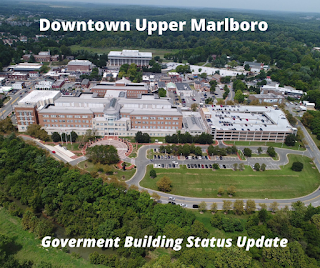
PGC comes up because blogreader will sent me a link to an article, ("Residents Oppose New Town Center in Upper Marlboro," NBC4) about how Upper Marlboro residents are organizing against a proposal for densification.  Upper Marlboro, the county seat, is poorly served by transit, being 13 miles from the New Carrollton Metrorail Station and 9+ miles to Largo Town Center.  From the article:

Senior citizens in Upper Marlboro's Marwood community are opposed to the possibility of a large development across from their community. “You can't even get in and out of the community during rush hour,” resident Christina Hough said. Landowners want to change the area from rural residential to mixed-use transportation.

“Once it gets rezoned to mixed-used transportation, anything, and I mean anything that's legal, can be built up there,” Hough said. The change could make way for hotels, restaurants, a gas station with a convenience store, an office building, a strip mall and almost 200 townhomes across the highway from the Westphalia Town Center that's under construction. 

“People coming out of the District of Columbia or elsewhere going south on Pennsylvania Avenue, it's hard to cross over to Westphalia, but on this side of the road, there is nothing, and this will be providing an opportunity for restaurants and other type of uses and stuff at this location,” said Arthur Horne, attorney for the landowner. 

The planning department voted against the development, saying it did not fit the county's plan for that area, a point attorneys for the landowners argued before the council Monday.
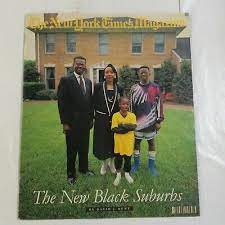
I've written a bunch about Prince George's County, Maryland, being that it abuts DC, and became a majority middle class black suburban county in the 1990s, even featured on the cover of the New York Times Magazine ("The New Black Suburbs," 1992; also see "Black, Successful and Safe And Gone From Capital," 1996).

The running theme is that the County had an opportunity to repattern its land use planning paradigm around transit, first with the opening of the Metrorail starting in the 1970s, as Arlington County did, where that County forced the rerouting of the Orange Line from the middle of I-66 to the Rosslyn-Ballston corridor, leading to a massive revival of the County's population and commerce.

Note that while Arlington County for a time lost out to Fairfax and Loudoun Counties because of cheaper space further out that became accessible via the new Silver Line Metrorail project ("The state of Arlington County Virginia's commercial real estate market: 2012 and the future," 2012), it has been resuscitated by Amazon's choice of Crystal City for its HQ2 ("Crystal City Arlington as Amazon one-half of HQ2 | Part 1: General + Housing impact," 2018).

But PGC didn't do that kind of land "reproduction."  It's still pretty much sprawl.   

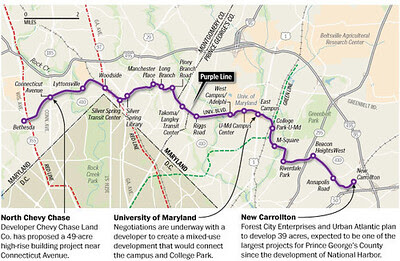
Washington Post graphic.

But the County has been given a rare second chance to repattern land use with the development of the Purple Line light rail program, which will link Bethesda in Montgomery County to New Carrollton, providing east-west connections to the Red lines in Montgomery County, and the northern end of the Green Line and Yellow Line, and the eastern terminus of the Orange Line, as well as to various MARC commuter railroad lines along the way, with 11 new light rail stations, in addition to the 15 Metrorail stations in the County, plus close by Fort Totten Station in DC.

-- "The future of mixed use development/urbanization: Part 3, Prince George's County, where's the there?," 2011
-- "A recommended new planning direction for Prince George's County," 2011
-- "Another lesson that Prince George's County has a three to five year window to reposition based on visionary transportation planning," 2011
-- "Frustration #3: the talk about transit oriented development and Prince George's County ," 2012

But even though the county states that they are committed to "transit oriented development," the reality is that the county is still very much committed to the sprawl paradigm, where major land use projects like National Harbor or Konterra have zero connections to high capacity transit.

Largo Metrorail Station.

Although they are now at the transit pods of development stage, promoting projects in Greenbelt ("Will US Bureau of Engraving and Printing relocate to Greenbelt?," 2019) and Largo ("Downtown is not a word without meaning: renaming the Largo Town Center to Downtown Largo is without meaning," 2021) among others.

New Carrollton should become the county's seat, moving from Upper Marlboro.  A related point was that if the County really wants to display bona fide commitment to TOD, they should move the county seat from Upper Marlboro, which has minimal transit connections, to New Carrollton, which has Metrorail, MARC, and Amtrak connections, is the major conurbation in the county, and will be the terminus of the Purple Line.

-- "Go big or go home: Prince George's County needs to think big and consider better revitalization examples for New Carrollton," 2014
-- "Prince George's County embarks on a zoning rewrite: Part 1," 2015
-- "Prince George's County embarks on a zoning rewrite effort: Part 2" 2015
-- "Purple Line Part 6 |  Creating a transportation development authority in Montgomery and Prince George's County to effectuate placemaking, retail development, and housing programs in association with the Purple Line," 2017
-- "Purple Line Part 7 | Using the Purple Line to rebrand Montgomery and Prince George's Counties as Design Forward," 2017

Although there is no question that the county has a true government campus in Upper Marlboro, the problem is that it is poorly located vis a vis the rest of the county and transit.

And PGC isn't the only entity that doesn't really understand how to leverage transit as a priming action for economic development.

-- "The ability to develop around transit stations is conditional on land use and mobility context," 2021

Residential property values and urban form.  Note I've also written that while many argue that the County's lagging residential property values have to do with racism, 

I disagree, making the point that the sprawl development pattern doesn't hold value in the same way that a more concentrated urban form does, especially when associated with fixed rail transit.

-- "The eight components of housing value," 2016/2015

This piece argues that border communities like Mount Rainer can better leverage their proximity to DC:

-- "When the one over neighborhood is in the county next door, and housing prices have been in the tank: Mount Rainer, Maryland," 2016

Quality of schools as another issue concerning residential choice.  I've had conversations recounted to me, stating that developers for the most part argue they'd rather develop in places other than Prince George's County because of how the school system lags other jurisdictions ("The Prince George’s County school board is making a great case for abolishing the school board," 2021, "School system beset by problems," "Schools Chief Tries Moving a Mountain," "No Continuity, Uninvolved Parents," "Even Affluent Are Forced to Make Painful Choices," four part series, 1998, Washington Post), that if people have children, PGC is their last choice, therefore why bother with new projects since they won't be able to sell at top dollar.  

One exception is the Route 1 Corridor, which is close to DC, and anchored by the University of Maryland and federal agencies.

Substantive school improvement is necessary to change PGC's position in the residential choice landscape at the metropolitan scale.

The failure to adequately leverage the University of Maryland College Park.  Separately, I've argued that College Park's militant refusal to become "a college town" has stunted its development and quality of life, the economic development potential of the county, and the quality of the school system because UMD isn't a school quality force multiplier the same way that NIH and NIST are in Montgomery County.

-- "To be a great city, College Park Maryland needs some "there", it needs a center," 2013
-- "More Prince George's County: College Park's militant refusal to become a college town makes it impossible for the city(and maybe the County) to become a great place," 2015
-- "College town follow up: alumni as residents and contributions to community capital," 2015
-- "Revisiting past blog entries: College Park as a college town and economic development | PG County and Amazon," 2018

A third chance to reorganize around transit?  WMATA has unveiled conceptual plans for a separated Blue Line that could add heavy rail service to National Harbor which has the area's only casino, the MGM Grand, which is a major trip generator ("The Blue Line Could Go to National Harbor One Day," Washingtonian Magazine).  

(The Blue Line to Greenbelt option is a version of my "Separated Silver Line" concept.  See "More on Redundancy, engineered resilience, and subway systems: Metrorail failures will increase without adding capacity in the core,")

Irrespective of whether or not WMATA actually does anything wrt its Rosslyn/Blue Line problem ("A "Transformational Projects Action Plan" for the Metrorail Blue Line," ), given that the Purple Line development process has been underway for more than 20 years, early on, PGC should have been pushing for an almost simultaneous planning of a second phase, extending the line from New Carrollton to Alexandria, providing connections to National Harbor.  Such planning isn't on the horizon at all.

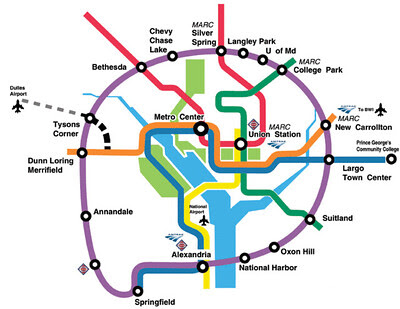
Original conceptual map of a circumferential Purple Line

(As another example of how long change takes, the first time I read about the Purple Line idea was when it was featured in a cover story in the Washington City Paper in the late 1980s.)

PGC could also be an advocate for repositioning MARC as a passenger rail service as opposed to a commuter service oriented to Washington, providing other opportunities for growth and intensification ("A "Transformational Projects Action Plan" for a statewide passenger railroad program in Maryland,"), by extending rail service to Annapolis and Southern Maryland.

Similarly, PGC should be an advocate of merging the MARC Penn Line with the VRE Fredericksburg Line ("A new backbone for the regional transit system: merging the MARC Penn and VRE Fredericksburg Lines"), better integrating railroad and heavy rail service ("One big idea: Getting MARC and Metrorail to integrate fares, stations, and marketing systems, using London Overground as an example"), and extending the Penn Line to Delaware ("Maryland trains to Newark inch closer," Wilmington News-Journal, 2017), although planning for MARC improvements have dissipated during the anti-transit period of Governor Hogan, although he is into maglev ("DC, Transformational Projects Action Planning, and the Baltimore-Washington Maglev project"), which could be another opportunity for Prince George's County.

As one example, merging the MARC Penn Line with VRE would provide much better connections to the new Amazon facility in Arlington County as well as to National Airport.

Conclusion.  Since the initial planning of the Metrorail system in the 1960s, Prince George's County has had multiple opportunities to reshape its land use and transportation planning paradigm.  Lack of vision and difficult political conditions within the county have made that unachievable.  

Given the long period required to make even simple changes like the 10+ year period it took for Virginia jurisdictions to get authorization to enact bag taxes, it's hard to say if there will ever be substantive changes on this dimension in PGC, at least within my lifetime.

Resetting goals.  Baltimore County is a little smaller than PGC population-wise, but still the 75th most populated county in the US.  When I worked there I said their problem was that they didn't think very big.

That despite its size and economic vibrancy, they were mostly content comparing themselves to Baltimore City, which for decades has been a shrinking and crime ridden city.  On that basis, they always come out ahead.

Back then, Baltimore County was a top 50 county by population.  My argument was that they needed to set those other counties as their peers for comparison and evaluation purposes, not Baltimore City, and set their sights accordingly.  

While more areas around the country have grown faster than DC area counties in the last ten years, Baltimore County is still in the top 75 counties in the US in terms of population based on 2021 data.  Other similarly populated counties should be their reference group, not a declining center city.

Fairfax County is the 40th largest county by population
Montgomery County is 45th
Prince George's County is 63rd
Baltimore County is 75th

Definitely there is a similar set of lowered expectations in Prince George's County.  Economically, it's a laggard compared to other Washington area jurisdictions, but compared to many such counties across the country, it is rich in opportunity.  

Prince George's County needs to create a new set of expectations on what it can achieve.

-- Reinventing Suburban Business Districts (ULI)
-- Reinventing America's Suburban Strips
-- Revitalizing Distressed Older Suburbs
-- Putting the Urban in Suburban: Art and Business of Placemaking
-- "The secret to a successful suburb: Lakewood, Cleveland Heights and the Inner-ring Divide," Cleveland Plain Dealer
-- "A County and its Cities: The Impact of Hennepin Community Works," Journal of Urban Affairs 30:3 (2008)
+ the example of Oklahoma City ("Change isn't usually that simple: The repatterning of Oklahoma City's Downtown Streetscape," 2021)

======

When I was thinking of running for City Council in Ward 4 in 2015 ("Outline for a proposed Ward-focused (DC) Councilmember campaign platform and agenda"), I talked to some people who had been on Council in neighboring jurisdictions.  One had been on the PG County Council.  He told me that "it's not a seminar where people learn and grow and make better decisions over time.  People who get elected think they know everything already, that they got elected because of their stated agenda."

Labels: , , , , ,

Saturday, October 30, 2021

Downtown is not a word without meaning: renaming the Largo Town Center to Downtown Largo is without meaning

Wikipedia photo.

Prince George's County Maryland wants to rename the Largo Town Center station as Largo, Downtown Largo, or Downtown Prince George's County.

-- Proposed Station Name Charge, Largo Town Center, WMATA

Comments are due by 5pm Monday.

The definition of the word Downtown is 

of, in, or characteristic of the central area or main business and commercial area of a town or city.

While PGC is somewhat center-less more generally, the closest it has to a center is New Carrollton, and I've suggested for years that if PGC wants to truly become a "transit oriented development" kind of place, it should re-center its government functions there ("Setting the stage for the Purple Line light rail line to be an overwhelming success: Part 4 | Making over New Carrollton as a transit-centric urban center and Prince George's County's "New Downtown"," 2017, first published 2014).  

Instead, it has the belief it is doing so around Largo and the Largo Town Center Metrorail station, and it has moved a bunch of government agencies there, but few that are citizen-facing.  

Most football stadiums are surrounded by a sea of parking lots and FedEx Field is no exception.

But for the most part, the land uses are de-concentrated, there is a failing retail center ("Redeveloping Largo shopping center aims to be the Pike & Rose of Prince George’s," Washington Business Journal), a new hospital ("University of Maryland could seed a complementary biotechnology and medical education initiative in Prince George's County"), and the FedEx Field stadium is a 1.5 mile walk away.


Rendering for an intensified Largo.

The hospital building is the tallest, but there is nothing that speaks of a concentration of business activity.  

Although to be fair, there is a long term plan for intensification, and the reality that such a plan is a couple decades away from realization -- for example, PGC Planning created a transit oriented development plan for the West Hyattsville station that 25 years later, still hasn't been realized.

I suppose from the standpoint of "rename it and they will come," a name change could be justified.

But it seems incredibly premature.

The reality is that renaming the station by including the word "Downtown" diminishes the meaning of  the word.

The core of Silver Spring's shopping district is branded as "Downtown Silver Spring."

By comparison there are many conurbations in the metropolitan area besides Downtown DC -- Rosslyn, Crystal City, Tysons Corner, Reston, Bethesda, Silver Spring, some parts of Alexandria, even the Southern Towers apartment complex in Fairfax County -- that have the kind of density and concentration that justifies being called a Downtown, but is lacking in Largo.

In order to promote "legibility" and accuracy within the Metrorail system, using the word Downtown to describe station areas which have few if any of the characteristics "of the central area or main business and commercial area of a town or city." should not be countenanced.

Labels: , , , ,

Friday, June 05, 2020

Brief Revisiting of the Silver Spring Mobility District series | Item #10: digital kiosks and the inclusion of community messaging network

These days the Purple Line is in the news because the contractor has provided notice to exit the project, likely as a way to get the State to pony up for the cost of various changes ("Just a reminder that what are called "public private partnerships" are contracts, not partnerships").

The Silver Spring articles the title refers to are a subsection of the multi-part series on leveraging the Purple Line light rail infrastructure program to drive complementary improvements across the transit network as well as to drive transformational projects within the communities served by the new infrastructure as a way to make the transit network more successful from the outset and to get better, greater, and faster return on the public investment in the system.

-- "Setting the stage for the Purple Line light rail line to be an overwhelming success: Part 1 | simultaneously introduce improvements to other elements of the transit network"

The series on Silver Spring grew out of Item #20 in the original list:
Create "sustainable mobility" corridors in Silver Spring (and other places), complementing the new PL.
After that piece, Silver Spring area resident reader Ed Drozd asked me to expand on the point, and at first I thought about this pretty narrowly (for me), with some basic multimodal and urban design enhancements on Fenton Street and Wayne Avenues, which emanate from the light rail station at the new Silver Spring Library.

But I did a lot of site visits and started thinking a lot bigger, culminating in this series, outlining how Montgomery County could leverage the Purple Line as a way to develop "an innovation district" around Silver Spring.

PL #5: Creating a Silver Spring "Sustainable Mobility District"
 -- "Part 1: Setting the stage"
-- "Part 2: Program items 1- 9"
-- "Part 3: Program items 10-18"
-- "Part 4: Conclusion"
-- "Map for the Silver Spring Sustainable Mobility District"
-- "(Big Hairy) Projects Action Plan(s) as an element of Comprehensive/Master Plans"
-- "Creating the Silver Spring/Montgomery County Arena and Recreation Center"

In some follow ups, I added a couple of points that I had missed.  Here's the complete list:

1. Make Fenton Street the primary "east side" sustainable mobility corridor -- a "Signature Street" -- in Downtown Silver Spring/Silver Spring Triangle

2. Make East-West Highway the primary sustainable mobility corridor on the "west side" of the Silver Spring Triangle.

3. Create a cycletrack network on Fenton Street and East-West Highway.

4. Create a network of pedestrian scramble intersections, where one designated signal phase is exclusively for pedestrians.
Oxford Circus, London

5. Rearticulate parking services on Fenton Street/across the Silver Spring Triangle to accommodate cycletracks/removal of street parking.

6. Incorporate greenspace improvements on Wayne Avenue between Fenton Street and Sligo Creek Parkway, treating Wayne Avenue as a "Parkway."

7. Extension of the public realm network through a small "road diet" program.

8. Create and implement a complementary set of urban design treatments.

9. Create and implement a more wide ranging set of programming.

10. Create a digital community and transit information network for Silver Spring, employing kiosks and mobile applications.

Last year the Washington Kastles tennis team played in a set up on the roof of the Union Market District in DC.

11. Creating the Silver Spring/Montgomery County Arena and Recreation Center (which suggests building a recreation center and "stadium" on the roofs of parking garages).

12. Developing the Silver Spring Triangle as a "Bike Friendly District.

13. Designate Silver Spring as a pilot node in the development of a DC-area "Parkiteer" secure bike parking network.

14. Bring Car2Go to Silver Spring. [Car2Go, a one way car sharing program, has since ceased North American operations.]

15. Create a district-wide retail development and recruitment program.

16. Positioning Silver Spring as an innovation district and/or an Ecodistrict.

17. Expand business innovation, through expanded start up support and development activities, and a larger scale makerspace.

18. Assess branding-identity and retune marketing.

Items 1-18 comprise the original list.

Items 19- 25 are additional points I developed afterwards, and are compiled in the 2019 blog entry, "Revisiting the Purple Line (series) and a more complete program of complementary improvements to the transit network" along with other items for the complementary transit network improvement program for the Purple Line, and an additional section on meta-planning points that I hadn't included in the original series (but I should have as a distinct PL article #8).

Ideally, I should go back to the original two entries on the program, and recompile and reorder as appropriate.

Map, Downtown Silver Spring
19. Extend the Ellsworth Avenue Pedestrian Mall west from Georgia Avenue to the Metrorail Station.

20.  Ideally this would be complemented by extending the retail district, by making over as retail the lower floors of the redeveloped Discovery Center ("Foulger-Pratt lands first new tenant for Discovery HQ remake," Washington Business Journal), ideally anchored by a departmenet Store--I suggested Boscov's or Primark--("Making "Downtown Silver Spring" a true open air shopping district by adding department stores").

I know this is a stretch given the state of retail even before the pandemic, but this is an area where a department store could work.

Department stores are a retail type that work best in cities--urban places.

They've been failing because in a sea of suburban retail they aren't distinct.  With the city as experientially focused and shopping as theater, department stores can shine in city settings, still ("Boscov's bucks the retail trend as other department stores close," Allentown Morning Call).

But ideally, and I didn't make this point in the original entry, adding both Boscov's and Primark would be even better. (Especially as it looks like Lord & Taylor, present in the White Flint District in Montgomery County and Friendship Heights in DC, will be closing.)
Primark store in Liverpool's pedestrian district

21. Pedestrianize part of Fenton Street (at the very least from Colesville Road to Wayne Avenue).

22. Add an Upper level exit from the Silver Spring Metrorail Platform.

23. Add at least one children's playground to the urban core.

24. Create an inter-city and long distance commuter bus waiting station on the ground level of the Silver Spring Transit Center on Colesville Road.

25.  Expand the shuttle services for the "parking district" (item #5) to include broader service within the catchment area of the light rail stations to facilitate movement to and from the stations without people "having" to drive.


What triggered this update is an article in Design Taxi, "New York’s Wi-Fi Kiosks Memorialize Murdered Black Americans Amid Protests," about how the LinkNYC digital kiosk system is displaying "ads" featuring the names of African-Americans killed by police.

The LinkNYC Instragram feed is full of images of the kiosks displaying various public service related ads, from honoring Black History Month, the display of artworks, exhibits at area cultural institutions, farmers markets, etc.

It's a good illustration of the discussion within Silver Spring Item #10, on how digital kiosk "ad" systems can deliver community-serving messages, including about local attractions, events, exhibits, etc.


Labels: , , , , , , ,