Suburban Maryland Purple Line light rail as an already successful economic development driver
The Purple Line is in the news because the contractors have served notice that they want to exit the deal, because they argue that the State of Maryland is not negotiating in good faith about the cost consequences of project changes and delays ("Just a reminder that what are called "public private partnerships" are contracts, not partnerships," "Design-Build Team Makes Decision to Leave Maryland Purple Line Rail Project," Engineering News-Record).

Washington Post graphic showing the route of the line.
The comments on articles in the Washington Post are mostly negative, that the state should drop the project, although a few argue that it merely indicates that privatization/public-private partnerships are usually fraught with peril, that the prime contractor, Bechtel, is enmeshed in big problems elsewhere which influences this project, with the suggestion that the State of Maryland should take over the project.

DC and Metropolitan Washington as (formerly) best practice in transit use. What has floored me about opposition to the project all along is that it is disconnected from reality, as the DC area is a best practice example of the success of heavy rail transit, complemented by bus service--at least previous to the recent service quality crash brought on by a failure to perform anticipatory maintenance and rebuilding as the system aged.
Instead they waited until they had no other choice, and the resulting service degradation significantly reduced ridership. And that was even before the pandemic, which reduced ridership even further.

And economic development. It can take decades to see economic development changes resulting from investments and expansion of transit infrastructure.
(Although now, with more experience and understanding, spillover economic development tends to occur more quickly.)
It took 20+ years to begin to see the significant improvements in DC's core and surrounding neighborhoods, resulting from the opening of Metrorail starting in 1976.
It took 20-25 years to see similar fruits of transit oriented development in Arlington County's Wilson Boulevard corridor.

DC's resurgence--in the last decade the city has added 100,000 new residents--is due in large part to the development of heavy rail transit, and in particular the creation of a multi-line network, as opposed to a couple lines.
The Purple Line as a suburban revitalization tool. The addition of light rail to the transit network, especially in a manner which improves the connectedness of the network--the Purple Line will connect five legs of the Metrorail system in Montgomery and Prince George's County as well as all three MARC railroad passenger lines--will increase the utility and usefulness of the overall network, leading to ridership increases.

-- "Transforming Inner-Ring Suburbs with Walkable Mixed-Use Development," Urban Land Magazine
Although I argue success could be even been greater, had the transit systems planned improvements in other parts of the network simultaneously. This is true both for the transit systems, and the counties, especially Prince George's County, which hasn't fully committed to transit oriented development, but instead equivocates and defaults towards automobility (even if they don't think so).
-- "Setting the stage for the Purple Line light rail line to be an overwhelming success: Part 1 | simultaneously introduce improvements to other elements of the transit network," 2017
-- Part 2 | the program (macro changes)
-- Part 3 | influences
-- Part 4 | Making over New Carrollton as a transit-centric urban center and Prince George's County's "New Downtown"
-- PL #5: Creating a Silver Spring "Sustainable Mobility District"
-- Part 6 | Creating a transportation development authority in Montgomery and Prince George's County to effectuate placemaking, retail development, and housing programs in association with the Purple Line
-- Part 7 | Using the Purple Line to rebrand Montgomery and Prince George's Counties as Design Forward
-- "Revisiting the Purple Line (series) and a more complete program of complementary improvements to the transit network," 2019

H Street streetcar as a economic development driver. Separately, I have a series of articles on the H Street streetcar in DC, making the point that while it is pretty much a planning failure because of errors by the Department of Transportation and the city's elected officials, it has been a massive success in terms of economic development, sparking the most intense development within any corridor in the city that is not directly served by Metrorail.
Arguably, about $1 billion in new development has been either spurred or accelerated by the streetcar.
The additional property, sales, and personal and corporate income taxes resulting from this development will more than pay for the streetcar, and provides a wide variety of neighborhood improvements.
-- "DC streetcars move to simulated service: passenger service expected within a couple months: DC streetcars part 1," 2015
-- "DC and streetcars #2: STREETCARS ARE ABOUT TRANSIT, just in a different way from how most people are accustomed to thinking about it," 2015
-- "DC and streetcars #3: More discussion (from almost two years ago)," 2015
-- "DC and streetcars #4: from the standpoint of stoking real estate development, the line is incredibly successful and it isn't even in service yet, and now that development is extending eastward past 15th Street," 2015
-- "Update on the DC Streetcar program on the verge of launching Sunday service," 2016
-- "Update/revision of H Street transit oriented real estate development table," 2016
Purple Line is already increasing property values. That's why an op-ed in last weekend's Washington Post, "The Purple Line is creating value — don’t blow it up now," which made the point that the PL has already led to significant property value increases in the corridor, is so important. From the article:
Despite the twists and turns of the Purple Line’s development, there already have been large increases in property values near planned stops. In a new investigation of the project’s impact on property prices, former Washingtonians David Corcino, Eric Parolin and I find that house prices are up roughly 10 percent for properties within half a mile of planned Purple Line stops, relative to properties farther away. Rather than needing decades to reflect this new transportation option, as a recent opinion piece urging the project’s cancellation mistakenly asserted, the area has already seen tremendous shifts in the local property market that reflect the expected value of this transit investment for residents.Fortunately the state is committed to continuing the project. To just walk away from the PL would be a massive waste of money and economic development failure, especially as the unfinished line is already reshaping the area's development patterns.
Note that even though Republican Governor Hogan is pretty much against transit--this tends to be true even of allegedly "moderate" Republicans--according to the WTOP story "Purple Line construction continues as squabble remains unresolved" the state is committed to finishing the project.
The state and Montgomery and Prince George's County need to improve Purple Line messaging. DC's officials have bobbled messaging on the streetcar and continue to restrict its ability to expand and become more useful and economically successful.
Montgomery and Prince George's Counties need to be clear in explaining the benefits from transit and the benefits of the Purple Line and the addition of light rail to the transit network. The counties need to step up on this because the State is not likely to.

Rebuild the consensus for transit, Market the Purple Line now. In the run up to Metrorail, WMATA did a lot of interesting outreach, including exhibits on the National Mall and the publication of a guide on how to use transit that was inserted as advertising in the then large circulating local newspapers.
After the Metrorail crash in 2009, I argued that given that the Metrorail system was then more than 30 years old, and much of the population of the metropolitan area wasn't around when the consensus for building it was created, that it was time to build a new consensus for transit and what it is supposed to accomplish in the Washington Metropolitan Area. I made a similar point in advance of the system's 40th anniversary in 2016
-- "WMATA 40th anniversary in 2016 as an opportunity for assessment"
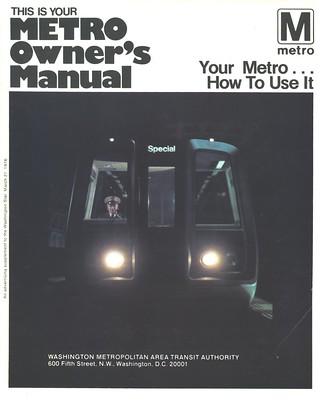
Metro (WMATA) Owner's Manual: Your Metro...How to Use It, cover. Advertising supplement to the Washington Star, 3/21/1976.
Arguably, a lot of the opposition to transit expansion--light rail in Suburban Maryland, streetcar in DC and Arlington--is an indicator of the need to rebuild that consensus understanding of transit, the value of transit expansion.
It's not like we don't have ample proof of the value.
As David Miller, former mayor of Toronto used to say, "you can't have a transit city without continually expanding transit."
I wonder if CAF (which has an office in DC) would be willing to bring over in advance a couple of the light rail vehicles that will be deployed on the Purple Line, for use in an ongoing marketing program.
Some transit infographics, whichcould be models for a pro-Purple Line campaign.

Graphic by American Public Transportation Association and the National Association of Realtors

From Moving Forward, an independent journalism project produced by Discourse Media. Data and analysis by George Poulos.
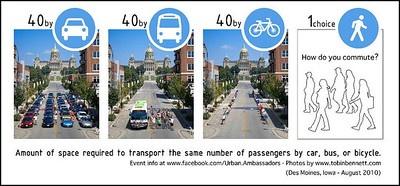
I think all communities should produce their own version of this poster, which shows the space efficiency of transit, walking and biking, compared to driving.


Equity as a marketing challenge. These days, a frequent criticism of investment in transit infrastructure is that rising property values leads to displacement and gentrification ("Transit-oriented development and gentrification: a systematic review," Transport Reviews, 2019). That is true.

So transit agencies, working with local governments, need to come up with a program to address that. I recommend creating what I call a "Transportation Renewal District" in association with new transit projects.
-- "Purple line planning in suburban Maryland as an opportunity to integrate place and people focused initiatives into delivery of new transit systems," 2014
-- "Quick follow up to the Purple Line piece about creating a Transportation Renewal District and selling bonds to fund equitable development," 2014
-- "Beyond the Tracks: Purple Line community development conference this Friday, March 21st," 2014
The TRD would function like an urban renewal district. You sell bonds--tax increment financing--against anticipated new tax revenue and use the monies in part to buy, hold, and develop property in ways that support equity planning goals--affordable housing, etc.
Labels: civic engagement, equity planning, planning and program delivery, provision of public services, social marketing, transit marketing, transportation planning
posted by Richard Layman @ 6:33 PM&Permanent Link
Follow this blog
17 comments