Rebuilding Place in the Urban Space

"A community’s physical form, rather than its land uses, is its most intrinsic and enduring characteristic." [Katz, EPA] This blog focuses on place and placemaking and all that makes it work--historic preservation, urban design, transportation, asset-based community development, arts & cultural development, commercial district revitalization, tourism & destination development, and quality of life advocacy--along with doses of civic engagement and good governance watchdogging.

Tuesday, June 02, 2026

This is not an installation by Barbara Kruger | You don't want real estate developers negotiating with Iran...

"I shop therefore I am," Barbara Kruger, 1987.
Manipulating the medium of advertising, Barbara Kruger is a conceptual artist known for her use of words, color, and typefaces to comment on American consumerism and mass market culture.

Below is the headline from a New York Times Magazine, "Jared Kushner, Steve Witkoff and the Profitable Business of Peace," about how Trump uses his son in law and other real estate guys instead of diplomats.  

It's definitely a sign of the rot in the American military being extended to the entire Government ("U.S. Capabilities Are Showing Signs Of Rot," Atlantic).

The irony is it could be one of Kruger's artworks.

I joke that my experience dealing with real estate developers in DC (and here in Salt Lake too), is that the more interactions I had, the more I became an intellectual Marxist, poking at the contradictions between capital and community.  Planning the Capitalist City is a worthwhile read.

There are great developers, some who don't do bad things while doing good work, others that do some bad things while doing good work ("Chris Donatelli, a DC real estate developer, dead at 58") and others who are not great at all and their work diminishes the architectural integrity of a community with contributions to community development at best being neutral and at worst, negative.

Real Estate Developers are the last people I'd want negotiating with Iran or revitalizing the Gaza Strip or negotiating with Putin.  Steve Witkoff's firm describes itself as half developer, half investor (financier). See "How The Witkoff Group Built South Florida’s New Breed Of Private Clubs," Forbes and "NYC’s top deals: The Witkoff Group sells One High Line condo for $10.5M," The Real Deal.

Still not good enough.

I used to joke that we didn't need to send soldiers to Afghanistan, but people with PhDs in anthropology.  In this case, we need to send diplomats who understand nuance to negotiate with other countries.

Although the "good developers" understand the more they invest upfront in explaining their project to the community, compromising when necessary, hopefully yielding improvements as a result, the faster they are likely to get approvals and permits on the back end.

Dealing isn't just dealing.  

And Trump's Art of the Deal was built on the premise of dealing from a position of strength when the counterparty is weak.  Trump loses his a** when the counterparty is equal or stronger.

So maybe developers who are good at that--and there are very few--have it within them to become "diplomats."  

As another example, I used to refer to one female real estate attorney as the velvet fist--she was so smooth, but didn't give up anything considered crucial to a project.  Etc.

Pulte Homes is building single-family homes and townhouses in Seven Hills, Ohio. Photo: John Benson, Cleveland Plain Dealer

And speaking of rot, I wouldn't pick a subdivision housing developer to run the nation's intelligence coordination agency ("Trump taps housing regulator Pulte to be acting director of national intelligence," Associated Press). 

Pulte Homes started in Detroit's suburbs but now they build across the country.

It turns out Bill Pulte isn't even part of the family business, he was kicked out ("Housing Official Who Attacked Democrats Invokes a Disputed Family Legacy," New York Times).

Labels: , ,

Friday, February 02, 2024

Immigrants as in-migration and city-town revitalization

It's no secret that immigrant in-migration can be a great source of energy for community revitalization.  One example is Somalis in Minneapolis-St. Paul ("Somalis finding their place in Minnesota," CNN, 2017).  

Another, Cape Verdeans in Boston ("Uphams Corner, Boston: revitalization "without" gentrification," 2023).  In fact a recent No Passport Required with Marcus Samuelsson episode on PBS featured the Portuguese disaspora in Boston--people from different countries but connected by language. And great food.

Members of the Denison High School mariachi ensemble pose for a group photo prior to the start of the 2022 Fiesta Mariachi celebration.  Photo: Brian Houlgrave, Des Moines Register.

Denison, Iowa.  Only because it was in my newsfeed I came across a brilliant piece about Denison, Iowa in the Des Moines Register.  Written by Courtney Crowder who is assigned to do feature articles around the entire state.  She's great.

-- "A beloved rural Iowa diner closes. A family of Mexican immigrants reopens it--with a twist"

The article is about how the town attracts Hispanics working in two area meatpacking plants.  How the legacy white community and the new Hispanic community were not connected, but the legacy leadership realized, in the face of rural shrinkage that wouldn't work, and how the two communities are albeit probably too slowly, intertwining.  

Denison is growing in population, when most rural communities are not.

DMR photo.

The article centers around an old restaurant that was the hub of the community but closed during the pandemic, and how it is being revived by a small scale Latino entrepreneur in a fusion style way--meatloaf, American breakfast and unlimited coffee, complemented by new Latino dishes.

She first wrote about the town's fusion work in how the high school music teacher and band leader added a mariachi band to get more students involved in music ("This Iowa meatpacking town didn't always welcome immigrants. Then the high school started a mariachi band," DMR).

WSJ photo.

Topeka. The Wall Street Journal reports that Topeka is looking at immigrants as a valuable resource for economic revitalization in terms of a source of workers, entrepreneurialism, and neighborhood revitalization, "The American City With a Message for Migrants: We Want You."

Financial Times.  Simon Kuper has a column on this phenomenon, "The surprising success of multi-ethnic cities."  From the article:

London, New York and Paris deserve more credit for how well they are holding together. Every day in these multi-ethnic cities, people of Muslim, Christian and Jewish origin share streets, buses and classrooms.

The article doesn't say a lot, mostly contrasting Western cities to places of conflict.  But cities have always been the place for exchange, and the development of "cosmopolitanism" -- an openness to new ideas and innovation (see Jane Jacobs' The Economy of Cities), and the bringing together of people from different places.

Elijah Anderson wrote some time ago The Cosmopolitan Canopy: Race and Civility in Everyday Life, about this phenomenon, focused on daily life in Center City Philadelphia.

Anderson walks us through Center City Philadelphia, revealing and illustrating through his ethnographic fieldwork how city dwellers often interact across racial, ethnic, and social borders. People engage in a distinctive folk ethnography. Canopies operating in close proximity create a synergy that becomes a cosmopolitan zone. In the vibrant atmosphere of these public spaces, civility is the order of the day. However, incidents can arise that threaten and rend the canopy, including scenes of tension involving borders of race, class, sexual preference, and gender. But when they do—assisted by gloss—the resilience of the canopy most often prevails. In this space all kinds of city dwellers—from gentrifiers to the homeless, cabdrivers to doormen—manage to co-exist in the urban environment, gaining local knowledge as they do, which then helps reinforce and spread tolerance through contact and mutual understanding.

-- "Bridging Racial Divides In 'Cosmopolitan Canopies'," NPR interview of Elijah Anderson 

Photo: Migrants gather Monday near the US-Mexico border wall after crossing a razor wire fence as members of the Texas National Guard stand guard, as seen from Ciudad Juarez, Mexico. Jose Luis Gonzalez/Reuters ("‘This is not over,’ Texas says after Supreme Court lets Biden administration remove razor wire at US-Mexico border," CNN).

Immigration and the US Southern Border.  I have a blog post, with lots of appended comments, about how the US should deal with the border with Mexico and in the Caribbean, "A solution to the immigration crisis on the Southern border, but it's too politically fraught," based on a chapter of the book End of Policing.  Professor Alex Vitale suggests that rather than criminalizing immigration, the US should adopt polices more like the EU's Schengen Zone.  

Granted the Zone is only for free cross-border movement for citizens of EU countries, but it is a model for how the US could develop an Americas Zone, with registration, allowing people to move back and forth without necessarily having to live in the US permanently nor get a green card to be able to work.  

The Alliance for Progress was a 10-year plan proposed by President John F. Kennedy in 1961 to foster economic cooperation between North and South America, particularly aimed at countering the perceived communist threat from Cuba. The program was signed at an inter-American conference in Uruguay in August 1961.

The reality is that desperate circumstances in Central and South America will always make the US a desired destination.  

Building a wall or saying "we're full" ("America is 'full,' Lindsey Graham says," ) doesn't reflect reality.

Vitale also suggests implementing an EU like INTERREG program.  INTERREG invests in less well off EU countries to provide residents with more reasons to stay rather than to emigrate West.

The US has dissipated a lot of its soft power with South America, providing opportunities for other countries ("China's Growing Influence in Latin America," Council on Foreign Relations).  And it has a fraught relationship anyway.  Lots of past military intervention or support of it never helps.

This would change it up considerably.

-- VARIATIONS OF U.S. PUBLIC DIPLOMACY IN CENTRAL AMERICA’S NORTHERN TRIANGLE, thesis, US Navy Postgraduate School

One of the ideas I had is an "Americas Expo" which could be like the World Expo and EU Capital of Culture program mixed into one, moving around to the various countries.

San Antonio Texas attributes a lot of its repositioning to having held HemisFair 1968 ("In 1968, San Antonio's World's Fair Changed The City Forever," Texas Standard, "HemisFair '68 transformed the city," San Antonio Express-News, "After the Fair's Over: The “Redemption Story” of HemisFair Park," San Antonio Current).

Building ties rather than rejecting them is the way to go.

Labels: , , , , ,

Sunday, January 01, 2023

New Years Day Post #1: Solutions versus cruelty | Immigration

Border wall of containers ordered by Republican Governor of Arizona Dan Ducey.  Photo: Ivan Pierre Aguirre for the New York Times.

These days I'm pretty depressed about the state of the US, given the virulence of the divide between Republicans and Democrats and a failure to focus on improving the quality of life of US residents versus cruelty and performance.

There is no question that things are far different from the time when states were considered opportunities for innovation--laboratories of democracy.

The quality of life outcomes for states under Republican rule are decidedly negative (2022 Scorecard on State Health System Performance: How did states do during the COVID-19 pandemic?, Commonwealth Fund, "SUMMARY OF 23 QUALITY OF LIFE INDICATORS — ARE RED OR BLUE STATES BETTER?," Applied Sentience, "Blue states rank better than red in livability: What does that mean?," San Jose Mercury News).

Perhaps the easiest indicator to track is life expectancy.

And long tax revenue capture.  Generally red states get a lot more back in government spending than they pay out.  While blue states pay more and get less.  Red states are the "takers" ("Blue high-tax states fund red low-tax states," Associated Press).

Immigration.  I think one of the most important entries I've written in the past couple years is on "the border crisis" -- immigration -- which Republicans call an absolute crisis. 

 It's a policy issue where Republicans get to show their cruelty ("GOP governors with presidential ambitions court Trump's base with cruelty to migrants," NBC News).

But sadly to reduce the power of the opposition, federal government practices even under Democrats can be pretty cruel.  

It amazes me because the states on the southern border with Mexico--Texas, New Mexico, Arizona, and California--drive a significant part of their economies through trade with Mexico.  California, being a Democrat run state, acts opposite of the other states.  

For example, Texas' biggest trading partner is Mexico and when they do things like tamper with border crossings it has significant negative effect ("Texas Ends Rule That Left Trucks Waiting For Hours To Cross Mexico Border," Forbes Magazine).  It's like Brexit leading to a significant drop in the UK's economic output, something every reputable economist said would happen.

But the Republican position on immigration makes it hard for Democrats, and makes it almost impossible for policy creativity.  Obama wasn't the greatest--he thought that being tough would get Republicans to work with him, but they didn't.  And Biden has some of the same issues.

The fact is that immigrants are an important source of labor, are motivated, increase the country's diversity, and add population in the face of lower birth rates.  Immigrants can be an important source of revitalization in otherwise shrinking cities etc.

End of Policing by Alex Vitale is pretty bracing.  Eight chapters discuss how we've criminalized certain social matters, and how police response to those problems mostly makes the outcomes worse.  

One chapter is on immigration (US Border Patrol, Immigration and Customs Enforcement), and in it he suggests that the US consider dealing with immigration comparable to the European Union, which has free movement within the EU's 27 countries.

I think it's brilliant.  

Creating an American Union of the US and Central and South American countries.  What it would require is creating a kind of "American Union" with Central and South American countries.  Where citizens of participating countries could register and could immigrate/work in other participating countries, and it wouldn't require citizenship in the "receiving" country.  I think it would also allow for temporary rather than permanent emigration.  People could come to the US, make some money, go back home.

At the same time, like the EU, the US should invest in creating "cohesion" programs of investment in Central and South American countries, so that conditions of poverty, political unrest, and negative public safety could be reversed, reducing the demand to emigrate.  

-- "A solution to the immigration crisis on the Southern border, but it's too politically fraught," 2021

And a Caribbean Union.  When I wrote the piece I was focused on the border with Mexico, but the same goes for the Caribbean.  It's unjust that Cuba emigrants have special privileges in coming to the US, and proximity to the US creates the same kinds of tensions for countries like Haiti, Dominican Republic, etc.

Puerto Rico.  And we really should give statehood to Puerto Rico, and create new programs of investment and energy independence for that colony.

=====

The Salt Lake Tribune, now a nonprofit, has an initiative called the "Innovation Lab," where they focus on longer term issues with an aim of producing articles offering "solutions."

I don't think the issue is the need for solutions so much as a willingness to be focused on solutions and action.

And big time innovation is outside of the mindset of most public officials and community stakeholders.

Labels: , , , , , , , ,

Wednesday, May 05, 2021

A solution to the immigration crisis on the Southern border, but it's too politically fraught

After writing about it last spring ("Fire I'll take you to burn"), I finally hunkered down and read The End of Policing by Brooklyn College professor Alex Vitale, and it's super well argued, about how in many areas of "public safety," making police response the "solution" doesn't work very well.

One key point of the discussion is how so many social problems -- drug use, mental illness, homelessness, student behavior in school, etc. -- have been criminalized, making police the predominate if not only response, and how this doesn't work very well in improving outcomes for individuals and communities. Especially because of the rise of "warrior policing" and the approach of "threat reduction" rather than "helping."

WRT the chapter on "Border Policing," in the section on alternatives, he mentions two programs from the European Union that are applicable to "solving" the US's Southern Border problem.

Marshall Plan for Mexico and Central America.  First, he mentions the various structural integration initiatives within the EU, including the INTERREG program, which is a program of "inward investment" designed to make communities better economically and socially, with of aim of helping communities keep existing residents and attract new residents, and reducing the motivation to emigrate to the west from the east.

I've thought about those EU programs a lot in terms of dealing with "the immigration problem" but also immigrant integration programs -- when I was writing about Marseille, I came across some great programs, for which I can't find the citations, although I know I have hard copies of some of the documents in my morass of boxes of files.  

Countries in the Northern Triangle are Guatemala; Honduras; and El Salvador.  Those countries, plus Mexico are the primary source of illegal immigration and asylum requests on the Southern border.

WRT to Central and South America, the political, economic, and social situation there is very complicated, and it's reasonable to ascribe a goodly amount of the problems there to the relationship those countries have with the US:

  • such as the high demand for drugs in the US which has destabilized supplier countries like Mexico, Colombia, and Bolivia as well as those countries on the transit routes between suppliers and the US
  • US involvement in the politics of those countries for two centuries
  • US training of the often repressive military in those countries
  • the flows of people in both directions and how this has intensified gangs and violence in countries like El Salvador, etc.

-- "Northern Triangle: terrifying to live in, dangerous to leave," WorldVision
-- "Central America’s Turbulent Northern Triangle," Council on Foreign Relations
-- "A Biden Plan for the Northern Triangle: What would a program to discourage illegal migration look like?," Center for Immigration Studies
-- "Why So Many Central Americans Are Seeking Asylum in the U.S.," KQED/PBS
-- Infographic/comic on the turmoil in Central America," KQED/PBS
-- "Generalized Violence as a Threat to Health and Well-Being: A Qualitative Study of Youth Living in Urban Settings in Central America’s “Northern Triangle”," Maria de Jesus and Carissa Hernandes

Those complications are why a US funded INTERREG type program -- a "Marshall Plan"-- for these countries is justified.

An opportunity for US border states to work with counterpart states in Mexico.  I was angry a few weeks ago when Governors Abbot of Texas and Ducey of Arizona had an op-ed published in the Washington Post ("Arizona and Texas governors: The border crisis in our states was created by the Biden administration") accusing the Biden Administration of failing on border management.  From the article:

To start, the administration needs to immediately reinstate the Migrant Protection Protocols, which disincentivize migrants from making the dangerous journey to the border by ending the policy of “catch and release” for those seeking asylum. Law enforcement officials and leaders in border communities are concerned that repeal of these protocols is a major factor behind the surge in illegal border crossings. Reinstating them would go a long way toward alleviating the crisis at the border. 

 Next, administration officials at all levels should state clearly that our country’s borders are not open and that immigrants seeking a better life or more economic opportunity should not be attempting to utilize the asylum process. The State Department should be heavily engaged in this strategy, as the Mexican president’s continued statements blaming this crisis on Biden are concerning.

"Trump emerges from seclusion to visit border wall," Reuters.  Reuters photo by Carlos Barria.

This completely ignores the reality of the dynamics that push people in these countries to attempt to emigrate to the US.  Desperation drives them to take this great risk.  

A wall isn't enough to stop their desperate circumstances ("A Section of Trump Border Wall in South Texas Cost $27 Million a Mile. It’s Being Foiled by $5 Ladders.," Texas Monthly).

At the same time, while the narrow focus of Abbott and Ducey doesn't surprise me, it's unfortunate because there is tremendous opportunity for the US border states (Texas, New Mexico, Arizona, California)  to work with their counterparts across the border in Mexico to strengthen those states.

Rather than whine, states like Texas and Arizona should step up ("Why Texas Should Lead the U.S.-Mexico Relationship," International Policy Digest).  From the article:

In large part, the size of Texas’ economy depends on the deep links the state has with its sovereign neighbor. Mexico and Texas share a 1,254-mile border and a centuries-old historic and cultural relationship. Mexico remains Texas’ largest trading partner and both markets are extremely reliant on one another. Texas exports around $109.7 billion in goods to Mexico, nearly half of which are from small and medium-sized Texan businesses. 

More than economic dependence, trade between the two represents the strength of Texan families. A 2018 report found that nearly $4.3 billion in remittances are sent to Mexico from nearly 1 million Texans looking to help their families on the other side of the border. These deep cultural and economic ties drive why Tex-Mex culture has never been stronger. Tex-Mex music and food have been exported around the world and in Mexico, has strengthened the affinity and interconnectedness between the two countries.

Note that the San Diego region has a number of initiatives with Tijuana and Baja California state, aiming to promote stability, economic development, and connections between the two regions. 

-- Partnering with Mexico webpage, City of San Diego

And I've written about how the US and California need to work more closely with Tijuana concerning sewage and stormwater discharges that foul the beaches of San Diego County as well as dealing with pandemic spread ("San Diego County and international border issues: sewage and pandemic").

Map of the Sonoran Desert Region, Arizona-Sonora Desert Museum.

In the early 2000s, there was a recognition in Arizona and Sonora State that it is in part a connected ecosystem that should be addressed jointly, although it seems as if that initiative no longer exists.

Certainly Texas border cities like Laredo and El Paso have long standing interconnections with their counterpart cities and states across the border.

Create an EU-like compact legalizing and simpliflying movement across these borders.  Second, and transformationally, Professor Vitale suggests that the "free movement" across borders for residents within the EU system's Schengen Zone of 26 participating countries could be a model for the US, providing a different way to think about managing and protecting the nation's Southern border with Mexico.

Migrants from Honduras, part of a caravan of thousands from Central America trying to reach the United States, climb a border fence to cross illegally from Mexico to the U.S., in Tijuana, Mexico, December 21, 2018. Mohammed Salem | Reuters.  

This would solve the illegal immigration problem, by legalizing border crossing in a managed way, allowing people to work and live in the US, without necessarily triggering requests for citizenship.  

Wall breach used by an SUV in an attempt to smuggle 24 people into the US.  Photo: USA Today.

And the frequent tragic deaths that result from people desperate to get in the US ("13 killed in California border crossing crash: How did it happen? Why were there 25 people in an SUV? A visual explanation," USA Today; "A boat packed with 32 people shows how migrant smugglers shifted to the sea," San Diego Union-Tribune) ought to be another reaon to look for different approaches.

Obviously, a number of measures would have to be taken to make this work, but in the long run, it would be a much better approach to building a wall and ignoring the conditions that produce "illegal immigration" as either an intended or unintended consequence and outcome of existing policies, practices, processes.

(Note that it used to function this way along many sections of the US-Canadian border, but as border issues became more politically fraught, steps were taken to hinder and block simplified crossing.  See the New York Times article, "Where U.S.-Canadian Border Is Marked by Petunias, Not a Wall.")

Conclusion.  It wouldn't be easy to do, but creating a kind of EU-like compact between the US, Mexico, Honduras, Guatemala and El Salvador would definitely cut the "Gordian knot" in a way that makes border crossing manageable rather than an often illegal act or complicated, chaotic process (asylum).  

A complementary investment and stabilization program for those countries, with participation by US border states, would go a long way towards reducing the desperate desire to emigrate from those countries.  

Ironically, the cost of investing in improving Mexico, El Salvador, Honduras, Guatemala and El Salvador may be less than the cost of funding the Southern Border functions of the US Border Patrol, the Immigration and Customs Enforcement Agency, other agency activities such as FEMA, DOJ, HHS, etc., and the cost of building and maintaining a wall that isn't impregnable ("The Cost of Immigration Enforcement and Border Security," American Immigration Council).

Graphic: Statista.

Sadly, the innovative and transformational approach this would require is outside of the political will currently expressed in the US.

Free movement, nativism and its contribution to Brexit.  One thing to consider about this idea is how free movement, especially the immigration of workers from Eastern Europe to Britain, in the face of ongoing industrial and economic decline in many parts of England and Wales contributed to the desires of many Britons to vote in favor of dis-engaging from the European Union ("Migration arguments supporting Brexit appear to be backed by animus," LSE).

While studies do not show a loss of jobs or income on the part of Britons as a result from immigration (Brexit and the Impact of Immigration on the UK, Centre for Economic Performance) sentiment against immigration rose after the 2008 recession ("How the Brexit campaign used refugees to scare voters," The World/PRI), and was used by the Conservative Party to divert people's attention from focusing on their austerity program rather than a Keynesian approach in response to the crash ("The UK is showing us why austerity is dangerous, but are we paying attention?," Economic Policy Institute).

Anti-refugee campaign poster for Brexit.
Nigel Farage with the poster. Photograph: Mark Thomas/Rex/Shutterstock

The Conservative Party blamed austerity on the EU, although the EU had nothing to do with it, and that likely led to the majority vote for Brexit ("Remember: it’s austerity, not Europe, that broke Britain," "Blame the scroungers. Blame the migrants. How Britain fell for austerity," Guardian).

Creating a Schengen Zone between the US, Mexico, El Salvador, Guatemala and Honduras will increase animus amongst those already negatively disposed towards immigrants, especially people of color, even though like in the UK, research finds that immigrants often work in jobs that US citizens don't want (meatpacking, agriculture, etc.), generate taxes, and consume less in the way of social services per capita.

Like with Brexiters demonizing the Poles and other Eastern Europeans, demonizing the "other" has a long standing history in the US. 

Labels: , , ,

Sunday, September 13, 2020

Government public communications is increasingly controlled by top elected officials

A couple days ago it was reported that political appointees to the public communications unit of the Centers for Disease Control shaped messaging to be more about supporting President Trump and less about the science of the coronavirus ("Trump ally who sought to change CDC Covid reports claims he was fighting 'deep state'," Guardian).

Also there is the matter of the appointment of to head of the US Agency for Global Media (formerly known as the US Information Agency, and parent of various US external communications programs like Radio Free Europe) and the anti-journalist/journalism acts that have followed ("CEO Of US Agency For Global Media Under Fire," NPR).

Artists and volunteers painting a mural at Chambers Park in Annapolis, to call attention to the Black Lives Matter movement and the killing  of Breonna Taylor by police in Louisville, Kentucky.  Photo: Paul Gillespie, Annapolis Capital-Gazette.

And the Washington Post has a story ("Md. officials wanted Black leaders not to use the term ‘police brutality.’ They resisted.") about how in Maryland, the Governor's Office of Community Initiatives ordered the Commission on African American History and Culture and the Banneker-Douglass Museum of African American to not use the term "police brutality" in association with a press release about the painting of a mural in Chambers Park, Annapolis, honoring Breonna Taylor, who was killed by Louisville (Kentucky) Police in a botched raid. From the article:
The commission’s chair, Tamara Wilson, said an official from the Governor’s Office of Community Initiatives, which oversees the commission and the museum, told her not to use “police brutality.” But Wilson declined to provide additional details.

Both the office of Gov. Larry Hogan (R) and the community initiatives office said there is no blanket ban on the term “police brutality,” which was included in a recent Baltimore Sun editorial column co-written by Sam Abed, Hogan’s secretary of the Department of Juvenile Services.

But Hogan spokeswoman Shareese Churchill acknowledged that the phrase was removed from the museum’s July 3 news release about a Breonna Taylor mural and replaced with the term “systemic racism.” Churchill said the change was made because the latter “is more of an umbrella term, a broader term, intended to strengthen the message.”
But as journalists ought to know, this is nothing new, and has been a pronounced phenomenon with government public communications for the past 15 or more years.

The George W. Bush Administration created a unit in the State Department for "public diplomacy" out of the belief that opponents to US actions in the Mideast didn't understand properly what the US was doing ("Speeding the Strange Death of American Public Diplomacy: The George H. W. Bush Administration and the U.S. Information Agency," Diplomatic History, 2010).

In DC's local government, each succeeding mayoral administration tightens the screws a little harder on public communications.  When I first started active involvement in local affairs, each agency pretty much controlled its own PR.  With the election of Adrian Fenty, the Mayor's office began to take control of the public communications activities of each agency.  Each mayor to follow has taken this further.

And when I worked briefly for Baltimore County government, I learned that all press releases from agencies, on various projects, had to be coordinated with, approved, and released by the County Executive's Office and the public communications staff there.

This is true, increasingly, throughout government.  Democrats and Republicans.  Conservatives and Labour and the Scottish National Party, the various parties in Germany, etc.

A more visible and recent example is with Boris Johnson as Prime Minister of the UK ("The dangers of No.10’s attempt to take back control of government communications," Institute for Government; "UK civil servants fear press office centralisation could 'undermine democracy'," Guardian).

And yes, it's a problem, because political goals and objectives shape what is communicated and what is said, too often in ways that is misleading.

-- "Public Relations and Propaganda: Restrictions on Executive Agency Activities," Congressional Research Service, 2005
-- "How the American government is trying to control what you think," Washington Post, 2015 (This is a Republican criticism of the Obama Administration, I wonder what they say about the Trump Administration...)
-- "Political Control Over Public Communications by Government Scientists," Harvard Law School Working Paper No. 17-44)
-- "Can Government Public Communications Elicit Undue Trust? Exploring the Interaction between Symbols and Substantive Information in Communications," Journal of Public Administration Research and Theory, 2020
-- "Why does the right keep pretending the left runs Britain?," Guardian

But Republicans are definitely worse on the science side. This goes back to Gingrich and his shutdown of the Congressional Office of Technology Assessment ("Some things are beyond understanding (well, not really)"). He knew that facts would get in the way of the things he wanted to do.

And the Trump Administration takes the problem to new heights.

Social media.  Especially with social media, Twitter, manipulation of video to show opponents in a false and misleading light ("Another fake Nancy Pelosi video goes viral on Facebook," CNN), alt right media, etc.

-- "The age of Twitter: Donald J. Trump and the politics of debasement," Critical Studies in Media Communication, 2017
-- "‘Very good chance’ democracy is doomed in America, says Haidt," The Australian
-- "Social Media Is Warping Democracy," The Atlantic.

Labels: , , , ,

Friday, May 22, 2020

How far has Brand America fallen? The US as a failed state | Las Vegas gets big coronavirus test donation from the United Arab Emirates

I few months back I joked with a co-author of the book Brand America, that the new Brand America under President Trump is "Can't Do. Won't Do. You Do. F*** You."

-- "It's Official.  Brand America is Tanking," Forbes

I see that Nevada is boosting its covid19 testing capacity because of a donation of 200,000 testing kits from the United Arab Emirates ("Las Vegas needed help testing for coronavirus. Then a crown prince stepped in," Los Angeles Times; "After the end of the world: the eerie silence of the Las Vegas Strip," Guardian; "Effects of coronavirus fear hit Las Vegas economy hard," Las Vegas Review-Journal). From the article:
One of the largest mass coronavirus testing sites in Nevada has opened in Las Vegas, a move that puts the city one step closer to reopening its economy. And it might not have been possible without the donation of more than 200,000 test kits, worth as much as $20 million, from the United Arab Emirates.

Within weeks of the coronavirus reaching Las Vegas, members of the public were clamoring to be tested, and hospitals and laboratories were running out of supplies. Nasal swabs were so difficult to come by that some clinics closed, and state officials called on the federal government for help.
AP photo of an empty Las Vegas Strip in March 2020 
Help did arrive in Las Vegas. Supply chains eased, allowing hospitals to buy more tests, and aid trickled in from Washington.

But the intervention that changed the state’s fortunes was a large donation from Mohammed bin Zayed al Nahyan, the crown prince of Abu Dhabi and de facto ruler of the United Arab Emirates, according to members of Nevada’s COVID-19 Response, Relief and Recovery Task Force, a group of business leaders supporting the state’s recovery.

Jim Murren, the former chief executive of MGM, who chairs the task force, said this week that the gift was the result of discussions with G42, an Emirati artificial intelligence and cloud-computing company. Although talks initially centered on how to bring back concerts and sports events to Las Vegas during the epidemic, Murren said his counterparts in the United Arab Emirates quickly realized Nevada didn’t have enough test supplies to help stem the spread of the disease.
Las Vegas Strip in 2017.  Photo: Atlantic City Press. 
At the time, the state could only manage to test hundreds, not thousands, of people daily. Those who did get tested endured lengthy wait times for results as their samples were shipped out of state to private labs in California or Arizona that could take as long as two weeks to deliver an answer. By the time state health officials learned someone had tested positive, it was too late to prevent them from spreading the virus. ... 
Nevada has received money and supplies from the Federal Emergency Management Agency but nothing that approaches the scale or the speed of the United Arab Emirates’ donation. [emphasis added] According to state health officials, FEMA has equipped Nevada with 26,000 testing swabs and 25,600 testing transport components. More supplies are on the way, officials said, but the shipments haven’t arrived.

For Murren and others on the task force, the United Arab Emirates’ gift is a sign of the relationships Vegas business leaders have cultivated overseas. But public health experts, who praised the donation, said it was also an indictment of the U.S. government’s halting response. [emphasis added] 
It made me think of "the song" "The Americans" from 1973. I didn't realize originally it was an on air editorial by newscaster Gordon Sinclair from CFRB radio in Toronto.

Instead, I was familiar with the "spoken word" 45 record version by Byron MacGregor, a newscaster at CKLW-AM radio. Back then, "CK" a high-power radio station based in Windsor, Ontario, focused on serving the American market for listeners and advertisers. It was definitely the #1 station in "Detroit."

The record focused on how much the US helps others and gets derided in response.


Obviously, that's the attitude that President Trump has, which has led to his America First agenda. 

Still, it's incredibly damning that the federal government's failure to take the lead in coronavirus testing is so severe that some states are turning to foreign countries for help.

Maybe Gordon Sinclair would think it's an example of the US finally getting back the kind of help it has given to so many others.

Instead I see it as an example of the USA as a "failed state" ("We Are Living in a Failed State," The Atlantic)."  From the LAT:
The Emirati donation “is reflective of the failure of the federal government to step up to its responsibility to make sure that in a time of scarcity every community gets the resources they need to respond to this pandemic,” said Jeffrey Levi, a professor of health policy at George Washington University.
One of the points made in "The Americans" is that at that time only the US made airplanes capable of long distance flights. These days, we have the Boeing 737MAX debacle that includes not just the airplane manufacturer but the failed oversight from its regulator, the Federal Aviation Administration.

Another was that the US aid and expertise rebuilt foreign railways in India, France, and Germany. Now, the passenger railroad system in the US is the worst of any major developed nation.

Of course, the UAE isn't a fully benevolent actor either. According to the LAT:
In addition to offering humanitarian relief, the United Arab Emirates has a financial interest in seeing Vegas come back to life. Dubai World, the state-controlled investment vehicle of Dubai, owns half of the sprawling CityCenter complex, which when it opened in 2009 on the Strip was the largest and most expensive private development in the city.
You get what you pay for.  WRT Las Vegas, too it's somewhat ironic. Las Vegas casino operator Sheldon Adelson is a strong investor in President Trump and the Republican Party for support of reduced taxes and an ultraconservative approach to Israel and the Mideast.

The tax cuts favoring the wealthy put hundreds of millions of dollars in Adelson's pocket, which was a pretty good return on his investment in Republican election campaigns, which he continued in both the 2018 and 2020 election cycles ("Sheldon Adelson to donate $100m to Trump and Republicans," Guardian).

Now the financial losses in Las Vegas at the Sands, owned by Adelson, and other casinos because of federal government failures to respond properly to the pandemic has cost all of that and more ("Las Vegas Sands Posts Loss Amid Coronavirus Shutdown," Wall Street Journal). From the article:
Casino operator Las Vegas Sands Corp. reported a 51% drop in revenue, with Las Vegas shut down in response to the coronavirus pandemic and reopened casinos in Macau struggling to recover.

On Wednesday, Sands posted $1.78 billion in net revenue for the three months ended March 31, down from $3.6 billion at year earlier. The company had a net loss of $51 million for the quarter, compared with $744 million in net income a year earlier.

Labels: , , , ,

Thursday, July 04, 2019

Even on Independence Day, it's hard to feel "patriotic" in 2019 Trump America


Staging featuring tanks for the President Trump "Salute to America" speech at the Lincoln Memorial for July 4th, 2019. Photo: Erik S. Lesser/European Press Agency.

The city is agog to some extent because of how President Trump has changed the traditional Fourth of July celebration in DC -- a parade and fireworks in the evening -- to include a speech at the Lincoln Memorial, with a VIP section, and the display of tanks and other military vehicles.

That's bad, sure.

But far worse is the demonization of just about anyone other than his hardcore base of supporters and the foreign dictators he likes to kow-tow to as "the other."

The treatment by the US of people crossing the border with Mexico seeking asylum is unconscionable ("Crammed into cells and forced to drink from the toilet – this is how the US treats migrants," Guardian).

It makes me feel sick. So challenging to my beliefs about what the United States stands for. Oppposite of the language on the plaque at the foot of the Statue of Liberty.

Asylum seekers aren't breaking a law and shouldn't be imprisoned.

It's a sad say when Uganda does a better job dealing with refugees than the United States ("We care for refugee children in Uganda. It's really not that hard to do it," Washington Post).

The photo of the father and daughter who drowned in the Rio Grande River, trying to cross in the U.S. is tragic.

People wouldn't be driven to such lengths if the US would just have a reasonable process for dealing with people seeking to leave Central and South America--areas and countries riven in part because of a negative history of US actions in those countries, along with the impacts of climate changes, the impact of US demand for drugs on governance and stability in those countries, etc.


The bodies of Salvadoran migrant Oscar Alberto Martínez Ramírez and his nearly 2-year-old daughter, Valeria, lie on the bank of the Rio Grande in Matamoros, Mexico, Monday after they drowned trying to cross the river to Brownsville, Texas. Martinez' wife, Tania, told Mexican authorities she watched her husband and child disappear in the strong current. | AP

Rather than focus on building a big wall, how about investing in those countries, both in social and political institutions as well as the economy, so that people are motivated to stay rather than to leave for either political or economic reasons.

The Guardian has an article, "Tree planting has 'mind-blowing' potential to tackle climate crisis," about how tree planting can be a significant and successful response to climate change.

One initiative could be a massive tree planting and broader environment program in Central and South America.

Etc.


From the standpoint of public diplomacy and "Brand America" Trump may complain about the trade deficit, but the "brand withdrawals" and destruction of brand value by the Trump Administration is immense and it will take a long time to be able to recover.

And the US will not be able to fully revive its reputation, as other countries, especially China, step into the breach as the US increasingly becomes hermetic and transactional in its approach to the world.

-- "Rebranding America," Boston Globe, 2005

From today's parade in Takoma Park, Maryland. (Sorry that my phone camera isn't that great--it takes in too much light.)

This grouping followed Marc Elrich, the County Executive, who walked in the Parade--he wasn't driven--and he wasn't surrounded with a security detail.
Contingent for Marc Elrich, County Executive, Montgomery County, Takoma Park Maryland Independence Day (Fourth of July/July 4th) Parade, 2019

Contingent for Marc Elrich, County Executive, Montgomery County, Takoma Park Maryland Independence Day (Fourth of July/July 4th) Parade, 2019

Make America Gracious Again placard, Takoma Park Maryland Independence Day (Fourth of July/July 4th) Parade, 2019

Labels: , , , , ,

Thursday, January 04, 2018

Interesting inter/national items

Generally, I don't write about these kinds of issues unless they touch on "national" matters such as on civic engagement and participatory democracy or urban questions.  But...

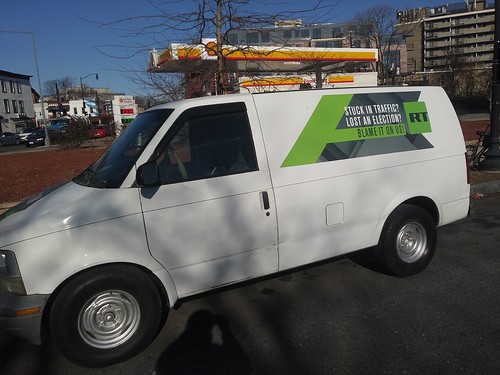
1. A Russia Today news vehicle with an "ad" making fun of US concerns about Russian involvement in US politics.

I saw this vehicle on the 1400 block of Maryland Avenue NE.
A Russia Today news vehicle with an "ad" making fun of US concerns about Russian involvement in US politics

2. I can't even measure how ironic it is that President Trump supports protests in Iran ("Trump Right, This Time, About Iran ," New York Times; "Iran: Trump's Tweets Are Inciting Protests," Al Bawaba) while denigrating protest and civic involvement in the US ("Donald Trump's Attack on Colin Kaepernick and Jemele Hill," The Atlantic Monthly") unless it's extremely conservative or virulently racist ("Trump Defends Initial Remarks on Charlottesville; Again Blames 'Both Sides'," New York Times; "Trump backs protesters — as long as they're not protesting him," Politico).

=====
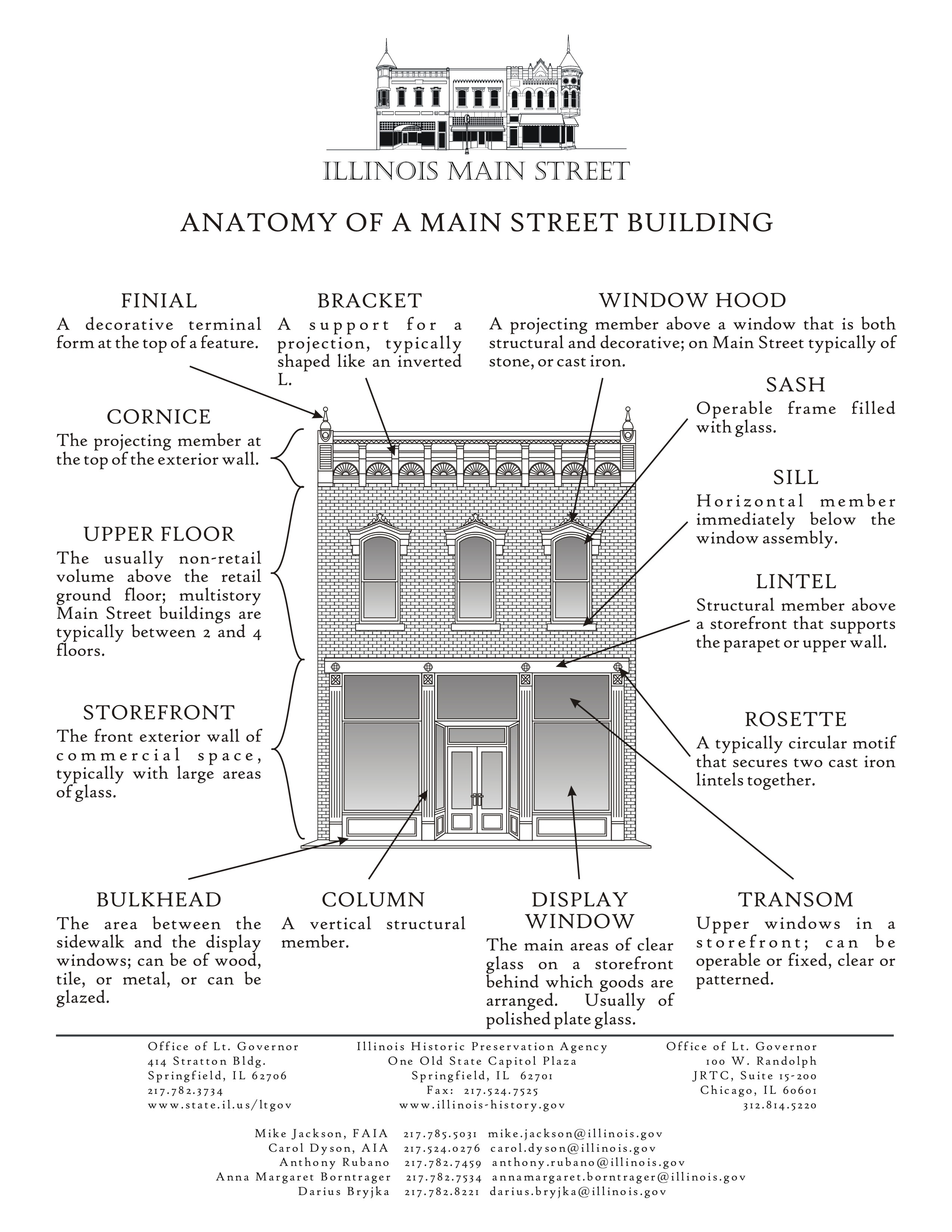
Although to bring this back to urban planning, there is always John Friedmann's analysis in the book Planning in the Public Domain, which lays out practice in terms of whether or not it supports the state, challenges the state, or does not recognize the state.
Basic Concepts, Planning in the Public Domain

Labels: , , , ,

Friday, May 12, 2017

US National Tourism Week: a perspective from New Zealand

My NZ e-correspondent comments on the recent blog post on DC tourism issues:

Your recent entry on your website refers to:
The lack of information center will be DCs biggest downfall for tourism , given the large number of sights and attractions are in the region.
New Zealand i-site in Fiordland.

Are US tourist information centers under any sort of governing body? All licensed tourist info centres in NZ are under the "i - site "umbrella," which is a bit like KOA branding of campsites . There is a set level of standards to be maintained

i - sites can book domestic travel anywhere in NZ by any mode ( air , bus , ferry ) has information on ALL types of accommodation in their region -- budget backpackers to ultra luxury, and communicate with each other to make bookings in other parts of NZ .

Some of the better i-sites include internet access, cafes , DoC information (the Dept. of Conservation administers National Parks and wildlife conservation), sells topo maps and videos, sells postage stamps, has a gift shop with quality souvenirs ..... all in a one stop shop.  Even some of the smaller towns in NZ ( with population of 3,000) have good i--sites -- it's not just the big players.

My response:
wrt info centers, here we're bigger country-wise and because conservatives for decades don't like funding federal "economic development," tourism promotion is primarily a state activity. That being said, most states do a very good job supporting "welcome" or visitors centers across their states, although they may or may not do accommodations reservations.

DC is an exception for a major city in that it does such a poor job, and this is complemented by the very parochial approach of the federal agencies. And DC extends its poor job by not extending information to area visitors centers located outside of the city but in the metropolitan area.

I missed out once on buying ephemera off ebay when there was a c. 1930s or 1940s photo of a federal "information center" in DC, but somehow I missed the deadline to bid and could never find another one.  I need to track it down.

With the federal agencies, fwiw, the problem isn't limited to DC.  It's the same for federal parks and lands and rec. centers across the country. They won't provide "local" information on site. Yet, they do economic impact studies every year about the economic impact of these facilities on local economies. It would be much greater if they would bend on this particular element.

the poor job of NPS marketing is why Utah stepped in to do its own campaign. It's so successful that they are overwhelming the facilities...
On what we might call "public diplomacy" and projecting the image of the US to "foreigners":


The following is a NZ perspective, which may or may not be widely known ( I suspect not)) by Americans.

Tourism -- People who are transiting through the US, but are not leaving the airports, have to pay for a visa to do so.  If I am flying from NZ to LAX, transferring on to another flight to London UK, will only be in the transfer terminal in LAX for an hour or two, I have to pay for a visa.

This is dumb !! As I will not be processed into the US by ICE , I don't understand why I need a visa to do so. Apart from places in Middle East, notably Saudi Arabia  there is no other country where I need a transit visa.

Who says?  (ABC LA photo.)

Entry conditions into US are a lot stricter, and more cumbersome. The US Embassy and Consulates do NOT handle visa applications. It is done by paying a toll call (regardless where one is phoning from in NZ).

I don't know what it is like now, but the US immigration that I struck were some of the most obnoxious folk I ever came across in the US . For starters it would help if they spoke slowly and clearly to us -- even those of us who speak English sometimes find a Southern Drawl a little hard to follow ...

And uniformed men waving guns in the air, herding us round like a bunch of sheep in the arrivals hall, is not exactly a friendly welcome. If these folk REALLY need guns (how often are they used?) they could be a little more discreet about it.

Twitter photo, Detroit Metropolitan Airport.

There are 2 lines for queuing; One marked "US Citizens" , and the other marked "Aliens" Although I am not a US citizen, I am NOT an alien. ET might be an alien, but the rest of us are "foreign citizens or "visitors to the US."

And with Donald Trump as your country's leader, goodness knows what he will do to make entry to the US harder for those of us who wish to visit.

Tipping.  Although some countries have a tipping culture, this is abhorrent to NZ or Australian folk, unless the service provided was (1) actually wanted, and (2) greater than expectations.

Porters who automatically take my luggage and put it into the trunk of a cab , then expect me to pay them to do what I would have done myself is asking for an argument from me.  American porters should ASK customers if they need their services, not just help themselves.

Labels: , , , ,

Friday, August 19, 2016

Public diplomacy and the Olympics: Ryan Lochte et al.

Because the US is arguably the richest nation in the world, the country tends to be very successful at the Olympic Games, and athletes representing the US win a plurality of the medals.

 Just as I joke sometimes that US soldiers serving in countries like Iraq or Afghanistan ought to have PhDs in Anthropology and Sociology, the athletes at the Games represent the US as a form of public diplomacy.

-- Public Diplomacy and the Olympic Games, USC Center on Public Diplomacy
-- Strategies for Improving Brazilian Public Diplomacy with the 2016 Summer Olympics, GWU Masters Thesis (this paper is not on what visiting countries can do, but the opportunities for host countries)

Ryan Lochte and his friends, and their debacle -- claiming they were robbed when actually they were confronted by security guards after breaking a door at a gas station -- embarrassed the US and Brazil.  See "Ryan Lochte apologizes for description of gas station incident," USA Today.

They typify why too often we are called "Ugly Americans" when we travel abroad.

Considering that Tommie Smith and John Carlos and were stripped of their medals at the 1968 Olympics because of their making the Black Power salute when they were on the awards podium--not that I think that was the right decision on the part of the IOC (and the US Olympic Committee, to their credit, did not agree)--at the very least, Ryan Lochte ought to lose any payments he is to receive from the US Olympic Committee for being a medal winner at these games.

Also see the past blog entry, "Re-branding America."
Brand America by Anholt

Labels: , , ,

Wednesday, September 23, 2015

World Tourism Day, September 27th and tourism amid strife and the possibility of a federal shutdown

======
Augmented with the sections on too many tourists and visitor rentals of residential properties and therefore reprinted with a new publication time.
======

In a global economy that is mostly post-industrial, tourism is one of the biggest industries and employers world-wide.  World Tourism Day, sponsored by the United Nations World Tourism Organization, is this Sunday, September 27th.

Strife and tourism.  It may seem selfish, but WTD gives us an opportunity to think about the circular nature of strife in various countries and how it impacts the willingness of people to visit.

For example, the Egyptian military "accidentally" killed 8 Mexican tourists using a helicopter gunship, thinking they were terrorists ("Bodies of eight Mexican tourists killed by Egyptian forces are returned home," Guardian).

And other North African countries have experienced terrorist attacks on tourists--killing dozens--intended to destabilize the local economy ("Tunisia hotel attack: 38 killed, tourists flee," CNN).

But it's not exclusive to North Africa ("Bangkok bombing hits Thailand tourism," Telegraph; "Thailand bombing won't crush tourism-—commentary," CNBC).  The recent bombing in Thailand has led to a 17% drop in tourist visitation so far.

Greece has been in the news because of its economy and elections, and that may have put off some people's willingness to travel there, while others may be motivated to visit because they know their spending will have direct and needed positive impacts ("Greece Makes Fast Recovery in Tourism," Wall Street Journal.

The waves of migrants from Syria to Europe also shapes the images people may have of the impacted countries and could impact their willingness to visit, at least now.

... and the US has complicity in all of this because the invasion of Iraq, a country not previously entangled with Al-Qaeda, destabilized in many ways, most of the countries in North Africa.

The ugly tourist.  When I was in college, I read The Ugly American, which was a pretty damning assessment of US action overseas, especially in Asia.  While there is always grumbling about tourists in most communities dependent on tourism, there has been more attention paid to the issue lately, not about Americans, who are often universally derided, but the Chinese ("For Chinese Tourists Behaving Badly, A Government Blacklist" NPR).

This is an element of what we might call "soft public diplomacy," and how as citizens when we travel to other countries, for good and for bad, we represent our nation. And the same goes with how we treat visitors when they are in our country as guests. Even if we might resent their economic primacy. According to NPR:
Last year, Chinese tourists took 109 million trips overseas, 20 percent more than in 2013. Many host nations may be inclined to overlook misbehaving Chinese tourists because China now contributes more money to the global tourism industry than any other nation.
Tourists at the entrance to Park Guell, Barcelona. Photo: Carl Davis, Alamy.

Too many tourists.  Too many tourists is a different issue from ugly tourists and has been an issue for awhile in ecotourist destinations with limited carrying capacity, as well as particularly popular cities like Venice, which have significant infrastructure issues (it's a city built on islands and connected by water) in terms of accommodating large numbers of people, especially itinerant visitors.

One city where this is becoming an issue is Barcelona ("Barcelona’s New Mayor Wants to Send Tourists Packing," Bloomberg), where tourists overrun cultural assets such as La Boqueria food market--making it into a food court rather than a place to buy food to cook at home (this is a problem with Pike Place and other public markets in the US too)--or sites and parks associated with the famed architect Antoni Gaudi.

Impact of house and room renting services like Airbnb and HomeAway/Homestay on tourism and local consequences.  One element of too many tourists is the conversion of residential housing to tourist-serving properties.  The rise of house and room rental services like Airbnb has exacerbated this problem, especially in popular cities already experiencing an overheated property market.

Airbnb spent millions of dollars on ads and other lobbying to legalize visitor rentals of residential properties in NYC.  Photo from Gawker.

Many cities have regulations against this kind of property use, as a way to ward off negative consequences from business uses of residential properties in residential neighborhoods.

In NYC it's against the law, despite Airbnb's lobbying, while in San Francisco, there are new regulations to cover the industry ("S.F. to create city office to enforce Airbnb law," San Francisco Chronicle)--it's harder for SF to oppose such services, because Airbnb is based in SF.

The blog associated with the World Travel Market conference upcoming in London in November had a piece on this subject awhile back, talking about how such services will completely transform and disrupt the accommodations industry and I made the point that the valuations of the firms involved are a function of froth in the market, not based on reality.

The reality is that before mobile commerce enabled the "aggregation of otherwise dis-aggregated properties into a consumable product", there was rental of such properties, but through classified ads in specialized magazines.

Just like there was demand for urban living but the market wasn't producing housing for that segment, so people interested in urban living ended up living in the suburbs (as discussed in Leinberger's book The Option of Urbanism), there was a market for tourists/visitors staying in non-hotel properties other than bed and breakfasts, but it wasn't being adequately serviced.  Now it can be and is.

But likely it's not going to put hotels and motels out of business, as likely a majority of the market isn't willing to stay in such properties regardless of availability--that being said the companies are innovative and worth a great deal of money.

Likely mobile commerce enabled personal property rental also expands the market for tourism somewhat as lower cost accommodations means that more people can afford to travel, because they can stay in some of these properties for less than cost of traditional accommodations (on the other hand some of these private rentals are significantly more expensive than traditional ones).

I like such services (we use HomeAway not airbnb) because it gives you the opportunity to consume a place more like a resident, if that is your intent.

One of the problems with such services though is that they can end up diverting residential properties to tourist use--renting use of a property for $100 or more per night usually generates more than the average cost to rent the same unit as a traditional tenant.  This is alleged to be a problem in Los Angeles, according to the report AIRBNB, RISING RENT, AND THE HOUSING CRISIS IN LOS ANGELES published by the Los Angeles Alliance for a New Economy (LAANE).

Studies of property providers show that a majority of the listed properties on such services, especially in high cost cities like NYC, are by real estate/property professionals, not individuals looking to make a bit of extra money. See "The Shape of Airbnb's business" and "The Shape of Airbnb's business (II)" by Tom Slee from his Whimsley blog.

US Federal Government shutdown and federal parks closures.   Once again there is the possibility of a federal shutdown, because of conflicts between the Republican party, which controls Congress (albeit barely) and the President/Democratic party ("Senate GOP takes lead to prevent government shutdown," The Hill).

According to the US Travel Association ("Shutdown Would Cost U.S. Travel Economy At Least $185M per Day"), a federal government shutdown would cost the U.S. travel sector at least $185 million per day in economic output due to lost activity and affect 530,000 travel-related jobs due to temporary layoffs, reduced wages and fewer hours worked.

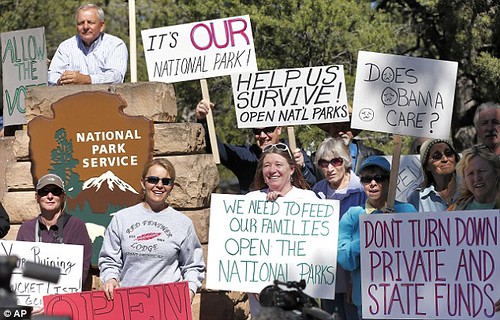
Local residents complain about the closing of the Grand Canyon National Park
Protest: Locals complain about the Grand Canyon National Park closure which is costing the community in lost tourism.  Image via the Daily Mail.

In those parts of the country with federal parks and public lands that are key elements of local tourism, there are more specific and hard felt effects on local economies from shutdowns.

This is why for some time I have argued that local and state parks and tourism planning needs to include contingency planning for federal shutdowns, and state and federal budget cutbacks ("Federal shutdown as another example of why local jurisdictions should have more robust contingency and master planning processes" and "Contingency planning in parks planning: Montgomery County Maryland edition").

According to the NPS report Effects of the October 2013 Government Shutdown on National Park Service Visitor Spending in Gateway Communities:
• A 7.88 million decline in overall NPS October visitation resulting in a loss of $414 million NPS visitor spending within gateway communities across the country;
• Gateway communities near forty five parks experienced a loss of more than $2 million in NPS related October visitor spending;
• Five states experienced a decline of over $20 million in NPS October visitor spending;
• Each dollar of funding for the 14 parks opened with state funding before the end of the shutdown generated an estimated $10 in visitor spending.
It turns out that the National Park Service does allow states to step in and pay for operation of facilities during shutdowns ("Feds will let states pay to reopen national parks," Associated Press).

But it's best to plan ahead and have those agreements in place before a shutdown, not once a shutdown is underway.

It happens we had a planned a trip to Gettysburg during this period, but Gettysburg is an unusual federal park in that the museum is controlled by the Gettysburg Foundation, not the NPS, and many of the grounds of the Battlefield are not directly under federal control.

Labels: , , ,