Rebuilding Place in the Urban Space

"A community’s physical form, rather than its land uses, is its most intrinsic and enduring characteristic." [Katz, EPA] This blog focuses on place and placemaking and all that makes it work--historic preservation, urban design, transportation, asset-based community development, arts & cultural development, commercial district revitalization, tourism & destination development, and quality of life advocacy--along with doses of civic engagement and good governance watchdogging.

Friday, May 22, 2020

How far has Brand America fallen? The US as a failed state | Las Vegas gets big coronavirus test donation from the United Arab Emirates

I few months back I joked with a co-author of the book Brand America, that the new Brand America under President Trump is "Can't Do. Won't Do. You Do. F*** You."

-- "It's Official.  Brand America is Tanking," Forbes

I see that Nevada is boosting its covid19 testing capacity because of a donation of 200,000 testing kits from the United Arab Emirates ("Las Vegas needed help testing for coronavirus. Then a crown prince stepped in," Los Angeles Times; "After the end of the world: the eerie silence of the Las Vegas Strip," Guardian; "Effects of coronavirus fear hit Las Vegas economy hard," Las Vegas Review-Journal). From the article:
One of the largest mass coronavirus testing sites in Nevada has opened in Las Vegas, a move that puts the city one step closer to reopening its economy. And it might not have been possible without the donation of more than 200,000 test kits, worth as much as $20 million, from the United Arab Emirates.

Within weeks of the coronavirus reaching Las Vegas, members of the public were clamoring to be tested, and hospitals and laboratories were running out of supplies. Nasal swabs were so difficult to come by that some clinics closed, and state officials called on the federal government for help.
AP photo of an empty Las Vegas Strip in March 2020 
Help did arrive in Las Vegas. Supply chains eased, allowing hospitals to buy more tests, and aid trickled in from Washington.

But the intervention that changed the state’s fortunes was a large donation from Mohammed bin Zayed al Nahyan, the crown prince of Abu Dhabi and de facto ruler of the United Arab Emirates, according to members of Nevada’s COVID-19 Response, Relief and Recovery Task Force, a group of business leaders supporting the state’s recovery.

Jim Murren, the former chief executive of MGM, who chairs the task force, said this week that the gift was the result of discussions with G42, an Emirati artificial intelligence and cloud-computing company. Although talks initially centered on how to bring back concerts and sports events to Las Vegas during the epidemic, Murren said his counterparts in the United Arab Emirates quickly realized Nevada didn’t have enough test supplies to help stem the spread of the disease.
Las Vegas Strip in 2017.  Photo: Atlantic City Press. 
At the time, the state could only manage to test hundreds, not thousands, of people daily. Those who did get tested endured lengthy wait times for results as their samples were shipped out of state to private labs in California or Arizona that could take as long as two weeks to deliver an answer. By the time state health officials learned someone had tested positive, it was too late to prevent them from spreading the virus. ... 
Nevada has received money and supplies from the Federal Emergency Management Agency but nothing that approaches the scale or the speed of the United Arab Emirates’ donation. [emphasis added] According to state health officials, FEMA has equipped Nevada with 26,000 testing swabs and 25,600 testing transport components. More supplies are on the way, officials said, but the shipments haven’t arrived.

For Murren and others on the task force, the United Arab Emirates’ gift is a sign of the relationships Vegas business leaders have cultivated overseas. But public health experts, who praised the donation, said it was also an indictment of the U.S. government’s halting response. [emphasis added] 
It made me think of "the song" "The Americans" from 1973. I didn't realize originally it was an on air editorial by newscaster Gordon Sinclair from CFRB radio in Toronto.

Instead, I was familiar with the "spoken word" 45 record version by Byron MacGregor, a newscaster at CKLW-AM radio. Back then, "CK" a high-power radio station based in Windsor, Ontario, focused on serving the American market for listeners and advertisers. It was definitely the #1 station in "Detroit."

The record focused on how much the US helps others and gets derided in response.


Obviously, that's the attitude that President Trump has, which has led to his America First agenda. 

Still, it's incredibly damning that the federal government's failure to take the lead in coronavirus testing is so severe that some states are turning to foreign countries for help.

Maybe Gordon Sinclair would think it's an example of the US finally getting back the kind of help it has given to so many others.

Instead I see it as an example of the USA as a "failed state" ("We Are Living in a Failed State," The Atlantic)."  From the LAT:
The Emirati donation “is reflective of the failure of the federal government to step up to its responsibility to make sure that in a time of scarcity every community gets the resources they need to respond to this pandemic,” said Jeffrey Levi, a professor of health policy at George Washington University.
One of the points made in "The Americans" is that at that time only the US made airplanes capable of long distance flights. These days, we have the Boeing 737MAX debacle that includes not just the airplane manufacturer but the failed oversight from its regulator, the Federal Aviation Administration.

Another was that the US aid and expertise rebuilt foreign railways in India, France, and Germany. Now, the passenger railroad system in the US is the worst of any major developed nation.

Of course, the UAE isn't a fully benevolent actor either. According to the LAT:
In addition to offering humanitarian relief, the United Arab Emirates has a financial interest in seeing Vegas come back to life. Dubai World, the state-controlled investment vehicle of Dubai, owns half of the sprawling CityCenter complex, which when it opened in 2009 on the Strip was the largest and most expensive private development in the city.
You get what you pay for.  WRT Las Vegas, too it's somewhat ironic. Las Vegas casino operator Sheldon Adelson is a strong investor in President Trump and the Republican Party for support of reduced taxes and an ultraconservative approach to Israel and the Mideast.

The tax cuts favoring the wealthy put hundreds of millions of dollars in Adelson's pocket, which was a pretty good return on his investment in Republican election campaigns, which he continued in both the 2018 and 2020 election cycles ("Sheldon Adelson to donate $100m to Trump and Republicans," Guardian).

Now the financial losses in Las Vegas at the Sands, owned by Adelson, and other casinos because of federal government failures to respond properly to the pandemic has cost all of that and more ("Las Vegas Sands Posts Loss Amid Coronavirus Shutdown," Wall Street Journal). From the article:
Casino operator Las Vegas Sands Corp. reported a 51% drop in revenue, with Las Vegas shut down in response to the coronavirus pandemic and reopened casinos in Macau struggling to recover.

On Wednesday, Sands posted $1.78 billion in net revenue for the three months ended March 31, down from $3.6 billion at year earlier. The company had a net loss of $51 million for the quarter, compared with $744 million in net income a year earlier.

Labels: , , , ,

Tuesday, October 22, 2019

Amazon’s growing spending on Seattle politics includes a spate of donations from Jeff Bezos’ ‘S Team’

Headline from the Seattle Times. From the article:
Earlier this year, 11 members of Amazon’s so-called “S Team” — senior leaders who report directly to Amazon founder and CEO Jeff Bezos — started writing checks to a group of Seattle City Council candidates and a political-action committee. For most of the executives, it marked their first donations to Seattle council races.

The local political spending of Amazon’s top executives, along with a record-setting $1 million contribution to a pro-business political-action committee last week, underscore the company’s desire for a more accommodating council in the city where it occupies nearly 50 buildings and has more than 50,000 employees. ...

Amazon’s local political awakening began in earnest in 2017, as the Seattle City Council started a public discussion of a “head tax” on big businesses to fund housing and homeless services. That year, the company donated $350,000 to a business PAC to help get Mayor Jenny Durkan elected. ...

Amazon’s $1 million donation last week to the Civic Alliance for a Sound Economy (CASE), a PAC associated with the Seattle Metropolitan Chamber of Commerce, was the largest outlay by a corporation or other single player in a Seattle city election. It came on top of $400,000 Amazon gave earlier to CASE to spend on the election.
Amazon isn't happy at Seattle's attempt to pass a "head tax" on employees for large corporations.

Since corporations game their taxes, and most cities don't levy income taxes, this is a way to get at taxing corporations.

The Seattle City Council passed the tax at $250 per employee, but later reversed it.  According to Geekwire, Amazon has more than 50,000 employees based in Seattle, so the tax would have raised at least $12,500,000 per year.  (See the discussion on District 1 Seattle Council Member Lisa Herbold in this election endorsement article from The Stranger.)

Even so, Amazon announced they would be moving a major division to suburban Bellevue ("Amazon details plan for Bellevue expansion, bringing several thousand jobs in coming years," Seattle Times).

Seattle's City Council, like San Francisco, tends to be quite liberal/progressive and has one of the nation's only Socialists, Kshama Sawant.

======
It does provide some scary thoughts concerning Amazon's entry into Arlington County, Virginia.  Then again, Virginia is a Dillon Rule state which means that the State Legislature must authorize by law, the ability of local governments to act.  In other words, no legislation on head taxes at the local level unless previously enabled by the State Legislature.

Labels: , , , ,

Thursday, June 21, 2018

Maybe Michael Bloomberg can be convinced to help fund transit referenda campaigns across the country?

An anti-transit flyer left by an Americans for Prosperity organizer. The group made nearly 42,000 phone calls and knocked on more than 6,000 doors in Nashville. illiam DeShazer for The New York Times.


The New York Times published a great piece about how the conservative uber wealthy Koch Brothers have made "transit promotion" a national issue, and they fund anti-transit campaigns at the local level, to fight off funding.

-- "How the Koch Brothers Are Killing Public Transit Projects Around the Country"

From the article:
“Do you agree that raising the sales tax to the highest rate in the nation must be stopped?” Samuel Nienow, one of the organizers, asked a startled man who answered the door at his ranch-style home in March. “Can we count on you to vote ‘no’ on the transit plan?”

In cities and counties across the country — including Little Rock, Ark.; Phoenix, Ariz.; southeast Michigan; central Utah; and here in Tennessee — the Koch brothers are fueling a fight against public transit, an offshoot of their longstanding national crusade for lower taxes and smaller government.

At the heart of their effort is a network of activists who use a sophisticated data service built by the Kochs, called i360, that helps them identify and rally voters who are inclined to their worldview. It is a particularly powerful version of the technologies used by major political parties.

In places like Nashville, Koch-financed activists are finding tremendous success.
I wrote about this in May, about what was happening in Nashville ("Nashville voting today on transit referendum") although there it's likely that the initiative would have failed anyway.

Interestingly, the conservative magazine National Review weighs in on the coverage, making the point that AFP put very little money into the campaign, and that the campaign tactics of the opponents were no different than the opponents.

-- "Koch Brothers vs. Nashville Transit: A Chilling Tale

Of course, the article deliberately misses the most important point, that a national group "bigfoots" in on a local issue and changes the argument, making it an issue not about local mobility but about taxes and "small government."

The Koch Brothers aren't new to making local issues "national," as their Americans for Prosperity organization has chapters in most states where they are fearless in fighting progressive initiatives and promote lowering taxes, even though taxes fund public goods..

-- Defending the American Dream Summit | Americans for Prosperity
-- "Americans For Prosperity may be America's third-biggest political party," Washington Post
-- "Koch brothers network lays siege to Florida as midterms loom," CNBC
-- "Americans for Prosperity offer 'Road to Freedom' to Colorado lawmakers," Colorado Politics
-- "Americans for Prosperity Dir. Disagrees with $60B Sandy Aid," NJTV/PBS

The Kochs were founders of the libertarian organization the Cato Institute and I term their kind of anti-government, anti-public good, anti-community pro-individual perspective "anarcholibertarianism."

Michael Bloomberg, former Mayor of New York City, founder of the Bloomberg financial information system which made him as wealthy as the Koch Brothers, and post his Mayoralty he's funded a variety of smart city initiatives through the Bloomberg Philanthropies, has announced he's putting up $80 million to help the Democratic Party in their quest to win majority control of the US House of Representatives ("Michael Bloomberg pledges $80 million for midterms to help Democrats retake control of House," Washington Post).

Transit campaign signs in Nashville.  Photo: Fox17.

Maybe Mr. Bloomberg could do the same for transit?  Step in and counter the effect of Americans for Prosperity generally, and with regard to transit/transportation improvements in particular.

With the proviso that proponents (1) take the time to build support, (2) which means not putting initiatives on the ballot on a super-accelerated timeline, which was one of the problems with the Nashville initiative.

Labels: , , , , ,

Thursday, April 18, 2013

A bad idea on two levels: Hiring a law firm with private donations to do research on school reform (and a bit on government contracting more generally)

According to the Washington Post ("Catania hires law firm to help craft D.C. school legislation"), Councilmember David Catania, chair of the DC City Council Education Committee, is seeking private donations to pay the Hogan Lowells law firm to research school improvement issues, so that he and his committee can be better prepared to deal with the issues before their Committee.

From the article:

The chairman of the D.C. Council’s Education Committee is using private donations to hire an outside law firm to help him craft a package of school-related legislation that would aim to lift student achievement and address points of friction between the city’s traditional and charter schools.

Council member David A. Catania (I-At Large) said he wants to improve upon “uncoordinated and often haphazard” efforts to retool public education in the city since the advent of mayoral control in 2007. Catania said he hopes to introduce a comprehensive bill this year that would address a broad variety of education issues, some of which are likely to provoke controversy.

I am the last person to argue against research, reports, and great preparation.

But... I don't understand the new ethics laws in DC, which in all likelihood, still aren't that robust, to see how this is legal.

1.  A "contract" like this should be bid out.  Although DC City Council, technically, is exempt from DC's laws about contracting and procurement and so they can pass laws that are basically contracts, without having to first have a process of soliciting proposals.

This was an issue with the Council's designation of a preferred re-developer of the Florida Market, now called Union Market, district in Northeast DC.  At the time, I called the process the dirtiest one that I had observed in my various local involvements.

2.  Public officials soliciting private donations to pay for research generally is a bad idea.  It sets the stage for undue influence, which by the way is a big problem with national education policy now anyway.  Much private money, including foundations, funds "research" provided to school districts to set policy, mostly with regard to teaching, evaluations, union contracts, and charter schools.

More recently, this kind of money is ending up being spended on campaigns for School Board candidates supporting the so-called "reform" agenda.  This was a big deal in the recent elections in Los Angeles, where among other funders, a Political Action Committee associated with former DC Schools Chancellor Michelle Rhee, now running her own nonprofit called "Students First", pumped lots of money into specific campaigns.  More than $6 million was spent on the campaigns for three positions.  These forces are likely to see victory in two of the three seats that they were contesting.  See the Reuters story, "Reform candidates see mixed results in Los Angeles school board race."

3. Besides, with a $440 million "budget surplus," you're telling us that there isn't a few hundred thousand dollars around to conduct research?

4.  Who is to say that Hogan Lowells, sure with a practice group in the education field, is the best organization out there to research the issues?  That's why an RFP process is a good thing, a public and vetted "scope of work" is necessary, etc.

5.  Plenty of organizations produce reports--"for free"--to influence public policy.  And it's paid for by private donations. But it's a private process. And ultimately, the ideas still have to "compete" for attention and confirmation in the public issuespace.

The kind of report that Catania is seeking should be paid for by the public.

It's also damning that the DC City Council lacks the capacity to do this level of research on their own.

But it is a step forward that CM Catania recognizes the necessity of research-based legislation, rather than just shooting from the hip, which is more typical.

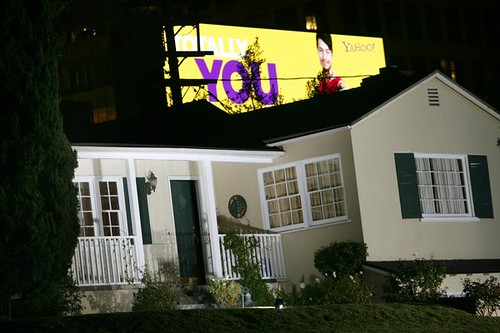
Digital billboard in the Comstock Hills neighborhood, Los AngelesA different but not unrelated issue in Los Angeles: private contracts and digital billboards

The Los Angeles Times has an incredibly long editorial, "Building a better billboard law in L.A.," that is amazing, about the necessity of a public process for dealing with the digital billboard issue there.

It seems that the Los Angeles City Council passed legislation in private session a couple years ago, giving special treatment to two billboard companies--in part to avoid lawsuits--and abrogating many laws and requirements for public processes with regard to the siting of billboards. The agreements were only disclosed after a third company sued, because they wanted to get in on the deal ("77 digital billboards ordered to go dark by Monday evening: Clear Channel Outdoor and CBS Outdoor lose ruling over a deal they made with the city of L.A. in 2006).

At least on this matter, the LA Times stands up for the public process in the editorial.  By comparison, the Washington Post editorial board continually advocates for less public process with regard to local government in DC.

Caption for image above: A home rented by Eazaz Dar, Commercial Consulate to the Consulate General of Pakistan, in the Comstock Hills neighborhood of L.A., has a glow cast into it from a digital billboard on Santa Monica Blvd, Dec. 17, 2009. Dar, who wasn't told about the glow or view of the billboard before renting, says he is still looking for thicker curtains for his bedroom window.(Jay L. Clendenin/Los Angeles Times)

Note with regard to digital billboards: approvals and public finance

I have been meaning to write about this issue separately. I don't have a problem with advertising and with billboards, although I do agree with various scenic and design restrictions placed on billboards.

What's interesting is that apparently digital billboards are much more lucrative for the companies. This seems obvious, because they can run many more ads in the same space. Because it's more profitable, companies are offering to share part of the revenue with the various local government permitting authorities. Because so many local governments are pressed for revenue, going forward with such agreements is very alluring.

Different issues, but they raise similar concerns about public contracting, ethics, and decision-making.

See "Electronic billboards attractive to cities: Debate over digital signs spreads across North County" from the San Diego Union-Tribune. From the article:

Critics say allowing digital billboards along North County freeways would create blight in the community. Supporters say they would give local businesses an opportunity to attract more customers.

They would also allow cash-strapped municipalities such as Vista to grab a slice of the advertising revenue the signs would generate.

Bret Schanzenbach, executive director of the Vista Chamber of Commerce, said digital billboards offer too many advantages to pass up, including promoting community events and boosting the city’s income. ...

In January, the Vista City Council asked its staff to begin negotiations with CBS Outdoors, one of the largest billboard companies in the world, to build two digital billboards along state Route 78.

On Tuesday, the council will review a draft agreement with the company and give city staff directions on how to proceed. Under the terms of the agreement, the city would get a 52 percent share of the billboards’ revenues, about $300,000 to $400,000 a year, according to a city report.

Meanwhile, Supervisor Bill Horn was approached last year by billboard industry officials about allowing such signs on county property, his spokeswoman Anita Lightfoot said.

Labels: , , , , ,