Rebuilding Place in the Urban Space

"A community’s physical form, rather than its land uses, is its most intrinsic and enduring characteristic." [Katz, EPA] This blog focuses on place and placemaking and all that makes it work--historic preservation, urban design, transportation, asset-based community development, arts & cultural development, commercial district revitalization, tourism & destination development, and quality of life advocacy--along with doses of civic engagement and good governance watchdogging.

Monday, November 27, 2023

London rejects a version of The Sphere

The recent blog entry, "Learning from Las Vegas: Round 2 | Planning for Activation and Transformational Projects," discusses how destinations can't rest on their laurels, they have to constantly focus on refreshment and adding new attractions, so they can keep up their stream of visitors.


The Sphere, created by Madison Square Garden Company, is an entertainment venue just east of the Las Vegas Strip. ("James Dolan’s $2.3 Billion Sphere Is Raising Eyebrows—in a Good Way," Bloomberg). Photos: Mikayla Williamson for Bloomberg.

One of the recently opened super major attractions is The Sphere ("The Sphere mesmerizing Las Vegas months before opening," Courthouse News Service, "Lighting up Las Vegas: The Sphere's most eye-popping displays since lighting up Sin City five months ago," Daily Mail), which is a multimedia extravaganza that is unparalleled, and requires special preparation to fully maximize the experience.  

The Sphere was Dolan’s baby, with the CEO conceiving the idea for a music-focused arena that has over 17,000 seats with a state-of-the-art sound system.

... The Sphere opened in late September with a U2 concert that impressed fans and critics who praised the arena’s sound and video system. A nearly hourlong show called Postcard from Earth plays regularly at the Sphere and has drawn interest from tourists. The shell of the Sphere amounts to a huge billboard. It’s covered in over a million LED bulbs, and has attracted advertisers and helped make the Sphere an instant Vegas landmark. 

The arena, the main asset of Sphere, was completed at a cost of $2.3 billion, about $1 billion above the original cost estimate. The company has yet to provide financial guidance for the arena, with Wall Street expecting some projections when the company reports September quarter results next month.

The cost of creating these experiences is high, and only a few cities across the globe likely possess the right set of conditions and high income residents and visitors with the money to spend on attending, once or more times per year.  To make the costs work, shows need to be shared across multiple sites. 

That's why they attempted to get approval to build one in London ("Proposed designs revealed for MSG Sphere, UK's largest concert arena," "Like Piccadilly Circus, but spherical: is east London ready for the MSG Sphere?," Guardian) which was first proposed in 2019 and has recently been denied ("Stratford sphere proposals rejected by London mayor," BBC).

From the BBC article:

Mr Khan rejected the development, citing the amount of light pollution that it would cause for Stratford residents, its huge electricity bill and associated lack of "green" credentials, and the impact it would have on heritage sites in the area. 

A spokesperson for the mayor said: "London is open to investment from around the world and Sadiq wants to see more world-class, ambitious, innovative entertainment venues in our city. 

"But as part of looking at the planning application for the MSG Sphere, the mayor has seen independent evidence that shows the current proposals would result in an unacceptable negative impact on local residents."

Paris has Euro Disneyland, Hamburg is a center for musical theater, Spain has the Mediterranean, London has lots of attractions including the O2 Arena concert facility.  Venice has the canals, Florence art, Rome ancient and contemporary history and the Vatican.  But a lot of these places now are concerned about overtourism, not adding new attractions ("Barcelona's war on tourism," New European, "Amsterdam's new tourism campaign is ready to ruffle some feathers," Lonely Planet).

But especially in the post-Brexit world, which has made entry to the country much more difficult, diminished British industrial output, exports, and reduced the number of tourist visits, London has to more carefully manage itself as a destination to maintain its position as a leading destination in Europe.

The Guggenheim Bilbao is sculptural and architecturally forward.  It has sparked a great deal of "architourism" to the city. Photo: ©FMGB, Guggenheim Museum Bilbao, 2017.

Sometimes that means taking a chance, the way Bilbao did on the Guggenheim Museum ("Why can't the "Bilbao Effect" be reproduced? | Bilbao as an example of Transformational Projects Action Planning").  

And it means managing the city as a destination.  

This does create tensions between anti-development forces among residents, but it's something that has to be overtly addressed.

Another rendering of the proposed Sphere in London.

But it's hard for a locally elected Mayor to buck the people who vote, and make such a pathbreaking long term decision.

From the BBC article:
City Hall said: "WSP concluded that the Illuminated Sphere, in conjunction with other artificial lighting within the proposed development… would be likely to have significant adverse effects on occupiers of nearby residential premises." 

This included at least 33 homes in the New Garden Quarter residential development; 28 homes in the Legacy Tower/Stratford Central; and 177 student rooms in the Unite student accommodation building. 

The size of the Sphere would make it a "bulky, unduly dominant and incongruous form of development" and cause harm to the setting of 16 heritage buildings, including the Grade II* listed Stratford Theatre Royal and three conservation areas.
These are tough issues to balance.  I'd say buy out the homes if that's what the owners want.  And recognize that the heritage built environment in London is strong enough to withstand the "incursion" of a structure like The Sphere, just as Bilbao was able to wrt the Guggenheim.

Although I will admit this goes against my strong historic preservation sense and the concept of the "architecture of the ensemble."

But like Liverpool and the Everton stadium ("Liverpool loses UNESCO World Heritage Site designation: An example of tough choices for cash strapped governments"), sometimes you have to make super hard decisions that go against the grain.


Mega events and city marketing.
  The book Wish You Were Here: The Branding of Stockholm and Destinations, authored by Julian Stubbs, makes the point that events, from mega events like the Olympics to big city festivals like Artscape in Baltimore (which has been wrecked somewhat by failures by the Baltimore Office of Promotion and the Arts and separately the city, which took over the agency) are important marketing touchpoints for cities.

He doesn't discuss big anchors like concert facilities or spectacles like The Sphere but they should be included.

For example, I surely hadn't thought of the economic impact at the local level of superstar concerts by the likes of Taylor Swift ("The Staggering Economic Impact of Taylor Swift's Eras Tour," TIME Magazine).  From the article:
If you live in one of the 20 locales Swift, 33, performed at in the last five months, your city has likely seen a boost in revenue from the hundreds of thousands of attendees who traveled from near and far. If you don’t—or simply couldn’t snag tickets due to the cost or the now infamous Ticketmaster snafu—chances are you’ve seen clips of the three-and-a-half hour show from celebrities’ Instagram stories. 

There’s also the timing: The tour has become the perfect outing for concert-goers itching for a post-pandemic live music immersive experience. “We are in an experience economy where people crave going out and participating in social events,” says Alice Enders, a music industry analyst at Enders Analysis and a former senior economist at the World Trade Organization. “It's no surprise that people are flocking to this Eras Tour experience in what is increasingly an otherwise digital environment we live in.”
... But the money goes far deeper than just net profits. The Eras Tour is projected to generate close to $5 billion in consumer spending in the United States alone. “If Taylor Swift were an economy, she’d be bigger than 50 countries,” said Dan Fleetwood, President of QuestionPro Research and Insights, in a story for GlobalNewsWire. On the opening night in Glendale, Ariz., the concert brought in more revenue for local businesses than Super Bowl LVII, which was held back in February in the same stadium. To use that event as a comparison, Swift has been performing the equivalent of two to three Super Bowls every weekend for the past five months (and six of seven nights at her last round of shows in Los Angeles).
Typically, every $100 spent on live performances generates an estimated $300 in ancillary local spending on things like hotels, food and transportation. But for the Eras Tour, Swifties are taking this to the next level, dropping an estimated $1,300-$1,500 on things like outfits and costumes, merchandise, dining, and travel—boosting local economies by hundreds of millions of dollars in one weekend.

Wish you were here isn't a primer or textbook, it's more of an outline and motivator aimed to get interested parties thinking and "thinking right" as it relates to place branding, and the impact of tourism on the local economy both in terms of visitation but also attracting new business and new investment to further strengthen the local economy. Typically, every $100 spent on live performances generates an estimated $300 in ancillary local spending on things like hotels, food and transportation. But for the Eras Tour, Swifties are taking this to the next level, dropping an estimated $1,300-$1,500 on things like outfits and costumes, merchandise, dining, and travel—boosting local economies by hundreds of millions of dollars in one weekend.

There are a bunch of case studies, not in super depth, for cities like New York, Barcelona, and Liverpool, which show the range of responses that are possible.

One point he makes is that cities need to invest more money and time into the creation of events and festivals, but he also discusses mega events like the Olympics and the World Cup.

Unfortunately, for many countries, mega events--like South Africa for soccer, and Greece and Brazil for the Olympics--such events don't work out, but that's not relevant to this particular entry. 

Light pollution.  I'm the first to admit I wouldn't want to live in the viewshed/lightshed of The Sphere overnight.  Apparently the Vegas Sphere shuts off at 11pm.  So it's not as big a deal as I thought.

Is seeing believing?  Even though it adds years to the approval process, I wonder if it will be easier for The Sphere to be approved in other places now that people can see it in operation.  People aren't big on thinking about approving things they aren't familiar with.

Bono, The Edge, Adam Clayton and Bram van den Berg of U2 perform during opening night of U2:UV Achtung Baby Live at Sphere on Sept. 29, 2023 in Las Vegas. Kevin Mazur/Getty Images for Live Nation

U2's residency at the Sphere is incredibly successful
("U2's First Batch of Shows at the Sphere Generated Nearly $110 Million in Ticket Sales," Billboard).  From the article:

U2 wrapped the first leg of the U2:UV Achtung Baby Live at Sphere residency on Nov. 4 with unprecedented box-office results. According to figures reported to Billboard Boxscore, U2’s 17 Sphere shows in Las Vegas grossed $109.8 million and sold 281,000 tickets. 

Opening night at Sphere was Sept. 29. U2 played another show the next night, 12 more in October and three in the first week of November. The gross and attendance figures average out to $6.5 million and 16,500 tickets per show. The average ticket price across all shows was $390.97. 

U2 is scheduled to play eight more shows in December, kicking off on Friday night. There are 11 more dates lined up between Jan. 26 and Feb. 18. The 19 shows on the books could generate another $120 million, pushing the residency to about $330 million in less than five months. Only Dion’s A New Day… would remain ahead in terms of all residencies in Boxscore history.

The only thing is few bands can pull this off.  U2 is one. 

Labels: , , , , , , ,

Thursday, June 28, 2018

Sadly, DC won't show so well during the Baseball All-Star Game

Sports mega-events as revitalization triggers.  Yesterday I was reading the book, Wish You Were Here: The Branding of Stockholm and Destinations, authored by Julian Stubbs.

His branding agency, Up There Everywhere, was the sponsor of the International Place Branding Conference event held earlier in the month in Liverpool, (to which I received a complementary registration, and my trip was also sponsored by a number of donors to a GoFundMe campaign to help pay for the trip).

The book isn't a primer or textbook, it's more of an outline and motivator aimed to get interested parties thinking and "thinking right" as it relates to place branding, and the impact of tourism on the local economy both in terms of visitation but also attracting new business and new investment to further strengthen the local economy.

There are a bunch of case studies, not in super depth, for cities like New York, Barcelona, and Liverpool, which show the range of responses that are possible.

One point he makes is that cities need to invest more money and time into the creation of events and festivals, but he also discusses mega events like the Olympics and the World Cup.  Unfortunately, for many countries--like South Africa for soccer, and Greece and Brazil for the Olympics--such events don't work out.  I have written about this quite a bit:

-- "Big sporting events (World Cup/Olympics), economic development and trickle down economics," 2014
-- "(Not enough time for a) 2024 DC-Baltimore Olympic Bid (to make sense)," 2014
-- "New Year's Post #3: More thinking on "return on investment" from different types of sports facilities and DC, and an Olympics in DC," 2015
-- "Rio Olympics," 2016
-- "Revisiting the Olympics selection process," 2017

Megaevents as end points vs. beginning points.  Barcelona is always given as an example of how to leverage a mega event like the Olympics successfully, while reading the book, I was thinking that most places really get this wrong because they see the event as the end game, when really it is the beginning, and a component, albeit a major component, of a wide ranging plan.

Basically, it's part of a "Transformational Projects Action Plan," an approach I've been developing for awhile.

Because for countries without the necessary infrastructure it is so costly to build it--South Africa estimated the cost would be $300 million and instead it was $3.5 billion--and because the event owners--FIFA and the International Olympics Committee--expect the host country to pay for everything, a very serious and objective calculation of the potential return on investment needs to be created, and some places should walk away.

Places off the beaten track and hard to get to, South Africa and Brazil, or easier to get to but not particularly wealthy like Greece, maybe should walk away.

In any case a very detailed business plan needs to be developed to ensure that economic benefits are reaped for many years after the event to make it worthwhile.  The plan needs to be in place for the years in advance of the event and for at least one decade afterwards.

E.g., with the 2012 Olympics in London over now for more than 6 years, they are still dealing with some of the sites and redevelopment plans.

Half Street SE, looking toward N Street.  WBJ photo.

Baseball All Star Game in DC.  This comes up with the Major League Baseball All-Star Game, which will be held in Washington next month.

The Washington Business Journal writes in "Unfinished business: It's All-Star time, and Half Street is one sad construction mess," that the area around the stadium looks pretty gnarly.

Last summer, I wrote about this, in "Urban design considerations for the area around Washington Nationals Baseball Stadium in advance of the 2018 All-Star Game."

Although I had been thinking about this problems since Opening Day in April 2017.

The entry makes the point that the streetscape around the Washington Nationals baseball stadium needs to be significantly improved to strengthen its urban design and placemaking qualities, especially since in July 2018 the Major League Baseball All-Star Game will be held there, to mark the 10th anniversary of the stadium. (This is discussed in depth in the piece.)

While that's an important date for the team owners, for the city, it would have been better for MLB and the Washington Nationals to have waited until the various construction projects were completed.

Special use permits should be required for such events, to ensure the best possible long term results from holding the event.  These kinds of events should require special use permits, so that localities have some say in when they are held.  In the case of a July 2018 All Star Game in DC, DC should have said no, the area wasn't ready.

Graphic from TDS & Associates.

Destination readiness: it ain't there.  In tourism, there is an important concept called "Destination Readiness."  As the WBJ article points out, the area around the baseball stadium isn't ready.

The Navy Yard district is getting there.  The soccer stadium is opening late next month, on Saturday July 14th, one day before the start of All Star Week.

The Wharf opened its first big section last fall, with another under development.

Imagine the impact of these sub-districts being knitted into one big destination, with all the necessary connections and design treatments.

They'll be at that point, in maybe five more years, and 2023 would have been way better for the City, although maybe not for the Washington Nationals, to have this event.

An urban design and placemaking plan.  Ideally, simultaneously with the construction program, there should have been an urban design and streetscape plan -- there are some plans but not as comprehensive as they should be-- and a ground floor plane and retail development program for the buildings leading to the stadium, so that it would be a great experience, instead of an office district + Potbelly vibe.

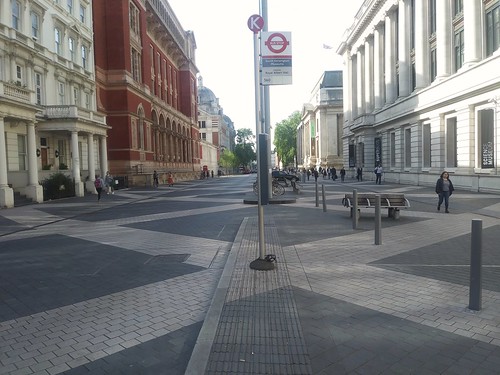
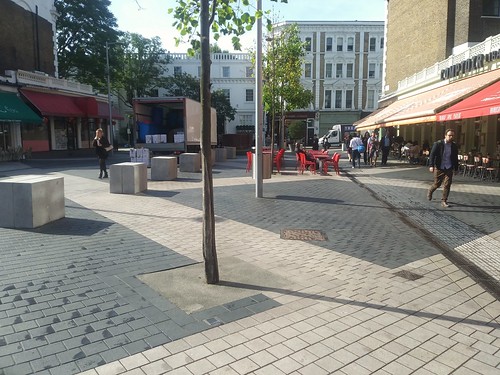
Besides models at Fenway Park in Boston--more as a gateway to the stadium, it's not a good example of special urban design treatments--and Camden Yards in Baltimore, the design of the streets in the area should be something like the design of Exhibition Road in London.

Although to my taste the road still is dominated by cars, albeit not that many, even as the design of the road and sidewalk is the same and the road can be closed for special events.
2018-06-28_01-16-54

A pedestrianized section of the road extends from the museum district to the area around the South Kensington Underground Station.
2018-06-28_01-16-08

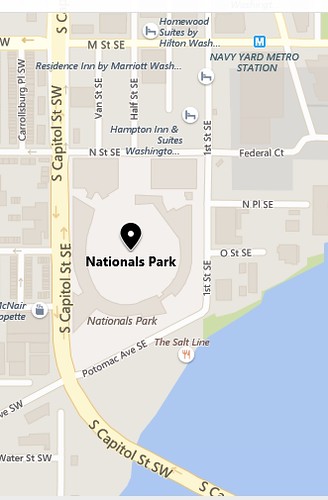
Map around the Washington Nationals StadiumGoogle Map of the area around Nationals Stadium.

In the Washington Nationals stadium area, such a treatment should be provided for all the streets and sidewalks in an expanded "stadium district" comprising Half and Van Streets SE between M and N Streets, N Street in front of the stadium.  Maybe even 1st St. SE too, and some of the other streets like N Place.

Pedestrian zones for DC.  Note that separately, inspired by my recent trip to Liverpool and my experience a few years ago in Essen ("Pedestrians, cars and the city: from opposition to cohabitation", Metro Politiques)," I am preparing a piece on creating short pedestrian "zones" in various places in Washington.

During the 2010 ThinkBike exercise led by a delegation from the Netherlands, one of the leaders was very surprised that DC didn't have any pedestrianized zones.

I was nonplussed.  Why should we?  Most pedestrian malls across the US have failed, etc.

But now I see that I was looking at this the wrong way.

You can have large pedestrianized zones like they do in Essen or Liverpool, so that they still function as the commercial and retail heart of the city--and that would be the ideal--or you can have short strips "here and there" where the conditions are totally favorable.

In most places where pedestrian malls failed, it was because they were too big relative to population density and activity.

It's best to start small, where you know you'll succeed, and build from there.

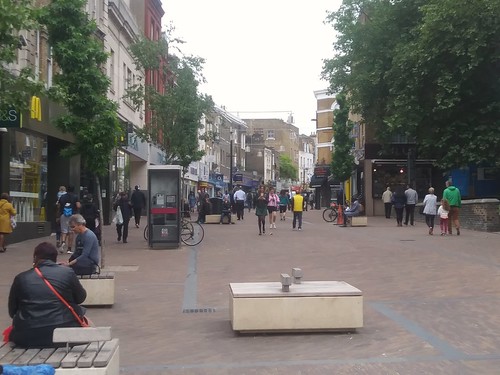
London has a number of pedestrian zones, but I don't think big districts like Liverpool or Essen.  One I happened across was Mare Street in Hackney.  It had the look of being there for many many years, but it turns out it's only a few years old.  It's short, a couple blocks, but it works.  And the borough is working on extending it, now that it is proven.
Mare Street/Narrow Way pedestrian zone, Hackney, London

It helps that it's by the Hackney Central London Overground Station and one of the borough's many shopping districts.

That's the idea I have for here.  A block or two here and there, in various places across the city.  Not many, fewer than 10.

Labels: , , , , , ,

Thursday, April 12, 2018

Sports teams shenanigans in Columbus Ohio and Miami

Last November there was an article in the Washington Post about the likelihood of the professional soccer team leaving Columbus, Ohio for the greener economic fields of Austin, Texas.  (Also see "The Crew want to move to Austin – but does Austin want the Crew," Guardian.)

Oddly, the article isn't accessible, nor findable within the website, but I seem to recall it making the point that Columbus has developed into a good soccer town, especially concerning matches between countries, for the World Cup, etc. and that the "organizational and community capital" (my words, not the column) would be stranded without the pro team.

According to the Austin Chronicle ("Columbus Crew News: Delay of Game? Legalese in Ohio could slow soccer team’s move to Austin"), this may be delayed because the State of Ohio does have a law requiring teams that received local or state government financing/benefits have to come up with a relocation agreement or wait six months. From the article:
The City of Columbus filed a motion Monday seeking to slow efforts by Precourt Sports Ventures to relocate the Columbus Crew SC to Austin. City Attorney Zach Klein's motion was filed as part of Ohio A.G. Mike DeWine's suit against PSV, which cites a state law requiring pro sports team owners who benefit from tax dollars to either reach an agreement with the host city or wait six months before relocating. Klein's motion argued that PSV could potentially wait out the six-month period, effectively preventing the people of Columbus from having a "reasonable opportunity" to buy the team. Should the motion be accepted, the Franklin County Court of Common Pleas could reset the start of the six-month window, throwing a wrench into Anthony Precourt's effort to have his team playing soccer in Austin by next March.
Not requiring an agreement but imposing a waiting period makes for an easy out.  The law isn't strong enough because it is still easy to leave, but is a start and more states should enact such legislation, but with much stronger provisions including "kill fees" for leaving if they've received tax dollars and benefits.

-- "The Columbus Crew's Austin Relocation Effort Has Its Own Oafish Astroturfing Campaign," Deadspin

2.  I've written about the ongoing saga of the Miami Marlins trying to stiff Miami-Dade County out of a "success payment" of five percent of the proceeds from the sale of the team ("Protecting local government interests: Jurisdictions at risk from slimy sports teams owners and the Miami Marlins as an example").

The new owners are a party to the suit and now they are trying to claim they are a foreign corporation ("To avoid Miami courtroom, Marlins claim citizenship in the British Virgin Islands," Miami Herald; "Miami Marlins try to duck lawsuit by claiming international citizenship," Sports Illustrated) and therefore the lawsuit should be moved to federal courts, and evading the jurisdiction of local courts which thus far haven't been particularly favorable to the claims of the defendants. From the Herald:
Lawyers representing the Marlins told a federal judge that at least one corporation that owns part of Marlins Teamco — the company Jeter and majority owner Bruce Sherman formed last year to buy the franchise — is based in the Caribbean. As a result, team lawyers argued, the dispute with Miami-Dade should be governed by jurisdictional rules that apply to international disputes.

The legal argument drew a sharp brush back from county lawyers, who mocked the "Jeter Marlins" for invoking treaty law in a lawsuit involving a Miami baseball team and the municipal government that owns Marlins Park.

"This is the most local of disputes, involving a locally-negotiated contract made between local parties under local law and requiring local performance," county lawyers wrote in arguing to keeping the lawsuit in Miami-Dade Circuit Court.

If successful, the Marlins' request would strip the case from a Miami-Dade judge who has already sided with Miami and Miami-Dade in a preliminary ruling rejecting the arbitration that Loria lawyers requested from the outset. If the Marlins are deemed a foreign-owned corporation, a federal judge could take over and then consider whether to trigger an arbitration clause in the contract the two governments signed with Loria in 2009 to steer public dollars to a stadium complex that opened three years later.

So both the previous owners and the new owners seem to be "slimy" as it relates to their actions as "partners" as part of the "public private partnership" involving the team, Major League Baseball, the City of Miami and Miami-Dade County as it relates to the city and county hosting the team and paying towards the construction of a stadium.

For all the talk of "public-private partnerships," this is an example of the reality that unless the counterparty acts like a "partner" they aren't, and we shouldn't allow the fiction to go on of calling such arrangements "partnerships".

Like with the State of Ohio legislation, it is important that contracts between the government and team "partners" need to include provisions on corporate domicile, where to sue if need be, etc.

Labels: , , , , , ,

Thursday, February 22, 2018

Protecting local government interests: Jurisdictions at risk from slimy sports teams owners and the Miami Marlins as an example

Professional sports leagues control who owns teams.  And the leagues and local team owners "gang up" against local jurisdictions in aiming to maximize the amount of government-provided monies for new stadiums and arenas.

If the team ownership group is flawed -- for example, yesterday's Washington Post has a nice column, "Boswell: Whatever Bryce Harper decides, the Washington Nationals played this right," about the difference in quality management and being principle-driven comparing the Washington Redskins football team and the Washington Nationals baseball team.

Granted neither team aims to leave any financial crumb on the table when it comes to their negotiating position with local and state governments, that being said, it's better to have "a public-private partnership" with a principled team and one that is managed well than an ownership group without principles and poorly managed team. 

Just recognize that the government needs to protect its interests rather than expecting the team to do it for them.

The Miami Marlins are a good example of this.  The team was owned by a guy with a bad reputation, first with the Montreal Expos, which he ended up selling to Major League Baseball--the team became the Washington Nationals, and in return was allowed to acquire the team in Miami.

Photo: Parsons, construction managers for the stadium.

Miami-Dade County, in return for money--about $500 million of a total cost of $600 million--for a new stadium, negotiated a 5% payment of "future profits" were the team to be sold before Spring 2018. 

It was expected that the new stadium and retractable roof would lead to success on the field ("By Raising Roof, Marlins Hope Interest Will Follow," New York Times).

Instead, the team has had losing seasons every year since the new stadium opened.  It's fair to say this is a better example of the fact that the quality of management is more important than a new stadium in determining success.

Loria sold the team last fall.

Now he is trying to get out of paying Miami-Dade County any money.  He bought the team for about $158 million and sold it for $1.2 billion.

It's now tied up in Court ("Jeffrey Loria to county: trust my numbers on the Marlins sale. Judge: no way.," Miami Herald).

Miami Marlins image.

Note that this does reflect my recommendation that localities negotiate a kind of virtual interest in a team to reflect the value of monies provided for stadiums/arenas ("Stadiums and arenas as the enabling infrastructure for "money-making" platforms," 2014; "New Year's Post #3: More thinking on "return on investment" from different types of sports facilities and DC, and an Olympics in DC," 2015).

Although I think this percentage should be significantly more than 5% since without the stadium-arena as platform, there is no team.

Given the Loria machinations, I'd recommend that this ownership interest be reflected in a lien on the sale of a team, or at least that a performance bond be required, to make it more likely that the team will not renege.

In any case, governments are at the mercy of the professional leagues in terms of who owns the team and how they'll operate it.

This is significantly asymmetric in terms of what is expected by the Leagues vis a vis local governments and financing.

Labels: , , , , , ,

Thursday, August 03, 2017

Revisiting the Olympics selection process

Not because they read my blog entries:

-- "Big sporting events (World Cup/Olympics), economic development and trickle down economics," 2014
-- "(Not enough time for a) 2024 DC-Baltimore Olympic Bid (to make sense)," 2014
-- "Rio Olympics," 2016
-- "Washington-Baltimore Olympics Bid for 2024," 2012
-- "More thinking on "return on investment" from different types of sports facilities and DC, and an Olympics in DC," 2015

but it appears that the International Olympics Committee is moving more towards the recommendations I made for improving the process of selecting host cities and mounting the games by providing more time to cities to prepare after the games are awarded and before they are held,  providing some (but in the great scheme not nearly enough) money to the host city in the interim, and sharing some of the risks, rather than putting most all the financial risk on the host city.

The current awards cycle was supposed to only award the 2024 Olympics. 

But after many cities in many nations were forced to drop out of the competition because of citizen opposition in the face of large costs and likely overruns, there were only two contestants, Paris and Los Angeles, both with strong bids.

Rather than have a loser, the IOC made the decision to award the 2028 Summer Olympics as well.  Paris and Los Angeles worked it out between them for the particulars, with Los Angeles choosing to go second, in 2028, giving them four more years to prepare.

I didn't know that the leader of the No Boston Olympics campaign has co-authored a book on the campaign and lessons learned.

Clearly the rise of citizen opposition, in fact Chris Dempsey, the guy (who had been a professional consultant for Bain & Company) who led the anti-Olympics campaign in Boston is now a consultant to citizen groups fighting these kinds of big projects ("Leader of No Boston Olympics tapped for transportation ," Boston Globe and "The inside story of No Boston Olympics," CommonWealth Magazine), forced the IOC to react and back down from its previously intransigence positions about the requirements it imposed on host cities.

From the Los Angeles Times article, "L.A. gains financial concessions in return for agreeing to host the 2028 Olympic Games":
After weeks of intense negotiations with the International Olympic Committee, Los Angeles officials have agreed to host the Summer Games in 2028 — instead of 2024 — in return for a deal they hope will generate hundreds of millions in additional savings and revenues.

It could also set a precedent as the IOC made concessions to L.A. that involved sponsorship sales, the retention of any potential surplus and upfront funding for youth sports programs throughout the city.  ...

Talks focused on four major issues, beginning with corporate dollars.

The IOC has estimated it will contribute $1.7 billion of its broadcast and sponsorship revenues to Paris 2024 organizers. L.A. sought a different arrangement that could boost its share to $2 billion or more in 2028.

Under normal circumstances, host cities begin preparations seven years in advance but do not receive most of the IOC contributions until two years before the Games.

For 2028, the IOC has agreed to give L.A. a $180-million advance that would cover the organizing committee’s costs for an extra four years and pump as much as $160 million into youth sports throughout the city. ...

If the Games finish at or under budget, the $487-million contingency would convert to a surplus — similar to the one left by the 1984 Los Angeles Games — and L.A. officials have struck a deal to keep most of that money.

The United States Olympic Committee would still take 20% of any surplus, but with the IOC waiving its customary 20%, the city could realize $100 million or more.

Labels: , , , , ,

Friday, August 19, 2016

Public diplomacy and the Olympics: Ryan Lochte et al.

Because the US is arguably the richest nation in the world, the country tends to be very successful at the Olympic Games, and athletes representing the US win a plurality of the medals.

 Just as I joke sometimes that US soldiers serving in countries like Iraq or Afghanistan ought to have PhDs in Anthropology and Sociology, the athletes at the Games represent the US as a form of public diplomacy.

-- Public Diplomacy and the Olympic Games, USC Center on Public Diplomacy
-- Strategies for Improving Brazilian Public Diplomacy with the 2016 Summer Olympics, GWU Masters Thesis (this paper is not on what visiting countries can do, but the opportunities for host countries)

Ryan Lochte and his friends, and their debacle -- claiming they were robbed when actually they were confronted by security guards after breaking a door at a gas station -- embarrassed the US and Brazil.  See "Ryan Lochte apologizes for description of gas station incident," USA Today.

They typify why too often we are called "Ugly Americans" when we travel abroad.

Considering that Tommie Smith and John Carlos and were stripped of their medals at the 1968 Olympics because of their making the Black Power salute when they were on the awards podium--not that I think that was the right decision on the part of the IOC (and the US Olympic Committee, to their credit, did not agree)--at the very least, Ryan Lochte ought to lose any payments he is to receive from the US Olympic Committee for being a medal winner at these games.

Also see the past blog entry, "Re-branding America."
Brand America by Anholt

Labels: , , ,

Friday, August 05, 2016

Rio Olympics

The Orange County Register has a great piece, "As Games nearly ready to begin, Rio's success or troubles may shape future Olympics," on the issues surrounding the Rio Olympics, which are occurring in the face of major economic deprivation, social and political unrest, the Zika virus public health crisis, and ever present crime. From the article:

A study of Olympic Games over the past 50 years by Oxford’s Saïd Business School found that the Games had an average cost overrun of 179 percent. An inflation rate of 11 percent has been a leading factor in Olympic costs rising $99.3 million from August 2015 to this past January.
“As with all Olympic bids since 1984, there are interested parties who are deeply invested for personal reasons, the principal one being financial gain, another being political advancement,” said Cashmore, author of “Studying Football.” “I have no doubt it occurred to some that a city might experience some benefit, but strictly as a byproduct rather than a direct effect of hosting the Games.
“The risks are colossal, too colossal for any individual or corporation to want to gamble. If you consider the security costs alone for London 2012 exceeded 1 billion pounds ($1.33 billion), you can’t imagine a corporation that operates for profit wanting to take a chance. In any case, even the most cursory examination of all the Summer Games since Sydney in 2000 alerts you to the fact that cities themselves, more specifically, their taxpaying residents, end up with enormous bills that take decades to settle.”
While some cities like Barcelona in particular have been successful at leveraging the Olympics as part of a larger and comprehensive land use and economic development plan and program, most cities have not been equally successful, being saddled with expensive buildings that take decades to pay off.

Also see "Much is at stake for Brazil as it takes center stage  in the Olympics," Los Angeles Times.and "Rio 2016: The high price of Olympic glory," Financial Times.

When I wrote about the fallout over Olympics bids and other mega sports events ("Not enough time for a) 2024 DC-Baltimore Olympic Bid (to make sense)" and "Big sporting events (World Cup/Olympics), economic development and trickle down economics") a key point was by the time the host city is chosen, such as with the Olympics they have only seven years before the event, and that isn't nearly enough time to build significant new infrastructure, irrespective of the issue that many of the buildings required for events are specialized with limited alternative uses, and the way that the International Olympics Committee has the majority of power, hosts are on the hook for overruns, which tend to be considerable.

Some simplification of requirements for host cities.  Even though the IOC revised the requirements for successful bids to allow for use of existing buildings rather than requiring new construction ("Olympic bid process to be simplified to allay fears over hosting games," Guardian), the reality is that especially for countries outside of the First World, the Olympics could be uplifting for communities but aren't, because of how asymmetric the power is between the IOC and the host community.

-- Olympic Games Framework for host city, 2024 Olympics bidding process, International Olympic Committee

Note that while I have not written favorably about a bid from the City of Washington, I did suggest when Chicago was bidding, back in 2009, that it would be possible to leverage the Olympics for intra-city, neighborhood, revitalization, in "Chicago Neighborhood Revitalization and the Opportunity presented by the 2016 Olympics." But the processes tend to be very top-down, and the Growth Machine types pushing for sports tourism aren't particularly interested in how a neighborhood might be able to be improved as part of the pre-Olympics development process.

Cities on the hook for cost overruns.  According to the New York Times ("The Backlash") it was the issue of seen paying for the privilege of the Olympics, and being on the hook for cost overruns, in the face of what was seen as limited economic returns, plus the realization that if Boston were selected the Olympics would take up the majority of political and economic energy within the state, regional, and local governments at the expense of being able to address housing, equity, and other issues, that led to the No Olympics 2024 campaign, which led to the city scuttling its bid.

IOC should share some of the cost of overruns.

Cities need more time.  To make the infrastructure development process more realistic and realizable, the IOC would have to change the timeline for the bidding process.  I'd add four more years to the time between being picked and holding the event--11 years instead of 7 years.

Instead, the Olympics could be augurs for local improvement if the IOC would use proceeds from television rights and sponsorship to help fund local infrastructure and other improvements as part of the selection and hosting process.

But that's not how it works.

Interestingly, the Guardian just ran a piece, "London's Olympic legacy: a suburb on steroids, a cacophony of luxury stumps," on post-Olympics revitalization in London.  It's taking a long time there too, even though London has been one of the world's strongest real estate markets for the last 15 years.

Proposals for the development of affordable housing haven't been realized and aren't likely to be.

Rio.  All those issues have come to a head in Rio de Janeiro, which hasn't been able to follow through on various commitments that were made, including ensuring that the water in Guanabara Bay was relatively clean ("Who is Polluting Rio's Bay?," New York Times; and "Rio Promised to Clean Up Guanabara Bay Before the Olympics:
Priscila Pereira was murdered while trying to make that happen
," Bloomberg Businessweek) for sailing.

Complaints are rife about failures in construction of the Olympic Village, and the new subway line, Line 4, will be running for the Olympics, but only for Olympics events, and it will close for awhile, open again for the Para Olympics, but not be fully operational until next year.

Plus there are allegations of corruption in how the subway contractors have been paid ("SUBWAY EXPANSION BUILT FOR RIO OLYMPICS OVERBILLED," Associated Press), etc.


Olympic Village

Line 4 Metro Station and Train (Image from Railway Gazette)

Labels: , , , , ,

Sunday, August 23, 2015

Another update on UCI bicycle championships in Richmond, and companion programming

The UCI world bicycle racing championships are mostly held in Europe, but out of a ten year cycle, from one to three races are held on other continents.  This year they will be racing in Richmond, September 19th-27th.

Over the years in the run up to the event, the city has been using their hosting of this marquee event to push forward a more active pro-bicycling agenda ("Richmond Biking roundup sparked by the UCI Road World Championships held this September), as well as to use the event as a way to promote Richmond's tourism program more towards international visitors.

They've had some failures.  The city's first cycle track won't be in place before the races and the same goes for bike sharing ("City running out of time to launch bike sharing by cycling event," Richmond Times-Dispatch ).

I thought it was interesting that the local Keep America Beautiful group is organizing litter cleanups in advance of the races.

Some activists called for the racing route to be changed, to avoid Monument Avenue's memorials to the confederacy.

I am not particularly into bike racing, but I am really impressed that many of the area's museums and other cultural attractions are organizing bicycling-specific exhibits during the races--some of the exhibits will be up beyond the races. The RTD has a full lineup of the programs here, "See cycles of history at bike exhibits all over Richmond."

And many of the city's cultural institutions will be open later during the event (my sense is that it won't necessarily result in greater attendance, because most people are there to see the races--but it's still a good idea).

... and like how economic impact data touted for various sporting events tends to be overstated, according to the RTD, "Some hoteliers say bike race numbers 'really overhyped'." Although bookings are higher. It's just that some hoteliers thought that the totals touted for the number of spectators, 450,000, were comprised of all out-of-town visitors needing hotel rooms, which wasn't the case.

Labels: , , , , ,

Sunday, June 21, 2015

Richmond Biking roundup sparked by the UCI Road World Championships held this September

In 2010, Richmond, Virginia decided to bid for the Union Cycliste Internationale annual road racing championship event, partly as a way to force and accelerate improvements in the city's biking infrastructure.

While the race mostly takes place in Europe, from time to time the event has been held on other continents, in Australia, Canada, Colombia, Japan, the United States--Colorado Springs in 1986, and is scheduled for Qatar in 2016.

Going up against Quebec City, Canada, and Oman, Richmond was selected in 2011.  Yes, the other candidates had dropped out by the end, but the reality was that Richmond had a fair amount of experience managing large scale bike races.

-- Richmond 2015 UCI Road World Championships, September 19th - 27th. 2015

To its credit, Richmond Times-Dispatch has covered the process and increased its coverage of biking and walking since the bid was announced, running dozens of articles, and sending a reporter to cover the 2014 races in Ponferrada, Spain, to become more familiar with the event and as a dry run.  From ("How Richmond won the right to host the UCI Road World Championships":
The event is expected to draw close to half a million spectators to Richmond over nine days and attract a worldwide television audience of about 300 million.

One of the largest sporting events in the world, the world championships is a nine-day event that attracts about 1,000 athletes, media from about 35 nations and a rabid fan base from around the world. While not as large as the Olympics or World Cup, the event takes years to arrange and thousands of people to stage.

Image from the Philadelphia International Cycling Classic from VisitPhiladelphia.

As a hard core "transportational cyclist" I am not particularly attuned to bike racing other than the Tour de France.

But Crystal City (The Air Force Association Cycling Classic) sponsors a bike race every year, as does the Manayunk District of Philadelphia, where the "Wall" is famous among bicyclists.

While over the past 5 years Richmond hasn't moved bike infrastructure forward as far as they intended ("Williams: On bike infrastructure, slow but steady wins race"), there have been a great many substantive and significant improvements:
More importantly, there are many pro-sustainable transportation efforts moving forward in a parallel fashion,, and the expectations concerning biking and walking infrastructure have been reset considerably and much higher than ever before.

For example the nonprofit health insurance provider Anthem has produced an online interactive bicycle guide called Pedal to Health and an event so momentous I decided to write this entry, Virginia Credit Union is introducing a new loan program for bicycle purchases
with loan amounts from $100 to $10,000, at 8.5% interest.  (Note that in the UK, they have a paycheck deduction program to assist bike purchases, which is intended for biking as transportation, but is not limited to that purpose.)  And low cost accommodations convenient for bicycle tourists, a new Richmond Hostel, will open this summer.

Sparking economic benefits for retailers.  Plus, the city has been conscious about trying to make direct connections between business development and retail sales and the event ("Business owners get tips to cash in on cycling event," "Richmond 2015 talks to businesses about how to participate in UCI bicycling event," and "City looking for ways to fill vacant shops"), which is something usually forgotten in the planning and carrying out of such events, which is why the local impact from large events for small businesses tends to be minimal.

Perhaps the UCI even in Richmond will be a significant exception.

But, and proving the comparative patheticness of the jokey column on biking ("Gear Prudence") in the Washington City Paper, in 2012, Style Weekly, Richmond's alternative weekly, laid out a call to action for the city concerning planning around and maximizing the quality of the experience for the event.

-- "Pedaling Forward: 36 ways to get Richmond's house in order before company comes in 2015"

Most of the recommendations are more about tourism and broader event issues, not so much about the biking environment. But biking-focused recommendations include:
1. Create an environment that respects bicycles.

2. Resurface the streets.

3. Many downtown streets will be closed during the races, so let's get in the habit now of parking off the street. Open up the Commonwealth of Virginia parking decks, now used by state employees on weekdays only, to the public after hours and on weekends.

23. Stage a nighttime bicycle ride, when busy daytime traffic ebbs, that winds through downtown and spotlights Richmond's historic, close-in neighborhoods. This will get folks excited about what things look like from a cyclist's viewpoint. 
Competing cyclists ascend Libby Hill, Richmond, Virginia, during the U.S. Open Cycling Championship in April 2007.   Photo:  Scott Elmquist, Style Weekly.

33. What about those folks who won't leave their houses during the cycling event and want nothing to do with it? WCVE public television could produce a documentary on the history of cycling — taking it back to the invention of the wheel, perhaps. Does anybody have Ken Burns' contact information?
Many of the recommendations are coming to fruition:
25. There's been periodic talk about establishing a youth hostel here to provide affordable lodging. Let's make it happen.

32. How about a bicycling exhibition at the Valentine Richmond History Center, Virginia Historical Society, the Science Museum or the Library of Virginia? Perhaps such an exhibit at Lewis Ginter Botanical Garden makes the most sense. It was in Lakeside that Lewis Ginter (1824-1897), the garden's namesake, opened a popular Wheel Club when the cycling craze first hit the United States in the 1880s.

34. If nothing else, the Capital Trail, the verdant walking and cycling route linking downtown Richmond with Williamsburg and Jamestown, must be completed. The sections that are completed are beautifully landscaped and restorative to the users. We need to get on with building the stretch through Henrico County.

and various arts related initiatives, which were suggested also.("A Summer of Cycling Brings the Art of the Race to Richmond," Style Weekly).
Although many have not, despite the creativity of the suggestions were, such as:
20. Let's sneak another capital improvement under the banner of the cycling fete. Why not make the former GRTC bus sheds (located in the upper Fan District near Byrd Park) the cycling center? Expositions, community events and concerts could be held here. Engage a developer to restore the complex and build studio apartments to house the athletes. They could be converted to general housing after the event.

Labels: , , , ,

Saturday, January 10, 2015

US bidders for the 2024 Olympics winnowed to Boston. DC temporarily escapes the drumbeat to pay for a new Redskins stadium.

Well, DC seems to have escaped, briefly, the drumbeat that will build to provide a publicly financed $1 billion stadium for the Washington Redskins ("New Year's Post #3: More thinking on "return on investment" from different types of sports facilities and DC, and an Olympics in DC") because the US Olympics Committee, choosing between Boston (official Olympics bid website), Los Angeles, San Francisco, and Washington, chose Boston ("USOC taps Boston as 2024 bid city," Associated Press).

Not everyone is favorable. There is a No Boston Olympics advocacy effort. And a Boston Globe columnist wrote a piece ("All that glitters about Boston's Olympic bid isn't gold") questioning the value of the event:
The question is not whether Boston is capable of hosting the Olympics. It is. The question is whether it’s worth it. Does the benefit outweigh the potential logistical and financial pratfalls of hosting gym class for the world? Based on recent Olympic Games, the answer is probably not.

The Olympics rarely have a lasting, transformative impact on a city, unless you’re talking about the financial ramifications of the event and the planned obsolescence of venues with a 17-day lifespan. Barcelona, host of the 1992 Summer Games, was the exception, not the rule. ...

The Summer and Winter Olympics do create indelible memories, like the 1980 US Olympic hockey team’s implausible triumph in Lake Placid, N.Y., or Mary Lou Retton in the 1984 Summer Games in Los Angeles.

But most of the memories are as ephemeral as the Olympic flame, fading into the black almost as soon as the famed fire is extinguished.

The Olympics would have been an excuse to build a new stadium in DC--currently the Redskins play in Landover, Maryland--on the site of the currently decrepit RFK Stadium (aerial view at left).

Personally, I would rather that the overall complex be redeveloped in a somewhat mixed use fashion (there isn't really the demand for large scale office or retail space) but mostly with housing ("Wanted: A comprehensive plan for the "Anacostia River East" corridor").

That would benefit the city more economically and socially than a stadium used fewer than 15 times per year.

But the complications for redevelopment are many:
  • The Washington Redskins need to be able to play jurisdictions against each other in order to extract the maximum amount of public funds.  
  • If DC redevelops this site, it doesn't have many other sites that could serve as alternatives.  So the team will continue to lobby for relocating to DC, and it has the ear of the current Mayor and certain Councilmembers like Jack Evans and Vincent Orange.
  • The site has environmental contamination issues, currently covered up by asphalted parking lots.  
  • There is a recreation easement on the full property--the parking lots support that use--which would have to be "extinguished," or bought out for a fee, paid to the National Park Service
  • The Kennedy Family is enamored of Robert F. Kennedy being memorialized in the name of the stadium and are likely to oppose any plans to redevelop the site without a stadium and the Kennedy name. 
A couple nights ago, at a National Building Museum presentation about the 11th Street Bridge Park project, I was talking to a couple people about this, and we lamented that DC isn't very good at coming up with a comprehensive program for improvement, rather than being somewhat good at producing one off projects that don't connect very well to anything else.

The Olympics bid is another example of this.  DC doesn't have much of a comprehensive program for urban improvement, even though it is pursuing a wide variety of projects simultaneously.

Labels: , , , , ,

Tuesday, January 06, 2015

New Year's Post #3: More thinking on "return on investment" from different types of sports facilities and DC, and an Olympics in DC

=========
Update: On Monday, the New York Times ran an article, "Olympic Stadium in Tokyo Is Dogged by Controversy," about the high cost of building Olympic stadiums.  From the article:
Beyond the merits of her design, the debate illustrates how Olympic stadiums engender more passion than almost any other buildings, and how the massive, expensive public projects become potent symbols of architectural prowess and economic pride — structures in which countries invest nothing less than their national identities. 
“There is always some controversy around large iconic buildings,” said Mike Holleman of Heery International, the architectural firm that designed the stadium for the 1996 Summer Olympics in Atlanta. “They are opportunities for countries to say to the world: ‘We’ve arrived, here’s an iconic venue. We can do that.’ That is the goal, to show the world that you can step up.” ... 
The Tokyo stadium faces another challenge that has dogged its cousins: It must avoid becoming an economic burden by carving out a life as an arena long after the closing ceremonies.
The article discusses high costs of stadiums in Montreal and Athens, but makes the point that the stadiums are expensive if they are not conceived from the start as facilities that can be adaptively re-used. However, if the city is still on the hook for giving the stadium to a professional sports team, like DC would be vis-a-vis the Washington Redskins football team, it's not as if the city would save any money.

=========

Two weeks ago, DC City Council approved a deal for a new soccer stadium on Buzzard's Point ("A Home for Soccer, and Renewal, in Washington," New York Times).

The Washington Wizards are seeking funding for a practice facility separate from Verizon Center--justifying it as possibly attracting players to live in the city, but I don't understand why practice in a building 2 miles away from the current facility will somehow attract players to city living when the current facility doesn't seem to.

And the city put a lot of money into Washington Nationals stadium, and certain elected officials keep hankering for the Redskins football team to return to the center city, as mentioned in the recent entry on the local football team.

From the LA Times article "Is the World Cup worth it? What about the Olympics? Andrew Zimbalist on the money side of sports":
The NFL wants not only a stadium that takes up 10 or 15 acres but another 10 or 15 acres of parking lots for tailgating. So you're taking up 25 to 35 acres of developable real estate and using it 10 to 15 times a year. It's silly. If you think the pleasure of having an NFL team is worth it, go ahead, but if you think you're going to help the local economy, then you are being sorely misled.
As Mayor-Elect, Muriel Bowser joined the team from DC that sojourned to California to present its case to the US Olympic Committee for why DC should be chosen as the US candidate for the host city for the 2024 Olympics.

Argh, today Comcast Sports Net reports that Mayor Bowser has signed up on the football stadium in DC bandwagon ("New D.C. Mayor wants Redskins back in city, but with new name").  So much for the "creative, risk taking, and innovative" city that she called for in her inaugural speech.

International Olympics Committee passes changes to reduce the cost of hosting the event.   In response to a great number of cities world wide turning down the opportunity to bid for the Olympics in the face of massive financial outlays at the 2014 Sochi Winter Olympics and the recognition that many facilities built for previous Olympics such as 2004 in Athens and 2008 in Beijing remain unused, the International Olympics Committee changed its criteria for choosing cities in ways that support use of existing facilities, and even mounting certain events in different countries from the primary host, all focused on reducing costs.

-- IOC webpage on why hosting the Olympics has tangible and intangible legacies
- "International Olympic Committee approves changes making it more affordable to host Games," ABC News
- "IOC Eases Rules for Cities Bidding for Olympic Games, Voice of America

While Post columnist Robert McCartney ("The troubling way that local leaders commit a city to host the Olympics.") points out a problem with the clamoring for the Olympics as not involving the public, I think the bigger issue is how to structure participation so that communities have significant ROI, instead of big outlays.

Stadiums as platforms for revenue generation/frameworks for determining what are successful sports facilities.  Last year, I wrote two entries on professional sports and local economic development that I am particularly proud of:
The entries discuss the preeminent role of the stadium-arena as enabling a money making machine ("platform") and lay out a framework for considering public spending on sports arenas and stadiums, in terms of being able to judge in a more nuanced way the real benefits, rather than being reflexively either for or against.

Embedness of sports facilities within the urban fabric are key.  The more that the facilities are disconnected from the urban fabric, ill-used, and automobile-centric the less beneficial they are.  The more that the facilities are integrated into the urban fabric, frequently used, and focused on transit enablement, the more beneficial they are.

The need for a master framework on public return on investment from sports facilities, teams, and events.  So there is room for a third post, although this one isn't likely to be as definitive, because I don't have the inclination to pore through the data necessary to generate a detailed calculation of the economic benefit and return on public spending for the different types of professional sports, based on the amount of subsidy demanded by the teams.

Published by Brookings Institution, this book comes out next month.

We'd also have to include special events in such a framework, but should start with regular team sports:

- baseball
- hockey
- basketball (men)
- basketball (women)
- football
- soccer in the US
- soccer in Europe

and special events such as:

- World Cup Soccer
- Football Bowl Games
- Super Bowl
- NCAA basketball playoffs and Final Four
- the Olympics, etc.

A good evaluation would look at monetary flows.  For example, the Super Bowl and Olympics control over marketing make it virtually impossible for local independent businesses to participate in or benefit from the event, even though most communities try to do something, always unsuccessfully.  (Those sports organizations could create a means for such businesses to participate but they haven't yet.)

Or the reality that much of the revenues booked as return on investment, from hotel rooms, rental cars, and airplane rides, don't remain local, but for the most part are repatriated elsewhere, although there is some local employment associated with the spending.

Why I don't favor a DC Olympics bid.  The biggest cost drains for the Olympics are five-fold: (1) the Olympic Stadium; (2) the Olympics Village for housing athletes; (3) all the various special facilities that are constructed for secondary sports, which in many countries end up being unused; (4) a media center; and (5) demands by the IOC for special travel lanes.

DC could get better results by pursuing different kinds of developments, guided by a better understanding of the financial revenues made by the city from different types of development.

Sports economist Andrew Zimbalist writes ("Let Boston 2024 pay for the Olympics," Boston Globe) that the cost of an Olympics Stadium is about $1 billion and 20 acres, and London is spending over $300 million to modify the 2012 stadium for subsequent use as a soccer stadium. From the article:
One venue that will have to be built is the Olympic Stadium, with an 80,000-person capacity. There are no venues in greater Boston that will meet IOC standards. The stadium needs a track and a field, plus all the luxury accoutrements of a modern sports facility. It will also need some 20 acres of land, complete with special access roads and parking. Such a stadium is likely to cost upwards of $1 billion.

Where would it go? Is it wise to sacrifice these 20 acres for the next several decades? What would be its use when the 17-day event is over? ... London is spending more than $320 million to “remodel” its Olympic Stadium for the West Ham soccer club.
An Olympics Village could be reused as housing, but where do you find the space to build such a large facility.  The Village in London has 3,200 apartments.

The bids from San Francisco and Boston propose using a great number of existing facilities.

The main problem with a DC bid is that damn Olympic Stadium.

Rather than replan the RFK Stadium area as a mixed use place with a lot of housing and some retail (see the 2012 entry, "Wanted: A comprehensive plan for the "Anacostia River East" corridor""), as a way to strengthen DC's economy and the urban fabric in Northeast DC, if DC wins the Olympics, we would be stuck with building a new Olympic Stadium and even worse, then having the Washington Redskins move back to the city.

Determining what benefits, if any, would flow locally. The big issue is what kind of long term benefits can be reaped from hosting the Olympics, as discussed a few months ago in "(Not enough time for a) 2024 DC-Baltimore Olympic Bid (to make sense).

Getting an Olympic Stadium and converting it for use by the local football team is no benefit as far as I am concerned.

The annual ROI from devoting 40 acres or so to such a facility is minimal compared to alternative uses. For example, the only reason Prince George's County makes about $7 million;/year from the team is from a tax on the tickets.

Expansion and extension of transit infrastructure would be especially worthwhile, but the way planning, design, and engineering works, it would be tough for such infrastructure to be able to be constructed by 2024, even if we started planning today.

Although in advance of the 2013 Super Bowl, New Orleans managed to construct a streetcar expansion to their stadium ("New Streetcar line just about ready to roll," Associated Press) along with some improvements to the airport.

It's Hardly Sportin' Stadiums, Neighborhoods and the New ChicagoOn a related note, there's an interesting article, "As Packers Expand, the Neighborhood Changes. Party On," in the New York Times about repatterning of development around the stadium in Green Bay, Wisconsin.  It's not unlike the discussion in It's Hardly Sportin' about the change in the commercial district around Wrigley Stadium in Chicago, when the team added lights and night games.

Labels: , , , , ,