Rebuilding Place in the Urban Space

"A community’s physical form, rather than its land uses, is its most intrinsic and enduring characteristic." [Katz, EPA] This blog focuses on place and placemaking and all that makes it work--historic preservation, urban design, transportation, asset-based community development, arts & cultural development, commercial district revitalization, tourism & destination development, and quality of life advocacy--along with doses of civic engagement and good governance watchdogging.

Sunday, September 13, 2020

Government public communications is increasingly controlled by top elected officials

A couple days ago it was reported that political appointees to the public communications unit of the Centers for Disease Control shaped messaging to be more about supporting President Trump and less about the science of the coronavirus ("Trump ally who sought to change CDC Covid reports claims he was fighting 'deep state'," Guardian).

Also there is the matter of the appointment of to head of the US Agency for Global Media (formerly known as the US Information Agency, and parent of various US external communications programs like Radio Free Europe) and the anti-journalist/journalism acts that have followed ("CEO Of US Agency For Global Media Under Fire," NPR).

Artists and volunteers painting a mural at Chambers Park in Annapolis, to call attention to the Black Lives Matter movement and the killing  of Breonna Taylor by police in Louisville, Kentucky.  Photo: Paul Gillespie, Annapolis Capital-Gazette.

And the Washington Post has a story ("Md. officials wanted Black leaders not to use the term ‘police brutality.’ They resisted.") about how in Maryland, the Governor's Office of Community Initiatives ordered the Commission on African American History and Culture and the Banneker-Douglass Museum of African American to not use the term "police brutality" in association with a press release about the painting of a mural in Chambers Park, Annapolis, honoring Breonna Taylor, who was killed by Louisville (Kentucky) Police in a botched raid. From the article:
The commission’s chair, Tamara Wilson, said an official from the Governor’s Office of Community Initiatives, which oversees the commission and the museum, told her not to use “police brutality.” But Wilson declined to provide additional details.

Both the office of Gov. Larry Hogan (R) and the community initiatives office said there is no blanket ban on the term “police brutality,” which was included in a recent Baltimore Sun editorial column co-written by Sam Abed, Hogan’s secretary of the Department of Juvenile Services.

But Hogan spokeswoman Shareese Churchill acknowledged that the phrase was removed from the museum’s July 3 news release about a Breonna Taylor mural and replaced with the term “systemic racism.” Churchill said the change was made because the latter “is more of an umbrella term, a broader term, intended to strengthen the message.”
But as journalists ought to know, this is nothing new, and has been a pronounced phenomenon with government public communications for the past 15 or more years.

The George W. Bush Administration created a unit in the State Department for "public diplomacy" out of the belief that opponents to US actions in the Mideast didn't understand properly what the US was doing ("Speeding the Strange Death of American Public Diplomacy: The George H. W. Bush Administration and the U.S. Information Agency," Diplomatic History, 2010).

In DC's local government, each succeeding mayoral administration tightens the screws a little harder on public communications.  When I first started active involvement in local affairs, each agency pretty much controlled its own PR.  With the election of Adrian Fenty, the Mayor's office began to take control of the public communications activities of each agency.  Each mayor to follow has taken this further.

And when I worked briefly for Baltimore County government, I learned that all press releases from agencies, on various projects, had to be coordinated with, approved, and released by the County Executive's Office and the public communications staff there.

This is true, increasingly, throughout government.  Democrats and Republicans.  Conservatives and Labour and the Scottish National Party, the various parties in Germany, etc.

A more visible and recent example is with Boris Johnson as Prime Minister of the UK ("The dangers of No.10’s attempt to take back control of government communications," Institute for Government; "UK civil servants fear press office centralisation could 'undermine democracy'," Guardian).

And yes, it's a problem, because political goals and objectives shape what is communicated and what is said, too often in ways that is misleading.

-- "Public Relations and Propaganda: Restrictions on Executive Agency Activities," Congressional Research Service, 2005
-- "How the American government is trying to control what you think," Washington Post, 2015 (This is a Republican criticism of the Obama Administration, I wonder what they say about the Trump Administration...)
-- "Political Control Over Public Communications by Government Scientists," Harvard Law School Working Paper No. 17-44)
-- "Can Government Public Communications Elicit Undue Trust? Exploring the Interaction between Symbols and Substantive Information in Communications," Journal of Public Administration Research and Theory, 2020
-- "Why does the right keep pretending the left runs Britain?," Guardian

But Republicans are definitely worse on the science side. This goes back to Gingrich and his shutdown of the Congressional Office of Technology Assessment ("Some things are beyond understanding (well, not really)"). He knew that facts would get in the way of the things he wanted to do.

And the Trump Administration takes the problem to new heights.

Social media.  Especially with social media, Twitter, manipulation of video to show opponents in a false and misleading light ("Another fake Nancy Pelosi video goes viral on Facebook," CNN), alt right media, etc.

-- "The age of Twitter: Donald J. Trump and the politics of debasement," Critical Studies in Media Communication, 2017
-- "‘Very good chance’ democracy is doomed in America, says Haidt," The Australian
-- "Social Media Is Warping Democracy," The Atlantic.

Labels: , , , ,

Sunday, February 16, 2020

Rider pushback against transit agencies/marketing campaigns

The lesson is to be very careful about your external communications and outreach.

1.  Boston.  MBTA sends out a social media/twitter message asking for videos about favorite stations as a Valentine's Day promotion, with the winner getting a free trip.  Mostly people posted about problems with the stations, infrastructure and service ("...The T asked people to share some transit love on Valentine's Day. The responses were heartbreaking," Boston Globe).

2.  Toronto Transit Commission has a big marketing campaign with wraps on streetcars and buses and ads in transit stations and bus shelters on fare evasion.

Toronto Star columnist Shawn Micaleff suggests it smacks of an incredible negative attitude about riders, given that fare evasion is about 5% ("Fare evasion may be a problem, but the ‘culture shift’ we need is a respect for transit riders").

The Toronto Sun reports ("Riders make spoof posters shaming TTC fare evasion campaign") on a guerrilla advertising campaign pushing back against the agency concerning service failures.  Although the ads aren't being placed in the public space as posters so far.  Instead they are being posted to thread on Reddit.

One of the spoof ads is pretty biting concerning the cost of fares (although comparatively speaking, TTC fares are cheaper than many other systems).

3.  Not exactly the same, but the transit agency for Ottawa, Ontario has an appointed citizen representative.

This year it's Sarah Wright-Gilbert.  She sees her role--she is a daily transit rider--as calling attention to service issues in a very public way.  According to the Ottawa Citizen ("'My only motivation is to improve public transit': Open, forceful citizen transit commissioner raises stink at city hall") that doesn't sit well with the transit agency management or other board members.

I can see why both groups of stakeholders would be upset with her.  There is a way you have to operate within government and/or the organizational world.  But there is a difference between acquiescing and continuing to outline issues in a forceful way.

It's hard to work within the system when the system is resistant.  OTOH, I can understand why she does it the way she does, given my experience in trying to be "constructive on the inside".

(1) You're ignored a lot of time.

(2) It takes years for your points to be acknowledged and then when they are incorporated into programs, you've long since been forgotten as the originator.  (Or you get screwed in other ways.)

(3) It's frustrating to say the same things over and over and over again, sometimes for a decade or more, and still see little forward motion.

(4) No room for critical analysis whatsoever.  A big part of the reason for this is that there is a fine line between what "powers that be" see as (personal) criticism and what I think is "critical analysis."  I've long since learned to not write critical analysis in personal terms (e.g., "X is stupid for doing Y" rather writing, "Y doesn't make sense for these  15 reasons..."  As it is listing reasons beyond 2 or 3 is too many...)

Any counter point is seen as criticism, and taken personally, not as analysis with the aim of improvement ("Helping Government Learn," 2009 and this 2007 post which references another Harvard Business Review article, "Your Company's Secret Agents," about "positive deviance").

Every so often I am wracked with self-doubt, figuring that I am a terrible, hopeless communicator, since the points I've been making don't seem to resonate.

Or I worry that I am getting stale in my thinking and ideas (even though my stale is usually better than most other people's very good).

=======
Some very early blog entries on the issue of transit marketing and strategic communications include:

-- "Making Transit Sexy," 2005
-- "More on Metro and rethinking transit marketing," 2006 (This piece includes discussion from the book Strategic Marketing for Not For Profit Organizations, a subtly different title from Strategic Marketing for Nonprofit Organizations by Andreasen and Kotler--both are worth reading.)

Some BART strategic communications responses.  A few years ago, BART got props for a twitter response feed that made the point that underfunding transit was the cause of system breakdowns ("BART gets candid in Twitter exchange with angry riders," San Francisco Chronicle).

Also with BART, the new police chief openly worked with the directors of the film "Fruitvale Station," about the killing of Oscar Grant III by a BART transit police officer ("Fruitvale Station' Is Based on the Story of Oscar Grant III," New York Times).

The BART system also has elected representatives, and according to a profile in the Chronicle, Lateefah Simon who represents part of San Francisco, probably has a similar outlook to Sarah Wright-Gilbert ("Lateefah Simon leads BART board on track to social justice").

Posting contact information at transit stations.  A BART director who wasn't re-elected, Zakhary Mallett, tried to get the board to agree to posting photos and contact information of board directors in transit stations.  They said this was suggested as a way to promote re-election, and the proposal did not pass ("Posting information on board members and the Metro," 2017).

I do think it's actually a good idea.  As should be information listing contacts for "Rider Advisory Councils" or similar programs.

When I used to commute to Baltimore, in Penn Station there was a bulletin board with information posted by the local chapter of the Rail Passengers Association.  And sometimes in smaller MARC stations I seem to recall, like in Kensington, Maryland?  But definitely not at DC-area Metrorail stations or Baltimore area MTA stations.

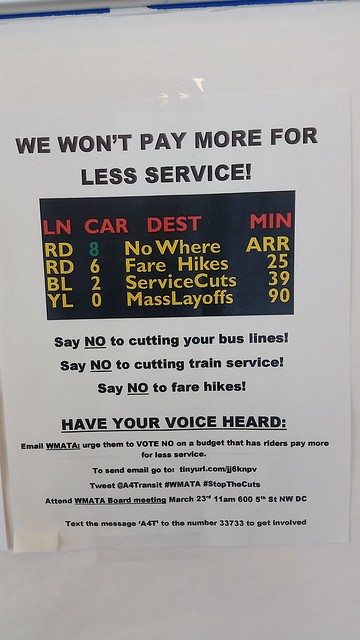
Flyer calling attention to Metrorail fare increases and service cuts posted at the Trips information center at the Silver Spring Transit Center... and shockingly, once I saw something similar at the Silver Spring Transit Center, probably posted by a transit employee?

Labels: , , ,

Thursday, February 21, 2019

An illustration that it is possible to integrate public service advertising into digital transit ad programs.

In "PL #5: Creating a Silver Spring "Sustainable Mobility District" | Part 3: Program items 10-18" I wrote:

10.  Create a digital community and transit information network for Silver Spring, employing kiosks and mobile applications.  For at least 15 years, I've been thinking about how to create and deliver a city- (county-) wide digital nonprofit and cultural communications feed, with sub-feeds for neighborhoods/districts.

Now, with real-time transit information feeds like TransitScreen, you can use them as the engine but add other feeds to the engine.  That's how the digital information kiosks work (called CityPost, produced by Smart City Media) alongside the Kansas City Streetcar.

From the Digital Signage Today article "Meridian deploys outdoor interactive kiosks in Kansas City" :
The interactive kiosks, located at Kansas City Streetcar platforms and throughout downtown, enable travelers to check the arrival time of the next streetcar, offer Kansas City locals and tourists access to city services, and display information about local restaurants, activities and events...

Kiosk users can sync their smartphones to the kiosk with a mobile app to save and share information. For example, Kansas City Streetcar travelers might see an ad for dinner at a local restaurant. They are then able to pull that information onto their mobile device to access again at their convenience.
There is also the LinkNYC program, delivered by Civiq Smartscapes, but these systems tend to be more focused on delivering advertising rather than useful community-specific information.  I have similar concerns about a program done separately by the New York MTA transit agencies.

The feed would be multi-stream instead of a single advertising feed or a single transit information feed. 

Take (1) the digital ad feed presented in bus shelters and transit stations; (2) add transit and mobility information like the TransitScreen application; and (3) create and deliver a separate "community information feed" promoting  nonprofit and public sector organization, events, public meeting notices, etc.  (Note that Outfront Media is doing (1) and (2) on screens in Metrorail stations.)

There is great need for systematically delivering community information in public and visible ways in many places, because community media outlets are going out of business because of how the Internet has changed the business of media and advertising.

In fact, Montgomery County does a form of delivering community information digitally at the Silver Spring Civic Center, where they have two digital screens side-by-side behind the information desk.  One presents the TransitScreen info, and the other cycles through "ads" for Montgomery County Government agencies and services, and community events.   

The idea is to create content in a way that works at two scales: (1) a city or county; and (2) at the sub-city/county scale, by neighborhood/ transit district.

The stream would be device independent, so that it could be displayed on screens and kiosks as well as received on a digital feed.  Besides delivering this digital network in kiosks at transit stations and key "crossroads," in bus shelters, and civic buildings and sites, ideally, places like coffee shops, office and apartment buildings, etc., would put up screens and "subscribe" to the feed as a service to their customers/tenants--many do this with transit information already.

As another example, recently I came across the Pitt Smart Living Project, but it seems to focus only on delivering area-specific transit information.

-- Pitt Smart Living Project TransitScreen for Sennott Square

To create and deliver the community ads and event content, I'd set up an "advertising and design curriculum" as part of the School of Art and Design at Montgomery College, perhaps with the involvement of the journalism program of Montgomery-Blair High School, which very actively markets its Silver Chips student newspaper to the community beyond the school. 

A way to extend the community and educational value of the program would be to create an equivalent of the teen graphic design program of Boston's Artists for HumanityArts on the Block, based in Kensington, could participate too.    The firm handling advertising in Montgomery County's bus shelters would be another partner.

Currently the MC Media Arts & Technology program is located at the Rockville campus, but in keeping with the presence of Discovery Channel in Silver Spring, perhaps this academic program could shift to the Silver Spring campus.

-- Smart City Media video showing the program in Kansas City

An issue is whether or not to include "for profit" ads.  I would in part to defray costs, but outside of bus shelters, perhaps ads should be limited to businesses based in Silver Spring, potentially the Silver Spring retail trade area (which includes parts of DC and arguably, part of Prince George's County), and Montgomery County outside of Silver Spring.


========
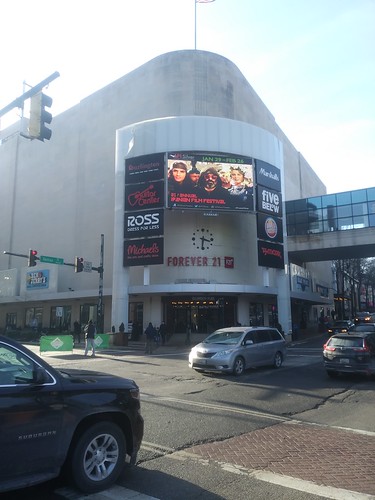
Note that this section above failed to acknowledge that the large digital advertising screen at the intersection of Fenton and Ellsworth Avenue features ads for community events.
Digital advertising screen, at intersection of Fenton and Ellsworth Avenues, Silver Spring, Maryland

When I was talking about this last summer with Ivan Bennett, former chief product design manager for Transport for London's bus system, he said that it is difficult to mix for profit and nonprofit ad programs.

(And that most good ideas have been figured out already, it's just funding that's the hindrance.)

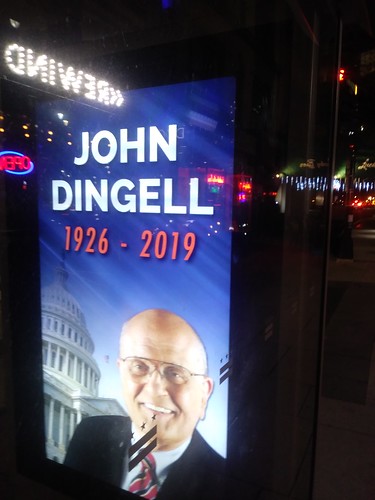
But then I saw this "ad" in a bus shelter on Connecticut Avenue NW last week.  John Dingell was a Congressman for Michigan who served many decades and he died a couple weeks ago.
John Dingell appreciation ad on his death, bus shelter, Connecticut Avenue NW, Washington, DC

Labels: , , ,