Rebuilding Place in the Urban Space

"A community’s physical form, rather than its land uses, is its most intrinsic and enduring characteristic." [Katz, EPA] This blog focuses on place and placemaking and all that makes it work--historic preservation, urban design, transportation, asset-based community development, arts & cultural development, commercial district revitalization, tourism & destination development, and quality of life advocacy--along with doses of civic engagement and good governance watchdogging.

Thursday, March 19, 2026

Suburban ethnic enclaves

All that's left of DC's Chinatown is this ceremonial gate, a couple restaurants and stores, a nonprofit or two, and a public housing development for Asians with fewer than 300 residents.

Last year I wrote a piece, "Sometimes you've got to recognize reality and let things go: the diminishment of DC's "Chinatown" as an authentic place," saying DC should accept that demographic trends means that the city's "Chinatown," is no more.  

What happened is that over the decades succeeding generations moved to the suburbs, and today new immigrants move to the suburbs directly without first stopping to live in the city.

The decline of ethnic enclaves in cities is widely recognized: few Little Italy's, or Germantowns, or Polish or Irish-dense neighborhoods (there's apparently a great Polish buffet in Chicago, "Just in time for Casimir Pulaski Day: The Red Apple Buffet, filling stretchy pants since 1989," Chicago Tribune), Welsh, etc.

Today, cities, at least those with lagging real estate markets, do see new immigrant enclaves form around Portuguese (Massachusetts), Somali (Minneapolis-St. Paul), and Latino cultures.

One of the things that keeps an enclave going is people continuing to speak their native language.

This isn't entirely new.  Dearborn, not Detroit, is home to an Arab-American majority, the largest outside of the Mideast ("Dearborn, Michigan: A visit to the first Arab-majority city in the US," BBC).

The city of Mississauga, Ontario, has imposed steep fines on the companies that own the plaza for failing to stop gatherings with fireworks and loud music. Nearby residents also complain about heavy traffic.Credit...Ian Willms for The New York Times

Toronto.  The reason I write this is the New York Times has an article ("The suburb that won't sleep") about the Ridgedale community and how a major shopping center there is a focal point for people from the Mideast and near parts of Asia--speaking Arabic and other languages, legacy populations find this unnerving.

A graduate planner who wrote her thesis on the community has an op-ed in the Toronto Star ("This Mississauga plaza has been called ‘chaotic’ and a ‘nuisance.’ Its critics are missing what makes it great").  She makes the point that cities ought to want these kinds of thriving business communities.

A comment on her LinkedIn calls attention to Dragon Centre in Scarborough, now I think it's demolished but over time it became the area's first Chinese-centric mall of significant size and heft.

Note that because of the development of such shopping centers as hubs, there is a planning effort aimed at helping them to strengthen their community hub characteristics ("s").

DC area.  It's seen as an anomaly, but thriving retail districts in these places happen because of immigrant-related commerce.  Decades ago, Washington Post food writer Tim Carman reported on ethnic food finds in obscure shopping centers in the suburbs.  

Later I wrote a couple entries about how buildings are envelopes, that even dull strip shopping centers can have thriving businesses (in fact, a few weeks ago I ate at the only decent Ethiopian restaurant in Salt Lake, located in such a place.

-- "Millennials and suburban hipness and Montgomery County, Maryland," 2013
-- "More thoughts on suburban hipness (it's really about commercial hipness generally, not urban vs. suburban)," 2013

In the DC area, Latinos are especially concentrated in Takoma Langley Crossroads and Wheaton, Asians in Annandale (after a couple stops in Clarendon and Bailey's Crossroads)

Eden Center functions similarly to Ridgeway Plaza, while Ethiopians and Eritreans are more dispersed across DC's suburbs, although Ethiopians first "landed" in DC proper.  

The city still has a number of decent Ethiopian restaurants, even for breakfast.

-- "A New Chapter for the Eden Center?," Arlington Magazine
-- "At the Eden Center, historic businesses stand tall and new ones plant roots, ARLNow
-- "New Tools for Keeping Immigrant-Owned Shops in Place," (University of) Maryland Today

Assemblymember Ash Kalra (D-San José) of the 25th Assembly District, left, and Assemblymember Tri Ta (R-Westminster) of the 70th State Assembly District unveil the Little Saigon Freeway sign at a section of the 405 Freeway Friday, April 18, 2025. (James Carbone)

Orange County, California is home to a large Vietnamese community, strong enough to have had Vietnamese elected to Congress ("CSUF Economists Analyze Little Saigon, Largest Vietnamese Community Outside of Southeast Asia," "Here's a look at the history of Little Saigon," "CSUF report on Little Saigon inspires revitalization and growth," Orange County Register).  From the article:

Orange County’s Little Saigon comprises parts of Westminster, Garden Grove, Santa Ana and Fountain Valley and is the largest Vietnamese community in the United States. Cal State Fullerton’s 2024 profile highlighted data about businesses, employment, education, rents and mortgages, among many other factors that characterize life for the multigenerational residents of Little Saigon.

Data presented in the report was intended to help guide decision-making by community leaders. “It offers cities, small businesses, nonprofits, educators, chambers of commerce and investors credible information to support thoughtful economic development decisions,” Nguyen said.

... Ever since refugee families began arriving in Orange County from Vietnam in 1975 in the first of several waves, Little Saigon has grown organically. The CSUF report now offers a guide for strategic growth for the future of its many communities.

Conclusion.  The paper, "The politics of Chinatown development in American cities" (Journal of Ethnic and Migration Studies) discusses the real estate development dynamics faced by Chinatowns in a set of US cities, creating a set of types, based on the Growth Machine thesis.

I realize the dynamics of ethnic district shrinkage are likely the same for other types of "districts" in cities be they ground-up developed arts districts that lose out to real estate development, working ports that are replaced by waterfront entertainment districts, New York City's garment district, etc.

It would be interesting to develop a similar framework for suburban ethnic enclaves in terms of their development, growth, continued growth, or decline.

Labels: , , , , , ,

Wednesday, January 07, 2026

Holy f***: Trump policy kills a woman in Minneapolis

Photo: Mathieu Louis-Rolland, Getty Images.

Protestors in Portland have been making fun of the extreme statements about Portland being out of control by wearing costumes at protests ("Portland’s Theater-of-the-Absurd Protests Reflect the Ridiculousness of Trump’s Lies," The Nation).

There's been a lot written about Trump using the National Guard as a tool to terrorize "Democrat cities" ("Trump’s use of National Guard troops on American streets is bad enough. This could be worse," Rhode Island Current), like Portland, Los Angeles, and Chicago.  

Ostensibly, the troops have been sent to cities “overrun” with crime. Yet data shows that has not been the case. Troops have been sent to largely Democratic-run cities in Democratic-led states.

The case for political theater being the real reason behind the deployment certainly was strengthened when largely Republican Mississippi sent troops to Washington D.C., even though crime in Mississippi cities like Jackson is higher than in D.C. Additionally, there is an even more dangerous purpose to the troop presence — that of normalizing the idea of troops on the streets, a key facet of authoritarian rule.

There are fundamental differences in training and mission between military troops and civilian law enforcement, with troop presence raising the potential for escalation and excessive force, and the erosion of both civil liberties and military readiness.

The Supreme Court recently ruled that the justification used by the Administration was flawed, and ordered them to stop ("Supreme Court rejects Trump’s effort to deploy National Guard in Illinois," SCOTus blog, "The Supreme Court has taken the National Guard away from Donald Trump," Economist).  Separately, as DC is subordinate to the federal government, NG troops are still in the city.

Of the many objections to the entry of federal law enforcement personnel into cities is their lack of training on urban policing, nor in de-escalation.  Armed troops are by definition escalatory.  It doesn't help that the Administration lies about what happens in their various engagements with protestors.

Another objection is that putting such forces in cities provides reputational risk to the military, because it's not what they are supposed to do.  In a way, although a bit different, it's not unlike how the British, during the Revolutionary War, forced residents to billet soldiers, at their own expense.  Here, it's a city being forced to take the brunt of the action by the military.

We know about the Administration's multi-faceted anti-immigrant program ("Protecting The American People Against Invasion" White House) with overtones of White Christian Nationalism ("The wrath of Stephen Miller," Atlantic), which has resulted in the imprisonment and/or deportation of many thousands of people.  It's not uncommon for US citizens to be swept up in the actions, and imprisoned ("We Found That More Than 170 U.S. Citizens Have Been Held by Immigration Agents. They’ve Been Kicked, Dragged and Detained for Days," ProPublica).

Immigration and Customs Enforcement personnel are able to operate in cities independent of the court judgements about the National Guard.

Chicago: A federal immigration enforcement agent points a crowd control weapon at a protester at East 105th Street and South Avenue N in the East Side on Oct. 14. Protesters gathered as U.S. Immigration and Customs Enforcement officers awaited the removal of their vehicle after it crashed during a pursuit.Anthony Vazquez/Sun-Times

And they are armed and aggressive.  Armed, not well trained Guardsman killed protestors at Kent State University in 1970 ("Kent State University marks 55th anniversary of May 4 shootings," Ideastream/NPR) but before that at the Historically Black College, Orangeburg State College in South Carolina, in 1968 where three students were killed ("Feb. 8, 1968: Orangeburg Massacre," Zinn Education Project).

One particularly egregious aggression was the raiding of an apartment building in Chicago ("“I Lost Everything”: Venezuelans Were Rounded Up in a Dramatic Midnight Raid but Never Charged With a Crime," ProPublica, "Stories from the federal siege of Chicago," Chicago Sun-Times).

Community members pray at the scene where a federal agent shot and killed Renee Nicole Good, 37, of the Twin Cities earlier on Portland Avenue in Minneapolis on Wednesday, Jan. 7. (Alex Kormann/The Minnesota Star Tribune)

That's escalated.  Today, we have the killing of an American citizen in Minneapolis ("Eyewitness describes ICE shooting that killed woman in Minneapolis," NBC).

With the director of ICE as part of the operation!

The Boston Globe has a video link of the engagement, and there is no question the ICE agent murdered the driver, a 37 year old woman.  ICE agents too, aren't well trained, for urban incursions.  This is the result.

U.S. Border Patrol Cmdr. Gregory Bovino joins federal agents at the scene of a shooting in Minneapolis on Wednesday, Jan. 7, 2026. (Ellen Schmidt/MinnPost via AP) Ellen Schmidt/AP

Ironically it's 5 years plus one day since the Trump-inspired violent protests at the US Capitol ("Jan. 6 insurrection," Washington Post).  The Administration just put up a webpage lying about what happened ("White House unveils Jan. 6 webpage saying Democrats ‘staged the real insurrection,’ criticizing Capitol Police," The Hill). 

One protestor, Ashlii Babbitt, was shot and killed by a member of the Capitol Police.  She's been made a martyr of the hard right, and under Trump, her family got a payout ("Trump administration to pay nearly $5M in wrongful death lawsuit of Jan. 6 rioter shot by police," Politico).  She was rioting.  Rioting isn't protected speech.  She was a criminal.  Trump also pardoned most of the people found guilty of rioting that day.

A bullet hole is seen in the windshield as law enforcement officers work at the scene of a shooting involving federal law enforcement agents, Wednesday, Jan. 7, 2026, in Minneapolis. Tom Baker/AP

Not the lady in Minneapolis, Renee Nicole Good, she's just dead.  Say her name... ("‘She was an amazing human being’: Mother identifies woman shot, killed by ICE agent," Minneapolis Star-Tribune).

The Administration is justifying the murder ("Live updates: Hundreds protest in Minneapolis after ICE officer kills woman," AP).  Calling the person driving away a "domestic terrorist" ("DHS Secretary Kristi Noem’s comments in wake of woman’s fatal shooting by ICE agent," MST).

“He’s been in situations like this before, and he certainly has been out there and followed his training today,” said Noem at the evening news conference in Minneapolis.

A federal agent sprays a protester with a chemical agent at the scene of a shooting in Minneapolis on Wednesday, Jan. 7, 2026. (Ellen Schmidt/MinnPost via AP) Ellen Schmidt/AP

Noem appeared to reference the same officer when she said that, back in June, he’d been rammed and dragged by an “anti-ICE” motorist.

Emergency medical technicians carry a person on a stretcher at the scene of a shooting in Minneapolis on Wednesday, Jan. 7, 2026. (Ellen Schmidt/MinnPost via AP) Ellen Schmidt/AP

The Republicans in Congress are supine in the face of the Administration's aggressions not just against the Constitution, but of the American People.

You would think this killing would be a moment comparable to when Senator Joe McCarthy's lies were challenged by Joseph Welch, the U.S. Army's chief counsel at one of McCarthy's many hearings about communists in government.  

He said: "Have you no sense of decency, sir, at long last? Have you left no sense of decency?"

That was the moment of McCarthy's downfall.  Were this to be a similar moment.

Sanctioned state violence.  The Trump Administration is one of the most violent in terms of how it deals with citizens and immigrants.  But this is not unique to the nation's history, with raids against "communists" in the 1870s and 1920s, anarchists (1910s), labor unions (1890s-1930), and the treatment of certain immigrant groups throughout history (Chinese, Mexicans, Jews).

But today it seems the US is taking its cues from Hungary and Russia, where the media is controlled and universities are subjugated, and countries like Chile under Pinochet, Saudi Arabia, Egypt, and Israel, China--Israel ("Watched, Tracked, and Targeted Life in Gaza under Israel’s all-encompassing surveillance regime," New York Magazine) and China are probably the most developed surveillance states in the world, more intricate than the Apartheid period of South Africa.  

Trump constantly threatens to stop elections and interfere with elections ("Trump’s Jokes About Canceling Midterm Elections Aren’t So Funny Anymore," Esquire), which is front and center in Erdoğan's regime in Turkey.

Plus there is the prosecution of Trump "opponents" such as James Comey (former director of the FBI) and Letitia Wilson (State Attorney General of New York).

Poland is an example that had degraded in terms of freedoms of citizens but is on a turnaround, with the election as president of Donald Tusk.  So it can be reversed.

It's incredible though that the US has reached this nadir.  I never thought that when I studied Latin America in political science courses in college, that the readings foreshadowed today's United States of America.

Labels: , , , , ,

Tuesday, August 19, 2025

Quote of the day from Boston Mayor Michelle Wu about immigration policies and the city

“The cities that live in your minds are totally foreign to the residents living in our cities, and we are picking up the pieces of your failures to deliver on your promises under the Trump administration.

From the Boston Globe article "Michelle Wu stands up for cities, not just for Boston":
Bondi’s saber-rattling takes place against the backdrop of Trump’s attempted military takeover of Washington, D.C., in the name of reducing crime. It’s a move he has already threatened to spread to other cities — notably, mostly cities run by Democrats of color.

Some see these maneuvers as an attempt to distract everyone from the Jeffrey Epstein scandal, and that may well be a consideration. But Trump’s dystopian view of American cities has long been a matter of record.

Labels: , , ,

Friday, July 18, 2025

Sometimes you've got to recognize reality and let things go: the diminishment of DC's "Chinatown" as an authentic place

 DC no longer has much of a "Chinatown," although there are some remnants, because as property prices increased and the central business district continued to grow and intensify, succeeding generations immigrated directly to the suburbs ("The End of the American Chinatown," Atlantic, 2019)  From "What makes a Chinatown Chinese?":

With traffic in no logic, streets that never seem to rest, and an earthy, old country-ish smell that greeted me on my arrival, I felt nothing but foreign in this town. All signs are in Chinese: advertisements, store windows, crates selling bok choy and other food items, newspapers, and street posters. I find myself part amused part clueless. 

San Francisco

My fascination with Chinatown began on my very first visit. As a starry-eyed tourist, I was left admiring the Chinese-style buildings and colorful elements adorning the bustling streets. I wondered what really made a Chinatown Chinese. What makes these ‘towns’ unique? Have they remained traditional as they were once? What led to the origin of Chinatowns across the globe in the first place? Below, I explore one such Chinatown in America.

For DC, that's the Annandale area of Fairfax County, which is also highly represented by other Asian ethnicities, in particular Vietnamese (which first moved to Clarendon in Arlington County post-fall of the South Vietnamese government, another example of emigrating directly to the suburbs) and Koreans.

This isn't an issue unique to DC -- "The politics of Chinatown development in American cities," Journal of Ethnic and Migration Studies

abstract:

Through a comparative case study of Chinatowns in Chicago, New York City, Oakland, and San Francisco, this paper argues that the variation in the trajectory of Chinatown development is contingent upon two major factors, namely, the internal cohesion of Chinatown elites (cohesive versus fragmented) and the political integration of the Chinese community into local politics (strong versus weak). Based on the two dimensions of internal cohesion and political integration, the paper creates a fourfold typology of Chinatown development: constrained development, shrinking neighbourhood, contested development, and comprehensive development. The typology provides an analytical framework to study the development of Chinatown and other ethnic communities beyond the cases.

-- "5 Chinatowns and the Communities Working to Preserve Them," National Trust for Historic Preservation 
-- Strategies for sustainable Chinatown, SF Planning
-- Revitalizing Chinatown Businesses: Challenges And Opportunities, Asian American Federation
-- "How to Save Chinatown: Preserving affordability and community service through ethnic retail," Berkeley Planning Journal
-- "Maintaining Authenticity in Ethnic Enclaves: Chinatown, Koreatown, and Thai Town, Los Angeles," masters thesis
-- "Chinatown: The Neoliberal Remaking of Culture in the Contemporary City," University of Chicago
-- "Rethinking the Growth Machine: How to Erase a Chinatown from the Urban Core," Urban Geography

-- "A New Chapter for the Eden Center?," Arlington Magazine
-- "At the Eden Center, historic businesses stand tall and new ones plant roots, ARLNow
-- "New Tools for Keeping Immigrant-Owned Shops in Place," (University of) Maryland Today

And wrt to government goals it becomes the tension between a thriving residential and commercial district and Asian identity ("Chinatown versus Chinese identity") versus an entertainment district.

Chinatown hasn't had "spectacular shopping" for decades. Gallery Place ad display, 2009.

But DC wants another try, according to the Washington Business Journal, "Tim Ma, Winston Lord tapped to lead next stage of Chinatown revitalization."  From the article:

Lord and Ma say they will act as a liaison between various legislative bodies and the community, connecting residents with programs and opportunities as well as leveraging their resources and connections with the District to mitigate challenges that community members are facing. 

The council, on first reading, also approved more than $8 million to fund construction of Gallery Square, a designated "high priority" project recommended by the task force, which aims to transform the space surrounding the Reynolds Center into a plaza that will host performances and markets. The council will consider the measure on second reading July 28.

But some residents and advocates aren’t convinced this plan will address the core challenges facing working-class Chinatown residents. Over the decades, the community has stood at a crossroads, balancing the increased foot traffic from large-scale developments with rising rent prices that have displaced small businesses and longtime residents.

This follows the creation of a "Chinatown Task Force" and aims to implement its findings.  It listed eight items as part of a presentation at an open house last year.

The Task Force’s focus areas include: 

  • Visioning: Develop a strategic vision for the future of the two city blocks that make up the Capital One Arena and Gallery Place, and reimagine the potential for amenities, activities, and new uses for this vibrant neighborhood. 
  • Activation: Identify temporary and permanent activation programs, including special events, to generate foot traffic and increase visitation to Gallery Place/Chinatown. The Task Force will identify and coordinate activities to enhance public safety, cleanliness, and public health resources in and around Gallery Place/Chinatown.
  • Investments and Incentives: Source, evaluate, and recommend investment tools to support stabilization of existing businesses, prioritize critical capital investments, and reposition real estate assets into new productive uses.
  • Community Engagement and Marketing: Promote community activations and provide updates about changes and planning for the future of Gallery Place/Chinatown.

I think it's a lost cause, not just because of the proximity of Capital One Arena, home to professional basketball and hockey, but because you can't have an ethnic district without ethnic residents and businesses (""Richard's Rules for Restaurant (Food) Based Revitalization, Salt Lake City and DC's Chinatown").  Even though the Task Force came up with a decent plan if you look at it in a vacuum separate from the reality on the ground.

-- 5 Goals for Chinatown, DC Planning

Chinatown only has a few hundred Asian residents, and has been shrinking ever since the construction of the original Convention Center in 1984.  The Task Force committee only had one Asian member, and all the co-chairs are Anglo or Black.

Are they going to provide incentives for Chinese people to live there?  From the 2013 blog entry, "Sometimes shouldn't you just call it a day: maintaining DC's Chinatown":
I think it's time to call it a day on Chinatown. For a long time, it's been Gallery Place. A handful of Chinese restaurants, a couple stores selling Asian knick-knacks, some lightpoles, and a senior housing building that looks the same as any other housing building constructed in the 1960s or 1970s doesn't make a place "Chinatown."

Compared to thriving Asian communities within other cities, such as Chinatown in Manhattan or the Chinatownization of Main Street Flushing (see "In Neighborhood That's Diverse, a Push for Signs" and "The Melting Pot on a High Boil in Flushing" from the New York Times), putting Chinese characters on signs for restaurants and other retail establishments just doesn't cut it.

Salt Lake City and Japantown.  Apparently there was a Japanese district on the edge of downtown, although it was pretty much eradicated a few decades ago with the construction of the Salt Palace Convention Center, where like Chinatown in DC, the core of the district was lost as 93 businesses closed and the population dispersed.

Down to a single block, two religious institutions--a Christian church and a Buddhist temple--remain.

As part of the creation of a "sports and entertainment district" around Delta Center arena, which now has both professional basketball and hockey after last year's relocation of the Phoenix Coyotes, there are plans for rebuilding this district ("At Nihon Matsuri festival, Salt Lake City Japantown leaders consider risks, merits of sports district," Salt Lake Tribune, "Cautious optimism for Salt Lake City Japantown’s future," Nichi Bei News).

From the SLT article:

And while project leaders say it will ultimately improve Japantown, local leaders who remember losing the culture hub to eminent domain and development in the 1960s are skeptical.

“I grew up here, and I remember as a child coming to Japantown and it was a cultural gathering place in those days,” said Floyd Mori, the festival founder and chair. “That was lost. It just went poof because all the commercial establishments were eliminated.”

I didn't know, being a recent transplant to the city, that movement for restoration predates the current Arena-related program  ("Revitalizing Japantown Street," University of Utah Alumni Magazine, Japantown Visioning Project).

I think it's headed for the same end as DC's Chinatown.  While one of the above-cited works includes a reference to Japantown in Los Angeles, the same dynamics pertain to other ethnic districts be they Japanese, Italian, Polish, German, Hispanic, Greek, Jewish districts, etc. 

If you lose the dynamism of the immigrant migration chain--first to the city then to the suburbs instead of direct to the suburbs, ethnic residents and businesses, and a strong demand for ethnically-related business activity rooted in serving the native population, there isn't enough economic, residential, and social activity to maintain the integrity of the district.

Dynamics of district failure can be extended beyond ethnic enclaves.  Thinking about the paper, "The politics of Chinatown development in American cities" (Journal of Ethnic and Migration Studies, I realize the dynamics of ethnic district shrinkage are likely the same for other types of "districts" in cities be they ground-up developed arts districts that lose out to real estate development, working ports that are replaced by waterfront entertainment districts, New York City's garment district, etc.

Deeper insights into the Growth Machine thesis ("The City as a Growth Machine: Toward a Political Economy of Place," American Journal of Sociology). I am thinking this dissertation is well worth a complete read, because its findings along with some of the key cited works, are very much extendable to the analysis of other types of development within cities, especially in terms of decision making.  Its findings might be a very good extension to Growth Machine Theory--the book Urban Fortunes is cited, although the author doesn't believe that the theory is particularly applicable to understanding the growth and decline of Chinatowns..

I argue the Urban Regime Theory of political science provides the explanation for "how" the Growth Machine works.  The findings of this dissertation could take that further.

=======


"Unrelated" is the value of immigration to the revitalization of cities facing out-migration and broken economies, e.g., the Somalis in Minneapolis-St. Paul, Portugese in various East Coast cities, etc.  Writer Doug Saunders captures this in the book Arrival City ("Arrival City: How the Largest Migration in History Is Reshaping Our World by Doug Saunders," Guardian).  Although Saunders focuses on much larger cities.

And the attack on immigrants by the Trump Administration. Which fails to acknowledge the importance of immigrants both to the national economy as well as to local economies, some extremely small, like Denison, Iowa.

-- "Immigrants as in-migration and city-town revitalization," 2024

Labels: , , , , , ,

Wednesday, April 16, 2025

Crisis in higher education from all sides, but especially from the Trump Administration

The right's hate of higher learning, seen as dominated by progressive politics, is meted out in a multi-pronged campaign under the Trump Administration ("Chris Matthews suggests Trump 'smart' to target Harvard and elite universities," Fox News).  From the AP story, "Trump restricts federal research funding, a lifeblood for colleges":

“It looks like much of the playbook is intimidation, more so than actual substantiated legal findings,” said Michael Pillera, director of educational equity issues at the Lawyers’ Committee for Civil Rights Under Law. “I think all of this is designed as an attempt to intimidate all universities, not just the institutions under investigation.”

1.  Universities with students supporting Palestinians over Israel are attacked for being anti-semitic.  This happened after Israel retaliated by attacking the Gaza Strip after Hamas terrorist attacks in October 2023, equating the two acts as equally heinous (which I agree with).  Lack of virulent support of Israel has been attacked, with minimal space accorded to the Palestinian position.


Students protesting against the war in Gaza, and passersby walking through Harvard Yard, are seen at an encampment at Harvard University in Cambridge, Mass., on April 25, 2024. (AP Photo/Ben Curtis, File)

2.  Which is used as an excuse to investigate Universities and cut off their federal funds. Columbia was told to give back $400 million because they claim the university is anti-semitic and they caved ("Columbia University caves to demands to restore $400m from Trump administration," Guardian). 


A protest calling on Harvard to fight back ("Amid crackdown on elite universities, Cambridge protesters urge Harvard not to concede to Trump demands," Globe).  Caption: Signs including "Hey Harvard Alums Say Grow A Spine!" and "Hands Off Free Speech" rise above a crowd at a Cambridge Common rally.Erin Clark/Globe Staff

Harvard was attacked too ("Why Harvard Decided to Fight Trump," New York Times) and hasn't capitulated ("Standing up to Trump was ‘a step on the road back for Harvard’," Boston Globe), so Trump retaliated further ("Trump administration freezes more than $2 billion in funding tied to Harvard," Globe), going as far as threatening the university's tax exempt status ("After Harvard rejects US demands, Trump adds new threat," Reuters).  

3.  Students espousing pro-Palestinian (or so called "anti-American") opinions are being denied visas and deported ("14 student visas revoked at UW, Seattle University, and Gonzaga," KUOW/NPR, "Trump administration revokes visas for over 25 students in the St. Louis area," St. Louis NPR, "Why are so many students in Mass. losing their visas? The answer lies in a little-known database," Boston Globe,"Nine people affiliated with MIT have had visas revoked, university president says," Globe) starting with Mahmoud Khalil, a student at Columbia University ("US judge rules Mahmoud Khalil can be deported for his views" and "The case against Mahmoud Khalil is meant to silence American dissentGuardian).  From the Globe:

At first it was just a handful of students with some connection to pro-Palestinian activity, then dozens more, many of whom had no link to the protest movement. Now the Trump administration has abruptly terminated the legal status of nearly 5,000 international students and scholars across the country, according to the American Immigration Lawyers Association, setting off waves of fear on campuses around the country.

4.  If it's not "anti-semitism" its DEI or diversity, equity and inclusion initiatives.  Universities and other institutions ("The protectors of Santa Monica Bay are caving to Trump’s dangerous demands," Los Angeles Times) have been told to drop it, or not be grant eligible ("More than 50 universities face federal investigations as part of Trump’s anti-DEI campaign," AP).  Many universities have capitulated including the University of Michigan ("University of Michigan shutters its flagship diversity program," Guardian).  

Related is the plan to eliminate the cabinet agency the Department of Education ("Trump orders a plan to dismantle the Education Department while keeping some core functions," AP).

5.  Separately the Trump Administration is suspending, cutting or threatening to cut grants to universities more generally  ("Trump restricts federal research funding, a lifeblood for colleges," AP).  Northwestern has been told $750 million--almost all of the money they get from the government--is at risk.  

In the interim schools are cutting back programs ("Leading Harvard scientist ordered to halt research in funding freeze," Boston Globe), reducing graduate program enrollments, etc.  From the article:

After decades of partnership with the U.S. government, colleges are facing new doubts about the future of their federal funding. President Donald Trump’s administration has been using the funding spigot to seek compliance with his agenda, cutting off money to schools including Columbia University and the University of Pennsylvania. All the while, universities across the country are navigating cuts to grants for research institutions.

The squeeze on higher education underscores how much American colleges depend on the federal government — a provider of grants and contracts that have amounted to close to half the total revenue of some research universities, according to an Associated Press analysis.

It adds up to a crisis for universities, and a problem for the country as a whole, say school administrators and advocates for academic freedom. America’s scientific and medical research capabilities are tightly entwined with its universities as part of a compact that started after World War II to develop national expertise and knowledge.

Also see "These 77 Colleges Have the Most to Lose From Trump’s Cuts," Chronicle of Higher Education

To me, (1), (2), (3) and (4) are a violation of the first amendment ("Under Trump, freedom of speech in universities takes on a new meaning," NPR, "Harvard’s challenge to Trump administration could test limits of government power," AP).   Also see "A handful of college presidents emerge as leaders of burgeoning resistance movement against Trump," Globe.

(5) is devastating to research, and by extension the preeminence of US science, and long term economic development.  Some professors are decamping to other countries ("Yale professor who studies fascism fleeing US to work in Canada," Guardian), the same thing that happened with Britain after it left the EU and stopped participating in the Horizon research program.  If you can't get scientific grants they can't work.

Philadelphia Inquirer columnist Will Bunch puts it like this:

In less than three months, the new Trump regime has gutted spending on scientific research and the humanities, broadly claimed “antisemitism” as a rationale for imposing or threatening massive federal aid cuts to elite universities, and chilled academic freedom with U.S. Immigration and Customs Enforcement raids and canceling student visas for foreigners. This all seems part and parcel with the GOP’s Maoist Cultural Revolution plan for a glorious American future in which the knowledge industry is abandoned for an economy of workers with tiny screwdrivers assembling iPhones.

China is already rapidly gaining on the US in terms of the amount of research, funding, and patents ("‘I think it is actively happening’: Is Boston’s biotech industry doomed?," Boston Globe, "China overtakes the US in scientific research output," Guardian). 

Conclusion.  Since destruction of higher education is the goal, appeasement won't work, they'll always up the ante ("Appeasing Trump Is Not the Answer," Chronicle of Higher Education).  From the article:

These three strategies — to sow dissension, to terrorize the vulnerable, and to suppress disagreement — are meant to work in tandem, to reduce the possibility that Columbia, or any university like it, might serve as a counterweight to the authoritarian, illiberal mode of democracy that the Trump administration is working to bring about, drawing on a playbook developed by Viktor Orbán, Narendra Modi, and Recep Tayyip Erdoğan.

... the authoritarian playbook involves reneging even on provisional compromises to achieve its ultimate goal: eliminating any alternative centers of power. That is why it is no surprise that further funding has been pulled.

If we remain in the business of free inquiry, our activities will offend the government in power. Half-measures seem certain to damage our reputation irreparably without any guarantee of future security.

Also see the journal article "Enacting the “Illiberal Playbook” in Hungary and Poland," Perspective on Politics.

.College aged students aren't reading books.  ("Young people won’t, or can’t, read a book. Now democracy is dying. Coincidence?," Philadelphia Inquirer).

@rosehorowitch tells us about how high school and college education practices have shifted away from full-book reading, leading to a generation of students who lack the concentration to engage in deep reading for more than a few minutes; and @natmalkus talks about the alarming decline in literacy scores among students and adults, and how screens plus education policy shifts have fed a slow-burning crisis in literacy and deep attention

Fewer babies means fewer college students means many colleges will close, affecting the economic well being of many communities, and a shrinking of the knowledge economy ("The reason why dozens of Mass. colleges could close in the next decade," Boston Globe).  From the article:

But there is more at stake than the fates of colleges and universities. Massachusetts has disproportionately depended on its celebrated higher education sector to drive its economy. Education is the state’s third-largest industry, based on the most recent figures from the Executive Office of Labor and Workforce Development. It also fuels the first and second biggest sectors: health care and professional, scientific, and technical services. As enrollment drops in the years to come, those industries are projected to face shortages of workers. There are expected to be 2,200 fewer graduates per year than are needed in life sciences, for instance, according to the Massachusetts Biotechnology Education Foundation.

... One of Massachusetts’ greatest strengths may be on the cusp of becoming a weakness. “There’s this symbiotic relationship between the universities and the knowledge economy in this state that it could be easy to take for granted and assume it would always be there,” says Mark Melnik, director of economic and public policy research at the Donahue Institute at UMass Amherst. “You don’t realize some of the vulnerabilities until they start presenting themselves.”

WRT the economic development impact, it's more about smaller, regional colleges: 

... The Harvards and MITs of the world “really don’t have much to worry about,” says Brendan Cantwell, a professor at Michigan State University who studies higher education economics. “But there are a ton of private colleges that are smaller and that have regional draw, that do not have big national markets, and that are really reliant on tuition. As the local market shrinks for those campuses, things are already difficult, and they will only become more difficult.”

Some states like Wisconsin and Pennsylvania have been consolidating and/or closing regional colleges for some time.

But not just local impact:

The economic impact goes beyond those college towns. It means fewer educated workers, in a state that disproportionately relies on them. “Our leading industries are here in large part because of the talented workforce,” says Edward Lambert Jr., executive director of the Massachusetts Business Alliance for Education. “One of the things that have kept them here is the talent pipeline.” If young people stop coming, and learning skills employers need, he says, “That affects not only the future pipeline, but present workers.”

Trump destroying a major US export, foreign students studying at US higher education institutions.  Higher education is/was one of the Countries biggest exports of services ("Trump is killing one of our strongest exports," Washington Post).

President Donald Trump says he wants to reduce our trade deficit. Yet he’s destroying one of our winningest exports: higher education. Colleges and universities are among America’s most competitive international exporters. In dollar terms, last year, the United States sold more educational services to the rest of the world than it sold in natural gas and coal combined.

Labels: , , , ,

Friday, February 02, 2024

Immigrants as in-migration and city-town revitalization

It's no secret that immigrant in-migration can be a great source of energy for community revitalization.  One example is Somalis in Minneapolis-St. Paul ("Somalis finding their place in Minnesota," CNN, 2017).  

Another, Cape Verdeans in Boston ("Uphams Corner, Boston: revitalization "without" gentrification," 2023).  In fact a recent No Passport Required with Marcus Samuelsson episode on PBS featured the Portuguese disaspora in Boston--people from different countries but connected by language. And great food.

Members of the Denison High School mariachi ensemble pose for a group photo prior to the start of the 2022 Fiesta Mariachi celebration.  Photo: Brian Houlgrave, Des Moines Register.

Denison, Iowa.  Only because it was in my newsfeed I came across a brilliant piece about Denison, Iowa in the Des Moines Register.  Written by Courtney Crowder who is assigned to do feature articles around the entire state.  She's great.

-- "A beloved rural Iowa diner closes. A family of Mexican immigrants reopens it--with a twist"

The article is about how the town attracts Hispanics working in two area meatpacking plants.  How the legacy white community and the new Hispanic community were not connected, but the legacy leadership realized, in the face of rural shrinkage that wouldn't work, and how the two communities are albeit probably too slowly, intertwining.  

Denison is growing in population, when most rural communities are not.

DMR photo.

The article centers around an old restaurant that was the hub of the community but closed during the pandemic, and how it is being revived by a small scale Latino entrepreneur in a fusion style way--meatloaf, American breakfast and unlimited coffee, complemented by new Latino dishes.

She first wrote about the town's fusion work in how the high school music teacher and band leader added a mariachi band to get more students involved in music ("This Iowa meatpacking town didn't always welcome immigrants. Then the high school started a mariachi band," DMR).

WSJ photo.

Topeka. The Wall Street Journal reports that Topeka is looking at immigrants as a valuable resource for economic revitalization in terms of a source of workers, entrepreneurialism, and neighborhood revitalization, "The American City With a Message for Migrants: We Want You."

Financial Times.  Simon Kuper has a column on this phenomenon, "The surprising success of multi-ethnic cities."  From the article:

London, New York and Paris deserve more credit for how well they are holding together. Every day in these multi-ethnic cities, people of Muslim, Christian and Jewish origin share streets, buses and classrooms.

The article doesn't say a lot, mostly contrasting Western cities to places of conflict.  But cities have always been the place for exchange, and the development of "cosmopolitanism" -- an openness to new ideas and innovation (see Jane Jacobs' The Economy of Cities), and the bringing together of people from different places.

Elijah Anderson wrote some time ago The Cosmopolitan Canopy: Race and Civility in Everyday Life, about this phenomenon, focused on daily life in Center City Philadelphia.

Anderson walks us through Center City Philadelphia, revealing and illustrating through his ethnographic fieldwork how city dwellers often interact across racial, ethnic, and social borders. People engage in a distinctive folk ethnography. Canopies operating in close proximity create a synergy that becomes a cosmopolitan zone. In the vibrant atmosphere of these public spaces, civility is the order of the day. However, incidents can arise that threaten and rend the canopy, including scenes of tension involving borders of race, class, sexual preference, and gender. But when they do—assisted by gloss—the resilience of the canopy most often prevails. In this space all kinds of city dwellers—from gentrifiers to the homeless, cabdrivers to doormen—manage to co-exist in the urban environment, gaining local knowledge as they do, which then helps reinforce and spread tolerance through contact and mutual understanding.

-- "Bridging Racial Divides In 'Cosmopolitan Canopies'," NPR interview of Elijah Anderson 

Photo: Migrants gather Monday near the US-Mexico border wall after crossing a razor wire fence as members of the Texas National Guard stand guard, as seen from Ciudad Juarez, Mexico. Jose Luis Gonzalez/Reuters ("‘This is not over,’ Texas says after Supreme Court lets Biden administration remove razor wire at US-Mexico border," CNN).

Immigration and the US Southern Border.  I have a blog post, with lots of appended comments, about how the US should deal with the border with Mexico and in the Caribbean, "A solution to the immigration crisis on the Southern border, but it's too politically fraught," based on a chapter of the book End of Policing.  Professor Alex Vitale suggests that rather than criminalizing immigration, the US should adopt polices more like the EU's Schengen Zone.  

Granted the Zone is only for free cross-border movement for citizens of EU countries, but it is a model for how the US could develop an Americas Zone, with registration, allowing people to move back and forth without necessarily having to live in the US permanently nor get a green card to be able to work.  

The Alliance for Progress was a 10-year plan proposed by President John F. Kennedy in 1961 to foster economic cooperation between North and South America, particularly aimed at countering the perceived communist threat from Cuba. The program was signed at an inter-American conference in Uruguay in August 1961.

The reality is that desperate circumstances in Central and South America will always make the US a desired destination.  

Building a wall or saying "we're full" ("America is 'full,' Lindsey Graham says," ) doesn't reflect reality.

Vitale also suggests implementing an EU like INTERREG program.  INTERREG invests in less well off EU countries to provide residents with more reasons to stay rather than to emigrate West.

The US has dissipated a lot of its soft power with South America, providing opportunities for other countries ("China's Growing Influence in Latin America," Council on Foreign Relations).  And it has a fraught relationship anyway.  Lots of past military intervention or support of it never helps.

This would change it up considerably.

-- VARIATIONS OF U.S. PUBLIC DIPLOMACY IN CENTRAL AMERICA’S NORTHERN TRIANGLE, thesis, US Navy Postgraduate School

One of the ideas I had is an "Americas Expo" which could be like the World Expo and EU Capital of Culture program mixed into one, moving around to the various countries.

San Antonio Texas attributes a lot of its repositioning to having held HemisFair 1968 ("In 1968, San Antonio's World's Fair Changed The City Forever," Texas Standard, "HemisFair '68 transformed the city," San Antonio Express-News, "After the Fair's Over: The “Redemption Story” of HemisFair Park," San Antonio Current).

Building ties rather than rejecting them is the way to go.

Labels: , , , , ,

Thursday, July 04, 2019

Even on Independence Day, it's hard to feel "patriotic" in 2019 Trump America


Staging featuring tanks for the President Trump "Salute to America" speech at the Lincoln Memorial for July 4th, 2019. Photo: Erik S. Lesser/European Press Agency.

The city is agog to some extent because of how President Trump has changed the traditional Fourth of July celebration in DC -- a parade and fireworks in the evening -- to include a speech at the Lincoln Memorial, with a VIP section, and the display of tanks and other military vehicles.

That's bad, sure.

But far worse is the demonization of just about anyone other than his hardcore base of supporters and the foreign dictators he likes to kow-tow to as "the other."

The treatment by the US of people crossing the border with Mexico seeking asylum is unconscionable ("Crammed into cells and forced to drink from the toilet – this is how the US treats migrants," Guardian).

It makes me feel sick. So challenging to my beliefs about what the United States stands for. Oppposite of the language on the plaque at the foot of the Statue of Liberty.

Asylum seekers aren't breaking a law and shouldn't be imprisoned.

It's a sad say when Uganda does a better job dealing with refugees than the United States ("We care for refugee children in Uganda. It's really not that hard to do it," Washington Post).

The photo of the father and daughter who drowned in the Rio Grande River, trying to cross in the U.S. is tragic.

People wouldn't be driven to such lengths if the US would just have a reasonable process for dealing with people seeking to leave Central and South America--areas and countries riven in part because of a negative history of US actions in those countries, along with the impacts of climate changes, the impact of US demand for drugs on governance and stability in those countries, etc.


The bodies of Salvadoran migrant Oscar Alberto Martínez Ramírez and his nearly 2-year-old daughter, Valeria, lie on the bank of the Rio Grande in Matamoros, Mexico, Monday after they drowned trying to cross the river to Brownsville, Texas. Martinez' wife, Tania, told Mexican authorities she watched her husband and child disappear in the strong current. | AP

Rather than focus on building a big wall, how about investing in those countries, both in social and political institutions as well as the economy, so that people are motivated to stay rather than to leave for either political or economic reasons.

The Guardian has an article, "Tree planting has 'mind-blowing' potential to tackle climate crisis," about how tree planting can be a significant and successful response to climate change.

One initiative could be a massive tree planting and broader environment program in Central and South America.

Etc.


From the standpoint of public diplomacy and "Brand America" Trump may complain about the trade deficit, but the "brand withdrawals" and destruction of brand value by the Trump Administration is immense and it will take a long time to be able to recover.

And the US will not be able to fully revive its reputation, as other countries, especially China, step into the breach as the US increasingly becomes hermetic and transactional in its approach to the world.

-- "Rebranding America," Boston Globe, 2005

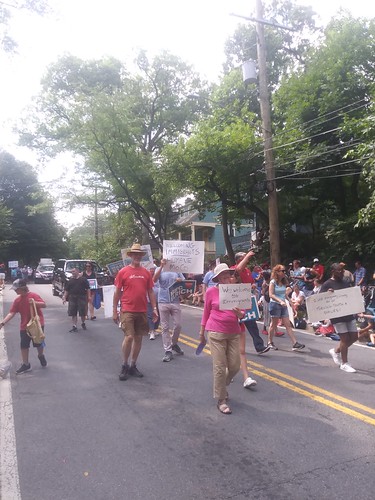
From today's parade in Takoma Park, Maryland. (Sorry that my phone camera isn't that great--it takes in too much light.)

This grouping followed Marc Elrich, the County Executive, who walked in the Parade--he wasn't driven--and he wasn't surrounded with a security detail.
Contingent for Marc Elrich, County Executive, Montgomery County, Takoma Park Maryland Independence Day (Fourth of July/July 4th) Parade, 2019

Contingent for Marc Elrich, County Executive, Montgomery County, Takoma Park Maryland Independence Day (Fourth of July/July 4th) Parade, 2019

Make America Gracious Again placard, Takoma Park Maryland Independence Day (Fourth of July/July 4th) Parade, 2019

Labels: , , , , ,

Wednesday, February 06, 2019

When you have to deal with on-the-ground reality vs. ideology: San Diego to hire "Immigrant Affairs Manager"

Judicial Watch is one of the many hard right organizations that's been developed over the past few years to push a conservative agenda.  One of its biggest issues has been to demonize the US Department of Justice and the FBI over the various investigations of Donald Trump, as a way to position "justice" as being overtly and directly political.

A lot of discussion about local governance uses a line that goes something like this:
"A pothole is neither Democratic nor Republican."
If you're a city in the border region along the US-Mexican border, you need to have a policy with regard to both Mexico and immigrants.

It's not an ideological exercise, but something you have to deal with every day.

For example, I've written about this in terms of how sewage water discharges from Tijuana impact beaches in San Diego County ("International entities that affect communities: embassies; sewage"), the pedestrian bridge connecting the US to the regional airport that is across the border in Mexico, or the need to improve transit connections between Tijuana and San Diego beyond the connection at San Ysidro.

JW in what they call their Corruption Watch blog, calls our attention to how San Diego, "run by a Republican mayor," is hiring an immigrant affairs manager ("Group Releases New Blueprint for Welcoming Immigrants and New Citizens to San Diego Region," SD City press release). Which is one of the recommendations from a report, Welcoming San Diego Strategic Plan on Immigrant & Refugee Integration, produced by a stakeholder group.

To me, that sounds pretty practical, given that San Diego County borders Mexico, the transit system goes to San Ysidro on the border, and that the city proper is about 20 miles from the border.

Although the report looks at immigration broader than merely between Mexico and the US. From the press release:
In 2016 San Diego County immigrant households contributed $7.5 billion in federal taxes, $2.1 billion in state and local taxes, and leveraged $16.3 billion in spending power. Immigrant entrepreneurs generated $1.4 billion in business income for the region. The top five countries of origin for immigrants in San Diego County are Mexico, Philippines, Vietnam, China and Iraq. ...

The long-term plan was created with input from hundreds of residents, dozens of organizations and businesses, and a cross-sector steering committee covering five topic areas: economic opportunity, education, inclusive access, civic engagement and safe communities. The committee studied strategic plans, immigrant affairs offices and best practices in peer cities across the nation.
"Foreign policy" is an area of interest for many cities. Besides the reality that certain big cities are part of a network of global cities, metropolitan areas are engaged in trade between the US and other countries, have ports, international airports, and often a big trade in international tourism.

Note too that many cities have "sister city" relationships with cities in other nations anyway, and often spend time and energy aiming to recruit foreign-based businesses.  Some cities even have foreign offices to do this.

Aaron Renn/Urbanophile often calls our attention to the Chicago Council on Global Affairs and the writings of Richard Longworth.

Cities are global.  E.g., Brookings Institution has the Global Cities Initiative.

Immigration is a source of urban revitalization energy.  Cities large and small have declined because of the outmigration of population usually spurred by sprawl, and either the decline or movement from the city of urban-based manufacturing.  One way to counter population decline is through the in-migration of immigrants.

-- "Immigration and America's Urban Revival," The American Prospect
-- Immigration and Metropolitan Revitalization in the United States (book)
-- Good Ideas from Successful Cities: Municipal Leadership on Immigrant Integration, Cities of Migration project, Canada
=====
1. When I was writing that series on European Union cities, I came across a great report that I can never seem to find now on Marseille's efforts at immigrant integration. They have big issues because of constant immigration from Northern Africa.

2. I was also thinking about the US and immigrant flows between the US, Mexico, Central America and South America when reading a long article in yesterday's Washington Post about the state of the European Union in the face of opposition to its goals by President Trump ("Europeans fear Trump may threaten not just the transatlantic bond but the state of their union").

When I was writing, I was super impressed to learn about the Interreg program of the EU, designed--although it doesn't always work--to improve the economic and social conditions of EU's eastern members in part as a way to reduce immigration to the more economically healthy western countries.

3.  Ever since my freshman year in college I've been interested in Latin America and it is so obvious that we need an initiative comparable to the EU to help to stabilize, socially and economically, the countries to our south.

If people had better economic, social and political conditions there, they would be less likely to want to emigrate--legally or illegally--to the US.

Similarly, imagine NAFTA if it also had been a kind of EU type project, providing for more exchange and opportunity and assistance beyond merely trade.

4.  And that the harder we make legal immigration, the more people are driven to immigrate "illegally." (cf. "Stephen Miller said he'd be happy if no refugee ever again set foot in US," The Hill).

Illegal immigration is partly a product of US intransigence.

5.  Ironically too, a large part of the Brexit issue along with distress within the EU over immigration and illegal immigration has a lot to do with the continuing fallout of the US invasion of Iraq in 2003 and the ever cascading destabilization that has occurred ever since.

Brexit and EU destabilization can be laid in part at the feet of President George W. Bush...

Labels: , , ,