Rebuilding Place in the Urban Space

"A community’s physical form, rather than its land uses, is its most intrinsic and enduring characteristic." [Katz, EPA] This blog focuses on place and placemaking and all that makes it work--historic preservation, urban design, transportation, asset-based community development, arts & cultural development, commercial district revitalization, tourism & destination development, and quality of life advocacy--along with doses of civic engagement and good governance watchdogging.

Wednesday, July 08, 2026

When governments sell land always put in clawback provisions

DC sold many school buildings in the 1980s and 1990s, mostly to nonprofit organizations.  The city's building inventory was large because segregation meant duplication of facilities.  Over time, many of these organizations sold the buildings off, to great profit.  But there was no provision in the sales contracts for the DC Public School System to get a portion of the increased sales price.

For example, Wormley School was sold to Georgetown University which eventually sold it to a developer for more than 5x what it paid ("University to Sell Wormley Property," Georgetown Hoya).

Although to be fair, partly they took advantage of new market conditions.  When the property sold first, DC was just about ready to take off in the c. 2000 change of consumer attitudes towards urban living which again favored cities.  

It makes sense then that the building is now condos but DC should have gained more from the transaction ("Apartment in Georgetown’s Wormley School Lists for $2.8 Million," Mansion Global).

Another building sold to the DC Teachers Credit Union, and they had offices there for awhile, has long since been converted to in-demand Capitol Hill condominiums.

Parkland, Florida is dealing with that now.  Decades ago they sold for $850,000 a piece of property to the county school system for an elementary school to be built in their community.  But the school was never built and the school system recently sold the same property for $14 million to the Broward Health hospital system ("Parkland seeks $850,000 refund from school district after land sale to Broward Health," Fort Lauderdale Sun-Sentinel).

Parkland wants their money back.  But they, like DC, didn't put provisions in the contract that the property should revert back to them if never used, or to be paid back the cost of the property if it were to be sold to a third party.

Traditionally, land bequests to governments and nonprofits most often include this provision of giving land with conditions that the property revert back to the original owners if the use changes.  

A D.C. streetcar passes the Douglas Memorial United Methodist Church near the H Street Corridor in Washington on March 7, 2018. (Evelyn Hockstein/For The Washington Post)

That's why the United Methodist Church on H Street NE in DC, formerly a "white" church, decided to integrate as the neighborhood changed.  They didn't see a future as a "white church" and wanted to sell the property but the conditions of the bequest made them change course ("This H Street church was a hub of the community in the 1960s, then came the riots. It never thrived again.," Washington Post).

Cy Pres Review.  I am not a lawyer, so take this with a grain of salt, but in some states, the State Attorney General's office is active in overseeing land sales and other dissolution acts involving nonprofits.  Such sales are supposed to be made with the continuation of the  property or monies still being used by nonprofits.

This is called Cy Pres Doctrine ("An Historical and Empirical Analysis of the Cy-Près Doctrine," University of Louisville School of Law Legal Studies Research Paper Series No. 2023-3) and the funds involved, Cy Pres Funds  In Pennsylvania this is in the news because of the closure of the University of the Arts.  A bunch of buildings were sold off by the bankruptcy court, not necessarily for non profit uses.  And a number of schools agreed to take their students.  

The Moore College of Art, the only independent private school of art in the city, argues it should get the bulk of the money, because it's closest organizationally to what UAS was institutionally ("Who should get the $63M endowment money of UArts? Depends on who you ask," WHYY/NPR, "University of the Arts’ $77 million endowment remains mired in court proceedings two years after the school closed," Philadelphia Inquirer) and New York AGs have been particularly active.

Among others, the AG was involved in the selling of Girard College and the move of the Barnes Institution ("Changing Donor-Imposed Restrictions: Cy Pres and Equitable Deviation," New York Community Trust) from Lower Merion Township to Philadelphia.  

Speculative ventures such as constructing this building without having tenants lined up put Cooper-Union at financial risk ("The Indicator: Cooper Union, I Love You but You’re Bringing Me Down," ArchDaily).

In New York State, a major case concerned Cooper-Union College, owner of the land under the Chrysler Building, the lease funds free tuition for the school, but the school wanted to start charging tuition because of financial exigency.  

They were allowed to do this, but with strict conditions ("A Second Chance for Cooper Union").

DC's AG hasn't been particularly proactive in these situations ("DC's Source Theater sold: cause for a cy pres review?").  I argued review should have occurred with the sale of the YWCA in Downtown and the Corcoran Gallery--its collection to the National Gallery, its building and art school to George Washington University ("When BTMFBA isn't enough: keeping civic assets public through cy pres review").

The YMCA at Rhode Island and 17th Street NW as another example.  I never got around to writing about a similar experience  with the YMCA in Dupont Circle. They sold their property to a developer and the recreation use at that site was abandoned.

YMCA said they didn't have experience with a facility serving both workers and residents and that they tried their best to increase membership but were unsuccessful ("Downtown YMCA to close amid rising competition from upscale gyms," Post; "Akridge to redevelop YMCA at 1711 Rhode Island as boutique office," Washington Business Journal).  From the Post:

The YMCA approved a deal to sell the hulking, 1970s concrete building to Akridge, a big local developer, for an undisclosed amount. At 100,000 square feet, it’s the YMCA’s biggest facility in the region, and the property, according to the D.C. Office of Tax and Revenue, has an assessed taxable value of $27.2 million. ...

The National Capital facility was never a typical one for the YMCA. The nonprofit organization traditionally serves neighborhoods, not business districts, and Reese-Hawkins said the money from the sale of the building will boost the organization’s community, after-school and summer programs throughout the region.

She hopes to eventually open another full-service YMCA in the city and is in talks with community leaders to assess the best fit. There are no gyms in the District east of the Anacostia River, and Reese-Hawkins said it is possible that one could land there.

The building that will replace the YMCA.

They never opened another full-service YMCA in DC.

The AG got involved in some cases but didn't meaningfully shape the outcome.  

For me, except DC City Government also lacks the imagination, Corcoran Galley should have been transferred to the city creating its first locally controlled arts museum--the other museums in the city are run by the federal government.  And the Corcoran School of Art and Design should have been merged into UDC ("Should community culture master plans include elements on higher education arts programs?").

With the sale of the YW and the YM the organizations argued that the money received would support their programs generally.  But the sale of these properties came at the expense of the availability of recreational resources made available to residents in the center city, and they had received membership fees and donations for years from patrons of these facilities, making the argument for there being a clear DC citizen interest.  

Both the YW and YM should have been "forced" to put some of that money towards the creation of a new city recreation facility serving those areas--if the city's Department of Parks and Recreation had a clue.  A proactive AG and some consultants could have shifted the dialog.

Parkland and cy pres?  With the Parkland case, I'd argue that the State AG could step in and do a cy pres review, and as part of a settlement, make the City of Parkland whole.

Labels: , , , , , ,

Tuesday, August 19, 2025

Quote of the day from Boston Mayor Michelle Wu about immigration policies and the city

“The cities that live in your minds are totally foreign to the residents living in our cities, and we are picking up the pieces of your failures to deliver on your promises under the Trump administration.

From the Boston Globe article "Michelle Wu stands up for cities, not just for Boston":
Bondi’s saber-rattling takes place against the backdrop of Trump’s attempted military takeover of Washington, D.C., in the name of reducing crime. It’s a move he has already threatened to spread to other cities — notably, mostly cities run by Democrats of color.

Some see these maneuvers as an attempt to distract everyone from the Jeffrey Epstein scandal, and that may well be a consideration. But Trump’s dystopian view of American cities has long been a matter of record.

Labels: , , ,

Wednesday, August 13, 2025

DC's Source Theater sold: cause for a cy pres review?

WBJ image.

In a follow up to the blog entry "Lack of a system breeds more of the same: Source Theater, Washington DC, up for sale 2006, 2024," from last December, the Washington Business Journal reports ("Source Theatre building on 14th Street NW sold to restaurateurs for $4.5M,") that the building has been sold to restauranteurs.  

The original asking price was more than $5 million, and CulturalDC, the owners of the property, although it had been acquired with funding from DC government, sold it to the restaurant group because they offered more money than the primary tenant, the Constellation Theatre Group.  From the Washington City Paper ("CulturalDC Sells Source Theatre to Restaurateurs):

“On multiple occasions, Constellation asked CulturalDC for a meeting to discuss a deal and share our funding sources, but they would not accept our invitations. Finally, in April 2025, Constellation sent our Best and Final Offer of $4.1 million. We know the email was received, yet CulturalDC chose not to respond and instead, allowed the offer to expire.”

For years, Source has served as the home base for several performing arts organizations, including Constellation and local opera company IN Series, as well as a site of CulturalDC’s own programming. The public listing for the building had an asking price of $5.8 million; it later dropped to $5 million, according to WBJ. But the price it ultimately sold for was $4.5 million—just $400,000 more than Constellation’s April offer.

President and CEO of Theatre Washington (and former City Paper publisher) Amy Austin expressed grief over the sale, writing via email: “I am sad that the Source Theatre has been sold to a restauranteur/developer and will no longer be available as a much-needed performance space for our ever evolving theatre community. The Source was a special place that holds a collective almost 50-year history of memories and experiences that touched countless audiences and artists.”

The city government evidently is too busy putting money into professional sports, $500+ million for basketball and hockey, and $1 billion for football, to address the matter of the Source Theater, which I believe was acquired with DC funds.  (The reality is that governments only have so much capacity for dealing with such matters, and the Source Theater likely fell through the cracks, because the city doesn't really have an arts and cultural agency in the sense of cities like Chicago, Boston, Philadelphia, etc.)

In "When BTMFBA isn't enough: keeping civic assets public through cy pres review" (2016), I argue that the State Attorney General should intervene in nonprofit real estate matters, when the property will lose its non profit use as a result of the sale, for a review if not recession of the sale.  Cy pres provides for independent review of decisions by nonprofit organizations.

The doctrine originated in the law of charitable trusts, but has been applied in the context of class action settlements in the United States. When the original objective of the settlor or the testator became impossible, impracticable, or illegal to perform, the cy-près doctrine allows the court to amend the terms of the charitable trust as closely as possible to the original intention of the testator or settlor to prevent the trust from failing. -- Wikipedia

While the State AGs in New York (Cooper Union College), Pennsylvania (Girard College, Art Museum) and DC (Corcoran Gallery of Art) have taken on such matters, the outcome isn't preordained, and they don't necessarily use the frame of review--keeping the facility open, for arts uses--that I would.

For example, the Pennsylvania AG didn't get involved in the sale of the assets of the University of the Arts, which shut down last year.  Through the sales, some of the properties maintained their cultural use, others will not ("Keeping Avenue of the Arts for the Arts,' Philadelphia Citizen).

Similarly, the DC AG did not push what I thought should happen ("Should community culture master plans include elements on higher education arts programs?" [2016]).

While CulturalDC may have financial problems of its own, hence the sale, I'd say its worthwhile in the public interest for the sale to be rescinded in favor of a purchase by Constellation.

Labels: , , , , , , , ,

Thursday, March 02, 2023

Goodwill of Greater Washington to build Arlington affordable housing as part of a first-of-its-kind redevelopment + the Flint YMCA

The Washington Business Journal reports that in Arlington County, Virginia, Goodwill is working with the Arlington Housing Corporation, a nonprofit, to redevelop a store site where they will have their store on the ground floor, with affordable housing above.  From the article:

Goodwill, a nonprofit that provides job training, education and other services to people with disabilities or who face other employment challenges, has owned the 1.4-acre parcel at 10 South Glebe Road since 1999. The property includes a 1950s-era, 26,000-square-foot building and parking lot, where the charity collects and resells donated items to help fund its operations. Goodwill now aims, in a joint venture with a Arlington-based nonprofit developer AHC Inc., to demolish and redevelop that site with a multistory housing complex, including something like 100 affordable units over a new store and donation center.

Nonprofits tend to not be particularly innovative so this is a big thing.  But I don't understand why nonprofits don't think of themselves as more intrepid, as "social enterprises" and become more oriented to this kind of activity.

Some nonprofits run social enterprises as a way to generate income for their program.  In fact, Goodwill, which works with the disabled, has done this for decades with their thrift stores.  In the early 2000s, some Goodwill stores repositioned around higher end thrift and fashion, by differentiating among the goods that were donated.

The Orange County Register reports ("Tiyya Foundation expands culinary program to help young immigrant mothers begin careers") on an immigrant support group, that runs a catering operation and a one star Michelin restaurant in Los Angeles to raise funds and employ people.

By contrast, a church in my greater neighborhood in Salt Lake is dissolving, and rather than sell their property so it can be redeveloped for affordable housing, they've sold it to a developer who will build market rate housing.

In "When BTMFBA isn't enough: keeping civic assets public through cy pres review" (2016), I've suggested that Attorney General offices need to pay more attention to nonprofits and how they deal with their real estate.  There is the tension between getting the most money and doing "good works."  But it seems to me that the Church missed the boat, compared to Goodwill in Arlington.

Basically, I guess I'm saying apply the "transformational projects action planning" lens to nonprofits when it comes to opportunities for better using real estate resources, and for seeding projects like social enterprises that can contribute to communities in extranormal ways.

=======

The Flint Michigan YMCA building is beyond its useful life and needs to be replaced.  They are doing a development ("Downtown Flint YMCA project gets $1.5M grant, $5.5M loan from state," Flint Journal) that will include:

a 2,400-square-foot medical rehabilitation facility, 50 apartments and more than 7,500 square feet of office space.
YMCA officials have said their new facility is expected to include a competitive lap pool, family splash pad, basketball court, exercise studios, a running/walking track, men, women’s and universal locker rooms.

Years ago the Boys and Girls Club on 14th Street NW in Washington DC suggested a similar kind of project, with housing above, as a way to generate revenue from the land to support their programs but it was opposed by the Ward 1 City Councilman. Apparently, a development did occur on the parking lot later, but the facility still there, seems to be closed.  And the development doesn't look like it's affordable housing.

Labels: , , , , ,

Wednesday, May 04, 2022

Revisiting Participatory "budgeting" and disposition of funds from legal settlements

In 2015 I wrote "Participatory "budgeting" and disposition of funds from legal settlements," because the DC Attorney General, Karl Racine, won some settlements, and he directed the proceeds to particular nonprofit organizations.

I found this troubling because (1) these are grants and (2) there was no "open and transparent public process" for making the grants.

Instead it was at the whim and interest of the Attorney General.

While it is likely he involved other people in the office in the process, citizens had no say. 

At the time, I suggested "participatory budgeting" processes could be used, where citizens set the agenda for how to use and direct such funds.

It happened again. (And has probably multiple other times as well.)

The Washington Post reports, "Trump organizations agree to pay $750,000 to settle lawsuit with D.C.," and that the funds will be directed to two nonprofit organizations.  From the article:

Racine’s office identified two D.C. nonprofit, youth-oriented organizations — Mikva Challenge DC and DC Action — that will each receive $375,000 via the settlement. 

Kimberly Perry, executive director of DC Action, said the 30-year-old child advocacy organization plans to use the funds to continue various initiatives for D.C. youths on education, health and economic security. ...

Mikva Challenge, which has been in the District since 2015 and part of a national organization, trains D.C. youths on civic leadership and democracy. It also provides summer jobs for school-age youths to work with D.C. political leaders such as the city council, attorney general’s office and the mayor’s office. On May 17, the organization will hold a mayoral debate regarding issues affecting D.C. youths.

They might be the best youth serving organizations in the city.  They might be the worst.  We don't know.  And we as citizens had no way to weigh in on the decision making process that led to the disbursement of these grants.

WRT the disbursement of legal settlements to "worthy organizations," the Attorney General's office should be required to have a strategic plan developed in a public process, setting consensus priorities for what to fund, and a process for organizations to apply for funds, and for the proposals to be evaluated, and funds awarded.

I know that Mr. Racine decided not to run for reelection ("D.C. Attorney General Karl Racine will not seek elective office in 2022," Post).  But still, this kind of grant making is a classic example of the potential for steering funds to supporters and incumbency.

Labels: , , , , , ,

Sunday, January 31, 2021

DC Attorney General's opinion on the appointment of the US Attorney for DC and DC's rising crime rate

In 2012, I wrote a blog entry about the then new master plan for the Seattle Police Department and what a step forward that was.  I still remember commenter charlie's reaction, that the master plan said very little about addressing crime or reducing the crime rate. 

==========

DC is an unusual jurisdiction for criminal prosecution.  Because it is still the federal district, not an independent state, the US Department of Justice is responsible for the trying of adult criminal cases which in normal circumstances would be tried by the local jurisdiction.

In short, in DC, the US Attorney handles both federal and local crimes.  The DC Attorney General handles the prosecution of juvenile crimes and civil matters more generally.

I favored the creation of an elected Attorney General position in DC as a route to developing the competence of the local office and as a justification for moving towards the devolution of local criminal prosecution to the local government.

-- "Executive Power vs. the will of the people and the DC Attorney General," 2015
-- "US Attorney General Barr's screwing up of the US Attorney's Office in DC as a justification for spinning off local prosecutions," 2020

But I haven't really seen that argument put forth, and something I never considered has happened--that the AG, at least under Karl Racine, seems to have used his office to help forward the election of DC Councilmembers--four of the thirteen worked for the AG before running for office.

The AG has an op-ed in the Washington Post, "President Biden’s choice for U.S. attorney should reflect D.C. values," about how President Biden should take into account the preference of DC citizens as expressed on various issues, when making the appointment for the position.

He mentions issues like hate crimes, and how federal prosecution of gun crimes ups the sentence, and this is counter to what "the people want."

But like how charlie skewered me about my love of the Seattle Police master plan in terms of its failures to address how it would reduce crime, all I could think about when reading this is that violent crime in DC is up, the use of guns in crime is up, shootings are up, and that the murder rate--while down significantly from the peak in the 1990s, when 479  people were murdered in 1991 ("D.C. Touts Lowest Homicide Rate in Nearly 50 Years," NBC4)--and then dropped steadily to a heralded low of 88 in 2012,  has more than doubled eight years later.  Last year's total was 198 murders ("Homicides in D.C. hit 16-year high; shootings also have spiked," Post).

How come AG Karl Racine didn't mention DC's rising crime rate as an issue of concern to local citizens, and its relevance to the choice of a US Attorney for the District of Columbia?

Labels: , , , , ,

Monday, July 20, 2020

US Attorney General Barr's screwing up of the US Attorney's Office in DC as a justification for spinning off local prosecutions

This building houses the US Attorney's Office for DC.

Because DC is a federal district, not a state, the US Attorney's Office, which in other federal prosecution districts (like the Southern District of New York) only handles federal criminal matters, handles local prosecutions of adults.

It's a great training ground for the Department of Justice, but at some level, the office can be disconnected from the local jurisdiction. By contrast, in most other cities the local prosecutor is publicly elected, and therefore, more connected to the issues and concerns of the voting population.

I have written a bunch of entries over the years, in support of creating a locally elected AG, and that office building the justification for the devolution of local prosecution authority to the local AG.

DC has a locally elected AG now, but there doesn't seem to be any traction wrt devolving local adult prosecutions to that office.

-- "Executive Power vs. the will of the people and the DC Attorney General," 2015
-- "Politico Magazine profile of DC AG Karl Racine | + some miscellaneous legal matters," 2019

More recently, the DC US Attorney's Office has been through a lot of turmoil because of Executive Branch interference in the prosecutions of Michael Flynn, Roger Stone, and Paul Manafort and the machinations concerning the appointment of a US Attorney to run the office.

The National Law Journal reports ("Inside the Disharmony at the DC Federal Prosecutor's Office") that there is a great deal of unrest within the office because of this ("A Loss to the Pursuit of Justice': Praise for Roger Stone Prosecutor Who Resigned").

Granted the disharmony is more about the prosecution of federal crimes, and the way the office positions are used to reward political functionaries, who at least under the current administration, tend to have zero experience or connection to DC.

So it's possible that this isn't affecting much the part of the office that does local prosecutions.

But it does provide further justification for splitting off and devolving local matters to the locally elected AG.

=====
The Federal AG should be popularly elected.  Separately, because "law belongs to the people, not the president" for a long time I've argued that the US Attorney General, who heads the Department of Justice, should be popularly elected, separate from the election of the President/Vice President.

The way that President Trump has used the law as a cudgel, and his pardon and suasion capacity to shape "justice" his way is yet another example of why to do this, although my argument about this predates Trump's election.

-- "Yet another example of why the US Attorney General should be popularly elected," 2020
-- "Ideally, the Federal Attorney General would be separately elected," 2017

I suppose knowing about how President Nixon misused the AG's power, and even President Kennedy appointing his brother, are other examples of why some disconnection of the criminal justice function from the President's power would be desirable.

Labels: , , , ,

Wednesday, February 12, 2020

Yet another example of why the US Attorney General should be popularly elected

For more than 10 years, from time to time I write a post recommending that the US Attorney General, head of the Department of Justice, be popularly elected, and that the Department of Justice and its constituent units should be an executive branch agency independent of the President, because "law, fairness, due process, and justice" belong to the people.

There are myriad examples in recent history of the need for an independent attorney general, to act in the breach, in the face of executive branch malfeasance and overreach.

A separation of the justice agency from the rest of the executive branch through popularly electing its head happens in a majority of states, and often at the local level too, with popularly elected "prosecutors" although at the local level, such officials are mostly focused on prosecuting criminals not creating a fair justice system.

Progressive local justice.  The tension between prosecution and justice is why there is a movement about to elect "progressive" local prosecutors, although this agenda is controversial wrt reducing charges, bail, etc. ("Progressives Are Winning DA Races But Face Pushback," Governing Magazine); "Criminal justice: Police, progressive prosecutors battle over reform," USA Today).  From the USA Today article:
Boston-based Suffolk County (Massachusetts) District Attorney Rachael Rollins, the first woman of color to hold a DA post in the state, acknowledges that pushing a reformist agenda “is an uphill slog, but we are deeply committed.”

Rollins, who calls herself “smart on crime,” says a hallmark of the progressive wave is relying “on numbers, not anecdotes.” She is busy hiring “technologists and data experts so we can document all this and show how these policies are making a difference.”
Executive branch/Presidential tampering.  The way that President Trump is tampering with justice, in pardoning people associated with his biddings who have been found guilty of crimes, in appointing a bagman as leader of the agency--William Barr, aiming the agency at investigating his opponents and perceived enemies, and now with the latest happenings in the Roger Stone case, asking the Department of Justice to go easy on him, in the face of previous recommendations by people running the case, is a perfect example of why this split should occur.

The Roger Stone debacle.  The Washington Post ("Trump attacks federal judge, prosecutors in Twitter tirade defending Roger Stone") and other media are reporting on the latest developments in the Roger Stone matter, which is the subject of a twitter thread by the President. From the article:
The timing of Tuesday’s online attack prompted many to accuse Trump, who has a long history mounting public crusades against judges and courts over unfavorable rulings, of attempting to intimidate Jackson and secure a more lenient sentence for Stone. ...

Trump’s fusillade of tweets came shortly after news broke that the Justice Department had overruled the sentencing recommendation for Stone submitted by federal prosecutors, an action that followed Trump blasting the recommendations as too harsh.
This action led the prosecutors handling the case to resign in protest ("Prosecutors quit amid escalating Justice Dept. fight over Roger Stone’s prison term").

Plenty of AGs are happy to tamper.  OTOH, there is no guarantee in this day and age that whoever ran for the office would not be as mendacious as William Barr ("What to do with an attorney general who disdains justice?," op-ed, Washington Post).

But Elliott Richardson, Ramsey Clark ... But definitely in the past, there have been great, honorable people who served as the US Attorney General.

Probably, were this change to be made, I'd also recommend shifting the role of Inspector General within the executive branch agencies too, having them report to the AG as well.

Labels: , , , , ,

Sunday, February 24, 2019

Politico Magazine profile of DC AG Karl Racine | + some miscellaneous legal matters

Written by local journalist Harry Jaffe, co-author of Dream City: Race, Power, and the Decline of Washington, D.C., an important work on DC during the first Barry Administration and a great unintentional discussion of Growth Machine politics, charlie calls our attention to this profile of DC's AG, "Meet the Man Curbing Trump’s Power Without Anyone Noticing."

Karl Racine at a press conference on the Emoluments Clause case.  Photo: Getty Images.

Obviously, I know about the emoluments case, where the DC AG is one of the lead plaintiffs in a case against President Trump concerning (in)direct payments from foreign governments via his property interests, something that is forbidden in the Constitution.

But the article also covers a bunch of items that I didn't know about, including how he has spurred the revitalization of the Democratic Attorneys General Association and the "nationalization" of electing Democratic AGs at the state level, something that the Republican Attorneys General Association had been doing for some time.

From the article:
But while the public has been mesmerized by Trump’s legal troubles, Racine has been quietly building out Democrats’ ability to check his administration at the state level. Without much notice, he’s quietly emerged as perhaps the single most important player in restoring Democratic clout in America’s legal system.

As D.C. attorney general, Racine is leading the ongoing emoluments suit against the president over foreign governments’ allegedly corrupt patronage of the Trump International Hotel in downtown Washington, along with Maryland AG Brian Frosh. As co-chair of DAGA, he has helped coordinate the legal and political strategies behind the lawsuits suing the Trump administration over issues including the separation of children and parents at the Mexican border, upholding the Affordable Care Act and protecting DACA recipients. And more substantial yet, Racine was the architect of one of the least-discussed but most far-reaching results of November’s elections: Democrats winning a majority of the nation’s attorney general positions—an electoral success with far-reaching implications for workers’ rights, immigration, civil rights, consumer protections and the ability to erect a judicial wall against the Trump administration.

And concerning locally-focused agenda items:
n the meantime, he’s managing 300 attorneys as the D.C. AG, focusing on work that is less publicized and more tangible in the lives of Washingtonians. His lawyers have forced landlords to repair substandard buildings, moved 1,723 children out of foster care, and gotten more than $10 million in relief to D.C. consumers. He’s also joined the leadership of the bipartisan National Association of Attorneys General, in line to be president in two years.

Racine says his heart is in reforming juvenile justice and creating pathways to keep kids out of the criminal justice system.
====
Building capacity and justification for local takeover of criminal prosecution?  My thing about the DC AG is the desire for the office to build the capacity to eventually be able to take over local criminal prosecution, which because of DC's status as a federal district, is the only place in the US where the Department of Justice handles this function, whereas in states, it's under the control of the state and localities.  In terms of prosecution, the DC AG handles cases involving children and youth.

-- "DC Attorney General election,"2014
-- "Another wrong judgement by the Washington Post: an elected Attorney General is a good idea and should be supported," 2010
-- "Another reason to support an elected Attorney General in DC," 2009
-- "More democracy as a solution for the need for an independent Attorney General," 2007

Reshaping local criminal prosecution Post-Ferguson and #BlackLivesMatter.  In the post-Ferguson environment there's been a backlash against the carceral state and the criminalization of poverty.  In some jurisdictions, such as Cook County, Illinois ("Prosecutors should create innovation offices to improve justice and public safety," ABA Journal), Philadelphia ("Larry Krasner's Campaign to End Mass Incarceration," New Yorker), new prosecuting attorneys have moved their offices in a different direction.

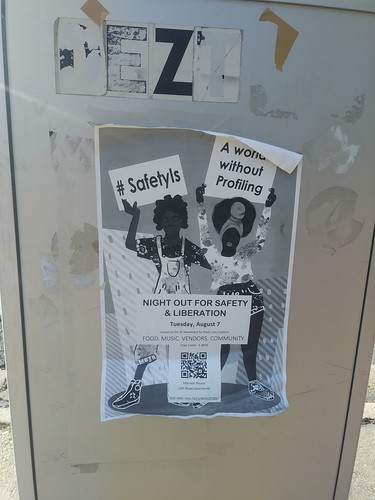
Flyer for "Night Out for Safety and Liberation"DC, #BlackLivesMatter, policing and prosecution.  In DC #BLM hasn't been particularly successful in pushing an anti-prosecution agenda although it's had some victories.

A couple weeks ago, DC announced it would be moving certain gun crimes to the Federal system, to get longer sentences ("U.S. to push D.C. gun cases into federal court as Washington struggles with a 40 percent murder spike," Washington Post).

While activists have complained about this recent move, I've always been struck by how prison sentences in bigger cities like Washington tend to be "more lenient" than those handed down in suburban jurisdictions.

For example, in a case where two DC residents robbed a store owner who had a store in DC but lived in Montgomery County, they committed the crime in MoCo which gave them multi-decade sentences, whereas for other violent crimes they had committed previously but in DC and Prince George's County they received shorter sentences ("2 sentenced to over 35 years in prison each for armed robbery, shooting at Montgomery County home," Fox 5 DC; "Two Men Sentenced for Silver Spring Robbery, Shooting," Bethesda Magazine).

National politics and the US Attorney General: shouldn't the US AG be popularly elected?  Plus, especially under the Trump Administration, because law "belongs to the people," I believe that the US Attorney General position should be popularly elected, with the DOJ as a separate Executive Branch agency.

Labels: , , , ,

Wednesday, July 26, 2017

Ideally, the Federal Attorney General would be separately elected

Changing the structure of the national government is almost impossible given the current conditions, but even in the best of circumstances it's very difficult.

When it comes to "society," we need to distinguish between "the people"/society and "government."  Government is created "by the people" so that we can be organized at the local-regional-state-national scale. 

I argue that law, since it is the way that relations are constructed and mediated between people within society, belongs to the people more than to the "government" ("Executive Power vs. the will of the people and the DC Attorney General," 2015)

It's why I argued that the DC Attorney General should be popularly elected although I am somewhat disappointed by the results thus far.

Elected AGs disconnect "ownership" and more importantly control of the law from the Executive Branch. 

As we can see from the Trump Administration, first in picking such a conservative as Jeff Sessions for Attorney General ("Jeff Sessions Confirmed as Attorney General, Capping Bitter Battle." New York Times), and now Trump's desire for the Justice Department to back off investigating Russian involvement in the 2016 Elections and culpability within the Trump campaign ("(President Trump and Jeff Sessions no longer on speaking terms," AOL), there is value to having "critical distance" between "the Justice Department" and the rest of the government, and this is in keeping with the concept that law, as a basic organizing instrument of society, belongs to the people first, and to elected officials second.

In short, I argue that the Attorney General of the US should be popularly elected, separately from the President.  And the Department of Justice should be under the AG.

Some years ago I mentioned this once at an event held by Ralph Nader, and he understood the value of the suggestion, even if the main speaker did not.

=====
I don't think Jeff Sessions ("Hearing Highlights: Sessions Questioned on Links to Xenophobia," NYT) could have been elected as Attorney General, given the various positions he holds on:

-- civil rights protections
-- voting restrictions
-- asset forfeiture
-- lengthening sentences regardless of case circumstances
-- private operation of prisons
etc.

It would be great for these kinds of matters to be discussed in the context of a campaign every four years.

To help increase voter turnout, I'd have this office be elected in the off-year cycle for national elections, not during the Presidential election cycle.

Labels: , , , , ,

Wednesday, July 06, 2016

When BTMFBA isn't enough: keeping civic assets public through cy pres review

Buying and holding buildings for arts uses.  In "BTMFBA: the best way to ward off artist or retail displacement is to buy the building" I discussed my incredulity at how the local arts community in DC doesn't seem to understand that if they don't want to be displaced, they have to own the properties they are using for artistic endeavor.

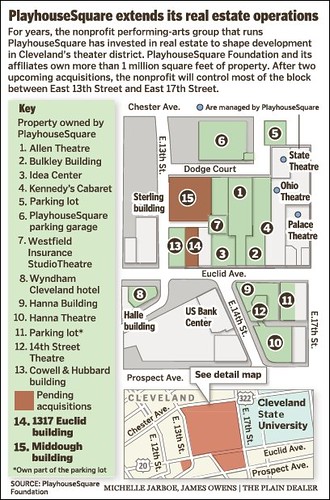
playhouse-square-real-estateThis isn't a new idea.

In Pittsburgh, the Pittsburgh Cultural Trust runs a number of downtown cultural establishments.

The Playhouse Square Foundation does the same thing in Cleveland, but also takes on a greater role in real estate development beyond arts uses.  I wrote about Cleveland here, "Real estate value capture and the arts."

At the neighborhood scale, the Gordon Square Arts District in Cleveland is another example.

But there are hundreds of such examples across the country.

Buying and holding retail spaces for retail uses, rented at below market rates.  Comparably, in Paris, the Vital'Quartier initiative charged the community development corporation SEMAEST to buy and hold real estate and rent it to desired retailers at sub-market prices.

According to Next Paris ("Opération Vital'Quartier: pour le commerce de proximité à Paris!") so far the initiative has supported 372 businesses and controls more than 500,000 s.f. of in-demand retail space.

What do you do when the arts organization sells the property to the highest bidder and the space is removed from the portfolio of civic assets supporting arts (or other public) uses?  There are many examples of arts uses being a component of an otherwise for profit development.   Usually these are generated by proffers by a developer in return for zoning bonuses and other allowances.  If they are negotiated well, the artist use is protected in perpetuity by an easement.

But a lot of times, at least in DC, such proffers are not protected by including easements or other protections to keep the space dedicated to arts uses.  Instead there is a belief that the organization "can be trusted" to do so.

A few years ago, in the case of The Source theatre, the city had to step in and stop the conversion of the sale of the building to a restaurant group ("Debt-Ridden Source Theatre Closes, Plans to Sell Building," Post).  But that was a rare direct action by the city, which had provided capital improvement funds to the theatre company.

Similarly, but with a much different outcome, the city through the Attorney General's Office, was a party to the dissolution of the Corcoran Gallery of Art through what is called a cy pres proceeding:
The doctrine originated in the law of charitable trusts, but has been applied in the context of class action settlements in the United States. When the original objective of the settlor or the testator became impossible, impracticable, or illegal to perform, the cy-près doctrine allows the court to amend the terms of the charitable trust as closely as possible to the original intention of the testator or settlor to prevent the trust from failing. -- Wikipedia
where they represented the public interest in nonprofit organization's operations.

But sadly, the Corcoran was allowed to shut down ("National Gallery of Art acquires 331 more works from the Corcoran," Post).  In "Should community culture master plans include elements on higher education arts programs?" I realized two years too late that the idea should have been "put out there" that the city should have taken over the Gallery and converted it into a locally-focused fine arts museum.

Mather Building, G Street NW, Washington, DC.

Another case of an arts group selling their space to the highest bidder is the Cultural Development Corporation, which had two floors of the Mather Building, located across the street from the Martin Luther King Library.

The building was converted to a condominium more than a decade ago ("D.C. sells long-vacant Mather Building" Washington Times; "Mather Building Renovation Set," Washington Post, 2001), and because it was in an arts overlay zone promoting arts uses downtown, some of the housing was sold to artists (live-work) at a discount, and space was provided--to Cultural Development Corporation--for arts uses.

A cy pres review should be initiated.  But Cultural Development Corporation sold their space ("CulturalDC Sells Flashpoint Gallery," Washington City Paper) and they claim this will benefit cultural activities in the city.  From the article:
CulturalDC, a prominent D.C. arts incubator, has sold its downtown office space and will search for new headquarters. CulturalDC will continue to operate Source, its theater space on 14th Street NW, and other programs around the District, but it will be shuttering Flashpoint, the longtime art gallery that shares its home at 916 G St. NW.

The organization put the second floor of its Gallery Place base up for sale last fall, according to interim executive director Tanya Hilton. Groups such as Fringe Festival, Washington Improv Theater, and Step Afrika! got their start in that second-floor incubator space. “Twelve years ago, it was a thriving haven for artists and nonprofits that had a need for administrative space,” Hilton says, but in recent years the space has since gone under-used.

While CulturalDC only intended to sell its second floor, Joe Reger, principal for JCR Companies, approached CulturalDC with an offer for both: the offices as well as the storefront gallery Flashpoint and the black box Mead Theatre Lab.

“We weren’t really expecting that,” Hilton says, who would not disclose the final sale figure. “The great news is that it gives CulturalDC the opportunity to really expand and move forward and have a bigger impact on the arts community, not only in the short term but in the long term.”
I believe that in such situations, it should be automatic that the Attorney General's office initiate a review of the transaction, and that it likely would be best for there to be an automatic "pre-sale" review of such transactions to determine whether or not they are in the public interest.

I would aver that the transaction should not go through, if keeping arts spaces downtown is a planning priority, and because the Cultural Development Corporation received control of these properties through extra-normal consideration and preference within land use planning processes.

Note that I recognize that an arts organization "incubator" or office space doesn't have to be Downtown.  But losing a gallery in a prominent location is an unrecoverable loss.

The YMCA at Rhode Island and 17th Street NW as another example.  I never got around to writing about a similar experience  with the YMCA in Dupont Circle. They sold their property to a developer and the recreation use at that site was abandoned.

YMCA said they didn't have experience with a facility serving both workers and residents and that they tried their best to increase membership but were unsuccessful ("Downtown YMCA to close amid rising competition from upscale gyms," Post; "Akridge to redevelop YMCA at 1711 Rhode Island as boutique office," Washington Business Journal).  From the Post:
The YMCA approved a deal to sell the hulking, 1970s concrete building to Akridge, a big local developer, for an undisclosed amount. At 100,000 square feet, it’s the YMCA’s biggest facility in the region, and the property, according to the D.C. Office of Tax and Revenue, has an assessed taxable value of $27.2 million. ...

The National Capital facility was never a typical one for the YMCA. The nonprofit organization traditionally serves neighborhoods, not business districts, and Reese-Hawkins said the money from the sale of the building will boost the organization’s community, after-school and summer programs throughout the region.

She hopes to eventually open another full-service YMCA in the city and is in talks with community leaders to assess the best fit. There are no gyms in the District east of the Anacostia River, and Reese-Hawkins said it is possible that one could land there.
The building that will replace the YMCA.

Hope is not enough.

DC activities should benefit disproportionately from the sale of the property, since it enjoyed property tax exemption benefits conferred by DC and it is likely that this facility was one of the highest value assets owned by the organization.

The public interest in the disposition of that property should be protected at the very least by an automatic cy pres review of the transaction.

For example, could a development there have been constructed in a manner that co-located other uses with the continuation of the recreational use?  Could the building have become jointly owned with the city's parks and recreation department? (Another reason why parks plans should include recommendations concerning other parks and recreation assets in a community not necessarily owned and operated by the local jurisdiction...)

Granted, DC has fewer options than other jurisdictions because of the height limit.  For example, a way that the YMCA could have generated money from the value of the property would have been to sell a form of "transferable development rights" to a developer to make a bigger property elsewhere. But for the most part that is a tool not available in DC because of the height limit.

Note that a cy pres review isn't a slam dunk.   In New York State ("A New Cooper Union," Student Activism), California, and Pennsylvania there are many examples of the State AG engaging in such matters and representing the public interest.

However, in DC, so far the AG's Office hasn't proved to be all that willing to buck real estate interests, which are the leading industry in the city, and these transactions generally benefit real estate development at the expense of the public interest.

-- "The Cy Pres Doctrine in the United States: From Extreme Reluctance to Affirmative Action," Frances Howell Rudko, Southern New England School of Law

But in terms of developing the capacity of the DC Attorney General's Office to one day take over criminal prosecution authority from the federal government, developing a proactive approach to oversight of nonprofit organizations in the city would be an important step ("Participatory "budgeting" and disposition of funds from legal settlements").

Labels: , , , , , , ,

Tuesday, June 23, 2015

Participatory "budgeting" and disposition of funds from legal settlements

Participatory budgeting is a method of allocating discretionary funds through a citizen involved and led process.

-- Participatory Budgeting Project

The initiative started in South America, and over the past few years elected officials in a number of cities, including New York City and Chicago, have used the method as a way to set priorities and allocate discretionary funds to projects in their Council Districts.

Boston has use PB initiatives as a way to increase youth involvement ("What Happened When the City of Boston Asked Teenagers for Help With the Budget," Next City).

Image from Californians for Justice.

More recently, the Mayor of San Jose, Sam Liccardo, who as Councilmember proposed using participatory budgeting methods as a way to better engage citizens in local government, proposes to use PB processes on a wider scale ("Budget input from community set for March," San Jose Mercury-News).

San Jose also uses a form of PB, called "Budget Games," as a way to make recommendations on the city's general budget ("San Jose residents play 4th annual Budget Games," Conteneo).

DC Attorney General directs settlement monies to past affiliations.  The Washington City Paper reports in "Nonprofits With Racine Ties Benefit in Chartwells Settlement," how some of the monies from a recent legal settlement with Chartwells over allegations of wrongdoing concerning the company's execution of its food service contract with DC Public Schools are being directed to charities with ties to Attorney General Karl Racine.  From the article:
Last week, Racine announced that his office had settled with Chartwells for $19.4 million over whistleblower claims that its food was regularly late or spoiled. The settlement inspired two councilmembers to call for investigations of Chartwells' continuing contract with DCPS. ... 
The settlement worked out well for five nonprofit groups that will receive a combined $5 million from Chartwells as part of the agreement. $500,000 of that money will go to Everybody Wins! DC, a literacy nonprofit whose board Racine served on until his election. Another $150,000 went to the Abramson Scholarship Foundation, which also once had Racine on its board.

Racine spokesman Robert Marus says OAG came up with the list of organizations that would receive Chartwells money. "They were groups he was familiar with," Marus says. Marus says there's nothing inappropriate about Racine approving a settlement that benefits organizations whose boards he once worked on. "There's no conflict here," Marus says.
Why not use Participatory Budgeting techniques instead?  Such funds shouldn't be allocated arbitrarily and capriciously according to the whims and past relationships of the Attorney General.

Even if such organizations do good work and there is no reason to believe that they do not, it would be best for settlement monies to be allocated in a public process towards projects defined as priorities in a public exercise that determines community consensus priorities. Participatory budgeting methods would be a perfect way to do this.

It would also extend the concept of democracy in the city, of which the creation of a separately elected AG position was a recent step forward.

Labels: , , , , , ,

Tuesday, April 07, 2015

Executive Power vs. the will of the people and the DC Attorney General

Unlike most other jurisdictions, DC doesn't have control over criminal prosecution of adults, a responsibility retained by the federal government as a vestige of federal control over the "District of Columbia."

While I didn't vote for Karl Racine, who won election to be DC's first popularly elected Attorney General, I have advocated for years that DC have an elected Attorney General, for a number of reasons.

-- Another reason to support an elected Attorney General in DC (2009)
-- DC Attorney General election (2014)

In the 2010 election voters approved a charter amendment to make the AG elected, to balance the sometimes conflicting responsibilities of representing the executive branch as well as the people, whose will is expressed through the creation and implementation of law.

The "people" voted in favor of an elected attorney general to provide a check on executive power, and to specifically have a representative of the people's interests vis a vis "the law" as it relates to the executive and legislative branches.

In addition, I like to believe the support was in part to create another element of the maturation of the city as a polity, in extending the structure of political organization to include an elected AG, which hopefully upon sound execution of the responsibilities of the office, could eventually lead to the federal government devolving responsibility for adult criminal prosecution to the local government.

At all levels of government, there are myriad examples of the need for an independent attorney general, to act in the breach, in the face of executive branch malfeasance and overreach,

In the meantime, to limit checks on the executive branch, Mayor Bowser proposes to create a separate executive branch legal structure ("D.C. mayor seeks to curtail power of new elected attorney general," Washington Post). From the article:
D.C. Mayor Muriel E. Bowser has proposed diluting the role of the city’s elected attorney general by consolidating power to review city laws, land deals and other legal business with attorneys on her staff, the attorney general said Friday.

The move calls into question whether the District’s first elected attorney general will be able to carry out the job envisioned in 2010, when 76 percent of D.C. voters chose to directly elect a chief attorney “responsible for upholding the public interest.”
Because the AG position was created by a charter amendment, the Mayor's proposed changes, which would change the responsibilities of the AG and the AG office, should be put to a vote of the people, as an additional amendment to the city's Home Rule Charter, and not addressed legislatively.

Labels: , , , , ,

Wednesday, April 01, 2015

Misguided proposal on how to fund DC's Office of the Attorney General

DC has recently created a separate, independent agency for the "State" Attorney General, comparable to how many other jurisdictions have an elected Attorney General, who while representing "the government" also represents "the people," thereby justifying a separate election process.

(Unlike other jurisdictions, criminal prosecution of felony offenses is under the control of the federal government, one of the many artifacts that have derived from the "District" of Columbia ultimately being under control of Congress, as the national capital is not a separate state.

That is a big area outside of the control of the DC Attorney General although my hope is that as the office develops, executes and builds maturity, Congress will cede control of criminal prosecution to the city.)

The first election for Attorney General was held last fall, and Karl Racine won, taking office in January.  Asking for an annual budget increase of $20 million, he argues ("DC's attorney general seeks bigger budget," Washington Post) that now that there is an independent AG office, funding should be increased to support the various areas that the office should address.

While I don't doubt that is the truth, he proposes rather than use general funds appropriated to the office, a budget increase could be funded out of the fines and judgement awards earned by the agency's activities.  Currently those monies go to the general fund.

Seeking funding through a percentage of fines and legal judgments creates the opportunity to misuse the legal process to generate funding, not unlike problems with police departments seizing assets of alleged criminals to fund activities.

DC's Metropolitan Police Department has been a fervent proponent of asset seizures, which sets a troubling precedent for other DC Government agencies.

-- Stop and Seize | Collections | The Washington Post, series on asset seizures by state and local police departments

I'd rather the agency be funded through normal appropriations processes.

Labels: , , , , , ,

Thursday, October 09, 2014

DC Attorney General election: why I won't be voting for Karl Racine...

A few years ago, citizens voted in a referenda to have an elected Attorney General.  It's a bit tricky because in other jurisdictions, the "Attorney General" (or Prosecutor) has responsibility for trying crimes.  In DC, those responsibilities rest within the US Attorney's Office, one of the many effects of DC being under the control of the federal government.

For that reason, DC's top legal officer has been an appointed official, focused more on meeting the legal needs of the government, particularly the Executive Branch.  Over the past few administrations, the office and position have been reorganized to be more like an AG office, and strife between the legislative branch and the executive branch over this office and "who it represents" led to the referendum.

While the referendum passed in 2010, opposition to the creation of the position by the Executive Branch and quiescence amongst the Council led to the City Council voting to delay the election for four years to 2018, because they said the ability to organize the functions of the office wasn't present.

Paul Zukerberg, a lawyer who has in the past run for City Council on a pro-legalization of marijuana platform, was key to getting the election up and running by taking the city to court, and winning.

Since then four others have joined the race:  Lorrie Masters; Karl Racine; Edward “Smitty” Smith; and Lateefah Williams.

The Post, which routinely editorialized against creating an elected Attorney General, as part of its general somewhat authoritarian agenda on local politics and governance (see the 2010 blog entry, "Another wrong judgement by the Washington Post: an elected Attorney General is a good idea and should be supported"), endorsed Karl Racine  ("Karl Racine for DC attorney general"), and I hate to say, that's probably the best reason to not vote for him.

It makes sense that the Post endorsed Racine, because as a letter writer to the paper pointed out, "In DC attorney general race, Karl Racine represents the influence of money."  Also see "DC’s Attorney General Jumps Into a Race He Didn’t Want: Did Irvin Nathan use a staff meeting to endorse Karl Racine?" from the Washingtonian.

Another is Racine's pandering in campaign literature.  In the last few days I got a couple different pieces of campaign literature from him with one focused on early childhood education and providing "wrap around" services for impoverished families.

While I do think childhood education must be focused upon in order to interdict multi-generational poverty, it's not the job of the Attorney General, and is mission creep of massive proportions.

Everybody values education.

I want an Attorney General to represent the people's interest in law, civil rights, etc.

They are connected.  But the AG position was never conceptualized as a primary element of the K-12 education infrastructure.

In any case, I'm inclined to vote for Zuckerberg because of his efforts to get the office back on the ballot, the way that the electorate intended.

Labels: , , , ,

Saturday, June 11, 2011

Local corruption and ethics

The Post has published a bunch of articles, columns, and editorials about corruption in DC and Prince George's County.

When they did their first go-around wrt PG County, I opined that they missed the point, that systems of corruption are engendered by how land use and development policy works there. That as long as the County Council and County Executive significantly insert themselves into the approval processes, there is a great deal of opportunity for corruption.

It's not any different in DC. While the Post is right to editorialize today, "City under a cloud: The District needs ethics reform; this bill isn't it," that the currently proposed legislation on ethics is inadequate, it's good to see them think a bit more systematically as expressed in the editorial. (Generally, I find that writers for daily newspapers are almost congenitally unable to think in terms of systems, which I ascribe to the fact that a newspaper is published every day and they keep focused on articles for the next day, and lack the "luxury" of thinking more long term.) From the article:

Instead of creating dubious layers of government where investigations can go to die, the council should strengthen the agencies — the office of campaign finance, the inspector general and the attorney general’s office — already in place. The office of attorney general, which already has an ethics officer, seems the appropriate place to vest more authority — particularly since it will become an elected office in 2014. It’s to the lasting shame of the council that, in a fit of pique with then-Attorney General Peter Nickles, it stripped the office of most of its subpoena powers. Another problem is the attorney general’s inability to bring criminal cases against those who commit offenses against the city.

Note though that the Post was against an elected attorney general position ("The case against an elected D.C. attorney general"). I was not. For exactly this reason, that we need to develop more positions in government that have strength, and that we build more checks and balances into the system.

(Note that the initial effort by CM Mendelson was to put more legislatively-passed provisions on the AG position. I, and others I presume, encouraged him to instead put forward legislation making the AG position independent of the Mayor, as a separately elected position. And that's what he did.)

In fact, now I think that the Inspector General position should be elected as well, so that the position is protected from undue influence of the Executive.

The problem with the Home Rule Charter is that it makes the Executive (the Mayor) all powerful, and that the City Council can pass laws, but exempt themselves from the requirements that pertain to the Executive Branch--DC Council can award contracts without RFPs--this was a problem with the proposal to redevelop the Florida Market (which is why I can never support Vincent Orange, who ringleaded that deal, or Harry Thomas, who kept that going after he replaced VO).

Since there is so much pressure within the local economy to jump in bed with developers (see "The City as a Growth Machine: Toward a Political Economy of Place" by Harvey Molotch), the point is to build robust systems that are resilient in promoting the right behavior.

One way is to change the City Council positions so that they are not "part time."

What I would like the various local statehood campaigns to do is to refocus, at least for awhile, on good government, and ridding our city of the corrupt practices that run rampant.

We can all contribute to this effort by starting with reading Corrupt Cities: A Practical Guide to Cure and Prevention and by exploring the Governance and Anti-Corruption website of the World Bank.
book cover, Corrupt Cities: A Practical Guide to Cure and Prevention by Robert Klitgaard, H. Lindsey Parris

Labels: , , , ,

Saturday, October 16, 2010

Another wrong judgement by the Washington Post: an elected Attorney General is a good idea and should be supported

I was pleased to see last year that Councilman Phil Mendelson put forward legislation to have the DC Attorney General (whose role is more circumscribed than the typical position elsewhere, as both local and federal criminal acts in the city are prosecuted by the Federal District Attorney's Office, which is the only instance nationally where this is the case) elected by the people, rather than serve as a position appointed by the Mayor.

From Wikipedia:
In the federal government of the United States, the Attorney General is a member of the Cabinet and as head of the Department of Justice is the top law enforcement officer and lawyer for the government. The attorney general may need to be distinguished from the Solicitor General, a high Justice Department official with the responsibility of representing the government before the Supreme Court. In cases of exceptional importance, however, the Attorney General may choose to represent the government himself or herself to the Supreme Court.
The individual U.S. states and territories, as well as the Federal capital of Washington, D.C. also have attorneys general with similar responsibilities. The majority of state attorneys general are chosen by popular election, as opposed to the U.S. Attorney General who is a presidential appointee.
If you read social psychology, there is a research thread on what is called boundary spanning, people whose place/position in life requires them to serve multiple constituencies simultaneously.

As Peter Nickles has proven, serving as Attorney General, it is very easy for the AG to serve the Executive Branch and politics, while underserving the simultaneous role of the Attorney General for representing and serving the people.

See "Bond between D.C. mayor and city's attorney general has grown stronger through the years" from the Post and "Vincent Gray Calls For AG Peter Nickles To Resign" from the Washington City Paper. A quote from Vincent Gray is in the City Paper article:

"'Two years ago, I voted to confirm Peter Nickles as Attorney General, with a belief and trust that he would put the interests of the people first, as required by D.C. law. There is no question about the fact that the Attorney General’s client is the District of Columbia, not the Mayor. That’s what the Office of the General Counsel to the Mayor is for. The Attorney General is supposed to be the people’s lawyer.
Unfortunately, it’s become increasingly clear that Peter Nickles not only sees himself as the Mayor’s lawyer, but also as the Mayor’s political hatchet man, and enabler of the Mayor’s cronyism. His politicization of the office is inappropriate at best, and illegal at worst. And by protecting the Mayor’s cronies, he has put the interest of the Mayor squarely ahead of the interest of his actual client. He has betrayed the public trust too many times to be an effective public advocate. Mayor Fenty should relieve him of his duties immediately.'"
But the Post, for the most part, has been advocating positions that limit and restrict democracy. I have argued before that the reason for this is that the Post has done investigative journalism for years about DC and Prince George's County transgressions and for the most part nothing happens. So they've become fed up and the editorial page promulgates positions that favor democratic authoritarianism.

Such is the case with today's editorial: "A referendum to reject : The case against an elected D.C. attorney general."

The argument is pretty specious, that the people running for office would have to raise a lot of money, and it would make them subject to special interests.

While this is in fact an issue, the reality is that for the most part Attorneys General in other "states" are more activist and involved in representing the people, taking up consumer fraud, the people's interest in nonprofit management of organizations, and other issues.

The AG position is one of the most prestigious in all of government, and it is likely that good people would vie for the job and would balance the sometimes conflicting roles of representing government and representing "the people."

-- National Association of Attorneys General

Once again, the Post is wrong.

Vote in favor of creating an elected Attorney General in the District of Columbia.
-------
Note that for a few years, I have also advocated that the U.S. Attorney General also be elected separately, rather than appointed by the President with confirmation by the Senate. Again, the Department of Justice ought to have two masters, the people, and the Executive Branch.

Labels: , , , , ,

Friday, December 28, 2007

Speaking of the need for an independent and active Attorney General

The Washington Business Journal reports, in "Boys & Girls Clubs to redevelop, sell valuable assets," about the deaccessioning and sale of real estate in DC, and a new focus on the suburbs for that organization.

Separately, I wrote in response to an email by Will Cobb, who is leading an effort for the neighborhood to take over the soon-to-be-sold "Eastern Branch" and continue the operation:

1. BGCGW is a tax exempt organization;
2. they state here that they are changing their business model and focusing on the suburbs;
3. and that they intend to sell DC-based assets (at a profit) to fund this;
4. without providing any return to any DC-based operations that would continue services as previously provided.

But their properties are tax exempt--meaning that for years, justifiably, the DC Government did not assess and collect property taxes on the Eastern Branch BGCGW property.

Earlier in the summer I wrote suggesting how this was an appropriate subject for eminent domain, which ironically, is something that Jack Evans picked up wrt the Georgetown (Jellef) branch. (See "Evans mulls eminent domain against Boys and Girls Club branch" from the Examiner.)

In other "states" the charities division of the Attorney General's office would likely step in as a representative of the people's interest, given the tax exemption and the fact that the organization is tax exempt. (E.g., how the State Attorney General in Pennsylvania has been involved in various matters concerning the Hershey Trust, Girard Trust, and the Barnes Foundation.)

From the report The Value of Between State Charity Regulators & Philanthropy:

... charities are created under state law and subject to state rules that have long defined the
basic fiduciary duties of the directors and officers managing them. In contrast to the uniform federal regulation of charities, state charity regulation varies widely from one jurisdiction to another. There is a degree of uniformity in the states’ substantive requirements, but little if any in the degree and effectiveness of their enforcement.


THE ROLE OF THE ATTORNEY GENERAL
State attorneys general are the chief legal officers of the states. They serve as legal counselors to state agencies and legislatures and as representatives of the public interest. Their powers, duties and responsibilities are defined and interpreted by state constitutions, legislatures and the courts.

The duty of the attorney general with respect to charities is to enforce the laws regulating charitable organizations and charitable solicitations, and to ensure the proper administration of funds dedicated to charitable purposes. In the absence of legislation, the legal remedies available to the attorney general to correct wrongdoing are as broad as the courts’ equity powers to grant them. The most typical remedies sought by regulators are restitution, imposition of fines, removal of directors and officers engaged in wrongdoing (and appointment of successors) and sometimes dissolution of the charity.

This clearly is a breach of trust and a breach of the intent of tax exemption, and an event that should trigger such an action.

There is nothing wrong with a charity selling property, and I imagine from the federal and local perspective, this would be considered a UBIT transaction and therefore subject to tax.

There is nothing wrong with a charity doing a public-private partnership (frankly, I think such should have been done with the BGCGW property on 14th St. NW in Columbia Heights).

But to sell and walk away with no concern for the trust and goodwill provided by the citizens of the District of Columbia over the years seems unconscionable and against the intent of the various provisions of Federal and DC Code on charitable activities.

(Similarly, the DC government invested millions of dollars over the years in the Children's Museum, only to see them now walk away to the National Harbor. Similarly, the DC Government should have/can still take a stronger position vis-a-vis this action and recapture.)

The District of Columbia Government needs to take a much stronger stand in relation to this proposed course of action by the BGCGW.

Labels: , , ,