Rebuilding Place in the Urban Space

"A community’s physical form, rather than its land uses, is its most intrinsic and enduring characteristic." [Katz, EPA] This blog focuses on place and placemaking and all that makes it work--historic preservation, urban design, transportation, asset-based community development, arts & cultural development, commercial district revitalization, tourism & destination development, and quality of life advocacy--along with doses of civic engagement and good governance watchdogging.

Monday, February 23, 2026

School boards as an element of democracy and strengthening citizen participation in local civic affairs

I love how Charlie Kirk said some murders were acceptable collateral damage from having a strong Second Amendment providing for gun ownership rights (the US has gone far beyond the reading of the original meaning of this amendment in expanding gun rights to individuals rather than to militias.

The same goes for democracy more generally, and citizen oversight.  Sometimes it's messy  and fractious.  Sometimes it leads to fraud and corruption.  The solution isn't to eliminate the oversight when it's problematic but to improve it.

For example, with DC's Advisory Neighborhood Councils, to reduce financial abuse, I argue all the bank accounts should be run through the city system, with checks beyond the existing ones when an ANC has an account at a local bank branch.

Calgary.

As importantly, in response to complaints about effectiveness of neighborhood councils, my response is to say we don't provide a training and technical assistance infrastructure for them--whereas cities like Seattle and Calgary ("Community association planning committees a hidden gem?," Calgary Herald, "New life for community associations," CREB) do, very effectively ("On the Role and Future of Calgary's Community Associations," University of Calgary).

In Calgary, community associations run recreation centers, not the city, such as the Thorncliffe-Northview Community Association with 800+ members and a recreation center with community functions.  "Calgary's 151 associations include approximately 1,800 board members, along with another 18,000 volunteers who run programs, said FCC."

-- "National Community Planning Month | Civic Involvement" (2025)
-- "Setting up DC's Advisory Neighborhood Commissions for success" (2022)

School boards.  The same goes for school boards.  Citizen oversight has been problematic for a long time.  This was true when NYC in the 1960s created community boards to provide input.  And with school boards in inner cities and suburbs both.

My solution, unlike what is suggested in Ontario, ""Getting rid of school board trustees is the right thing to do" (Toronto Star), is a training and technical assistance infrastructure with participation tied to salaries--often school board members get paid, at least in the US.

From the Star:

Perhaps they tried to persuade you that trustees embody true grassroots governance of our schools. More probably, you have no recollection of ever seeing or hearing from your local trustee, let alone voting for him or her. Possibly you have no clue what their name is after all these years — and all those elections. The reality of local democracy today is that turnout for most trustee elections is abysmally low — typically in the range of 10 to 30 per cent of eligible voters.

Yet our freshly empowered trustees gain a free hand to meddle in massive school board budgets. And then point fingers in ideological or tangential debates about what’s taught in classrooms across the province. Trustees weren’t always so disconnected.

More than 200 years ago, school trustees were Ontario’s first elected politicians, predating by decades the MPPs and MPs who later sat at Queen’s Park and on Parliament Hill. In a province dominated by one-room schoolhouses, they played a pioneering role as “trustees.”

All these years later, trustees are no longer the leading edge of democracy, they are a lagging indicator of dysfunction and distrust. Today, trustees have been overtaken in relevance and importance by senior levels of government — municipal, provincial and federal — on measures of accountability and also accounting.  ... To date, a record seven local school boards have been taken over by outside supervisors

I know there are professional associations for school boards, plus conferences (often citizens criticize attending such meetings as a waste of money) and they do get technical assistance and training, but obviously there needs to be more and better and accountability about it. 

From the Education Week story "School Boards Are Struggling. Could a New Research Effort Help?":

... Jonathan E. Collins, an assistant professor of political science and education at Teachers College, Columbia University. Education research focuses more heavily on the work of teachers and administrators, and there’s a dearth of national data on how school boards form, how they function, and how their stewardship affects student learning.

Collins founded a new research lab this month to help provide solutions and paint a clearer picture of how the most local of local governing bodies operate. The School Board and Youth Engagement Lab, or S-BYE, plans to assemble a national data set on factors such as how boards are elected and how they interact with the public. It also will partner with local boards to pilot new communications tools.

An angry crowd at a Loudoun County, Virginia, school board meeting in June, 2021. Evelyn Hockstein/Reuters

Separately, an issue in the US is fractious opponents filling school board meetings with vitriol and even threatening members to the point where they choose to no longer serve ("School boards get death threats amid rage over race, gender, mask policies," Reuters, "Mitigating Threats Against School Board Officials," Princeton, "School boards around the country are under fire. What exactly do they do?," CNN, "Culture Wars Could Be Coming to a School Board Near You," Time Magazine).  That's a different issue but one that needs to be addressed.

Constituent services funds disbursements.  Another area where I've brought this up is with constituent services funds available from Councilmembers.  I think that the decisions should be made via participatory budgeting techniques executed by citizen committees within the office ("More on ethics: discretionary funding-constituent funds," 2011).

Labels: , , , ,

Wednesday, April 19, 2023

National Volunteer Week: April 16th-22nd

You'd think I'd know about National Volunteer Week, the third week of April, but either I didn't know or I forgot.  But there have been a bunch of Associated Press articles in my newsfeed, which clued me in.

-- "Volunteers speak on why they serve and why more people don’t"
-- "Nonprofits scramble for help amid dearth of volunteers"
-- "New to volunteering? A How-To-Guide to find the right fit"
-- "Why are volunteerism rates uneven? Florida, Wyoming explain"
-- "Corporate volunteerism: ‘Not charity. It’s good business'" 

One of the many regrets I have is not getting a PhD in planning.  My intended thesis was around urban planning and civic participation and engagement, because local land use issues are the issue most likely to get people involved in local civic affairs, other than having children and being involved in education issues.

Because of my own journey of involvement in planning, I have always advocated for structuring planning processes in ways that educate participants, build their skills, and obviously, provide opportunities for substantive input and shaping the process.

I think that parks, libraries, sustainable mobility programs, and other civic assets are potential touchpoints for civic engagement and participation.  But that our management processes aren't set up to do that.  And this is increasingly important as our country becomes more polarized, and even outside of this, people are very quick to criticize elected officials and government processes as uniformly corrupt, etc.

But parks agencies and libraries aren't set up to do this purposively. And they don't acknowledge civic engagement as an important element of parks practice in their master plans.

WRT parks, I always use the example of Park Pride, the friends group for Greater Atlanta, and Park People in Canada, which publish a lot of interesting guides on parks as platforms for community and engagement.

National Trails Day (June), National Public Lands Day (September),  and Parks Month (July) are good times to promote civic engagement and volunteerism, as is Earth Day, which is Saturday.

Schools have PTAs, but there isn't the kind of investment in capacity building and technical assistance to make it happen.  

Lots of libraries have friends groups.  The Friends of the Salt Lake City Library, which covers all of the libraries in the city, is particularly good ("Outdoor library book sale as an opportunity for "social bridging"/triangulation").

Filling sandbags at Sugar House Park, Salt Lake City.

This week: How about volunteering in something?  This past week, many people in the Salt Lake Valley have come together to fill sandbags, to ward off the flooding expected from the melting of the record snows.  My neighborhood is crossed by a couple of these creeks, and flooding has been happening already.

The sandbags are used by city and county agencies, and residents who abut creeks and other places likely to flood.

=====
a lot of this section is reprinted from other entries
=====

Citizen engaged planning practice.  (These are just some examples.)  What distinguished the no longer extant Minneapolis Neighborhood Revitalization Program is that it was citizen-led.  Using money from TIF bonds, funds were provided to neighborhood groups to work with the school system, parks board, and other agencies.

Neighborhood groups had to come together to come up with and implement a program of community improvements.  The city developed a capacity building and training infrastructure to support it, after they realized the average community group didn't have the capacity to do it on their own.

In DC, a great example is community-initiated urban design improvement planning by the Bloomingdale Civic Association in their Bloomingdale Village Center Project, which stepped in amidst the failure of the DC Office of Planning and Department of Transportation to pursue transformational planning approaches despite the hundreds of thousands of dollars spent on community planning.

In Calgary, where neighborhood recreation centers are run by community organizations, the Federation of Calgary Communities provides technical support and an extensive schedule of training classes for community groups, including having urban planners on staff to assist neighborhoods dealing with difficult problems and new development  ("Community association planning committees a hidden gem?," Calgary Herald)

The Seattle Department of Neighborhoods sponsors a variety of programs where citizens undertake community projects with financial and training support from the city.  Unlike DC's "constituency service" programs by Councilmembers and the Mayor's Office, these initiatives are designed to support DIY self-help efforts driven independently of elected officials.  While out of date in terms of current programs, the book Neighbor Power describes the first couple decades of the program.

Safe Routes to School programs can be a system for civic engagement and neighborhood improvement.  Interestingly, the Tacoma Washington SRTS program adds "Engagement" to the traditional 5/6 E's framework for bike and pedestrian planning.  

Nationally, the Safe Routes to School Partnership is the primary resource.

Starkville in Motion is an advocacy group in Mississippi that used "walking and biking to school" as a way to engage the community on improving pedestrian and bicycling infrastructure more generally, which is a point made by the Washington State guidebook, School Walk and Bike Routes: A Guide for Planning and Improving Walk and Bike to School Options for Students, that infrastructure improvements for children walking and biking to school also benefit neighborhoods and builds support for the program.

Pedestrian advocacy organizations like Feet First in Seattle have provided a great deal of support to Walk to School efforts.  

Models for technical assistance and capacity development

  • Decades ago, there was an organization called the Nonprofit Support Center, which provided training in a number of cities, including DC.
  • Dallas Public Library has an Urban Information Center with special information and publications on urban issues.
  • The Massachusetts Citizen Planner Training Collaborative is a statewide training program for members of planning and zoning boards, but this concept can be extended to civic engagement more generally 
  • The 1970-1980s Citizen Involvement Training Project at the University of Massachusetts Amherst produced training materials and workshops (not unlike the ABCD Institute
  • The Project for Public Spaces produced a workbook, now in a second edition, called How to Turn A Place Around, which they also offered as a workshop.  It's a great model for urban design focused workshops for neighborhoods that can also be used as civic engagement training.
  • The Asset Based Community Development Institute, now at DePaul University, is focused on supporting the development of ground up citizen capacity and projects
  • Community Design Centers were a 1960s and 1970s initiative to provide urban design assistance to neighborhoods.  Funded by HUD, and typically based at universities, many communities still are served by such programs, as well as urban design studio programs for architecture and planning schools.
  • The Chicago Bungalow Association is a great example of a historic preservation initiative focused on stabilizing neighborhoods through historic preservation.
  • Park Pride, the city- and county-wide park support organization in Atlanta, sponsors an annual conference for park professionals and advocates (they need to do more to get park advocates to participate), which is a great way to communicate best practices and build the knowledge-base of the park community.  They also have a small grant program for friends of parks groups.
Instead of contracting with consultants like most planning departments, Salt Lake City has developed a "civic engagement unit" that works across all city agencies for public projects (transportation and planning mostly, but other agencies too.  But there isn't a capacity building and training program to build citizen capacity like conferences, workshops, and trainings.  

Civic engagement in Savannah in the 1980s-1990s
(no longer operational)

After finding that top-down community improvement programs weren't successful in terms of retaining and attracting residents, in the late 1980s, Savannah began developing an approach to community improvement that complemented city improvement and nuisance abatement programs by engaging citizens as "designers of neighborhood programs and producers of community change," assisted by financing, capacity building and technical support from the city government.  

It's comparable to the point Rolf Goetze makes in Building Neighborhood Confidence, that the point of government assistance in revitalization isn't to foster dependence, but to provide the spark and help to get the community back to the point where it is (re)investing in itself.  

This is the reverse of how many city governments approach community improvement, and what Savannah did is described in detail in Leading by Stepping Back: A Guide for City Officials on Building Neighborhood Capacity, published in 1999. 

Ward Halls/Democracy House.  In "Outline for a proposed Ward-focused (DC) Councilmember campaign platform and agenda," calling it "Democracy House," I suggested that ward offices be created (not unlike ward/precinct halls in cities "back in the day") and that as part of the function, space and resources be provided to community groups involved in ward-specific activities.  Ward Democracy Houses should also include at least one annual "community organization fair" which could also serve as a volunteer recruitment event.

Funds for small projects.  A fund for small projects should be created for each ward, and the Participatory Budgeting process should be used to allocate funds ("An update on Participatory Budgeting practice in New York City," 2018).

Some cities already do this.

Savannah's "Grants for Blocks" program was aimed at micro projects, providing micro grants ($500 was the maximum, today it would be about $1,000, with inflation), supporting house and community improvements without a great deal of bureaucracy.

Each year a "Neighborhood Convention" unveiled the projects to the community.


Salt Lake has a small grants program too, mostly targeting lower income areas.  But there are also funding opportunities for arts projects and events.  The amounts are maybe too small, especially with inflation, but that the programs exist is pretty amazing.

And a big funding tranche for capital improvement projects ("Salt Lake City Capital Improvement Program process allows for citizen initiated projects").  Not quite 10% of the projects each year are citizen initiated.  (I wrote an application for a study on improving park restrooms.  It's likely to be approved.)

Labels: , , , ,

Wednesday, May 04, 2022

Revisiting Participatory "budgeting" and disposition of funds from legal settlements

In 2015 I wrote "Participatory "budgeting" and disposition of funds from legal settlements," because the DC Attorney General, Karl Racine, won some settlements, and he directed the proceeds to particular nonprofit organizations.

I found this troubling because (1) these are grants and (2) there was no "open and transparent public process" for making the grants.

Instead it was at the whim and interest of the Attorney General.

While it is likely he involved other people in the office in the process, citizens had no say. 

At the time, I suggested "participatory budgeting" processes could be used, where citizens set the agenda for how to use and direct such funds.

It happened again. (And has probably multiple other times as well.)

The Washington Post reports, "Trump organizations agree to pay $750,000 to settle lawsuit with D.C.," and that the funds will be directed to two nonprofit organizations.  From the article:

Racine’s office identified two D.C. nonprofit, youth-oriented organizations — Mikva Challenge DC and DC Action — that will each receive $375,000 via the settlement. 

Kimberly Perry, executive director of DC Action, said the 30-year-old child advocacy organization plans to use the funds to continue various initiatives for D.C. youths on education, health and economic security. ...

Mikva Challenge, which has been in the District since 2015 and part of a national organization, trains D.C. youths on civic leadership and democracy. It also provides summer jobs for school-age youths to work with D.C. political leaders such as the city council, attorney general’s office and the mayor’s office. On May 17, the organization will hold a mayoral debate regarding issues affecting D.C. youths.

They might be the best youth serving organizations in the city.  They might be the worst.  We don't know.  And we as citizens had no way to weigh in on the decision making process that led to the disbursement of these grants.

WRT the disbursement of legal settlements to "worthy organizations," the Attorney General's office should be required to have a strategic plan developed in a public process, setting consensus priorities for what to fund, and a process for organizations to apply for funds, and for the proposals to be evaluated, and funds awarded.

I know that Mr. Racine decided not to run for reelection ("D.C. Attorney General Karl Racine will not seek elective office in 2022," Post).  But still, this kind of grant making is a classic example of the potential for steering funds to supporters and incumbency.

Labels: , , , , , ,

Friday, May 11, 2018

Revisiting stories: DC Councilmember constituent service funds

This is an issue again, after disclosure that Councilmember White gave money to an event not held in the city ("Trayon White donated to event where Louis Farrakhan bashed Jews," Washington Post and the Washington City Paper has a good article ("Do Constituent Services Funds Always Serve Constituents?") on the ongoing issues and problems with these funds, in both the Legislative and Executive branches. 

Also the WCP article from 2014, "Evans Constituent Service Fund Spends Another $26K on Sports Tickets," about CM Evans and his predeliction to use the funds for tickets to sports events, a kind of subsidy to the sports teams.

I've written about this over the years, and what I wrote before is equally relevant today

-- "The bane and benefit of constituent services funds: a response to the Washington Post editorial," 2015
-- "Interesting article on how constituent service provision by legislators reduces the likelihood of systemic change," 2012

In 2012, then Councilmember Tommy Wells dissolved his constituent services fund. Which I thought was a bad idea:

-- "Dumb... to fix bad practices, make them democratic instead of just eliminating them," 2012

Besides necessary tightening of what the monies can be used for, as I wrote ("Missing the point on constituent service/discretionary funds available from legislators," 2011):
The point isn't that the funds exist, but the arbitrariness and/or self-serving nature of how the funds are used/allocated.

The solution to the lack of democracy, openness, logic and transparency isn't taking the money away/eliminating the funding source--groups and projects need the opportunity to garner funds for worthy projects--it's to make the process more open, transparent, participatory, and democratic.

To use a hip term, "crowdsourcing" or some such might make the point better that the issue is to address the arbitrary and capricious nature of the allocation process, not to eradicate the funds.
I argued that rather than eliminate the funds, how about the allocation process be changed, that instead of the Councilmembers being responsible for giving the donations, and all the unseemliness that can happen as a result, how about having the funds be allocated through a "Participatory Budgeting Process," where citizens in the Councilmember's district (or entire city for At-Large members) make the decisions.

Of course, the participation process in the committee would have to not be rigged -- in other words, all interested citizens ought to be able to participate, not just people appointed by Councilmembers to a committee with the expectation that they will be toadies and make allocations the way that the Councilmember wants, without question.

Labels: , , , ,

Friday, August 07, 2015

The bane and benefit of constituent services funds: a response to the Washington Post editorial

Constituent services funds are a tough nut.  These are funds used by elected officials to help out individuals and groups in need.  But these funds are funded by private donations--and donors are likely to donate in order to curry favors from the elected-- and for the most part, the help goes to supporters, so the funds, legally sanctioned, are more or less "incumbency protection programs," which government isn't supposed to be supporting in an overt fashion.

The Post, in editorializing ("Mayor Bowser should get rid of her constituent services fund") about why Mayor Bowser should not have such funds, lists the number of agencies and programs at her command, and states that with access to so many resources the/a Mayor doesn't need yet another slush-like fund.

But the Post misses two essential points.

First, for the most part, government isn't set up to help individuals outside of ongoing programs or on an ad-hoc basis.  If you're down on your luck and can't pay your utility bill, or something else, there is no "government office" to go to get help on a one-time basis.  You can get help if you qualify for various government assistance programs, but that doesn't provide help "in arrears."

Or Councilmember Evans seems to think providing sports events tickets to constituents is a good way to spend constituent service funds.  For the most part, that wouldn't be a legitimate or good use of government funding, so tapping the constituent service fund could be seen as an acceptable action.

Constituent services funds provide a way to give assistance to individuals that normal government institutions and processes are unequipped to provide. That's why elected officials create such funds and why the funds are provided via private donations.

A good example of city strictures on help for individuals is how one of the city's Advisory Neighborhood Commission (the equivalent of New York City's "Community Boards") attempted to spend some of its government-provided funding for gloves and hats appropriate for winter use for homeless people, and the city's legal office ruled that this would be considered spending monies on individuals and was therefore not legal.

From Meeting Minutes, April 2015, ANC3B:
... That grant is being reviewed because a grant to Friendship Place by another ANC was ruled illegal because it was for clothing such as winter hats and gloves.
Second, DC lacks systematic funding programs to support community events and organizations.  Constituent service funds can be used to support community organizations and events.  It doesn't really happen much, but it would be a theoretical possibility.

The Post has been against constituent services funds for a long time.  I don't disagree with the editorial writers that constituent services funds are most likely misused and are seen by elected officials as most important for abetting incumbency.   For that the Post is happy to get rid of the funds without recommending any alternatives that can provide the kind of ad-hoc support that such funds are supposed to be providing.

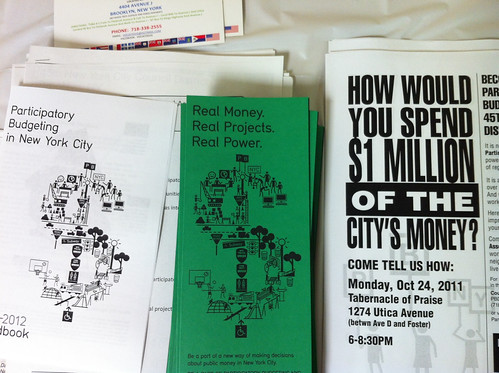
Participatory Budgeting NYC materialsFlickr photo fom the participatory budgeting process for NYC Councilman Jumaane D. Williams by Daniel LeTorre.

Participatory Budgeting as one alternative. About four years ago, when the Post wrote a similar editorial, I responded stating that participatory budgeting could be a solution to ethics issues with constituent service funds.

See "Missing the point on constituent service/discretionary funds available from legislators" and "More on ethics: discretionary funding-constituent funds."

In cities like Cleveland, Chicago, and New York, each councilmember gets a tranche of money to spend on community projects.  Those funds can be misused for incumbency protection just like constituent services funds.

Some councilmembers, to improve the process, have organizes citizens to consider the requests and make decisions and appropriations in an independent process, called "participatory budgeting," in a manner that simultaneously improves citizen participation and democratic outcomes while helping people and reducing the potential for misuse.

The Mayor of San Jose, California has introduced participatory budgeting as a way for citizens to be much more involved in the city's annual budget process ("Budget input from community set for March," San Jose Mercury-News").

-- Participatory Budgeting Project

An additional move would be to create systematic funding programs for neighborhood improvements, groups, and citizen projects.  This wouldn't help individuals in need, but there should be funding programs that support neighborhood programs and projects and initiatives.

The projects don't all have to be big.  But like with microenterprise funding programs for the impoverished in underdeveloped countries (e.g., programs by the Grameen Bank) sometimes groups or a block just need a little bit of money to assist in their execution of projects.

I mentioned this in my piece "Outline for a proposed Ward-focused (DC) Councilmember campaign platform and agenda."
Another area for participatory budgeting: disbursing funds to community groups from legal settlements. In June, I wrote about participatory budgeting as being a far better way to distribute settlement funds from legal judgments than merely directing monies to organizations with connections to the city's Attorney General. See "Participatory "budgeting" and disposition of funds from legal settlements."

Conclusion. It is unfortunate that the Post's "solution" to evident problems with constituent services funds is to eliminate rather than to significantly improve the process and increase the potential for democracy.

Labels: , , ,

Tuesday, June 23, 2015

Participatory "budgeting" and disposition of funds from legal settlements

Participatory budgeting is a method of allocating discretionary funds through a citizen involved and led process.

-- Participatory Budgeting Project

The initiative started in South America, and over the past few years elected officials in a number of cities, including New York City and Chicago, have used the method as a way to set priorities and allocate discretionary funds to projects in their Council Districts.

Boston has use PB initiatives as a way to increase youth involvement ("What Happened When the City of Boston Asked Teenagers for Help With the Budget," Next City).

Image from Californians for Justice.

More recently, the Mayor of San Jose, Sam Liccardo, who as Councilmember proposed using participatory budgeting methods as a way to better engage citizens in local government, proposes to use PB processes on a wider scale ("Budget input from community set for March," San Jose Mercury-News).

San Jose also uses a form of PB, called "Budget Games," as a way to make recommendations on the city's general budget ("San Jose residents play 4th annual Budget Games," Conteneo).

DC Attorney General directs settlement monies to past affiliations.  The Washington City Paper reports in "Nonprofits With Racine Ties Benefit in Chartwells Settlement," how some of the monies from a recent legal settlement with Chartwells over allegations of wrongdoing concerning the company's execution of its food service contract with DC Public Schools are being directed to charities with ties to Attorney General Karl Racine.  From the article:
Last week, Racine announced that his office had settled with Chartwells for $19.4 million over whistleblower claims that its food was regularly late or spoiled. The settlement inspired two councilmembers to call for investigations of Chartwells' continuing contract with DCPS. ... 
The settlement worked out well for five nonprofit groups that will receive a combined $5 million from Chartwells as part of the agreement. $500,000 of that money will go to Everybody Wins! DC, a literacy nonprofit whose board Racine served on until his election. Another $150,000 went to the Abramson Scholarship Foundation, which also once had Racine on its board.

Racine spokesman Robert Marus says OAG came up with the list of organizations that would receive Chartwells money. "They were groups he was familiar with," Marus says. Marus says there's nothing inappropriate about Racine approving a settlement that benefits organizations whose boards he once worked on. "There's no conflict here," Marus says.
Why not use Participatory Budgeting techniques instead?  Such funds shouldn't be allocated arbitrarily and capriciously according to the whims and past relationships of the Attorney General.

Even if such organizations do good work and there is no reason to believe that they do not, it would be best for settlement monies to be allocated in a public process towards projects defined as priorities in a public exercise that determines community consensus priorities. Participatory budgeting methods would be a perfect way to do this.

It would also extend the concept of democracy in the city, of which the creation of a separately elected AG position was a recent step forward.

Labels: , , , , , ,

Wednesday, May 07, 2014

Strengthening DC's political systems and structures: The Inspector General and DC Auditor positions should be abolished and replaced by an elected Public Advocate

Yesterday, the Post editorialized about the need for improvements in the DC government office that handles the city's election processes, the Board of Elections and Ethics, because of continual problems in managing elections, reporting results, etc.

And the City Paper has a piece on the soon to be expired term of the city's Inspector General and the process for replacement.  See "Council Blocks Plan to Change How Inspector Generals Get Picked."

The process is more flawed than merely how the IG is chosen.

I write a lot about the broad issue of the city's political and governance structures and the need for significant changes, to improve accountability and to build civil society and governance capacity in the city--after all, if the city is truly serious about achieving statehood stakeholders ought to acknowledge and accept that to build the case, the city needs to function a lot better governmentally (it doesn't help that two former Councilmembers are in or about to be in jail, one resigned his office in the face of an indictment, and Mayor Gray continues to be under a cloud because of various improprieties associated with the 2010 election).

The "best" solution with regard to the Inspector General position (and the DC Auditor--that office reports to the City Council and the IG to the Mayor) is to abolish both positions in their current incarnations and merge them into an elected Public Advocate position and office, with independent oversight and investigative power.

Continuing the same setup doesn't provide the city with very good accountability mechanisms.

With regard to the text below, reprinted from a 2013 post, note that in the last couple weeks, the Toronto Ombudsperson released a scathing report about mismanagement in the Toronto Community Housing Corporation and this led to the resignation of the director and other officials whose mismanagement had been encouraged by the Mayor.  See "TCHC vice president out after  ombudsman's report" from the Toronto Star. Interestingly in DC Government, while misfeasance isn't often sanctioned, opposition to mayoral policies is (e.g., "DC Government at-will employees need protections to tell the truth")

From "Continued musing on restructuring DC's City Council (mostly)":

I haven't thought this through enough, but the way that things "work" in DC is piss-poor.  Also see "The system of corruption: when you don't understand "systems", of corruption or anything else, you don't understand outcomes" and "DC ethics legislation misses the point: focus on what produces corruption as a regular outcome, not monitoring."

Toronto has both an Ombudsperson and an Integrity Commissioner.  In New York City, there is the Office of Public Advocate which functions similarly to an  Ombudsperson, which is a position that is supposed to provide citizens with a vehicle to investigate alleged violations of rights or malfeasance in government.  These offices are set up to be independent of the Executive and Legislative Branches, giving citizens an alternative when other venues aren't responsive, and allowing findings to come out without being "edited" before release by agencies or elected officials.

California jurisdictions also have what is called a Civil Grand Jury, which is made up of citizens, but rather than focus on criminal or civil matters that normally are heard by juries, they address the operation of government agencies.

DC does have an Auditor who reports to City Council, in a similar way to how the Government Accountability Office is one of the agencies, like the Congressional Budget Office, and the Congressional Research Service of the Library of Congress that provides support to the US Congress.

Similarly, the  nspector General is a unit of the DC Executive Branch.  Neither the Auditor nor the Inspector General are able to freely operate independent of their respective branches of government.

Electing a public advocate/ombudsperson

DC doesn't have a Public Advocate/Ombudsperson position.  We need one and the person should be elected, with a three term limit.  In a kind of way, like how in Michigan public colleges and universities function as a fourth branch of government, a public advocate should function similarly.

Labels: , , , , ,

Monday, February 11, 2013

Why inspector generals often don't seek the whole truth...

In today's Post, "Sad failure of 2 inspectors general," education journalist Jay Mathews* is shocked that neither the DC Inspector General nor the Inspector General of the Department of Education want to look too deeply into massive cheating on standardized tests while Michelle Rhee was the Chancellor of DC Public Schools.  (* An illustration once again that most journalists don't think about the world in terms of systems.)

I'm shocked that he is shocked.

From "Book review: 'Radical: Fighting to Put Students First' by Michelle Rhee" in yesterday's Post:

Early on, already hearing concerns about what those reforms might cost him, Fenty called his staff together. “There’s only one person who’s allowed to say no to the chancellor and that’s me,” he told them, according to Rhee. “Anyone else who does will be looking for a new job.”

Ultimately, inspector generals aren't fully independent, because they work for, in the case of the DC IG, for the Mayor, and in the case of the Department of Education for the Secretary of Education and the President.

Michelle Rhee was lauded by DC's Mayor and by the Secretary of Education. Not unlike how Rod Paige's purported success as a school superintendent in Texas--he was Secretary of Education under George Bush--was found to be the result of serious fraud ("The 'Texas Miracle'" from CBS News), people who should know better don't really want to know what happened because it would embarrass them and call the question on their theories of urban education reform focused primarily on testing and teacher firings.  (Although by this point this can only be called "implausible" deniability.  cf. "plausible deniability.")

This is why I suggest that DC reposition the Inspector General position into a popularly elected Public Advocate/Ombudsperson office, complemented by a Civil Grand Jury process.

----------------
From the past blog entry "Continued musing on restructuring DC's City Council (mostly)":

Building and extending ethics infrastructure

I haven't thought this through enough, but the way that things "work" in DC is piss-poor.  Also see "The system of corruption: when you don't understand "systems", of corruption or anything else, you don't understand outcomes" and "DC ethics legislation misses the point: focus on what produces corruption as a regular outcome, not monitoring."

Toronto has both an Ombudsperson and an Integrity Commissioner.  In New York City, there is the Office of Public Advocate which functions similarly to an Ombudsperson, which is a position that is supposed to provide citizens with a vehicle to investigate alleged violations of rights or malfeasance in government.  This positions are set up to be independent of the Executive and Legislative Branches, giving citizens an alternative when other venues aren't responsive, and allowing findings to come out without being "edited" before release by agencies or elected officials.

California jurisdictions also have what is called a Civil Grand Jury, which is made up of citizens, but rather than focus on criminal or civil matters that normally are heard by juries, they address the operation of government agencies.

DC does have an Auditor who reports to City Council, in a similar way to how the Government Accountability Office is one of the agencies, like the Congressional Budget Office, and the Congressional Research Service of the Library of Congress that provides support to the US Congress.  Similarly, the  Inspector General is a unit of the DC Executive Branch.  Neither the Auditor nor the Inspector General are able to freely operate independent of their respective branches of government.

Electing a public advocate/ombudsperson

DC doesn't have a Public Advocate/Ombudsperson position.  We need one and the person should be elected, with a three term limit.  In a kind of way, like how in Michigan public colleges and universities function as a fourth branch of government, a public advocate should function similarly.

Addition

Creating a Civil Grand Jury process in DC


An Office of the Public Advocate should augment its processes through the creation of a process similarly to the Civil Grand Jury process in California.  For example, in Los Angeles:

the main function of the Civil Grand Jury is to investigate county, city, and joint-power agencies. This is a significant civil function. The Grand Jury acts in a "watch-dog" capacity, by examining carefully and completely, the operations of various government agencies within Los Angeles County.

There the process is heavy duty, requiring a one year commitment (my grand jury service right now is slightly less than 30 working days), so it would have to be tweaked, but putting such a process in place in DC would demonstrate a new commitment to ethical, open, transparent, and forthright government.

Certainly, a Civil Grand Jury investigation into the test cheating scandal at Noyes Elementary School and other schools would be a worthy pursuit.

But there could be so many other great investigations...

-- LA Civil Grand Jury information forms

Note that I haven't figured out how to integrate the judicial process of a Civil Grand Jury into a Public Advocate Office, which is an odd kind of legislative-executive justice position.

Labels: , , , , , ,

Sunday, February 10, 2013

The DC Chief Financial Officer position: what is to be done? Make it elected!

When DC went into receivership in the 1990s and the Federal Government created the Financial Control Board to manage the financial affairs of the city, a Chief Financial Officer position was created to independently manage the financial affairs of the city.  The CFO is appointed by the Mayor to a 5-year term, by the  Mayor, with confirmation by the City Council.

For the past 11+ years, the CFO has been Natwar Gandhi.  While the city's finances have been managed fairly well under his tenure including high ratings of the city's bonds and finances, a variety of improprieties occurred within the various units under his purview.  Recently he resigned, effective in June.

Besides those problems, a recent press release by the DC Library Renaissance Project about the CFO's evaluation of a land sale deal of city-owned property in the West End makes good points that the evaluation of the deal was incomplete, disadvantaging the city.  See "After Gandhi’s Resignation, Questions About West End Library Deal Remain Unanswered." From the press release:

The information that D.C. Council members were provided by the CFO, while not untrue, omitted a key variable: the estimated fair market value of the land to be sold. Without further analysis of their own, Council members would not have had adequate information to evaluate the deal.

At stake is the value of three properties in the West End “sold” to a developer, Eastbanc, through a complex and unprecedented land swap. The deal calls for a new library facility, new firehouse, and new affordable housing — together worth $30 million according to Eastbanc — in lieu of payment for the land.

The CFO’s report states, based on values from its own tax database and those of an independent valuator, that the land sale would reduce the city’s assets by approximately $30 million. The Mayor, D.C. Council members, and community groups assumed that $30 million in new construction matched the $30 million reduction in assets, making the deal seem reasonable.

In his testimony, however, the CFO noted that deed and recordation fees totaling $1.45 million would be forgiven as part of the deal. Since deed and recordation fees in D.C. are based on a formula of 1.45% of the total estimated fair market value, the real value of the land is $100 million, not $30 million. So transferring ownership to Eastbanc is a giveaway worth roughly $70 million.

There are definitely issues and problems with how the CFO office operates.  There needs to be more openness and transparency with regard to evaluation of tax abatement requests and other matters, as well as contracting (which is under the Executive Branch).

The kinds of proscriptions offered in this old Boston Globe op-ed about eminent domain, "Make Eminent Domain Fair For All," offer some good guidelines for how to tighten DC government procedures with regard to these kinds of decisions about financing.  From the article:

• Requiring... that any exercise of eminent domain for economic development have a primarily public purpose rather than a merely incidental one.

• Requiring the government to demonstrate the public benefit through a full-scale financial analysis that could be challenged in court.

• Requiring that eminent domain not be used for a solely fiscal purpose and that it instead must be part of a comprehensive land use plan.

• Requiring that the affected neighborhood have adequate participation in the planning process, a right that would be backed up by state-provided technical assistance upon the neighborhood's request.

• Requiring that the state demonstrate good-faith dealing with the owners of the property targeted for taking prior to exercising the eminent domain power.

Today's Post has an article, "DC mayor wants to rethink strong CFO role," where Mayor Gray suggests that the city's elected officials should take back control of this function of government.

Scary. Many of DC's elected officials have clear conflicts of interest or other ethical issues that make it difficult for citizens to believe that they would carry out these responsibilities responsibly--after all that's why the Federal Government created the CFO set up to begin with.

Make the CFO an elected position

Just as years ago I had suggested that the city's Attorney General position should be popular elected ("DC elections and the referendum on the Attorney General" and " Another wrong judgement by the Washington Post: an elected Attorney General is a good idea and should be supported") and that will happen effective in the 2014 election, I recommend that the CFO position be popularly elected as well, to increase the checks and balances existing between the various branches of local government and to make a more direct link between "the people" and the necessity of financial stewardship propriety within local government.

The city has an opportunity to strengthen its processes and democracy at the same time by making the CFO or a "Comptroller" position popularly elected.

In New York City, the Comptroller is popularly elected, and limited to serving a total of 3 terms.  The Comptroller position in New York State is also popularly elected, without the term limit.  I'd recommend a term limit for the position.

(Comptrollers can be elected in other jurisdictions as well, such as at the county government level, or at the state level, such as in Texas.)

Making the CFO elected would, along with my previous suggestion (in "Continued musing on restructuring DC's City Council (mostly)") of creating an independently elected "Public Advocate" or Ombudsperson position, incorporating also the functions of the Inspector General (which currently is a position that serves at the pleasure of the Mayor, and is not fully independent), be a significant contribution to improving openness and transparency in DC government.

Labels: , , , , , ,

Sunday, January 06, 2013

Continued musing on restructuring DC's City Council (mostly)

So I have written quite a bit over the past few years (and summarized in the New Year's Day entry) about changing the structure of city government, mostly as it relates to City Council.

Last year was not a good year for DC Government

• People involved in the 2010 Mayoral campaign for Vincent Gray pleaded guilty to campaign improprieties.  There's a good chance that Mayor Gray will be charged as well.  Plus there was the hiring of relatives of people who worked on the campaign--most have since resigned.  And other wacked stuff.

• the shadow Mayoral campaign that went unreported to the Board of Election and Ethics was funded by Jeffrey Thompson, owner of Chartered Health, a big recipient of DC health care contracts.  That business is now in receivership.  He left his accounting firm, and he's likely to face felony charges.  Although Chartered Health is now about to be bought by another health care firm.

• Former Ward 5 Councilman Harry Thomas Jr. is in federal prison.  And the people who allowed him to misuse their charities so that he could abscond with public funds pleaded guilty to various charges, but they weren't given jail time.

• Former Council Chair Kwame Brown pleaded guilty to fraud with regard to personal financial dealings and resigned his office.  His brother pleaded guilty to similar charges on a different matter.  It's hard to say if there will be further local charges with regard to misuse of campaign funds.

• Councilmember Jim Graham (Ward 1) has been implicated in mis-dealings both with regard to regulation of the taxi industry, lottery contracting, as well as misuse of his position when he was a board member of WMATA to shape the results of who would win the right to develop Metro-owned land in his ward.

• Hundreds of millions of dollars of commercial property tax assessment reductions sparked a scandal in the Office of Tax and Revenue and brought renewed attention to the Chief Financial Officer, Natwar Gandhi....

• especially with regard to how the CFO office appears to have manipulated internal audit reports, keeping reports in draft to ward off release, and significantly editing final reports and

• allegations over misfeasance in awarding the contract to run the lottery made the New York Times last week ("Fired, but Firing Back, Over Dealings in Washington") although they've been part of local media coverage here for quite some time;

• the seeming conflict of interest of Councilmember Michael Brown (who was not re-elected) who works for a lobbying firm with active gaming clients and the push to allow Internet gaming in DC;

• not to mention various misuse of campaign funds by other Councilmembers(Councilwoman Alexander), various outlandish comments by Councilman Barry, and the high paying "side jobs" of certain Councilmembers; etc.

Right now, legislators are "part-time," but making full-time salaries, although a slight majority of Councilmembers don't have second jobs. Term limits were passed in 1994 but later rescinded by Council.  Each ward--there are 8--has one representative, and there are 4 at-large members.

Suggesting a comprehensive agenda for change

I recognize that "process redesign" in and of itself probably isn't enough when the Growth Machine culture is pretty much focused on self-interest and not on democracy and civic interest.

A lot of the discussion about the failures of elected government in DC focus on the domination by local "Democrats" and how lack of "competition" with a second, viable party thereby diminishes the quality of governance here.

(People also mention not having higher offices to run for creates a worse environment for corruption.  States like New York, Illinois, Pennsylvania, Louisiana, Florida, and Maryland demonstrate that even with the opportunity for higher office, corruption still can be a big problem.)

Many people think that the "solution" is electing "Republicans" necessarily.  I don't, even though I am working on a post about what a conservative urban agenda might look like and there are examples of Republican mayors across the country who aren't tea partiers...   E.g., I just don't think that the so-called local Republican agenda is pro-city enough for me, at least not yet, as it has been laid out by Republicans over the last 3 election cycles.

I don't think the issue per se is having a viable Republican Party as much as it is (1) having a viable Democratic Party--the local political party infrastructure isn't working very well, hasn't elected Committee members in 4 years, and the chair of the party was just appointed to fill the seat of a now vacant at-large position until the special election and (2) having viable second and third parties.  With regard to the latter, this recent entry discusses locally-focused parties in Vancouver and Montreal ("Repositioning cities (at least on the coasts) for greater political prominence, and a city-first agenda") and note that it has been suggested that local parties form in Toronto, to deal with failures in local governance there.  Maybe that's Republican and Statehood-Green, maybe it's something else...

The changes proposed below are designed to provide some "architecture" for the support of multiple parties in the city.  Right now, the way that the government and election process is structured is designed to foster the continuation of DC as a one-party city.


Summary recommendations

1.  Increase the number of wards.
2.  Increase the number of councilmembers
3.  Move the legislature to part-time service and reduced pay
4.  Reduce the size of councilmember staff
5.  Increase the research capacity of local government
6.  Institute term limits for elected officials.
7.  Change the date of the primary election to extend the electioneering period.
8.  Institute ranked choice voting for local elected officials.
9.  Institute additional campaign finance limits for local elections.
10. Create an elected public advocate/ombudsperson.
11. Reconstitute a school board with oversight over pre-K to 12 public education, traditional and charter schools.
12. Build civic capacity and infrastructure.


Council composition: making the DC Council a legislature means making it bigger

In discussing the status of DC Council with Peter Shapiro, former Councilmember in Prince George's County and with aspirations to be a DC Councilmember now that he lives in DC, he made the point that with regard to the desire for statehood, DC Council ought to be shifted more towards a "legislature," with higher aspirations, a greater concern for quality output, and more members.

While more "unwieldy" than at present, with a larger number of representatives a much larger majority would be needed to pass legislation.  As Washington Post journalist Mike DeBonis made the point in an article cited in this blog entry "The highly paid DC City Council and governance and voting systems," right now it's too easy to pass legislation, you only need 7 votes now, perhaps making the City Council a bit too "productive" in terms of generating a passel of new legislation in every Council session.

DC currently has 8 wards, and has had the same number since Home Rule was enacted.  Each ward is supposed to have about 75,000 residents.  Ward 1, the densest ward, is the smallest in size.  If DC continues to grow, without any changes, the access to local elected officials will shrink somewhat as the size of the city grows without a concomitant increase in governance infrastructure.


Increase the number of wards and add councilmembers

Alternative 1:  Increase the number of wards, from the current number of 8 to maybe 11.  As the city increases in population, shrinking the population of wards by adding to the number will help keep wards more intimate and accessible.  By having two councilmembers in each ward that would make 22 councilmembers + in this scenario, probably 8 at-large members, plus the Council Chair.  16 votes would be needed to pass legislation.


Don't increase the number of wards but add councilmembers

Alternative 2:  Add one representative for each ward, so that one ward councilmember would be up in each election cycle.  It would also provide more intra-ward competition amongst councilmembers, unlike the monopolies currently present.  One additional at-large member could be added for each cycle as well.

This would make 16 ward members and 6 at-large members, if there are three at-large members elected in each election cycle, plus the Council Chair, elected city-wide.  12 votes would be needed to pass legislation, up from 7 now.

Alternative 3:  16 + 8 at-large members, plus the Council Chair, elected city-wide, if there are four at-large members elected in each election cycle.  13 votes would be needed to pass legislation.

More Councilmembers allows standing committees to be filled out, with a bit more specialization, and for the creation of additional committees as needed.

2 Council representatives in each ward would provide more intra-ward political competition unlike the way that a single Councilmember dominates a ward now.  In combination with changes to campaign finance laws (see below), having two representatives in each ward would increase the opportunity for inter-party competition and success for non-Democratic Party candidates.

It's easier to make a bigger legislature part-time, which justifies cutting salaries

While it is true that if DC truly has aspirations for Statehood, it needs to take its Legislature seriously--the Council as it is set up is probably not "best practice," there is something to be said for not making it full-time, and in doing so, reducing the salaries from the current amount of $ to something like $75,000/year.  Right now, according to this report, City Councils in Philadelphia and Other Major Cities, by the Pew Charitable Trusts, the DC City Council has the second highest salaries of any local body across the U.S.

That would allow for an increase in the number of Councilmembers without requiring significantly more money in salary.

Size of Council office staff

Adding Councilmembers means more staff and more space to house additional councilmembers and their offices.  Both would increase costs.

However, DC Council has more staff--around 7 in addition to staff assigned to the support of standing committees but under the direction of Councilmembers and likely provided some support to the office--per Councilmember compared to surrounding jurisdictions, even though three (four, if you count Baltimore County) of those jurisdictions have significantly more population and land mass.  The number of staff for DC Councilmembers is larger than the amount of staff allocated to State House and Senate offices in Maryland and Virginia (although maybe they need more staff than they have).

Although with a unitary government (the equivalent of state, county, and city in one jurisdiction) and expanded taxing authority, arguably the DC legislature has more responsibilities.

If the Council were increased in size, by cutting the size of staff compared to the current number, it would be possible to put somewhat of a brake on increased costs that would come from having more councilmembers and more staff.

Increasing the capacity of City Council to do substantive research and get independent analysis and advice

Although the Council needs to add a serious research unit and independent oversight to help improve the quality of the Council's output.  I guess it has this kind of unit, but I can't say that I know much about it.  Given how much I read reports and documents, it's fair to say that they aren't pumping out substantive work.

One way to add research heft to staff might be to have most staff (not the chief of staff) be half-time assigned to a Councilmember and half-time to a subject area, serving the entire Council.

Another example of adding to knowledge heft would be New York City's Independent Budget Office.  The IBO is a publicly funded agency that provides nonpartisan information about New York City's budget to the public and their elected officials. IBO presents its budgetary reviews, economic forecasts, and policy analyses in the form of reports, testimony, memos, letters, and presentations."

Arguably the DC Fiscal Policy Institute, a unit of the national advocacy group Center on Budget and Policy Priorities does this, but they are more of a low income issues advocacy group--though I don't argue about the quality of their work.

The DC Appleseed Center does some of this kind of work too, but they are more or less a vassal of the Growth Machine, so they don't push for the hardest but best choices (e.g., like my ideas about merging a DC Community College with Montgomery College and/or PG County Community College, or shifting the local 4 year and graduate university to a relationship more comparable to SUNY's statutory colleges).

Many state governments have municipal and legislative service units, such as the Municipal Research and Legislative Services Center of Washington State.  We need access to something like this in DC.  (Had I ever revitalized the Citizens Planning Coalition into a kind of action-research-policy organization, it would have had a function like this.)

Term limits

DC citizens passed through referendum, term limits of two terms for Councilmembers and the Mayor, in 1994.  When the term limits were about to kick in and term out various Councilmembers, the City Council overturned the results.  (I really should sit down and read the Home Rule Charter to see how they could do this legally.)

While term limits are typically pushed by conservative political organizations looking to minimize the power of  progressive politics, as is argued by the San Francisco Bay Guardian, in "Taking on term limits,"  the reality is that political inertia is harmful to the health of the polity, even if some institutional memory is lost as elected officials are forced to step down, and this can strengthen the power of interest groups and staff at the expense of the public.

Still the state of representation on DC City Council is proof that terms limits are probably a good thing.  I'd recommend a maximum of three terms for Councilmembers, maybe 4-5 terms max for a combination of Councilmember plus Council Chair, and two terms for Mayor and Attorney General (effective with the 2014 Election the AG position, which in DC is not responsible for prosecuting criminal acts, will be popularly elected).

Timing of the primary election

Having too early of a primary, in a setting where most of the potential candidates are from one party, minimizes the time that candidates have to campaign, which privileges incumbents, who have greater name recognition.

DC used to have its primary in September, which was ruled to be out of compliance with federal laws designed to ensure that military personnel have the ability to vote in their home states, by ensuring that primary elections are held no later than 80 days before the general election.

But while the "Sense of the Council Primary Election Timing Resolution of 2010" stated that the DC Primary Election should be held no later than the first week of August, final legislation moved the primary to April, which shortened by 5 months the period for electioneering compared to the previous date in September, and shortened by roughly 4 months the maximum period that could have been provided, according to the 2010 Act.

I would argue for the first Tuesday in August, which complies with federal law and provides the maximal time for campaigning.  (Although August is a bad time for election turnout, but then, primaries are for the most motivated anyway.)
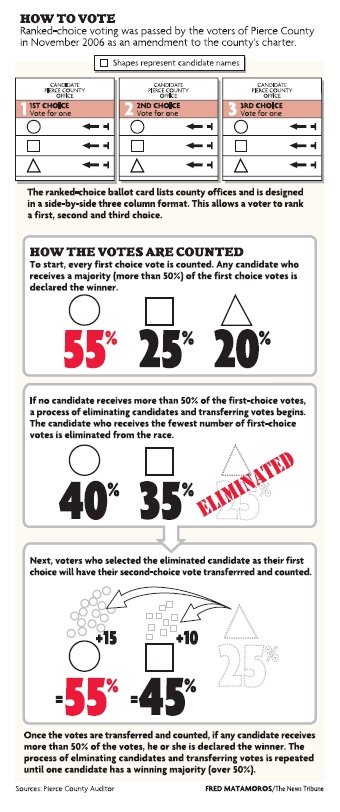
Ranked choice voting graphic, Pierce County WashingtonRanked voting

Another way to increase the ability to mix up voting is to have ranked choice voting.  It's more complicated, but it allows people to indicate first, second, third, etc. choices, and as candidates are eliminated, a more diverse set of candidates can be elected--note that it's possible, not probable.

Peirce County, Washington used ranked choice voting for a couple of elections, but it was repealed in 2009.  This diagram is from the Tacoma News-Tribune circa 2008 and is used with permission.  San Francisco started using ranked choice for local elections in 2005.

DC is most likely to elect Democrats to elected office, but the fact is that the candidates vary considerably in terms of their progressiveness, ethicsness, raceness, etc.

So the ability to rank candidates would help more progressive candidates get elected when a typical election has multiple "good" candidates running and just one "bad" candidate, and the bad candidate has a built in advantage because his/her supporters don't split their votes.

Limiting the amount of money spent on Council campaigning

Election finance reform is necessary to ensure that the changes above, other than term limits, would work to increase the diversity of elected officials within the city.

Money and access to it is the great unequalizer.  Second and third parties typically find it much more difficult to raise funds than the party in power.

So while I don't believe in "starving the beast" of government necessarily, I do believe in more severe limits on campaign financing.  (And I really envy the British and their 4 to 6 week campaign period for national elections.)

Until around 2006, DC's ward electioneering was pretty simple and not too expensive, even if only Democrats were getting elected.  But with the election of Adrian Fenty to Mayor and Vincent Gray to Council Chair, their Ward seats came up for special election.

Both Fenty and Gray used this opportunity to build their campaign machine and extend its reach to wards.  Donations were extracted by the respective campaign machinery for use by the annointed candidates (Muriel Bowser in Ward 4 and Yvette Alexander in Ward 7), who ended up raising much more money for their special election races than had previously been raised for ward-based campaigns.

If you want to make it possible for second party candidates to win at the ward level, there are going to have to be serious restrictions on the amount of money spent in ward-level campaigns.  I don't have specific recommendations, just note that it needs to happen.

Building and extending ethics infrastructure

I haven't thought this through enough, but the way that things "work" in DC is piss-poor.  Also see "The system of corruption: when you don't understand "systems", of corruption or anything else, you don't understand outcomes" and "DC ethics legislation misses the point: focus on what produces corruption as a regular outcome, not monitoring."

Toronto has both an Ombudsperson and an Integrity Commissioner.  In New York City, there is the Office of Public Advocate which functions similarly to an Ombudsperson, which is a position that is supposed to provide citizens with a vehicle to investigate alleged violations of rights or malfeasance in government.  This positions are set up to be independent of the Executive and Legislative Branches, giving citizens an alternative when other venues aren't responsive, and allowing findings to come out without being "edited" before release by agencies or elected officials.

California jurisdictions also have what is called a Civil Grand Jury, which is made up of citizens, but rather than focus on criminal or civil matters that normally are heard by juries, they address the operation of government agencies.

DC does have an Auditor who reports to City Council, in a similar way to how the Government Accountability Office is one of the agencies, like the Congressional Budget Office, and the Congressional Research Service of the Library of Congress that provides support to the US Congress.  Similarly, the  Inspector General is a unit of the DC Executive Branch.  Neither the Auditor nor the Inspector General are able to freely operate independent of their respective branches of government.

Electing a public advocate/ombudsperson

DC doesn't have a Public Advocate/Ombudsperson position.  We need one and the person should be elected, with a three term limit.  In a kind of way, like how in Michigan public colleges and universities function as a fourth branch of government, a public advocate should function similarly.

Reconstituting an elected School Board

With the dissolution of the DC Public Schools Board and the transferring of authority over the public schools to the Mayor of DC and the assumption of oversight over the school system by the DC City Council, what happened is that no independent review of the school system is provided except through election and occasional coverage of schools issues by the City Council.  And the School Board was changed to have "state-level" responsibilities with no authority over local school system issues.

City Council isn't set up or at least big enough in its current configuration to provide adequate oversight.  The law transferring authority to the Mayor didn't provide for an independent ombudsperson for the schools.

While with the reorganization of the City Council in the new term to have a standing Committee on Education, presumably Council could begin to provide the necessary level of oversight.  I doubt it though.

Better to reconstitute a local school board but set it up to have authority over both the traditional public school system and charter schools, to have to have a master plan for pre-K to 12 education in DC, etc.  Granted, there is a fine line between oversight and micromanagement.  But there is enough to cover to justify a separate board.

That would require changes in federal law too, since the Public School Charter Board is independent of the electorate and basically is unaccountable.  In this recommendation, the PSCB would be dissolved and folded into a newly elected local school board.

Building civic infrastructure

Currently, DC doesn't have an "Office of Neighborhoods," unlike many other cities.  Typically such an agency provides technical assistance and training to citizens and civic organizations.  There is an "Office of Neighborhood Engagement" in the Mayor's office and each councilmember provides constitutent service.  But in both cases these outfits are designed more to build support for and dependence on the Mayor and Councilmembers, rather than to build the capacity of citizens and groups to act independently.

That needs to change.

I have written about this in the context of Advisory Neighborhood Commissions, but the same recommendations pertain more generally.   These blog entries discuss my thoughts about this more specifically.

Another element to this would be to have the city's grantmaking infrastructure, for both the Executive and Legislative Branches, to be reorganized on the principles of Participatory Budgeting, where citizens working together end up coming to consensus on what to fund.  And all the resources of the Asset Based Community Development Institute...

Labels: , , , , ,

Wednesday, December 12, 2012

Helping and making a difference year round (not just at holidays)

Probably the period between Thanksgiving and Christmas/Hanukah is when a lot of extra volunteerism happens, and nonprofits send out various annual fundraising appeals to eek out donations before the end of the tax year.

Urbanophile has a post, "What Are You Doing For Your City?," that makes the point that it's not enough to pontificate how to make the city better, that we need to take action and help in credible ways now.

From the entry:

It’s tempting to think that if we read (or even, like me, write) an urban blog, vote, or write the occasional letter of protest that we are doing our part. But while words, protest, and lobbying are important, they are not nearly enough.

Instead, I’ve tried to challenge myself to try to find ways to actually do something tangible, physical that contributes to civic improvement. Something beyond just my words. I was a long time free software contributor, and am glad to have been able to participate that way. I also helped drive the creation of the Indianapolis neighborhood map and online architectural tours. But that’s frankly not a whole lot.

On the other hand, if everybody challenged themselves to take on at least one personal project, whatever or however small it might be, our cities would be much better places. Many neighborhoods could benefit from just having someone committed to keeping their own block free of trash. Or may a guerrilla gardening project at some lonely, pathetic stretch of dirt on a city right of way. There are a million things that are within our grasp to actually do ourselves to make an improvement. We aren’t always dependent on somebody else to make things better. We can make a start in our own back yard.

So I’d like to challenge all of you to do that. What’s your project for improving your city? And I’ll also challenge me, as I don’t have much going on at present and haven’t made much of an impact since I moved. As we come to the end of the year, let’s all plan to make a tangible difference of some sort where we live.

2.  Normally, I wouldn't be so quick to devalue "indirect" service, focused on creating long term, structural change,even it usually takes years to see tangible results.  See "Good volunteerism vs. "bad" volunteerism."

Focusing on structural change is important. Most people are content to write a check or do nothing--hell, most of my neighbors don't even pick up litter in front of their houses--or to volunteer at a soup kitchen once/year.

Most people don't really have the capability to look more deeply at issues and problems and suggest deeper and more comprehensive solutions.

Focusing on structural change is thankless and takes a long time, there are plenty of defeats along the way, and the wins don't usually accomplish all that you intended.

But I think the point that taking on a personal project, in addition to tilting at windmalls, is a reasonable suggestion.

3. TransitMiami has an interesting post, "The Power Of Thinking Small" (reprinted from the Biscayne Times), which makes the point that too often we are focused on "thinking big" when there are plenty of do-able important little projects "under our feet" that we can address now, if we make up our minds to do so. From the entry:

There are a series of questions we should be asking about life in downtown Miami that are emphatically about the small and simple things: Are the sidewalks clean and inviting, or are they caked with old chewing gum and poorly lit? Are there public maps to guide people around? Is the transit system easily navigable? Are there attractive public spaces with places to congregate? Is bicycle parking readily available? Are there places for children? Pets? Adequate crosswalks and crossing times? Does walking feel safe and inviting?

If the answer to some of these questions is no, the solutions are usually simple, relatively inexpensive, and can offer a high return on investment. Their importance must not be dismissed, though it sometimes feels like these basic livability issues are hardly being addressed.

Left: guerrilla wayfinding sign by the Miami Improvement Alliance.

The piece discusses Scott Douglass, the founder of the Miami Improvement Alliance, which aims to bring people together to work on community revitalization projects--sanctioned or guerrilla, that are achievable without spending a lot of time or money.

The group’s first project was the creation of “urban wayfinding signs” to encourage visitors to the recent Red Bull Flugtag event at Bayfront Park to venture across Biscayne Boulevard and explore what downtown Miami has to offer. While unsanctioned by any local authorities, the initiative had the blessing of many local business owners.

4.  Tactical urbanism offers a framework for thinking about community projects that you might want to take up.

-- Tactical Urbanism Manual, vol. 1
-- Tactical Urbanism Manual, vol. 2

5.  Most community libraries, parks, trails, recreation centers, and neighborhood schools ought to have "friends of" programs that we could participate in and shape, plus various neighborhood groups including historic preservation and community revitalization programs.

Although "structurally speaking," most local governments don't set up how they work in a fashion that respects and engages citizens.  (We won't talk about planning processes...)  Baltimore is exceptional with a couple programs such as the Weed Warriors program in the parks department that works with citizen volunteers to rid parks of invasive weeds, and the Live Baltimore resident attraction program.

In a blog entry about "networked solutions" I argue that the way communities set up friends programs is too complicated, requiring that involved citizens spend a significant amount of time on administration, paying for incorporation, etc., instead of spending their time "doing".)

This article, "Minneapolis' Superhighway: The Midtown Greenway," from Rails-to-Trails Conservancy on the Midtown Trail in Minnesota mentions that while the corridor is run by the city, the volunteer nonprofit Midway Greenway Coalition is engaged in many projects that support, maintain, and improve the trail.

6.  Another way to serve is to be on the board of a community organization (although that can be like tilting at windmalls too).

7.  Another interesting example from Miami, is how the local community foundation, the Miami Foundation, has created Give Miami Day as an online giving event (not unlike how nonprofits nationally are working to create in line with Black Friday, Small Business Saturday, Cyber Monday, and Giving Tuesday post-Thanksgiving shopping events, see "Cyber Monday and now #GivingTuesday" from CNN) to build local giving and individual philanthropy by encouraging residents to make donations to Greater Miami community organizations.

More than 300 organizations have signed up to participate.  And to reward giving, the Miami Foundation will match a percentage of individual donations made that are between $25 and $10,000, increasing the total funding raised by the groups.  See the Miami Herald articles, "First-ever Give Miami Day is Wednesday" and "Miami, this is the day to give."

This 24-hour donation period began at midnight Wednesday, December 12 and ends at midnight, December 13.

In addition to the Miami Foundation's matching gift program, other community organizations such as Catalyst Miami are leveraging the event by organizing donation match programs of their own.

8.  And stoop down, and pick up some litter on your way to or from the subway, around a bus stop, on your block, in your neighborhood park, or from the trail that you walk or ride on. ("Every litter bit hurts.")

Labels: , , , ,