Rebuilding Place in the Urban Space

"A community’s physical form, rather than its land uses, is its most intrinsic and enduring characteristic." [Katz, EPA] This blog focuses on place and placemaking and all that makes it work--historic preservation, urban design, transportation, asset-based community development, arts & cultural development, commercial district revitalization, tourism & destination development, and quality of life advocacy--along with doses of civic engagement and good governance watchdogging.

Thursday, September 24, 2020

Adams Morgan "public" plaza case an example of DC public space planning failure

Most every year, DC ranks in the top 5 "city park systems" in the US based on the flawed scoring methodology of the Trust for Public Land's ParkScore® system.

DC ranks highly because of the inclusion of federal parks and open space resources and because the methodology doesn't rank based on the variety and type of spaces, programming provided, etc. ("Washington DC has lots of parks and open space, but it's not the #1 City park system in the US"," 2019).

A robust parks and open space planning process would plan at three scales: city-wide; multi-neighborhood or district (quadrant); and neighborhood.  It would classify spaces and work to ensure that neighborhoods have a goodly breadth and variety of such spaces and uses available to them.  

For example, in the plan for the Buckhead District of Atlanta, the master plan outlines the following nomenclature for types of spaces: 

  • civic spaces (including plazas) 
  • public art
  • neighborhood parks
  • dog parks 
  • community parks and sports facilities
  • conservation parks
  • trails and greenways
  • streets and sidewalks (treating streets as linear parks)
  • cultural and historic sites 

The Washington Post reports ("Judge rules that groups have no legal standing to fight Adams Morgan project") on a Court ruling concerning a case brought by neighborhood groups in the Adams-Morgan neighborhood on retaining a "public plaza" at the southwest corner of the intersection of 18th Street and Columbia Road NW.

In the 1970s, the now defunct Perpetual Savings and Loan constructed a branch there with a large publicly used plaza in front.

Apparently, no easement was ever recorded.  

And because the city doesn't have a parks and open space master plan, nor such plans at the neighborhood scale like Adams-Morgan, the failure to secure an easement for this space was never identified as an issue (DC generally has a problem with securing easements when necessary, for sidewalks and similar spaces).

By contrast, when a master plan for more intensive development was created for the area around the Columbia Heights Metrorail Station, including the DC/USA retail development and a large number of a multiunit residential buildings, a master plan was created (Columbia Heights Public Realm Framework Plan) and a public plaza was created as part of the overall plan.

There is a splash fountain, farmers markets a couple times a week, it's a staging point for demonstrations and other events, etc.

It's a great example of what I call the layering of public spaces and activities ("The layering effect: how the building blocks of an integrated public realm set the stage for community building ," 2011) and it's also a great example of what most DC neighborhoods don't have, a centrally located appropriately-scaled public plaza, because DC just doesn't do that kind of fine-grained and nuanced public space planning.

A few years ago, the Adams Morgan property was sold to a local developer, which aims to build a large apartment building there, with a significantly reduced public space in front, one that could not accommodate current farmers stand and other larger scale activities.

The Court ruled that the parties to the lawsuit didn't have standing.  

That if there is supposed to be an easement, the DC Government would be the appropriate party, not independent neighborhood groups.  (Although it's not out of the question for nongovernment entities to secure these kinds of easements*.)

It's rare for the city to take on private developers but it's not unheard of ("360 Apartment building + Giant Supermarket vs. a BP gas station, which would you choose?," 2013), although it's increasingly unlikely by the successors of Anthony Williams, who tend to have an unreflexive approach to "economic development" vis a vis public space and interests.

There are other cases in the city--in Brookland, Columbia Heights ("Another example of the need to do comprehensive parks, recreation and civic assets planning at multiple scales, including neighborhoods like Columbia Heights," 2019), and Takoma where the city has bought land or agreed to do so in favor of maintaining park-like uses.

Here the failure is a lack of systematic planning at many scales, forcing neighborhood groups to take on matters that a city ought to be dealing with.

Crappy space.  Interestingly, many of the comments on the Post article are negative, saying that the space is crap and therefore not worthy of saving.  

That's ridiculous.  The point is not that the space is poorly designed, but its centrality and potential viability.  Badly designed spaces can be improved.

Property rights or a planning failure.  And many of the comments focus on that the space is privately owned and the owner should be able to do whatever they want.  The issue is more complicated.  It's really a matter of lack of planning, both in terms of parks planning more generally but also in identifying the failure to secure an easement for the continued use of the public space.

Possible solution: Eminent Domain.  One of the Post comments raised the specter of eminent domain.  But that's actually a great suggestion.  

DC should buy the property, place an easement on a portion of the site for a plaza--probably larger than what the developer proposed but smaller than what residents may want--and then sell the rest of the property for development.

The Boston Globe article, "Make eminent domain fair for all," outlines a good process.

Next steps.  All along the city should have stepped in to this issue as a planning matter, but for the most part the city refused to do so, treating it as a property development and approval matter.

The City AG is noncommittal about stepping in.  I don't know what the position of the Councilmember is.  I doubt the very pro development Mayor wants to get involved.

Ideally, like with the BP gas station on the 300 block of H Street NE discussed in this entry, there could be a mediated process, where the developer gives up more space for public use, and a process for managing it independently, perhaps in part for a monetary exchange.

Councilmembers should demand that the city complete the Parks and Open Space Master Planning process as well as to create sub-plans at the quadrant and neighborhood scales as appropriate, using models from elsewhere as well as the Columbia Heights Public Realm Framework Plan, which was never used as a template to expand, extend and improve neighborhood planning practices in DC.

*Easements: Foggy Bottom Association and the Columbia Hospital for Women.  The Columbia Hospital for Women in Foggy Bottom wanted to expand, but the neighborhood association wanted assurances that this wasn't a chimera for real estate development.  The Hospital agreed to an easement, held by the FBA, restricting expansion to hospital-uses only.

When the Hospital shuttered and was sold, FBA had extranormal rights to oppose the project because of the easement they held.  FBA agreed to give up or "release" the easement ("extinguish") in return for a large monetary payment, part of which--more than $1 million--was used as an incentive payment to Trader Joe's, to open a specialty grocery store on the site.

A neighborhood group could have been the signatory to an easement agreement with Perpetual.  Although this didn't ever happen.

Labels: , , , , , ,

Friday, October 25, 2019

Baseball World Series in DC #2: Eleven urban planning lessons from the Washington Nationals stadium

=======
Updated 8/19/2020
Because I miscounted, there are 11 lessons, and to repair a couple typos.
=======

Probably at least half the comments on the previously cited Washington Post article, "Long before the World Series, this ragtag group of D.C. property owners was evicted to make way for baseball," criticized the Post for being "negative," stating that the Post should only be positive on the eve of the third World Series game.

Here are some of the urban planning lessons I've learned from the Washington Nationals (and the MCI Center/Verizon Center/Capital One Arena).

1.  Siting, urban design, and transportation connections are fundamental.  DC is a great example for cities (as are NYC, New Jersey, Boston, and Philadelphia, and White Sox vs. Wrigley Field in Chicago) on right siting and wrong siting for sports facilities, and how this makes a difference in positive ancillary economic development.

RFK Stadium has a subway station, but it isn't centrally located and the site was never designed to spur additional development.  The old Uline Arena, home to hockey and basketball teams, lacked good transit access.  Capital One Arena is served by three Metrorail lines and is 4 blocks from the other three lines.  Nationals Stadium is served by one Metrorail line and many people go there by car, leading to terrible congestion.

Capitol One Arena and Nationals Stadium anchor districts beyond the four walls of the facility.  Even though both Nationals Stadium and the Arena are modern buildings, counter to the "throwback" designs of Camden Yards, they fit in with their surroundings.  Most importantly, they are designed for the city, not surrounded by parking lots.

PacBell Park was later named AT&T Park, and now is called Oracle Park, after the software company.

John King, urban design writer for the San Francisco Chronicle, in his 2003 article on PacBell Park, "Opening Day Distraction / Why the ballpark was a great idea, four years later," laid out the lessons from that facility.   From the article:
In short, Pac Bell Park is a brick-paneled seminar on urbanity. Let us study the lessons taught by this one really smart - but so gosh-darn cute! - building." The lessons are:
  • Blank slates are boring
  • Recycling pays off
  • The More Travel Options the Better
  • Waterfronts Need Action, Too
  • Don't Fear Progress
  • You Can't Beat the Real Thing
His review of the baseball stadium for the San Diego Padres ("Petco Park top-notch -- but no splash hit / San Diego's new stadium evokes Aztec ruins more than baseball") provides the counter lessons on what not to do.

2.  While it's important to oppose public financing and giveaways to owners and leagues, given the likelihood such rewards will be provided to sports teams, we need to focus equally on maximizing positive urban design, transportation demand management, and other community benefits from the facility.  These pieces outline a framework for what to look for.

-- "Stadiums and arenas redux: Mayor Bowser still wants the area NFL team to relocate to DC" (2019)
-- "Stadiums and economic effects" (2013)
-- "An arena subsidy project I'd probably favor: Sacramento" (2014)
-- "Sports stadiums (and arenas) and local economic development and a DC soccer stadium" (2014)
-- "Stadiums and arenas as the enabling infrastructure for "money-making" platforms " (2014)
-- "More sports: sports-anchored entertainment districts and LA Live

3.  The relationship between a team and a jurisdiction should be a partnership, but it's very one-sided, favoring the owner.  Be sure you specify what you want in the contract.  A locality has maximum leverage is before the contract is signed.  Provisions not included in the original contract are unlikely to ever be added later because the team won't want to do anything that costs extra.

-- "Everything they do centers on cash (sports-related economic development)" (2006)
-- "Brief follow up on DC and a new football stadium for the Redskins" (2018)
-- "Yes, modify and extend the RFK Campus lease; No, don't do it for the Washington Redskins football team" (2018)
-- "Been to Largo lately? Sports teams often aren't very good partners..." (2018)
-- "Protecting local government interests: Jurisdictions at risk from slimy sports teams owners and the Miami Marlins as an example" (2018)

The baseball team owners are okay.  But being better than the owner of the Washington Redskins football team isn't the standard we're looking to exceed.  Mostly team owners are looking out for their own interests and the Lerners are no exception ("The problem with Ted Lerner's lifetime achievement award," Washington Post),  They aren't going to give up anything they aren't required to by contract.

4.  Without the facility, there is no platform: cities funding facilities should get a piece of the action.  Ted Leonsis, owner of the Washington Wizards and Washington Capitals, talks about how a sports team is more than the team or game, it's about the platform.  Without the facility to play the game, there is no platform.

And local jurisdictions paying for facilities need to be able to better benefit economically from providing the platform.  That means creating a kind of virtual ownership interest that gets monetized each time the team is sold.

-- "New Year's Post #3: More thinking on "return on investment" from different types of sports facilities and DC, and an Olympics in DC" (2015)
-- "Stadiums and arenas as the enabling infrastructure for "money-making" platforms " (2014)
-- "Protecting local government interests: Jurisdictions at risk from slimy sports teams owners and the Miami Marlins as an example" (2018)

5.  But despite my arguments that given the strength of the market, development would have happened even without the Capital One Arena or the Nationals Stadium, that undersells the economic value of such facilities as anchors, draws, destinations, and development accelerators.  I'm half right, but half wrong, maybe even 60% wrong.

-- "Did MCI Center really miraculously improve DC's east end?" (2005)
-- "MCI Center and Abe Pollin: let's accurately report all the history" (2008)
-- "More sports: sports-anchored entertainment districts and LA Live" (2018)

It took me many years to accept the positive impact of the now named Capital One Arena on the success of Downtown Washington. While I still believe that I am right that the area would have revitalized eventually (and actually there are success problems with the development still today, 21 years later, because of problems with the urban design) there is no question that it:

(1) accelerated improvements much more quickly than had the development process been more organic and slow

(2) draws and re-introduces suburban residents of the metropolitan area to the city, and contributes more positively to the image of DC within the metropolitan landscape for commerce and residential choice

(3) Economic analyses showing no impact from sports teams are done at the metropolitan scale, and under-report the impact of appropriately sited, designed, and integrated facilities in urban settings.

In short, center cities may do better with stadiums and arenas, which draw spending from elsewhere within the metropolitan area, compared to suburban locations.

It's Hardly Sportin' Stadiums, Neighborhoods and the New Chicago6.  Entertainment districts aren't great for retail.  In all the discussion about mixed use around stadiums and arenas, the reality is that it's great (relatively speaking) for restaurants and nightlife, and not for retail outside of sports team related merchandise.

It's also related to the increased interest in "buying" experiences but not things.

People aren't really interested in buying stuff that they have to carry around, bring into the stadium etc. (although a store could offer delivery as a way to spark sales).  And they don't go shop after the game, especially night games.

Retailers in the Navy Yard/Ballpark District or The Wharf will sputter for the most part, except when they are convenience retail (like groceries) offered primarily to residents.

But we should have realized this earlier, Costa Spiro and Larry Bennett, authors of It's Hardly Sportin': Stadiums, Neighborhoods, and the New Chicago, about adding lighting to Wrigley Field in Chicago describe how the Wrigleyville commercial district was reproduced into an entertainment district complementing Cubs games.

It doesn't help that games may be scheduled to start at times that discourage attendees from going anywhere else to consume food and drink before games.

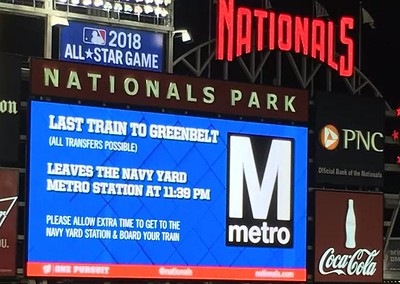
7.  Get it in writing: Put transportation demand management requirements in the contract.  The Lerners continue to refuse to pay to extend transit service hours in the event games go beyond closing time.

-- "Sports events and the transit city: participation in transportation demand management shouldn't be an option" (2015)
-- "Incentives vs. requirements: stadiums/arenas and transportation demand management" (2012)
-- "Upping our "short game" on transportation demand management planning for sporting events" (2011)
-- "Baseball, Hot Dogs, Apple Pie and Transportation Demand Management" (2006)
-- "Will the Washington Nationals agree to pay to keep Metrorail open late durng the playoffs?" (2014)

BTW, the Chicago Cubs are required to do transportation management planning as a part of their use permit. Having arenas on top of train-subway stations like Madison Square Garden and Barclays Center means that a majority of attendees end up using transit. It would be useful to have such data for the Capital One Arena.

MTA in Greater New York, Metrolink in Southern California, and other railroad passenger systems do a wide variety of marketing promotions to encourage attendees to use trains to get to and from games.

Digital billboard at Nationals Stadium showing the closing time for the WMATA system/Navy Yard Metrorail station
Digital billboard at Nationals Stadium showing the closing time for the WMATA system/Navy Yard Metrorail station.  Photo by Ryan J. Allen, Twitter, 2016.

8.  The Business Improvement District that includes the ballpark should be a Community Improvement District, incorporating residents on the board.

-- "Integrating citizen residents into "business" improvement districts: Capital Riverfront district as an opportunity and example of the need for change" (2014)

Rendering showing special pedestrian urban design street treatment for Half Street SE, in the vicinity of the Washington Nationals Stadium
9. Look to make long term urban design and transportation improvements at the outset. With regard to the Nationals Stadium, it's been ten years since the stadium opened, but significant urban design improvements for Half Street SE, the street that leads from the Navy Yard Metrorail Station to the Ballpark, are still in process and weren't complete before the All Star game in July 2018.

-- "Developers plan a pedestrian-friendly 'gateway' on the road to Nats Park," Washington Business Journal
-- "
Urban design considerations for the area around Washington Nationals Baseball Stadium in advance of the 2018 All-Star Game" (2017)
-- "Sadly, DC won't show so well during the Baseball All-Star Game" (2018)

For Capital One Arena it would have been to build an "underground" connection between Metro Center and Gallery Place, to encourage people to walk between the two stations, rather than to ride the Red Line subway for one stop.  NYC, Chicago, and Montreal provide examples for how that could still be done. The Minneapolis Skywalk system is another example.

-- Urban Design Manhattan, Regional Plan Association (1969)
-- "Hong Kong needs to create a formal and planned pedestrian mobility network (2016)
-- "Public improvement districts ought to be created as part of transit station development process: the east side of NoMA station as an example" (2016)

10.  There was inadequate concern about retaining desirable businesses displaced by the ballpark.  Some of the businesses were light industrial, arts related, etc., that employed people, provided facilities to pursue creative endeavors, etc.  But because they were industrial zoned, the supply of such spaces and buildings in DC is limited, and therefore the spaces at current costs are highly expensive, most of these businesses were either pushed out of DC and/or ceased to operate.

There should have been more efforts made on retaining these businesses.

11.  DC can't assess income taxes against the incomes of home team or visiting players, while other cities/states do so.  One of the elements of figuring out the economic value of sports subsidies is the income tax revenues that come from players.  Because it's held that players "only earn income" when they play in a contest, both home and visiting team players end up having to pay taxes to the place where the match is held.

But Congress forbids DC to levy income taxes on nonresidents and that ends up being a side benefit for professional sports teams.

=======
But yes, even though I am not that interested in team sports, I have been watching Washington Nationals baseball games in the post-season.

Labels: , , , , ,

Baseball World Series in DC as an opportunity for urban planning reflections: #1 | revisiting blog entries from 2005/2006

Groundskeepers prepare the infield for batting practice at Nationals Park in Washington, Thursday, Oct. 24, 2019. The Houston Astros and Washington Nationals are scheduled to play Game 3 of baseball's World Series on Friday, Oct. 25. Photo: Patrick Semansky, Associated Press.

As the Washington Nationals prepare to host the first World Series game in the city since 1933, the Washington Post article, "Long before the World Series, this ragtag group of D.C. property owners was evicted to make way for baseball," about the businesses displaced in favor of the Washington Nationals stadium makes me realize this is a good opportunity to reflect back on past writings, especially at the outset of the blog in 2005, including pieces suggesting that DC didn't have to roll over for Major League Baseball and give them everything they wanted with little in return, because DC had things to offer too--a thriving economy and one of the nation's largest markets.

The JDLand blog, focusing on changes in the section of Southeast on the northside of the Anacostia River, between South Capitol Street on the west and 11th Street SE on the east and south of I-695, the Southeast-Southwest Freeway,  was an early DC blog and helped motivate and shape the development of this blog.

She has a pretty understated entry on the Series, "The Neighborhood's Latest Milestone: A World Series."
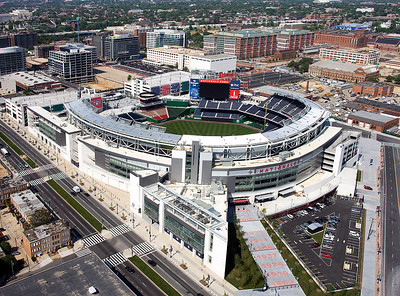
Aerial view of Nationals Park. The Nationals' previous stadium, RFK Stadium, is barely visible near the top of the picture
Aerial view of Nationals Park. The Nationals' previous stadium.  Carol M. Highsmith.

Last summer, the Washington Post ran a long piece, "Ballpark Boomtown," about the economic development impacts of the stadium, going through a long list of development projects that have been created or planned since the announcement of the ballpark and its subsequent opening.

It's almost impossible for anti-stadium funding advocates to succeed against the marketing machine of professional sports teams and leagues.

Stadiums get built, so reflexive opposition might be a waste of time.  At the same time, some of my reflexive opposition to public financing of a stadium then is mediated now in terms of the reality that in most situations, professional sports leagues and teams will get what they want--unless states have laws requiring approval by the citizens in referendums (the case in California, which is why the SoFi stadium there is being built with private money).

Since they'll get public financing, advocates need to have a fallback position, and that fallback position is how to get the most in community benefits and other considerations in return.  That's the focus of the second piece in this series, while the third is on a couple lessons learned.

That line of reasoning, expressed in these entries:

-- "Stadiums and arenas redux: Mayor Bowser still wants the area NFL team to relocate to DC" (2019)
-- "Stadiums and economic effects" (2013)
-- "An arena subsidy project I'd probably favor: Sacramento" (2014)
-- "Sports stadiums (and arenas) and local economic development and a DC soccer stadium" (2014)
-- "Stadiums and arenas as the enabling infrastructure for "money-making" platforms " (2014)
-- "More sports: sports-anchored entertainment districts and LA Live

obviously builds upon these early writings about the creation of the Washington Nationals baseball team and stadium in Washington, DC.

Congress sweats the small stuff: cares about the cable television contract for the Nationals, but not how professional sports teams have a negotiating advantage vis a vis localities
-- "Screw investigating steroids, Congress needs to look at how cities screw themselves over sports stadia" (2005)
-- "Baseball, hotdogs, Congress, and misplaced priorities" (2006)

Griffith Stadium was embedded in the Le Droit Park/U Street neighborhoods
Griffith Stadium, home to the American League baseball team in Washington, was embedded in the Le Droit Park/U Street neighborhoods.

Modern or "throwback" design for a baseball stadium
-- "Baseball, Hot Dogs, Apple Pie, and Business as Usual" (2005)
This piece argued in favor of an "old style" baseball park, like Camden Yards in Baltimore, or originals like Wrigley Field in Chicago and Fenway Park in Boston.  It quoted from the work of Notre Dame architecture professor Philip Bess.

EIGHT IMPERATIVES FOR TRADITIONAL NEIGHBORHOOD BASEBALL PARKS

1. Think always of ballpark design in the context of urban design;
2. Think always in terms of neighborhood rather than zone or district;
3. Let site more than program drive the ballpark design---not exclusively, but more…;
4. Treat the ballpark as a civic building;
5. Make cars adapt to the culture and physical form of the neighborhood instead of the neighborhood adapting to the cars;
6. Maximize the use of pre-existing on- and off-street parking, and distribute rather than concentrate any new required parking;
7. Create development opportunities for a variety of activities in the vicinity of the ballpark, including housing and shopping;
8. Locate non-ballpark specific program functions in buildings located adjacent to rather than within the ballpark itself.

Mixed use development around stadiums and arenas
These days, marketing and promotion for "both halves" of the area--the Navy Yard to the east and the area more immediately around the  is led by the Capitol Riverfront Business Improvement District.

-- "Baseball, Hot Dogs, Apple Pie, and Mixed Primary Uses," 2005
Advocates for mixed use development around the Ballpark, and that is what has happened/is happening via the adjacent Navy Yard development and the separate developments on the side of it, closest to the Stadium.

-- "Denver's Delightful LoDo District-- A Lesson for Stadium District Development" (2006)
Makes the point that all the cheerleaders for the stadium were arguing that it would be the primary driver of change.  Many used the example of Denver's LoDo district, which is anchored by sports stadiums.  But the reality is that LoDo had been revitalizing for decades and had long reached critical mass before the addition of the stadiums.  The entry cites a travel article on visiting Denver--in February, when the stadiums are mothballed.

-- "Unforced Error: DC Officials Bobble the Ball When it Comes to Transit, Urban Design and the New Stadium" (2005)
Argues that there could have been a better location for the stadium that would have spurred more ancillary development.  I'd say "I was wrong" in that the "Capitol Riverfront" area is redeveloping "fine."

But the idea of building behind L'Enfant Plaza would have helped that area a lot, could have spurred decking of large sections of the Southeast-Southwest Freeway and likely the Navy Yard would have still developed.

Also, being located there, it would have been on five of the city's six subway lines (Yellow/Green/Blue/Orange/Silver) as opposed to being located on only one line.

"Batter up, "M Street Live." Is inauthenticity on the horizon for the Anacostia SE Waterfront?
" (2005)
Expresses concern about inauthentic entertainment districts like the "Live" districts created by the Cornish Companies in cities like Louisville and Kansas City.

Transit/transportation demand management
-- "Baseball, Hot Dogs, Apple Pie, and Transit! San Francisco's PacBell Stadium" (2005)


This piece argues for good transit connections. But I didn't discuss transportation demand management.  Later it turned out that the Nationals refuse to pay the subway system to stay open late when games go past the system's normal operating hours.

The negative about the location of the Washington Nationals Stadium is that it is served by only one transit line, the Green Line, therefore requiring transfers to other lines.

By contrast, DC's arena for basketball and hockey, now called Capital One Arena, is immediately on top of the Red, Green, and Yellow Lines, and is a couple block walk to a direct connection to the Blue, Orange, and Silver Lines.

(Although too many people transfer to the B/O/S Lines via the Red Line for a 4 block ride, rather than walk.)

waterfrontlinerailservice-- "Streetcar shortline proposal to support the Baseball Stadium" (2005)
Using the Waterfront Line in Cleveland as an example, this piece suggests a streetcar line could be built from the Stadium connecting to the Capitol South station, offering a connection to the Blue, Orange, and Silver Lines and on to Union Station, providing a direct connection not only to the Red Line, but to the passenger rail network.

Ask for stuff, don't just give in to demands
-- "Maybe DC can learn that it has something that developers want" and "When you don't believe you're really 'world class,' you make bad deals," (2005)

-- "Get it in the contract or you have no leverage" (2006)
Why didn't the DC Government (1) write a contract with Major League Baseball that didn't have almost impossible construction deadlines; (2) mixed-use provisions; and (3) requirements for underground, not aboveground, parking?

1. Protect yourself, make demands, recognize your value;
2. Get it in the contract.

Labels: , , , , ,

Friday, January 18, 2019

Poletown, GM, the Archdiocese, etc. and the closure of the Detroit Hamtramack GM plant

Another story I didn't get around to discussing was the November announcement that General Motors will be closing some car plants to rightsize production in the face of reduced sales of cars (as opposed to trucks and SUVs).

It's a surprise to many that with low gas prices (that's why you need higher excise taxes on gasoline) more and more people are buying SUVs and trucks, so plants making cars are redundant.

The reason that this announcement is particularly poignant is because the Poletown neighborhood was wiped out in the early 1980s, because GM wanted to build a plant there.    Hamtramck is a small city enveloped by Detroit that at the time was Polish-majority, hence the name "Poletown."

Immaculate Conception Church.  Historic American Building Survey photo.

The residents fought with the help of organizers (I knew some of them back when I was in college), but the air was kicked out of them when the Catholic Church agreed to sell the various church sites in the district.

- "GM Hamtramck plant closing reopens old Detroit controversy," Detroit Free Press
-- "Thousands lost their homes in epic fight to build GM’s Detroit plant. Now it’s closing," Washington Post

In 1981, the Michigan Supreme Court ruled that the use of eminent domain for this project was legal, although a couple decades later the same Court sheepishly ruled they were in error.

-- "Michigan Legal Milestones: 33. Poletown and Eminent Domain," Michigan Bar Association
-- "Michigan Court Reverses "Poletown" Decision on Eminent Domain," Appraisal Institute

"Poletown Lives" was a documentary made about what happened.  And books and journal articles have been published as well.

-- Lost Poletown webpage, Detroit Historical Society

Houses in Poletown.  Photo from a Detroit Free Press image gallery.

Ironically, GM "needed" the land occupied by the Poletown neighborhood for a parking lot for the workers.  A big one, sure.  But a parking lot. 

If the company had been willing to build a parking garage, they wouldn't have even needed the land and a neighborhood wouldn't have been demolished.

One lesson is that even back then, Detroit had lots of empty land and the company should have been directed to empty land, rather than land that was utilized productively with residences, businesses, even a hospital.

Today, GM announced it's not likely that another vehicle will be assigned to the plant for manufacture ("GM's Barra signals no new vehicles for Detroit Hamtramck, Lordstown," Detroit Free Press).

Labels: , , , ,

Tuesday, January 06, 2015

Eminent domain issues in DC come up again

Today's Post reports ("Eminent domain could spell end to DC neighborhood's 25-year fight against trash") that Ward 5 Councilmember Kenyan McDuffie wants to use eminent domain to seize an unwanted trash transfer station, ostensibly because DC Water needs space to replace a facility in the Capitol Riverfront district that is slated for commercial redevelopment.

Eminent domain is supposed to only be used to satisfy an evident public purpose, and the idea here is that DC Water needs a space to relocate some of their facilitiles.

The shotgun-style house at 1229 E St. SE in DC's Capitol Hill Historic District has been neglected and boarded up for years. (Ileana Najarro/The Washington Post)

It happens that I am a "fan" of execution of eminent domain authority in certain instances, although more as a threat for getting property owners in line in terms of maintaining their properties.

For example, instead of letting properties rot for decades, like the shotgun house on Capitol Hill (see "Eminent domain and receivership to "cure" habitual nuisances") the city should seize the property, or at least threaten to do so,

I don't think the city would have to go to this extent very often.  If they did it a couple times, afterwards, the possible threat of it happening would be enough of a cudgel to get most property owners to do what they are supposed to do anyway--maintain their property.

Alternatively, some would become motivated to sell the property to someone else willing to do the work necessary to get the property up to code.  That's what already happens with DC's extremely underutilized or inappropriately focused condemnation process.  (Some of the officials are too quick to approve demolition, not caring that's what the property owner wants to do anyway, which is why they've neglected the property to begin with.)

Eminent domain for commercial property development is more tricky.  I do like the framework for consideration as proposed in this op-ed, "Make eminent domain fair for all," published in the Boston Globe in 2005, in response to the Kelo decision.

From the op-ed:
State court judges have emphasized in the past that, to comply with the Massachusetts Constitution's own requirement that eminent domain be for a public use, the government must demonstrate that eminent domain will really benefit the public. New legislation could respond to that by:

-- Requiring, as Justice Anthony M. Kennedy suggested in his Kelo concurrence, that any exercise of eminent domain for economic development have a primarily public purpose rather than a merely incidental one.

-- Requiring the government to demonstrate the public benefit through a full-scale financial analysis that could be challenged in court.

-- Requiring that eminent domain not be used for a solely fiscal purpose and that it instead must be part of a comprehensive land use plan.

-- Requiring that the affected neighborhood have adequate participation in the planning process, a right that would be backed up by state-provided technical assistance upon the neighborhood's request.
I think these are pretty good guidelines that appear to be blown off by too many jurisdictions. It is because of the frequent mis-use of eminent domain authority, not just ur-beliefs about the sanctity of property rights, that so many people are so concerned and worked up about eminent domain issues.

2.  Getting to today's article, I can't see how the proposed use of eminent domain would not be deemed a taking. Property takings are unconstitutional.  That's why the public purpose has to be clear and evident for a government to be able to seize a property.  Remember, that ultimately the property owner is compensated for the property, but usually the level of spending is disputed.

The particular site is not the only possible private property to which DC Water could relocate.  DC already owns properties that could be appropriate for DC Water.

It seems pretty clear that the proposal is designed to rid the area of an unpreferred use (although according to residents, the DC Water use would be equally disfavored) with something else, despite an agreement in place to let the facility operate until the 2030s.

3.  Plus, a good lawyer for the trash transfer station could argue that the city wants to put the facility out of business in order to capture more business from private trash collection companies.  Such firms using the city's trash transfer facilities, such as at Fort Totten, pay a fee to dump the trash.

Such an action would be anti-competitive and illegal also.

Labels: , , , , , ,

Tuesday, July 22, 2014

Eminent domain and receivership to "cure" habitual nuisances

One of the people that Suzanne works with doesn't live that far from us--about one mile away, but south, much closer to Kennedy Street--which is one of the problem streets in our greater neighborhood, so the quality of life for her family is much different, because they have nuisance properties on the block (one vacant, in another the resident is engaged in prostitution, but she goes over to the vacant house, etc.), nuisance neighbors, and terrible luck--the most recent being a stolen car ran into their sidewall (they live at the end of a block of rowhouses, abutting an alley) doing significant damage to the masonry.

The stories remind me of how f*ing hard it used to be to live north of H Street NE back in the day--the burglaries, muggings, assaults (the car we rented for our honeymoon was stolen), etc. that I experienced, the crime in general, the murders and drug sales in the area, etc.  I stuck it out but my ex-wife didn't and frankly, it takes way too much energy to have to deal with it.  I don't have the energy to live in such conditions now.

It also reminds me of the critical mass of "revitalizers" being necessary to turn around problem areas.  See "Revitalization in stages."

Receivership statutes.  In talking over the latest b.s. that Suzanne's colleague is dealing with, I mentioned receivership as a needed option in DC--because it takes years and years and years to force changes with recalcitrant property owners and how I used to testify a lot recommending that the city enact receivership statutes to facilitate this ("Receivership for housing," ""Why I hate DC" or the appropriate tactical strategy to apply to nuisance properties/ disinvestment is investment, not demolition," and "Pennsylvania passes receivership law with regard to vacant/nuisance properties") comparable to the State of Ohio.

Instead, DC's property abatement laws and regulations are incredibly complicated and put too much responsibility on the city government to act, when typically government agencies aren't supple enough and have a limited number of tools to work with when it comes to individual properties.

As a kind of example, see the article in the Post ("Old home's restoration helps to restore pride in Anacostia") about how the L'Enfant Trust is rehabilitating a property in Anacostia that has been vacant for many years.  That's the kind of action I anticipate if we had the right receivership statutes and procedures in place.

The shotgun-style house at 1229 E St. SE is seen in the Capitol Hill Historic District. (Ileana Najarro/The Washington Post)

Eminent domain.  But earlier this evening we we had been talking about the shotgun house debacle in Capitol Hill ("Pre-Civil War shotgun house in the hands of D.C. preservation board," Washington Post) which has been going on for more than one decade ten years (this City Paper article is from 2002, "Dwelling in the Past: Larry Quillian wants to raze his shotgun shack") ... and I said, the city should have taken the property by eminent domain years ago.

Sure the city would have had to pay for the property, but if they would have exercised that sort of power even just a few times against particularly egregious property owners, word would get around, and negligent property owners would start cleaning up their act, knowing that a property seizure was in the realm of possibility.

(Not unlike how the DC Department of Housing and Community Development seized the Park Southern Apartments, because of financial improprieties mostly, but also poor management.  Although that was by receivership, not eminent domain. See "D.C. housing complex’s decline raises questions about management, politics" from the Washington Post.)

Note that at the National Trust for Historic Preservation national meeting in Portland, Oregon in 2005, eminent domain was suggested as an option, in one of the sessions I attended.   With regard to checks and balances on eminent domain, see "Making eminent domain fair to alL" from the Boston Globe (2005).

Labels: , , , , , ,

Thursday, February 20, 2014

Sentiments from West Virginia and Virginia

I can't imagine that eminent domain is an issue in most places, including on this side road in Hardy County, West Virginia, although it is close to the Lost River State Park.

The second image is from I-66 in Virginia.


Labels: , , ,

Sunday, August 08, 2010

A conservative Christian take on cities


The website Cyburbia calls our attention to some articles in recent issues of The World, a "conservative" Christian magazine published by the Unification Church (when it was weekly, I believe they included copies with subscriptions to the Washington Times.

- High BIDs | With cities in financial trouble, public-private improvement districts are finding ways to flourish

-Issue: "Cities of God and Man" March 27, 2010
Centers of the Battle

Savannah, Georgia: How an Old World planner created one of the country's most enduring cities > full story

New Orleans, Louisiana: New Orleans is anything but a nonplace > full story

Detroit, Michigan: The Motor City is facing hard times, but there's more to Detroit than decay > full story

Brooklyn, New York: Post-Kelo laws haven't stopped the use of eminent domain by developers > full story

Port-au-Prince, Haiti: Port-au-Prince is a city desperately seeking turnaround—and that's before the earthquake > full story

Labels: , , ,

Friday, December 28, 2007

Speaking of the need for an independent and active Attorney General

The Washington Business Journal reports, in "Boys & Girls Clubs to redevelop, sell valuable assets," about the deaccessioning and sale of real estate in DC, and a new focus on the suburbs for that organization.

Separately, I wrote in response to an email by Will Cobb, who is leading an effort for the neighborhood to take over the soon-to-be-sold "Eastern Branch" and continue the operation:

1. BGCGW is a tax exempt organization;
2. they state here that they are changing their business model and focusing on the suburbs;
3. and that they intend to sell DC-based assets (at a profit) to fund this;
4. without providing any return to any DC-based operations that would continue services as previously provided.

But their properties are tax exempt--meaning that for years, justifiably, the DC Government did not assess and collect property taxes on the Eastern Branch BGCGW property.

Earlier in the summer I wrote suggesting how this was an appropriate subject for eminent domain, which ironically, is something that Jack Evans picked up wrt the Georgetown (Jellef) branch. (See "Evans mulls eminent domain against Boys and Girls Club branch" from the Examiner.)

In other "states" the charities division of the Attorney General's office would likely step in as a representative of the people's interest, given the tax exemption and the fact that the organization is tax exempt. (E.g., how the State Attorney General in Pennsylvania has been involved in various matters concerning the Hershey Trust, Girard Trust, and the Barnes Foundation.)

From the report The Value of Between State Charity Regulators & Philanthropy:

... charities are created under state law and subject to state rules that have long defined the
basic fiduciary duties of the directors and officers managing them. In contrast to the uniform federal regulation of charities, state charity regulation varies widely from one jurisdiction to another. There is a degree of uniformity in the states’ substantive requirements, but little if any in the degree and effectiveness of their enforcement.


THE ROLE OF THE ATTORNEY GENERAL
State attorneys general are the chief legal officers of the states. They serve as legal counselors to state agencies and legislatures and as representatives of the public interest. Their powers, duties and responsibilities are defined and interpreted by state constitutions, legislatures and the courts.

The duty of the attorney general with respect to charities is to enforce the laws regulating charitable organizations and charitable solicitations, and to ensure the proper administration of funds dedicated to charitable purposes. In the absence of legislation, the legal remedies available to the attorney general to correct wrongdoing are as broad as the courts’ equity powers to grant them. The most typical remedies sought by regulators are restitution, imposition of fines, removal of directors and officers engaged in wrongdoing (and appointment of successors) and sometimes dissolution of the charity.

This clearly is a breach of trust and a breach of the intent of tax exemption, and an event that should trigger such an action.

There is nothing wrong with a charity selling property, and I imagine from the federal and local perspective, this would be considered a UBIT transaction and therefore subject to tax.

There is nothing wrong with a charity doing a public-private partnership (frankly, I think such should have been done with the BGCGW property on 14th St. NW in Columbia Heights).

But to sell and walk away with no concern for the trust and goodwill provided by the citizens of the District of Columbia over the years seems unconscionable and against the intent of the various provisions of Federal and DC Code on charitable activities.

(Similarly, the DC government invested millions of dollars over the years in the Children's Museum, only to see them now walk away to the National Harbor. Similarly, the DC Government should have/can still take a stronger position vis-a-vis this action and recapture.)

The District of Columbia Government needs to take a much stronger stand in relation to this proposed course of action by the BGCGW.

Labels: , , ,

Saturday, December 01, 2007

Arson and neglect as a redevelopment tactic

I have a bad habit of watching CSI: Miami. It's not that great, and it sure makes Miami seem dangerous, not to mention misrepresents the etiology of murder there, but it lets me deaden my mind. Last night a repeat focused on misuse of eminent domain authority. To get a street designated blighted, a developer paid someone to commit crimes on the street, to be able to show rapidly rising crime rates.

So it's interesting to see this paragraph:

Some town residents are saying the fire could actually help to speed up Main Street redevelopment. Many of the burnt buildings were decades old, and the area had been slated for an overhaul.

From a story in Canada's National Post, "Huge fire sweeps through Wasaga Beach."
Firefighters battle a monstrous fire on the main drag at Wasaga, Ontario
Firefighters battle a monstrous fire on the main drag at Wasaga, Ontario early in the morning of Friday, Nov. 30, 2007. (Photo: Matt Whittley)

Also see the past blog entry, "Arson as a(nother) redevelopment strategem."

Labels: , ,

Monday, September 17, 2007

Florida Market story in the Washington Times

Captures the issues quite well. See "In market for change?" Rare for the Washington Times, the online story comes with a nice photo gallery, The Capital Market.

And speaking of providing access in other formats, the Washington Times has added an audio function that will read stories to you aloud. It's a bit odd, but if you are blind, or want to hear and not read, it's a way to get the story.

Labels: , , , ,

Sunday, April 01, 2007

Excellent op-ed against eminent domain

Ironically, I am not against eminent domain authority. But like any weapon, it must be used very carefully and judiciously. Too often, it is not.

This well-written piece from the LA Times, "Don't destroy my neighborhood, LAUSD: His house, along with many others in his community, may be forcibly condemned to make way for a public school," shows yet another example of a poorly thought out process.

The school system proposes to condemn one of two occupied blocks. In either case, 22 occupied houses would come down. Yet, a church owns a large empty lot nearby, which could just as easily be condemned without losing taxable property, and the School System already owns another nearby block qcquired through condemnation--the houses are empty but still extant--that lies fallow and unused.

Labels: , , ,