Rebuilding Place in the Urban Space

"A community’s physical form, rather than its land uses, is its most intrinsic and enduring characteristic." [Katz, EPA] This blog focuses on place and placemaking and all that makes it work--historic preservation, urban design, transportation, asset-based community development, arts & cultural development, commercial district revitalization, tourism & destination development, and quality of life advocacy--along with doses of civic engagement and good governance watchdogging.

Monday, May 18, 2020

Different policy proscriptions are required depending on the economic strength of the local market: Community Revitalization/Historic Preservation

Pre-pandemic, DC was a strong real estate market, at least from about 2003, not before. But during the strong market period, actions it would take with regard to "nuisance properties" would likely get the property back online. One such tactic is the 4x tax surcharge on vacant properties.

But I remember a former Washington City Paper writer suggesting that such a surcharge would be great for Flint, Michigan.

 I said no, Flint has thousands of vacant properties, so a surcharge would merely lead to the demolition of such properties. And a vacant lot is no better, in fact, even worse to deal with in a weak real estate market, but because new construction won't appraise for a mortgage, given the state of pricing.

When DC was in a more weak state, a "condemnation order," which is an order to cure a nuisance property, would often result in the building being torn down. That's because either the property owner didn't have the money to fix it or because it didn't seem as if the increased costs would be paid off in terms of higher value.  Perversely too, by removing the building, the property tax would go down significantly.

Depending on the neighborhood, these days, the same property would be worth upwards of $1 million.

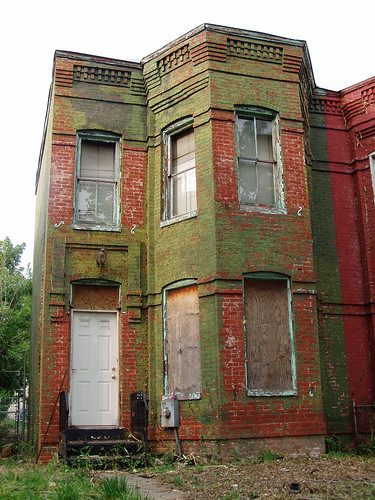
Frame Italianate rowhouse, 800 block of 10th Street NE, Washington, DC
800 block of 10th Street NE

For example, the vacant lot to the right of this building had been occupied by a frame rowhouse practically identical to the one still standing. But a condemnation order led to its being demolished. 

This was around 2002-
2003. But by 2005 definitely, the real estate market in this neighborhood had turned the corner.

The house still standing is valued at about $700,000 for tax purposes, and in 2018 the vacant lot sold for over $400,000.

But the property is still vacant today, and it is going on 20 years.

Had the property been improved and sold and lived in by a couple people paying property, income, and sales taxes, and hopefully patronizing local businesses and even contributing to community improvement, the city would have been far better off.

I have to believe that having a different process, focused on keeping the existing property intact, but fixing it up, would have been the better choice.

There is an article in the Richmond Times-Dispatch, "'I almost started crying when I saw it': A historic house tied to the Underground Railroad was demolished in Petersburg" about the demolition of a property on Pocahontas Island in Petersburg, Virginia. The city issued an order to condemn the building.

From the article:
Twitty recently received notice from the city’s code compliance department to repair or demolish the deteriorated structure.
Photo: Daniel Sangjib Min, RTD. 

“The owner took the demolition route,” Sangregorio said.

Twitty had rejected offers to sell the property, including from members of Stewart’s family and Preservation Virginia, whose CEO, Elizabeth Kostelny, called the loss of the house “tragic and completely unnecessary.”

“Many groups and individuals had shown great interest in helping to save and rehabilitate the structure,” she said.
Google Street View image of 215 Witten Street, Petersburg, Virginia.

Instead of fixing it up, the owner tore it down.

And given that May is National Historic Preservation Month, this is particularly noteworthy because the house "was old" and folklore connected it to the Underground Railroad story.

In any case, a vacant lot, in a weak market, is likely to remain vacant for decades.

But the city could have gotten a different result with different processes. The policy goal for such a house and such a neighborhood should be  conservation of existing buildings, not just for reasons of history and/or historic preservation, but because the likelihood of new construction happening is remote.

Instead of issuing a condemnation order or allowing for a house to be demolished, the process could have involved receivership ("Receivership as a strategy for notorious nuisance properties," 2017) where a third party is able to step in and fix it, and even eminent domain to force the sale of the property in a situation where the property owner is unwilling to maintain the property in a manner that maintains the health, safety, and value of the community.

In the Ohio receivership program, the entity that cures the nuisance can be awarded the property through a separate legal process.

Labels: , , , , , ,

Thursday, August 24, 2017

Revisiting the need for "Tower renewal" (multiunit) programs

One of the unintended consequences of the kind of "fractional ownership" that is created by condominiums is that when properties are on the decline, it can be difficult to get a majority of owners to agree to take the necessary steps to arrest the decline, and that's the case even if they have access to financing, which in the case of many declining properties is not the case.

-- "The long term potentially negative aspects of condominium buildings as a dominant housing form in cities," 2016
-- "Deeper thinking/programming on weak residential housing markets is required: DC example, Anacostia," 2012

The US Department of Housing and Urban Development has long had a program designed to help fund renovation of aging multiunit affordable housing buildings.

But as multiunit buildings age, support programs may be needed whether or not the buildings are "affordable" or social housing or market rental buildings or owner occupied buildings.

Because Toronto's housing stock is about one-half multiunit, they've responded to this problem by developing the "Tower Renewal" program ("Tower renewal: The Watergate and Southwest DC, and Toronto," 2011).

-- Tower Renewal Partnership
-- Understanding the Tower Landscape, report

While some communities have implemented one element of the Toronto program, energy efficiency loans, few communities have developed the broader program.

There is a special need to step in when multiunit buildings are in otherwise weak real estate markets, where more can go wrong, risk is higher, and financing is more difficult to obtain.

This comes up again as the Washington Post reports on how residents of a condominium community in Prince George's County, the Lynnhill Condominiusm in Temple Hills, were forced to vacate because of fire code and building code violations ("Lynnhill Condominiums in Temple Hills shuttered for fire code violations").

Of course, the deadly Grenfell fire in London a couple months ago also brings attention to the concept of "tower renewal," and the necessity of focusing on what is most important.  There, tall residential buildings aren't required to have sprinklers.  See "Lessons of the Grenfell blaze: How can Canada's thousands of aging towers be kept safe," Toronto Globe & Mail.

Interestingly, there is one other tool in the toolbox, "receivership," which it happens I suggested be applied on the Lynhill Condominiums back in 2014: "Receivership is an underutilized tool: Lynhill Condominiums in Prince George's County, Maryland."

Doing nothing in the three years since ends up helping no one at the Lynhill Condominiums.  Then the issue was a large water bill that hadn't been paid for a couple years.  The unpaid bill was an indicator of worse to come.

Toronto’s new Residential Apartment Community zoning category, by loosening up the rules on tower neighbourhoods, aims to advance social integration and economic development.  ILLUSTRATION BY DANIEL ROTSZTAIN

Placemaking initiatives for multiunit communities.  It happens that the Toronto Globe & Mail just published an article ("Towering ambitions") about how to make tower communities more livable, by allowing the inclusion of retail opportunities and other amenities. 

But that's more a strong or stable market issue, and density.  If you have the right density (a/k/a "potential customers") retail can work.  If the basic problem is too small a market, it's difficult to do anything, because adding housing in a market with weak demand isn't feasible.

Environmental sustainability and multiunit housing.  See "Toronto Green Multiunit Building Challenge," 2016.

Labels: , , , , , , , ,

Friday, February 17, 2017

The answer is: Receivership

The question is posed by the headline of this Washington City Paper article, "What Can Elected Officials Do About D.C. Slumlords?" From the article:
“It’s frustrating because we have incredibly strong tenant protections, and yet negligent landlords still find a way to persist,” [Councilmember] Nadeau says. “That’s one of the biggest challenges that we face.”
I wrote about this earlier in the month (See "Receivership as a strategy for notorious nuisance properties"), in response to a City Paper cover story on a slumlord, making the same point:
Receivership.
In that article, Mari commented (which I seem to have missed), writing:
Why they aren't being seized... might be because of what happens the day after the property is seized.

DC government is a lousy landowner. When DC Gov takes a property it will sit vacant for years..... YEARS. DC Gov also doesn't appear interested in being a landlord. To hand if off to a non-profit seems interesting, but what non-profit out there that presently exists that is a real non-profit and not a "non-profit" that only exists to get contracts from municipalities? 
Taking a property would make an impact, but it would also use up a lot of resources.
This is my response:
I missed this comment. You are of course, absolutely right.

In my early writings, I joked that DC's primary property management strategy is "demolition by neglect." And that in an objective evaluation, using criteria of the Housing Courts in Ohio, DCG wouldn't be deemed a credible and eligible receiver, based on past practice.

That's why starting from the very beginning, I've argued that DCG shouldn't be the receiver, but capable nonprofits.

In Ohio, such activities are monitored by the Housing Court, so a receiver has to act, implement the plan to cure the nuisance, or they lose control of the property too. And receivers that fail don't get properties awarded to them in the future.  [added -- Failure is not rewarded, unlike the current process.]

I can't claim to know all the ins and outs of the various nonprofits in DC, but one that I observe to be very credible is Jubilee Housing. An organization like that could become a receiver.   (There are some good for profit property managers. They could act as receivers too.)

In Cleveland, it was the Cleveland Restoration Society (but because the job was so difficult, they got out of it for awhile). They were motivated to save historic properties from demolition.

And recently I wrote about a "nonprofit" business in Philadelphia set up to cure nuisances and make them habitable, usable properties that strengthen the neighborhood. (I can't claim to like their design choices but they do good work otherwise.) See "A great example of the market at work: making a business in restoring blighted properties/curing nuisances (Philadelphia)."

Labels: , , , , , ,

Sunday, February 05, 2017

Receivership as a strategy for notorious nuisance properties

The Washington City Paper has an important cover story this week, "Life Is Hell for Tenants of Giant D.C. Slumlord Sanford Capital," about the systematic abuse of tenants by a residential property owner that seems to specialize in poorly maintained properties catering to the extremely impoverished.  The company has been sued off and on over the years.

Washington City Paper photo by Darrow Montgomery.

For as long as I've written this blog, I've mentioned how some states and cities have very strong receivership statutes, which allow for the seizure of properties, in order to "cure" nuisances and correct behavior. Ohio has a particularly strong statute.

-- Ohio Revised Code; Title 37: Health-Safety-Morals; Chapter 3767, Nuisances; Section 3767.41

 Pennsylvania too ("Pennsylvania passes receivership law with regard to vacant/nuisance properties," 2010). Also see "When tax lien sales further, not staunch, disinvestment: Indianapolis," 2015.

Note that DC Government's management of properties is not such a great track record that they ought to be the manager of such properties. In my writings, I've suggested this authority be given to nonprofits, as is the case in Ohio. To win receivership, a management and action plan must be created and approved by the Housing Court. To clear title of liens and to be awarded the property, the nuisances have to be successfully cured.

Why Sanford Capital's properties aren't being seized is beyond me. (Other than the fact that the city doesn't want to have to have too contentious a relationship with commercial property owners.)

Having such a statute and process in DC would go a long way towards correcting the negative actions of companies like Sanford Capital.

Taking the property will have a lot bigger impact than paying a legal judgement, which is tax deductible.

Labels: , , , , , ,

Monday, January 09, 2017

A great example of the market at work: making a business in restoring blighted properties/curing nuisances (Philadelphia)

Many times I have written about how the State of Ohio has a strong receivership statute which allows nonprofits to take over properties that are "notorious" nuisances, "cure" the nuisance, and get awarded ownership of the property, which they subsequently sell.

The Cleveland Restoration Society has acted under that statute to fix properties and preserve their historic character, and then to sell them to property owners committed to maintaining the property ("Housing receivership to cure nuisance properties").

Pennsylvania has a similar law, called Act 135 ("Pennsylvania passes receivership law").  In Philadelphia, two people have created a business of curing nuisances and fixing properties on behalf of nonprofits ("These guys are Philadelphia's professional Blightbusters," Philadelphia Inquirer).

From the article
Operating under the more-corporate-sounding Scioli Turco Inc., they have mastered the ins and outs of an obscure state law called Act 135 that enables nonprofits to take control of blighted properties, fix them up, and sell them ("Philly nonprofit finds way to reverse blighted properties," Philadelphia City Paper). The owner gets the proceeds, minus the cost of repairs and Scioli Turco’s expenses.

It sounds almost too easy, yet Scioli Turco’s successes with Act 135 promise an alternative to the usual, slow-moving approach to attacking Philadelphia’s blight problem.

Scioli Turco is the brainchild of two Bella Vista activists, Joel Palmer, a retired pharmaceutical salesman, and Jeffrey Goldman, a database analyst. Frustrated by a long-vacant VFW post in their neighborhood, they asked the courts in 2011 to appoint them as the building’s conservators under the Act 135 rules.

Using their own money and loans, they put in $100,000 to stabilize the building. After selling it for almost three times that amount, Palmer said, they realized “the process was scalable” and decided to form a nonprofit to pursue other eyesores. ...

Since then, Scioli Turco has rescued 50 problem properties, not just in Bella Vista, but around the city.
Seems like a pretty creative and proactive method for revitalizing neighborhoods and addressing persistent problems.

-- Implementation and Best Practices Manual, Pennsylvania’s Abandoned and Blighted Property Conservatorship Act, Regional Housing Legal Services
-- Using Conservatorship to Reclaim Properties: Case Studies

Labels: , , , ,

Thursday, August 18, 2016

Reclaiming Vacant Properties Conference, 2016, September 28th - 30th, Baltimore, Maryland

The Center for Community Progress, which focuses on assisting communities in dealing with property abandonment in the face of weak real estate markets and broken economies, sponsors a national conference on the topic each year.

Next month, the 2016 conference will be held in Baltimore, Maryland.

Early bird registration rates are available through the end of August, which saves $200 over the cost of a regular registration.

-- Reclaiming Vacant Properties Conference (RVP) 2016
=======
When I first heard about the organization, based on actions in Genessee County and Flint Michigan ("The Man Who Owns Flint," Governing magazine and "Not just Flint: Philadelphia wrestles with vacant property, tax cheats, Flint Journal) I was somewhat horrified, because the national press seized on their work as an example of widespread demolition being "the only solution" for inner city neighborhoods when the reality is much more nuanced.

Once a building is demolished, it's gone.

The west side of the 800 block of 10th Street NE in the H Street neighborhood of Washington, DC had been frame houses.  Most were demolished in favor of a community development corporation ersatz brick rowhouse project constructed about 15 years ago.  

Next to the still standing Italianate frame rowhouse was a similar building, which the city condemned sometime around 2002, and the building was demolished.  Had it been renovated, today it would be worth close to $1 million.  Instead, there has been a vacant lot for almost 15 years.  Google Street View image.

Some neighborhoods are capable of recovery, even if over long periods of time. And demolition doesn't cure the real problem, which is disinvestment. Instead it creates a different problem, vacant land.

In 2002, I learned about how the State of Ohio has a strong receivership statute, which allows for nonprofits to take over vacant properties, and when properly "cured" (fixed up), they can be awarded the property and it can be resold. The Cleveland Restoration Society did this a lot to help to stabilize neighborhoods, fixing up historic properties and then selling them to people committed to living in the property going forward. This has helped to stabilize neighborhoods that otherwise would have declined in the face of the region's population shrinkage.

Alan Mallach's book Bringing Buildings Back is an excellent primer on neighborhood stabilization through focused attention on vacant properties.

-- "Bringing buildings back is really about bringing neighborhoods back" (2006)

In DC, for a number of years I testified in favor of creating a similar statute here -- because most properties in DC neighborhoods are capable of being restored as the real estate market even 15 years ago was comparatively strong -- but the City Council never seemed too interested. Instead, the City Government is the prime actor in dealing with vacant properties, and for various reasons it isn't particularly successful.

-- "Slumlording isn't always so simple" (2014)
-- "Pushing rehabilitation of vacant buildings/nuisance properties" (2012)
-- ""Why I hate DC" or the appropriate tactical strategy to apply to nuisance properties/ disinvestment is investment, not demolition" (2009)

Fortunately, the Center for Community Progress promotes nuanced responses to the vacant property problem, even if that isn't always communicated in media coverage.

Labels: , , ,

Friday, December 04, 2015

When tax lien sales further, not staunch, disinvestment: Indianapolis

DC has had issues with its program of selling tax liens.  Today's DC real estate market, very strong overall, is much different than it was more than 15 years ago, when the DC Government began an aggressive program for selling property tax liens.

The idea behind the program was to get languishing properties into productive use, by selling the lien, and the lien owner being motivated to get the tax debt paid with interest by the property owner, when if not paid, the lien owner gets the property and most likely then sells it, which eventually leads to it being reoccupied.

But many of the liens involved people who could no longer take care of themselves well, and people lost properties over tax debts as little as $150 ("Left with nothing" and "Jonetta Rose Barras: What lies beneath D.C.'s tax-lien abuses," Washington Post; "Meet the Man Behind D.C.'s Predatory Tax Lien Practices," Washington City Paper).  This problem is slowly being rectified in DC.

Although I will say that activists attempted to raise these issues at the time, but their remonstrations were ignored.

Land banks.  In weak real estate markets, acquisition of properties through tax liens and the creation of land banks has been a strategy to deal with disinvestment and abandonment (I don't like to use the word "blight" because blight is a condition that results from disinvestment).

Dan Kildee, at the time county treasurer in Genessee County, Michigan, which is centered around Flint--which has been devastated as a result of the decline of General Motors and the shutdown of multiple automobile manufacturing plants that had been based in and around the city, developed an aggressive tax lien and land banking initiative that became a national model ("Ten years of fighting blight: Genesee County Land Bank," Flint Journal).

Later, Kildee created the Center for Community Progress as an organization to foster the concept and to provide training and technical assistance to communities in similar situations.

My concern at the time when Flint and Dan Kildee got a lot of national media coverage, was that attention failed to make the distinction between "strong" and "weak" real estate markets, and there was an almost blanket support for demolition as the primary strategy ("Genesee County Land Bank says it has demolished 1,800 houses since 2013," Flint Journal.  In potentially strong markets, it's far better to save and rehabilitate properties.
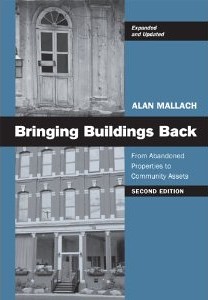
Bringing Buildings Back by Alan Mallach
It's not enough to acquire property, the trick is building demand so properties can be rehabilitated and occupied.
Wayne County Michigan, where Detroit is located, has been similarly aggressive in land banking. But the problem in weak markets is not necessarily acquiring or assembling properties, it's lack of demand to either buy, renovate, and reoccupy properties, or to build new buildings on now vacant land.

This is why I say "demolition" of properties isn't a solution.  A nuisance property may be demolished, but the problem isn't eliminated.  Instead, a new problem, a vacant lot, has been created. And often it is harder to develop a vacant property than it is to fix a disinvested property.

The book Bringing Buildings Back is a good resource for addressing the problem, as are focused neighborhood improvement programs like Baltimore's Healthy Neighborhoods Initiative, and Baltimore's resident recruitment initiative, Live Baltimore.

Historic Macon Foundation has been particularly adept at focusing historic preservation housing rehabilitation in neighborhoods in the city's core.  One of their initiatives worked with Mercer University, which wanted to help improve the neighborhoods abutting their campus.

HMF argues that their approach has moved from focusing on individual exemplary houses to preserving and improving entire neighborhoods. It's a shift in perspective that still (sadly) is noteworthy and exceptional.

-- Neighborhood Revitalization presentation, Historic Macon Foundation

Over time, some states have developed similar initiatives based on the Main Street commercial district revitalization approach, but applied to neighborhoods.  In Pennsylvania, they called it the Elm Street program.

But these programs tend to wane over time, partly because it takes many many years to develop demand and "fix" languishing communities, and because as political administrations change, so do their priorities, and programs such as these are often seen as being Administration-specific rather than "good programs" that need need to be supported over long periods of time.

This residence, at 1517 N Kealing Ave., is owned by Mt. Helix, the worst code violator in the city of Indianapolis. (Photo: Robert Scheer / The Star)

Indianapolis and tax liens.  Starting in mid-November, the Indianapolis Star published a number of articles about problems with the tax lien system there.

Unlike the system in DC, which from the standpoint of getting properties reoccupied, has worked, because DC is a strong real estate market with greater demand for housing than there is supply, in weak markets, the tax lien process can make the situation worse, not better.

The series kicked off with "Blight Inc.: How Our Government Helps Investors Profit From Neighborhood Decay." From the article:
Indianapolis is pockmarked with 6,800 abandoned homes that stunt property values, attract crime and destabilize neighborhoods. But one of the primary causes is mostly hidden. And it is, in large part, enabled by our own government.

An Indianapolis Star investigation has found that, increasingly, the empty house next door is not owned by a bank or an individual, but by one of many investors, often from out of state, who are enticed by the prospects of cheap homes that can be purchased — sight unseen and in bulk — at government tax sales. ...

The Star found that oftentimes these companies don’t make the needed improvements or even maintain their homes. Many of the houses languish neglected and empty for years. Some for as long as a decade. And the system makes it easy for investors to walk away without paying their taxes. In some instances, homes go to tax sale again, and again, and again.

... The Star’s examination of eight years of tax sale data showed investors walked away from more than 6,000 properties and stiffed Marion County for at least $28 million in uncollected taxes. Meanwhile, our government spends millions every year cleaning up trashed properties, issuing code violations, subsidizing redevelopment and responding to emergency calls to unsecured empty homes.
Because there is a "national system" for investing in tax liens ("Tax sales support get-rich-quick cottage industry"), which the Indianapolis Star describes as having been created during the Depression, national actors tend to be better equipped to acquire the liens.

As a result, area residents and organizations who would normally be motivated to take over properties to fix them and to get them reoccupied to help stabilize and improve neighborhoods, rather than profiting from it, are outbid by the national firms ("When neighbors wage war on blight: 'It;s extremely frustrating") and more often than not, because the properties are in weak market neighborhoods, tax lien properties continue to decline further ("Fires, drugs and murders haunt one company’s empty homes") because of mismanagement, failure to market the properties, or deliberate fraud.
Tax lien property in IndianapolisThis house, at 1909 Cornell Ave., has gone to tax sale four times. It is now owned by San Diego-based Mt. Helix, the company with the most abandoned homes in Indianapolis. (Photo: Robert Scheer / The Star)

As the Star points out ("Declining neighborhoods: Indy's auction block) it doesn't make sense that neighborhood decline is furthered by government action because of the way the tax lien system works, rather than being abetted by it.

This particular article is a definitive discussion of the tax lien system, and its problems.  

Receivership as an alternative. Not all land banks work out well ("Land bank, hit by scandal, holds back as blight spreads") and frankly, sometimes often alleged nonprofits can be mendacious too, as past history in DC has proven. The Indy Star series also uncovered malfeasance by nonprofits working with the tax lien companies, and failing to improve properties.

But many years ago I learned about receivership statutes in Ohio, which are another model for how to deal with nuisance properties (see "Eminent domain and receivership to "cure" habitual nuisances").

-- Preservation Services - Cleveland Restoration Society
-- Cleveland Restoration Society Saves Historic Van Sweringen Demonstration Home in Shaker Heights – now For Sale to a Preservation Buyer, press release

There, nonprofits can petition to take over a nuisance property, provided the Housing Court approves their plan for "curing" the nuisance. When they fix the property, they can then petition the Court for ownership of the property and waiver of liens. The organization then sells the property to residents committed to maintaining the property. The organization may lose money on the sale, but the neighborhood wins, because instead of a vacant property or lot, they now have a rehabilitated house with residents committed to the house and the neighborhood.

The key element of this process is that the nonprofit can't get ownership of the property until they cure the nuisance. Control is conditional on successful action. Having tight accountability mechanisms is a key difference between successful and unsuccessful programs.

But financing remains a problem. Nonprofits typically don't have a lot of money and staff, so they can do this for only a few properties at a time, and have to wait for the proceeds from the sales of properties before they can take on new projects.

Other innovative programs for neighborhood stabilization.  A few years ago I mentioned a Wall Street Journal article about a community-focused bank that had few problem residential mortgages, because they kept the loans they "originated," so they were motivated to be diligent (see "When locally/regionally owned companies make a difference over national firms").  This demonstrates the importance of community-headquartered banks, which focus on portfolio investing, making high quality to residents and businesses within their communities

Cleveland Restoration Society has developed another innovative program with the First Federal Bank in Lakewood (a suburb of Cleveland), where people can get loans from the bank to rehabilitate and occupy otherwise disinvested properties ("Cleveland Restoration Society, First Federal offer incentives to sell vacant, rundown homes," Cleveland Plain Dealer).

This program builds on another CRS loan program, called the Heritage Home Program, which has funded the improvement of over 1,000 historically designated residences.  That was funded in part by "Community Reinvestment Act" related financing tied with the City of Cleveland putting its accounts at banks agreeing to fund the program.
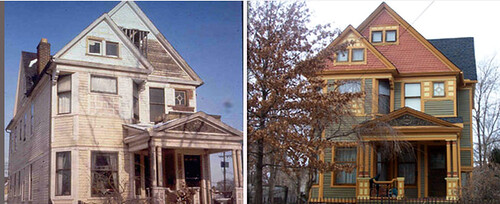
Home improvement via the Cleveland Restoration Society
>A before (left) and after of a home renovated with the help of the Cleveland Restoration Society's Home Heritage Program. CRS announced an expansion of the program Thursday. 

And unlike the firms active in Indianapolis, one company that has purchased a lot of foreclosure properties around the country, REO Homes LLC, has found it is good business to contribute to community improvement efforts in order to build the value of its own properties (see "Interesting wrinkle on neighborhood revitalization: investor fixing nearby properties to raise own property values").

Conclusion.  Property tax lien programs can be a negative, not a positive, for community stabilization and improvement, depending on the intent of the companies that are involved.  It can make more sense to create different kinds of programs that keep ownership and improvement of properties in local hands, rather than to expect non-local firms to be motivated in the same way to do a great job and focus on long term property and neighborhood stabilization.

(I can't claim to be aware of all the great programs and models that are out there.  I do know that many such programs exist and we need to raise the awareness of these programs and what works so that more communities can refocus their programs for better outcomes.)

A side note: too often the web doesn't substitute for high quality investigative reporting by local newspapers.  The Star says this is what it did to produce the series of articles:
The Star conducted more than 50 interviews with public officials, developers, residents, experts and corporate executives; and analyzed data from numerous sources, including: Eight years of Marion County property sales data; more than two years of data from Code Enforcement, police, fire and medical services; Marion County property records; and property value data maintained by the Polis Center at Indiana University-Purdue University Indianapolis.

The Star also visited Baltimore and San Diego, examined blight reduction programs in five other cities, and reviewed hundreds of pages of academic articles and case studies.
That's a lot harder than rewriting a press release and not asking any questions concerning whatever remains undisclosed.

This kind of time, depth and perseverance was once typical of newspapers focused on local reporting and improving communities, backed by the money generated by newspaper sales and advertising.  As both sources of revenue have declined precipitously, it is rare for newspapers to take on these kinds of investigations.

Newspaper chains are frequently criticized for dumbing down their papers, but perhaps more than most, the Gannett Newspaper chain has remained committed to funding investigations at many of their newspapers (e.g., earlier this year, the Sioux Falls Argus-Leader produced a nice series on the importance of focused teaching of reading skills).

The Star series definitely rises to the same level as two great Chicago Tribune series, "Squandered Heritage" on demolition of properties eligible for historic designation, and "Neighborhoods for Sale" on real estate development and aldermanic privilege .


Graphic from the Indy Star series.
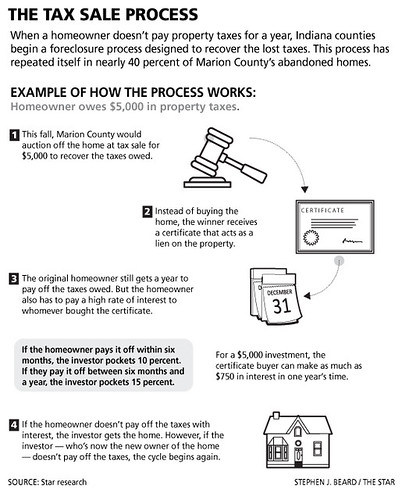
How tax lien process works

Labels: , , , , , , ,

Tuesday, January 06, 2015

Eminent domain issues in DC come up again

Today's Post reports ("Eminent domain could spell end to DC neighborhood's 25-year fight against trash") that Ward 5 Councilmember Kenyan McDuffie wants to use eminent domain to seize an unwanted trash transfer station, ostensibly because DC Water needs space to replace a facility in the Capitol Riverfront district that is slated for commercial redevelopment.

Eminent domain is supposed to only be used to satisfy an evident public purpose, and the idea here is that DC Water needs a space to relocate some of their facilitiles.

The shotgun-style house at 1229 E St. SE in DC's Capitol Hill Historic District has been neglected and boarded up for years. (Ileana Najarro/The Washington Post)

It happens that I am a "fan" of execution of eminent domain authority in certain instances, although more as a threat for getting property owners in line in terms of maintaining their properties.

For example, instead of letting properties rot for decades, like the shotgun house on Capitol Hill (see "Eminent domain and receivership to "cure" habitual nuisances") the city should seize the property, or at least threaten to do so,

I don't think the city would have to go to this extent very often.  If they did it a couple times, afterwards, the possible threat of it happening would be enough of a cudgel to get most property owners to do what they are supposed to do anyway--maintain their property.

Alternatively, some would become motivated to sell the property to someone else willing to do the work necessary to get the property up to code.  That's what already happens with DC's extremely underutilized or inappropriately focused condemnation process.  (Some of the officials are too quick to approve demolition, not caring that's what the property owner wants to do anyway, which is why they've neglected the property to begin with.)


Eminent domain for commercial property development is more tricky.  I do like the framework for consideration as proposed in this op-ed, "Make eminent domain fair for all," published in the Boston Globe in 2005, in response to the Kelo decision.

From the op-ed:
State court judges have emphasized in the past that, to comply with the Massachusetts Constitution's own requirement that eminent domain be for a public use, the government must demonstrate that eminent domain will really benefit the public. New legislation could respond to that by:

-- Requiring, as Justice Anthony M. Kennedy suggested in his Kelo concurrence, that any exercise of eminent domain for economic development have a primarily public purpose rather than a merely incidental one.

-- Requiring the government to demonstrate the public benefit through a full-scale financial analysis that could be challenged in court.

-- Requiring that eminent domain not be used for a solely fiscal purpose and that it instead must be part of a comprehensive land use plan.

-- Requiring that the affected neighborhood have adequate participation in the planning process, a right that would be backed up by state-provided technical assistance upon the neighborhood's request.
I think these are pretty good guidelines that appear to be blown off by too many jurisdictions. It is because of the frequent mis-use of eminent domain authority, not just ur-beliefs about the sanctity of property rights, that so many people are so concerned and worked up about eminent domain issues.

2.  Getting to today's article, I can't see how the proposed use of eminent domain would not be deemed a taking. Property takings are unconstitutional.  That's why the public purpose has to be clear and evident for a government to be able to seize a property.  Remember, that ultimately the property owner is compensated for the property, but usually the level of spending is disputed.

The particular site is not the only possible private property to which DC Water could relocate.  DC already owns properties that could be appropriate for DC Water.

It seems pretty clear that the proposal is designed to rid the area of an unpreferred use (although according to residents, the DC Water use would be equally disfavored) with something else, despite an agreement in place to let the facility operate until the 2030s.

3.  Plus, a good lawyer for the trash transfer station could argue that the city wants to put the facility out of business in order to capture more business from private trash collection companies.  Such firms using the city's trash transfer facilities, such as at Fort Totten, pay a fee to dump the trash.

Such an action would be anti-competitive and illegal also.

Labels: , , , , , ,

Tuesday, July 22, 2014

Eminent domain and receivership to "cure" habitual nuisances

One of the people that Suzanne works with doesn't live that far from us--about one mile away, but south, much closer to Kennedy Street--which is one of the problem streets in our greater neighborhood, so the quality of life for her family is much different, because they have nuisance properties on the block (one vacant, in another the resident is engaged in prostitution, but she goes over to the vacant house, etc.), nuisance neighbors, and terrible luck--the most recent being a stolen car ran into their sidewall (they live at the end of a block of rowhouses, abutting an alley) doing significant damage to the masonry.

The stories remind me of how f*ing hard it used to be to live north of H Street NE back in the day--the burglaries, muggings, assaults (the car we rented for our honeymoon was stolen), etc. that I experienced, the crime in general, the murders and drug sales in the area, etc.  I stuck it out but my ex-wife didn't and frankly, it takes way too much energy to have to deal with it.  I don't have the energy to live in such conditions now.

It also reminds me of the critical mass of "revitalizers" being necessary to turn around problem areas.  See "Revitalization in stages."

Receivership statutes.  In talking over the latest b.s. that Suzanne's colleague is dealing with, I mentioned receivership as a needed option in DC--because it takes years and years and years to force changes with recalcitrant property owners and how I used to testify a lot recommending that the city enact receivership statutes to facilitate this ("Receivership for housing," ""Why I hate DC" or the appropriate tactical strategy to apply to nuisance properties/ disinvestment is investment, not demolition," and "Pennsylvania passes receivership law with regard to vacant/nuisance properties") comparable to the State of Ohio.

Instead, DC's property abatement laws and regulations are incredibly complicated and put too much responsibility on the city government to act, when typically government agencies aren't supple enough and have a limited number of tools to work with when it comes to individual properties.

As a kind of example, see the article in the Post ("Old home's restoration helps to restore pride in Anacostia") about how the L'Enfant Trust is rehabilitating a property in Anacostia that has been vacant for many years.  That's the kind of action I anticipate if we had the right receivership statutes and procedures in place.

The shotgun-style house at 1229 E St. SE is seen in the Capitol Hill Historic District. (Ileana Najarro/The Washington Post)

Eminent domain.  But earlier this evening we we had been talking about the shotgun house debacle in Capitol Hill ("Pre-Civil War shotgun house in the hands of D.C. preservation board," Washington Post) which has been going on for more than one decade ten years (this City Paper article is from 2002, "Dwelling in the Past: Larry Quillian wants to raze his shotgun shack") ... and I said, the city should have taken the property by eminent domain years ago.

Sure the city would have had to pay for the property, but if they would have exercised that sort of power even just a few times against particularly egregious property owners, word would get around, and negligent property owners would start cleaning up their act, knowing that a property seizure was in the realm of possibility.

(Not unlike how the DC Department of Housing and Community Development seized the Park Southern Apartments, because of financial improprieties mostly, but also poor management.  Although that was by receivership, not eminent domain. See "D.C. housing complex’s decline raises questions about management, politics" from the Washington Post.)

Note that at the National Trust for Historic Preservation national meeting in Portland, Oregon in 2005, eminent domain was suggested as an option, in one of the sessions I attended.   With regard to checks and balances on eminent domain, see "Making eminent domain fair to alL" from the Boston Globe (2005).

Labels: , , , , , ,

Friday, February 21, 2014

Receivership is an underutilized tool: Lynhill Condominiums in Prince George's County, Maryland

In "Deeper thinking/programming on weak residential housing markets is required: DC example, Anacostia" I discussed ways in which the DC Government can support the improvement of multiunit housing in impoverished areas, modeled on the Tower Renewal Project in Toronto.  (HUD also has a similar financing program to rehabilitate and preserve lower income housing that needs to be updated.)

But the need for "tower renewal" is more widespread.

Lynhill Condominiums on Good Hope Road in Temple Hills, Maryland.  Image from WTTG-TV (Fox 5).

Today's Post has an article, "Prince George's to condemn Temple Hills condo complex if water is shut off," about a failing condominium complex in Prince George's County just outside of the DC line--a two-bedroom condo sold there for $9,900 in 2013, the monthly fee is approaching $700, and the management company hasn't been paying the water bill which is now over $120,000, and so the Washington Suburban Sanitary Commission has sent a shut off notice.  If the water is shut off, the buildings will be condemned and everyone will have to leave, so that a few hundred people will be without housing.  Note that Fox5 reported on this last week, "WSSC will cut water to large condo complex in Prince George's County."

It makes more sense for there to be a receivership process, so that the government can step in and take over management of the building, to improve it, and to ensure that the WSSC bill gets paid, but also so that people aren't displaced.

I have written about the receivership process as it is used in the State of Ohio on historic preservation matters ("Housing receivership to cure nuisance properties: the option that DC refuses to consider").

Prince George's County needs to explore that option pronto, for this and other properties.

Labels: , , ,

Monday, January 06, 2014

Slumlording isn't always so simple

Right:  A house being rehabilitated in Detroit by DIY Network's Nicole Curtis.  Caption: Curtis also bought the charred remains and lot of the house next door to the house on Campbell Street. It was destroyed in a fire. It took two days with a Bobcat to clear the lot, Curtis said on Facebook. "We were here for a week and half outside before we ever made it inside," says Sykes. (Nicole Curtis/Facebook)

There is coverage about an activist's campaign in Baltimore to call attention to vacant, abandoned, and poorly maintained buildings in the city--focused mostly on residential properties.  See "Foes of Urban Blight Take Aim at Landlords" from the Wall Street Journal.

Not that I want to defend a slumlord (and I have accused people of being such from time to time when they deserve to be so labeled), but as discussed in the entry on "abandominiums" in Anacostia DC ("Deeper Thinking, Programming Needed for Weak Residential Markets") property abandonment is most often the result of it being more expensive to maintain a property than it yields in rental income or the problems in successfully renting and managing the property exceed the skills, time, and financial capacity of the owner.

This is an especial problem in weak real estate markets and submarkets, with more supply of potential housing than there is demand.

I have discussed from time to time the book Building neighborhood confidence: A humanistic strategy for urban housing by Rolf Goetze, which was published in the mid-1970s, to which I was introduced in 2003.  Goetze was the director of research for the Boston Redevelopment Authority, and the basic point that he makes--discussing all these issues in far greater detail than I--that in such situations the government can and should step in and help in rebuilding confidence in a neighborhood through a property improvement strategy, but that the point of the investment is to rebuild the confidence of property owners in the neighborhood and in investing on their own, that the point isn't to create dependence, but to provide the necessary support.

Bringing Buildings Back by Alan MallachNote that a more current book on the same topic is Bringing Buildings Back by Alan Mallach.  See the past blog entry "Pushing the rehabilitation of vacant buildings/nuisance properties" for a more detailed discussion of this topic.

In cities like Baltimore or Detroit or Cleveland or St. Louis with tens of thousands of vacant buildings typically the city is so overwhelmed by the problem that it is unable to focus on the hard reality of addressing nuisance and vacant properties one site at a time.

This piece suggests creating neighborhood by neighborhood plans with detailed inventories of properties and thumbnail strategies and tactics for addressing the problems.

But the biggest problem is lack of demand and the reality that the cost of rehabilitating a property is far greater than the market value of residential properties in the area.

I have been thinking about this in terms of the tv show "Rehab Addict" on DIY/HGTV, which recently did a rehab of a duplex in Detroit ("Where others see blight, Detroit native Nicole Curtis sees a diamond in the rough" Detroit News).  According to Trulia, the value of the property is about $70,000.  And it probably cost around that much--except that tv shows end up getting donated services which cuts costs--to fix.

I am not saying don't fix the properties, just that yelling at someone that they are a slumlord ends up not helping very much.

And because "used houses" sell for so cheap, it's too expensive to build new single family housing for sale to owner-occupants, because the cost of new construction is greater than the cost to buy existing housing--and so properties won't appraise at the price necessary to get a conventional mortgage.

This is why to right the markets in such neighborhoods, public sector intervention is usually required.  At the same time, it's difficult for the public sector to choose winners and losers--saying that there are only so many resources to go around and that it's best to focus on neighborhoods with greater potential for improvement--so usually money is spread around to multiple neighborhoods but not at the level necessary to bring about critical mass improvement.

That being said, the neighborhood that Nicole Curtis picked does seem to be reasonably stable as opposed to many other Detroit neighborhoods, so that the project won't go for nought.

Labels: , , , , , ,

Friday, June 14, 2013

Housing receivership to cure nuisance properties: the option that DC refuses to consider

Vacant Rowhouse in Trinidad, Washington, DCVacant rowhouse in the Trinidad neighborhood of DC, photographed sometime before February 2006 by Frozen Tropics.

In 2002, I went to the National Trust for Historic Preservation conference, which was then in Cleveland, and I was exposed on a bunch of tours to the neighborhood stabilization efforts of the Cleveland Restoration Society and the Famikos Foundation.

Because Cleveland was and is a shrinking city, with minimal appreciation in housing prices, restoring historic properties doesn't came back in improved housing values the way it does in a strong market neighborhood in Brooklyn, or DC, or Alexandria, Virginia, or certain neighborhoods in Boston, etc.

In weak market cities the priority is neighborhood stabilization.  So often these organizations--at least back then, complemented by other city and county programs--would get control of properties and stabilize and improve them, often to the point beyond the amount a house could sell for in that market, in order to save the house and improve the neighborhood.

Disinvestment, 2nd and T Street NEBuilding at right at 2nd and T Street NE, around 2006.

I looked into this further and discovered that these efforts were aided by a strong State of Ohio statute providing for the ability to establish receivership for properties and a separate "Housing Court," to address housing-related matters.

Receivership can be awarded in order to cure habitual nuisances, and the Housing Court had the ability to award title for properties in receivership--provided that the nuisance was cured.  (DC nonprofits and the city have a bad habit of getting control of properties and then doing nothing with them for many years.  In such a situation, these entities ought not to be deemed "fit" to be able to be awarded properties through the receivership process.)

I was impressed and from 2002 to 2006, I used to testify about this before various DC City Council committees.  See "Receivership for housing" for part of the written testimony.  Eventually I stopped because there was no werewithal to take this concept up and apply it within DC.

The City Paper has a piece, "Lost and Foundering," about long term vacant properties in DC, and how the primary method that the city uses to get them back on the market--from the article:

D.C. has a system that’s supposed to prevent vacant and blighted properties from staying this way. If the Department of Consumer and Regulatory Affairs finds a property to be vacant, the agency slaps it with a 5-percent property tax; if it’s vacant and blighted, it becomes a 10 percent tax, a steep increase from the standard .85 percent rate for residential property. Generally, that charge is enough incentive for the property owner to fix up the building or sell it.

But what happens if the city can’t find the owner? When I visit 430 Manor Place, there’s a stapled packet of D.C. Superior Court documents taped to the front doorstep—Boese says these packets appear there periodically—detailing a lawsuit against the house’s owner, listed as “Estate of Irby L. Dickinson (a/k/a Irby Dickenson a/k/a Irby Dickson)” and “Unknown Heirs of Irby Dickinson,” both with an address in Birmingham, Ala. City property records show that “Irby Dickenson” bought the Manor Place property in 1945, though there’s also mention of an “Alma Dickinson” in 1968 and an “Irby Dickerson” in 1999, when the city put a lien on the house.

Vacant Rowhouse in Trinidad, Washington, DCLeft: another vacant property in the Trinidad neighborhood, photo by Frozen Tropics.

The primary method is to have a big tax on vacant property.  That does encourage sale to presumably better owners, but at the same time, it can encourage demolition, see "D.C. buildings linked to Armenian Genocide museum to be razed" from the Washington Business Journal, as an example.  Generally this is not in the public interest, but is done to reduce taxes.  (Something similar happened in the H Street neighborhood, with buildings next to the Atlas Theater.  The property owner got permission to demolish the buildings, which would have been contributing structures in a historic district, but H Street is not designated.  But the rise in value of the properties encouraged the owner to sell to a property owner disposed to take care of the property instead.)

Vacant building allegedly for lease, H Street NERight: this building on H Street has been up for lease for at least ten years.  One way to get around the vacant property tax is to slap up a for lease sign, even if you are asking way to much money to lease the building and it requires thousands of dollars in renovation costs, which the property owner is not willing to pay.

The secondary method is to move on a property in Condemnation Court.  Again, this will motivate some property owners to sell, but others will just demolish the property, which may have been their intent all along.  See "Dwelling in the Past: Larry Quillian wants to raze his shotgun shack" from the City Paper.  I think of a building demolished on 10th Street NE around 2002, in response to a "condemnation notice".  The lot is still vacant today and if they had just fixed up the property, today it would be worth in excess of $600,000.  This is not in the public interest either.

The third method would be to have a method to establish receivership for properties that are determined to be nuisances, just like in the State of Ohio.  That DC doesn't do.

Hence, the problem of having properties stay vacant, often for decades, or buildings that should be preserved, getting demolished, and the creation of new nuisances--vacant lots--that are just as hard to "fix".

--------
Also see the past blog entries, "Investment vs. Disinvestment," which discusses in part what I call "the language of revitalization" and  "Preservation Laws do matter," which discusses the necessity of having the right laws and remedies in place, in order to address demolition by neglect and other neighborhood stabilization issues.

-- and the book Bringing Buildings Back by Alan Mallach, see "Bringing buildings back is really about bringing urban neighborhoods back "

-- while focused on weak markets, the Center for Community Progress focuses on vacant property issues, including receivership.

-- Their annual conference on Reclaiming Vacant Properties is September 9th-11th in Philadelphia.

-- Also see the Washington Post story, "Manassas's 9300 Prescott Ave. home sees likely resolution to weary story," about a house that has been vacant for decades, and the inability of the locality to address the situation for many years, and how neighbors came together to buy the house in order to "cure" the nuisance.

Labels: , , , , , ,

Saturday, May 12, 2012

Pushing the rehabilitation of vacant buildings/nuisance properties

400 K Street NE
400 K Street NE, now undergoing renovation, after at least 24 years of being vacant.

In weak real estate markets, disinvestment is a real problem, and you have few tools at your disposal to turn places around, because investments in reconstruction of properties, and extranormal investments in multi-decade disinvested properties, don't necessarily come back in significantly increased property value.

This is something that I didn't really appreciate for a long time.  E.g., you can invest $100,000 or more in a "historic" (designated or not) house in many DC neighborhoods and the property value will increase by two or more times the cost.

In a place like Cleveland or Cincinnati or Rochester, NY, you can spend $100,000 for a house that would cost 5-7 times more than that in DC, but the investment in fixing it up, say $100,000 to $200,000, could take decades to come back in terms of increased value of the property ("return on investment").  So from the standpoint of economics, it doesn't make sense to make such an investment.  When it's done, it's done for "noneconomic" reasons.

That's why organizations like the Cleveland Restoration Society or the Landmark Society of Western New York have extensive rehabilitation, support, and financing programs, because to revitalize neighborhoods, they have to employ non-market solutions, because at the neighborhood level, the economies are broken.

This is hard for many people to understand with regard to DC, because they are relatively new to the city.  (But even in the bad years, the DC preservation community never really developed an array of tools and programs designed to assist homeowners in rehabilitating properties.  Here it's mostly been a ground-up effort.  Only in the past few years, has a tax credit program for homeowners been put in place, targeting certain disinvested neighborhoods.)

Up into the middle part of the last decade, many neighborhoods, especially commercial districts, suffered significantly from vacant properties.  Of course, much of this was generated by the riots after the assassination of Martin Luther King and the abandonment that resulted.

For example, in my old H St. neighborhood, which I moved into first in September 1987, I can think of three of my favorite buildings--one is still vacant since then, and the other two have only been started to be rehabilitated in the last 18 months--and who knows how long the buildings were vacant before 1987.

The City Paper Housing Complex blog has a great piece, "No vacancies: how nuisance properties turn around," on Reuben Pemberton, who runs the Vacant Buildings Unit for the Dept. of Consumer and Regulatory Affairs.  Mr. Pemberton appears to be an "odd duck" as far as DCRA is concerned, because according to the article, his focus is on using the vacant buildings tax penalties (in DC, vacant buildings are taxed at a much higher rate) as a fulcrum to get buildings back into productive use.

In my experience, other units of DCRA haven't focused on maintaining qualities of place so much as they have been on "immediate eradication of the nuisance," which for the most part, just creates a new nuisance.  E.g., a nuisance building that gets demolished then just becomes a nuisance lot, but that much harder and more expensive to redevelop.

I used to testify about this quite a bit, from around 2002 to 2006 (e.g., "Why I hate DC" or the appropriate tactical strategy to apply to nuisance properties/ disinvestment is investment, not demolition"). Now, as the city continues to attract new residents ("Census: DC adds 16,000 new people" from the Post), this problem seems to be working its way out.

It's much harder in weak market cities, much harder, which is why programs from organizations like the Center for Community Progress are so important.  (Their national conference is next month.)

Bringing Buildings Back by Alan Mallach covers the process very well also.  As Alan points out, the issue really comes down to making locations valuable again, so that there is demand for what are otherwise vacant buildings.  According to Rolf Goetze, buildings in the center city became vacant through overproduction of suburban housing, and outmigration from the cities to those properties.
Bringing Buildings Back by Alan Mallach

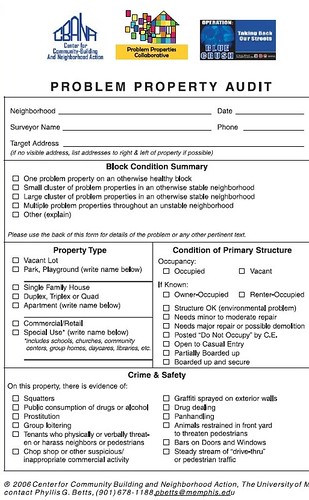
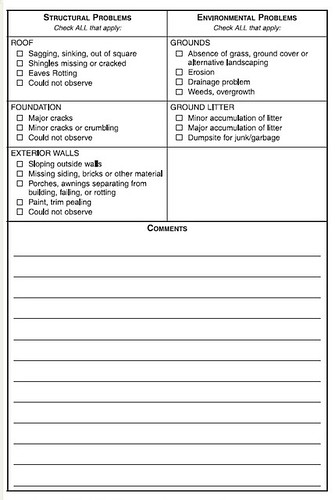
One thing that cities can do, is provide more tools to neighborhoods so that they can get a handle on vacant properties languishing within their communities.  For example, I am fond of the Problem Property Audit survey form from the University of Memphis.  I don't think that this kind of information is made available on a neighborhood by neighborhood basis in DC or in most cities.

Getting the tax policy right is really important.  In other places, like Ontario ("Guelph forum to investigate demolition-by-neglect" from the Guelph Mercury; note that the article is very good in describing the general problem of vacant properties and how to rehabilitate them) and in the UK, if a property is empty, the property taxes can be reduced.  This seems to me to be a nonsensical policy, as it is a disincentive to improving neighborhoods, even though the opposite is claimed by landlords.  On the other hand, in weak markets, it can reduce the pressure to demolish otherwise "worthless" buildings, preserving the option and opportunity for renovation at some point in the future.

-- Toronto Property Tax Rebate Program for Vacant Commercial and Industrial Buildings (it's actually a Ontario provincial law)

Another strategy, "receivership," is discussed in the testimony cited above.


Problem Property Audit, page 1 - University of Memphis
Problem Property Audit, page 2 - University of Memphis

Labels: , , , , , ,

Tuesday, December 13, 2011

A challenging art project about urban revitalization in Baltimore

For quite awhile, I've always contrasted the opportunities available to revitalizers in comparatively strong markets in cities like Washington, DC, versus much weaker real estate market cities like Baltimore, which has tens of thousands of vacant properties and neighborhoods with tough revitalization issues.

That being said, Baltimore has some great assets and a strong civil society and network of neighborhood organizations complemented by citywide capacity building and advocacy organizations like the Citizens Planning and Housing Association, so there are a number of interesting revitalization initiatives across the city e.g., in the past I've mentioned various efforts by the Reservoir Hill Improvement Council.
Whitelock Community Farm, Reservoir Hill neighborhood, Baltimore
Food for sale at the Whitelock Community Farm, Reservoir Hill neighborhood, Baltimore>

The Baltimore Sun has an article, "Art project uses vacant home to bring neighbors together: MICA students project film onto boarded-up house on Mount Royal Terrace," about a project by Sabrina Chin & Melissa Crisco, students at the Maryland Institute of Contemporary Art (this blog entry "Engaged civic/planning efforts" discusses a variety of other interesting urban planning related initiatives by other students) where they are projecting scenes from an active inhabited house on the windows of a vacant house at 2110 Mount Royal Terrace, which, yes, is in Reservoir Hill too, and one of many vacant houses there.
video being projected on 2110 Mount Royal terrace.
Photo by Sabrina Chin. Kim Forsyth is in the video.

From the article:

The hulking white duplex at 2108-2110 Mount Royal Terrace — a vacant eyesore for 20 years — is a financial and emotional drain on neighbors, who maintain a five-block stretch of historic homes that overlooks the Jones Falls Expressway and acts as the eastern border of Reservoir Hill.

But for two nights this past weekend, residents gathered on the sidewalk in front of the empty house, watching it and imagining what it would be like if someone lived there.

The occasion was an exhibit by two students at the nearby Maryland Institute College of Art, who used the 120-year-old home as a movie screen, with videos projected onto the plywood that covers the first-floor windows. The videos, of neighborhood residents performing household tasks, made it appear as if the house were lit up and bustling with activity.

"It reminds me of those murals you used to see, that kids would paint on boarded-up windows: a painting of a flower box, a cat sitting in the window," said neighbor and Baltimore City Councilman Nick Mosby as he and about 15 others stood in the chilly air Saturday night, sipping hot cider.


It definitely provides us with an opportunity to consider disinvestment and the difficulty that residents can have when it comes to "forcing" other property owners to maintain properties.

In Ohio, it's possible to get receivership control over habitual nuisances like this one. But you still need people willing to buy, renovate, and live in the property.

It happens that Mount Royal Terrace is beautiful. But that doesn't matter when you can't get particular properties back into productive use.
Mount Royal Terrace, Reservoir Hill neighborhood, Baltimore
Walkway, Mount Royal Terrace, Reservoir Hill neighborhood, Baltimore.

Other photos of Reservoir Hill which put working on revitalization in weaker markets in stronger perspective.
Reservoir Hill neighborhood, Baltimore

Attractive green boulevards, Reservoir Hill neighborhood, Baltimore

Vacant properties, Reservoir Hill neighborhood, Baltimore

Labels: , , ,

Thursday, January 13, 2011

Demolition, demolition by neglect, and the need for better laws and processes in DC

820 C Street SE
The boarded up building on the left is now a vacant lot. Google image. Is a vacant lot an improvement or a different sort of nuisance?

Capitol Hill is abuzz over the demolition of a building, 820 C Street SE, in the Capitol Hill Historic District. There is a particularly good review of the event in The Hill is Home, "The Little House That Couldn’t."

I got roped into a email-chain on the topic, where it was expressed that why couldn't the big bad Capitol Hill Restoration Society, "known for its terrorizing of good folk who want to do stuff to their houses" (mostly an overstatement but that's another issue) couldn't do anything, are they just like the Big Bad Wolf, focusing on the little issues and missing the big picture?

Of course, as in these kinds of cases, the issue is a lot more complicated. Basically, these little events are examples for the most part of deeper problems within the overarching set of building regulations that we have in DC with regard to nuisance properties.

The demolition of this building is an odd case, a problem that arises from a Chinese custom of the extended family retaining ownership of buildings owned by deceased relatives because of the belief that their spirit is still present in the house, meaning that decisions about the property are not subject to normal kinds of regulatory and market forces that militate against nuisances.

This is a problem on H Street NE too (which is why I learned about the impact of the Chinese custom on modern day revitalization), with 411 H Street NE, which has been vacant for decades for the same reason. The building with the maroon painted 2nd floor is the building in question. The last time I looked at the property, not having ever noticed before, there is writing on the window still advertising the presence of a once extant Chinese laundry on the premises. (Google image.)
411 H Street NE

In such situations, DC’s practices for dealing with nuisances, even in historic districts, are demonstrated to be inadequate. That’s the lesson here. Although the problem can be with any recalcitrant property owner, and have nothing to do with religion.

The problem is that the laws in the city are written relying on the goodwill of property owners to do the right thing. If the property owners aren’t so motivated, demolition is much more likely.

The one thing that the vacant property tax rate has done is move a number of property owners to sell.

But for people who for whatever reason aren’t subject to the laws of economics, even the vacant property tax isn’t enough.

Hence the demolition of this particular building.

If DC had a receivership statute providing for the seizure of properties in the case of notorious uncured nuisances, the demolition of this property wouldn’t have happened. I testified about the need for such statutes from 2002-2005 or so, but then I stopped because you can only repeat yourself for so long. (I will append sections of that testimony at the end of this entry.)

The thing that this particular case demonstrates also is that neighborhood organizations typically aren't positioned to be able to understand and globalize the issues and response properly, e.g., understanding how this problem reflects greater problems, and then mobilizing on a citywide basis to address it. Not to mention doing it.

Actually, CHRS is better on this kind of problem than most of the other neighborhood preservation groups because their interest area is greater than the strict boundaries of Capitol Hill, but encompasses the areas around and on the outskirts of the historic district, in undesignated areas. That's why they helped me on H Street issues with regard to historic preservation back when I was involved. They supported the creation of Main Street programs for Barracks Row (8th St. SE) and H Street NE, etc.

But still, there is a challenge with regard to identifying and rectifying broader problems, and gaps in local laws and regulations. That's why I became interested in receivership, because I came to believe it was the only way to address problems with buildings that couldn't be resolved by either the market or the enforcement of various building regulations.

______________________________________
From previous testimony to DC City Council on these issues:

1. Shortsighted nuisance abatement policies too often lead to demolition of historic properties.

Despite the demand for housing in DC’s core, many properties remain vacant, tied up by speculators who are aggressively unconcerned about how their behavior harms nearby residents and entire neighborhoods. Too often, demolition-by-neglect is used as a tool by speculators to assemble property for large-scale development and the conversion of predominately residential areas to commercial use. In the meantime, our neighborhoods are held hostage. When these buildings come down, it’s easy to think that since we have thousands and thousands of historic buildings, losing one doesn’t make much difference.

It does. Every demolished building becomes a vacant lot—negative space—defined by neglect.

Condemning a building and ordering it razed does not abate a nuisance. It simply creates a new nuisance just as persistent, damaging, and long lasting.

2. A Revised Nuisance Property Law is Necessary

In our opinion, the primary tool that the City employs to abate nuisance properties is demolition. Whether or not this is the intent of Council is unclear, but the fact is, by default, the Department of Consumer and Regulatory Affairs is setting prevailing neighborhood stabilization policies through its regulatory activities, and their actions appear to lean towards the razing of properties, rather than the promotion of rehabilitation and habitation.

Not only does tearing down a property destroy unrecoverable assets, it creates a new nuisance in its place, one even harder to abate. While it is true that housing inspections, "Clean it and lien it" and other fines and sanctions exist, such sanctions have impact only if property owners are truly interested in maintaining the building. If not, a property owner prefers to let it rot, and fines will have no impact. A property owner committed to “demolition-by-neglect” can afford the middling fines. The fine for demolishing a building illegally is only $500–chump change to someone trying to build something new that might not otherwise be allowed. By contrast, consider that in San Antonio, fines and penalties for demolition by neglect and illegal demolition are set at the cost of reconstruction. “Market value” fines are likely to be strong deterrents.

While the DC Council passed a new law concerning vacant and nuisance properties, it is unclear how successful this law will be in practice. I am not hopeful.

(a.) The law puts great demands on the Executive Branch, particularly the Department of Consumer and Regulatory Affairs, and it is evident through its words, deeds, and staffing that this agency is unable to meet these new demands.

(b.) Many DCRA inspectors lack critical expertise in assessing historic properties including critical structural engineering expertise, and they appear to be under-concerned about the importance of urban design and form. Given that more than one-third of buildings in this city are more than 60 years old, this knowledge deficit critically under-serves the city. The fact is, most properties can be rehabilitated, in most cases for less than the cost of razing and clearing a property and building new. To be fair to DCRA inspectors, they cannot be expected to know this if they aren’t trained in these assessment techniques, and if the system is stacked in favor of demolition.

(c.) The new law requires the identification and provision of monies to support the creation and operation of a revolving fund for property acquisition and rehabilitation. Money has not been forthcoming, paralyzing action in the interim.

(d.) Despite the existence of current laws requiring maintenance and habitability, many properties seem to escape the notice of inspectors for years and years, until finally the owner requests a demolition permit.

(e.) The Board of Condemnation of Insanitary Buildings, an entity within DCRA, is responsible for the abatement of nuisance properties but it tends instead to simply order their razing. Again, housing policies at the highest levels of the District government should favor the rehabilitation of historic properties, particularly houses, for many reasons. The “out of sight, out of mind” BCIB is perhaps operating in ways counter to the expectations of the City Council.

(f.) With regard to BCIB, it is troubling to discover that while this once was a board made up primarily of citizens, with a limitation of no more than one-third government officials, today the board is comprised predominately of government officials from DCRA, DPW, DHCD, and the Department of Administrative Services. Such officials are susceptible to lobbying by property owners and their representatives, and it is likely that these officials don’t always seek to have the properties independently evaluated by professionals with specific expertise in the stabilization and rehabilitation of historic properties.

While the Vacant and Nuisance Property Act does allow the District Government to take control of properties, this provision is unfunded, and it is likely that this authority will only be used once properties are too far gone to rehabilitate. In short, where are the real tools to take control of properties in order to stabilize and rehabilitate them, in situations where the owner has evinced no desire to maintain them in a habitable condition? This is especially important in DC where so much of the residential housing is attached. The beautiful rows of houses that make our neighborhoods so distinctive are endangered and adjoining residents are at special risk when a single row house becomes a nuisance.

Demolition punches gaping holes in the streetscape, and radically degrades neighborhood character. This kind of demolition of undesignated but eligible properties is going on all over the city and is counter to the neighborhood stabilization and improvement initiatives that the Council and Mayor endeavor to implement.

It is essential that the City Council revisit these issues. The Vacant and Nuisance Property Act and the Housing Act of 2002 are not yet enough to ensure that properties are being rehabilitated rather than destroyed. Agency actions need to be consonant with the desire revitalize neighborhood residential and commercial districts.

3. A Model Receivership Statute For Proactive Abatement of Nuisance Properties is Necessary

One way to address defects in current laws and regulatory activities is for the Council to pass legislation authorizing the appointment of independent receiverships able to take control of properties in order to abate evident public nuisances. Fines and inspections aren’t enough. And, the failure to fund the revolving fund authorized in the Vacant and Nuisance Property Act shows the necessity of identifying and allowing other interested parties to act proactively to revitalize and stabilize our neighborhood residential and commercial districts.

All the many activities that the DC Government is engaged in to restore our neighborhoods and bring people back to our city, from the City Living Campaign to the DC Main Streets program, are undercut by recalcitrant property owners who feel no obligation to maintain their properties. Acting only after a neighborhood suffers years of avoidable neglect fails all of us committed to a livable city.

I have lived in my neighborhood for most of 16 years. There are properties that were boarded up when I moved here – former corner stores and large and small houses, and commercial buildings on H Street–that are still boarded up today. Meanwhile a great deal of renovation is going on, and housing prices have as much as tripled due to increased interest and confidence in the neighborhood as a result of the construction of a new subway station on the northern edge of the neighborhood. But that has had little impact on absentee property owners with no motivation or desire to improve and/or sell their properties, or those trying to assemble large tracts of land for redevelopment.

(The new Class 3 property tax assessments will make a difference. But there are loopholes that property owners are using to avoid being categorized as a Class 3 property, and because these properties carry extremely low assessments due to their dilapidated condition, it may take longer than we wish to have the impact we are looking for—to have property owners put the properties back in play, because it is too expensive to let them sit.)

Nuisance properties degrade our neighborhoods and abet disorder. These “vacant” buildings tend to be problems and eyesores–places for illegally dumped trash to pile up and for loitering, squatting, drug use, prostitution and the like. With the enactment of a receivership law, these buildings can once again contribute to their neighborhoods.

The State of Ohio has a strong Receivership Statute that allows nonprofit organizations to petition the local Housing Court with a plan for the abatement of an identified public nuisance. (Ohio Revised Code; Title 37: Health-Safety-Morals; Chapter 3767, Nuisances; Section 3767.41, Buildings constituting public nuisance; action to enforce regulations; and receivership.)

The Cleveland Restoration Society uses this law to take control of properties that are being "demolished by neglect" and takes forceful action to stabilize and/or to fully rehabilitate the property. They are motivated to do this to preserve buildings in historic districts—but the effect is preservation and stabilization of Cleveland neighborhoods.

The Housing Court can clear title once the nuisance is abated, and the property can be sold to people who agree to live in and maintain the property. Covenants in the sales agreement ensure that the property will be maintained and protected. The best way to abate a nuisance is to fix it and get the house lived-in. Long term, receivership may be one of the best ways to preserve, stabilize, and revitalize our neighborhoods. And judging by how the program seems to be working, independent receiverships are likely to be more effective and more neighborhood-oriented and open to community participation than a program like the Home Again Initiative.

It is important to recognize that in Ohio, title is cleared only after the nuisance is abated. Too many nonprofit organizations in DC have been known for acquiring vacant properties, and then letting the property disintegrate further. In Ohio, receivership plans have deadlines, and unsuccessful receiverships are terminated, making it unlikely that the organization will be awarded receivership again.

Receivership could be one of the best tools we have to preserve houses—affordable houses—and neighborhoods in the District of Columbia. Without it there is no real way to force the hand of property owners who otherwise have no intention of maintaining habitable buildings. The option of receivership, with the ability to clear and award title to guarantee resale and habitation, would give residents and community organizations the ability to be proactive, rather than reactive and helpless. Besides, having the authority to force receivership will be a strong encouragement to absentee landlords to sell, rather than to sit on their property, and otherwise risk the chance of losing their property without gain. Either way, our neighborhoods win.

Labels: , , ,