Rebuilding Place in the Urban Space

"A community’s physical form, rather than its land uses, is its most intrinsic and enduring characteristic." [Katz, EPA] This blog focuses on place and placemaking and all that makes it work--historic preservation, urban design, transportation, asset-based community development, arts & cultural development, commercial district revitalization, tourism & destination development, and quality of life advocacy--along with doses of civic engagement and good governance watchdogging.

Thursday, May 19, 2011

Detroit as a "garden city"

Image: 1944 ad from the Bohn Aluminum and Brass Corporation, which was based in Detroit.

The major theories that drive land use planning are about 110 (Garden City, suburbanism, Howard) and 90 years old (Tower in the Park, Corbusier) respectively.

As someone who grew up in Detroit when I was young, the stories I read about how the city wants to convert itself into a big garden really saddens me. See "Imagining Detroit" from the New York Times. From the article:

Imagine blocks that once boasted 30 houses, now with three; imagine hundreds of such blocks. Imagine the green space created by the city’s heartbreaking but intelligent policy of removing burnt-out or fallen-down houses. Now look at the corner of one such street, where a young man who has used the city’s “adopt-a-lot” program (it costs nothing) to establish an orchard, a garden and a would-be community center on three lots, one with a standing house. (The land, like many of the gardens, belongs to the city and is “leased” for a year at a time. But no one seems especially concerned about the city repossessing.) A young man who adopts eight lots and has bought another three has an operation that grows every year and trains eager young people. A Capuchin monastery operates gardens spanning 24 lots, five of which they own; at one of them, I meet Patrick Crouch, who’s supervising 10 gardeners-in-training and reminds me that “community gardens are not just about ‘gardens’ but ‘community.’”

The gardens are everywhere, and you almost can’t drive anywhere without seeing one — a corporation named Compuware is establishing one downtown — but it goes beyond that.

Detroit was once the manufacturer for the world--and while motor vehicles were central, sure, it wasn't just motor vehicles. Detroit's manufacturers were key to the victory over Nazism in World War II.

If anything communicates how the creation of a global economy has led to the decline of US manufacturing, it is making over Detroit into a big market garden. I guess it takes recycling and "adaptive reuse" to a new level.

Labels: , ,

Saturday, September 04, 2010

Planning for contraction

The problem of center city decline is not new, especially if you are from the midwest of the United States, where deindustrialization and globalization has led to the decimation of so many communities. I have been interested in this for awhile, every since I first learned about the Youngstown 2010 project in 2001.

The Boston Globe has a nice piece in tomorrow's paper on the topic, "How to shrink a city:Not every great metropolis is going to make a comeback. Planners consider some radical ways to embrace decline."

My only problem with this discussion is that policymakers in the U.S. tend not to be very nuanced in their application of "big ideas."

Places like Detroit, which has lost 1/2 its population and the main industries are in decline, and is in the midwest, or communities like Flint, Michigan, have many fewer opportunities than cities on the east coast of the U.S. such as Philadelphia, Newark, or Baltimore. After all, is was not that long ago that Brooklyn and other parts of New York City were considered to be seriously declining.

Planning for contraction (a term my friend Drew Ronneberg, a resident and advocate--he is now an ANC commissioner in 6A) needs to be a robust process, based on the right frameworks and typologies of communities and both their reasons for decline and the opportunities that are present or can be realized.

-- Shrinking Cities project (Europe)
-- Dan Kildee's Center for Community Progress
-- Bringing Buildings Back by Mallach
-- National Vacant Properties Campaign
-- Reclaiming Vacant Properties Conference, Cleveland, 10/13-15/2010

Labels:

Sunday, August 08, 2010

A conservative Christian take on cities


The website Cyburbia calls our attention to some articles in recent issues of The World, a "conservative" Christian magazine published by the Unification Church (when it was weekly, I believe they included copies with subscriptions to the Washington Times.

- High BIDs | With cities in financial trouble, public-private improvement districts are finding ways to flourish

-Issue: "Cities of God and Man" March 27, 2010
Centers of the Battle

Savannah, Georgia: How an Old World planner created one of the country's most enduring cities > full story

New Orleans, Louisiana: New Orleans is anything but a nonplace > full story

Detroit, Michigan: The Motor City is facing hard times, but there's more to Detroit than decay > full story

Brooklyn, New York: Post-Kelo laws haven't stopped the use of eminent domain by developers > full story

Port-au-Prince, Haiti: Port-au-Prince is a city desperately seeking turnaround—and that's before the earthquake > full story

Labels: , , ,

Wednesday, June 16, 2010

Brookings report on metropolitan trends

The title of the article from Smart Planet, "Brookings: five waves of change will reshape US cities in the 2010s," says "cities" but the report is really about metropolitan areas as a whole.

The report: The State of Metropolitan America

The trends:

Growth and outward expansion: “Between 2000 and 2009, [metro areas] grew by a combined 10.5 percent, versus 5.8 percent growth in the rest of the country. But they continued to spread out, too, as their less developed, outer areas grew at more than three times the rate of their cities and inner suburbs.”

Population diversification: “The United States population is today one-third nonwhite, and those groups accounted for 83 percent of national population growth from 2000 to 2008. Immigration continues to fuel our growth, too, and now nearly one-quarter of U.S. children have at least one immigrant parent…. Large metropolitan areas will get there first, as their under-18 population had already reached majority non-white status by 2008.”

Aging of the population: “Large metro areas are in some ways aging faster than the rest of the nation, experiencing a 45 percent increase in their 55-to-64 year-old population from 2000 to 2008. As a result, their single-person households are growing more rapidly as well, especially in suburban communities that were not designed with these populations in mind.”

Uneven higher educational attainment: “More than one-third of U.S. adults held a post-secondary degree in 2008, up from one-quarter in 1990, helping to propel our economic growth. But younger adults, especially in large metro areas, are not registering the same high levels of degree attainment as their predecessors. Moreover, the African American and Hispanic groups projected to make up a growing share of our future workforce now lag their white and Asian counterparts in large metro areas on bachelor’s degree attainment by more than 20 percentage points.”

Income polarization: “By 2008 high-wage workers in large metro areas out-earned their low-wage counterparts by a ratio of more than five to one, and the number of their residents living in poverty had risen 15 percent since 2000.”

Labels: , , , ,

Wednesday, April 01, 2009

Historic preservation continued

In response to Cavan's points in yesterday's entry on preservation:

You have to remember that historic preservation was central to retaining people with choice in the many decades when trends did not favor urban living.

So while I don't know MoCo well enough to figure out why places like Chevy Chase remained relatively untouched in MoCo w/o historic preservation guidelines I would aver this has to do with the fact that the neighborhoods are comparatively wealthy with quality housing stock and other desirable qualities and that maintenance of these qualities is a priority whether or not there are preservation guidelines...

--------
Addition: Partly this has to do with the difference in perception of the value of the respective places at the time.

For example, places like Chevy Chase, Maryland, not in the city, were valued both for its location and for the qualities of place. For the most part in the 1950s, 1960s, and 1970s especially, DC neighborhoods, even close-in neighborhoods, were not valued for the quality of place, but only for their location. This became particularly pronounced after the 1968 riots.

"Urban pioneers," be they gay ( see A Passion to Preserve: Gay Men as Keepers of Culture by Will Fellows) or straight (see Living City by Gratz or Changing Places by Willkie and Moe), but committed to beauty and quality, were the exception.
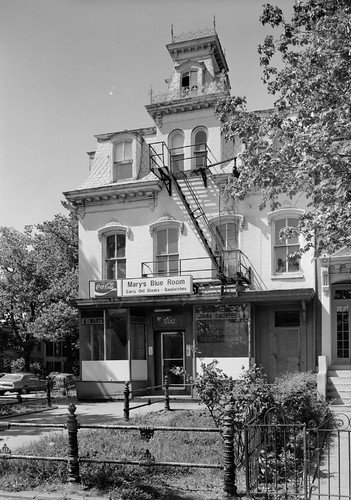
Mary's Blue Room, Capitol Hill
The demolition of this building by the Capitol Hill Baptist Church touched off the campaign to create a local historic preservation law, to provide protections against "local undertakings." At the time, the federally designated historic districts only provided protection against projects funded by the federal government.
---------

I do know that most preservationists in Washington, those dating from the 1960s and 1970s in particular, took up preservation at a time when stabilization of the city and its neighborhoods was the utmost priority.

What to do in the face of a shrinking population "scarred people" at least in my opinion, and it shapes how they look at the world today.

And yes, as anon (and w in other entries points out), groups like the Capitol Hill Restoration Society appear to be overly focused on parking and such, rather than placemaking and livability and promoting transit.

One of the problems with advocacy for placemaking is there is no real organization that does it nationally. (In reality, Project for Public Spaces functions more like a consulting firm, as conducting planning projects around the country provides the bulk of its income).

I argue that next generation historic preservation needs to incorporate placemaking and livability issues more firmly and directly into the agenda. And I would argue that the National Trust for Historic Preservation isn't grappling with these issues the way that I think they ought to be.

Frankly, it is the urban design aspects of historic neighborhoods that make historic neighborhoods potentially such livable places and efficient loci for transit. It's not the historic architecture necessarily that contributes these qualities, although it is nice to look at.

(For a variety of aesthetic reasons, I prefer this kind of architecture, and I would argue that it isn't strictly a matter of "opinion" or aesthetics, but the result of a particular way of building and designing, based on materials and technologies and expectations about living that result in housing with externally-supporting qualities at the same time maximizing internal, or household, supporting qualities as well. Production home building techniques and home building for the suburban setting has tended to focus home building around automobility and internal-supporting qualities at the expense of supporting external, connecting to the world outside of the envelope of the house's four walls qualities.)

Preservationists need to figure out how to be concerned about the future and in a setting of potential residential housing and population growth, rather than a setting where the city shrinks. (Note that preservation issues in weak real estate markets are fundamentally different. There it is a matter of maximizing the qualities of place to maintain a neighborhood's relevance, attractiveness, and marketability in the regional residential housing landscape. Altternatively, I get tired of going to National Trust conferences in regions with weak real estate markets and have them brag about being able to do preservation without displacement because it's easy to do that in areas with limited housing demand.)

I argue that preservation (or baring that, design guidelines for the entire city) is still important and relevant in a growing city. The teardowns and popups we are experiencing in most of the well-placed undesignated neighborhoods, otherwise marked by attractive and quality housing stock dating from the 1880s to the 1930s, not having to meet any design requirements, are for the most part incompatible, from a design and quality standpoint, and these new buildings or popups or massive additions significantly alter neighborhoods in ways that diminish overall architectural coherence and attractiveness of these neighborhoods.

In terms of the point about balancing concerns for the external (or neighborhood) with the internal (requirements and desires of the household), most teardowns, popups, and massive additions are done by people who want to maximize and extract the value of the location, without necessarily contributing to either the use or exchange value of the location.

Types of Use Values*

Daily Round: The place of residence is a focal point for the wider routine in which one's concrete daily needs are satisfied.

Informal Support Networks: Place of residence is the potential support of an information network of people who provide life-sustaining products and services.

Security and Trust: A neighborhood also provides a sense of physical and psychic security that comes with a familiar and dependable environment.

Identity: A neighborhood provides its residents with an important source of identity, both for themselves and for others. Neighborhoods offer a resident not only spatial demarcations but social demarcations as well.

Agglomeration Benefits: A shared interest in overlapping use values (identity, security, and so on) in a single area is a useful way to define neighborhood.

Ethnicity: Not infrequently, these benefits are encapsulated in a shared ethnicity... When this occurs, ethnicity serves as a summary characterization of all the overlapping benefits of neighborhood life.

(* From chapter four of Urban Fortunes: A Political Economy of Place by Logan and Molotch.)

Labels: , , ,

Monday, November 24, 2008

Places can be compared, but there are always differences

Even so, as I say, all places are unique, but rarely are their circumstances so special that communities cannot be compared.
------------------------
But I forgot to write while there are always differences, that doesn't make the comparisons invalid, nor does it mean that you can't make inferences.
------------------------

The New Orleans Times-Picayune is running a series on what my friend Drew Ronneberg (chair of the ANC6A Economic Development and Zoning Committee) calls "planning for contraction." Such planning typifies what the rustbelt should be doing. Youngstown, Ohio pioneered this with the Youngstown 2010 project. For a time, although the Mayor who initiated it was not re-elected, so did Niagara Falls, New York, which is much less successful compared to Niagara Falls, Ontario, but more like most cities--declining--in upstate New York. (There is also the European Shrinking Cities project.)

See "It's time for New Orleans to admit it's a shrinking city, some say" and "Faded Midwestern cities offer ways New Orleans could slim down to match its smaller population"
It's time for New Orleans to admit it's a shrinking city, some say
DAVID GRUNFELD / THE TIMES-PICAYUNE. A rebuilt home sits like an island among empty lots on Warrington Drive in Gentilly. The city's gap-toothed recovery raises questions about where New Olreans should invest its increasingly limited resources.

The Dallas Morning News has an interesting article, "DeSoto, Duncanville become involved in 'new urbanism'," about how smaller places with "no there there" are building town centers. In our area, Rockville has done this recently and it is finally successful after a previous unsuccessful iteration and of course, you can argue the same for Silver Spring--there was there there, but it was tarnished, so they went about purposefully revitalizing the community. Maybe they didn't do it the way I would have, but they did it, and Downtown Silver Spring is fundamentally a different place today than it was 10 years ago--in a good way, basically.

I find this interesting because parts of DC are growing and have the potential to add population, but this faces what one might call "nimbyism"--not in my backyard attitudes. Some of this is at times justifiable, but at other times I would argue that it fails to recognize the temporal aspects of city-building and that DC cannot remain static while other communities within the region grow, change, innovate, improve... or decline.

DC is not necessarily a declining city anymore. But many neighborhoods are acting in ways that likely will make it a declining city in relative terms. As Marc Brookman says in an interview, "He zones in on 'smart growth'" in the Philadelphia Inquirer:

Q: What are the usual areas of concern about these [mixed use, denser] developments?

A: Increasing density, allowing for the mixture of uses within the same site, and the perception that as a result of increased intensity of the use of the land that it will create adverse impacts.

Q: What does the alliance say in response? Why should municipalities consider this type of development?

A: Because it maximizes the investment in existing infrastructure, reduces the amount of environmental degradation that otherwise would occur if more land was disturbed to accommodate the same amount of people, and it creates a sense of place where individuals can live, work and shop without making long trips in automobiles. And it's a much more efficient use of the land than individual large-lot communities.
BLIGHTTAX112308.jpg
New Orleans Times-Picayune graphic.

Labels: , , , ,




