Rebuilding Place in the Urban Space

"A community’s physical form, rather than its land uses, is its most intrinsic and enduring characteristic." [Katz, EPA] This blog focuses on place and placemaking and all that makes it work--historic preservation, urban design, transportation, asset-based community development, arts & cultural development, commercial district revitalization, tourism & destination development, and quality of life advocacy--along with doses of civic engagement and good governance watchdogging.

Thursday, February 20, 2014

Sentiments from West Virginia and Virginia

I can't imagine that eminent domain is an issue in most places, including on this side road in Hardy County, West Virginia, although it is close to the Lost River State Park.

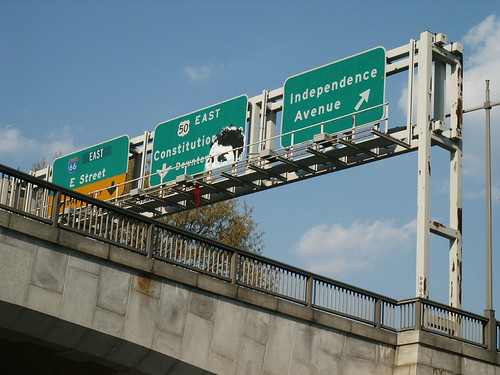
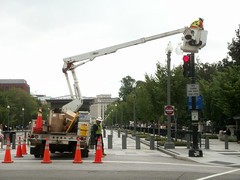
The second image is from I-66 in Virginia.


Labels: , , ,

Saturday, February 09, 2013

There is nothing to celebrate in the tags of Cool Disco Dan

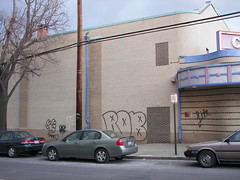
Graffiti is a tough issue when it comes to urban revitalization. Many people see graffiti as an indicator of disorder, which makes it that much harder to rebuild and reinvest in neighborhoods, to attract visitors etc.

At the same time, there are a variety of types of graffiti.

A doughnut shop in Dupont Circle, for whatever stupid reason, wanted to pay "homage" to Cool Disco Dan in its name, but people objected, calling it a commodification of black culture.  See "Cool Disco Donut Changes Name to Zeke’s D.C. Donutz" from the Washington City Paper.

Cool "Disco" Dan tagged buildings throughout the city in the 1980s and 1990s, and I aver there was absolutely nothing artful in his "work".

I don't see how anyone can call it much different from a dog pissing on a tree, marking his territory.  The territory is marked, but nothing is added by the marking. The same goes for many other taggers, including "Koma" and "Nores", who tagged throughout DC in the early part of the last decade. See "2 Charged With Graffiti: Md. Men Spray-Painted in Much of D.C., Officials Say" from the Washington Post.)

I just don't see what there was to celebrate.  (However, Suzanne counters that with time, the work has gained meaning and achieved status among people who live in the city, even though it is incredibly simplistic, much different from the graffiti that has come afterwards stylistically, and that despite this simplicity, later taggers didn't cover it over with newer work.)

Image from Art Crimes article.

Other graffiti makes a statement, either politically or artistically.  (Suzanne calls this commentary.)

And because I appreciate discourse, protest, and art, I can see value in this.  See for example work depicted in the publication Beautiful Decay.

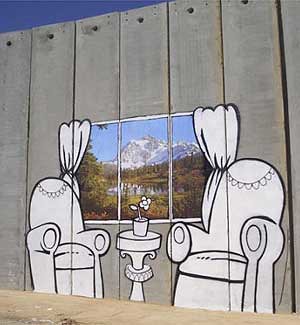
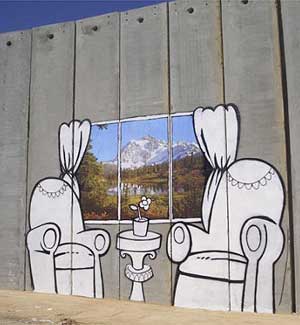
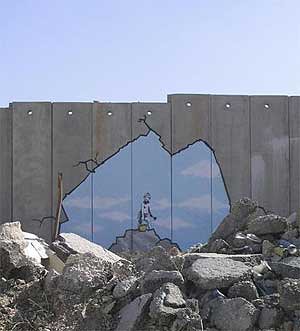
For example, Banksy's pieces on the West Bank wall separating Jordan and Israel are incredibly provocative.

Or even the gutsy move of Borf to tag a highway sign.  ("The Mark Of Borf" and "With Guilty Plea, Borf to Try the Art of Graffiti" from the Washington Post.)  But I am still glad he was caught and stopped.  His tags defaced so many DC buildings, at a great cost.

There is also the interesting point that many taggers are suburbanites who come into the city and deface it, because their work is visible in the city and invisible in the suburbs.

From an urban revitalization standpoint, most people don't make distinctions. Any marks are seen more like a dog pissing on a tree.

But I will concede that some graffiti artists do make us think or appreciate or consider the world in different ways.
Borf on the Bridge
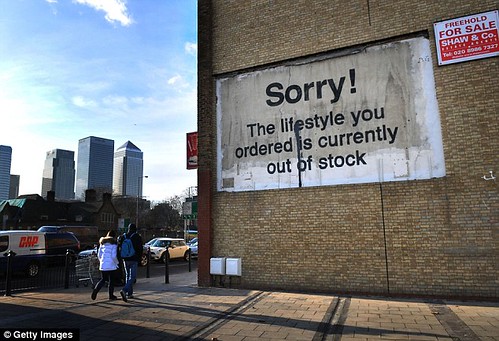
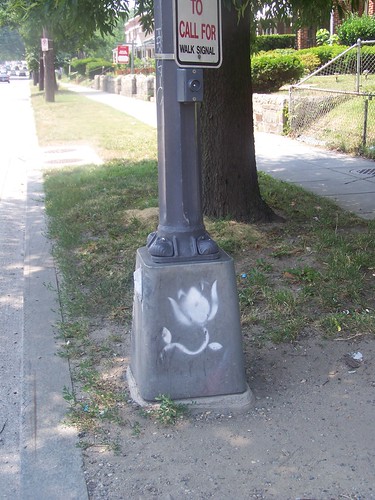
This image, from Flickr by barkingmoose.  The next two images below depict work by Banksy.  First image, photographer unknown.  Second image by Getty Images.  See article from the Daily Mail.  The last image is from DC.

Emailing: banksy3gal

Sorry! The lifestyle you ordered is currently out of stock (Banksy billboard, near Canary Wharf)

Graffiti flower on the base of a streetlight, North Capitol Street NE

Labels: , , , ,

Monday, January 24, 2011

Anti-walmart flyer, DC


Anti-walmart flyer, DC
Originally uploaded by rllayman
Picked this up at the Yes! Grocery on Georgia Avenue over the weekend. (Note that Yes! is a great place to buy fresh spices in bulk--so they are cheaper and fresher.)

I don't have a scanner so I apologize for the flash effect.

I like the choice of images on the flyer. Classic example of the line: "a picture is worth 1,000 words."

------
WRT Walmart, it's interesting how in DC, mostly elected officials have rolled over ("New DC economic chairman supports Ward 5 Wal-Mart" from the Post) while there is still a fight in New York City ("Walmart launches big NYC media and P.R. push" from Crains's New York Business) and the Office of Public Advocate produced a report on the negative economic impact of Walmart ("Wal-Mart’s Economic Footprint: A literature review prepared by Hunter College Center for Community Planning & Development and New York City Public Advocate Bill de Blasi").

It's true that DC zoning laws don't provide any leverage for opposing Walmart, unlike some other communities which have strong review provisions for larger scale retail (big box).

And imagining DC Council actually turning out high quality reports and analyses. I can't think of an example of such in recent memory.

Labels: , , , , ,

Friday, April 17, 2009

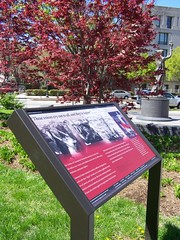
An example of history being written by the winners: Memorial park sign(National Park Service): Victims of Communism memorial

Having been particularly interested in the history and culture of Latin America while in college, and learning about the impact of U.S. military intervention and participation in many South American countries, I must say that I find this memorial interesting and ironic. Where is the monument for "victims of capitalism?" (And can you imagine such an authorization bill for such a monument making it through Congress?)

I wondered this after reading this recent Nicholas Kristof column, "At Stake are more than banks" in the New York Times. From the article:

“In London, Washington and Paris, people talk of bonuses or no bonuses,” Robert Zoellick, the World Bank president, said this week. “In parts of Africa, South Asia and Latin America, the struggle is for food or no food.”
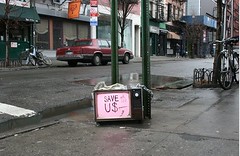
Street art with a television set, Lower East Side, Manhattan
Street art with a television set, Lower East Side, Manhattan. Photo by Roy Mock, submitted to the New York Times.

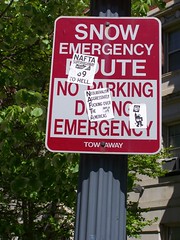
Street sign with protest stickers, 13th and Massachusetts Avenue NW
Street sign with protest stickers, 13th and Massachusetts Avenue NW.

Labels: , ,

Thursday, February 12, 2009

Art and challenge

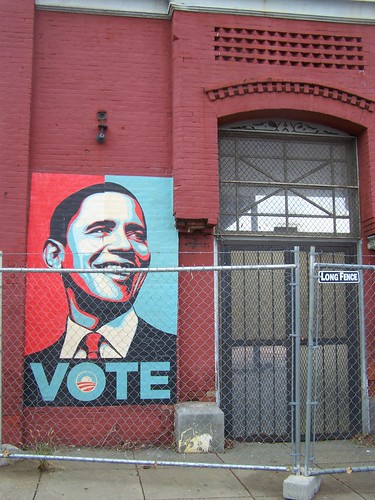
Obama painted sign (Fairley image) on the O Street Market
Is this art, graffiti, protected political expression, and/or vandalism? (Painted poster on the O Street Market, 7th Street NW, Washington, DC.)

Something that my girlfriend and I argue about is graffiti. An artist, she focuses more on the expression and execution of graffiti, while I, committed to commercial district and urban revitalization, (while admiring some qualities, at times) tend to come down in favor of order, and the negative perceptions that too often result from what is called, justifiably, vandalism.
Graffiti in Brookland, January 2007
Dealing with a massive tagging of buildings on 12th Street NE in Brookland DC's commercial district took a great deal of my time in February 2007 and beyond, when I was a Main Street commercial district revitalization program manager there.

Shepherd Fairey (Obey, Obama's Hope poster, etc.) is a good example. He's amazing. As of course is Banksy. At the same time, some people see their products as vandalism. See "Cultural acclaim, residents' anger: Artist's arrest points to a Boston divide" about the recent arrest of Mr. Fairey in Boston, from the Globe.
Emailing: banksy3gal
This image of a Banksy effort, "graffiti," painted on the wall separating the West Bank from Israel is a particularly powerful comment on politics and separation.

There is a great journal (I meant to get a subscription for Suzanne as a Holiday present...) called BEAUTIFUL DECAY on this broad field.

Labels: , , , , , ,

Tuesday, February 03, 2009

Streetscape improvements in Brookland (a/k/a more Brookland kvetching)

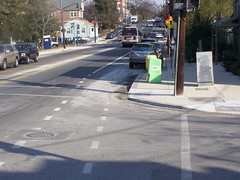
DC's Department of Transportation is now implementing improvements in the streetscape on 12th and Monroe Streets NE, as called for in the Brookland Transportation and Streetscape Study. There are many changes but the major ones are these:

1. New sidewalks, topped with conglomerate (like the sidewalks on the National Mall);
2. Sidewalk bulbouts at intersections to improve the street crossing experience for pedestrians;
3. Streetlights on every utility pole;
4. Bike lane striping on Monroe Street;
5. Relocated bus stops to provide a better "transit waiting environment" for riders.

There has been a lot of complaining on Brookland e-lists about the bulbouts stating that they protrude into the driving lane and obstruct bicycle lanes.

While I think that bicycle lanes could have been implemented slightly better on the 800 and 900 blocks of Monroe Street, I don't think that people's complaints hold water.

I didn't get over to Brookland to check til yesterday, but I did take a bunch of photos. Things seem fine to me, with one exception--besides implementing the bicycle lanes differently on those two blocks, I would have also included sidewalk-side lights on the utility poles too. There is a difference between "sidewalk lighting" and "street lighting" and a thriving commercial district needs both.

100_5512.JPG
New lights on utility poles provide much more light on 12th Street NE in Brookland

100_5513.JPG
This bulbout at the northeast corner of 12th and Monroe Street NE comes out to the proper distance--equal to the width of the parking lane. The sidewalk is topped with conglomerate and is the new standard for neighborhood commercial districts. The idea for this type of sidewalk came from a resident in the H Street neighborhood. DDOT subsequently adopted the idea and has made it standard.

100_5516.JPG
The bus stop at this location was moved south slightly, and provides a better location for both the bus driver and oncoming cars as the view at the intersection is no longer obscured, and riders don't have to walk out into the street because of the placement of the treebox at the previous location.

100_5519.JPG
Looking west to the 900 and 800 blocks of Monroe Street NE, where the bicycle lanes do move a bit along the block, rather than maintain a straight line. This could be corrected by removing the striped yellow line median, and devoting the recovered space to the bicycle lane.

100_5520.JPG
Looking east, at 9th and Monroe Streets NE.

100_5510.JPG
While all of 12th Street is zoned commercial, there are distinct blocks of residential housing, which likely should be downzoned back to residential. Most of the residential buildings--rowhouses and some detached four squares--especially south of Kearny Street, is used for housing.

Labels: , , ,

Friday, January 09, 2009

Big time protests in Oakland, California

in response to the killing on New Year's Eve by a BART police officer of a 22 year old African-American, detained as one of a group of people allegedly fighting, on a subway platform at the Fruitvale BART station (ironically, the development pattern at this station is heralded as a key transit oriented development success).

See "Oakland protest organizer watched in horror" from the San Francisco Chronicle (this article has links to all the coverage of the killing). The video links are from coverage from CBS5. The third video in the photo array from "Oakland storekeepers tell of night of terror" is comprehensive (and 12.5 minutes long). Apparently there were a second day of protests, although they were much less violent. See "2nd Night Of Violent BART Protests In Oakland" from CBS5.

The video with "Oakland protest organizer watched in horror" features an interview with the CBS5 reporter, who describes his perception that certain protesters pushed the violence.

I imagine that it is fears of these kinds of protests, where violent action is incited and organized by people with experience, that leads to massive street closures being mandated for the Inauguration. (See "Bridge Closings Rile Virginians " from the Post, which includes a great quote from Congressman James Moran of "security on steroids.")
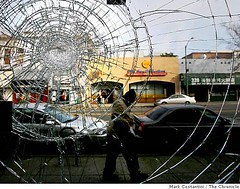
Storefront window broken during protest
A man walks past a broken door window at Yoon's Pharmacy on 15th and Franklin streets in Oakland on Thursday. (Mark Costantini / The Chronicle)

Labels: , , ,

Sunday, December 21, 2008

Another gas station defeat in the H Street neighborhood


shell letter
Originally uploaded by inked78
Letter signed by Councilmembers Tommy Wells, Kwame Brown, and Mary Cheh on the Shell gas station matter. Flickr images by Inked78.

-- Shell Letter page two

Greater Greater Washington reports, in "Public Space Committee says Shell, No," that the neighborhood quest against the construction of a new gas station at 14th Street and Maryland Avenue NE has been successful.

As many people know, the L'Enfant Plan was designed with an interesting perspective and legalities concerning public space, so that most of the "yards" in front of buildings are technically publicly-owned. So for a business to incorporate these public spaces into their business use, there has to be permission granted (public space permits, variances and special exceptions from zoning regulations if needed, etc.).

The organized residents fought the project by focusing on the need for the applicant for public space permits.

Separately, ANC6A has commented on the building permit application process, in part as a result of this process, where applicants can game the system. Many projects require three separate approvals from the Public Space Committee (DC Department of Transportation), Historic Preservation Office (Office of Planning), and the Office of Zoning, before permitted projects move to the next stage of design, permitting, and construction (DC Department of Consumer and Regulatory Affairs/Building and Land Regulation Administration).

ANC6A suggests that one single "business process" be designed to structure this process. I think they would argue that public space and design matters be addressed before going forward with hearings by the Zoning Commission/Board of Zoning Adjustment.

I don't think that the ANC's letter on the matter is up on their website quite yet.
Shell no protest sign

Oh, and this was another matter involving former Councilmember John Ray, who seems to be the go-to zoning lawyer for odious matters.

This is interesting for another reason. Starting in 2000, residents on the west side of the neighborhood organized against a massive increase in size for the BP station (then Amoco) then located on the 300 block of H Street. For decades, it was a scourge on the neighborhood, and hotspot for crime. I would argue the business was managed badly to drive out adjoining businesses, so that Amoco could acquire the other sites for expansion (I call this the creation of noxious uses).

This was one of the first times that the neighborhood came together despite the fact that H Street was and still is somewhat, a barrier between the north and south sides of the neighborhoods. Historically, south of H Street had been more white, and north of H Street more black, to work on fighting this expansion, which was eventually successful.

This set the stage for neighborhood revitalization, as neighbors and merchants came together to work on this and other projects.

Heretofore, the neighborhood had been warehoused by the H Street Urban Renewal Plan, which mostly called for destruction of eligible for designation historic buildings and the creation of automobile-oriented office buildings, garden apartments, and strip shopping centers in their place. (Of course, the destruction of buildings during the riots didn't help.)

The effort against the gas station helped to reverse that process, which before, mostly the Stanton Park Neighborhood Association had been fighting alone.

Of course, I would argue also that the creation of the New York Avenue Metro station, an infill station on the red line between the Union Station and Rhode Island Avenue stations, was also essential because improved transit access meant improved locational advantages north of H Street, which significantly improved demand for housing in this area.

To improve neighborhoods, you need people with income... You can call this gentrification, but the failure of center cities has more to do with the failure to maintain local economies within the metropolitan context.

In the 8 or 9 years I've worked on these kinds of issues, I guess I'd say it's easier to bring people together to fight something they don't want (gas stations and car dealerships) than it is to get them to work together and create a common vision to work toward and achieve.

Labels: , , , , ,

Friday, December 19, 2008

He was a "bad" guy, but great on transit

Paul Weyrich, hardcore, hard right conservative think tank and campaign guru, has died. See "Leading conservative activist dies" from the Legal Times.

He was the author or co-author of five papers published by the American Public Transportation Association:

-- Bring Back the Streetcars!: A Conservative Vision of Tomorrow's Urban Transportation (by Weyrich & Lind)
-- Conservatives and Mass Transit: Is it Time for a New Look? (by Weyrich & Lind)
-- Does Transit Work? A Conservative Reappraisal (by Weyrich & Lind)
-- How Transit Benefits People Who Do Not Ride It: A Conservative Inquiry (by Weyrich & Lind)
-- Twelve Anti-Transit Myths: A Conservative Critique (by Weyrich & Lind)(pdf file)

-------------
Weyrich was also publisher of the now defunct New Electric Railway Journal, which was published from 1992-1998. The following are articles from the printed magazine:
-- New Orleans Prepares for the Past, Spring 1992
-- Portland’s New/Old Trolleys, Spring 1992
-- The Kelley Park Trolley, Winter 1993
-- Vintage Memphis, Winter 1993
-- Metamorphosis on Main Street, Summer 1993
-- Real Streetcars Outdraw Fakes, Autumn 1993
-- Past Is Present, Autumn 1993
-- Veterans from Down Under, Autumn 1994
-- The Streetcar Renaissance in Dallas, Summer 1995
-- Heritage Trolleys in Memphis and Galveston, Spring 1996
-- Heritage Trolleys in Transit, Spring 1996
-- New Orleans Joys, Fall 1996
-- Charlotte's Heritage Trolley, Winter 1996-97
-- The New Ladies in Red, Vol X No I

It's hard to reconcile the two very different sides of Paul Weyrich.

Labels: , , , ,

Friday, December 12, 2008

Organizing

Last night, the Shafeek Nader Trust had a presentation about the 19th Joe A. Callaway awards for 2008, which acknowledge recipients for their civic courage. I was talking with a colleague during the reception and we were talking about organizing, protest, and the current historical moment.

-- the protests in Greece in response to the shooting death of a 15 year old by police officers led to sympathy protests in other European cities, see "Greek protests spread to European cities" from the Telegraph;
-- the airport takeover in Thailand which led to a change in government;
-- the sit-in at Republic Windows in Chicago, after the business was closed due to a loss of credit. Banks are now offering the company financing, which will allow the business to reopen. See "Republic Windows & Doors plant sit-in still a stalemate" from the Chicago Tribune. (I missed this story in the parade of stories about Illinois Governor Blagojevich.)

Note that this blog entry from Inc. indicates that the owner of Republic Windows intended to shut down the company and transfer the orders and business to another company he bought in Iowa. See "No Good Guys At Republic Windows."

Labels: ,

Wednesday, December 03, 2008

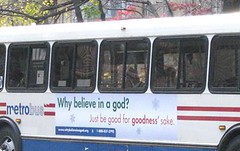
Humanist (atheist) advertising campaign on buses

1203_News-Tab
Examiner photo.

Today's Examiner reports on complaints of an atheist advertising campaign run on Metrobuses, "Metro fields hundreds of complaints about bus ads."

My short response (I have to get to a meeting) is from the Constitution of the United States of America:

Amendment 1 - Freedom of Religion, Press, Expression. Ratified 12/15/1791. Note
Congress shall make no law respecting an establishment of religion, or prohibiting the free exercise thereof; or abridging the freedom of speech, or of the press; or the right of the people peaceably to assemble, and to petition the Government for a redress of grievances.

Amendment 14 - Citizenship Rights. Ratified 7/9/1868. Note History

1. All persons born or naturalized in the United States, and subject to the jurisdiction thereof, are citizens of the United States and of the State wherein they reside. No State shall make or enforce any law which shall abridge the privileges or immunities of citizens of the United States; nor shall any State deprive any person of life, liberty, or property, without due process of law; nor deny to any person within its jurisdiction the equal protection of the laws.
...

5. The Congress shall have power to enforce, by appropriate legislation, the provisions of this article.

-------

The only problem is that government agencies really really really really hate complaints. So instead of having to deal with them, normally they wouldn't even put themselves in this position (i.e., no ads at all). As an ACLU person points out in the article, once you take ads, you can't choose. Now, if it weren't times of financial exigency, a gun shy board would then vote to take no advertising, which is the only way to bar "specific" ads--bar them all. It won't happen.

The interesting thing about these arguments is that they exhibit intolerance and anti-freedom of speech, which demonstrates the necessity of the First Amendment to begin with (more about protection of minorities within representation later...).

Labels: , , , ,

Monday, September 15, 2008

Housing shenanigans in DC

226665613_5bdcd98007.jpg
Flickr photo by solecism.

This is reprinted from the current issue of themail, published by DC Watch:

Another Tenant Emergency
Andrew Willis Garces,
willisa@gmail.com

This year Mayor Fenty has been lauded for responding to the crisis in rental housing administration laid bare by a March 10 Washington Post expose by Debbie Cenziper. Part of this response has included, in the last two months, laying off housing inspectors, decreasing the amount of tenant purchase funding available to low-income tenant associations, and firing respected rent administrator Grayce Wiggins, who sided with the Kennedy-Warren tenants against politically connected property manager Barac Co. earlier this year. The march towards reform continued this week with the notice that the tenant organizers who worked with Cenziper for months to document DCRA’s failings will likely be laid off on October 1, following the Department of Housing and Community Development’s refusal to renew contracts with the two largest tenant education service agencies.

This year alone, with funding from DHCD, Housing Counseling Services and the Latino Economic Development Corporation have provided critical services to tenants in 163 buildings with more than 13,600 units. At all of these properties, the tenants are presently at risk of, or have just recently avoided being displaced and losing the affordability of their homes. Many have project-based Section 8 contracts, and some are at critical points in the tenant purchase process. An appeal from HCS executive director Marian Siegel sent this week reads, in part, “We are currently working with 115 properties that need support from attorneys, educators, developers and others as we will no longer have staff necessary to meet these needs.”

It is inarguable that tenant education and organizing has been the most effective and probably the cheapest anti-displacement strategy funded by the city government, particularly in Columbia Heights and other neighborhoods hit hardest by the housing boom. Tenant rights laws are, after all, useless if tenants aren’t familiar with them. As a former District tenant organizer myself, I can attest to the widespread ignorance of tenant rights among residents of subsidized housing. You can send comments on this plan to DHCD’s director, the mayor, deputy mayor, and city council housing committee chair: leila.edmonds@dc.gov, neil.albert@dc.gov, adrian.fenty@dc.gov, and mbarry@dccouncil.us. And please send copies of your E-mails to mariansiegel@housingetc.org and mhidalgo@ledcdc.org.

Labels: , , ,

Saturday, September 06, 2008

Net tools and civic engagement

Streetsblog Google map on Sheldon Silver, screen shot
Streetsblog has a very nice entry, "Pin it on Shelly!," where they produce a counter-narrative to that produced by State Assemblyman Sheldon Silver, who was key in preventing NYC in experimenting with the implementation of congestion pricing in Manhattan. (Silver is the Speaker of the Assembly, the top dog.)

Silver's election site has a Google Map with pins showing the largesse that he has brought to his district. Streetsblog has produced a different Google Map, showing the negative impact on his constituents of blocked urban design and placemaking initiatives due to his politicking and palavering.

Labels: , , ,

Thursday, August 21, 2008

The perfect being the enemy of the good

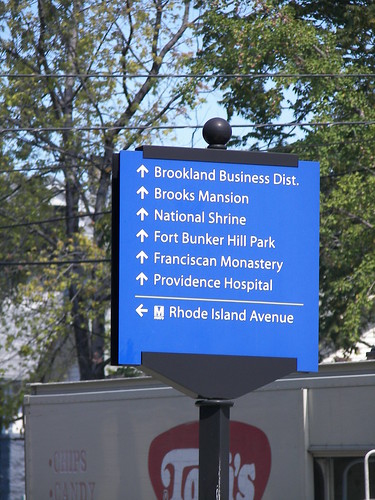
Wayfinding sign at Rhode Island Avenue and 12th Street NE by brooklandcdc.

1. I have been meaning to write about the Brookland overhead utility wire issue, but Greater Greater Washington beat me to it in "Brookland energized over power lines."

a. It's true that it's better to have buried utility lines.

b. But it's costly.

c. DC is unusual compared to most jurisdictions because the cost of typical streetscape and sidewalk improvements _are not charged to individual property owners_.

d. But somehow this doesn't cover burial of utility lines, at least outside of the L'Enfant City, where it is mandated that street-side utility wires be buried underground.

e. So the reason that DDOT and the Office of Planning kept putting aside people's wishes for underground wiring on 12th Street is that many property owners would have to pony up a lot of money in a special assessment. (At least this is my understanding.) Much of 12th Street NE, though zoned commercial, is residential, making special assessments particularly onerous.

f. The DDOT streetscape plan came up with a nice framework for conceptualizing the commercial and residential aspects of 12th Street NE (current commercial area) and Monroe Street NE (future commercial area) in Brookland, preserving the primary residential parts, and focusing commercial intensity.

g. If the organization that I had worked for last year had been better situated internally and externally, we would have adopted that framework, and worked to educate people about why it made sense.

h. One of the problems with the 12th Street NE commercial district (besides the residents who are and the community organizations which are congenitally unable to work together and come to consensus, in addition to the dominant neighborhood narrative/trope, forged during the anti-freeway battles, that they can successfully agitate for what they want and fight off any development whatsoever) is that it is too disjoint. The Monroe to Otis part needs to connect up with the part closer to Michigan Avenue, which is anchored by the Yes Organic Market and the pathetic Kelly's Ellis Island restaurant.

i. So it does bother me that most of the Brookland activists don't favor comprehensive improvements in the zoning for 12th Street, which except for the two blocks between Monroe and Otis, is C1, which is very much car and on-site parking oriented.

j. The cost of burying the utility lines is probably relatively minimal though, given that the street will already be torn up, less than $1.5 million (based on the cost of utility burial in other cities that I have come across, such as for Lenoir, NC, however I imagine that the costs assessed by Pepco are much higher).

k. Note that outside of the L'Enfant City and Georgetown, street-side utilities aren't buried, although on some main routes such as Georgia Avenue NW, most utilities are provided to the Avenue via the rear of the street, from side streets.

l. But even with buried utility lines, and a quality streetscape, without the ability to forge a more coherent business district in spatial terms, along with "better" merchants and property owners able to leverage the improvements, Brookland commercial district won't improve.

m. Especially because the area has about 1/3 of the population it needs to support adequate neighborhood-serving retail and lacks the attractions necessary to attract customers from outside of the immediate neighborhood.

n. Restaurants in Brookland prove the point I make time and time again about the necessity of quality restaurants serving as anchors for neighborhood-based commercial district revitalization. Colonel Brooks Tavern is on-again, off-again. For the past 18 months + I think it has been very good, albeit more expensive than I would like to pay. But Kelly's declined precipitously. Cardinal's Nest has been a disaster, and the new BBQ place just doesn't know how to pull it together.

o. Meanwhile in Takoma/Takoma Park, the groups do know how to work together (for the most part, although maybe not on the Metro site redevelopment). They are working to revive and reopen the Takoma Theater, and two new restaurants are coming to the Takoma Park side of the commercial district, one owned by Gillian Clark (ex of Colorado Kitchen), the other an artisinal pizza place. Plus they have two decent restaurants already.

p. Maybe I should put up the slide presentation I created on the Brookland Main Street program on slideshare. It's pretty good if I say so myself and discusses niche development opportunities and has a rough "build out analysis" for 12th Street NE, identifying opportunities to improve the building stock, add retail options, and strengthen the streetscape and commercial district simultaneously.

q. I really can't write much more on my experiences in Brookland, other than I finally accepted that the perfect model or ideas in and of themselves aren't enough, that you have to have community support, and build the consensus required to effect change, otherwise you get nowhere.

r. cf. the introduction in the current issue of themail on why the school "reform" effort is likely to fail. Chancellor Rhee and Mayor Fenty don't have enough experience in planned change, innovation, and transformation to really understand how to bring it about. Instead, they think that everyone other than themselves and the closest members of their team are the problem.

Similarly in Brookland, residents and groups don't know how to "play well with others." Instead of saying to govt. people that they disagree, and here's why, they instead call on higher ups within specific agencies or City Council and demand that those people be fired. It makes it hard for those government agency workers to then turn around and advocate for Brookland.

Plus, knowing how the process works, the government agencies would rather put their efforts toward projects in other communities, because they can get more accomplished more quickly. (This is something else that the people in Brookland "taught me.")

Some of the worst and craziest community meetings I have ever experienced--other than two specific meetings in the H Street neighborhood--were in Brookland. It's one reason that I didn't want to live in Ward 5!!!!!!!!!!!!!!!!! and even though with trepidation we did look at some houses in Brookland instead we lucked out and found a jewel of an area in Ward 4 and now we are happily ensconced there. (In short, I'd rather eat at Ledo's Pizza or McDonald's on Georgia Avenue rather than go to Brookland.)

2. My pushing for best practices and high quality projects is frequently a sore point with colleagues who tell me to not let the perfect be the enemy of the good. (That's my problem with the EYA project ArtsDistrict Hyattsville, which is good for what it is, but should be considered a transect violation from the standpoint of new urbanism. My making that point seems to have bumped me off the promotional e-list of the area's primary "new urbanism-smart growth" promotion organization.)
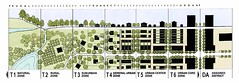
Transect.jpg

Labels: , , ,

Wednesday, August 13, 2008

DC: stodgy, button-downed or weird?

Creative DC has a blog entry, "Make DC Weird," about Make DC Weird:

a project that DC oficemates Susannah Wells and Effie Kapsalis recently launched after Kapsalis visited Austin, Texas, home of the Keep Austin Weird movement. Their mission: to call attention to the parts of DC life that thwart its conservative reputation, from burlesque dancers to roller derbies and drag races, as well as local businesses trying to make their mark.

(Disclosure: I know the initiators of the Keep DC Weird project although I didn't know about the project.)

This dovetails with something I have been thinking about for a couple weeks, a "performance-public" art project currently staged in Coney Island in Brooklyn, a demonstration of water-boarding. See "Coney Island Sideshow Has Guantánamo Waterboarding as Its Theme" from the New York Times for more.
Michael Nagle for The New York Times. In Steve Powers’s “Waterboard Thrill Ride” in Coney Island animatronic figures simulate an interrogation method used in Guantánamo; visitors view the scene through a barred window.

But thinking of art and political expression, isn't it amazing how rare it is for significant politically oriented public and performance art to be produced within DC, which is the center of political power in the United States and therefore the world? (Protests too seem to be something that happens on the Mall but don't impact the every day all that much.)

Part of it has to do with the lack of creative spaces, cheap places to rent, to be able to explore (also known as the point Jane Jacobs made about the need for "a large stock of old buildings" to be present in Great Cities--paid o
ff, with low rents and running costs, to seed innovation) and do things cheaply.

Over time, the buildings that seeded this kind of innovation in DC (Park Lane on Pennsylvania Avenue NW, the building located where the Q Street exit of the Dupont Circle Metro station opens to the street, etc.) either were replaced with new Class A buildings or upgraded from Class C buildings to Class A buildings (mostly the former).

I mean, this is a city where the property management companies ordered office workers to stop putting fun messages using videogame characters on their office windows open out to the street. ("
Sticking Together on Vermont Ave.: Post-it Note Art Spreads From Window to Window" from the Washington Post.)
TOP: Amy Smith creates a Ms. Pac-Man out of Post-It notes on an eleventh-floor window of 1110 Vermont Ave.
How do you think property owner would feel about renting a ground floor corner space at 7th and E Streets NW to guerrilla artists like Banksy (not really a guerrilla anymore) for a temporary installation?
Emailing: banksy4gal by you.
Banksy project on the West Bank

At the same time, as nongovernment organizations (Center for Science in the Public Interest, Common Cause, etc.) function more like traditional organizations rather than advocacy groups challenging the system, fewer people more likely to think and act in more challenging ways are likely to come to DC. In short, San Francisco, Berkeley, Austin, and New York City are going to remain centers of alternative idea and art production compared to our fair city.

Labels: , , , ,

Tuesday, March 18, 2008

Referendum on development project gets nasty in Scottsdale, Arizona

See "Pressure mounts as activists press for referendum ," from the Arizona Republic. From the article:

It's all part of the scene that's taken place outside of Scottsdale libraries and coffee shops since activists decided to gather the 1,961 signatures needed to force a referendum on the Hanover project. On Feb. 19, the Scottsdale City Council approved the 230-unit luxury apartment-and-retail development for a site on Indian School Road and Goldwater Boulevard. Opponents, who claim the project is too tall and dense, have until Thursday to submit petitions.

The developers, Hanover R.S. Limited Partnership, said the project would revitalize a deteriorating zone. Attorney John Berry has called it a "ripple of redevelopment" making downtown Scottsdale an international luxury hot spot.
Volunteers and paid circulators said they have been threatened by circulators working for the developer. In some cases, volunteers said they are too afraid to continue, Giller said.

Tom Irvine, an attorney for developer Hanover R.S. Limited Partnership, said the activists simply are not used to the "rough and tumble" of campaigning. People circulating petitions for Hanover are gathering support for the project, Irvine said.

Labels: , , ,

Tuesday, January 22, 2008

Martin Luther King Day, riots, and H Street NE, Washington, DC

(Martin Luther King, Jr. and Rev. Abernathy on the First Desegregated Bus, Montgomery, Dec. 21, 1956. Photo by Ernest Withers.)

USA Today has a nice feature on this, including a well-done video story on H Street NE, with excellent photos and interviews. See "40 years after the riots, King's vision 'unfinished'." (There are also videos on neighborhoods in Kansas City and Chicago.)

I have been meaning to write about the Barack Obama-Hillary Clinton debacle over "it takes a president, not a village, to get things done."

The reality is that change is a process. As I have written before in terms of the writing by John Friedmann in terms of creating radical planning discourse, government is oriented to system maintenance and a wee bit of change and innovation. Transformation efforts, and the Civil Rights Movement was the biggest social and political transformation effort/movement in U.S. society in the past 60+ years, start from outside government, with the people. (Revolutionary movements challenge governments and the entire political system.) Sure, laws are only changed by elected officials, but it takes thousands, millions of individual efforts before the point of legislative and/or executive branch change within government is reached, and eventually (if ever) realized.

Labels: , , ,

Tuesday, January 15, 2008

We're (not) connected to you by more than power lines ®


Farola
Originally uploaded by Daquella manera
Pepco's slogan is "We're connected to you by more than power lines."®.

Presumably that means there's a relationship involved. A number of bloggers attended the presentation last week by James (Jim) Sebastian and Heather Deutsch from DC's Department of Transportation about the progress of the Metropolitan Branch Trail for bicycling and walking.

Apparently the big holdup is a transfer of land from Pepco, which is stalled.

The "solution" or the ability to apply pressure is really quite simple:

1. File a complaint with the DC Public Service Commission. They will investigate it. Pepco is regulated by the PSC.

2. Start calling Vincent Orange every day. He's the regional vice president for DC for Pepco. That means he handles government relations. Since DC regulates the electric utility company, in theory Pepco wants that relationship to be hunky-dory.

202-872-2000 is the general number for Pepco.

Make it a little less comfortable, and the property division and the lawyers will get some motivation to move things along.

(Utility work by Pepco workers. Photo by Daquella Manera.)

Labels: , , ,

More Purple Line shenanigans

From Action Committee for Transit:

PURPLE LINE THAT DOESN'T GO TO PRINCE GEORGE'S COUNTY PUSHED BY CHEVY CHASE INFLUENTIALS

Well-connected Chevy Chase residents and golfers have launched a renewed push for a Purple Line route that would avoid their affluent neighborhoods and an exclusive country club -- and wouldn't go to Prince George's County at all.

The aim is to revive a "Purple Line Loop" route proposed in 2003 and quickly rejected by Maryland transportation planners. Under this plan Purple Line trains would share the Red Line track through D.C. but cross from Medical Center to Silver Spring on elevated tracks built above the Beltway. From Silver Spring, the Purple Line trains would go back into D.C., bypassing Prince George's County entirely.

A letter-writing campaign aimed at Governor O'Malley, Lt. Gov. Brown, and Montgomery County officials began this past Saturday, January 12. Participants include J. Paul McNamara, a vice president of Columbia Country Club. The Purple Line route now under study follows old railroad tracks that adjoin Columbia
Country Club's golf course.

"One of the great things about the Purple Line is how it will bring Montgomery and Prince George's Counties together," commented James Allen, co-chair of Prince George's Advocates for Community-based Transit. "This project absolutely must serve both counties."

Ben Ross, president of the Montgomery-based Action Committee for Transit, joined Allen in denouncing the "Loop" plan. "Light rail will be an asset to all the communities it runs through," added Ross, who lives across the street from the future Purple Line station in Bethesda.
--------
This isn't a surprise. People who don't want something, or who want something very badly, never give up. I hesitated putting this up, because I am certain this proposal has no traction, but...

-------
Flickr Image by thecourtyard who writes: An MTA aerial photo showing the three potential Purple Line routes through East Silver Spring. From top to bottom: Wayne Avenue; Silver Spring Avenue/Thayer Avenue; and Sligo Avenue. All three would meet in the vicinity of Piney Branch Road and Flower Avenue.

Labels: , , ,

Thursday, December 27, 2007

Public protest in private spaces

With the commodification of public space (i.e. the recent debacle in Silver Spring with the Peterson Companies attempting to enforce restrictions on photography), and the long time holdings that shopping malls, while they have supplanted downtowns, don't have the same responsibilities for the public sphere and free speech, that the California Supreme Court has ruled otherwise, see "Court upholds protest at mall," from the Los Angeles Times, is welcome.

However, Chris Brewster writes on the urbanists list that Marsh v. Alabama (1946) has made the case for decades that private places that function as public places have Constitutional responsibilities, stating that:

As development patterns have ventured back out of malls and most recently become more akin to historic "company towns," it matters less and less if the property is private or not. I am sure this case will be tested soon in some factual pattern due to the evolution of development patterns.

Labels: , , , ,