Rebuilding Place in the Urban Space

"A community’s physical form, rather than its land uses, is its most intrinsic and enduring characteristic." [Katz, EPA] This blog focuses on place and placemaking and all that makes it work--historic preservation, urban design, transportation, asset-based community development, arts & cultural development, commercial district revitalization, tourism & destination development, and quality of life advocacy--along with doses of civic engagement and good governance watchdogging.

Wednesday, February 05, 2025

Nonprofit funding under threat by actions from the Trump Administration

 Reporting in Crain's Chicago Business, "Nonprofits turn to donors after shock of Trump federal grant freeze," reminds me of my writings about incorporating into organizational planning scenarios for exogenous changes in conditions.  From the article:

The Trump administration’s freeze on federal grants sent a shudder through nonprofits. Now the sector will look to donors and foundations to help shore up finances in the short term as they face an uncertain future.

“Trump's directives are a) reminder to all nonprofits not to be overly reliant on any single funder — be that the government or a big donor — because just as you're receiving that money, that money can suddenly go away,” says Bill Stanczykiewicz, director of The Fund Raising School at Indiana University's Lilly Family School of Philanthropy.

Stanczykiewicz says nonprofits should now be reaching out to donors to remind them of the financial uncertainty they face, “explain to them what the situation is and why it's important to help now.”

Chicago-area nonprofits are already heeding that advice. WBEZ, an affiliate of NPR, sent out an email to subscribers explaining its financial precarity. P33, the civic-corporate partnership aimed at boosting the city's tech fortunes, made a similar plea in a recent email.

That writing was spurred by parks specifically, and how during federal shutdowns, national parks close, and these parks are often fundamental economic drivers for local communities.  The National Park Service does have a system where localities can pay for parks to be open during shutdowns, but you have to be prepared in order to do so.

Similarly, in recessions, state governments will close parks or rest stops, and the local community often doesn't have plans in place to be able to address the action in a timely fashion.

Local and state government planning doesn't like to make recommendations to higher ups.  In other words, when I said during my Baltimore County bike planning gig that we needed to make recommendations about state policy, my boss demurred, because "we don't have authority over them."  My counter was, if they don't hear what the problems are, they won't respond.

So I recommend local parks plans have recommendations for state, federal and other parks within their jurisdiction, if only to put these recommendations on record, and to represent the interests of local residents.  Similarly, parking plans for jurisdictions should acknowledge private parking resources, and recreation plans should at least survey and touch on the element of private sector provision of facilities and programs.

The Trump Administration takes this to a whole new level.  First, it isn't afraid to try illegal actions, like the recent funding freeze ("What does Trump's federal funding freeze mean for people who get aid?," CBS), later countermanded by the Courts--the Executive Branch doesn't have this authority.  Second, the House and Senate, Republican-controlled, are not likely to criticize the moves, even though such moves may significantly harm large segments of their constituencies--for example, Medicaid, the low income health insurance program, ended up being frozen as well.

(I'm on Medicaid so I have been paying attention.  And I have no agency, as Utah's elected Republicans are not likely to step up.  The only reason Utah, a very red state, participates in the program which grew out of Obamacare, is because there was a voter referendum.  Otherwise, the state government wouldn't have pursued.  They understand the importance, but health care conflicts with the Republican go it alone zeal-ology. "Medicaid Funding Freeze Would Hurt Trump’s Own Voters," US News).

Another example is US Agency for International Development, which funds aid projects overseas.  The Trump Administration is trying to dissolve the agency, lay off its staff, and stop the grants, even though these actions require Congress approval.

Also see "WA Head Start programs shaken in aftermath of Trump funding freeze," Seattle Times. From the article:

As of Monday, about a quarter of Head Start grant recipients in Washington were locked out of a system they use to collect federal payments in the wake of the Trump administration’s brief but chaotic freeze on federal grants last week. As of early Wednesday morning, one program, on the Olympic Peninsula, still could not access the system, said Joel Ryan, executive director of the Washington State Association of Head Start and ECEAP, during a virtual news conference U.S. Sen Patty Murray held with other Washington officials. Shortly after the news conference ended, Ryan received word that the Olympic Peninsula program could reenter the payment system.

This is but one example of many from across the country.

Local government funding rescissions for nonprofits can be a threat too.  It's happened in Oakland, California as a result of budget gaps ("Oakland nonprofits lose critical funding amid city’s budget woes: ‘We are blindsided’," San Francisco Chronicle).

The changing of Brand America from positive to negative.  During the first Trump Administration, I commented to Simon Anholt, co-author of the book Brand America, which when written he opined it was the strongest brand in the world, that now the brand is:

Can't do.  Won't do.  You do.  Fuck you.

The book was updated in 2010, Brand America: The Making, Unmaking and Remaking of the Greatest National Image of All Time.

It's due for another update, with the focus on "Breaking Brand America."

Labels: , , , , , ,

Monday, January 13, 2025

Is DC screwed economically because of Trump and the Republicans? Probably.

 I'd say yes.  Moving agencies and firing employees reduces the demand for office space and housing in DC proper.  The growth in the federal government after 9/11 definitely benefited the city in terms of residents, even though much of the business of cybersecurity is in the suburbs.

-- "High anxiety: What losing 100,000 federal jobs could mean for the local economy," Washington Business Journal

Although in his first term he was successful in doing this with only a couple agencies, even though it came with crippling those agencies in terms of talent unwilling to locate, especially the USDA's Economic Research Service moving to Kansas City, but also BLM to Grand Junction, Colorado.

Although this has been a problem for the last couple decades, as Republicans have been uninterested in investing in federal agencies, especially those located in DC proper.  Plus the Maryland and Virginia delegations constantly aiming to move agencies to their jurisdictions.

From the article:

But one of the potentially most destabilizing and long-term changes would be if the soon-to-be president follows through on his goal to reduce federal employment in this region — a bedrock of the local economy where roughly one in 11 people work directly for the federal government and many more work as contractors.

Some 370,000 people across D.C., suburban Maryland and Northern Virginia are federal employees. Federal civilian employment in D.C. alone is 162,144 as of December — more than any other U.S. territory or state, according to data from the Congressional Research Service. Roughly 27% of wage and salary income earned in D.C. is from federal work, said Erica Williams, executive director of the D.C. Fiscal Policy Institute.

...Trump and allies from his incoming administration have said they’d like to cut spending on federal employment. That includes relocating roughly 100,000 jobs out of the high-cost D.C. region to states with lower cost of living and possibly closing some agencies altogether, such as the Department of Education. Some of his inner circle such as those leading the Department of Government Efficiency are also looking into consolidating agencies that regulate banks, according to The Wall Street Journal.

,,, It’s likely there would be multiple layers of challenges to any attempt by Trump to drastically reduce the federal workforce in Washington or elsewhere. He would need congressional approval in order to shut down an agency. A vote that would have eliminated the Department of Education failed to garner the needed 60 votes to pass in the Senate in 2023.

Uncertainty won't help either.  People will decide not to take government jobs.  It will definitely reduce office demand regardless.  It's hard to say about the residential market.  Many 10,000s of jobs would have to be eliminated to make a difference, especially since housing demand remains greater than supply.  This will have long term negative impact on "talent attraction".

Don't forget the multiplier effect.  Each primary job generates additional support jobs.  I don't know what the multiplier effect is for "paper pushers" (information coordination) versus doing jobs.  For example one economist estimates for "innovation jobs," the multiplier effect is 5 ("The Multiplier Effect of Innovation Jobs," Sloan Management Review).

Diversifying DC's Economy.  For a long time and for obvious reasons DC has been focused on the federal government as its primary economic engine, along with the trade associations, law firms, lobbyists, and related groups that seek benefits, provide services, etc.

DC proper needs to continue to focus on diversifying its economy.  I've written before that the government functions in the city proper tend to be information coordination, not doing, which has less positive impact.  E.g., when Obamacare was created DC economic planners said well, we can do electronic health records as a cluster etc. (note that the big player in health care is the Center for Medicare and Medicaid Services which is based in Baltimore).  But health informatics isn't part of what HHS proper does.

Military.  In the past, I've mentioned how the area economy is divided into military related and not military related  ("The East-West Divide | DC area regional economic development: anchors and where they are placed matter + airports | But military spending matters the most," 2021).  NoVA has a stronger economy because it is more centered on the military..  The strong IT cluster is broader than the military, but is still heavily focused on it. 

Engineering/Higher education.  DC should work to leverage the higher education institutions in the city, especially around engineering ("Naturally occurring innovation districts | Technology districts and the tech sector,"), but they haven't really done it.  For example, comparably to how Bloomberg created the Cornell Tech initiative in NYC ("Cornell Tech’s economic impact on NYC to double by 2030," Cornell Chronicle, "Better leveraging higher education institutions in cities and counties: Greensboro; Spokane; Mesa; Phoenix; Montgomery County, Maryland; Washington, DC,"). From the Cornell article:

A new analysis finds that Cornell Tech, its alumni and its 115 startups achieved $768 million in total economic impact and supported 2,800 jobs in New York City in the 2023-24 fiscal year.

According to the report, from economic development firm HR&A Advisors, Cornell Tech is projected to generate $1.5 billion in annual economic impact while supporting 7,000 jobs by 2030, affirming its reputation as the most effective economic development project undertaken by city government in recent decades.

“New York City has been a consistent draw for ambitious and intelligent people from around the world,” said Greg Morrisett, the Jack and Rilla Neafsey Dean and Vice Provost of Cornell Tech. “Cornell Tech has created a novel academic and entrepreneurial environment that brings new tech talent to the city who go on to become industry leaders and builders who are driving our city’s workforce and technology industry.

Corporate headquarters recruitment.  Before covid I thought the city could compete for "back to the city" corporate headquarters, but those still seem to be focused in the DC area on the suburbs, e.g., Boeing or Hilton ("Could bringing premier regionally headquartered business enterprises to the Pennsylvania Avenue Corridor be key to its renewal and revitalization?").

Health education and biotechnology.  In the series about better leveraging health care east of the river, the second piece was repositioning St. Elizabeths campus as a center for biotechnology research and graduate health education ("Part Two: Creating a graduate health and biotechnology research initiative on the St. Elizabeths campus"), but learning more about what happened in Ann Arbor, after Pfizer closed its research center there, made me realize that it's a lot easier "to start from the ground up" when you already have products in the pipeline   ("How the closure of a Pfizer research center in Ann Arbor, Michigan led to the development of a more robust and independent biotech sector").  Children's Hospital got a portion of the Walter Reed campus to do this kind of research too, but I haven't heard much about it since.

Maglev as a way to rebrand the Central Business District.  I also argued that maglev to the central business district could be a way to strengthen the appeal of locating business in Washington, but the city government was oppositional (""DC, Transformational Projects Action Planning, and the Baltimore-Washington Maglev project"). 

In short, many opportunities but few taken. 

Labels: , , , , ,

Friday, November 11, 2016

Implications of a Trump/McConnell/Ryan Administration on DC's commercial real estate market

Welcome to Washington, DC at Rhode Island & Eastern Avenue NEThe Bisnow real estate e-letter posits the DC commercial office market (and the area economy) will benefit from a Trump presidency.  From the article:
Avison Young US capital markets managing director John Kevill expects to see a pickup in leasing activity from the GSA, government contractors, consultants and lobbyists. "His promise to spend on infrastructure, reinvigorate the military, hire more ICE agents than ever before," John says, "will lead to a growth in the local government footprint."

He says this may result in a resurgence in demand for existing suburban office stock that has largely been considered functionally obsolete. He also predicts a growth in lobbying for industries like healthcare and tax reform, leading to increased demand for trophy CBD office space.

Elizabeth Norton's research team at Transwestern looked at the market impacts of every election since World War II, and found generally greater local office demand when the White House was in Republican hands. 
Although, she says, this is largely due to the timing of events like military conflicts and recessions, and cautions against looking too much into the party in power. "It's hard to speculate the true impact at the end of the day, but historically we find it's events, rather than the president, that truly impact the market[.]"
I am not disposed to be as positive.

(This blog entry from 2015 discusses the state of the local economy within DC and this recent post is about the high cost real estate market within the city making it difficult to attract businesses seeking lower cost locations, "Choosing urbanized places vs. choosing DC as a place to locate significant headquarters business operations: Marriott and CoStar.")

While there is no question that "events' shape what happens with government and its growth and post-9/11 hyper growth of the federal government, especially the national security elements, are the perfect example.

For example the Washington Post series from 2012 on the rise of the homeland security function ("Top Secret America") outlines how the rise of the National Security State in the post-9/11 environment has significantly benefited the DC region, and more IT-related military contractors (like SAIC) are relocating their headequarters to Northern Virginia to be closer to their clients. (Also see "Montgomery County's real jobs problem is that it is an adjunct, not a full-fledged, member of the military-industrial complex.")

But while that happened, there has been plenty of stinting on other areas of government, and plenty of animus towards investing in large scale projects such as a unified campus for the Department of Homeland Security or a new campus for the FBI.

Plus military installation consolidation away from Arlington County, Virginia has crushed their commercial office market in Crystal City especially, and has for many years.  And Congress hasn't been much open to paying extranormal market rates for federal leases in the Washington area ("A follow up example with regard to Metropolitan Revolutions: the National Science Foundation moving to Alexandria").

It's important to distinguish between what we should call the Legislative or Congressional Republican Party and the Presidency.

Increasingly year after year since the Gingrich Speakership in the early 1990s, Congressional Republicans haven't been much interested in "investing" in the federal government, outside of projects in their districts or state, and they especially haven't been interested in investing in federal facilities in DC in particular.

-- "Neglected National Mall Languishes," Associated Press, 2009
-- "Washington's Boom Goes Bust," New York Magazine
-- "Federal Government Downsizing Sends D.C. Region Tailspinning," Falls Church News-Press
-- "Will Congress Pull the Plug on Homeland Security's Move to St. Elizabeths," Government Executive
-- "New Year's Post #3: an illustration of the decline of the federal role in DC's real estate market (at least right now)"

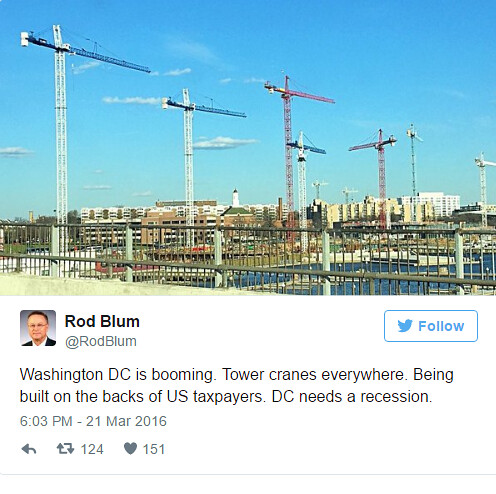
That kind of sentiment was expressed earlier in the year by Iowa Congressman Ron Blum, animated and angry about the success of DC's local economy.
Iowa Congressman Ron Blum isn't happy with DC's boom in real estate development
With conservative control of the House and Senate I can't see them becoming pro-government in terms of agency expansion and real estate, especially in DC, or in Virginia or Maryland, both of which went for Clinton, although in Virginia it was much closer and outstate Republicans still control the state government more or less.

Another project to watch will be the final selection of a site for a completely new FBI headquarters campus.  Maryland, a very Democratic state, has a Republican Governor, while Virginia's Governor is a Democrat, but the State Legislature is dominated by the Republican Party.

The Washington Business Journal ("How Donald Trump's victory might affect the FBI headquarters competition) figures the project will land in Maryland.  From the article:
Clinton is a close friend of Virginia Gov. Terry McAuliffe, and her running mate, Virginia Sen. Tim Kaine, is a former governor of the commonwealth. It stands to reason that if Clinton had defeated Trump, it would have significantly boosted Virginia's shot at landing the 2.4 million-square-foot FBI headquarters.

Maryland, long the front-runner for the $2 billion-plus HQ project, should remain there with Trump's victory.
That the federal government doesn't do traditional capital budgeting is another problem. See the past entry "We are all asset managers now."

Twitter photo by Ellison Barber.

But, with the Trump International Hotel in the Old Post Office Building, maybe President Trump will be inclined to push for real estate investment in DC.  Or not ("Protestors gather outside Trump hotel in DC," WUSA-TV)

What about the residential market?  As far as DC's residential real estate market is concerned, Republicans tend to live in the suburbs, Democrats in the city.  Maybe it will stay about the same, maybe it will decline.  I don't think that it will continue to be extranormally successful.

I can also see the potential for a rise of Mideast-policy-related terrorist incidents in the U.S., which mostly has been immune from it, outside of "homegrown" incidents (Orlando, San Bernardino, etc.).

If such incidents happen in DC, it could have major implications on the residential real estate market because for safety reasons, people may choose to not live in the city.

Labels: , , , , ,

Thursday, July 02, 2015

Why Mayor Bowser is right to be leery of systematic lowering of taxes

DC is about to significantly lower its income tax rates ("Meet the Democrat in D.C. who is cutting taxes for the rich" and "DC takes final step toward sweeping tax reforms, accelerates cuts," Post) out of a belief that DC's tax structure could work better, needs to be more competitive with the suburbs, and most residents need a tax reduction.

The Mayor isn't behind the change, while by contrast the Washington Post editorial board is all in ("By not lowering tax rates, D.C. is shortchanging its residents").

But the reality is that it is mostly "urban myth," that DC's taxes are significantly higher than the suburbs, although Maryland's taxes being higher than Virginia's, there are some differences.

It's not that I don't think it's great to lower taxes, but I know that the city is hard pressed financially despite the comparatively great economic times ("Wall Street's opinion of D.C. is at all-time high," Wall Street Journal).

Despite the city's "huge" budget (about $12 billion annually, 40%+ comprised of funding for and from federal programs, like health care), most every dollar is called for, and it is difficult to come up with money to improve roads ("U.S. roads, bridges are decaying despite stimulus influx," USA Today), to fund much in the way of small cost innovative efforts and other needs ("Boom or bust? D.C. lawmakers try to make sense of budget," Washington Post).

The bonding debt cap (bonds are used to finance capital improvements) is close to being reached ("D.C. in debt: Never before has the city owed so much" and "D.C. Council report suggests District may need to raise its debt cap," Washington Business Journal) which means that it will have to increase its debt cap.  In the meantime, the city is driven to financial engineering stratagems, such as trading land for a new soccer stadium ("A Safe Bet?," Washington City Paper) to reduce the need for capital funding,

(Although I argue for increasing the building height limit downtown as a way to increase property tax revenues and to pay for necessary infrastructure, such as Metrorail improvement and expansion.)

Plus, some of the long term trends for the city's economy, if not unfavorable, at the very least, should raise serious concerns and reflection:

1.  DC's economy is not very diversified.  It is dependent on the federal government.  And the federal government is shrinking.  Concomitantly, the DC (and metropolitan) economy is shrinking too ("Washington's Boom Goes Bust," New York Magazine; "Federal Government Downsizing Sends D.C. Region Tailspinning," Falls Church News-Press).
  • First, the Republican-controlled Congress has been cutting back on government spending. Since a disproportionate amount of these expenditures are in the Washington region, this slows down and shrinks the metropolitan economy.
  • Second, the Republican-controlled Congress is dialing back regulation, actively thwarting the expansion of various government agencies, such as the Consumer Financial Regulation Board.  This affects the DC and metropolitan real estate market.
  • Third, the Republican-controlled Congress is less willing to invest in government and therefore government agencies are shrinking, not growing, and they are moving out of more expensive real estate submarkets like DC proper to more distant locations.  This affects the DC and metropolitan real estate market and DC especially.
  • And the Republican-controlled Congress isn't very interested in investing in the creation of a Department of Homeland Security campus on the St. Elizabeths west campus--which DC touts as the anchor of investment and revitalization East of the River, and the reuse of the St. Elizabeths east campus.  ("Will Congress Pull the Plug on Homeland Security's Move to St. Elizabeths," Government Executive).  This has a huge impact on the DC commercial real estate market.
  • Plus, fewer government workers and use of less well connected locations for federal activities means less demand for transit, dropping WMATA revenues, and increasing financial exposure of local governments for supplemental appropriations to the transit authority.
Proximity to the federal government drives the city's commercial real estate market in the Central Business District, and certain key submarkets arguably outside of the CBD: Union Station/NoMA; Capitol Hill; Southeast; and Southwest.  

More than 20% of DC's property tax revenue stream comes from commercial real estate property taxes in these districts.

2.  A shrinking metropolitan economy reduces the attractiveness of DC as a place to live. Residential population growth is slowing down.  Recent trends favor urban living, which has stoked demand for in-city housing.  But it has also been driven by large population growth associated with the post-9/11 growth in the federal government sector.

For a couple years during the Gray Administration, DC was adding more than 1,000 new residents each month.  That number is now about one-third lower ("Washington-area population increase slowing down," Washington Post).
  • This reduces the demand for DC residential real estate.  Some people might say that's a good thing, that it will reduce velocity within the market, which thus far has led to a rapid run up in housing prices.  On the other hand, it means that some areas where the city is trying to add population will not grow as fast or grow at all, and the ability to revitalize those communities declines.
  • Reduced numbers of high wage earning residents reduces city property, income, and sales tax revenues. and has negative impact on the city's quality of life also. 
3.  Plus an expected rise in mortgage interest rates will likely have negative consequences on population in-migration and could threaten the success of the residential real estate market.
  • Right now, a $1 million mortgage on a house worth $1.25 million--houses in Capitol Hill, Columbia Heights, Dupont Circle, Georgetown, Logan Circle cost this much or more--costs between $6,000 and $7,000/month, including taxes and insurance.  That requires a household income of approximately $250,000.  
  • If interest rates increase by 50% -- approximately 6% -- or 100% -- approximately 8%, the monthly payments would be $10,500 to $14,000/month, requiring household income of $375,000 to $500,000 respectively.
  • but it would increase interest in multiunit housing in both the rental and owner markets.
In such a financing environment, the city's residential real estate market could crash.  This will be less of a problem for people who already own housing, but it will be difficult for new residents to buy, and likely the owned real estate market, at least for single family housing, will become stagnant.

This will lead to more support for accessory dwelling units, because more people will need additional income from their property in order to make the mortgage payment.

4.  Organizations of all types: business; nonprofit; government; are using less office space per employee. ("Changing Office Trends Hold Major Implications for Future Office Demand," CoStar Group).

Yes, it's true that there is a rise in demand for in-city and in-edge city locations, which will help the city somewhat vis-a-vis the suburbs ("The suburban office park is a relic. Here's the damage it's done to one D.C.-area county," Washington Business Journal) but the general reduction in s.f./worker eliminates a fair amount of demand that is unrecoverable except through growth..
  • The old metric was that it took 250 square feet (s.f.) to support one employee.  Now the number is 200 s.f./worker, trending further downward to 160 s.f  to 180 s.f. per worker. 
  • That is a reduction in demand of 50,000 s.f to 90,000 s.f. per 1,000 workers.  That opportunity cost in the loss of leasing activity gets big fast and is why area vacancy rates are climbing, from 10% in DC to higher in the suburbs.
  • This could reduce DC's demand for office space by many millions of square feet.
  • This is also why there is increased interest in converting older office buildings to housing ("Will D.C. area developers turn more office buildings into apartments," Washington Post) to repurpose otherwise unwanted space.
5.  Law firms are contracting, merging and going out of business.
Conclusion.  Given these indicators, I'd be very leery about reducing significantly DC's ability to generate tax revenue from income, property, and sales ("Poll: D.C. residents favor mayor's sales tax increase," Washington Post) taxes.

Lower rates reduces the city's financial flexibility in potentially turbulent economic circumstances, which I don't think can be ruled out.

In this matter, I am firmly in Mayor Bowser's court.

Labels: , , ,

Thursday, November 20, 2014

Another indicator of the decline of federal spending and its impact on the Metropolitan Washington economy

DC is not Las Vegas, where the massive national computing and consumer electronics exhibitions tend to be held.  Here, the big business in computing is the federal government.  So the "FOSE" (Federal Office Systems Exhibition) show was about the biggest, with 20,000+ attendees and major exhibitors.  (The Association of the US Army show--big on armaments--is probably just as big or bigger.)

The Washington Post reported the other day that FOSE is now kaput ("With the end of FOSE, government dependent trade shows take yet another hit"), so the 2014 show was the last, even if the website still lists show dates for 2015, as it hasn't been updated to reflect the decision.

FOSE trade show
FOSE in 2009.  Flickr photo by Joe Flood.

According to the article, attendance at trade shows relying on federal government workers as attendees are down about 30%.  I know training budgets have taken a big hit as well, which impacts various contractors.

As mentioned previously, Congress isn't into investing in federal buildings housing federal workers, especially if those agencies are regulators, and especially if those buildings are in DC, which lacks voting Congressmembers.

And in the comments, charlie mentions that Rosslyn, one of the Arlington county submarkets that has office buildings as tall or taller than those downtown, has a 30% vacancy rate right now, although that's partly due to the age of the buildings and the increased prominence and dominance of Tysons Corner and Reston as office districts and competitors for tenants.

Labels: , , , , , ,

Wednesday, October 23, 2013

Regulation as an economic burden on "job creators"

In some of the coverage of the Federal Government shutdown, I watched some Senator talk about how all federal regulation is unnecessary, an unreasonable and wasteful economic burden on business.

Just one eensy area of federal regulation concerns air quality and the release of pollutants into the atmosphere.

China, without the same level of regulations in this area as the USA, is suffering greatly from air pollution and smog.

It's a perfect example of the value of regulations.  Although I agree that there is some regulatory overreach sure and that the emphasis needs to be on protecting the public and the environment.
china-smog-harbin3
Buildings and streets are seen under heavy smog in Harbin, northeast China's Heilongjiang province on October 22, 2013. Thick smog enveloped a major Chinese city for a third day on October 22, with schools and a regional airport shut and poor visibility forcing ground transport to a halt in places.   AFP photo.
Smog in Harbin, China. 
AFP photo.  A man pushes his bike up a ramp to a bridge in thick smog in Harbin on Oct. 21, 2013. The Chinese city's official news site said: "You can't see your own fingers in front of you."   An index measuring PM2.5, or particulate matter with a diameter of 2.5 micrometers (PM2.5), reached a reading of 1,000 in some parts of Harbin. A level above 300 is considered hazardous, while the World Health Organization recommends a daily level of no more than 20.

Labels: , , , ,

Wednesday, February 06, 2013

The Urbanophile on "Washington" "DC"

Aaron Renn, the Urbanophile blogger, who also writes for the Manhattan Institute's City Journal, has an interesting take, "Hail Columbia! Welcome to America’s New Second City," on Washington now taking on the role of the nation's "Second City," because of the rise in importance and dominance of the federal government over more and more of the nation's economy.

From the piece:

1. Washington has developed a unique prosperity in the modern economy that goes well beyond its traditional recession-proof nature. Cities like Dallas boast “horizontal” success in adding people and jobs. Places like San Francisco boast of “vertical” success in raising per capita GDP and income. But Washington alone among big cities combines the stunning wealth and productivity of a New York with the volumetric growth of a Houston. It is a city simply without peer in America.

2. The scale of Washington now enables it to play with the big boys. In 2000, Chicago’s economy was about 50% bigger than Washington’s. Now it is only 25% bigger. Washington has more people with graduate degrees than Chicago and is on the verge of passing Los Angeles. At current growth rates, the combined Washington-Baltimore region will pass the 10 million population threshold in about 15 years to join the ranks of the world’s megacities.

3. Washington’s wealth extraction model has evolved from simply profiting from federal spending to a form of economic hegemony based on the regulatory superstate. The region may actually take a blow in the near term from fiscal retrenchment at the federal level, but the increasingly intrusive, fine grained control of the federal government over every aspect of American life ensures that the country will continue to pay tribute to Washington no matter what, and means you basically have to play in Washington to make it as an industry in America today.

It's tough with this kind of article in terms of distinguishing between Washington the city and the Washington metropolitan region, which is comprised of not just Washington DC but  also multiple suburban cities and counties. That was a problem also in the recent NYT Sunday Magazine piece on the same general subject "Washington Versus America").

The military and health sectors are two of the most significant economic drivers in the nation. And increase in the federal role in these areas has economic return to the Washington Metropolitan Region.

We don't realize how much this is the case. See "America’s staggering defense budget, in charts" from the Post. 20% of the federal budget is spent on the military.

As the NYT piece pointed out (as did a series in the Washington Post, see the blog entry "Montgomery County's real jobs problem is that it is an adjunct, not a full-fledged, member of the military-industrial complex") much of the metropolitan area's success in the last decade has been driven by the escalation of federal spending on the military generally and "homeland security" specifically--and this largesse by the way has mostly bypassed Washington the city and is spent in the suburbs and elsewhere in Maryland and Virginia.

The military spending tends to be much greater and has more immediate impact. This accounts for the relatively greater success of Northern Virginia vis-a-vis Suburban Maryland.  As this spending falls off (see "Charleston's economy girds for leaner defense budgets" and "Defense budget cuts hit businesses, localities" from USA Today), there is a greater likelihood of economic decline in Northern Virginia especially.

While all that Aaron writes is true, at the same time the primary economic development priority for the "local" Washington is to work to develop a local economy that is not fully dependent on the "federal government" for success. Right now it mostly is--the real estate market is hot because of the law firms, trade associations, contractors, and federal government agencies needing to be housed.

Eventually (post-grand jury duty), I plan to write a kind of review essay on this subject, in the context of the city's recent economic development "plan."  (Also see "One of the stupidest ideas of all time: "trading" the Washington Redskins for the FBI headquarters.")

Labels: , , , , ,

Friday, February 01, 2013

The "government" and the economy

I am incredulous about the quote from Sen. John Cornyn in yesterday's Post, in the article, "Economy shrinks as federal spending cuts trump private sector’s growth," about negative economic growth in the last quarter of 2012.

But Sen. John Cornyn (Tex.), the No. 2 Republican in the Senate, called the idea that economic growth relies on government spending “a Keynesian pipe dream.” The best thing Washington can do for the economy is to rein in the deficit, GOP leaders said.

The first reality is how much of the US economy is dependent on military spending. Military contractors have been in stasis out of concern that the "fiscal cliff" will be reached triggering sequestership and large cutbacks in military spending ("Joint Chiefs warn Congress that looming defense cuts would 'hollow' military" and "Contractors not fretting as sequestration threat looms" from the Post).

The second has to do with the impact of federal policy on the financial system, and how lack of predictability and stability (way more significantly than the current level of deficit spending) and stability.

Third, droughts and storms couldn't have helped the economy that much either.

Not to mention the ongoing downsizing of local governments. People out of work don't spend money. Etc.

Anyway, how's austerity policy working out for the UK? Also see "America’s fiscal policy is not in crisis: The urgent challenge is to promote economic recovery" from the Financial Times.

From the article:

The US confronts huge challenges, at home and abroad. Its fiscal position is not one of them. This is a highly controversial statement. If one judged by the debate in Washington, one would conclude that the federal government is close to bankruptcy. This view is false. Yes, the US does confront fiscal challenges in the long term. But these are largely caused by the soaring costs of its inefficient healthcare. Yes, the US is engaged in a fierce debate on fiscal policy. But this is due to philosophical disputes over the role of the state. Yes, the US has been running large fiscal deficits in the short run. But these are a result of the financial crisis. ...

This brings us to the philosophical dispute. One side of the political debate is strongly committed to the idea that taxes should fall. Some in this camp argue that all taxation is theft. Others believe taxes destroy incentives. Yet others argue that any state support saps self-reliance. Meanwhile, those on the other side of the debate believe, as strongly, in a safety net that covers risks related to health, ageing and unemployment. President Barack Obama defended this position, to my mind persuasively, in his inaugural speech. ...

In practice, political equilibrium tends to include the commitments to spending, but not the parallel commitments to revenue. In the long run, adjustments must be made. ...

The federal government is not on the verge of bankruptcy. If anything, the tightening has been too much and too fast. The fiscal position is also not the most urgent economic challenge. It is far more important to promote recovery. The challenges in the longer term are to raise revenue while curbing the cost of health. Meanwhile, people, just calm down.

Calm? I wish.

Labels: , , , ,

Sunday, June 24, 2012

"States rights", block grants, and community development and transportation

The reason that you need federal policies, rules, and regulations for how transportation or community development monies are to be used at the local level is because states, depending on their needs and agendas, may decide to spend the money on something else.

With regard to transportation, upwards of 15% of all trips nationally are made by walking or biking.  While the national percentage of transit trips is low, about 5%, in center cities this percentage can be much higher--in DC, the number is between 30% and 40%, while in New York City the number is even higher.

So you can argue that transportation monies should be spent, depending on the state, upwards of 15% to 30% on walking, biking, and transit.

Of course that's not how it is, most of the money is spent on roads.  Nationally, 1.5% of transportation funds are spent on walking and biking infrastructure (called the "Community Transportation Enhancement Program").

So biking and walking advocates are seriously concerned about provions in the proposed re-authorization of the federal transportation bill to strip out basic requirements to spend a certain percentage of federal transportation monies allocated to the states on walking and biking.  See "House Transportation Negotiators: Cut Funds for Biking and Walking, Then We’ll Talk" from Daily Kos.

Similarly, transit advocates--supported even by Republican lawmakers from transit cities--are fighting reductions in funding for transit infrastructure.  See "House raid on gas-tax fund would devastate mass transit on Staten Island" from the Staten Island Advance.

Anyway, the example of why states should not be given leeway on walking, biking, and transit funding that they claim that they will use responsibility comes to us from Louisiana, where Republican superstar Governor Bobby Jindal has redirected federal funds provided to the State of Louisiana for mitigating the destruction of property and economic activity as a result of Hurricane Katrina, to the funding of 1/2 of one years worth of pre-K education throughout the state. See the Associated Press story "Hurricane recovery money to fund pre-kindergarten."

Of course, this is an example of the misuse of funds for local economic and community development matters too, and an illustration of why funds appropriated to "community development" often don't have the impact that people expected.

(Also see "County officials fight to keep transit funds loophole" from the Ventura County (CA) Star.  In California, counties over 500,000 in population receive a portion of sales taxes that are supposed to be used to fund local transit services.  Ventura County got an exemption, and so they don't spend the money on transit, but on roads.  Since local redevelopment agencies have been dissolved, and these agencies had paid for a wide variety of local government positions and services, the County wants to maintain their authority to use this money for non-transit services.)
 

Labels: , , , , , , , ,

Thursday, May 31, 2012

Potentially positive unintended consequence of Congress taking control of the Union Square section of the National Mall

Delegate Norton's office calls our attention to this press release:

Norton Applauds Passage of Union Square Filming Amendment, Reiterates Call for Expanded Filming of Capitol

Washington, DC—Congresswoman Eleanor Holmes Norton (D-DC) said she was pleased with passage today by the House Appropriations Committee of an amendment to the fiscal year 2013 Legislative Branch Appropriations bill ratifying the Capitol Police Board’s decision to continue to allow commercial filming and photography in Union Square (the area just below the west side of the Capitol), after it was transferred last year from the National Park Service (NPS) to the Architect of the Capitol (AOC). After the transfer, Norton met separately with all the federal stakeholders to ensure that the NPS policy would be maintained after the transfer.


However, the Congresswoman said she would continue to seek an expansion of the areas where commercial filming and photography of the Capitol are permitted. In a letter last week, Norton urged the Committee on House Administration and the Senate Committee on Rules and Administration to hold a hearing to explore the possibility of expanding the permissible areas around the Capitol for commercial filming and photography. “I am gratified that the Appropriations Committee has given the Capitol Police Chief the express authority to allow commercial filming and photography in Union Square,” Norton said. “With this precedent, we have an even stronger case for allowing commercial filming and photography beyond Union Square. An expansion would benefit both D.C. and the nation. More films--and the large crews and tax dollars they bring--would be made in D.C., and films and photographs of the Capitol help illustrate our democratic system to the rest of the world.”

Norton said the transfer of jurisdiction from NPS occurred abruptly in the fiscal year 2012 omnibus spending bill without hearings. She believes that a hearing would show that there are advantages to an expansion at a time when the economy is struggling, and that there are no security risks. Particularly considering that filming requires the permission of the Capitol Police, Norton said, the transfer is an opportunity to explore commercial filming and photography of the Capitol for the first time in decades.

In the last sentence of the release, Delegate Norton made the point that the transfer, and the continuation of access to this area for filming and demonstrations--something that was a concern to various quarters (see "Control of the Mall’s Union Square changes hands" from the Post ) may provide an opportunity to expand the concept of film access more broadly to other areas of the Capitol Complex.
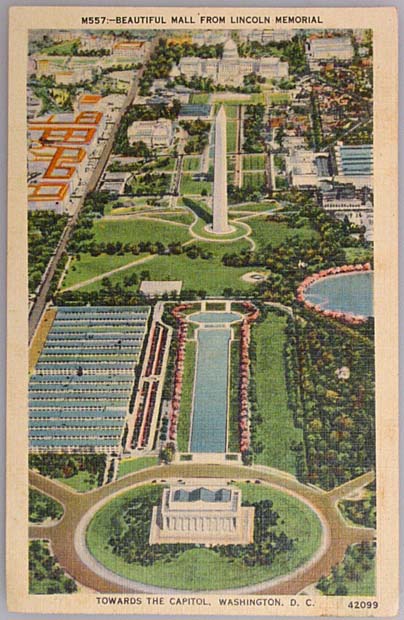
National Mall, from the Lincoln Memorial
While Congress generally has not been interested in putting monies toward National Mall improvements because they don't care about Washington except as a place to excoriate, over a long term perspective, this could change.  This was discussed in a great Associated Press takeout, "Neglected National Mall Languishes," from a couple years ago.


At the same time, having this section of the National Mall under the control of Congress gives Congress more reason to deal with National Mall issues on a regular basis.


This is a long term goal that Delegate Norton and her staff will have to try to stay on top of, but clearly, they already are.

Labels: , , , , ,

Tuesday, May 10, 2011

Why DC gets dissed by the federal government a lot: Union Station edition

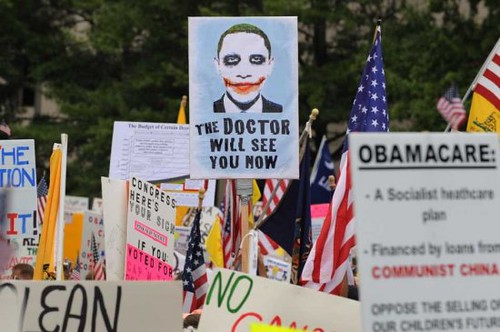
march and demonstration held by thousands to protest health care reform
A sign (top) portrays a ghoulish depiction of US President Barack Obama and reads 'The Doctor Will See You Now', during a march and demonstration held by thousands to protest health care reform proposed by the US President in Washington DC, USA, 12 September 2009. Organized by a conservative group called the Tea Party Patriots, the demonstration began at Freedom Plaza and ended at the US Capitol Hill. Photo: European Press Agency/MICHAEL REYNOLDS


The City Paper Housing Complex blog has a story, "Union Station Can’t Get It Together," about Union Station not receiving any US DOT monies for the improvement of the transit infrastructure there.

A couple years ago, the Associated Press did a great story about the National Mall in Washington, DC, "Neglected National Mall Languishes," about why Congress is not very interested in appropriating money for its improvement--because they would rather provide money for projects in their own districts. From the article:

An Associated Press analysis of congressional spending since 2005 found the mall has been at a disadvantage in competing for extra funds doled out by lawmakers, compared with sites that are represented by powerful members of Congress. The mall is in Washington, D.C., which has no vote in the House or Senate.

Last year, when dozens of ducks and ducklings died of avian botulism because the water in a mall pool near the Capitol was so fetid, and as urgent repairs were needed to stop the Jefferson Memorial’s sea wall from sinking into the mud, the Senate killed a $3.5 million earmark for the mall.

Instead, funding went to projects back home. All told, Congress sent home more than $181 million in earmarks through the park service budget last year — an election year — according to data compiled by the group Taxpayers for Common Sense and analyzed by the AP.

Given that the Obama Administration got whupped in the 2010 midterm elections, it doesn't make sense for the Administration to rub salt in the eyes of the anti-Washington folk and not earn any votes for the 2012 election in the process.

Appropriations are more likely to go where they can have electoral impact. DC doesn't have have voting representatives in the House and Senate, and even if we did, we'd still vote for the Democratic Party whether or not Union Station gets special federal appropriations this year...

-- Also see "Running Against Washington" from a 1976 issue of Time Magazine and this blog entry from 2006, "Running against Washington means you're predisposed not to help it."

It's not that Union Station "can't get it together," but instead, "Union Station can't catch a break."

Labels: , , , , , , ,

Thursday, December 02, 2010

You don't gotta have art

The video that drew the complaints, created by the late artist David Wojnarowicz, includes a brief segment showing ants crawling over a reproduction of Christ on the cross. Photo Credit: David Wojnarowicz/national Portrait Gallery Photo

I have written a number of times before about the conflict between national hagiography and critical reflection in national cultural policy as it relates specifically to the museums located in Washington, DC.

For the most part, but not exclusively, these controversies involve the Smithsonian Museums--the "nation's museums" which get 70% of their funding from the U.S. Government.

These museums, along with the U.S. Capitol, the White House, and the Washington Monument, are the primary destinations for tourists visiting Washington, DC.


The other three are:

- Robert Mapplethorpe photographs at the Corcoran ("Corcoran, to Foil Dispute, Drops Mapplethorpe Show" from the New York Times)

- a somewhat critical exhibit label on the Enola Gay airplane at the National Museum of Air and Space which was opposed by WWII veterans groups (see "The Enola Gay Controversy" website from Lehigh University)

- a culturally-specific narrative paradigm at the National Museum of the American Indian (see "A Museum of the Indian, Not for the Indian" from The American Indian Quarterly)

Plus, you could argue Marc Fisher's criticism that the National Museum of American History's "renovation" didn't do much in the way of change and challenge is also relevant to the discussion. See "German-American Heritage Museum promotes culture, doesn't tell whole story."

Fisher's piece criticizes what he calls the balkanization of history and culture, without taking responsibility for his role in diminishing the ability to engage in critical thought processes concerning the presentation of history.

These examples show how difficult it is to question, to be controversial, to challenge authority, especially in Washington, DC, especially when someone, somehow, can get to a legislator, and threaten access to federal funds.

There is a letter to the editor in yesterday's Post by William Hudnut, the former mayor of Indianapolis, about "American exceptionalism" that is apt with regard to this issue:

While in many respects America is exceptional, and there's no place most Americans would rather live, it might be well for those who are touting this message of American exceptionalism in unqualified language to be reminded of the Republican Party's founder and patron saint, Abraham Lincoln, who as president-elect, in a speech to the New Jersey Senate in Trenton on Feb. 21, 1861, spoke of America as God's "almost chosen people." The qualification "almost" is significant; it supplies a cautionary note about making an absolute statement that could fuel the fires of jingoism and messianism.

Hudnut's letter jibes with a point made in Blake Gopnik's piece today:

And that brings us to a big problem faced by almost anyone who cares deeply about art today: Many Americans think of art as being only about beauty and pleasant experiences of pretty things. Whereas those who spend a big chunk of their lives with it - artists, of course, but also critics, curators, scholars, collectors and plain devotees - tend to think that art can be much more than that. It can raise tough questions, and puzzle us, and challenge our ideas about what both art and life can be.

If this tougher view of art is even partly right, it is inevitable that some of the art that ends up in our museums, as curators hunt for what might turn out to be good in the end, will upset or provoke some, even many, of its viewers. Does that mean that no taxpayer money should go to any museum? I believe that, instead, it means that all of us need to take a deep breath when we feel put upon by art we dislike. For the good of all of us, all of us might sometimes need to bear with the occasional offense.


For what it's worth, in 2004 I attended the National Trust for Historic Preservation Conference in Louisville, Kentucky. The first couple nights I stayed in the Clifton neighborhood and I stumbled upon a temporary art/performance art exhibition in a rentable formerly industrial building of some sort.

One of the pieces was a video, in a light box, shown through a kind of pewter cut out in the shape of cross, showing men engaged in fellatio.

Right then, I said to myself, "wow, this shows how constrained it is with regard to the kinds of art that can be presented in DC."

Surely the major presenting institutions (National Gallery of Art, Smithsonian American Art Museum, National Portrait Gallery, which are public, and the Corcoran and the Phillips Collection, which are private) lack the kind of latitude that a gallery or pop up exhibition (think something like Artomatic, which isn't all that challenging either) can have.

Of course, the controversy over the Mapplethorpe photos, which almost destroyed the Corcoran, has already demonstrated this fact.

Gopnik's piece from yesterday is very important. He makes two key points:

1. That particular religious orders aren't supposed to be able to dictate how the rest of us think or what we can see; that fundamentally, the Catholic Church's criticism of this piece and the Smithsonian's response is no different from an Imam's fatwa.

2. That the criticism, fundamentally, is about homosexuality, and any object of the church being associated with this, even as Jesus has been used for centuries in art as a symbol of suffering. He writes:

The attack is on gayness, and images of it, more than on sacrilege - even though, last I checked, many states are sanctioning gay love in marriage, and none continue to ban homosexuality.

Video showing the piece by David Wojnarowicz containing ants crawling on a cross -- part of the sexuality-themed exhibit "Hide/Seek: Difference and Desire in American Portraiture".

Labels: , , , ,

Friday, July 24, 2009

Let's go to the Mall...

After festivals and celebrations in early July, the National Mall is worn from wear, as seen from the top of the Washington Monument facing the Capitol in Washington, on Tuesday, July 14, 2009. Crumbling sidewalks near the Jefferson Memorial are sinking into the Tidal Basin. Reflecting pools are filled with green, smelly water. And millions of visitors have trampled the soil into virtual concrete where grass can't grow. The National Mall is in danger of becoming a national disgrace.(AP Photo/Jacquelyn Martin)

The City Desk blog/Loose Lips at the City Paper calls our attention to an AP story on the state of the National Mall, "Neglected National Mall languishes." From the article:

An Associated Press analysis of congressional spending since 2005 found the mall has been at a disadvantage in competing for extra funds doled out by lawmakers, compared with sites that are represented by powerful members of Congress. The mall is in Washington, D.C., which has no vote in the House or Senate.

Last year, when dozens of ducks and ducklings died of avian botulism because the water in a mall pool near the Capitol was so fetid, and as urgent repairs were needed to stop the Jefferson Memorial's sea wall from sinking into the mud, the Senate killed a $3.5 million earmark for the mall.

Instead, funding went to projects back home. All told, Congress sent home more than $181 million in earmarks through the park service budget last year — an election year — according to data compiled by the group Taxpayers for Common Sense and analyzed by the AP. Nearly half that money was driven by lawmakers who were on the House and Senate appropriations committees.. ...

Government watchdogs say earmarks corrupt the budget process. "We're making spending decisions on the basis of political muscle, rather than project merit," said Stephen Ellis, vice president of Taxpayers for Common Sense. "Because the mall is owned by nobody, even though it is this gem for many Americans, it gets short shrift," he said.

The mall didn't just lose out on earmarks. In January, Congress deleted $200 million in stimulus funding for the mall. And last year, a bill that would have appropriated $100 million for mall repairs failed.

Republican Rep. Jeb Hensarling of Texas said mall funding wasn't an emergency. "It's entirely appropriate for Congress to fund repairs for the National Mall in the traditional process, but the American people are smart enough to know that it will do very little or absolutely nothing to provide economic stimulus," he said.

House Republican whip Eric Cantor of Virginia similarly derided efforts to "help upkeep the grass on the lawns of Washington."

This is the problem with the federal institutions and civic assets located within DC. As long as we are reliant on Congresspeople to fund the maintenance and improvement of these assets, which for better or worse, are constituent civic assets both for the nation and for our city, we are screwed.

Most of them spend all their time running against and railing against "Washington." So why should they consider investing in Washington, or Washington's role as the center of government, and its place at the center of interpreting the narrative of the nation, National Myth and Culture, etc.

On the other hand, as "Washingtonians" our hands are plenty full trying to get the municipal government to function and we don't have enough time to serve as adequate stewards of the "local" civic assets that carry both national and local meaning.

See "Running Against Washington" from a 1976 issue of Time Magazine and this blog entry from 2006, "Running against Washington means you're predisposed not to help it." We need another Mr. Smith...
http://imagecache2.allposters.com/images/pic/MG/170537%7EMr-Smith-Goes-to-Washington-Posters.jpg

Labels: , , , , ,

Friday, February 06, 2009

U.S. Senate Continues to Consider the American Recovery and Reinvestment Act

From the American Public Transportation Association:

The U.S. Senate today will continue to consider the American Recovery and Reinvestment Act of 2009. The Senate version of legislation currently contains $8.4 billion for public transportation through existing formula programs, $5.5 billion for a multi-modal discretionary grant program for states and local governments for highway, transit and other surface transportation projects of national or regional significance, and $2 billion for high speed rail.

Yesterday, an amendment offered by Senator David Vitter (R-LA) to strip several programs from the bill, including the $2 billion for high speed rail and $850 million for Amtrak was defeated by a vote of 65-32. An additional amendment to remove high speed rail funds from the legislation may be offered by Senator Kit Bond (R-MO). No other additional amendments relevant to transportation and infrastructure were considered. However, several significant amendments remain pending and others are expected to be offered as the Senate proceeds with its consideration of the bill.

There are a number of amendments that may be offered on the Senate floor that could add additional funding for public transportation, including:

* An amendment sponsored by Senators Patty Murray (D-WA) and Diane Feinstein (D-CA) that would add $25 billion for infrastructure, including $5 billion for transit. (This amendment, which would add funds for the New Starts and Fixed Guideway Modernization programs, was set aside after it failed on a procedural vote, but the amendment sponsors may to attempt to revive it.)

* An amendment sponsored by Senators Charles Schumer (D-NY) and Arlen Specter (R-PA) which would add $6.5 billion for transit, and allow a portion of the funds to be used to cover operating expenses; and

* An amendment sponsored by Senators Barbara Boxer (D-CA) and James Inhofe (R-OK) that would redirect stimulus funds not obligated within one year of passage to highway, transit and water resources projects.

In addition, APTA continues to track an amendment expected to be offered by Senator Kit Bond (R-MO) that would eliminate the multi-modal discretionary grant program described above and transfer the funds to the Federal Highway Program to be distributed under the federal Surface Transportation Program (STP). The intermodal program as currently drafted would make funding available for the New Starts, fixed-guideway rail modernization programs, as well as passenger and freight rail projects not otherwise eligible under the bill.

Action Alert


Contact your Senators immediately and urge them to:

* Support amendments to the American Recovery and Reinvestment Act that increase funding for public transportation;

* Oppose amendments that would eliminate funding for passenger and high-speed rail initiatives;

* Oppose the Bond amendment to eliminate the $5.5 billion multi-modal discretionary program and transfer the funding to the Federal Highway Administration's Surface Transportation Program.

Also see the report from Streetsblog, "Senate’s $50 Billion Highway Giveaway Nearly Dead" which is more optimistic about the likelihood of failure of the proposed pro-highway amendment from Senator Bond of Missouri.

Labels: , , ,

Tuesday, January 27, 2009

The stimulus, planning, and the American Economy

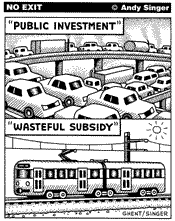
Andy SInger No Exit comic, public investment vs. wasteful subsidy
Andy Singer's No Exit comic.

Being a skeptic, I think that we are entering a "correction" of massive proportions where consumer spending could decrease somewhat significantly, reducing the overall size of the economy--people buying fewer cars, fewer clothes, making fewer discretionary purchases, saving more money, etc. will have an impact on the economy in many ways.

If you believe this, today's full page ad in the Washington Post by the American Automobile Association, calling for continued economic support of automobility seems to be asking to continue to "invest" limited federal monies in ways that look backward, rather than forward towards a new paradigm that links transportation and land use planning, and one that focuses on optimal mobility rather than automobility.

There is an article in National Journal about the failure of the finance industry and how it supports Hamiltonian-like industrial policy and heavier government involvement in the economy ("Washington's Sad Triumph"). I am torn about this because while I favor planning, at the same time i think that government, especially federal government tends toward stagnation, because the bureaucratic impulse is for system maintenance, not system improvement, and as special interest groups work to shape federal legislation in their favor.

What we need with government involvement is innovation and transformation. Sometimes we get it--the Internet is one example--but much of the time it is business as usual. (The "Growth Machine" theory about local political and economic elites focused on a joint agenda of local economic growth is easily extended to how industrial and other business sectors work in a similar fashion to shape national policy.)

The "stimulus" proposal gets me down because like most government "stimulus" plans, more than anything, it's a grab bag of programs, elements, and policies du jour. Meanwhile, for the first time in a long time, Americans support spending on infrastructure, and even spending more money in taxes on infrastructure, according to this op-ed, "Rebuilding effort" in yesterday's Baltimore Sun. From the op-ed:

Right now, 78 percent of Americans polled say government is responsible for the failure of America's infrastructure. They don't think the problems can be solved in the first 100 days of a new administration in Washington. Rather, they want ongoing strategic investments to improve America's standard of living and our individual quality of life. When more than 98 percent of Americans believe they have "the right to demand" that America's infrastructure is "efficient, convenient and modern," Washington better not fail.

Despite record transit ridership, virtually every system in the country, except maybe for Rochester, NY (see "Creativity Helps Rochester’s Transit System Turn a Profit" from the New York Times) faces big deficits, service cuts, layoffs, and/or fare increases. See "A mass transit dilemma: Ridership up, funds down" from the Los Angeles Times for a round up on this. (Of course, when the economy is in recession, tax receipts decline, and state and local governments, required to have balanced budgets, must cut services and staff, which is a policy that only deepens a recession.)
Transit usage
So the reason I get skeptical of government planning is because it often promotes stagnation, many government programs don't build value or increase return on investment. And building long term value is what I think government should be about, first and foremost.

So thinking about how Spain is reformulating its national transportation policy around high speed rail, makes me sad that the U.S. doesn't have a national transportation policy built around high speed rail in the corridors where it makes the most sense.

For example, in the Midwest, where Wisconsin State Governor Jim Doyle suggested that

Federal economic stimulus money could be used to build a Midwestern high-speed passenger rail system that would link Chicago to Minneapolis with stops at Milwaukee, Madison and even Green Bay

according to "Gov. Doyle pushes high-speed rail for stimulus funds" from the Milwaukee Journal-Sentinel.

Just as the U.S. built (through economic subsidy or stimulus) a national railroad system in the 1860s, why not begin rebuilding our economy around reduction in oil use by doing the same for the 21st Century. A north-south east coast high speed rail corridor, along with the same along the west coast, and a upper and lower transcontinental high speed rail corridor would be the way to do this. Rebuilding U.S. railroad technology capacity would be a way to employ the hundreds of thousands of unemployed manufacturing workers, and would be a far better use of stimulus money that $80 million for new loading docks for the Philadelphia Museum of Art.
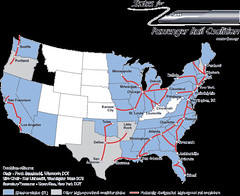
High Speed Rail map, States for Passenger Rail Coalition
The gaps in this map from the States for Passenger Rail Coalition shows the need for a national policy and plan...

Labels: , , , , , ,

Sunday, December 28, 2008

Speaking of using stimulus "investment" to build a better future rather than to just build highways

Having suffered losing my bicycle seat and post to a eager thief at Fort Totten a couple weeks ago, I went to Arrow Bicycles in Hyattsville yesterday--figuring that since they are about the newest bike shop around they are probably the most in need of customers during this trying retail season.

While waiting, I was poking through back issues of Cycling Plus, a UK cycling magazine that they had lying on the repair counter, and I came across an article about the Cycling Demonstration program launched by the UK, "Bristol named as UK's first 'cycling city'" and "Will Bristol spend its cycling city cash?"

This is something that both Washcycle and I have written about in the past, but it took seeing this article again in the context of the discussion of road-oriented federal infrastructure stimulus spending to think again about how very little forward-thinking, discussion of transformation, of building "better" not just building more, is happening.

Can you imagine if the equivalent of $200 million was being spent as part of the stimulus package, comparable to the program in the UK, on creating one "Cycling Demonstration City" and 16 additional "Cycling Demonstration Towns."

See for example:

-- Bristol's cycling project seeks boss to spend £22.8m (Evening Post)
-- Britain Invests Hundreds of Millions to Encourage Cycling (Environment News Service)
-- Bristol wins first cycling city title in £100m plan to get Britons pedaling (Guardian)
-- Government seeks UK's first 'cycling city' (Guardian)

Rails to Trails Conservancy has a trails oriented transportation enhancement proposal floating around, but for me, it misses the point, because it's more about trails than it is about pushing forward creating substantive bicycle-friendly mobility environments that are regularly used as part of how people get around day to day, rather than weekend fun things that are primarily recreational.

But think about this from the Cycling Plus story:

Bristol wants to double the number of people cycling over the next three years, by:

• Creating the UK's first on-street bike rental network, modelled on the successful Paris scheme
• Establishing a 're-cycling' scheme, providing free bikes to those in deprived communities
• Building a facility for cyclists in the city centre providing showers, bike parking and lockers so commuters can have a wash and brush up before work
• Creating a dedicated cycleway to link the suburbs with the city centre opening up new, safer options for commuters who currently rely on their cars
• More than doubling the number of children receiving cycling training.


In announcing Bristol as the UK's first cycling city, Transport Secretary Ruth Kelly said, "A quarter of journeys made every day by car are less than two miles. Cycling is an alternative that could bring real health benefits to millions of adults and children, as well as helping them save money and beat congestion.

Can you imagine hearing a similar quote from current U.S. Secretary of Transportation Mary Peters?, who is famous for saying that the reason the Minneapolis bridge failed is because of money spent--in her terms "wasted"--on supporting bicycling, walking, and other non-automobile oriented transportation infrastructure.

The steps Bristol is moving to take, or the steps I suggest in the paper "Ideas for Making Cycling Irresistible in DC" about what could be done to create a truly world-class bicycling infrastructure in the City of Washington are the kinds of programs I would like to see supported, developed, and extended as part of enhancing transportation, mobility, and the economy.

Labels: , , , ,