Rebuilding Place in the Urban Space

"A community’s physical form, rather than its land uses, is its most intrinsic and enduring characteristic." [Katz, EPA] This blog focuses on place and placemaking and all that makes it work--historic preservation, urban design, transportation, asset-based community development, arts & cultural development, commercial district revitalization, tourism & destination development, and quality of life advocacy--along with doses of civic engagement and good governance watchdogging.

Saturday, August 24, 2013

Washington, DC and protest

Being the National Capital, Washington, DC is a symbol of the nation, and the National Mall is frequently a place of celebration; such as events held during the Presidential Inauguration; festival, such as the annual Smithsonian Folklife Festival or National Book Festival; and protest, ranging from the Bonus Army marchers in the 1920s, the Anti-War protests in the 1960s and 1970s, and of course, many marches on Washington for peace, justice, and civil rights, including the 1963 March on Washington for Jobs and Freedom, which is being celebrated this weekend, its 50th anniversary ("50 years later, thousands retrace March on Washington," USA Today).

I collect postcards about Washington, images of either the Federal City as well as the local city (restaurants, landmarks located within neighborhoods, church buildings, etc.), and I am especially interested in the messages that visitors write on the postcards which tells about their impressions of the city.

One of the great things about DC ephemera (and sadly, with the migration of such materials to the Internet they cease to be able to be collected) is that back when people sent postcards and such, they sent them home to friends and relatives, so you can find good stuff all around the country.

I picked up some postcards in Seattle.  Going through them at the shop I set interesting ones  aside for further review.

Suzanne commented on this one, it seemingly being a particularly average "Greetings from Washington" postcard.  She wondered why I wanted to spend money on such a boring card.

But I wasn't interested in the cover image.  It was the message.

The person visiting the city came during a big Anti-War protest, the "Moratorium," and the message comments on how the protest made getting around difficult, that streets were closed, and also full of people.

Some of the other elements I look for in postcards are the postmarks--most are generic "Washington" postmarks, but I've picked up postcards with Takoma Park, Brookland, Terminal Station (Union Station), and Mount Vernon on the Potomac (Mount Vernon, Virginia) postmarks--and the cancellation message, which on occasion may be interesting.

This particular postcard was sent by a health care professional to someone that she worked with, addressed to a specific medical ward at the hospital.  She had come to DC for a conference.

Maybe this is some of what she saw. 

Caption: With the U.S. Capitol in the background, demonstrators march along Pennsylvania Avenue in an anti-Vietnam War protest in Washington, on Moratorium Day, November 15, 1969.  From: an AP file photo reprinted in a North Jersey Herald history feature on events in the year 1969.

Labels: , , ,

Thursday, May 31, 2012

Potentially positive unintended consequence of Congress taking control of the Union Square section of the National Mall

Delegate Norton's office calls our attention to this press release:

Norton Applauds Passage of Union Square Filming Amendment, Reiterates Call for Expanded Filming of Capitol

Washington, DC—Congresswoman Eleanor Holmes Norton (D-DC) said she was pleased with passage today by the House Appropriations Committee of an amendment to the fiscal year 2013 Legislative Branch Appropriations bill ratifying the Capitol Police Board’s decision to continue to allow commercial filming and photography in Union Square (the area just below the west side of the Capitol), after it was transferred last year from the National Park Service (NPS) to the Architect of the Capitol (AOC). After the transfer, Norton met separately with all the federal stakeholders to ensure that the NPS policy would be maintained after the transfer.


However, the Congresswoman said she would continue to seek an expansion of the areas where commercial filming and photography of the Capitol are permitted. In a letter last week, Norton urged the Committee on House Administration and the Senate Committee on Rules and Administration to hold a hearing to explore the possibility of expanding the permissible areas around the Capitol for commercial filming and photography. “I am gratified that the Appropriations Committee has given the Capitol Police Chief the express authority to allow commercial filming and photography in Union Square,” Norton said. “With this precedent, we have an even stronger case for allowing commercial filming and photography beyond Union Square. An expansion would benefit both D.C. and the nation. More films--and the large crews and tax dollars they bring--would be made in D.C., and films and photographs of the Capitol help illustrate our democratic system to the rest of the world.”

Norton said the transfer of jurisdiction from NPS occurred abruptly in the fiscal year 2012 omnibus spending bill without hearings. She believes that a hearing would show that there are advantages to an expansion at a time when the economy is struggling, and that there are no security risks. Particularly considering that filming requires the permission of the Capitol Police, Norton said, the transfer is an opportunity to explore commercial filming and photography of the Capitol for the first time in decades.

In the last sentence of the release, Delegate Norton made the point that the transfer, and the continuation of access to this area for filming and demonstrations--something that was a concern to various quarters (see "Control of the Mall’s Union Square changes hands" from the Post ) may provide an opportunity to expand the concept of film access more broadly to other areas of the Capitol Complex.
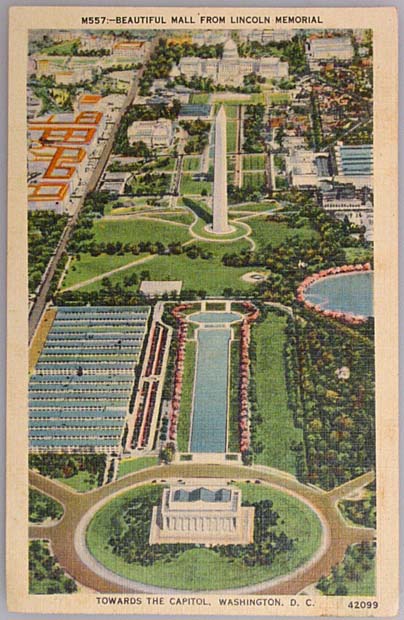
National Mall, from the Lincoln Memorial
While Congress generally has not been interested in putting monies toward National Mall improvements because they don't care about Washington except as a place to excoriate, over a long term perspective, this could change.  This was discussed in a great Associated Press takeout, "Neglected National Mall Languishes," from a couple years ago.


At the same time, having this section of the National Mall under the control of Congress gives Congress more reason to deal with National Mall issues on a regular basis.


This is a long term goal that Delegate Norton and her staff will have to try to stay on top of, but clearly, they already are.

Labels: , , , , ,

Monday, April 09, 2012

Trust for the National Mall to exhibit final National Mall designs: APRIL 9 - 15

Image of the National Mall from McClatchy Newspapers article, "National Mall needs multimillion-dollar face-lift."

From the Trust for the National Mall:

The Trust for the National Mall, the official non-profit partner of the National Park Service dedicated to restoring and improving the National Mall, will exhibit the final design concepts of the National Mall Design Competition from Monday, April 9 through Sunday, April 15. The concepts will be displayed for public viewing and comment at the Smithsonian Castle Great Hall and the National Museum of American History.

The concepts, created by the country’s top designers, re-envision three prominent National Mall locations: Constitution Gardens, Sylvan Theater on the Washington Monument Grounds and Union Square. The winning designs, to be selected by a Jury of design experts, will be announced in May.

The Trust for the National Mall is .

National Mall Design Competition Public Exhibition
Monday, April 9 - Sunday, April 15, 2012

Union Square Design Concepts
Smithsonian Castle Great Hall
1000 Jefferson Drive SW, Washington, DC
Open 8:30 AM – 5:30 PM

Constitution Gardens and Sylvan Theater on the Washington Monument Grounds Design Concepts
National Museum of American History, Lemelson Hall, First Floor West
1400 Constitution Avenue NW, Washington, DC
Open 10:00 AM – 5:30 PM

Labels: , , ,

Tuesday, May 10, 2011

Why DC gets dissed by the federal government a lot: Union Station edition

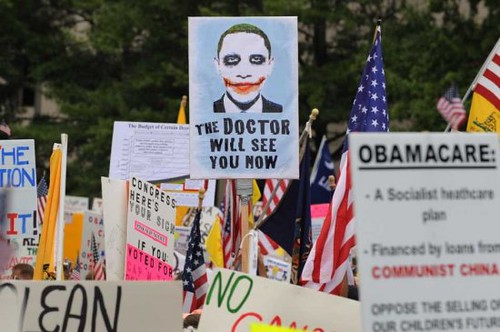
march and demonstration held by thousands to protest health care reform
A sign (top) portrays a ghoulish depiction of US President Barack Obama and reads 'The Doctor Will See You Now', during a march and demonstration held by thousands to protest health care reform proposed by the US President in Washington DC, USA, 12 September 2009. Organized by a conservative group called the Tea Party Patriots, the demonstration began at Freedom Plaza and ended at the US Capitol Hill. Photo: European Press Agency/MICHAEL REYNOLDS


The City Paper Housing Complex blog has a story, "Union Station Can’t Get It Together," about Union Station not receiving any US DOT monies for the improvement of the transit infrastructure there.

A couple years ago, the Associated Press did a great story about the National Mall in Washington, DC, "Neglected National Mall Languishes," about why Congress is not very interested in appropriating money for its improvement--because they would rather provide money for projects in their own districts. From the article:

An Associated Press analysis of congressional spending since 2005 found the mall has been at a disadvantage in competing for extra funds doled out by lawmakers, compared with sites that are represented by powerful members of Congress. The mall is in Washington, D.C., which has no vote in the House or Senate.

Last year, when dozens of ducks and ducklings died of avian botulism because the water in a mall pool near the Capitol was so fetid, and as urgent repairs were needed to stop the Jefferson Memorial’s sea wall from sinking into the mud, the Senate killed a $3.5 million earmark for the mall.

Instead, funding went to projects back home. All told, Congress sent home more than $181 million in earmarks through the park service budget last year — an election year — according to data compiled by the group Taxpayers for Common Sense and analyzed by the AP.

Given that the Obama Administration got whupped in the 2010 midterm elections, it doesn't make sense for the Administration to rub salt in the eyes of the anti-Washington folk and not earn any votes for the 2012 election in the process.

Appropriations are more likely to go where they can have electoral impact. DC doesn't have have voting representatives in the House and Senate, and even if we did, we'd still vote for the Democratic Party whether or not Union Station gets special federal appropriations this year...

-- Also see "Running Against Washington" from a 1976 issue of Time Magazine and this blog entry from 2006, "Running against Washington means you're predisposed not to help it."

It's not that Union Station "can't get it together," but instead, "Union Station can't catch a break."

Labels: , , , , , , ,

Friday, July 24, 2009

Let's go to the Mall...

After festivals and celebrations in early July, the National Mall is worn from wear, as seen from the top of the Washington Monument facing the Capitol in Washington, on Tuesday, July 14, 2009. Crumbling sidewalks near the Jefferson Memorial are sinking into the Tidal Basin. Reflecting pools are filled with green, smelly water. And millions of visitors have trampled the soil into virtual concrete where grass can't grow. The National Mall is in danger of becoming a national disgrace.(AP Photo/Jacquelyn Martin)

The City Desk blog/Loose Lips at the City Paper calls our attention to an AP story on the state of the National Mall, "Neglected National Mall languishes." From the article:

An Associated Press analysis of congressional spending since 2005 found the mall has been at a disadvantage in competing for extra funds doled out by lawmakers, compared with sites that are represented by powerful members of Congress. The mall is in Washington, D.C., which has no vote in the House or Senate.

Last year, when dozens of ducks and ducklings died of avian botulism because the water in a mall pool near the Capitol was so fetid, and as urgent repairs were needed to stop the Jefferson Memorial's sea wall from sinking into the mud, the Senate killed a $3.5 million earmark for the mall.

Instead, funding went to projects back home. All told, Congress sent home more than $181 million in earmarks through the park service budget last year — an election year — according to data compiled by the group Taxpayers for Common Sense and analyzed by the AP. Nearly half that money was driven by lawmakers who were on the House and Senate appropriations committees.. ...

Government watchdogs say earmarks corrupt the budget process. "We're making spending decisions on the basis of political muscle, rather than project merit," said Stephen Ellis, vice president of Taxpayers for Common Sense. "Because the mall is owned by nobody, even though it is this gem for many Americans, it gets short shrift," he said.

The mall didn't just lose out on earmarks. In January, Congress deleted $200 million in stimulus funding for the mall. And last year, a bill that would have appropriated $100 million for mall repairs failed.

Republican Rep. Jeb Hensarling of Texas said mall funding wasn't an emergency. "It's entirely appropriate for Congress to fund repairs for the National Mall in the traditional process, but the American people are smart enough to know that it will do very little or absolutely nothing to provide economic stimulus," he said.

House Republican whip Eric Cantor of Virginia similarly derided efforts to "help upkeep the grass on the lawns of Washington."

This is the problem with the federal institutions and civic assets located within DC. As long as we are reliant on Congresspeople to fund the maintenance and improvement of these assets, which for better or worse, are constituent civic assets both for the nation and for our city, we are screwed.

Most of them spend all their time running against and railing against "Washington." So why should they consider investing in Washington, or Washington's role as the center of government, and its place at the center of interpreting the narrative of the nation, National Myth and Culture, etc.

On the other hand, as "Washingtonians" our hands are plenty full trying to get the municipal government to function and we don't have enough time to serve as adequate stewards of the "local" civic assets that carry both national and local meaning.

See "Running Against Washington" from a 1976 issue of Time Magazine and this blog entry from 2006, "Running against Washington means you're predisposed not to help it." We need another Mr. Smith...
http://imagecache2.allposters.com/images/pic/MG/170537%7EMr-Smith-Goes-to-Washington-Posters.jpg

Labels: , , , , ,

Tuesday, April 14, 2009

National Mall "stuff"

National Mall, from the Lincoln Memorial
1. There are a bunch of books on the subject. I am thinking that should use this fact as the impetus to finally get a "DC/urban issues" reading group going:

-- The National Mall: Rethinking Washington's Monumental Core
-- The Washington National Mall
-- Worthy of the Nation: Washington, DC, from L'Enfant to the National Capital Planning Commission
-- (journal article) "Politics, Public Space, and Memorials: The Brawl on the Mall"

Plus National Capital Planning Commission reports, plus even some journal articles and such about museums such as these:

-- Grasping the World: The Idea of the Museum;
-- Continuing dialogues: Evolving views of the National Museum of the American Indian (journal article);
-- The National Museum of the American Indian as Cultural Sovereignty (journal article).

2. The American Society of Landscape Architects has released today "recommendations of a panel of design experts who convened to address plans to revive the National Mall. The panel's findings report is in response the National Park Service’s recently published preliminary preferred alternative and addresses specific features of the Mall including: additional memorials, water features, Union Square and the downtrodden grass and walkways.

A full copy of the findings report as well as the executive summary and video clip of the panelists’ working session can be found on ASLA ’s Web site (www.asla.org/nationalmall).
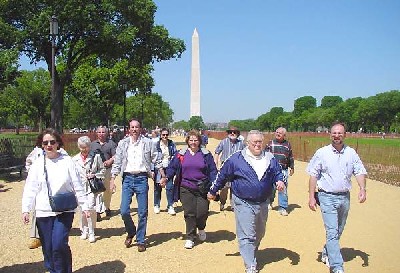
Tourists determinedly taking on Washington on the National Mall
(Photo source unknown.)

3. I find one of the panel's recommendations:

-- The panel calls for an end to additional centers of interpretation for monuments and memorials. They propose centralizing these needs in a National Mall orientation center. Renovation and remediation of the Smithsonian Arts and Industries Building , now empty yet near a key Metro stop, could serve this purpose.

to be particularly intriguing although I can't imagine special interests not being able to get to Congress, and get "special exceptions" for their "unique" circumstances. And it would require working with the Smithsonian Institution, which has their own problems.

4. But then again, one of the big problems is that the Mall is under the purview of the National Park Service and the buildings bracketing the Mall are for the most part under the purview of the Smithsonian (plus the National Gallery of course, and the Architect of the Capitol) and I don't know how much these institutions interact.

5. The aforementioned National Park Service’s recently published preliminary preferred alternative is online here. It was released a couple weeks ago.

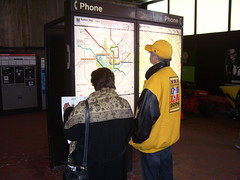
Looking at a map at the Takoma Metro Station
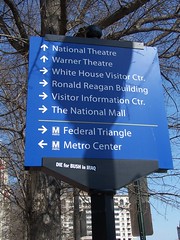
6. Plus, the National Park Service is implementing a wayfinding system according to the Washington Post, "Here, Even Icons Need IDs: Park Service Wants Tourist-Friendly Signs for Mall Monuments," and you see evidence of this in markers starting to be installed in parks such as Logan Circle (I don't have photos yet).

But this in part is the impetus for my future post on wayfinding. There are at least 10 separate wayfinding "systems" in the city. They aren't coordinated. We need a wayfinding conference as a start, and then a concordat to start integrating signage into one wayfinding system within the city. (And it's time to assess and update the "blue" wayfinding signage program. Plus, how many years should it take to get the Children's Museum taken off signs since it hasn't existed in the H Street neighborhood for at least four years.)

The wayfinding systems (not in ranked order necessarily):

1. The street and highway signage system generally (DDOT);
2. The "blue" wayfinding signage system (DDOT pays for it, the Downtown BID coordinates the system under contract);
3. The heritage trail signage (CulturalTourismDC);
4. The National Park Service;
5. The Architect of the Capitol;
6. Signage information on bus shelters and signs and in subway stations;
7. DC Department of Parks and Recreation for city parks (not really, but they should);
8. Intra-campus signage systems such as for the Library of Congress or Catholic University;
9. Banner programs within Business Improvement Districts and commercial districts, and neighborhoods;
10. While it doesn't exist in a coordinated fashion, a parking wayfinding signage system ought to exist as well (within the context of mobility, not just automobility).
Wayfinding Sign

Labels: , ,

Tuesday, September 09, 2008

A pan of the Martin Luther King memorial

Catesby Leigh, writing for the Wall Street Journal, doesn't think well of the capabilities of the Commission on Fine Arts, the federal body that reviews memorials (as well as projects that affect the federal core and presence in the city), in "An Inflated, Ossified Memorial."

I find a number of CFA's decisions unfathomable myself, if quality design is supposed be what is obtained.

Labels: ,