Rebuilding Place in the Urban Space

"A community’s physical form, rather than its land uses, is its most intrinsic and enduring characteristic." [Katz, EPA] This blog focuses on place and placemaking and all that makes it work--historic preservation, urban design, transportation, asset-based community development, arts & cultural development, commercial district revitalization, tourism & destination development, and quality of life advocacy--along with doses of civic engagement and good governance watchdogging.

Monday, August 04, 2025

Another view on the sale of federal buildings: need for updated facilities | Impact comparable to the closure of city-based navy shipyards?

I have been quick to criticize the Trump Administration for its agenda on shrinking its real estate portfolio.  While some of it, like abrogating leases, was a part of Trump/Musk DOGE agenda of destruction of the federal government without any connection to need for a functioning government--e.g. leases for Social Security offices and federal land management offices were broken--there is another issue.

The buildings, many built before 1980 are old, often poorly maintained and expensive to renovate.  Then it may make sense to sell and rebuild, or since the government is shrinking, lease smaller buildings.

The JFK Federal Building in Boston. Photo: Paul Marotta/Getty Images

From the Boston Globe article, "The federal government could soon sell these three big downtown Boston buildings The JFK, O’Neill, and McCormack federal buildings span 2.6 million square feet, combined. A federal board is considering putting them up for sale":

... much of the federal government’s 180 million-square-foot property portfolio needs extensive repair, and is riddled with expensive problems such as antiquated air systems, leaking roofs, unusable elevators, and flooding basements, the board said. Buildings managed by the GSA are on average more than 50 years old.

“Congress cannot appropriate its way out of this maintenance backlog,” said Nick Rahall, a former congressman from West Virginia and PBRB board member. “The inventory needs to be shrunk so tax dollars can be invested in properties where employees are actually coming to work.”

Like a broken clock being right twice a day, the Trump Administration has, amongst its chaotic and authoritarian decision making, made a couple of good decisions.  This may be one at least partially,.

-- "Trump Policies Shake the Foundations of the US Office Market," Natixis

-- "Trump May Sell Up to 67% of Government's Office Portfolio," CRE Daily

However, proponents of the sale of federal property argue that there is a lot of profit to be made ("Chance favors the prepared mind: residential conversion of federal buildings in Downtown DC needs "A Vision Plan for Judicious Conversion of Federal Properties in the District of Columbia."" [2025]) and that's a problem.  

The buildings are old, the commercial property market is soft, especially in Boston ("One of Boston’s skyline-defining towers is on the auction block — and expected to sell at a big discount," Boston Globe) and DC (The Increasing Levels of Vacant Office Space: The Achilles’ Heel of DC's Office Market), made only worse by federal government shrinkage and federal real estate being a significant element of the local market ("Trump wants to move 100K federal jobs out of D.C. What could that look like?," Virginia Public Media), and the buildings may not lend themselves to refurbishment, making the property valuable only in that it can be redeveloped after the expense of demolition of current facilities.

And, still, these decisions will be negative for most major downtowns where a sell off will occur ("The 443 federal buildings Trump administration could sell," Boston Globe).

=====

Impact as significant as closure of federal Navy Yards.  In the 1960s and later, the Department of Defense closed naval facility shipyard functions in cities like Brooklyn, DC, Boston, Charleston, South Carolina, and Philadelphia.  

Thousands of workers at the sites lost their jobs ("Military cutback will eliminate 37,000 jobs," AP, about a later round of closures), some functions were dispersed, often to suburbs, and with the multiplier effect even more jobs were lost (about the closure of the Navy Yard in Long Beach, "In Long Beach, an Era Ends in Tears," Los Angeles Times).

Blog commenter Will makes the point that this had significant impact on what was called 1960s "urban decline."  A lot of the jobs were industrial.  The closure shifted cities to a post-industrial economy but with fewer jobs overall, and fewer blue collar jobs especially.  (This is one of the arguments made by William Junious Wilson in When Work Disappears.

For example, at its peak in WW2, the Washington Navy Yard had 20,000 employees working on ships and munitions manufacturing, the Philadelphia Navy Yard, 40,000 employees (that facility didn't close until the 1990s), 42,000 at the Brooklyn Navy Yard.

At the time, too, these facilities were developers of innovative technology, although the concept of spinoff commercial technology transfer wasn't an issue then.

The shrinkage of the federal government under the Trump Administration will likely have similar effects.

Labels: , , , , , ,

Thursday, March 29, 2018

Initiative to preserve low cost office and working space in London

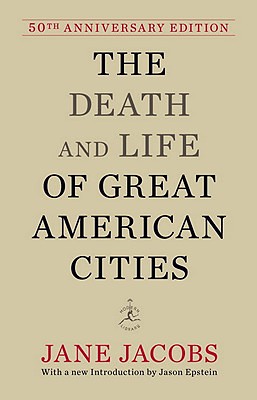
Book cover, The Death and Life of Great American CitiesJane Jacobs wrote in Death and Life of Great American Cities that cities need "a large stock of old buildings" in order to spark innovation. "Old buildings," paid off, probably somewhat scruffy, have low rents, and startups need low costs to succeed.

From the book:
Cities need old buildings so badly it is probably impossible for vigorous streets and districts to grow without them. By old buildings I mean not museum-piece old buildings, not old buildings in an excellent and expensive state of rehabilitation–although these make fine ingredients–but also a good lot of plain, ordinary, low-value old buildings, including some rundown old buildings.

If a city area has only new buildings, the enterprises that can exist there are automatically limited to those that can support the high costs of new construction. These high costs of occupying new buildings may be levied in the form of an owner’s interest and amortization payments on the capital costs of the construction. However the costs are paid off, they have to be paid off. And for this reason, enterprises that support the cost of new construction must be capable of paying a relatively high overhead–high in comparison to that necessarily required by old buildings. To support such high overheads, the enterprises must be either (a) high profit or (b) well subsidized.

If you look about, you will see that only operations that are well established, high-turnover, standardized or heavily subsidized can afford, commonly, to carry the costs of new construction. Chain stores, chain restaurants and banks go into new construction. But neighborhood bars, foreign restaurants and pawn shops go into older buildings. . . . Well-subsidized opera and art museums often go into new buildings. But the unformalized feeders of the arts–studios, galleries, stores for musical instruments and art supplies, backrooms where the low earning power of a seat and a table can absorb uneconomic discussions–these go into old buildings. Perhaps more significant, hundreds of ordinary enterprises, necessary to the safety and public life of streets and neighborhoods, and appreciated for their convenience and personal quality, can make out successfully in old buildings, but are inexorably slain by the high overhead of new construction.

As for really new ideas of any kind–no matter how ultimately profitable or otherwise successful some of them might prove to be–there is no leeway for such chancy trial, error and experimentation in the high-overhead economy of new construction. Old ideas can sometimes use new buildings. New ideas must use old buildings.
This is basically the concept of filtering or what the Chicago School of Sociology work on cities called "ecological succession" but applied to commercial office space. 

In the residential model, people moved to the place that they could afford, typically a "slum," and as their circumstances improved, they moved up and out(ward), replaced by people in similar economic circumstances compared to their outset, and the process is repeated.

In commercial property development, this is defined in terms of the quality of the building, which is usually a function of age:
Class A the newest, best and most expensive, versus inferior or older properties, typically referred to as Class B and Class C buildings, but I'd say there are even Class D buildings, usually in terrible locations.
The thing is, in the strongest markets, most property owners are motivated to constantly refresh their buildings so that they are the most marketable, profitable, and fully rented.

In those markets, having a large stock of buildings matters less, because the prices aren't any lower.

One way to deal with this is through shared spaces like We Work.

-- "Do companies like WeWork offerany meaningful value?," Chris Harvey/LinkedIn
-- "Why People Thrive in Coworking Spaces," Harvard Business Review
-- "Co-Working Spaces Are Redefining What It Means To Go To The Office," NPR

But like the concept of incubators, it's important to recognize what such spaces are good at, and the needs that they aren't very good at meeting.

Collaborative work spaces are ideal for nano businesses and usually individuals and very small groups, not going concerns with greater demand for space, especially at low cost.

The East End Trades Guild is making affordable commercial rent an issue in local borough council elections.

The New Economics Foundation in London is calling attention to a campaign focusing on the cost of commercial office space in London, with an aim of being able to keep buildings around that exemplify the ability to effectuate what Jacobs wrote about.

-- "LONDON’S SMALL BUSINESSES COME TOGETHER TO DEMAND AFFORDABLE RENTS: 230 SMALL BUSINESSES CALL ON LONDON POLITICIANS TO JOIN THEM IN CONFRONTING THE CAPITAL’S AFFORDABLE WORKSPACE CRISIS," press release

The East End Trades Guild is the lead group pushing the issue, and had a campaign forum a couple weeks ago, which included the launch of their "Affordable Workspace Manifesto for a London Working Rent":

The manifesto calls on councils across the capital to:
  • Recognise Community Value of small and micro business to boroughs’ prosperity and reflect this in economic and planning policy decisions
  • Identify at least one Empty Asset in their borough and convert into affordable workspace before the end of 2018
  • Create a Small Business Community Land Trust to support small and micro businesses in perpetuity
  • Create a Register of Landlords to allow small businesses to compare rents
  • Support the development of an Affordable Rent Formula for small and micro businesses
The concept of a "Small Business Community Land Trust" is not unlike the SEMAEST initiative in Paris.

-- Wrk/LDN: Shaping London's future workplaces, New London Architecture

Again, as part of doing economic development planning, strong market cities especially need to plan for this.

I've become particularly attuned to this within DC, where the height limit ends up constraining land supply and office space, creating the opposite of conditions called for by Jacobs.  

Labels: , , , ,

Friday, January 06, 2017

Supermarkets (and cinemas) and "captive leases"

A captive lease is when a retailer closes a store but continues to pay the rent on the abandoned space to prevent it from being re-leased to a competitor.  Typically this happens most with grocery stores and cinemas.

My personal experience with this was in the H Street NE neighborhood in DC, where Safeway closed two smaller stores (and other smaller stores in other neighborhoods) when they opened up the large multi-neighborhood serving big store at Hechinger Mall in the early 1980s.

By the time I moved to the neighborhood in the late 1980s, people had changed their shopping patterns, further reducing customer traffic for the H Street commercial district.  One of the store spaces remained empty by then, while the other had been leased to People's Drug (and after that, a Murry's Food Store).  See "Ensuring that lease restrictions don't encumber a commercial property's future."

It's come up more recently with supermarket closures in Suburban Chicago and now Cleveland.

In the latter, Giant Eagle Supermarkets just announced the closure of two stores and a gas station, and the Mayor of Cleveland, Frank Jackson, isn't happy based on this letter ("Mayor Jackson responds to Giant-Eagle closures," WKYC/NBC).  From the letter:
The closure of these stores would require a customer to travel another several miles on the east or west side to one of your stores by car.We also learned that over 120 jobs are at risk. We have been provided no information on whether these employees have been offered positions at other stores and we have received many calls today from concerned employees who also just learned that they will be without a job in thirty to sixty days. The closing of pharmacies on January 14, 2017 means that customers have just ten (10) days to transfer prescriptions, placing a hardship on many of our seniors and those with disabilities for whom this process can be very difficult.

We are also concerned that if these stores remain closed that the remaining term of the lease will prevent other grocery stores from leasing at these locations, to limit competition which was done when Giant Eagle moved from Lorain Avenue to the newer West 117th store. These vacant stores are a negative influence on our community and can affect other leases for nearby retail.
What he needs to do is get the City Council to pass legislation making so-called "captive leases" illegal. DC passed such legislation in 2014 ("D.C. Council bill aims to save Palisades grocery store," Washington Business Journal).

From the Crain's Chicago Business story, "Why some former Dominick's stores are still empty":
Vacant grocery stores inconvenience residents, slash sales tax revenue and can diminish a neighborhood's reputation as a viable retail center. They also can devastate nearby retailers, along with the owners of shopping centers lacking an anchor tenant to draw in the masses.

“It's a stigma on the neighborhood that a grocer is leaving and not being replaced immediately,” says retail broker Dan Tausk, a principal at Oak Brook-based Mid-America Real Estate Group, who represents the Trader Joe's chain in Chicago. “It's devastating in all aspects.” ...

Although the 19 vacant Dominick's buildings have different owners, Albertsons has long-term control over many of the spaces through its leases. In some cases, it has exercised options to extend the leases on empty spaces, according to real estate sources.

By keeping control of those spaces, Albertsons can sublease them to nongrocery retailers that don't compete with Jewel stores, or consider opening its own stores.

“In most cases, the landlords would rather have control of the space,” Witherell says. “In reality, most of the spaces are controlled by (Albertsons).”

In the most unusual scenario, Itasca-based Tony's Finer Foods has been unable to open a store in a Schaumburg building it owns. Tony's announced plans last year to take over a former Dominick's on Roselle Road, shortly before buying the building for almost $6.9 million in July, according to Cook County property records.
Chicago Tribune photo.  Also see "'Dark' former Dominick's stores frustrate suburbs."

In the year since that story was written, local governments in suburban Chicago are working together to try to get the lease owner, Albertsons, to release restrictions.  Interestingly, the stores had been owned by Safeway, when Safeway wasn't owned by Albertsons.

Now that it is, the company is not interested in the buildings being leased supermarkets, because Albertsons still owns Jewel Supermarkets, the market leader in Chicago.  From "Suburban leaders ask Albertsons to work with them to fill vacant stores," Chicago Daily Herald:
Leaders from nearly a dozen suburbs gathered Thursday in Naperville to express their concerns with leases on former Dominick's locations that have been sitting vacant for nearly three years.

The mayors and village presidents of Bartlett, Buffalo Grove, Glen Ellyn, Fox Lake, Naperville, Oswego, Palatine, Palos Heights, Romeoville, Schaumburg and Woodridge gathered for a news conference in which they called upon Albertsons, the parent company of Jewel-Osco, to do more to fill the spaces.

"The damaging effects of keeping these spaces vacant is very difficult for a lot of these communities," Naperville Mayor Steve Chirico said. "We need to do a better job working together and putting the community first, and right now the communities are not being put first. We're asking for their help. We need to see some participation." ...

However, leases on 15 vacant Dominick's continue to be paid for by Albertsons. On Thursday, municipal officials said they want the practice of extending those leases to cease.

"When you're leasing a space that doesn't have a tenant and you're renewing that lease for five years purposely so you can control whatever goes in there, that's where we're having an issue," Bartlett Village President Kevin Wallace said.

Romeoville Mayor John Noak said there is interest in the vacant spaces and willingness from suburban leaders to work with Albertsons to get them filled, but the company is not cooperating.
These suburbs should develop and pass model legislation making captive leases illegal. Chicago did this about 10 years ago.

Cinemas.  I mention cinemas in passing because as companies moved from small locations of one to three screens to large screens, they would put similar lease restrictions on the buildings.  That's why so many cinema buildings have been converted to other uses like pharmacies--CVS is particularly fond of such buildings, although they are not the only company.

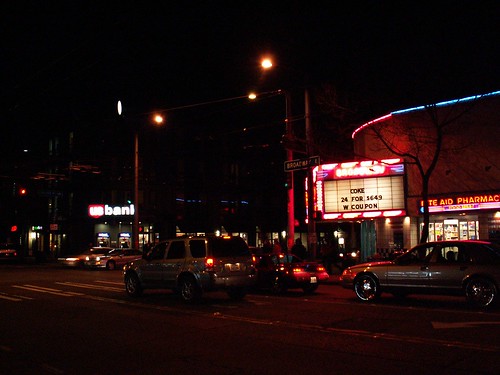
01242008-54A Rite Aid in Capitol Hill neighborhood of Seattle is in the old Broadway Theater building, and Rite Aid maintains the theater marquee.

Labels: , , , ,

Thursday, December 31, 2015

Brief update to DC and Streetcars #4

Following up on last week's entry, "DC and streetcars #4: from the standpoint of stoking real estate development," the Prince of Petworth blog calls our attention to the brochure marketing the retail spaces for the property on the south side of the 600 block of H Street NE.

This is the project that involves the reconfiguration and expansion of two office buildings rented to DC government as primarily housing.

(An earlier iteration was planned around 2005 but didn't move forward.  Jair Lynch Properties purchased the site and pursued the same kind of project, but with different plans and designs from what had been approved earlier.  This is another example of the length of time it can take projects to come to fruition.  This one is 10+ years.)

And it shows how the new construction section of the development will be 9 to 10 stories tall, compared to the 5 story buildings constructed in the late 1980s.

This supports my thesis that the streetcar is leading to the development of taller buildings than would normally be expected in site locations outside of the half-mile radius from Metrorail stations.

The marketing brochure, from KLNB, highlights the fact that the property, which will be located across the street from Whole Foods, has recently signed Starbucks and Unleashed by Petco, which will join a CVS, which opened last year.

And like how such marketing brochures show subway stations, this one also calls out streetcar stops as an element of particular interest to retailers looking for the best locations for new stores.

It's worth looking at the entire brochure (POP unhelpfully did not provide a link to the primary document) to see how such properties are marketed, as well as to see the comprehensive map diagram they've provided for housing and retail developments in the H Street/NoMA retail trade area.

The question asked in a March 2015 cover headline of the Express has been definitively answered, and that's without the streetcar being in service.

As the streetcar enters service, and people get experience with it, the drumbeat for expansion will steadily increase.

Labels: , , , , ,

Tuesday, March 24, 2015

(Not) Understanding how retail chains make property decisions: Baltimore, Starbucks, and Salon Magazine

Salon has an article ("Black history bulldozed for another Starbucks: Against the new Baltimore" about how Starbucks is destroying black history in Baltimore, because they are moving into locations that had been black businesses--which happens to not be true, but makes for a less punchy headline.

But the reality is maybe more complicated, or at least different from how it's portrayed in the article--although the article is written in a fashion that I have a hard time interpreting.

Starbucks in DC at 3rd Street and Pennsylvania Avenue SE.

Although it happens that the word "bulldoze" isn't meant literally, it is true that "Starbucks can bulldoze" historic buildings in favor of new construction.

But remember that Starbucks doesn't own properties for the most part.  They are tenants.  So the key actor is the developer, who owns and develops properties.

The other thing I learned about Starbucks (and other chains)--besides "how every commercial district needs one as the solution"* (and this has been supported by the economists at Zillow, who fail to recognize that a Starbucks location is a follower of success not the creator of success, see "Confirmed: Starbucks knows the next hot neighborhood" and "Zillow says homes close to a Starbucks rise in value more quickly," San Jose Mercury-News), is that at the level of the market, it's not "Starbucks" making property decisions so much as their local commercial leasing representatives, even though they also have personnel dedicated to "global store development" for their biggest markets (Old job listing for store development, Starbucks.

* Starbucks follows, it doesn't lead.  I make the joke about Starbucks "as the one thing a commercial district needs" because when you work in the field, that's what residents come up to you and say, repeatedly.  It's not that simple.  Similarly, Zillow is wrong that Starbucks knows the next hot neighborhood.  They are followers, not leaders, and their locations are co-incident with what we might call high-value "amenity districts."

For example, Starbucks considers the location at 8th and D Streets SE on Eastern Market Square in Capitol Hill a distressed location, even though the number is full of houses costing $800,000 or more. There aren't many examples of Starbucks stores leading neighborhood and commercial district revitalization efforts.  In DC, they followed Xando...

For example, in Indianapolis and other Midwest markets, Veritas Realty represents Starbucks, and one of their principals has inked over 80 leases for Starbucks stores.

In DC, the reps retained by Starbucks are clued into how DC is organized, and that "historic buildings" are not only perfectly acceptable sites, but highly valuable sites in historic neighborhoods. A majority of DC's Starbucks locations are in historic buildings.

The renovated gas/caffeine station at Highland and Willoughby is now a Starbucks. (Lisa Boone / Los Angeles Times)

But this isn't the case only for DC or Boston or Manhattan or similar markets, as there is an article ("Starbucks restores old Gilmore gas station for your refueling pleasure") in the Los Angeles Times about how Starbucks has resuscitated a circa 1930s gas station as a cafe. 

You can't get much more "historic preservation" than that.

The challenge is in those markets where the local representatives aren't hip to historic buildings. And to figure out who they are and how to appeal to Starbucks' "Global Store Development" division to make a different decision.

In fact, it's not unlike Walmart and their push into center cities.  Now the company is willing to locate "in cities" when before they weren't. But that's just locating.

Where urbanists have made a mistake is in believing that Walmart now has a special commitment to building city-appropriate stores.  That is not the case.

Walmart doesn't care about whether or not the building is "urban". That's up to the developer who comes to them with a proposal.

 As long as the location meets their criteria, they don't care what the building is/looks like, etc.

So we have a one story Walmart on Georgia Avenue NW in DC, while others in the city are part of mixed use projects, with housing and/or office above, because that's the kind of projects those particular developers were creating.  It's just luck of the developer draw.

Anyway, the Gentri-fuck-ation piece in Salon is otherwise over my head.  Not unlike the piece in Gawker ("Irrigating the (Food) Desert: A Tale of Gentrification in D.C.") that blames improving supermarkets for gentrifying DC neighborhoods like Petworth.

I guess it's better to have crappy supermarkets.  But in any case, supermarket companies, like Starbucks, follow the market, they don't lead the change.

Labels: , , ,

Thursday, November 20, 2014

Another indicator of the decline of federal spending and its impact on the Metropolitan Washington economy

DC is not Las Vegas, where the massive national computing and consumer electronics exhibitions tend to be held.  Here, the big business in computing is the federal government.  So the "FOSE" (Federal Office Systems Exhibition) show was about the biggest, with 20,000+ attendees and major exhibitors.  (The Association of the US Army show--big on armaments--is probably just as big or bigger.)

The Washington Post reported the other day that FOSE is now kaput ("With the end of FOSE, government dependent trade shows take yet another hit"), so the 2014 show was the last, even if the website still lists show dates for 2015, as it hasn't been updated to reflect the decision.

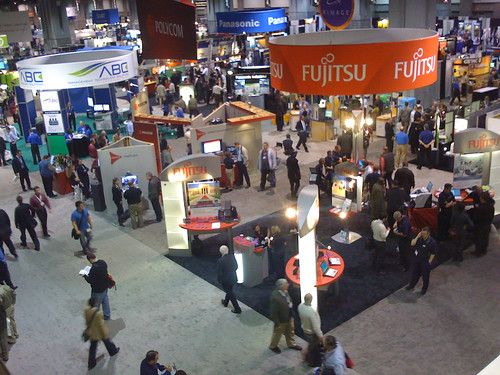
FOSE trade show
FOSE in 2009.  Flickr photo by Joe Flood.

According to the article, attendance at trade shows relying on federal government workers as attendees are down about 30%.  I know training budgets have taken a big hit as well, which impacts various contractors.

As mentioned previously, Congress isn't into investing in federal buildings housing federal workers, especially if those agencies are regulators, and especially if those buildings are in DC, which lacks voting Congressmembers.

And in the comments, charlie mentions that Rosslyn, one of the Arlington county submarkets that has office buildings as tall or taller than those downtown, has a 30% vacancy rate right now, although that's partly due to the age of the buildings and the increased prominence and dominance of Tysons Corner and Reston as office districts and competitors for tenants.

Labels: , , , , , ,

Wednesday, June 12, 2013

Ensuring that lease restrictions don't encumber a commercial property's future

Former Wal-MartI was disturbed yesterday, when talking with someone about Walmart's foray into DC, to realize that I completely forgot to raise an important issue about how chain retailers put provisions in leases that put restrictions on what kind of tenants can lease the property if and  when the chain store closes or moves to another location.

It's not discussed in this report, ANC4B Large Tract Review Report on Walmart, 5/2011, for which I was the chief author.

Note that this practice is typical in shopping centers under single ownership (see the ABA Lawyer article "Restrictive Covenants - the Life Cycle of a Shopping Center") but become much more complicated when applied to traditional commercial districts with properties owned by a myriad of operators. Also see "Small stores face uphill battle getting into malls" from the Toronto Globe & Mail.

In DC proper I can think of two examples of what are called retail restrictive covenants and how they can make it very difficult to re-lease vacant commercial retail spaces.

Safeway, when they closed neighborhood-located stores (such as on 12th Street NE in Brookland or on H Street NE) in favor of opening "regionally-serving" and much bigger supermarkets at locations such as Hechinger Mall or Rhode Island Avenue (that store has since closed) had a provision that the space couldn't be re-leased to another supermarket.  Many of these spaces stayed empty or were converted to nonretail uses like adult daycare or medical offices.

(I think CVS probably did this too, but I don't have any first hand knowledge of it.)

And when a movie theater chain closed its older theaters on Thomas Jefferson Street NW in Georgetown (called the Foundary Theaters) in favor of a different location, they had a restrictive covenant in the lease to prevent the space from being re-leased to another cinema company.

In Chicago, a few years ago the City Council passed legislation making such lease terms illegal.  See the 2005 blog entry "Chicago City Council proposes law making retail restrictive covenants illegal." And according to "On the Path of Lease Resistance" from the New York Law Journal, state law in New York State generally doesn't support retail restrictive covenants either.

With regard to Walmart in DC, I don't really care if they come in--I can choose to not shop there and don't feel I have to impose my choices on others, at least this particular choice--as long as the urban form of the sites is right, because if and when their stores are replaced, we have the right urban form.  That's why I am so worked up over the fact that most of their stores aren't really urban, even if they aren't parking fronted like their suburban stores.

But if Walmart puts significant lease restrictions in their deals with local property owners, the ability of those sites to be reshaped and released in positive ways is seriously encumbered in ways that don't promote urban design and revitalization at all.

-----
Note that I agree with the Post that DC Council's imminent passage of wage requirements on big boxes is misdirected.  Instead, a big box ordinance addressing a variety of issues, including retail restrictive covenants, and mitigating potentially negative effects on small retailers is something that should be taken up.  See the Post editorial, "Is the DC Council trying to scare off retailers?"

Labels: , , , ,