Rebuilding Place in the Urban Space

"A community’s physical form, rather than its land uses, is its most intrinsic and enduring characteristic." [Katz, EPA] This blog focuses on place and placemaking and all that makes it work--historic preservation, urban design, transportation, asset-based community development, arts & cultural development, commercial district revitalization, tourism & destination development, and quality of life advocacy--along with doses of civic engagement and good governance watchdogging.

Thursday, October 02, 2025

Going to the dogs

In the past I've written about dogs as an indicator of people feeling safe living in cities, and that dog walking provides the impetus for many to actually walk outside in a city.  Plus, dogs (and little kids) act as a "social bridge" (what William Whyte called "triangulation") in getting people who don't know each other to interact.

Some say, with justification, that dog parks are an indicator of reproduction of space and gentrification.  This study, "Dog Parks and Coffee Shops: Faux Diversity and Consumption in Gentrifying Neighborhoods" (Journal of Public Policy and Marketing) is based on DC.

-- "Dog Parks and Coffee Shops documentary about gentrification in DC," 2020

OTOH, how many times have you stepped in dog poop or narrowly avoided it?  Even people who do pick up the poop often toss it into recycling cans, contaminating the waste meaning it can't be recycled.

Suzanne was talking to people about my illnesses, and a person opined that I should get a dog.  That's the last thing I'd be interested in, even though health researchers think having a dog is a good thing ("Can’t commit to a dog? Have one for a day — science says it’s good for you.," Washington Post).  

Psychologist Kerri Rodriguez, who leads a group at the University of Arizona that researches animal-human interactions, said spending just five or 10 minutes with a dog can make people happier and decrease their stress.

In fact, research has shown that when people interact with dogs, oxytocin — known as the love hormone — increases in both species. This is true even if you’re petting someone else’s friendly dog.

Actually my response was "F* that."  I can walk and do things without a dog, and without the responsibility of dog maintenance.  Reading and writing makes me happier...

Note that for a long time, urban multiunit apartment buildings have been offering dog-related amenities to tenants ("Pet-Friendly Apartment Amenities Gather Steam Amid Societal Shifts," Commercial Observer).

1.  "America’s Most Dog-Friendly City Has Had Enough," Wall Street Journal

.  People aren't managing their dogs and feel entitled to take them anywhere.  From the article:

Rose Crelli loves dogs. The violinist grew up with sled dogs in Alaska. She stops to pet dogs on the street. If she had to rate her love on a scale of 1 to 10, it would be a 10.

But Crelli, 29, has started thinking maybe San Francisco is too dog-friendly. While she and a friend were having coffee at Alamo Square park, the pair were approached by five different off-leash dogs in an area that requires dogs be leashed. The final visitor, a golden retriever, sent Crelli over the edge. “It literally launched itself at my pastry and got its mouth all over it and covered it with drool,” she said. The dog’s owner saw the whole thing and kept walking.

I had something like this happen to me in DC.  It cost me a cup of coffee and the dog owner felt no compunction for recompense.

2.  "An Italian City Is Considering a Dog Tax for Tourists and Locals," New York Times.  It's to pay for the costs associated with errant dog owners who don't pick up dog poop, etc.

A bill in Bolzano, Italy, would mean that dogs bringing their owners to the Tyrolean Alps for some scenery and mountain air would face a new charge of roughly 1.50 euros ($1.75) per day, the Italian news media reported.

Local dogs won’t escape under the bill, which would come into force in 2026 if it is approved by the provincial council. Residents would be charged an estimated 100 euros per dog, per year, bringing back a dog tax that was abolished in 2008.

Flickr photo by Edgar Zuniga, Jr.  Sugar House Pond.

3.  Sugar House Park, Salt Lake.  We don't have a dog park, dogs are required to be on leash, but the vast open spaces of the park lead many to unleash their dogs.  For the most part it isn't a problem, and we don't have the resources to enforce the rule.

The board member representing the County Parks Department, which operates the park for us under contract, says if we had a dog park, then people would be more inclined to follow the rules.  

Note the dog park denoted at the lower right of the map for SLC's Fairmont Park.

For me, given that there is a city park a couple blocks aware with over 2 acres devoted to a dog park, I think it's unnecessarily duplicative to create one in our park.

4.  Great guidance offered by Salt Lake County Parks.

-- Salt Lake County Off-Leash Dog Park Master Plan

5.  "Chicago restaurants mixed on the prospect of dogs at the table," Crain's Chicago Business.  An alderman has put for legislation to allow dogs in restaurants, not just on patios.  Holy health department Batman!

6.  Private dog parks with bars and play areas are a new type of business on the rise across the country ("Detroit dog park and bar set to open a suburban outpost," Crain's Detroit Business, "Detroit’s first indoor and outdoor dog park with beer garden plans second location," Detroit Free Press).  Usually they have membership fees.  

The Southfield Barkside will have 5,000 square feet of indoor, climate-controlled, off-lease play space and 8,000 square feet of outdoor fenced-in space. The indoor space will feature wi-fi and TVs. The Southfield location will also have dedicated indoor and outdoor play areas for small dogs. The new dog park and bar will have space for 150-200 guests and a staff of 15-20.

Bark Social when it was operative, in Bethesda, Maryland.

I know one went out of business in DC ("Bark Social dog park, bar files for bankruptcy, shutters all DMV locations"), so I expect the market isn't that big.  Although Bark Social is relaunching on a much smaller scale.

7.  Dog parks issues in Boston ("Boston has few dog parks. It’s led to a pitched battle over public space," Boston Globe).  Apparently Boston is particularly dog friendly.  Many parks it's against the rules to walk dogs, even on leash.  

The article discusses how some park systems across the county have hours where off leash use is allowed, partly as a public safety measure, to crowd out negative uses.

8.  Apparently there is an issue with pet rescue sheltering in DC, which dropped its vendor without a new one on deck ("Inside the Year-End Scramble to Save More Than 100 D.C. Dogs," Washington City Paper).

Labels: , , , , , , , , , ,

Monday, August 04, 2025

Another view on the sale of federal buildings: need for updated facilities | Impact comparable to the closure of city-based navy shipyards?

I have been quick to criticize the Trump Administration for its agenda on shrinking its real estate portfolio.  While some of it, like abrogating leases, was a part of Trump/Musk DOGE agenda of destruction of the federal government without any connection to need for a functioning government--e.g. leases for Social Security offices and federal land management offices were broken--there is another issue.

The buildings, many built before 1980 are old, often poorly maintained and expensive to renovate.  Then it may make sense to sell and rebuild, or since the government is shrinking, lease smaller buildings.

The JFK Federal Building in Boston. Photo: Paul Marotta/Getty Images

From the Boston Globe article, "The federal government could soon sell these three big downtown Boston buildings The JFK, O’Neill, and McCormack federal buildings span 2.6 million square feet, combined. A federal board is considering putting them up for sale":

... much of the federal government’s 180 million-square-foot property portfolio needs extensive repair, and is riddled with expensive problems such as antiquated air systems, leaking roofs, unusable elevators, and flooding basements, the board said. Buildings managed by the GSA are on average more than 50 years old.

“Congress cannot appropriate its way out of this maintenance backlog,” said Nick Rahall, a former congressman from West Virginia and PBRB board member. “The inventory needs to be shrunk so tax dollars can be invested in properties where employees are actually coming to work.”

Like a broken clock being right twice a day, the Trump Administration has, amongst its chaotic and authoritarian decision making, made a couple of good decisions.  This may be one at least partially,.

-- "Trump Policies Shake the Foundations of the US Office Market," Natixis

-- "Trump May Sell Up to 67% of Government's Office Portfolio," CRE Daily

However, proponents of the sale of federal property argue that there is a lot of profit to be made ("Chance favors the prepared mind: residential conversion of federal buildings in Downtown DC needs "A Vision Plan for Judicious Conversion of Federal Properties in the District of Columbia."" [2025]) and that's a problem.  

The buildings are old, the commercial property market is soft, especially in Boston ("One of Boston’s skyline-defining towers is on the auction block — and expected to sell at a big discount," Boston Globe) and DC (The Increasing Levels of Vacant Office Space: The Achilles’ Heel of DC's Office Market), made only worse by federal government shrinkage and federal real estate being a significant element of the local market ("Trump wants to move 100K federal jobs out of D.C. What could that look like?," Virginia Public Media), and the buildings may not lend themselves to refurbishment, making the property valuable only in that it can be redeveloped after the expense of demolition of current facilities.

And, still, these decisions will be negative for most major downtowns where a sell off will occur ("The 443 federal buildings Trump administration could sell," Boston Globe).

=====

Impact as significant as closure of federal Navy Yards.  In the 1960s and later, the Department of Defense closed naval facility shipyard functions in cities like Brooklyn, DC, Boston, Charleston, South Carolina, and Philadelphia.  

Thousands of workers at the sites lost their jobs ("Military cutback will eliminate 37,000 jobs," AP, about a later round of closures), some functions were dispersed, often to suburbs, and with the multiplier effect even more jobs were lost (about the closure of the Navy Yard in Long Beach, "In Long Beach, an Era Ends in Tears," Los Angeles Times).

Blog commenter Will makes the point that this had significant impact on what was called 1960s "urban decline."  A lot of the jobs were industrial.  The closure shifted cities to a post-industrial economy but with fewer jobs overall, and fewer blue collar jobs especially.  (This is one of the arguments made by William Junious Wilson in When Work Disappears.

For example, at its peak in WW2, the Washington Navy Yard had 20,000 employees working on ships and munitions manufacturing, the Philadelphia Navy Yard, 40,000 employees (that facility didn't close until the 1990s), 42,000 at the Brooklyn Navy Yard.

At the time, too, these facilities were developers of innovative technology, although the concept of spinoff commercial technology transfer wasn't an issue then.

The shrinkage of the federal government under the Trump Administration will likely have similar effects.

Labels: , , , , , ,

Wednesday, April 20, 2022

Denver's Urban Land Conservancy as a BTMFBA implementer

The previous entry, "Nonprofits need to BTMFBA too," re-mentions that nonprofits have to have a real estate and facilities strategy as part of master planning, that just like artists, they can't expect real estate developers to plan for them, plus they need to be prepared in the face of strong, money-driven real estate markets.

Almost immediately after I published that entry, there was an article in my newsfeed, "How this nonprofit in Westwood is avoiding being gentrified out of the area," from the Denverite, about how the in the neighborhood is able to control its real estate destiny by partnering with the (Denver) Urban Land Conservancy.  From the article:

This month, Re:Vision, a Westwood nonprofit that focuses on improving food access and food security, and the Urban Land Conservancy, a real estate nonprofit that aims to preserve communities and prevent displacement, announced they’d be collaborating through a real estate partnership that allows each organization, especially Re:Vision, to continue benefiting the westside. 

“This partnership has been years in the making,” said Sarah Harman, ULC’s vice president of real estate. “I think it was around 2019 that ULC and Re:Vision really started talking about what we might do together. And that brainstorming resulted in this new partnership with Re:Vision and ULC’s continued and deepened engagement with the Westwood neighborhood.” 

Re:Vision, which started in 2007, owns and operates the RISE Westwood Campus, a community hub that hosts an urban farm, the nonprofit’s no-cost grocery, Cultura Chocolate, a commissary kitchen and several other businesses and community needs. The campus was previously a junkyard, and Re:Vision purchased the site with a $1.2 million loan from the city in 2014 with some stipulations, one being the nonprofit had to use the site for community use.

Typically, land conservancies and land trust deal with open space and farmland, although urban-focused land trusts tend to focus on multiunit housing.

And that's an issue here too, as it appears as if the Urban Land Conservancy is also focused on adding housing to the site over the long term.

But the ULC is also focused on providing and preserving "shared office space for nonprofits and mission-minded organizations."

While I still believe in the need for overarching organizations like SEMAEST and other types of community development corporations to focus on this kind of property preservation specifically, this is another model for accomplishing it.

Labels: , , , , , , ,

Monday, April 18, 2022

Nonprofits need to BTMFBA too

This isn't news.  Nonprofits, artists (Sharon Zukin, Loft Living, 1982), gays ("The 'gaytrification' effect: why gay neighbourhoods are being priced out," Guardian), churches ("Churchly blight," 2007), etc. held property because the areas weren't in high demand.  

When conditions, attitudes, and popularity changed--in particular wrt urban settings and urban living--the neighborhoods moved from being weak markets to strong markets, and only the people and organizations with the most money are able to compete.

The BTMFBA thesis--Buy the * * Building Already--makes the point that to be able to retain presence in the face of market pressures, you need to own the building.

-- "BTMFBA: the best way to ward off artist or retail displacement is to buy the building," 2016

My original piece, "Arts, Culture Districts, and Revitalization" (2009), made the point that artistic disciplines and organizations needed discipline-specific culture plans with a focus on facilities, because without facilities there is no arts district or space for artists and organizations.

The original piece didn't outline a mechanism--now I think it should be arts-focused community development corporations, operating at a city or county wide scale ("Reprinting with a slight update, "Arts, culture districts and revitalization"," 2018).

But it's about nonprofit uses of all types, not just the arts, which I do write about from time to time ("BTMFBA revisited: nonprofits and facilities planning and acquisition," 2016).

The Washington Post has an article, "A food pantry’s closure means more than lost meals for hundreds of families," about a food bank shutting down in Nashville, a particularly strong real estate market of late, because it lost its lease.

All nonprofits should have a real estate/facilities plan as part of strategic planning.

This is especially true for nonprofits operating in strong real estate markets.

From the article:

"Right now I’d say nonprofits are facing a confluence of crises,” said Tim Delaney, the president and CEO of the National Council of Nonprofits. “We’re out here fighting, trying to find some balance with increasing demand, rising costs, and declining donations — holy cow! It’s too much for a system to bear.” 

The Little Pantry met the increased demand, but it also had to deal with increased costs, on everything from food prices to rent and real estate. Downey realized her organization would be forced to close its doors late last year after failing to find an affordable new location in one of the nation’s hottest real estate markets. According to experts, the same pressures could soon shutter nonprofits everywhere, underscoring the shaky state of so much of the country’s charitable community. Free health clinics, child care organizations, prison reentry programs, domestic violence shelters — all could collapse under the same financial weight that brought down the Little Pantry. 

“All these things threaten the ability of nonprofits to serve people in their local communities,” Delaney said. “Policymakers at all levels of government are just assuming nonprofits make it work, but we can’t. God Almighty, we try, but at a certain point, the laws of economics take over.”  ...

Downey began renting her current building five years ago. It was a crumbling former school building owned by a church. The Little Pantry agreed to undertake repairs and renovations and put around $300,000 into the property. 

But by late 2021, Downey knew the owner would not be renewing the lease, and, despite working with real estate agents and friends, she struggled to find a new location. 

And local community foundations should take the initiative to work with nonprofits on such matters, create a facilities/real estate initiative, etc.

One example, although it works on the national scale, is the Kresge Foundation.  It funds buildings, usually up to half, with a required local match. 

In a recent entry ("Speaking of the need for arts-related CDCs to buy, hold, and operate arts facilities: Seattle and BTMFBA | The Inscape Arts building"), I mentioned how Seattle has created a city department, Cultural Space Agency, to work on this but only for arts groups, but it has minimal funding and expects the profit motivated private sector to take the lead.  From the article:

One building Downey toured — already outside the Little Pantry’s budget — was sold to an outside investment company before she had left the parking lot, Downey said. 

This type of function needs to be extended to nonprofits more generally. 

====

I am now on the board of a large public park that is semi-independent of the city or county park system.  There is a master plan, but not really a formal capital planning process, especially one that integrates tightly with city and county funding systems.  One of my major goals is to get a standing committee on capital planning and finance, a capital plan, etc.

Labels: , , , , , ,

Thursday, February 13, 2020

Slumlording in Akron, Ohio

Lower quality units rent at higher prices when supply is constrained.  Commenter Charlie has pointed out in the past that one problem with demand being greater than supply in housing is that non-premier and substandard units rent for higher prices than they should warrant, because people have little choice.

Lower quality units in weak markets are often rented to desperate tenants, who then are bullied to not complain for fear of eviction.  There is a kind of opposite problem too.  Desperate people will live in terrible quality housing because avaricious landlords will rent it to people below market prices, because they can't afford better housing.

But then tenants are in a bad position, because if they complain about the quality of the unit, even if not up to code, they face the threat of eviction.

OTOH, I do have a wee bit of sympathy for the property owner, because unless they are long time owners, they've bought dilapidated properties, which are expensive to fix, especially when rent revenue is low, and property taxes are comparatively high given the value of the property.  (Weak market cities tend to have high property taxes in a desperate attempt to raise the revenues necessary to pay for municipal services and operations.  E.g., we just spent a lot !! of money to get our house "up to code" to be able to rent it out, and it was in decent condition.)

Renter Anthony Williams gently lifts the hood over the stove as he talks about how it fell while his son was cooking in the dilapidated home he rents on Tuesday Jan. 28, 2020 in Akron.  MIKE CARDEW / AKRON BEACON JOURNAL

An Akron Beacon-Journal article ("Tenant hits 'slumlord' in the pocketbook") goes into great detail on such a slumlord, who also games his property taxes, figuring he can make more money by not paying taxes, although now the County is on to him, and is targeting his properties for code and tax enforcement.

It's worth a read.

One tenant has one upped the landlord through a housing court action, so his rent is being escrowed because the landlord hasn't cured building code violations. 

Interestingly, when the Summit County Land Bank has taken over properties with tenants, as a result of property tax foreclosure actions, they take great pains to sell the property to the tenant.

Receivership.  Ohio has a strong housing receivership statute, which allows nonprofits to take over properties and "cure" notorious nuisances.  When a property is fixed, the housing court can extinguish liens and debts on the property, and award ownership to the nonprofit, which then sells the property.

I wonder why Summit County and/or Akron aren't using this tool.

Labels: , , , , ,

Thursday, February 09, 2017

Smell, maintenance, allergic tenants: why restrictions on dogs/pets isn't unreasonable

Last Spring, I wrote about the negatives of Amtrak's decision to allow pets on board trains--smell, maintenance, and most importantly, other passengers may have allergies to pet dander ("Amtrak's allowing cats and dogs on trains disses people with allergies").

Charity Struthers, right, holds her dog, Benny Goodman, on the roof of the Park Chelsea Apartments. (Evelyn Hockstein/For The Washington Post)


Accommodation for dogs is an increasingly popular amenity in high end property buildings.   I"An apartment building in Chelsea is luring tenants with doggie day care,"Boston Globe; "Going to the Dogs: Pet Amenities Aren’t a Luxury Anymore," Multi-Housing News, "Welcome to 'Yappy Hour': Developers lure D.C.’s dog-lovers with parks and perks," Washington Post).

Historically, this level of accommodation hasn't been present in public housing.  The Washington Post reported earlier this week ("Some pets now allowed for disabled and elderly residents in D.C. public housing") that in senior housing buildings, the DC Housing Authority will remove most restrictions on having pets.

But some advocates say that the policy doesn't go far enough.  From the article:
For a large majority of public-housing tenants — meaning thousands of people living in apartment complexes that are not designated strictly for elderly and disabled residents — the no-pets rule will still apply. Among those tenants, the only people exempt from the prohibition are residents who are legally certified as needing pets or service dogs to help with mobility or emotional problems. That has been the case for years.

Because of the continuing ban, the two biggest advocacy groups for allowing pets in public housing say they are not satisfied with the revised policy. The American Society for the Prevention of Cruelty to Animals and the Humane Rescue Alliance called the housing authority’s decision merely “a positive first step.”

The groups argue that all tenants should be allowed to keep pets. In reviewing the pet policies of 150 public-housing agencies in the United States, the ASPCA says, it found that only three are as strict as the D.C. regulations.
My response.  There is a difference between a ban and a restriction.  I do think it's reasonable to extend the ability to have pets across the portfolio of public housing properties, not only for senior and disabled tenants.  However, there is no reason to not limit certain types of pets--dogs and cats in particular--to particular floors or buildings, to constrain the potential for problems.

Usually, to control for smell, maintenance, and allergies, for profit housing organizations tend to "restrict" pets to particular buildings or wings of buildings. And they charge for the privilege of having a pet.

From the Globe article:
A dog lover himself, Szary gambled that the convenience of an on-site doggy day-care facility, in addition to standard luxury amenities like hot tubs, game rooms, and fire pits, would be key in attracting young professionals to Chelsea. One North charges $50 a month per dog, and $35 for each cat. It reserves the right to restrict so-called aggressive breeds and limits dogs to two per unit. The day care is an additional $19 a day.
Restricting pet accommodation to particular floors and buildings is a reasonable action for public housing authorities, just as it is for privately owned housing.  

I do think it's worth considering adding a small monthly fee for allowing animals, to cover the costs they incur to the property.

And take it the next step and add, where appropriate, dog parks and other placemaking accommodations on public housing sites.

Labels: , , , , ,

Reston Town Center parking issue as a "planning failure" by the private sector

==========
Correction: Note that Reston Town Center's does not charge for parking on weekends. See "All Reston Town Center merchant leases raised spectre of paid parking, owner says," Washingtong Business Journal). The text below has been corrected. 2/9/2017
==========

Reston Town Center is an "edge city" in the classic sense, and it has more than come into its own as a suburban business and residential district (ULI book, Transforming Suburban Business Districts and summary report, Ten Principles for Reinventing Suburban Business Districts) even before its integration into the Metrorail transit system.

It's an illustration that urbanization is by no means a phenomenon exclusive to traditional center cities and suburban towns.

-- "Silver line reshaping commercial office market in Fairfax County"
-- "Short term vs. long term thinking: transit, the Washington Examiner, Fairfax/Loudoun Counties vs. DC"

From a planning sense, RTC is in the news because of the introduction of paid parking to the development, which is 100% privately owned.

Paid parking is not totally foreign to the suburbs, but it is still an exception. The challenge comes when privately owned "retail" centers become a mix of commercial and non-commercial functions, how does the public have input into the changes?

I wrote about it a couple times last year, because it is an illustration of the gap in having public planning processes in places where most or all of the property is privately owned.

-- "What to do about public input when seemingly public facilities are privately owned?: Parking at Reston Town Center, Fairfax County, Virginia"

But it's in the news again ("Send lawyers and money: Reston Town Center merchants organize for potential battle with Boston Properties," Washington Business Journal) because the change has been introduced, and restaurants are experiencing up to a 40% loss in business. From the article:
Here is what has the largely independent retailers so peeved: Boston Properties instituted a $2 an hour weekday parking fee in order, it said, to cut down on commuter parking. In the month since, businesses have reported a drop in business anywhere from 10 to 40 percent, as well as a marked decrease in retail employment applications. Parking is mostly paid through an app, which many users say they have found confusing. Other patrons are just staying away on principle. ... 
Meanwhile, a group of patrons is organizing a protest march at Reston Town Center for March 4.
-- Reston Town Center Parking FAQ
-- Change.org petition
-- Park Free RTC Protest Facebook Page

Analysis.

1.  The property owner said they needed to introduce paid parking to reduce "free parking" by commuters, seeking no cost parking to support their use of Metrorail.  What that means is the problem they've identified is during commuting hours--the daytime--Monday through Friday,

2.  But they've introduced paid parking on a 24/5 basis, including evenings, but not on weekends. Note that evenings and weekends are when retailers and restaurants conduct the bulk of their business.

3.  Retailers can validate parking, but the company has introduced a program that limits validation by retailers to particular parking structures, making it impossible to "trip chain" or "park once" and conduct multiple activities seamlessly in one trip, for example, having a meal and seeing a movie.

4.  This illustrates they've introduced a transaction focused, not service focused process.  Which structure is used shouldn't matter.

5.  Boston Properties shouldn't be so concerned about revenue, if they are merely focused on managing the parking inventory in terms of commuting.

Recommendations

1.  Reston Town Center should be focused on managing the resource/charging for parking when it matters, which now is during the week during the "daytime."  Like in Montgomery and Arlington Counties, where county parking structures usually have free or reduced parking at nights and on weekends, they should do the same.

2.  If not, RTC should cover the cost of validation for the retail and entertainment establishments, at least for a long period of time.

3.  They need to integrate all the resources (each individual parking structure) into one seamless system, and provide multiple options for paying, and even include people as the new system is introduced--it's a fully automated system now.

Public Participation Recommendations.  Irrespective of the general issue of paying for parking to manage the resource being an issue in suburbs too, as I wrote almost a year ago, even though the development is privately owned, it's considered by the users to be a "public space," the community's Downtown.

4.  In recognition that the space is "owned" in part by its users, the property owner needed to create a very public planning process for the consideration and implementation of paid parking at the Reston Town Center.

While Boston Properties had some meetings and did studies behind the scenes, their efforts didn't extend to the lengths that a traditional public process would go, and they are paying for it now (See the letter to the editor, "Reston Town Center parking poorly designed, poorly implemented says transportation consultant" and "Reston Town Center paid parking discourages my family from visiting," Fairfax County Times).

Just the cost of counsel for one lawsuit is greater than it would have cost to run a public planning process.  And who wants to go through the hassle of dealing with your customers as demonstrators?

Going forward, such developments should take steps to provide for public engagement and involvement, even though it wouldn't go to the extent of "oversight."

5.  Create an advisory council.  Reston is an unincorporated area of Fairfax County and has separately, a very powerful citizens organization, the Reston Association, which is very involved in area planning.  Interestingly, the Association doesn't appear to have weighed in much on the RTC parking issue.

I would recommend the creation of an Advisory Council for the Reston Town Center, not unlike the WMATA "Riders Advisory Council" or how universities may have neighborhood-town engagement committees, to provide a regular channel for back and forth communications and consultation (George Washington University Community Advisory Committee).

Arguably, the organization could step in and broker the creation of this kind of committee, which should have membership based on relationship to the RTC (patrons, business owners, residents, commercial tenants, etc.), which therefore would preclude residentially-based membership restrictions, which is atypical for the organization's other committees.

Montgomery County Urban District Advisory Committees.  Another model, although it is County-created, is how Silver Spring, and Wheaton have "Urban District Community Advisory Committees," when each of those areas is unincorporated.

More recently a similar committee has been created to advise on issues related to the redevelopment of the White Flint area, which has land use conditions similar to that of Reston, but a much wider array of "property relations."

===============
From Ten Principles for Reinventing Suburban Business Districts:
Community building involves the mobilization of public and private capital to create assets that engender pride and value in a community. It involves the activation and growth of community support through stakeholder consensus. The transformation of suburban business districts relies on a three-way partnership of the private sector, government, and the broader community. Community outreach must be ingrained in the process from the outset.

Many community-building projects have failed or wasted precious time and financial resources either in litigation or in gaining community support because essential communication channels were not established at the beginning. In essence, such communication builds understanding and trust. The three-way partnership should be built on a firm foundation of shared goals and, at the very least, should include a fair and open process that allows all interested parties to be heard before decisions are made and implemented. (p. 11)

Labels: , , , , ,

Thursday, August 15, 2013

Interesting wrinkle on neighborhood revitalization: investor fixing nearby properties to raise own property values (part two)

There is an older blog post, "Does it matter who is buying foreclosed homes in Oakland?," by Callie Shanafelt of the California Health Report about the prevalence of investor acquisition of foreclosed properties in Oakland and "does it matter?"  She writes:

A June Urban Strategies Council report shows an increasing trend of private investors buying properties in Oakland. Investors bought 42 percent of the 10,508 homes foreclosed on in the city from 2007 to October 2011.

The report raised the ire of some Oaklanders who worried that outside investors are buying up the city and preying on the problems of homeowners in distress. ... The report expresses concerns that outside investors may mismanage upkeep of properties and drain local wealth. 

She links to some interesting reports about the phenomenon in Oakland and more generally.  The PolicyLink report, When Investors Buy Up the Neighborhood: Preventing Investor Ownership from Causing Neighborhood Decline, makes the point that the closer the investor is to the property, the more likely they are going to be a "good" proprietor of the property, rather than to just let it languish.

This example of REO Homes LLC, as described in the previous entry, is quite interesting, almost unheard of, because they are actively working to improve the neighborhood in which they are heavily invested.

Sure they are self-interested, but they see the value in contributing beyond maintaining and investing in their own properties.

This is very rare.  I can't think of similar examples.

What is key is the level of investment.  The more they are invested in a particular area, the more it makes sense for them to spend money on other things.

Of course, the trick is to get them to do good quality improvements, rather than crap.  (Crap is the problem we have in the undesignated DC neighborhoods, because 9 out of 10 times, value engineering and a lack of appreciation for potentially historic architecture and materials rules the day.)

--------
I am tangentially involved in a project trying to get control of a historic theater building, and one of the problems is raising money to buy the building.  There is a lot of development activity in the area, but the projects are comparatively "small," so it is less advantageous for the developers to drop a million dollars or more into this other project, which if re-opened, would make their residential units more attractive to potential renters and buyers, increase retention, etc.  But on a unit basis, the investment doesn't make sense...

Labels: , , , ,

Interesting wrinkle on neighborhood revitalization: investor fixing nearby properties to raise own property values (part one)

The Wall Street Journal has an intriguing article, "Companies Spruce Up Neighborhoods, Putting Gentrification in Overdrive," about how a company, REO Homes LLC, which scooped up a bunch of single family houses after the 2008 real estate crash led to massive price drops, is investing in neighborhood improvements in neighborhoods where they own a preponderance of houses, in order to drive up prices and demand.

From the article:

On a recent weekday morning, a crew was busy sprucing up the exterior of Koonal Parmar's one-story house in West Oakland. They trimmed trees, pressure-washed the wood siding and touched up his paint job.

Mr. Parmar didn't pay a dime for all this. The upgrades were compliments of REO Homes LLC, an investment firm that owns several houses on Mr. Parmar's block. In addition to helping homeowners upgrade their homes, REO has mended fences and planted hundreds of trees along city streets.

"The neighborhood was badly in need of capital, to maintain, beautify and restore it," said REO founder Neill Sullivan, while driving his hybrid sedan through the streets of West Oakland.

The company's motives aren't altruistic. They are part of a broader strategy designed to upgrade the neighborhood to attract higher-income residents who, in turn, will help boost properties' values. ...

These efforts aren't occurring everywhere. In cities far away from vibrant employment centers or where crime and unemployment are high, vast tracts of housing remain abandoned. But in working-class communities in or near Washington, New York, Boston, Los Angeles and San Francisco—where employment is relatively strong and housing costs are high—big investors have become an active part of the housing market.

It's the opposite of what in the past I have called "churchly blight," where inner-city churches buy up properties around their building, and don't maintain them, to drive demand and prices down, which makes it easier for the church to amass more property.

It is an interesting thing about the market vs. government involvement, that if money can be made, the private sector can and will move forward, and more quickly, so that they can realize their investment.

The key is that there is a difference between weak markets (at the metropolitan, city, and neighborhood level) and strong real estate markets.  Where money is hard to make, you're not going to find many private investors investing in their own properties, let alone other people's.

In short, you aren't going to find private investors making similar investments in weak markets and weak submarket neighborhoods, unlike what REO Homes is doing in West Oakland.

Typically inner city revitalization of neighborhoods is driven by government and other non-market programs, because the real estate market on its own isn't favorable.  Various methods for improvement include:

• historic preservation and the creation of historic districts
• programs like Pennsylvania's Elm Street program (Maryland copied it but calls it Pine Street) which uses principles of the Main Street commercial district revitalization program, but applied to residential areas
• other housing improvement measures
• conversion of formerly commercial buildings into housing
• use of historic preservation and New Markets tax credits to rehabilitate buildings (some states and localities may have additional historic preservation tax credits programs of their own)
• housing ownership programs of various sorts (such as Paducah, Kentucky's program for artists)
• use of low income housing tax credits to construct housing
• investment in other civic facilities; etc.

Rolf Goetze's Building Neighborhood Confidence (long out-of-print) is very interesting in how it describes a process for reinvigorating confidence in otherwise declining areas, to arrest and reverse the downward trend.  He makes the point that public investment in otherwise private matters is done not to foster dependence on public monies, but to prime the pump so that people are motivated to invest their own time and money in improvement.

Part of a chapter in Death and Life of Great American Cities describes redlining--the process where banks systematically deny loans to commercial and residential applicants in certain neighborhoods, because they are considered high risk, most often in the inner city--and how the author noticed one neighborhood was thriving in an otherwise declining region.  There was a community bank still based in the neighborhood, and it continued to make loans.  (Note that until the earlly 1970s, even the Federal Housing Administration wouldn't providing mortgage financing to loans in mixed race neighborhoods because they were seen as high risk.)

The chaining up of banks has made this prospect more and more unusual, although there are various small banks developing again, in response to the chaining up, plus there are what are called "Community Development Financial Institutions" which are designed to provide small business loans to community applicants.

And Alan Mallach's Bringing Buildings Back: From Abandoned Properties to Community Assets is another important resource concerning neighborhood revitalization in weak markets.

----------
Interestingly, the Norfolk Virginian-Pilot has an article, "Norfolk residents speak on Ghent's removed benches," about how in one park in the Ghent neighborhood, all the benches were removed because of complaints about loitering.  That's an indicator of declining neighborhood rather than an improving one.  Most of the story comments are critical, but some are not.

But the point is that if you want a park to serve as a foundational neighborhood and civic asset, design and placement of benches is very important, depending on where on the ladder of neighborhood revitalization the community is placed.

See the past blog entry "Systematic neighborhood engagement."

Labels: , , , ,

Tuesday, August 16, 2011

More on "a new middle school" for Ward 3 DC

128
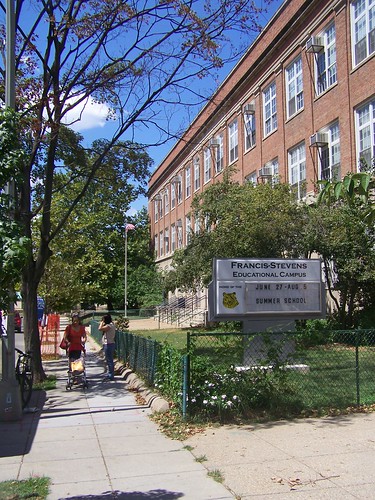
Francis-Stevens Educational Campus, DC. According to the Master Facilities plan, as a junior high school the school had a capacity of 520, as a Pre-K to 8th grade school it's 450, and the enrollment is about 230 students.

Shockingly, the Chancellor of the DC Public Schools system has sent a letter to Councilmember Cheh stating that any consideration of building a new middle school in Ward 3 has to be considered systematically, and that DCPS has hired a consultancy to do a capacity analysis. See "DCPS: Ward 3 request for new middle school to be considered ‘systematically’" from the Post. The entry includes a copy of the letter.

On the other hand, DCPS did do a capacity analysis of all the schools in the context of the school modernization and construction program, and unlike many documents, it's still online despite the "upgrade" to the DC Government website.

-- DC Public Schools Master Facilities Plan, 2010

(And while there are odes to the new high schools that have opened in the city, the new Woodson, plans for a new Anacostia High School, and a new Dunbar, I'd argue that at least one of these schools should have been closed, because there is a great deal of underutilization/under-enrollment in the high schools and the city has more high schools than it needs. So rather than spend $102 million on a new school, don't build one at all. Instead, consolidate. See "A hopeful moment as new H.D. Woodson High School opens its doors" from the Post.)

My "complaint" is that DCPS has no real strategy for systematically improving schools so that they can capture more enrollment.

With elementary and junior high schools, I've argued that the way to do it is to focus on the centers of excellence that already exist (e.g., bilingual education at Oyster, Montessori programs at various locations, Capitol Hill Cluster schools) and expand outward. And create new such programs, e.g., such as International Baccalaureate programs, which DCPS has done. Or an arts cluster, something I recommended in 2003/2004 in the H Street neighborhood, to leverage the developing arts district there, etc.

The same goes for the "excellence" in Ward 3 schools, which is a geographical phenomenon based on the Ward's in-boundary students, who have familial demographics more comparable to high-performing schools in the suburbs. Expand this pocket of excellence outwards, to schools in areas abutting Ward 3.

Of course, where it all breaks down is the failure to support teachers, students, classrooms, schools, principals, and parents and families through robust professional development, support, and capacity building programs, combined with horribly arbitrary and capricious evaluation and personnel decision-making practices.

Still, Francis School, which is located in Ward 2, pretty close to Georgetown and Ward 3, could be converted back to a junior high school, given a quality staff and educational program, and it could handle the overcapacity that is being generated by the success of the education program in Ward 3, without having to spend very much money at all.

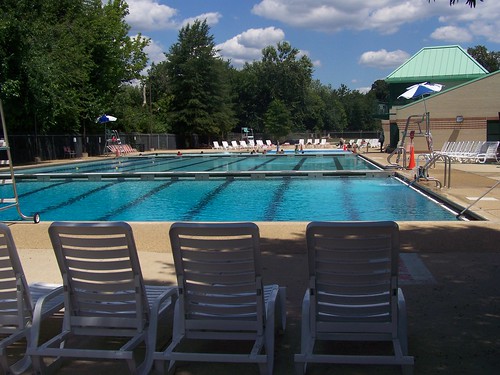
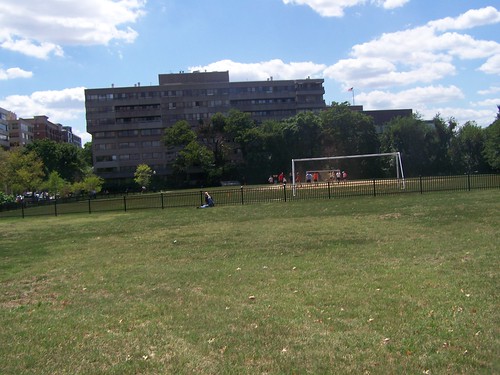
Francis has a pool next door, and nice athletic fields, small admittedly, used more like a public park.

132

131

Labels: , , ,

Thursday, May 19, 2011

Nuisance property abatement strategies: demolition vs. security planning and management: example from Greenbelt

Franklin Park Apartments image from the owner. Improvements in public safety at the complex, located in Greenbelt, Maryland, now match the green, garden-like setting.

In 2005, I wrote a blog entry about dealing with nuisance properties--issues such as abandonment, litter, disorder, crime--through focused programs, including receivership. But all too often the kneejerk reaction is demolition/destruction of the property.

The entry was triggered by a Baltimore Sun article on the yanking of a certificate of occupancy for a multi-unit apartment that is the site of a great deal of disorder. Northwestern Police District Deputy Major Mary Ellerman is quoted as saying "The only way to rid this area of the problem is to demolish." (The article was titled "City targets landlord in new tack to rid apartments of drugs, guns" but is no longer available online.)

A press release about a focused interdiction and security effort at the Franklin Park Apartment complex in Greenbelt, Maryland ("Crime Declines 30 Percent at Franklin Park Apartment Community in MD Under New Ownership") discusses how new ownership and a commitment to the creation and execution of a robust security management plan has significantly reduced crime at a previously problem location in Prince George's County, Maryland. From the release:

“Fieldstone Properties and the Greenbelt Police Department share a robust partnership in providing a safe place to reside,” said Greenbelt Police Chief Jim Craze. “Overall crime at Franklin Park is down 11 percent in the first quarter of 2011, with a remarkable reduction of 50 percent in robbery. These reductions can be directly traced to the presence of a Community Policing Officer assigned full-time to the neighborhood, other directed patrols in the area, and diligent, proactive management of the property.”

“The future is bright.” Chief Craze added. “From every indication, further reductions can be expected.”

Tim White is the Community Policing Officer assigned full-time to Franklin Park. Fieldstone Properties has provided him with an office, direct access to its tenant database, and a golf cart for patrolling the 153-acre property. “The golf cart is so quiet that people don’t hear me coming,” he said. “Some people don’t like that.” Officer White provides tenants with his cell phone number, email address, and an anonymous tip line. Aiding Officer White’s work are new community-wide security improvements, including call boxes and security camera enhancements.

Franklin Park’s management has initiated leasing policies that include criminal background checks. As a result, tenants in more than 260 apartments have been evicted, and all tenants are now held responsible for the behavior of their visitors. “There’s a new sheriff in town,” said Debbie Dillon, Executive Vice President, Fieldstone Properties.

Some people might object to the criminal background checks and evictions, but that can be a key step into reducing systemic criminal activity. Management is about making hard choices and the right choices, and continued focus and vigilance.

This success story is a perfect example of abatement of nuisance properties through management and implementation of robust security plans, rather than demolition and the creation of vacant property.

Also see these stories from the Gazette about the property and the new ownership team, "Owner of Greenbelt complex seeks $15M for bridge to Metro" and "New owner hopes to improve Greenbelt apartment complex."

Labels: , , ,