Rebuilding Place in the Urban Space

"A community’s physical form, rather than its land uses, is its most intrinsic and enduring characteristic." [Katz, EPA] This blog focuses on place and placemaking and all that makes it work--historic preservation, urban design, transportation, asset-based community development, arts & cultural development, commercial district revitalization, tourism & destination development, and quality of life advocacy--along with doses of civic engagement and good governance watchdogging.

Friday, January 24, 2025

Place breaking versus place making: Making people places | independent coffee shops, small business spaces, outdoor spaces

One of the major precepts of Jane Jacobs Life and Death of the Great American City is that cities need "a large stock of old buildings."  

East Ohio Street, Allegheny City, Pittsburgh.

This wasn't because she was a historic preservationist, but because old, mostly paid off buildings were cheaper to rent space from than new buildings ("Big Data Backs Jane Jacobs: Cities Need Old Buildings," Smart Cities Dive, Older, Smaller, Better Measuring how the character of buildings and blocks influences urban vitality, NTHP).

  1. Older, mixed-use neighborhoods are more walkable. 
  2. Young people love old buildings.
  3. Nightlife is most alive on streets with a diverse range of building ages. 
  4. Older business districts provide affordable, flexible space for entrepreneurs from all backgrounds. 
  5. The creative economy thrives in older, mixed-use neighborhoods.
  6. Older, smaller buildings provide space for a strong local economy. 
  7. Older commercial and mixed-use districts contain hidden density.  

What she didn't anticipate is that in strong markets, either at the city-wide or sub-district scale, regional, national and international real estate actors would bid up the space and improve it, so that even "old buildings," became the equivalent of flashy and new and not cheap to rent.

Early on when I got involved in commercial district revitalization, I believed that only historic buildings were capable of supporting the kind of innovation that Jacobs wrote about.

But later I came to understand it was more about the building as an envelope.  I came across really cool businesses in 50s and 60s strip centers in Phoenix and West Seattle that were in "modern buildings" but older and cheaper, and that innovation was dependent both on rent pricing and the capacity of the business proprietor to be cool.

Place breaking.  Years ago, charlie commented on how gentrification changes places, business proprietors, businesses, amenities etc.  It's not a new concept but I didn't pay it enough attention.  Recently, I came across the term "place breaking" as opposed to "place making" in terms of maintaining vital and interesting places, neighborhoods and commercial districts ("How might the concept of ‘place-breaking’ challenge and support the practice of place- making?").

For example, there used to be a cheap Chinese quick service restaurant up from Dupont Circle Metro Station, where you could buy dinner, with extra rice, for less than $5.  (Yes, this was the 1990s.)  That space got bought by a national REIT and upscaled.

Supreme Taste is located at the corner of Broadview and Gerrard in East Chinatown. Nick Lachance Toronto Star.

Karon Liu of the Toronto Star makes a good point about how Chinatowns are defined in part by great Chinese BBQ ("This Toronto restaurant keeps Chinese barbecue alive").  That without it the experience and opportunity is lacking.  That's a simple example of place breaking.

I've come across a book on the topic, Upscaling Downtown: From Bowery Saloons to Cocktail Bars in New York City, although it's more about the process of upscaling a place and how its changed.  I do look forward to reading it.

It reminded me of the book It's Hardly Sportin' about Wrigleytown, the commercial district adjacent to Wrigley Field, where the Chicago Cubs play.  

The book describes how "capitulating" to night baseball changed the business mix towards nightlife and entertainment away from serving neighborhood residents.

Strip centers.  Unfortunately, strip centers can be a major real estate asset class owned by the same regional, national, and international actors, depending on the market, with costly rents, therefore mostly attracting chain businesses.  But thousands are still independently owned and capable of supporting independent business.

-- Ten Principles for Reinventing America's Suburban Strips, "The Future of the Strip," ULI

IN THE SUBURBS.  Because center city rents trend high, suburban strip centers can be a locus of innovation in the way that the center city no longer is.  You see this a lot in restaurant reviews, for example Tim Carman of the Washington Post and Karon Liu of the Toronto Star write a lot about great restaurants in suburban strip centers.

This strip center in Scarborough is working with the organization plazaPOPS to reallocate some parking spaces to pop up markets.

In Toronto there is also an initiative to work with Strip Centers to improve their place value ("Toronto-area strip malls are foodie havens. Here’s how this project is helping them become places for people, not just cars," Star).

Infographic: Independent Coffee Shops.  I suspect that the cities with a higher density of independently owned coffee shops have a greater amount of independently owned retail spaces still.  It hasn't all been rolled up by the big firms.


Sunset Strip, West Hollywood
.  There is a superb article in the
San Francisco Chronicle about the Sunset Strip in West Hollywood and how it has changed with the change of real estate ownership and upscaling of retail concepts so that it no longer has space for "hanging out" the way it did back in the 60s and 70s when it was known for eclectic and electric nightlife, including the club Whiskey A Go Go where The Doors band got its start.  ("Once LA's nightlife epicenter, the storied Sunset Strip has a murky future"). 
Also see "Then and now: See how much the Sunset Strip is changing," Curbed LA.

Ultimately, the Strip writ large has failed to produce more substantive scenes in recent decades because it’s no longer amenable to supporting a critical cornerstone of subcultures: the lost art of hanging out, where fun also comes with absorbing and exchanging ideas. The raucous venues of decades past lived alongside locales like Ben Frank’s, a now-defunct 24-hour coffee shop, where people could spend time together in a low-stakes environment. “Youth culture, even if it isn’t counterculture, needs people running into each other, physically, in space,” Rupert says. “And that’s not what the landscape of [the Sunset Strip] offers anymore. I can’t think of a single place you could just go and hang out without, like, an $80 bar tab.” 

Interestingly, the City of West Hollywood's Economic Development Strategy report acknowledges the "deficiencies" to small business and nightlife and affordability as the district is "upscaled" and calls for changes. 

Little Saigon in Annandale.  The Washington Post writes about a two mile strop in Falls Church being designated as "Little Saigon" in recognition of the Asian business enclave-cluster there ("East Coast’s largest Vietnamese cultural hub now sits on ‘Saigon Blvd.’" also "This ‘Little Saigon’ shaped their childhood. Now they fear for its future," 2023).

Eden Center in Falls Church, Va., contains the East Coast’s largest concentration of Vietnamese businesses. Local government officials are drafting a possible blueprint on how it might be enhanced. (Valerie Plesch for The Washington Post)

Interestingly, this cluster got its start in Clarendon in Arlington County, when post-war Vietnamese immigrants settled there, because it was cheaper.  This is an example of how later generations of immigrants migrate directly to the suburbs without an initial stop in the center city.

As Arlington implemented its "urban renewal" plan for the Wilson Boulevard corridor, the district moved west into Fairfax County and Falls Church.

There's been a couple year planning process on how to maintain the enclave without losing properties to large scale actors.  Like some of the other planning initiatives mentioned above, the University of Maryland planning school did a workshop and report on how to maintain the centrality of small businesses in this ecosystem ("New Tools for Keeping Immigrant-Owned Shops in Place," Maryland Today)  

Ironically, I remember them doing a similar report about Silver Spring in the early 2000s.  And more recently on the Purple Line corridor (Preventing Small Business Displacement in Six Neighborhoods Along Maryland’s Purple Line Light Rail Corridor, A Long Life for Long Branch: Tools to Preserve Independent Retailers).  It'd be interesting to compare.  (And frustrating, because probably, over 20+ years, the recommendations are pretty similar.)

-- Small Business Anti-Displacement Toolkit, 2024

Bars in Shinjuku’s Golden Gai.Photographer: Noriko Hayashi/Bloomberg

Tokyo.  Granted, my only knowledge of Tokyo comes from watching NHK.  But the metropolis, while it has plenty of tall modern buildings and big business districts, maintains a large stock of old and smaller buildings" located in what they call "shopping streets" as well as many districts across the city.  

Japan has both a strong retail chain system like 7-11 and independent businesses simultaneously ("Why 7-Eleven Is a National Treasure in Japan," New York Time).  In other words, Japan allows for a heterogeneous retail sector, partly because of how property ownership is organized, unlike the US where it is more homogeneous and oligopolistic and focused on large property owners.  (Plus, why are their chains like 7-11 better than ours?)

This allows for the creation and maintenance of all kinds of small businesses, although as the way work is organized affects the survival capability of some of these place ("Why Neighborhoods and Small Businesses Thrive in Tokyo," Bloomberg, "Last orders? Soaring costs and declining demand take toll on Japan’s legendary izakaya,").

Microspace and regulation in Tokyo.  The book Emergent Tokyo: Designing the Spontaneous City discusses ground up small business development in terms of microspaces and the regulatory regime which supports them, a regulatory framework that is much different from the US.  From the Bloomberg article:

There is an economic logic to these developments. If you’re developing something at large scale, you want to get a high return. So you’re looking usually at luxury condos, stacked over high-end retail and restaurants, maybe with some anchoring project like an art gallery, and also what’s called POPS, privately owned public space. 

 We’re not saying it’s all bad. There are reasons to have those kind of projects, but there are things that corporate urbanism can’t easily bring to your city like a sense of community, spontaneity, idiosyncrasy, surprise that really make our cities flourishing and exciting places to be.

... This is going to sound wild to anyone who lives in the US, but for any two-story rowhouse in Tokyo, the owner can by right operate a bar, a restaurant, a boutique, a small workshop on the ground floor — even in the most residential zoned sections of the city. That means you have an incredible supply of potential microspaces. Any elderly homeowner could decide to rent out the bottom floor of their place to some young kid who wants to start a coffee shop, for example.

... Of course, regulation at all different levels figures into that. It’s this incredibly dry topic, but actually how you regulate small business and spaces changes everything about the emotional color palette that your city can paint with. In Tokyo, for example, small businesses get a lot of interesting tax incentives. Liquor licenses are extremely cheap and easy. A liquor license in an American city can sometimes run up to $500,000. You’re not going to have a little four-seat, mom-and-pop bar for the locals. So those regulatory and policy choices that we make fundamentally determine what our cities are going to feel like.

Fullerton, California.  Is one of many cities ("Fullerton’s ‘Walk on Wilshire’ to permanently close at end of month," Orange County Register), small and large--Philadelphia, New York City, San Francisco, etc.--that are ridding themselves of street closure initiatives focused at providing business opportunities for restaurants and commercial districts in the face of covid and restrictions on how many people could be in a business at any one time.

A deadlocked vote by the Fullerton City Council means the city’s popular downtown promenade, Walk on Wilshire, will close permanently at the end of the month. Wilshire Avenue will reopen to vehicular traffic.

The 200-foot street closure on Wilshire Avenue west of Harbor Boulevard began in 2020 to spur outdoor dining during the peak of the pandemic. The road was closed to vehicles to create outdoor dining spaces intended to help local restaurants at a time when California imposed indoor dining restrictions and people were looking for more social distancing options. Over five years, the City Council extended the temporary street closure multiple times while launching a pilot program to permit business owners to rent and build parklets on the street space. A majority of Fullerton residents seemed to support the street closure, according to a city survey. Large crowds of residents urged the City Council to continue the program in October and again in January.

Still, a majority of the several restaurants along that stretch of Wilshire Avenue declined to participate in the parklet program due to its associated costs. Restaurants needed to lease street space from the city to build a parklet. Jung and Valencia argued it would be too expensive for the city to continue the program permanently. A staff report said the city invested $90,000 in the temporary partial street closure and would need to spend up to another $250,000 for a permanent closure. Staff estimated the city would recoup $60,000 per year in annual lease revenue from participating businesses.

A view along the tree-lined Wilshire Avenue from the intersection of Harbor Boulevard in downtown Fullerton Fullerton on Thursday, January 28, 2021. (Photo by Mark Rightmire, Orange County Register/SCNG).

I wrote a piece back then, "From more space to socially distance to a systematic program for pedestrian districts (Park City (Utah) Main Street Car Free on Sundays)," making the point that cities and commercial districts should have been focused already on making spaces attractive to potential customers--place making instead of place breaking.  But that it was good to take advantage of covid in terms of changing retail business practices.

Sadly, by going back to a focus on privileging the car, cities are diminishing one of their key potential competitive advantages--walkability.

Labels: , , , , ,

Tuesday, January 21, 2025

BTMFBA: London edition

The Buy the Mother Fucking Building Already series of articles about how arts groups (independent retail and nonprofits) should buy their own buildings to protect their interests.  The premier example is SEMAEST of Paris, which focuses on buying and holding retail space and making it available to independent retailers.

-- "BTMFBA: the best way to ward off artist or retail displacement is to buy the building," 2016

-- "BTMFBA: maintaining arts spaces in the face of rising real estate values | Seattle, New York City," 2024
-- "New form of BTMFBA in San Francisco," 2023
-- "A wrinkle on BTMFBA: let the city/county own the cultural facility, while you operate it (San Francisco and the Fillmore Heritage Center)," 2021
-- "BTMFBA: Baltimore and the Area 405 Studio," 2021
-- "Revisiting stories: cultural planning and the need for arts-based community development corporations as real estate operators," 2018
-- "BMFBTA revisited: nonprofits and facilities planning and acquisition," 2016
-- "BTMFBA: artists and Los Angeles," 2017
-- "BTMFBA Chronicles: Seattle coffee shop raises money to buy its building," 2018
-- "Dateline Los Angeles: BTMFBA & Transformational Projects Action Planning & arts-related community development corporation as an implementation mechanism to own property," 2018
-- "From BTMFBA to 'community right to buy,'" (2024)

although sometimes nonprofits can't be trusted either.

-- "Lack of a system breeds more of the same: Source Theater, Washington DC, up for sale 2006, 2024," 2024
-- "When BTMFBA isn't enough: keeping civic assets public through cy pres review," 2016

=====

It turns out that London has a similar organization, focused on the arts, called the Creative Land Trust ("Mayor launches groundbreaking Creative Land Trust").  Starting in 2019, it aimed to get 1,000 spaces, recognizing that there is demand for 14,000 such spaces across the city.  I don't think they've come anywhere near to that amount of space under control as of yet, while SEMAEST, much older, has more than 700,000 s.f. under control.

-- Creative Places Create Value: The Impact of Creative Workspace on Local Residential Property
-- Urban Precarity: Affordable Art Studios and Creative Flight in the Post Covid City, Kings College, London

One of their projects, small at 4,600 s.f., is in a new build residential complex.  And two floors in a building in Hackney Wick (a cool district I stayed in in 2018).

Sydney, Australia is modeling a similar program ("Sydney launches cultural strategy with plans for a new Creative Land Trust to boost affordable artist workspace Creative Land Trusts: a proven solution for growing affordable creative workspace in cities," World Cities Creative Forum, "The radical property plan to bring artists back to Sydney," "The plan to use White Bay Power Station to fix Sydney’s live music crisis," Sydney Morning Herald).

Sydney’s proposed Creative Land Trust is closely modelled on the same-name scheme launched by the City of London in 2019 to fix its acute shortage of rehearsal and studio spaces. The scheme involves allowing properties gifted or transferred by public or private landowners to working artists, musicians and writers at a subsidised rate.

Council analysis of the 2021 census found the number of artists, musicians, writers in greater Sydney fell by 11.6 per cent when in every other capital city the population of creatives had increased, showing the impact of rising property prices on the creative sector.

... Over the last decade, Sydney’s cultural infrastructure has shrunk by the equivalent of three Sydney Opera Houses, Lord Mayor Clover Moore will tell cultural leaders. Of that lost space, 14,400 square metres was once production space occupied by artists, musicians, writers and performers, a decline of 28 per cent over that time.

... The council identified the need to help the “missing middle” in its updated cultural strategy that is to be voted on by councillors on June 24. “There is a notable lack of midsized venues, mid-sized organisations and opportunities for mid-career artists,” it noted.

To this end, Moore said city council would boost cultural funding by $20 million over the next 10 years. Out of this, 50 individual fellowships per year, start-up grants and artist residencies would be funded with writers to be given space to work in City of Sydney libraries and community centres.

The difference between these programs and DC is that DC doesn't want to be on the hook for creating, buying, and holding such spaces.

Labels: , , , , , , , ,

Sunday, December 22, 2024

From BTMFBA to "community right to buy"

 BTMFBA, or Buy The Mother F------ Building Already, is a set of blog entries about how arts groups specifically and nonprofits more generally, need to own their facilities in order to be able to control their futures.

-- "BTMFBA: the best way to ward off artist or retail displacement is to buy the building," 2016

-- "BTMFBA: maintaining arts spaces in the face of rising real estate values | Seattle, New York City," 2024
-- "New form of BTMFBA in San Francisco," 2023
-- "A wrinkle on BTMFBA: let the city/county own the cultural facility, while you operate it (San Francisco and the Fillmore Heritage Center)," 2021
-- "BTMFBA: Baltimore and the Area 405 Studio," 2021
-- "Revisiting stories: cultural planning and the need for arts-based community development corporations as real estate operators," 2018
-- "BMFBTA revisited: nonprofits and facilities planning and acquisition," 2016
-- "BTMFBA: artists and Los Angeles," 2017
-- "BTMFBA Chronicles: Seattle coffee shop raises money to buy its building," 2018
-- "Dateline Los Angeles: BTMFBA & Transformational Projects Action Planning & arts-related community development corporation as an implementation mechanism to own property," 2018

although sometimes nonprofits can't be trusted either.

-- "Lack of a system breeds more of the same: Source Theater, Washington DC, up for sale 2006, 2024," 2024
-- "When BTMFBA isn't enough: keeping civic assets public through cy pres review," 2016

‘David Cameron’s talk of a volunteer-led “big society” became a cover story for funding cuts and the closure of leisure facilities.’ Photograph: David Rowe/Alamy

Under Conservative control of the UK from 2010-2024, local governments were severely crushed by actions of the central government, austerity and other cuts, and further mandates meant that local governments faced up to a 2/3 drop in revenues.

Many local governments have gone bankrupt and are blamed for lack of probity and good management, when really it is a mark of system failure.

Many shut down facilities like libraries and recreation centers ("Councils reduce library and culture spend by almost £500m since 2010, new analysis shows," CCN), and got involved in bad real estate deals to try to earn revenue ("Councils’ disastrous journey into commercial property investments," LandlordZone).  From the article:

English councils collectively went on a near £7bn commercial property buying spree, a journey which has now proved to be responsible for bringing some of them to the edge of bankruptcy. Their commercial investments, often made at huge distances from their boroughs over the last eight years or so, involved the purchase of office and industrial buildings, shopping centres, cinemas and even solar farms. 

 And despite their impressive looking multi-page strategy documents justifying their investment cases, many of which are still available on these council’s websites, the edifice eventually came tumbling down. In the case of many of these councils it has led to budget cuts to many services, redundancies, fire sales of council properties and an appeal to central government for bailouts.

The Labor government has introduced a proposal giving communities the right of first refusal on properties up for sale, to pursue community/public good/social infrastructure goals ("The Guardian view on a ‘community right to buy’: unleashing the power of the local," Guardian).  From the article:

In theory, the bill will give communities a head start over private investors in bidding to save, run and, in some cases, repurpose valued buildings and assets. As the local government minister, Jim McMahon, told the House of Commons last week: “When we talk about important community assets, we see from an economic point of view that it is far better for them to be used and be productive, but … we also recognise that they are hugely important to community identity and pride.” 

That is an insight to be built on by a government that, while understandably prioritising growth, sometimes tends to an overly technocratic understanding of its mandate for change. The new “right to buy” legislation can help shift the balance of power in less well-off areas, where local development has too often meant more betting shops or fast food outlets. But Labour’s overall communities strategy needs to be considerably fleshed out if its impact is to be transformative.

In places that have suffered from underinvestment and a sense of disconnection from power for decades, the white paper’s aspiration to boost local engagement and “community voice” will only be fulfilled through a long-term injection of major funding and support. In a recent report [Fixing the foundations: A communities strategy for Britain], the Power To Change thinktank recommends the creation of a community growth network, dedicated to building up organisational capacity and confidence in areas where the social fabric has been steadily eroded.

Now you could argue that other attempts by local councils to own properties, or mis-management or failure to keep control of buildings in a nonprofit portfolio doesn't bode well for this policy.

The failure of ArtScape in Toronto ("Artscape tried to launch a ‘game changer’ for artists. Now it’s on the brink of collapse," Toronto Globe & Mail) is another illustration that arts groups buying properties with the expectation of major revenue generation are likely to fail.

I think the issue here is the focus on maintaining and extending social infrastructure rather than revenue generation and that this new policy is workable.  And how Power to Change recommends capacity building is an important add on to better enable success.

Labels: , , , , , , ,

Wednesday, December 11, 2024

Lack of a system breeds more of the same: Source Theater, Washington DC, up for sale 2006, 2024

 A lot of my thinking about arts revitalization and more generally as an element of a community's culture was influenced by the failure of a bunch of DC arts organizations around 2003-2006.  

The Source Theater was one of the failures ("Debt-Ridden Source Theatre Closes, Plans to Sell Building," "Source Theatre's Last Act: Building To Be Arts Center," Washington Post, 2006).

The actual Source Theater group disbanded, and with the purchase by Cultural Development Corporation later in 2006, the building was retained for use by cultural groups, more as a rental facility.

Ironically, the building has been put up for sale again, 18 years later ("Small D.C. theater companies have a challenge: Finding theaters The stalwart Source Theater is up for sale, shining a spotlight on the issues many under-the-radar companies face in post-lockdown Washington," Washington Post).  From the Post:

... the Source Theatre, an intimate 120-seat stage at 14th and T streets NW that has served audiences for nearly 50 years, is up for sale — a turn of events that has arts leaders pointing the finger at both city leaders and one another. 

“Since the pandemic, the arts community, specifically the theater community, has not bounced back,” says Kristi Maiselman, executive director and curator for the arts nonprofit CulturalDC, which owns the Source. “If the city wants arts spaces, they have to find a way to support them in this landscape.”

With audiences not yet returning at pre-pandemic levels, many small theaters are turning to the city government for support. And the D.C. government spends more on the arts per capita than any state. But it isn’t just small companies asking for help, which makes a race for resources that much tighter.

Gosh, I've been saying that for almost 20 years.

Also see "“Free Our Source”: Theatre Washington Calls on CulturalDC to Keep Source Theatre a Theater," (Washington City Paper).  The discusses how the Theatre Alliance of Washington has called on the property owner to sell Source Theater to them or a similar organization.

The failure to think about those failures in terms of rethinking the local arts ecosystem as a network led to pieces such as:

-- "More on (DC's) Cultural Infrastructure," 2009 
-- "Building the arts and culture ecosystem in DC: Part One, sustained efforts vs. one-off or short term initiatives," 2015
-- "The song remains the same: DC's continued failures in cultural planning as evidenced by failures with Bohemian Caverns, Howard Theatre, Union Arts, Takoma Theatre...," 2016

-- about discipline-focused approaches to the creation of arts districts and arts presentation:

-- "Reprinting with a slight update, 'Arts, culture districts and revitalization'," 2009/2019

and what I would do were I given the task of creating in DC a robust local arts ecosystem--as opposed to the federal arts institutions "given to" and within DC such as the Smithsonian Museums, National Gallery of Art, Kennedy Center, US Botanic Garden, etc.

-- "What would be a "Transformational Projects Action Plan" for DC's cultural ecosystem," 2019

DC spends a lot of money on the arts, but it doesn't protect its interests very well, especially because it's not interested in managing and owning property.  Ultimately owning facilities is key to protect the city's interest.

This piece, "Cultural resources planning in DC: In the land of the blind, the one-eyed man is king" (2007) on the failures of organizations back in 2003-2006,  includes an extract from a memo from 2006 on how DC should organize cultural planning and presentation  that I wrote for use in a board planning exercise by the then reorganizing Historical Society.  From that memo:

Proposals/Recommendations

1. That DC develop a comprehensive cultural development, management, and funding plan, setting priorities for the development, harvesting, and funding of cultural resources assets;

2. And consider the development of an allied tourism management and development plan, either separately or within the same framework;

3. create a comprehensive Cultural Resources Management office, likely merging a variety of programs and assets currently spread around various agencies

4. Provide funding, both for capital improvements and operations, that that also considers providing significant ongoing funding to cultural resources deemed important.

5. Develop an open and transparent grant process.

I guess I should have added to the list, the thread about arts facilities being owned by a city, county, or community development corporation as a portfolio, the series Buy the Mother Fucking Buildings Already

-- "BTMFBA: the best way to ward off artist or retail displacement is to buy the building," 2016

-- "BTMFBA: maintaining arts spaces in the face of rising real estate values | Seattle, New York City," 2024
-- "New form of BTMFBA in San Francisco," 2023
-- "A wrinkle on BTMFBA: let the city/county own the cultural facility, while you operate it (San Francisco and the Fillmore Heritage Center)," 2021
-- "BTMFBA: Baltimore and the Area 405 Studio," 2021
-- "Revisiting stories: cultural planning and the need for arts-based community development corporations as real estate operators," 2018
-- "When BTMFBA isn't enough: keeping civic assets public through cy pres review," 2016
-- "BMFBTA revisited: nonprofits and facilities planning and acquisition," 2016
-- "BTMFBA: artists and Los Angeles," 2017
-- "BTMFBA Chronicles: Seattle coffee shop raises money to buy its building," 2018
-- "Dateline Los Angeles: BTMFBA & Transformational Projects Action Planning & arts-related community development corporation as an implementation mechanism to own property," 2018

Labels: , , , , , ,

Thursday, August 11, 2022

New Granite Library, Salt Lake County Public Library System

It's time for an update to my post, "Neighborhood libraries as nodes in a neighborhood and city-wide network of cultural assets."  But this isn't it.

=====

Salt Lake City and Salt Lake County have separate library systems, although each library is open to the patrons of the other.  So double the libraries.

Salt Lake City's libraries are distinctive because they have a lot of elements that add value.  They've thought through things in a manner that most library systems have not, even touted systems like DC and Seattle.

For example, all the libraries have large meeting rooms.  Each of the rooms is outfitted with a piano.  Every library has a children's section, which includes a slop sink.  The libraries have maker spaces and other dedicated spaces.  The Marmalade branch has a coffee shop (poorly designed so it hasn't really worked) and the meeting room, outfitted with stadium style seating, is set up so that it can be securely open separate from when the library is closed. And the main branch is superb ("The Salt Lake City Central Library is Incredible,"2013).

Salt Lake County is a leader in terms of developing co-located functions as part of community facilities.  For example, the Millcreek Community Center includes a library, recreation center and senior center, and the food service for seniors is positioned as a cafe open to the public, plus it abuts a small park.

The Viridian Center library complex includes very large meeting rooms capable of holding a few hundred people each and can be joined together and an outdoor amphitheater.  And the Sorenson Community Center, with recreation facilities, in Salt Lake City, has a number of community serving functions, including a social services oriented dental clinic, as it is located on the city's west side, which is less well off economically.  

Oh, and interestingly, the County provides recreation centers throughout the county.  Even in incorporated cities like Salt Lake City the recreation centers are run by the county.

Granite Library is the newest county library and it replaces and expands two smaller library facilities that were nearby.  It has a lot of meaning to the community, because it's on the site of the old Granite High School, which despite efforts to retain the building, did not come to fruition ("District approves $2.5 million demolition of Granite High School," Salt Lake Tribune). 

SLT photo by Al Hartmann.

The school district sold the land, but the County and City of South Salt Lake, after a lot of effort, were able to get the developer to sell them back part of the site, for a community facility because there was a strong sense that the site should continue to have a public purpose.

And they built this library ("At new Granite Library, Utah's past and present meets," SLT).  

And while it isn't quite set up with co-located functions in the same way as some of others, it does have exemplary examples of multi-purpose elements on site.  

The "front yard" of the building includes a picnic area (needs some shade trees), a children's playground with exercise equipment, and a pergola-style amphitheater.  Public art is also placed on site, and the building materials are of exceptional quality.  The grass is a specially selected blend that uses small amounts of water.

And adjacent to the picnic area there are accessible commercial electricity connections so food trucks can hook up and operate a lot more quietly.

The City of South Salt Lake is big on installing exercise equipment in their parks, and they have two multipurpose community centers that I intend to write about later.  I presume that helped bring about the exercise playground to this site.

Inside, the library has a great maker space, including a "green screen room" for video work, and the large meeting room has a first that I've seen, a demonstration kitchen.  

There are children's and teen spaces, smaller meeting rooms, and other functions. Computers of course.

But the green screen room and kitchen facilities definitely stand out.

Salt Lake City and County libraries tend to have way better periodical collections than DC's branch libraries, and the Granite Library is no exception.

The small meeting rooms incorporate large scale photos of memorable moments from Granite High School.  And there is a display case with ephemera and other memorabilia from the old High School as well.


Labels: , , , , , , ,

Thursday, May 12, 2022

Millcreek City, Utah to incorporate public climbing wall into its City Hall

Millcreek was an unincorporated part of Salt Lake County.  Fearing annexation from Salt Lake City, it incorporated part of the township into a city.  Comprised of residential areas and car centric commercial areas, it is in the process of creating a "center" along 3300 South, building a new city hall and related facilities.

Millcreek was awarded a $200,000 grant to build an 81-foot tall climbing wall on the northeast corner of City Hall. The tallest outdoor climbing wall in the state, it will be operated by a private contractor.

They just announced that their under construction City Hall will incorporate a public climbing wall (Millcreek City newsletter).  

Given my support for co-location of public facilities ("Prototyping and municipal capital improvement programs," 2008; "Five examples of the failure to do parks and public space master planning in DC," 2021; "Update: Neighborhood libraries as nodes in a neighborhood and city-wide network of cultural assets," 2019), I think this is really interesting.

I like the way that the concept of a network of civic or public assets was illustrated by parks planner David Barth.


Labels: , , , , , ,

Wednesday, April 20, 2022

Denver's Urban Land Conservancy as a BTMFBA implementer

The previous entry, "Nonprofits need to BTMFBA too," re-mentions that nonprofits have to have a real estate and facilities strategy as part of master planning, that just like artists, they can't expect real estate developers to plan for them, plus they need to be prepared in the face of strong, money-driven real estate markets.

Almost immediately after I published that entry, there was an article in my newsfeed, "How this nonprofit in Westwood is avoiding being gentrified out of the area," from the Denverite, about how the in the neighborhood is able to control its real estate destiny by partnering with the (Denver) Urban Land Conservancy.  From the article:

This month, Re:Vision, a Westwood nonprofit that focuses on improving food access and food security, and the Urban Land Conservancy, a real estate nonprofit that aims to preserve communities and prevent displacement, announced they’d be collaborating through a real estate partnership that allows each organization, especially Re:Vision, to continue benefiting the westside. 

“This partnership has been years in the making,” said Sarah Harman, ULC’s vice president of real estate. “I think it was around 2019 that ULC and Re:Vision really started talking about what we might do together. And that brainstorming resulted in this new partnership with Re:Vision and ULC’s continued and deepened engagement with the Westwood neighborhood.” 

Re:Vision, which started in 2007, owns and operates the RISE Westwood Campus, a community hub that hosts an urban farm, the nonprofit’s no-cost grocery, Cultura Chocolate, a commissary kitchen and several other businesses and community needs. The campus was previously a junkyard, and Re:Vision purchased the site with a $1.2 million loan from the city in 2014 with some stipulations, one being the nonprofit had to use the site for community use.

Typically, land conservancies and land trust deal with open space and farmland, although urban-focused land trusts tend to focus on multiunit housing.

And that's an issue here too, as it appears as if the Urban Land Conservancy is also focused on adding housing to the site over the long term.

But the ULC is also focused on providing and preserving "shared office space for nonprofits and mission-minded organizations."

While I still believe in the need for overarching organizations like SEMAEST and other types of community development corporations to focus on this kind of property preservation specifically, this is another model for accomplishing it.

Labels: , , , , , , ,

Monday, April 18, 2022

Nonprofits need to BTMFBA too

This isn't news.  Nonprofits, artists (Sharon Zukin, Loft Living, 1982), gays ("The 'gaytrification' effect: why gay neighbourhoods are being priced out," Guardian), churches ("Churchly blight," 2007), etc. held property because the areas weren't in high demand.  

When conditions, attitudes, and popularity changed--in particular wrt urban settings and urban living--the neighborhoods moved from being weak markets to strong markets, and only the people and organizations with the most money are able to compete.

The BTMFBA thesis--Buy the * * Building Already--makes the point that to be able to retain presence in the face of market pressures, you need to own the building.

-- "BTMFBA: the best way to ward off artist or retail displacement is to buy the building," 2016

My original piece, "Arts, Culture Districts, and Revitalization" (2009), made the point that artistic disciplines and organizations needed discipline-specific culture plans with a focus on facilities, because without facilities there is no arts district or space for artists and organizations.

The original piece didn't outline a mechanism--now I think it should be arts-focused community development corporations, operating at a city or county wide scale ("Reprinting with a slight update, "Arts, culture districts and revitalization"," 2018).

But it's about nonprofit uses of all types, not just the arts, which I do write about from time to time ("BTMFBA revisited: nonprofits and facilities planning and acquisition," 2016).

The Washington Post has an article, "A food pantry’s closure means more than lost meals for hundreds of families," about a food bank shutting down in Nashville, a particularly strong real estate market of late, because it lost its lease.

All nonprofits should have a real estate/facilities plan as part of strategic planning.

This is especially true for nonprofits operating in strong real estate markets.

From the article:

"Right now I’d say nonprofits are facing a confluence of crises,” said Tim Delaney, the president and CEO of the National Council of Nonprofits. “We’re out here fighting, trying to find some balance with increasing demand, rising costs, and declining donations — holy cow! It’s too much for a system to bear.” 

The Little Pantry met the increased demand, but it also had to deal with increased costs, on everything from food prices to rent and real estate. Downey realized her organization would be forced to close its doors late last year after failing to find an affordable new location in one of the nation’s hottest real estate markets. According to experts, the same pressures could soon shutter nonprofits everywhere, underscoring the shaky state of so much of the country’s charitable community. Free health clinics, child care organizations, prison reentry programs, domestic violence shelters — all could collapse under the same financial weight that brought down the Little Pantry. 

“All these things threaten the ability of nonprofits to serve people in their local communities,” Delaney said. “Policymakers at all levels of government are just assuming nonprofits make it work, but we can’t. God Almighty, we try, but at a certain point, the laws of economics take over.”  ...

Downey began renting her current building five years ago. It was a crumbling former school building owned by a church. The Little Pantry agreed to undertake repairs and renovations and put around $300,000 into the property. 

But by late 2021, Downey knew the owner would not be renewing the lease, and, despite working with real estate agents and friends, she struggled to find a new location. 

And local community foundations should take the initiative to work with nonprofits on such matters, create a facilities/real estate initiative, etc.

One example, although it works on the national scale, is the Kresge Foundation.  It funds buildings, usually up to half, with a required local match. 

In a recent entry ("Speaking of the need for arts-related CDCs to buy, hold, and operate arts facilities: Seattle and BTMFBA | The Inscape Arts building"), I mentioned how Seattle has created a city department, Cultural Space Agency, to work on this but only for arts groups, but it has minimal funding and expects the profit motivated private sector to take the lead.  From the article:

One building Downey toured — already outside the Little Pantry’s budget — was sold to an outside investment company before she had left the parking lot, Downey said. 

This type of function needs to be extended to nonprofits more generally. 

====

I am now on the board of a large public park that is semi-independent of the city or county park system.  There is a master plan, but not really a formal capital planning process, especially one that integrates tightly with city and county funding systems.  One of my major goals is to get a standing committee on capital planning and finance, a capital plan, etc.

Labels: , , , , , ,

Tuesday, February 11, 2020

Integrating multiple amenities into public projects: cherry trees along the path at the University of Toronto Scarborough paths/trails

In testimony I provided in 2002 about city community development policies, I made the point that "every dollar we spend needs to accomplish multiple objectives, because we have limited funds and the city has tough competition that isn't standing still."

That testimony was about the use of urban revitalization funds, and I advocated for them to be concerned about the quality of design, not just the construction of "any old thing."  E.g., instead of "power washing formstone" on one facade improvement project on H Street NE, I said "why didn't you remove the formstone?"

Co-location.  One way to do this is through co-location of public-serving facilities.  I have a long piece about various examples, focused on libraries but with some other examples, "Update: Neighborhood libraries as nodes in a neighborhood and city-wide network of cultural assets."  And now I would argue this is a form of what I call "Transformational Projects Action Planning."

In the DC area, Arlington County, Virginia is the leader on co-location.  Examples include a library in Shirlington with a theater company and where the Thomas Jefferson Middle School is also a community center with a theater and resident theater company, indoor track-exposition building, art studios, and fitness equipment.

Baltimore County, Maryland has some examples too, including how the library in Pikesville is colocated with a senior center ("In same building, senior center, library enjoy large and loyal following in Pikesville," Baltimore Sun).

In Salt Lake County, among other facilities, the Millcreek Center, originally consisting solely of a recreation center, now has three facilities, a senior center, recreation center, and public library branch, plus a "cafe" -- open for breakfast and lunch, which is organized around serving meals for the senior center, but foods can also be purchased by others.

Salt Lake County's example shows the missed opportunity in DC, which develops senior centers separately from recreation centers.

In West Hollywood, California the city alongside the County library system jointly constructed a civic center with a variety of co-located facilities including a 32,000 s.f. library branch, coffee shop, bookstore, a children's theater, and the city's Council Chambers ("West Hollywood Library's new edition," Los Angeles Times), along with a 400 space parking garage and an expansion of the abutting city park.

In a brilliant design move, The back of the West Hollywood City Hall and Library connects to a public park and instead of a green roof, there is a public pool and tennis courts ("Rios Clementi Hale and LPA Win West Hollywood Park Commission," Architect's Newspaper).
Rendering, West Hollywood Library and City Park

Trails as more than a path from A to B.  When I started a short term bike and pedestrian planning job years ago in Baltimore County, I happened to ride along the Northwest Branch Trail in Prince George's County, on the way home from a volunteer gig.

In the short stretch of the trail between Rhode Island Avenue and Queens Chapel Road you pass the following connected facilities: a skatepark (before it was a basketball court); connection to a nearby park; baseball field; tennis courts; and a playground.  And at Queens Chapel Road you are proximate to various shopping options, including three grocery stores, plus a further connection to the West Hyattsville Metrorail Station.

It really made me see how shared use paths can be so much more than a path between points.  They are about accessibility as well as an opportunity for integrating and extending urban design and the civic asset network and placemaking.

During my Baltimore County period, I learned about a planning effort in Lower Merion Township, Pennsylvania, across the Schuylkill River, from the Manayunk neighborhood of Philadelphia, which aimed to create a shared use path with similar kinds of connections. The path, now called the Cynwyd Heritage Trail, opened in 2011.
The Cynwyd Heritage Trail connects the Southeastern Pennsylvania Transportation Authority’s (SEPTA’s) Cynwyd Station to Bala Cynwyd Park, the historic West Laurel Hill Cemetery, and Westminster Cemetery, as well as a pedestrian bridge across the Schuylkill River. Though only 1.8 miles long, the trail is part of the Circuit Trails, a developing 800-mile urban network of trails in Greater Philadelphia, of which about 350 miles are currently complete. ...

Interpretive signs tell about the cemeteries, former train stations (Cynwyd and Barmouth), and an old cotton mill along the route. A gravel footpath parallels the asphalt trail at various points, where you will find benches and Adirondack chairs overlooking the river. Starting at SEPTA’s Cynwyd station, you’ll find a small coffee shop and restrooms.
-- Friends of the Cynwyd Trail
-- Cynwyd Heritage Trail Phase II Plan

In Everett, Massachusetts, an extension to the Northern Strand Community Trail will be multifaceted according to a recent article in the Boston Globe:
The work includes extending the trail to Lynn and finishing parts that are currently unpaved, while adding benches, landscaping, community gardens, a bocce court, and play equipment along the route, said Kurt Gaertner, assistant secretary for environmental policy in the Executive Office of Energy and Environmental Affairs.
-- Bike to the Sea community trails promotion group
-- map

Incorporating edible landscapes into trails.  And then the Toronto Star has reported on a project at the University of Toronto Scarborough campus ("Yes, you can eat the cherries along U of T Scarborough’s new public trail"), where a trail connection constructed on the campus to link to nearby city/regional trail system has been planted with edibles (I am familiar with similar initiatives in Berkeley, California and Salt Lake City, although with vegetables), which will be free to pick.  From the article:
This past fall, the University of Toronto Scarborough (UTSC) unveiled a 500-metre-long accessible trail that connects the university to the nearby city-maintained trails in the Highland Creek valley. Along the main part of the trail, hundreds of shrubs and perennial edible garden plants have been added, as well as a dozen black cherry and black walnut trees.

All of which, once they’re ready for harvest, will be available for picking at the edge of the pathway for anyone walking by.

Daniel Bender, director of the culinary research centre at the University of Toronto Scarborough (UTSC), hopes the new edible plant-filled trail will be the beginning of a big change in how campuses and cities see their relationship to parks and ravines in the 21st century.
(There is a blackberry patch still extant I think on the west side of the Metropolitan Branch Trail just south of the New York Avenue bridge underpass, although it's destined to be demolished in favor of development.)

For awhile I've been thinking about how food plantings ought to be incorporated into the public space. Many years ago (I can't find the photograph) back when Sheila Dixon was Mayor of Baltimore, I remember seeing rosemary and other herbs planted around City Hall.

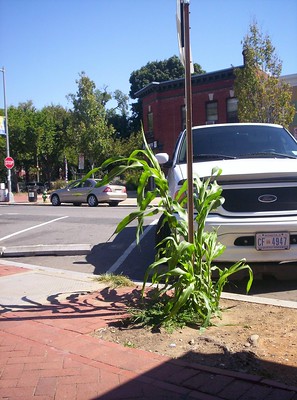
Corn at Eastern MarketAnd there was a rogue corn plant growing in a treebox at Eastern Market. 

On 4th Street SE, one resident plants tomatoes and basil in his treebox.

And in various parts of the city, DDOT has planted serviceberry bushes, which have a brief period of ripe fruit at the end of May/beginning of June, which is great for pie.

Treebox planter used for growing herbs and vegetables, 100 block 4th Street SE, Capitol Hill, DC
More about what I've been thinking about this in terms of a broader community in a subsequent post using the concepts of the Food Forest ("For D.C. students, lessons in growth, of the garden variety," Washington Post) and the Tomato Independence Project in Boise/Treasure Valley, Idaho.

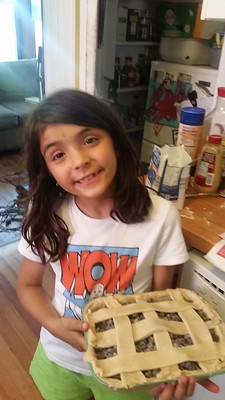
Marina with one of the serviceberry pies we made, picking the berries from bushes on a nearby street (we made three pies) Making serviceberry pie (although we use a recipe for Saskatoon Berry Pie.)

Labels: , , , , , , ,

Sunday, March 03, 2019

Update: Neighborhood libraries as nodes in a neighborhood and city-wide network of cultural assets

========
This piece originated in the Summer of 2017, when I met with some stakeholders in Southwest DC and they told me that DC Public Library was embarking on the process of renovating the Southwest Branch. So I wrote a memo outlining best practice library branch planning, in the context of my belief that libraries should serve as "nodes in a neighborhood and city-wide network of cultural assets."

Later I published it as a blog entry in March 2018.

Related blog entries afterwards include "National Libraries Week and a libraries update" and a cultural facilities specific entry concerning what I call "Transformational Projects Action Planning" ("Downtown Edmonton cultural facilities development as an example of "Transformational Projects Action Planning"").

In 2018, DCPL began planning to renovate the Lamond-Riggs Branch, and has embarked upon a broader Facilities Master Plan planning process.
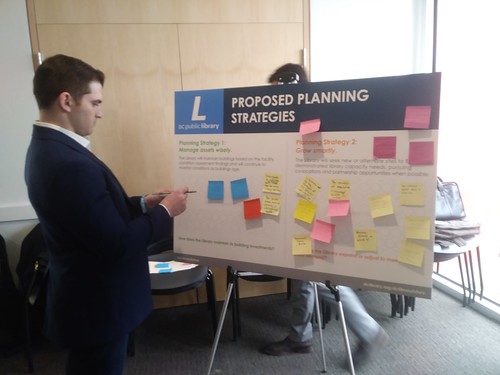
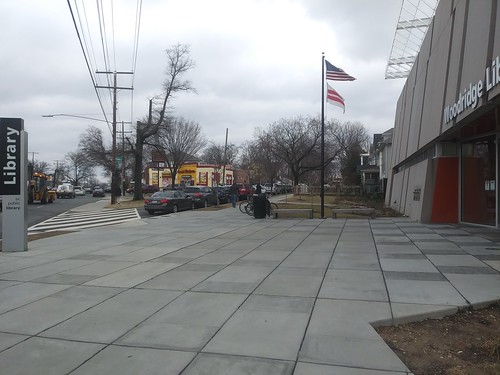
DC Public Library Public Facilities Master Planning process, Woodridge Library, March 2nd, 2019

They had focus groups in December (although I didn't get to participate), and are undergoing a round of public meetings which started last week and include a couple meetings this coming week.

In the context of that planning process and submitting comments, I feel the need to update this piece in terms of some of the other best practices I've come across since, or forgot to include in the original piece, so that they are in a unified document.

=================

While there is no question that the DC branch library replacement construction program has created wonderful libraries across the city, at the end of the day they are still libraries but with newer facilities and separately, an expanded array of programming.

Unfortunately there was never a planning process undertaken at the outset aimed at rearticulating neighborhood libraries to serve multiple goals and roles as key anchors within neighborhoods and as nodes within an integrated network of civic assets more generally, and within a sub-network of cultural facilities specifically.

I came across other initiatives which extend these ideas along the lines I have imagined:

-- Civic Commons Reimagining Our Cities’ Public Assets, Reimagining the Civic Commons
-- Civic Infrastructure: A Model for Civic Asset Reinvestment, William Penn Foundation
-- RE-ENVISIONING NEW YORK’S BRANCH LIBRARIES, Center for an Urban Future
-- Re-envisioning Branch Libraries, Architectural League of New York
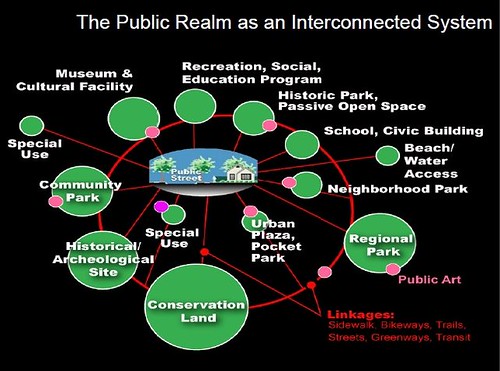
Public Realm as an Interconnected system, Slide from presentation, Leadership and the Role of Parks and Recreation in the New Economy, David Barth

I have used the concept of the "public realm as an interconnected system" by David Barth as a way to illustrate the idea.
DC has not embraced the concept of a "civic commons" or ensuring that the greatest possible civic return is received from such investments overall and from each one individually.

The replacement planning process for the Southwest Branch of the DC Public Library could result in much more than a rebuilt library, it can expand the “program” of a typical library by creating a multifunction “civic” mixed use cultural and civic public facility.

This matters especially because the building that will be constructed is expected to serve the community for many generations.

What is proposed at the end of this document is the creation of a multifaceted public library and community center, serving as the premier civic asset and community hub and anchor in Southwest DC, complementing the commercial and residential districts and other civic and cultural facilities (Waterfront Metrorail Station, DC Government buildings on 4th Street SW, cultural facilities such as Arena Stage, and the Washington Channel waterfront, and public parks, recreation centers, and schools.

The concept is based on three ideas. First, libraries are the most widely used civic facilities in a community.

Second, libraries tend to be the primary “cultural asset” within neighborhoods and sub-districts of a city, whether or not this function is planned for purposively.

Third, one of the biggest resources that libraries (and recreation-community centers) have, at least potentially, is “flexible space” which can be programmed in a wide variety of ways to serve various community needs—but typically this space is not organized and managed in ways that allow it to be flexibly used by different types of groups and at times when normally such facilities would be closed.

It turns out Dayton, Ohio is doing a form of this, but they aren't articulating what they are doing in terms of a network of cultural facilities, rather they focus on the role of libraries as "community centers."

NextCity reports that Dayton has been doing expansive library creation for a few years now ("Dayton is making the library a must visit destination").  It's a shame that they haven't received the recognition for this that is deserved, because in the US context, it is exceptional.  From the article:
But the most progressive thing about Dayton — the thing that puts its coastal, blue-state brethren to shame — is its public library system, one of the most dynamic in the country.

In an era of widespread internet access, cheap digital books and federal disinvestment, cities across America are attempting to reinvent their aging library systems. Dayton is at the forefront of this movement. The Dayton Metro Library is leading the city’s cultural transformation, putting $1 million dollars into local art, and using the largest bond issue in state history to radically change the form and function of its library spaces. It is customizing branches for the specific communities they serve, implementing new architecture that can adapt to future technologies, and designing programming that integrates the library into the daily routines of city life. ...

David Schnee, a principal at Group 4, says they modeled concepts for the Dayton Metro Library system on Dokk1, a Danish library that calls itself a “citizens’ house” and functions as a “center for knowledge and culture.” DOKK1 includes a playground, a café, a “creative room” for young children, the city archives, a nursing room (though nursing is permitted throughout the facility), a game room for board games, citizen support services, and media in multiple languages — in addition to library standbys like a quarter of a million books.

Dayton’s system is now “one of the first American interpretations of the concept of having the library be an active community center,” says Schnee.
Referencing examples of multifaceted facilities elsewhere can infuse the process of planning such a facility in DC/Southwest DC, and allow us to rethink the planning process for neighborhood libraries generally, and specifically in terms of creating a neighborhood-centric program for the rebuilt library branch in Southwest.

Below are a number of relevant examples.  Another resource for best practices is the European website, Model Programme for Public Libraries.

Extraordinary “mixed use” libraries

Idea Store, London. The Tower Hamlets borough is one of the most impoverished in London. The borough offered continuing education and workforce development programming with limited success and even though they enjoyed wide support, the libraries were old and underutilized.

After an extensive planning process, with a special focus on reaching people who didn’t use the library, the borough came up with a new concept aimed at improving library and education services by combining them into one facility, supporting urban revitalization goals by locating the new facilities in transit-accessible commercial districts, and incorporating “involvement” principles drawn from successful retail stores as a way to engage audiences.

Even though the Idea Store and some of DC’s rebuilt neighborhood libraries shared the same architect—David Adjaye, also a designer of the new Smithsonian Museum of African American History and Culture—it is clear that the success of the Idea Store is not design-forward architecture as much as it is the rearticulated, innovative, integrated, and expanded library program, which was developed by the library system, not the architect.  [Future Proofing the Library: The Idea Store,” 2015, Cities of Migration, “When is the Library not a library? When it is the Idea Store,” 2004, Guardian]

Combined library-cultural centers, Montreal. In Montreal, cultural centers have been added to a number of borough library centers, bringing an array of facilities that wouldn’t normally be included within a library program such as auditoriums and theaters, and a range of meeting rooms capable of meeting specialized needs, such as for music. The combined library/cultural center becomes the primary “cultural facility” for the borough district, but also is part of a network of similar “library” facilities across the city, and simultaneously within the larger network of cultural facilities within the city and metropolitan area.

Booksellers Alley on a Friday night.

Separately, the provincial library, Bibliothèque et Archives nationales du Québec, in Montreal functions as a node in a network of central libraries for the Province, but also serving the central library function for Montreal. Besides being open til 10 pm many nights of the week, on the alley side of the building they have rented stalls to booksellers, creating “Booksellers Alley.”

The Notre-Dame-de-Grâce Cultural Centre houses the Benny Library, an exhibition hall, as well as an indoor terrace and an outdoor yard that’s ideal for open-air cultural events. The 200-seat performance hall was designed for dance, but offers multidisciplinary programming for all age groups.

The Montreal North Maison culturelle et communautaire has a performance hall with 234 seats; a rehearsal hall, a room for exhibitions; a concourse decorated with a mural by Isabelle Haveur; 16 rooms for community activities, including a recording studio and a community radio station; a day care center, and a small restaurant managed by Les Fourchettes de l'Espoir, a non-profit organization whose mission is to help and support the disadvantaged.

In keeping with its location near the University of Montreal, the Intercultural Library in Côte-des-Neiges specializes in “foreign languages,” and besides holdings in a range of languages, offers language classes, and cross-cultural programming including “world music.”

The Pointe-aux-Trembles Library houses the Centre multimédia de l'est de Montréal, a social enterprise that aims to expand access to multimedia technologies for artist and creative as well as office and business use.

Salt Lake City Library System. While serving the entire city and more comparable to DC’s Martin Luther King Library, the Salt Lake City Central Library is perhaps the nation’s most intriguing example of rearticulating libraries as cultural facilities—as “mixed use” knowledge and cultural facilities. The old library building remains on the site, across from the new library, and is used as a museum.

The arcade of the Salt Lake City Central Library.

While modeled after an even larger library designed by the same architect for Vancouver, BC, the design and program for the Salt Lake Library was created through a robust planning process that engaged both librarians and other professionals alongside residents and other stakeholders.

The Salt Lake central library building has inside and outside sections. The library is on “the inside” and is organized into two sections joined by a soaring arcade, with traditional library functions on the largest side of the building. Besides many floors of materials, study tables, wifi access, and a green roof with public access, the collections side of the building includes exhibit space, an art gallery, a small café, and a specialized children’s collection.

On the other side of the arcade, the upper floors are lined by tables, chairs, and study carrels, connected to the main building by walkways. On the ground floor, like “Booksellers Alley” on the back of Montreal's central library, “storefronts” house the Friends of the Library Bookstore, a craft and art gallery, café, an ATM and a rack of transit information, and one storefront bay designed to serve community uses on a temporary basis, for example, during a public master planning process, the City Department of Planning held an open studio and “office hours” in the space. A 300 seat auditorium is located below ground.  Many of the floors include “fireplaces,” adding an additional placemaking element.

Located in the “outside” portion of the building, which is an extension of the “arcade” side of the interior building, are the local public radio station and the Community Writing Center of the Salt Lake Community College. The radio station has an audio loop connection to the auditorium, so that meetings can be recorded for subsequent broadcast or broadcasted live.

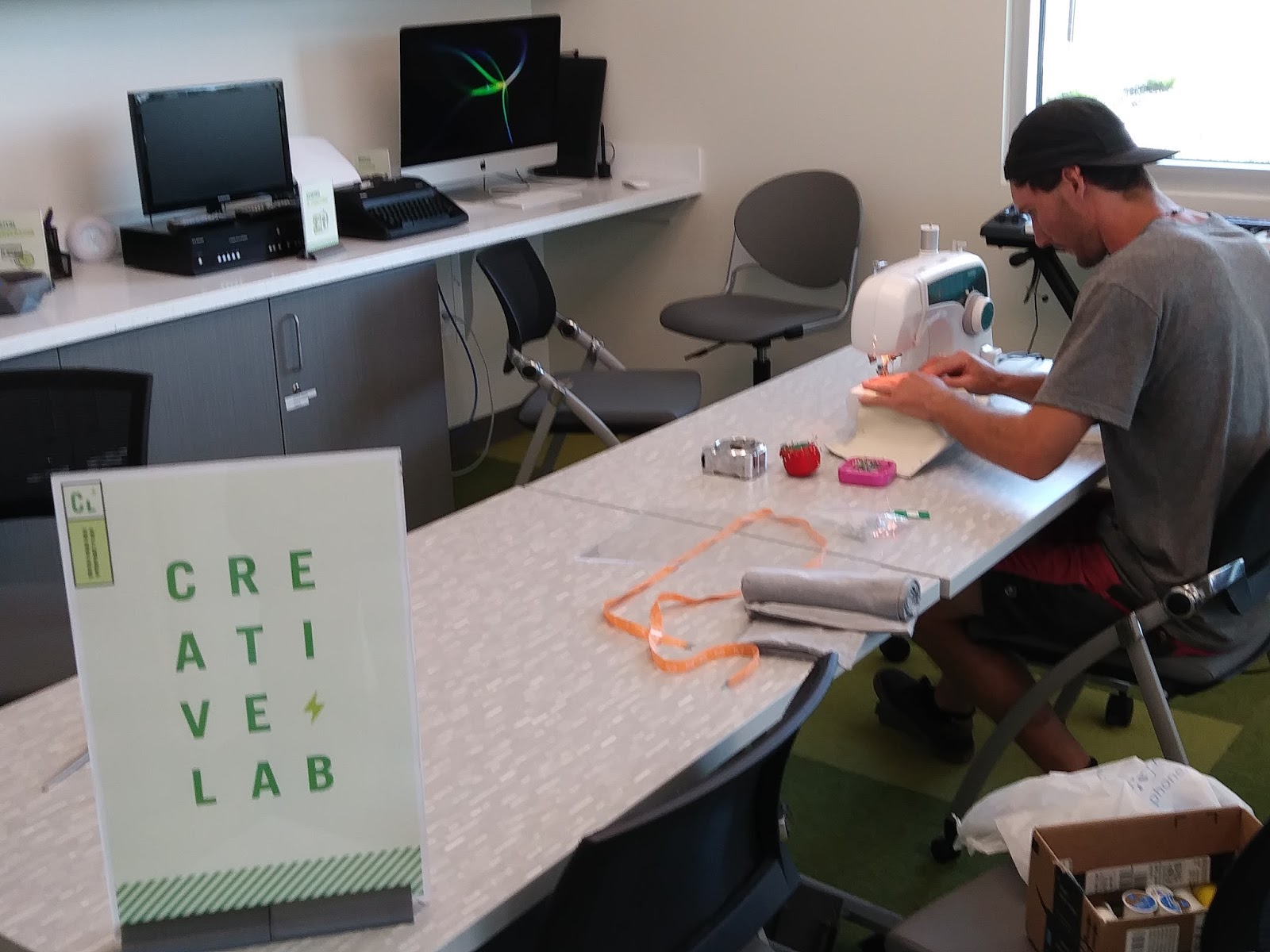
The Library system is spreading these concepts to the neighborhood branches.  The Marmalade Branch of the SLC Library System includes a coffee shop and a meeting room that can be used outside of library hours because it has a separate entrance. The room has retractable stadium seating that can seat 150 people. The branch also has a small maker space including digital and analog equipment such as a sewing machine. 

Patrons can consume coffee they've purchased on-site throughout the library branch.  This branch gets more adults than other branches, and library staff opine this might be because it is the only branch library with an on-site coffee shop.

Separately, library card holders can also "check out" sewing machines and other equipment. 

All the branch libraries have a children's area with a toy section and a "slop sink."  The large meeting rooms in each branch library have a piano. 

The Glendale Branch has a maker space for the exclusive use of teens.

The Boston Athenaeum. While a membership rather than a public library, besides having an extensive book collection including rare books, there is an art collection with more than 100,000 items, a gallery space, and an extensive public program of lectures, readings, concerts and other events.

San Jose has a single facility serving as the central library and the library for San Jose State University, although each is a distinct library, there are differences in hours, but city residents have access to and can check out the more specialized collection of the university library.  (Case Study, Penn; Economies of scale in the library world: the Dr. Martin Luther King Jr Library in San Jose, California).

The central library in Worcester, UK is a joint venture of the University of Worcester and the Worcester County Council and also incorporates an innovative program, according to the case study on the Model Programme website.

In West Hollywood, California, the city and the County library system constructed a co-located facility that includes, a 32,000 s.f. library branch, coffee shop, bookstore, a children's theater, and the city's Council Chambers ("West Hollywood Library's new edition," Los Angeles Times), along with a 400 space parking garage and an expansion of the abutting city park.

Library public space and park connections

This section is added with some previous items consolidated here, based on failures of DCPL to connect the Francis Gregory and Woodridge Library branches to adjacent park spaces or to otherwise fail to reprogram underutilized adjacent public space.
Woodridge Branch, DC Public Library
Woodridge Library.

Woodridge Branch, DC Public Library

While the new West End Library branch is connected to a cafe, and the cafe has an outdoor patio, there isn't an extension of this patio for the library, which could be used by patrons not purchasing food or drink.  There is an interior courtyard surrounded by the library, but mostly library patrons don't have access to this, and there is no door connecting the library's large meeting room to the courtyard, which it abuts. 


Dokk1/Denmark. "Dokk1 in Aarhus, Denmark, is the best new public library of 2016," Slate.

I especially like how the outside "stairs" for the building have been designed to also serve as outdoor amphitheatre seating.

Space for Change, in Danish and English, describes the library in more detail.

Salt Lake County Viridian Events Center.  As part of the library branch in West Jordan, Utah, the Salt Lake County Library System has created an multi-function events center, a facility that can be combined as one room or divided into two or three rooms, with a maximum capacity of 700 people.  Outside there is a separate amphitheater for outdoor events with a capacity of 250 people.

The Park City Central Library abuts "Library Field."  The side of the library building abutting the Green has a cafe and outside patio, and the building opens to and connects the spaces ("Park City protects Library Field, ‘our Central Park’," Park Record).
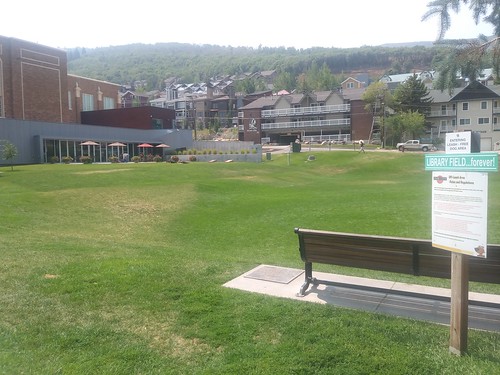
Park City Library, Utah

Pavement Park at the South Park Library in Seattle.  DC's Woodridge Library abuts a large park, but it is incredible that the library wasn't designed to integrate into the park at all, nor was the street space outside the library entrance reconfigured to be more of a public square fronting the building.

As a counter example, part of the street in front of the South Park Library Branch in the Seattle Public Library was reconfigured as a "pavement park" extending the civic qualities of the public space outside of the library ("New South Park pavement park celebrates Day of the Dead," Curbed Seattle).
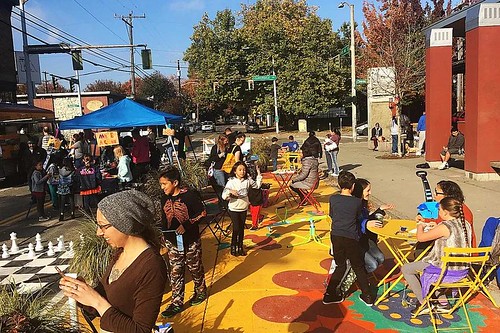
Pavement Park in front of the South Park Library Branch, Seattle
Pavement Park in front of the South Park Library Branch, Seattle.  Seattle DOT photo.

Another example of library-relevant placemaking creativity is Bell Street Park in Seattle, which was created by converting one lane of a two-lane street into park-type space, including this section in front of the former Belltown Community Center. The Center, in a leased facility, closed last year when the lease expired.
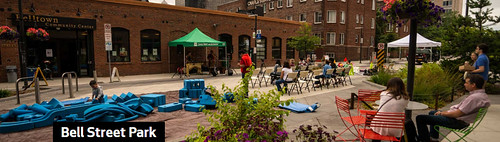
Bell Street Park, Seattle, abutting the Belltown Community Center


Bryant Park Reading Room, NYCBryant Park abuts the 42nd Street “branch” of the New York City Public Library System, which serves as the main library for NYPL system.

Bryant Park is managed separately by a nonprofit conservancy.  One of their programs for the park is what they call “The Reading Room,” outfitted with tables, chairs, books and periodicals.

The Reading Room is actively programmed with poetry and other readings, book clubs, author talks, children's activities, etc.

San Diego neighborhood branch libraries often include “lanai”-like space—enclosed outdoor patio space that is controlled and secure by being accessible from the inside of the library. (Similar spaces have been developed at Salt Lake's newer branch libraries.)  Note that I used the term "lanai" but really the concept is derived from interior courtyards typical of housing in Mexico especially.

As mentioned above, Salt Lake Central Library has a green roof which is open to the public.  The Library is situated on Library Square, which includes green and open space and a public plaza, and is across the street from the City-County Hall.  The old library remains on the site, and is used as a museum featuring traveling exhibitions.
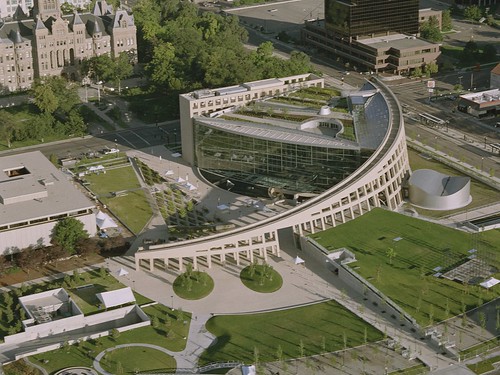
Aerial, Library Square, Salt Lake City

The San Diego Central Library doesn't have a green roof, but does make its roof accessible to the public, which also includes meeting room facilities.

The back of West Hollywood City Hall and Library connects to a public park and instead of a green roof, there is a public pool and tennis courts ("Rios Clementi Hale and LPA Win West Hollywood Park Commission," Architect's Newspaper) as shown in the renderings below.
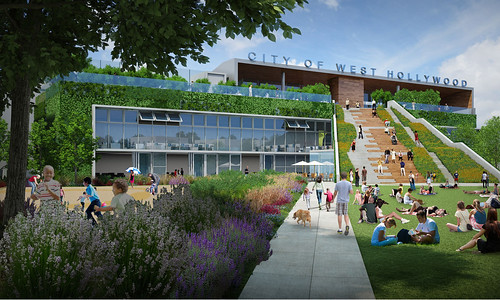
Rendering, West Hollywood Library and City Park

Rendering, West Hollywood Library and City Park

Mixed use civic facilities including a library

Pounds Centre/Hampshire County, UK. Includes a library, two spaces specifically designed and programmed for teens, athletic and fitness facilities, a publicly-accessible office for the local housing authority, a café which sources food locally and has catering operations, a small publicly-accessible laundry, day care, a dental clinic, multiple counseling programs, and offices for some community organizations, and wide ranging programming. Rooms can also be rented for private and public events.

Montgomery County, Maryland. The Rockville Library includes space for non-library government offices and the Center for Visual Arts, which has galleries, studio spaces, meeting rooms, and educational programs for all ages and camps for youth. Rockville is the seat of the county government and the library has an expanded special collection of government related materials. The Silver Spring Library includes space for the Levine School of Music and a small cafe.

In the summer, branches in the county's conurbations, including Silver Spring and Bethesda and the City of Rockville, are open until 9 pm on Fridays and Saturdays.

Shirlington Library/Arlington County, Virginia. The Shirlington Library was rebuilt to include space for the Signature Theatre, which has two black box theaters; the largest can accommodate 275-350 people. In addition to the theaters, the facility has meeting and rehearsal rooms, dressing rooms and showers, kitchens, and scene, prop, and costume shops.

ImaginOn, Charlotte-Mecklenberg County, North Carolina is a joint venture with the Children's Theatre of Charlotte.  It includes two theaters, separate library sections for children and teens, and an audio-visual studio for teen use.

Drumbrae Library/West Edinburgh, Scotland. Besides the library, the facility has adult learning rooms, community meeting rooms, computers, a public housing office, an office for the local government including the community policing team, a health information center, a careers and higher education center, public computers, and an adult day care center.

Athenaeum/Goucher College, Baltimore County, Maryland. The building combines the college’s main library and student activities center. Besides the campus library, the building has spaces for performances, lectures, and other events, an art gallery, the campus center for community service and multicultural affairs, fitness facilities, meeting and study spaces, and a café.

Ballard Library and Neighborhood Service Center, Seattle. The Neighborhood Service Center section of the building includes office services for the city government, passport application services, Seattle Public Utilities, community courts, and meeting facilities.

Hollywood Library and apartments, Portland. The four-story building houses the library branch and a café on the ground floor, with 47 mixed-income apartments on the upper stories.

The Takoma Park City Hall includes a Community/Recreation Center and the city library is separate but part of this complex.

Salt Lake County has a number of co-located facilities, such as the Millcreek Community Center, which includes a Library, Senior Center, and Recreation Center, abutted by a small public park.  The facility includes public meeting rooms separate from the library, and the Cafe Evergreen, a small cafe open during the day during breakfast and lunch, where the food service function also supports the senior meals program and on-site eating and congregating.  The facility was first created decades ago, as a recreation center.

Enhanced media functions

Besides offering access to computers, many libraries offer expanded IT/computer related programming and increasingly, makerspaces ("Social Innovation, Democracy and Makerspaces," Science Policy Research Unit, University of Sussex).  DCPL has maker spaces of various types, including a small music studio at the Shepherd Park Library.

In London, the former Willesden Green Library in London rented space to a used bookstore.

In Orange County, California, the library branch in San Juan Capistrano has a nice "Friends of the Library" bookstore. It is marketed by the city in tourism and other materials as the city's only bookstore.

As mentioned above, the Salt Lake City Central Library includes studios for one of the city's NPR stations and an audio connection between the auditorium and the station.  A branch library in the Montreal system includes a community radio station.

Civic engagement media and programming.  Other special collections that I think should be adopted by more libraries include Dallas' Urban Information Center, on cities and municipal government, so that citizens can be more knowledgeable on civic matters and issues.  Although such a collection would be best augmented with programming.

Local history collections.  Many libraries, including DC's Georgetown branch Peabody Room, have rooms-collections devoted to local and community history.  (The main library Washingtoniana collection does this for the entire city.)  Libraries could have dedicated exhibit space for traveling exhibits.

For example, as part of the Anacostia Community Museum's "Right to the City" exhibit, they are developing community-specific exhibits to be displayed at DCPL branches in Anacostia, Mt. Pleasant, Shaw, Southwest, and Woodridge.

When the Cincinnati Museum Center was closed for renovation, they delivered various community outreach and exhibit programs which they will continue to offer even though the museum has been reopened ("During Union Terminal renovation, the Museum Center took its programs out to the public: And now that approach will become permanent, WCPO-TV).

Other specialized media collections.  Library systems like the New York Public Library have various special collections located at particular libraries, but the special collection serves a city-wide/knowledge function beyond service to the immediate area.  One example is the Schomburg Center for Research in Black Culture. 

The Montgomery County Library system has a special health and medicine collection at the Wheaton branch.  In DC, given the proximity of the West End Library to the GWU Hospital, perhaps such a special collection could have been developed at that branch, etc.

In this vein there is the "Library as Incubator" project/website which aims to link artists and libraries and foster the use of the space in libraries to incubate art production and arts initiatives.

This is a good illustration of the importance of having flexible spaces that support cultural production in a more systematic way through a more creative utilization of libraries as community and cultural spaces.

And somewhere I saw a mention of an arts book circulating library in association with an arts center. There is also a performing arts library branch of the New York Public Library at Lincoln Center.  (Except for its out of the way location, creating such a library at the Kennedy Center would be logical.)

Yes, most public library systems participate in inter-library loan programs but it is difficult to find more specialized publications in arts or urbanism etc.  Outside of university libraries it is very difficult to find such publications.  Public libraries should do more acquisition and development of such special collections.

The old theater housing BRIC House includes a separate facility for the Urban Glass studios.

Brooklyn Information and Culture/BRIC House. BRIC is a nonprofit media and arts organization serving Brooklyn, including running the borough's community access cable television service. It supports a wide variety of cultural programming across the borough, including free concerts at Prospect Park, a calendar of events, etc.

In 2013, it opened an arts center called BRIC House in a previously vacant theater, showing films and presenting lectures and readings, complemented by a gallery and a flexible performance space. BRIC has a studio residency program for working artists, and offers classes in photography and video production. BRIC House’s upper stories are home to a separate arts organization, the Urban Glass studios and education program in artistic glass production.

As part of its operation of Brooklyn’s Public Access Cable Television channel, BRIC partners with the Brooklyn Library system, and offers classes in media production at a number of branches. The Coney Island branch library is outfitted with a television studio on the second floor, run by BRIC, and residents who have been trained through BRIC classes can rent/check out video production equipment ("Library unveils new television studio at Coney branch," Courier Life).

Image from Boston Magazine.

WGBH--TV and radio studio in the Boston Central Library.  When I was doing research for my comments on the DC Cultural Plan (ugh, not very good), I found out that Boston's public broadcasting group has opened a studio on the ground floor of the library there ("WGBH studio and cafe to open at Boston Public Library," Boston Globe).

For example, DC's Office of Cable Television should reposition more like NYC's television operations, with studios at one or more library branches, and in a city like DC, we should aim for the creation of a tv network operating something like the Book TV programming of CSPAN.

Collecting and making available local music. In another entry, I mentioned how the digital tv and radio studio at WCPO-TV in Cincinnati is used for a program that features bands coming to town to play in local venues. The Seattle Public Library has a program, called Playback, to collect and offer to library patrons access to locally produced music ("Seattle musicians- submit your music to Seattle Public Library's collection," My Wallingford).  So does Salt Lake City Library, through the HUM -- "Hear Utah Music" -- initiative.

Note that DCPL does have a "punk music archive," but I don't know if it includes actual music, or if it is just dedicated to printed material, like flyers. Also a couple years ago, the American University Museum had an exhibit on DC's foray into New Wave in the 1980s, "Twisted Teenage Plot."

The Chicago Public Library has a teen recording studio called YOUmedia.  The renovation plans for the South Shore Branch include a YouMedia studio and recording facility ("South Shore Library Set To Get $2.5 Million Upgrade With New Recording Studio And More," Block Club Chicago).

The Helsinki (Finland) Library System has two especially innovative programs. Library 10, a special library focused on music and culture, started as a program located in the city's multi-functional  CableFactory arts center, but has since been relocated to a different site. In addition to its book and media collection, the library provides space and equipment for the production and presentation of independently-produced work.

Meetingpoint is an experimental library without books, which provides technical assistance and guidance for digital communications and living in a digitally-connected society. Meetingpoint also develops digital communications platforms for organizations, with a focus on civic participation. 

Both programs have extended hours, open as early as 8am and close as late as 10pm. Both programs are seen as models for helping to develop new ways of developing programs, organizing space, and serving patrons for the new Central Library.

(Apparently, the Helsinki Library system also manages the libraries in the public schools.)

Many libraries have specialized 'zine collections ("Do Zines Belong in OC's Public Libraries?," OC Weekly).

Other media specific but non-library programs that should be reviewed for ideas include the Podcast Garage in Boston ("The Podcast Garage celebrates a year," Boston Globe), The Writer's Center in Bethesda, Maryland; and the Chicago Poetry Center.
WBUR-FM, Boston University, CitySpace studios
CitySpace Studios building, WBUR-FM, Boston University.

WBUR-FM CitySpace studios.  Another model, but by a university not a library, is the expansion of Boston University's WBUR-FM.  The station is an NPR affiliate and after receiving a $5 million donation, is building new studios, called Cityspace,  Studios will continue to produce daily broadcasts as well as live radio shows, political debates, and performances.  According to the University ("WBUR Breaks Ground on New Cultural Venue CitySpace," BU Today):
WBUR general manager Charlie Kravetz says the 7,500-square-foot space, which will have at least 240 seats and is expected to serve an estimated 30,000 people a year, will focus on discourse. “CitySpace is the logical extension of WBUR’s role in Boston,” says Kravetz. “WBUR is no longer just a radio station. It’s a multiplatform media organization that reaches people on air, online, on demand, and on stage.”

CitySpace, ... will produce up to 200 programs a year, including debates, interviews, readings, theatrical performances, and family programming, with all events streamed live and archived for on-demand access. ... Floor-to-ceiling glass windows will allow passersby to watch the events inside, and the station plans to install benches and speakers outside the building.
WBUR-FM, Boston University, CitySpace studio

Other mixed use civic facilities without libraries

Silver Spring Civic Building, Montgomery County, Maryland. Besides housing offices for the County Government, the building has meeting rooms for use by public and private groups, a gallery/exhibit space, and a large multi-use plaza for outdoor events. A portion of the outdoor plaza is dedicated to winter ice skating. The largest room can accommodate 720 people.

Thomas Jefferson Community Center, Arlington County, Virginia. The community center is combined with a middle school, providing facilities that are more robust than either a community center or junior high school could offer on its own. These additional facilities include an indoor track/exposition hall, fitness facilities, art studios, and a theater-auditorium which supports a resident children’s theatre company.

University of Michigan Student Unions. These facilities include space allocated on a year-to-year basis to student organizations of all types, complemented by permanent offices for the student government, campus student-run activities organization, and the university student housing cooperative.

Western District Police Station, Baltimore. Community-serving facilities have been added to a newly renovated police station, including a community meeting room, a health and wellness clinic, a wifi hotspot, landscaped garden-open space, and public art.

Culture centers/programs

Chicago Cultural Center. The former Central Library has been repurposed as a cultural center serving Downtown Chicago, with an auditorium, meeting and exhibit spaces, and offices for the City Department of Cultural Affairs and the Chicago Children’s Choir. The first floor also houses the city’s primary tourism visitor center (Choose Chicago). More than 1,000 events are presented annually.

Creative Alliance at the Patterson, Baltimore. Located in the Highlandtown Arts District, the Creative Alliance has restored the old Patterson Theater which continues on as a venue for movies, performing arts, and presentations. Two art galleries present more than 20 shows annually, and is complemented by workshops, an artist in residence program, a community outreach program, and after school arts programs serving more than 2,000 students each year.

Town Hall Education Arts Recreation Campus, Ward 7, Washington, DC. This facility has cultural, health, recreation, and education elements and space for organizations ("On Mississippi Ave. SE, a place of light and learning" and "New $34 million community center building coming to Southeast," Washington Post).

92nd Street Y, New York City.  The organization serves more than 300,000 people each year through early education, fitness, and cultural programs, including music and dance performances, a widely publicized lecture series, readings, and films, arts education including studios and workshop spaces, adult education, as well as early childhood and parental education, and a senior center.

Other “mixed use” cultural facilities with social enterprise dimensions

Mestizo Coffeehouse and Gallery, Salt Lake City. This nonprofit coffeehouse and art gallery also serves as a presentation space, and offers free use of meeting spaces to community nonprofits.

Tia Chucha's Centro Cultural & Bookstore, San Fernando Valley, Los Angeles.  Chicano author Luis J. Rodriguez and his wife Trini added a bookstore to their cafe and later created a companion cultural center ("A bookstore that's like a favorite aunt," Los Angeles Times).  Over time the initiatives were combined and converted into a nonprofit organization.

Programs include workshops in art, dance, theater, writing, healing, and indigenous studies, the annual Concerned Words Festival, a publishing operation, Dos Manos, a music label, a resident dance company, and a youth empowerment program.

An event at Red Emma's, a key anchor in Baltimore's Station North Arts District.

Red Emma’s Bookstore, Baltimore. The bookstore is organized as a business cooperative, and a café is managed and owned separately but shares the space. They are connected by a large open space set up with tables and chairs. This section serves as café, free-form “sitting space”—no purchase required, and meeting room, reconfigured for lectures, author talks, and community meetings.

Busboys and Poets restaurants, Washington, DC. These restaurants typically have a meeting space suitable for lectures and private meetings, restaurant space, coffee house/bar spaces, and small bookstores, run by the area bookstore, Politics and Prose.

Regional chapter facilities for the American Institute of Architects. AIA chapters in large cities typically have multiuse facilities with exhibit halls, meeting rooms for lectures and presentations, an architecture and design bookstore, as well as chapter offices, sometimes a library, etc.

Food-related social enterprises that could be models for food service in libraries

Skyline Bistro, Worcester Technical High School, Worcester, Massachusetts. This restaurant is open to the public and is run by students in the culinary and hospitality technical education programs.

Colors Restaurant, Restaurant Opportunities Center. The restaurant workers labor and training organization runs restaurants in New York City and Detroit that serve as training sites for people being trained in culinary, bartending, and fine dining/table waiting programs.

Forge City Works in Hartford, Connecticut operates the cafe, branded as "The Kitchen," in the Central Library, as part of its culinary training programs.

Skid Row Coffee is a social enterprise workforce development program operating a cafe in the Los Angeles Central Library.

The Marmalade branch of the Salt Lake City Library has an independently managed coffee shop on the ground floor.  (Although the facility is underpowered, making it difficult to be successful, and the street facing facade of the building should have been designed to be permeable to better support the cafe.


Proposed program for a Southwest DC “Neighborhood Library and Cultural Center”

Considering the various model mixed use facilities outlined above, I propose that the rebuilt Southwest Library incorporate an expanded cultural-, civic-, and community-focused program.

The specifics of the program should be developed through a robust planning process, but could include:
  • Library functions
  • Meeting rooms
  • Special spaces such as music and artist studios, possibly configured for access outside of normal “business hours”
  • Exhibit space
  • Community art gallery which could be managed as a nonprofit gallery
  • Auditorium-theater
  • Café which could be run as a social enterprise
  • Office space for community organizations such as the ANC and the Southwest Neighborhood Assembly
  • Outdoor reading room.

To support retail development and entrepreneurship objectives, the “Community Hub” could have a set up where the café supports entrepreneurship development and could have pop up restaurant functions at night. Alternatively, a café could be run as an education-social entrepreneurship program in association with area hospitality/culinary training programs, perhaps with the Restaurant Opportunities Center, which has expressed interest in opening a training branch in DC.

Community bookstore.  In the original version of this memo, it was suggested that a small bookstore could be included in the building footprint—the Biblioteque National de Quebec in Montreal has bookseller stalls on the backside of the library.  Many libraries have "friends of the library" bookshops selling books, including some examples listed above, or the former Willesden Green library also included space for a used bookstore.

But since then, a branch of the local Politics & Prose bookstore chainlet has opened in the nearby Wharf District development.

Upshur Street Books with President Obama and his daughters Malia and Sasha. 

Currently there is a resurgence in the development of small bookstores ("The novel resurgence of independent bookstores," Christian Science Monitor), as for profit businesses and community hubs, including in DC, Loyal Books, formerly Upshur Street Books ("Bookstore celebrates opening in DC," Washington Post) in Petworth, which is notable for having received a visit from President Obama and his daughters.

Labels: , , , , , , ,