Rebuilding Place in the Urban Space

"A community’s physical form, rather than its land uses, is its most intrinsic and enduring characteristic." [Katz, EPA] This blog focuses on place and placemaking and all that makes it work--historic preservation, urban design, transportation, asset-based community development, arts & cultural development, commercial district revitalization, tourism & destination development, and quality of life advocacy--along with doses of civic engagement and good governance watchdogging.

Wednesday, January 05, 2022

Pontiac Michigan: a lagging African American city in one of the nation's wealthiest counties

I've written about Oakland County, Michigan vis a vis Detroit, and how the multi-decade County Executive, L. Brooks Patterson, spent a lot of time working to keep the county ascendant at the expense of the majority black center city.

-- "The rise of Oakland County is built on Detroit's fall," 2014
-- "One more idea about Detroit: merging not with Wayne County but Oakland County," 2019
-- "Revisiting stories: the death of L. Brooks Patterson, County Executive, Oakland County, Michigan," 2019
-- "Michigan politics as an illustration of the impact of the decline of industry on social capital," 2020

Oakland County has not quite 1.3 million residents and the population is roughly 75% white and 14% black.  Located immediately north of Detroit, later waves of black outmigration from the city led to significant demographic changes in communities like Southfield and Oak Park, which are now majority black.

Built on the earlier success of the auto industry, as of the 2010 Census, Oakland was the seventh wealthiest county in the US--and the second wealthiest, after Fairfax County, Virginia, of places with at least one million residents.

The county has lots of office parks, Oakland University, and an industrial promotion initiative called Automation Alley, aimed at keeping its industrial base competitive.  While definitely a suburban community, it has a number of traditional town centers predating suburbanization, like Royal Oak, Ferndale, and Birmingham, and Pontiac, the county seat.

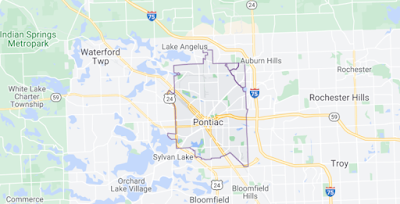
Pontiac, about 20 miles north of Detroit, is the Oakland County seat, but in the 1970s, the county government began relocating most of its facilities to a new automobile-centric headquarters campus in adjacent Waterford Township, with criminal justice facilities (courthouse, jail) remaining in the city.  This removed the valuable energy government office districts can provide to city economic health.
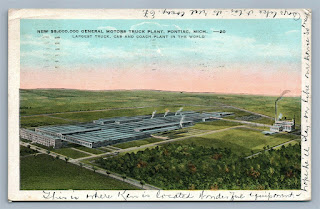
When I lived in Michigan, Pontiac was known for its industry--home to GM's Pontiac Motors division when that brand still had verve, but also GM's extensive medium truck and bus manufacturing operations, and for being a majority black community in a predominately white community.

It was one of the first cities in Michigan to employ busing to achieve school integration, and it was challenged violently, with bombings of buses in 1971.

Pontiac is about 20 square miles, while Oakland County is 907 square miles.  Today the city has about 60,000 residents, down from a peak of 85,000 in 1970.  The population is about 52% black, with over 20% of the population below the poverty line. By contrast, the overall poverty rate in Oakland County is 7.8%.
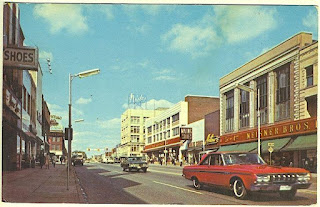
Deindustrialization.  At its peak, GM had 30,000 employees working at various plants in Pontiac, and was the largest property holder and paid the most in property taxes ("Pontiac, Michigan feels brunt of GM's pain," Reuters).  

But GM's dissolution of the Pontiac brand, the sale of its bus manufacturing operations, and the cessation of the manufacturing of large trucks led all but one of GM's facilities to close there by 2010. 

Now there are a few hundred employees, at a single facility.

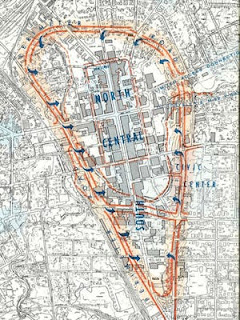
The city also suffered population outmigration and went through some iterations of urban renewal, including the construction of a ring road around the city, to facilitate car-based commuting traffic, at the expense of walkability and the economic health of the Downtown.

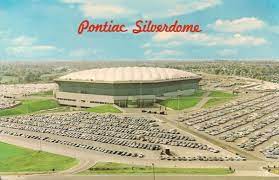
Football stadium. As part of an earlier period of outmigration from the center city, for a time, the Detroit Lions football team relocated to a covered stadium built in Pontiac, called the Silverdome, although the team returned to Detroit in 2002.  

(For a time, the Detroit Pistons basketball team played at a suburban arena in nearby Auburn Hills/Auburn Township.  Chrysler moved from inner city Highland Park to Auburn Township as well.)

Being located on the edge of the city, by freeways, the stadium provided zero energy to Pontiac's core.  

Although Pontiac was hardly an exception, as other suburban stadium and arena projects across the county also had minimal positive impact ("Framework of characteristics that support successful community development in association with the development of professional sports facilities").
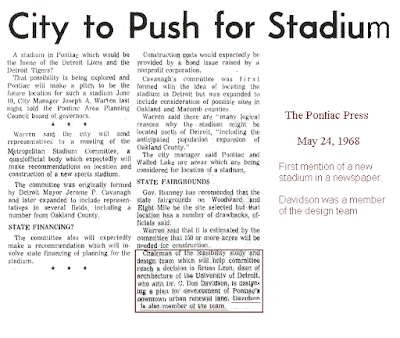
Deindustrialization was a problem across the state and the state failed to step up.  Like Detroit and Flint ("The real lesson from Flint is about municipal finance," 2016), Pontiac was one of a set of legacy cities in Michigan that because of the drop in property and income tax revenue from population shrinkage and deindustrialization went into bankruptcy, being the first to do so in 2011.  Plus, the economic multiplier effect.  Each auto job supports 3-4 other jobs.  Not all are local (e.g. parts plants from afar) but many are, furthering job losses and economic decline.

Even when plants stayed open, automation often reduced employment by as much as 75%.  It occurs to me that in multiple cities across Michigan, facing similar problems, not limited to GM or Chrysler or Ford:

  • Battle Creek (Case Equipment moved to Kentucky), Bay City (GM), Benton Harbor, Detroit, Flint (GM, Buick), Jackson, Kalamazoo (Upjohn and GM, see "Former GM plant in Kalamazoo finds second life as successful business park," Kalamazoo Gazette--while successful the industrial park replacing the GM plant has 1/8 of the workforce), Lansing (Oldsmobile), Pontiac (Pontiac, GM Truck), Saginaw (GM)  
that like the Massachusetts Gateway Cities Initiative, the State of Michigan should have developed a state-wide initiative addressing deindustrialization and its impact on center cities across the state ("Growth Ideology in a Period of Decline: Deindustrialization and Restructuring, Flint Style," Social Problems, 1992, "Understanding Resilience Through Regional Responses to Economic Restructuring," dissertation, 2010).

Instead, later Republican administrations focused on cities declaring bankruptcy, fitting their narrative of incapable cities run by Democrats, rather than developing a broader economic revitalization initiative.

Pontiac looks to do Downtown street calming.  A recent article in the Detroit Free Press, "State agrees to unwind Pontiac's Woodward 'Loop' that leaders say strangles their downtown," says that the city is going to get rid of the ring road, in an attempt to reapply more city-centric urban design principles. From the article:

When it opened in 1964, the design of Pontiac’s Woodward Avenue Loop — formerly called Wide Track Drive — was hailed as a triumph.  (Wide Track was named after a Pontiac Motors marketing campaign for its cars.)

Its swaths of one-way pavement unsnarled bottlenecks and shunted GM workers as well as parts-laden tractor-trailers through Pontiac’s downtown and to half a dozen bustling factories. The high-capacity roadway played into the dreams of midcentury designers, on a binge they called urban renewal.

The road re-routing created a set of five one way streets, each five lanes wide.  It was decidedly anti-urban, facilitating car movement over people and a thriving downtown.  

Moving the government center and the creation of Pontiac Mall, on the border of the city and Waterford Township, were other actions that redirected economic activity away from Pontiac's Downtown to other parts of Oakland County. 

Why does Pontiac lag in the midst of great wealth?

And I hate to admit, reading that article, that I hadn't ever really thought about the reality that while Oakland County is wealthy and white, could that wealth have been harnessed to spur the economic revitalization of Pontiac, to reverse the steady drumbeat of decline?

Deindustrialization and outmigration?  It's not just deindustrialization, although that's a factor.  Pontiac was on the decline long before GM shut down its plants, just like many other cities across the state, the Midwest, and the nation.

Lack of political longevity?  The now deceased County Executive L. Brooks Patterson was in office for 27 years.  Certainly, unlike Mayors who are in office for usually no more than 2 terms, he had the opportunity to address Pontiac's poverty over the long term.  (Community revitalization is a multi-decade process, see "Main Street Niches in a Mass Sales World," 2004.)

Lack of attention to revitalization needs in legacy communities?  It's not like Patterson wasn't paying attention to the needs of inner ring suburbs, as Oakland County is the first and only county in the US to have created a county-wide Main Street commercial district revitalization program, which it did in 2000.  Pontiac participates, and has had a Downtown Development Authority for decades.

Tax harmonization.  Could the county have applied various tax harmonization strategies, like what has been done in Greater Minneapolis, or how various counties share sales taxes with legacy communities. (This likely would have required approval by the state legislature.)

Best practice county revitalization initiatives.  To be fair, plenty of counties have areas of persistent poverty.  But should this be the case?   

Are we taking poverty for granted, especially when it is co-terminate with race?

Recently I made this point about Montgomery County, Maryland and how its East County section remains a laggard ("East County, Montgomery County, Maryland: Council redistricting spurs ideas for revitalization | Part 1 -- Overview").  

Fairfax County, Virginia has been working on the revitalization of the Route 1 Corridor for decades ("Fairfax County’s Richmond Highway area ripe for development during next decade," Virginia Business).  And both counties are comparable to Oakland in terms of wealth.

The most typical initiatives focus on inner ring suburbs. But Pontiac is different as it was never a suburb in the traditional sense, but a stand-alone city, secondary to the center city, but significant and unitary, with its own economy, newspaper, civic institutions, etc.

Previous entries call attention to Hennepin County, Minnesota ("A County and Its Cities: the Impact of Hennepin Community Works", Journal of Urban Affairs) and Oklahoma City--not a county exactly, but the city is larger than other city-counties like Philadelphia or San Francisco ("Change isn't usually that simple: The repatterning of Oklahoma City's Downtown Streetscape"). 

Maryland had/has a couple of smart growth related initiatives.  The "Community Legacy Revitalization Program," is a state program funding revitalization planning and projects in existing places, and there was a similar initiative at the county scale in Baltimore County under former County Executive Jim Smith ("Community renaissance set down in writing," Baltimore Sun; "Baltimore County Confronts Suburban Decline").  

Is it racism or the "soft bigotry of low expectations"?

Pontiac is a little place, 60,000 residents and 20 square miles.  In the midst of great wealth. 

From the standpoint of money, political administrative longevity, and political capacity, there's no reason that Pontiac should have continued on its negative trajectory.  Just like the way that cities like Bilbao have been renewed, using an approach that I call "transformational projects action planning." 

-- "Why can't the "Bilbao Effect" be reproduced? | Bilbao as an example of Transformational Projects Action Planning," 2017
-- "Economic restructuring success and failure: Detroit compared to Bilbao, Liverpool, and Pittsburgh," 2014
-- "Minneapolis Super Bowl: Urban Revitalization and Transformational Projects Action Planning," 2018
-- "Downtown Edmonton cultural facilities development as an example of "Transformational Projects Action Planning"," 2018

there's no reason that Pontiac couldn't have been improved similarly.

It seems like economic revitalization there ought to be a straightforward process although granted they went through a bunch of flawed urban renewal iterations and severe deindustrialization

10 Pontiac School District buses were destroyed in an attack by the Ku Klux Klan.  Detroit News photo.

On the other hand, L. Brooks Patterson did start his political career defending opponents to busing and school integration.  In Pontiac! ("RIP, L. Brooks Patterson, Racist," Detroit Metro Times, "Busing set off Democratic debate flare-up, but does it still matter in Detroit?," Detroit News).

While Patterson's campaign "against" Detroit and Wayne County could be termed to be more a kind of "economic county-ism," racism was an issue.

But wrt Pontiac, perhaps it was more about benign neglect in the context of institutionalized and/or structural racism, and the failure of the state to think systematically about deindustrialization and its impact across the state.

The default is to see Pontiac/blacks as perennially poor, as a condition not particularly amenable to change.

While it's rare for counties to develop revitalization programs the way that Hennepin County did--which it did out of desperation, facing severe property tax revenue losses in the face of economic and population decline in Minneapolis--we can raise the bar for counties like Oakland, where overall they are fine economically, but possessing severe pockets of poverty and decline.

Some recommendations.

1.  The State of Michigan should develop a program addressing deindustrialization more systematically, using the Massachusetts Gateway Cities Initiative and "Hennepin County Works" program as models.

2.  Oakland County should make "leveling up" Pontiac its number one economic development priority.

3.  Building on the nascent road dieting effort and examples of successful communities nearby like Royal Oak ("Downtown Royal Oak social district opens this weekend -- Here's what to know," Fox2 Detroit, "Baker College to Build Flagship Metro-Detroit Campus in Downtown Royal Oak," "Royal Oak and Rochester Downtowns Win National Awards," OC Times) and Birmingham, focus on redeveloping the residential and retail possibilities Downtown.

-- Reinventing Suburban Business Districts (ULI)
-- Reinventing America's Suburban Strips
-- Revitalizing Distressed Older Suburbs
-- Putting the Urban in Suburban: Art and Business of Placemaking
-- "The secret to a successful suburb: Lakewood, Cleveland Heights and the Inner-ring Divide," Cleveland Plain Dealer

4.  Develop a revitalization plan using the Transformational Projects Action Plan approach, with Oklahoma City's Metropolitan Area Projects program and the downtown streetscape program as best practice models..

5.  Why not merge Pontiac into Oakland County?  This would make County prioritization of Pontiac revitalization unavoidable.

6.  Baring that, why not consolidate Pontiac and Waterford Township (Michigan makes it almost impossible now for cities to annex townships.  Waterford is 92% white and has 72,000 residents). But combining the two would make it tied as the state's third largest city, and would add the stronger residential tax base of Waterford.

7.  Consider merging the Pontiac School District with adjoining school districts, like Waterford. This is difficult, as communities like local control of schools.  

OTOH, a majority of Oakland County school districts are shrinking and consolidation could be advantageous, especially if combined with a MAP 4 Kids program of construction and other improvements like the second phase MAP program in Oklahoma City ("MAPS for Kids wraps up," Daily Oklahoman).

Labels: , , , , , , ,

Sunday, August 11, 2019

One more idea about Detroit: merging not with Wayne County but Oakland County

Vacant houses in Detroit
Rebecca Cook, Reuters.

In the 2014 piece, "The rise of Oakland County is built on Detroit's failure," I did discuss city-county merger as one way to change the trajectory for the City of Detroit, which while revitalizing at its core, faces real long term issues concerning lack of market demand for residential living.

I favor city-county merger for legacy cities like Pittsburgh, St. Louis (it will be on the ballot but I haven't written about it yet), Baltimore ("Opinion: What Baltimore and D.C. can do to start working better together as a region (Baltimore Business Journal op-ed)," 2016), and Detroit, as a way to deal with difficult financing and governance issues ("The real lesson from Flint Michigan is about municipal finance," 2016).

But Detroit's decline has significantly impacted Wayne County too, and the County has other issues besides Detroit, aging infrastructure

Since the tri-counties haven't grown much, there isn't much chance of Detroit's recapturing the lost 1.2 million residents...

That's why after I wrote the 2014 piece, I realized that instead of merging with Wayne County, Detroit should merge with Oakland County, which is the most economically successful county in the Detroit Metropolitan Area.

That would be an unprecedented kind of merger.

But outside of creating more rigorous metropolitan government structures, along the lines in Greater Portland Oregon and Minneapolis-St. Paul, that's maybe the only kind of quantum scale change that could truly change Detroit's trajectory.

All the great media discussion notwithstanding:

-- "12 big developments set to transform Detroit," Curbed Detroit
-- "Detroit's Revival Is in Full Swing, But Some Question Its Future," Barron's
-- "Commentary: How Detroit Became a Model for Urban Renewal," Fortune
-- "Detroit's Big Comeback: Out Of Bankruptcy, A Rebirth," NPR
-- "Is Detroit Really Experiencing a Full Recovery?" CityLab

When I did a tour of New Orleans in 2006, after Katrina when the city was devastated, the native tour guide was outraged, and wanted us to be outraged too. I said, "how is this any different from what happened to Detroit?"

Detroit suffers from racism sure (see the writings of Thomas Sugrue) but it was also the auto industry's plan to break the UAW, which mostly has worked, but at the expense of cities in Michigan, especially Detroit and Flint (Pontiac, Lansing, Bay City, and Saginaw too).

In the 1950s, Detroit had something like 15 auto assembly plants, each of which employed thousands of people, and scads of supplier plants, each of which employed hundreds or thousands of people.  Now Detroit has two assembly plants.

Similarly, Flint at its peak had over 80,000 people employed by GM.  Now it is fewer than 8,000.

So that is why Michigan shifted Republican over the past few decades as auto workers, who tended to vote Democratic (cf. George Wallace, and Reagan Democrats), lost their jobs and left the state.

It's also why I get f*ing tired of reading comments on articles about how Democrats who run cities drive them into the ground.  The issue is far more complicated.

Look at all those robots!  Photo from "10 Auto Industry Jobs that Will Die Due to Automation," MoneyInc.

At the end of the day, locally elected officials have little control over what corporations do and mega economic trends like capital investment, globalization, the replacement of workers with machines, industrial consolidation, etc.

The systems that fund local government were created when the nation was growing rapidly.  We are past that phase now, and in many cases, especially for legacy communities with aging infrastructure and growing pension liabilities, local government funding systems won't generate enough revenue

Labels: , , , , , ,

Tuesday, April 09, 2019

USA Today newspaper and network investigation on special interests writing a significant number of state legislative acts

State Legislatures are notorious for passing legislation putting unfunded mandates on localities and restricting the ability of cities to pass laws.  For example, concerning the environment, smoke free environments, business initiatives, etc.

-- "States Are Blocking Local Regulations, Often at Industry's Behest," New York Times, 2015
-- "Blue Cities Want to Make Their Own Rules. Red States Won't Let Them," New York times, 2017

It's not news that the American Legislative Exchange Council, a pro-business and anti-tax lobby figured out that they could have a lot of impact by focusing on state legislatures.

What is news is the depth of their success, as documented by USA Today in a two-year investigation that includes follow up, state-specific articles published in various Gannett Newspapers across the country.

From "What is ALEC? 'The most effective organization' for conservatives, says Newt Gingrich":
The American Legislative Exchange Council became the nation’s best-known "model"-bill factory over its four decades by providing more than fill-in-the-blank legislation.

The industry-sponsored group has weathered controversy and flourished because it also offers conservative Republican elected officials a social network, access to campaign donors and a blueprint for how to accelerate their political careers.

The networking takes place at ALEC's annual meetings, where the group fetes and entertains lawmakers and their families. Relationships are forged over drinks and dinners, where lawmakers sit alongside conservative luminaries and corporate chiefs.

“What ALEC does is more than provide the model bills, they provide relationships,” said Alexander Hertel-Fernandez, an assistant professor at Columbia University who has studied the influence of ALEC and other conservative groups on state legislatures. “They approach you when you are first elected and build these enduring social connections with you.”

By the end of each ALEC conference, attendees leave motivated to evangelize for conservative policies and equipped with ready-made legislation.
-- "Copy, Paste, Legislate: A visual introduction"--
-- "Used car dealers didn’t want to fix deadly defects, so they wrote a law to avoid it"
-- "Stand your ground, right to work and bathroom bills: 5 model bills that spark controversy"
-- "How we uncovered 10,000 times lawmakers introduced copycat model bills — and why it matters"
-- "What's the solution for model bills? Reveal who wrote them, critics say"

And coverage by other newspapers in the Gannett Newspaper chain includes:

-- "Bills banning local plastic bag regulations use ALEC model," Montgomery Advertiser
-- "Model bills have foothold in Montana Legislature," Great Falls Tribune
-- "Kentucky lawmakers didn't write these bills. But many are now laws," Louisville Courier-Journal
-- "Mississippi leads nation in filing legislation that other people wrote," Jackson Clarion Ledger
-- "Why some Iowa legislation looks a lot like bills crafted by special interest groups," Des Moines Register

For all the complaints about USA Today's origins as "McPaper" ("At 25, 'McPaper' Is All Grown Up," New York Times), these days, like the New York Times, it uses its position as a "national newspaper" to undertake investigations that have implications beyond a particular city or state.

Apparently, the investigation grew out of reporting over the years by the Phoenix-based Arizona Republic concerning the impact of measures of and involvement by ALEC in the state legislature ("Unchaining Democracy in Arizona," Blog for Arizona).

Labels: , , , ,

Friday, December 16, 2016

Opinion: What Baltimore and D.C. can do to start working better together as a region (Baltimore Business Journal op-ed)

I wrote an op-ed in response to an article that ran in last week's Baltimore Business Journal discussing the meeting of a group of stakeholders from DC and Baltimore sitting down over dinner and talking about the need for a stronger focus on regionalism.

I have paid attention to Baltimore pretty carefully since I got involved in urban revitalization as an avocation and vocation, partly to contrast the difference between strong and weak real estate markets and to be able to become more nuanced in understanding the differences in opportunity that result from significant differences in material conditions.

For example, DC still has a strong center and a transit network, while Baltimore is bigger, has more poverty and crime (although for a time crime was worse in DC), has lost relevance with the outmigration of population and economic activity, and has a couple rail transit lines, but no transit network.

I worked briefly as a planner in Baltimore County in FY2010 (I wasn't able to stay on for a couple reasons, one being during the recession they were cutting staff and agencies not adding people) and that gave me more insights into some of the issues in the metropolitan area, and I have written many blog entries over the years about it, including:

-- "From the files: transit planning in Baltimore County"
-- "Best practice suburban bicycle planning using the 'action planning' method"
-- "Morgan State University should move their architecture and planning school to Downtown/Station North Arts District"
-- "Marketing resident attraction"
-- "New Baltimore area regional plan for sustainability"
-- "One big idea: Getting MARC and Metrorail to integrate fares, stations, and marketing systems, using London Overground as an example"

Here's the article but note that the actual article is locked and only available to subscribers.
============================
"Opinion: What Baltimore and D.C. can do to start working better together as a region," Baltimore Business Journal, 12/16/2016

In “Building a case for regionalism between Baltimore and D.C.,,” published Dec. 9, Melody Simmons reported on a recent meeting of Baltimore and Washington stakeholders.

As a planner-writer with experience in both communities, I believe building the Baltimore and Washington metropolitan areas into a single region is dependent on three things:

1. Each metro needs to “get its house in order” by functioning and acting at a “best practice” level;

2. More efficient physical connections need to be constructed within and between the metropolitan areas; and

3. More attention needs to be put on working together — rather than reflexively choosing to be obstreperous, the first inclination needs to be to collaborate.

Here are five initiatives where Maryland can start setting the stage for making real a powerhouse Baltimore-Washington region:

1. The state must acknowledge that the two metropolitan areas drive the state economy and rather than pit the areas against each other or against other parts of the state, a program of high value investment in both the Baltimore and Washington areas needs to be prioritized.

2. While as a Washington resident I would never argue for re-merging the city into Maryland. Maryland should “take ownership” of D.C. by recognizing it is the linchpin of the economies of Anne Arundel, Charles, Howard, Montgomery, and Prince George’s counties.

3. For example, the state government needs to have an open mind about financial solutions for the D.C.-area’s sputtering Metrorail system and should be “all in” on not only building the Purple Line as currently planned, but should initiate the planning process now for extending the Purple Line from New Carrollton to Alexandria, Va., and extending the Purple Line from Bethesda to Tysons in Northern Virginia should be part of any discussions about rebuilding the American Legion Bridge.

4. As the home to national political dysfunction, Washington has serious image problems. For different reasons, so does the Baltimore area. The metropolitan economy languishes in the face of Baltimore’s crime and population shrinkage despite the city’s incredible array of assets.

To completely redefine “Baltimore,” serious consideration must be given to a merger of Baltimore City and Baltimore County. The two jurisdictions separated in 1851. Consolidation isn’t easy, but Louisville and Lexington in Kentucky and Nashville, Tenn., offer models that show that it can be done.

A combined city and county would have a population of 1.425 million, making it the nation’s seventh largest city, the most populous and powerful jurisdiction in Maryland, and a much bigger player in the multi-state mid-Atlantic region.

It would increase bonding-financing capacity and enable significant transformation of the role of transit. A merger of the city and county community colleges would create a powerhouse institution as well, as would the merger of the parks and recreation systems

A merger could create difficult political issues, because the formerly suburban county would have more legacy residents and like in Toronto and London, where more conservative suburban voters tend to outvote more progressive voters in the core, this could create representation and governance issues.

A slightly different governance model could be adopted, providing for city-county consolidation, but also the creation of separate boroughs within “the city.” Boroughs are smaller and more local governments, with elected representation and responsibilities for planning and the delivery of certain services. London, Montreal, and Paris are some of the cities that are organized in this fashion.

5. High quality transit defines great cities. Right now transit in the Baltimore area doesn’t have the kind of multiplicative place and investment value that can intensify development and population. That’s why it’s so hard to build transit oriented development projects like State Center or Penn Station, or new lines like the Red Line.

The major impetus for New York City’s consolidation in 1898 was to increase its ability to raise funds to build the subway system. A merged Baltimore would have the heft to address strengthening, extending, and leveraging transit investment.

Reconfiguring the light rail system to serve Towson and extending it a bit into Hunt Valley, extending the line southward to Howard County, spiffing it up with new, design forward, rail cars, connecting the light rail and subway lines more directly in the vicinity of Lexington Market, and extending the subway line to White Marsh would begin to create a transit system and network out of what are now two disconnected rail lines.

================
They did a good job cutting the piece down.  But mostly, they did so by cutting the last three points.  Here's the rest:

6. MARC is one of the more successful commuter railroads in the US. In recent years, the system has added weekend service on the Penn Line between Baltimore and Washington, but the Camden and Brunswick lines operate only on weekdays, and the Brunswick line doesn't offer reverse commute service from Washington to business districts in Montgomery and Frederick Counties.

Like how London reconfigured some rail lines to function as a railroad equivalent of subway service, MARC should integrate its fare media system and station network into the local transit systems in Baltimore and Washington--the MTA CharmCard and WMATA SmarTrip fare cards are already interoperable.

Building on that, Maryland should create a framework where DC can become a co-owner of MARC system, with expanded coverage and stations within DC, new lines to Annapolis from Baltimore and Washington, service to Charles County, and reverse commute service added to the Brunswick line. An improved station in West Baltimore, a new station in East Baltimore, and service between Frederick and Baltimore should be part of this program.

7. Longer term the merger of MARC and Virginia Railway Express should be on the table -- I suggest calling the new system RACER, for "Railroad Authority of the Chesapeake Region" -- extending the Penn Line into Virginia, and adding lines throughout the multi-state region including connections to Delaware, Pennsylvania, and Richmond.

8. DC’s public higher education system does not have institutions of quality comparable to the University System of Maryland. Why not treat DC residents as “residents” for enrollment purposes at Maryland’s public institutions of higher learning?

There are plenty of other initiatives that can be added to this list, ranging from integrating tourism planning, building the region into a biotechnology powerhouse, better leveraging the value of federal research facilities and higher education institutions, integrating airport planning, supporting the Port of Baltimore at the multi-state scale, etc., but this is definitely a start. Now on to making a list for Washington.

Labels: , , , ,

Wednesday, September 17, 2014

Presentation by Henry Cisneros

Island Press - Option of Urbanism Investing in a New American Dream - Christopher LeinbergerYesterday was the third conference on "Walkable Urban Communities" with the topic of "Social Equity and Walkable Urban Places," held by the GWU Center for Real Estate and Urban Analysis, featuring the ongoing research project spearheaded by Christopher Leinberger, a developer and advocate focused on re-centering more real estate development activity towards "walkable urban places" in the suburbs or the center city, rather than on "drivable suburban" (or "conventional subdivision development").

The conference was co-produced by the Urban Land Institute with the sponsorship of the Venable Law Firm and LOCUS, a program of Smart Growth America.

The opening presentation was by Henry Cisneros, who was the Secretary of the US Department of Housing and Urban Development under President Clinton, and before that was Mayor (and Councilmember) of San Antonio, Texas.

Since then he has led CityView, a company that builds urban housing as a revitalization strategy, working with funders committed to community investment.  I didn't know that he has a PhD from GWU...

My notes from his talk.  I won't claim this is verbatim.

There are many factors converging that favor cities as places that attract residents and businesses.  At HUD, I worked to refocus the department on urban places.  To do so we needed place-based metrics to be able to answer the question "are we making a difference in physical places."  (He made the point that the way the federal government is set up, how program authorization and appropriations work, that programs function in ways where it can be difficult to see substantive impact.)

Cities are the platforms for social progress.  Cities have the ability to be masters of their own destiny and are the places where government has the real opportunity to make a positive difference in people's lives.  Plans and visions make this happen.  Many cities have willed their way to a different destiny.

The motive force of a city's agenda is the public good.  While cities work with the private sector in public-private partnerships, the agenda of the city is different.  It is not motivated by generating profit primarily, even if profit is generated.  The primary outcomes are social improvement and equity--the larger public good.

13 trends impacting cities

  1. Sustainability, both in terms of the impact of climate change (e.g., Superstorm Sandy and the way it impacted New York City and the New Jersey Coast) and the opportunities presented by new building materials
  2. Embedding technology in urban real estate
  3. Harnessing new advanced technology businesses (media, information technology, etc.) and anchor instutions like universities and medical centers as engines of urban growth and opportunity
  4. modernization of urban infrastructure (not just replacing infrastructure, but extending and improving it.
  5. Mixed income mixing, affordable housing and cross-subsidization
  6. Preparing for demographic change--the population is aging, and the composition of youth demographics is changing, e.g., starting this year, the majority of the K-12 student population is majority minority
  7. taking on density--many constituencies oppose this, but in the urban context density is key
  8. making walkability real
  9. adding transit related value to communitys
  10. incorporating public space and amenities into public and private projects as a way to improve them and make them successful
  11. creative design and modern materials offer new opportunities in construction 
  12. financing of urban real estate development in more creative ways
  13. cementing public-private partnerships and how they work
The new urban moment.  Despite all the talk about stasis in politics and the dysfunction of national government, this is a new moment and there is a new urban reality that is one of great opportunity. This potential is provided by our cities and the opportunities present within them.

Labels: , , ,

Wednesday, January 15, 2014

States, economic development, and sub-state/metropolitan area political restructuring

Taxation capacity as a way to assess likely success of political jurisdictions.  My first political science class in college was with A.F.K. Organski.  His claim to fame was figuring out how "taxing capacity" and "tax collection effectiveness" were useful ways to evaluate the likely success of revolutionary states like (North) Vietnam vis-a-vis its struggle for dominance with the US-supported (South) Republic of Vietnam.  It turned out that the North Vietnamese had a stronger sense of nationhood and commitment based on the relative effectiveness of the respective governments and taxation.

2.  Scranton as an example of a failure to meet financial obligations due to lack of taxing capacity.  Last week an article, "For Scranton residents, bankruptcy is an inviting option," in the Los Angeles Times about Scranton, Pennsylvania discussed its economic travails--its population is half what it was when the city was at its peak and it is constantly raising taxes to meet financial needs. 

The city is on the precipice of bankruptcy and people quoted in the article see bankruptcy as a solution.  But even with the ability to discharge certain debts, it appears to me that there is no real long term solution for the city, because given its population and place within the greater economy, the city will never have enough population and property tax revenue to meet its financial needs--even if reduced.  The city's taxing capacity is sub-optimal. 

Scranton makes up about 1/3 of the population of Lackawanna County.  To counter outmigration trends, why not just merge the city and county?  (That's what Louisville, Kentucky and Jefferson County did around 2005, although Louisville was not in financial straits in the same way as Scranton.)

3.  City-county mergers as a financial tactic.  Although I have many reservations about suggesting center city-county mergers, because of how inner city progressivism can be overwhelmed by relative suburban conservativism and anti-cityism, from an economic standpoint, more metropolitan areas need to go through this kind of political and financial restructuring to bring revenues in line with costs and to get savings from economies of scale.

The Brookings Institution has suggested this for Pittsburgh and Allegheny County for many years.  I think about it from time to time with regard to Baltimore City and Baltimore County--they were separated back in the 1850s. 

And in small cities where I've written revitalization plans, Brunswick, Georgia and Cambridge, Maryland, it seems to make sense also.  And Detroit and Wayne County, Michigan.  Etc.

4.  States need to reorient their economic development policies towards cities and metropolitan areas.  Relatedly, Aaron Renn, in his blog, "Why State Economic Development Strategies Should Be Metro-Centric," and in Governing Magazine, "How Globalization Isolates Struggling Cities," writes about how states need to change their approach to economic development, by focusing on strengthening center cities and planning at the metropolitan level, rather than by somewhat disconnected and arbitrary districts.

These pieces provide a useful and necessary follow up and extension to the discussion in the Brookings Institution book Metropolitan Revolution (see my review and "Resurging cities, resurging metros, the impoverished and the Metropolitan Revolution (continued)").

5.  But states aren't likely to change.  While Aaron's right, I thing that the urban-rural dichotomy in most states, accentuated and strengthened by gerrymandered political districts, makes states agreeing to:

(1) shift their economic development approach from disconnected districts to instead focus on cities and metropolitan areas as integrated units

(2) forge-push-require more consolidation of cities and counties in order to get their revenue and cost structure in better balance given today's scenarios of either lower growth or decline

almost impossible.

6.  So in many places, especially center cities between the coasts, things will be getting worse, not better.  Without extra-normal and somewhat selfless political leadership, taking such steps is almost impossible because these kinds of restructuring programs involve significant dislocation and difficult choices, especially because the number of areas needed to be helped exceeds the available political will, money, and toolbox of solutions.

That being said, without putting such ideas out there and the random place acting upon them, the only alternative is continued severe decline.

Labels: , , , ,