==================================
Revised slightly with the Bilbao example below, so "reprinted".
==================================
Clearly, TDM requirements aren't taken seriously in Prince George's County, where the under construction MGM Grand Casino is arguing against accommodating public transit bus services on the site ("
MGM National Harbor says public buses won't have access to casino site,"
Washington Post).
According to the US Census, using data from the 2013 American Community Survey (
via the Census Reporter website, pictured at right), 17% of Prince George's County residents use transit to get to work--not that employees at the Casino will be exclusively from that County.
The Prince George's County's Master Land Use Plan prioritizes transit as a mobility option and choice. Land use and transportation decision making should have fealty to this priority.
The article provides details about employee work trips to other destinations on the site.
For example, 10% of employees of the Gaylord National Harbor Resort use transit.
And it quotes transit advocates as saying that MGM is reneging on commitments made during the planning process.
The decision on providing transit access to the National Harbor site shouldn't be exclusively the decision of the developer and tenants of the site.
It is a public policy choice and decision.
MGM National Harbor Casino and the Peterson Companies, developers of the site, are out of line.
But they have been for awhile ("
At National Harbor, commuting is a daily trial for service workers,"
Post) and the siting of such a major destination "shouldn't" have been allowed without significant upgrades to the non-automobile transportation network there.
The real problem is Prince George's County's continued failure to synchronize land use and transportation planning. The problem is PG County's transportation and land use planning failures, of which National Harbor is but an (albeit prominent) example.
Separately from current "Purple Line planning" the County should have prioritized development of light rail between Suitland Metrorail Station to Alexandria (which is a link as part of a complete Purple Line anyway).
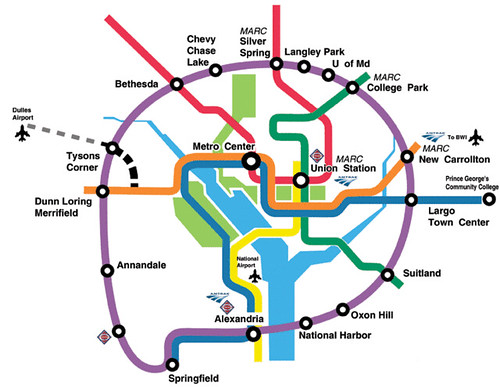 The original full circumferential Purple Line proposal would provide a light rail transit connection for National Harbor
.
Once the
Guggenheim Museum Bilbao opened, even though they already had subway service, the City realized they needed to improve surface transit and decided to do so with "a tram" which they built the first leg from time of conceptualization to opening in less than 4 years. (It helps that they have a train car manufacturer in the Basque Country, and some argue it was a form of self-dealing.) The system continues to be expanded and now the Basque Country is building trams in other cities.
-- paper,
Return to the Rails: The Motivations for Building a Modern Tramway in Bilbao Spain
PGC could have been gutsy and moved something like that forward, creating an urban renewal district (like what Portland did for the yellow line) to fund and build it and they'd have some high quality transit service now.
The need for a transportation financing and management district for the National Harbor district. If PGC intends for National Harbor to become an edge city of a type, a kind of new "town center" for Southern PG County, then they have to treat it differently from the standpoint of transit and mobility.
And that shouldn't be solely a financial responsibility of the NH developers and tenants, although they should pay towards it.
It's analogous to what I just wrote,
"parking lot district" vs. "transportation management district" on Bethesda.
There needs to be a TMD created for National Harbor and a tax on development there to pay towards it and funding should be supplemented by other county sources, out of the idea that they are building a new activity center for the southern county.
There are transportation demand management plans for casinos in other jurisdictions. The Institute of Transportation Engineers has various papers on casinos and TDM. But with the rise of more in-city and in-county casino locations, it would be useful to compile new data for casino settings outside of the major casino agglomerations in Las Vegas and Atlantic City.
Springfield, Massachusetts. Ironically, the master plan proposal for an MGM casino in Springfield, Massachusetts is much more focused on connecting to other revitalization efforts in the Downtown core, where the facility is to be constructed.

See "
MGM 1st with Springfield casino details, 1st in Western Massachusetts with $400,000 application fee" from the
Springfield Republican.
The
transportation plan section of the proposal commits to the creation of a transportation demand management program and the hiring of a transportation coordinator, accommodates public transit, proposes a casino shuttle bus, improvements to bus shelters in the vicinity of the project, employee ride sharing (van pooling, etc.), car sharing, suggests paying for transit home in unexpected circumstances, etc.
According to the document:
The TC or TMO will be responsible for:
Posting and distributing announcements
Holding promotional events to encourage ridesharing, using public transit, bicycling, and walking
Monitoring the program and assisting in the evaluation
Providing transit schedules and information about program services
Coordinating on-site sales of transit passes
Managing transit subsidy programs for employees
Coordinating rideshare and carpool programs and coordinating with employees to offer preferential parking for participants
Coordinating with PVTA and MassRIDES to implement TDM programs and improve transit mode share
The Rivers Casino is the upper left of this photo, immediately adjacent to the Allegheny Light Rail Station in Pittsburgh. Image from Subchat.
Pittsburgh. The Rivers Casino is one of the sponsor-funders of free transit from Downtown to their Northside Pittsburgh location via the light rail system's
North Shore Connector.
The casino was required to develop and execute a transportation demand management plan as part of the licensing agreement with the state.
Although the initial plan did not suggest the creation of the North Shore extension to the light rail, which had been discussed for many years, and the extension also serves baseball and football stadiums located there.
Las Vegas. The Las Vegas Monorail has various financial issues, but does connect various casinos within the city, including the MGM Grand. The system is supposed to be extended from the last stop, the MGM Grand, to the airport.
Casinos in Maryland are regulated by a state agency and commission: Transit advocates should file a complaint with the agency. While it doesn't surprise me that Prince George's County didn't protect its interest on this matter--after all, National Harbor has been resistant to providing high quality transit access from the outset, transit advocates should also file complaints on this matter with the regulator of casinos in Maryland:
... with a copy of the complaint to the State of Maryland Department of Planning. I would think that the failure to accommodate transit could be construed as a violation of state planning requirements concerning "priority funding areas" and smart growth regulations.
I don't track what the agency does in great detail, but they did provide recommendations concerning transportation and the Baltimore casino.
My sense is that MGM could come around, based on their activities in other cities such as Detroit or Springfield, Massachusetts, but they are probably taking their anti-transit cues from the master developer of the site, Peterson Companies.
Labels: casinos, gambling-gaming, transportation demand management, transportation planning