Rebuilding Place in the Urban Space

"A community’s physical form, rather than its land uses, is its most intrinsic and enduring characteristic." [Katz, EPA] This blog focuses on place and placemaking and all that makes it work--historic preservation, urban design, transportation, asset-based community development, arts & cultural development, commercial district revitalization, tourism & destination development, and quality of life advocacy--along with doses of civic engagement and good governance watchdogging.

Friday, November 04, 2022

Valley Regional Transit (Boise): Pollution Solution marketing thrust | Transit is/as the Pollution Solution

The transit agency in Boise is positioning its ongoing shift to electric buses as the "Pollution Solution" although this is more about the switch to electricity from diesel.


But I think that the idea of transit as "the" "Pollution Solution" vis a vis motor vehicles and the reality that most trips are of one person is a great marketing positioning regardless of the fuel source.

-- Great cartoon-based brochure, Pollution Solution, Valley Regional Transit

Labels: , , , , , ,

Thursday, May 05, 2022

Networks as a commodity or differentiator: EV charging networks

There's an article ("There's An EASY Fix For Our EV Charging Network," CarBuzz) about how one of the problems with electric vehicles is the different standards for charging networks, and specifically how Tesla's system is incompatible with others.

The article suggests that it's in Tesla's interest to make its network compatible, because that will reduce reticence on the part of potential EV buyers.

As mentioned recently, cities have a real issue in providing access in rowhouse neighborhoods ("Earth Day 2022").  

In Seattle, the City Light utility instead of constructing buildings on lots, wants to put in EV chargers ("Seattle City Light Plans More Surface EV Charging Lots in Dense Neighborhoods," The Urbanist).  And there are real problems with chargers now in terms of them actually working, people blocking them, etc.

ATMs.  The story reminded me of how in the beginning of ATMs, banks saw them as a key differentiator and a way to get more customers.  So they didn't share their networks with other banks in their market, but were focused on adding affiliates in other markets.  

The classic example is the MAC network that started in Philadelphia with Philadelphia National Bank.  

When I moved to Washington in the late 1980s, MAC was a big thing.  When I worked on television about telecommunications and IT in the early 1990s, I came across this article about it ("MAC—Philadelphia National Bank’s Strategic Venture in Shared ATM Networks," Journal of Management Information Systems, 1990)

Today, it mostly doesn't matter, people don't think of particular banks and ATM networks, except when they want to avoid fees when they take money out standalone, at machines in networks in which your bank is not a member (best way to avoid this is to buy something at a pharmacy or grocery and take money out).

Gasoline too was once differentiated.  Back in the day, gasoline companies like Texaco, Gulf, Standard, Conoco, Shell, Esso, etc., invested a lot of money in branding, advertising, and points of differentiation--from clean restrooms at Texaco to "touring services," maps, and special blends of gasoline, etc.  

Mobil redesigned its stations to be particularly design forward, etc.

-- Mobil logo design

-- "The gas stations that Eliot Noyes designed for Mobil Oil," Domus

Now, gas is gas.  Do people really go out of their way to buy Chevron or Speedway gasoline?  Well, they might, especially if they participate in loyalty programs that provide discounts on the cost of gas, but other than that, no.

Tesla supercharger network.  It truly is a differentiator now.  It charges cars so much faster than a typical charger.  And at least in the beginning, Tesla offered "free charging for life" or other charger network access incentives as part of the car marketing and buying process.  People are bummed that these incentive programs are being eliminated.  

OTOH, there are complaints that even Tesla's branded supercharger network isn't always well maintained.

New competitive advantages, even with "commodities."  But, this article ("More On Tesla Opening Up Its Supercharger Network To Other EVs," InsideEVs) makes a very good point about access still providing the capacity for differentiation or at least competitive advantage, in that cars of competitor marques using the network would have to provide trackable information that Tesla could use for better understanding the market, as well as having the names and contact information on non-Tesla EV car owners.


Labels: , ,

Monday, March 16, 2020

Quotes exemplifying political leadership, or not

From the 2017 March for Science protest.

From Franklin D. Roosevelt’s first inaugural address in 1933, at the height of the Great Depression:
“So, first of all, let me assert my firm belief that the only thing we have to fear is … fear itself.”
Winston Churchill in 1940, as the United Kingdom military retreated from France (Dunkirk), brought back to the UK in large part by citizen boaters, with the fear of a Nazi invasion:
“Never in the field of human conflict was so much owed by so many to so few.”
And President John F. Kennedy, during the Cold War between the US and the USSR:
“And so, my fellow Americans: ask not what your country can do for you — ask what you can do for your country.”
JFK also created the Peace Corps...

President Trump:
"No I don't take responsibility at all."

WRT President Trump's overall statement, it seemingly isn't really problematic. He doesn't take responsibility, stating that the government is incapable of creating lab tests quickly in extranormal situations, that you need the private sector to do it ("I ran the White House pandemic office. Trump closed it," Washington Post.

That's not true. Other countries and other government agencies like the World Health Organization developed tests and systems just fine.  Although others did not.

Charlie shares with us a great article from the Financial Times, "Containing coronavirus: lessons from Asia," although because it is an article normally behind a paywall, it might not work.

It discusses best practice response by Taiwan, South Korea, Hong Kong, and Singapore.

Because these countries dealt with SARS and MERS, they maintained epidemic response systems which were allowed to atrophy in the US.

The piece cites a medical journal article on the Taiwan response to Covid-19, "Response to COVID-19 in Taiwan: Big Data Analytics, New Technology, and Proactive Testing," Journal of the American Medical Association.

Labels: , , , , ,

Digital advertising promoting positive health behaviors to ward off Coronavirus


A coronavirus public service announcement is displayed on the scoreboard prior to Inter Miami and D.C. United playing at Audi Field on March 7, 2020 in Washington, DC. (Photo by Patrick Smith/Getty Images). 

 Since this photo was taken, professional sports leagues have suspended their seasons, and events of this size in stadiums and arenas have been banned in most major cities across the US and increasingly in other countries.


A billboard on the A194 in South Shields warns motorists of the symptoms of coronavirus and gives advice on what to do if they feel ill


Coronavirus campaign by the British government on billboards in Wood Green, north London Matthew Chattle—Barcroft Media via Getty Images. "Government coranavirus ad campaign to take over TV, social media, print and and billboards," i news


An NHS coronavirus information sign at Heathrow Airport in London today; Heathrow said the number of passengers travelling through the airport fell by 4.8 per cent year-on-year in February due to the impact of coronavirus.


Highway message board in Southern California.  Photo: Getty Images.  


Munich airport: The sign reads "Wash your hands, keep a distance, cough into your elbow."


A billboard advising people to be responsible and stay home is seen at the almost empty Preciados Street, due to the coronavirus outbreak, in central Madrid, Spain, March 14, 2020. AP photo?


A billboard near the Crosstown Expressway on Friday, March 13, 2020, displays information about the coronavirus and the hotline set up by the City of Corpus Christi and local health district. (Photo: Courtney Sacco/Corpus Christi Caller-Times)


The Outdoor Advertising Association of America has developed a set of open access public service messages on Coronavirus in standard digital formats.


Lamar Advertising is one of the firms participating in the OAAA program.  

Labels: , , , , ,

Monday, January 22, 2018

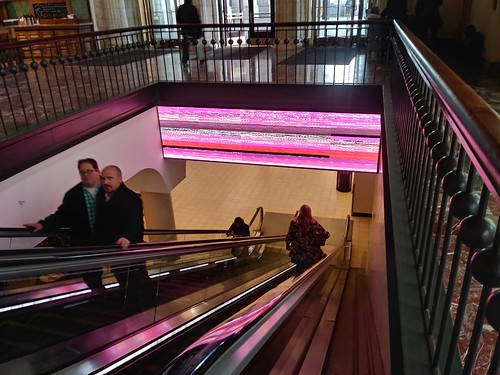
Unintentional video art created by a nonworking digital ad display at Union Station, Washington, DC

Digital ad display systems could also display digital art, as well as community information, transit information, etc.

Unintentional video art created by a nonworking digital ad display at Union Station, Washington, DC

Labels: , ,

Thursday, October 19, 2017

Quote of the day, revisiting "when you define everything as a success"

Mainly Macro is a blog by Oxford University economist Simon Wren-Lewis, which I read to try to upgrade my knowledge about economics and the UK. In a recent post, "The lesson monetary policy needs to learn," he refers to the writings of economist Martin Sandbu at the Financial Times--unfortunately only available to subscribers--where the final point in a recent column is:
"admitting one has got things badly wrong is a prerequisite for doing better”
Revisiting bicycle sharing as an example of policy making and program implementation that needs to be better evaluated.  I wrote "The problem when you define every outcome as a success, you don't learn, and therefore failure is more likely: bike share as examples" over my frustration (not limited to) in discussions about bike sharing programs how everything is defined as a success, making it difficult to do better, or assess whether or not large investments in bike sharing are the best use of resources in fostering greater take up of biking for transportation as a significant element of sustainable mobility policy and practice.

I was thinking about this a couple weeks ago, not just because of the entry of "Chinese bike share" into the U.S. and specifically into DC where five different bike share companies have entered the market on a test basis, but because I had to get my bike fixed, and while in the shop I read through the current issue of Adventure Cycling Magazine, a publication from the Adventure Cycling Association, which is focused on promoting bike touring (something I don't do, because I don't really ride for recreation but for utilitarian purposes).

Atlanta and bicycle sharing.  One of the articles focused on an increased promotion of bicycling for transportation in Atlanta and quoted the city's director of bicycle planning and discussed her satisfaction there with their bike share program--they have at least 500 bikes--because they are used at about the rate of 0.7 times per day per bike, and "that is the rate we were aiming for."

Because the most successful systems in Europe have 10 to 15 times that rate of use, and the most successful system in North America, New York City, has about 8 uses per bicycle per day ("Citi Bike Sets New Ridership Record In 2016, With Nearly 14 Million Rides," Gothamist), which is more than double the rate in DC, this strikes me as an incredibly low bar to reach -- comparable to the metrics most cities set for achieving various milestones, what we would call a C- (or lower) grade in school.

That grade isn't really passing.

College student bike sharing. Separately, I have been e-talking with an instructor at a university that is looking to launch bike share, and because "they have no money," they are in talks with a company that will provide bikes on a basis similar to the "Chinese bike share" companies at $1 per ride.

I said that won't serve your students very well, nor broader transportation demand management practice, because it won't promote regular use both daily and multiple times per day.

Instead, I recommend what is called a "bike library" or "bike fleet," how schools like UCLA or North Central College provide a bike to a student for the entire semester for either free or a "low price" (UCLA's price has more than doubled over the past couple years) along with a lock, helmet, and repair services -- the point being that you want to support the use of biking as a routine behavior rather than as a casual less committed practice.

Lime Bike bicycle sharing bicycles parked/abandoned outside a small apartment building on the 700 block of Irving Street NE in the Brookland neighborhoodPer ride priced bike sharing services. I am fine with the per ride bike sharing services being offered.  My problem with these services is two-fold.  First, they are somewhat chaotic as many of the users deposit the bikes when they are done in ways that aren't properly respectful of the public space.

(Although some riders do park the bikes at bike racks.  Suzanne also points out that maybe some of the bikes are left askew because someone tried to ride it without paying, and the bike wouldn't move, so they just abandon it.)

Second, it's that these services vastly re-price upward the use of a bike--if you were to ride twice a day, it would cost over $700/year--it's only comparatively cheap if you compare a single use to a transit fare or taxi ride.

But if you buy a bike for between $300 and $400 (used bikes can be had for much less) and use it for 5 to 10 years, even spending $200/year on maintenance means the cost for use, no matter how many trips you take, is less than $1 per day.

Lessons.  The primary question we need to be asking is what is the purpose of bicycle planning? 

1.  Is it to promote the development and support of people making a choice to predominately cycle for at least some (but a significant number) of their transportation needs/trips? 

2.  And should cost for use and access be an element of  the program?

3.  Or is the purpose of bike planning primarily to support occasional, casual use on the part of people with a very limited interest in biking for transportation?

If 10-15% of trips by bike is a reasonable goal for Washington, DC's transportation mix, then the city has a long way to go.  Is bicycle sharing the best way to more than triple bicycling as a element of DC's transportation mode share?

From a transportation demand management standpoint, it is the first--to make bicycling a significant and real form of (sustainable) transportation that is efficient and effective and regularly used.

For discussion about biking to work in the DC metropolitan area, see "Surprising stats: How many people bike to work around DC and more," WTOP-radio).

That choice should then shape the agenda, planning, and implementation process of various infrastructure, facilities, and programs developed to support biking for transportation.  It should shape the choice of programs you want to support and promote.

If you want to make biking visible, but not a substantive mode (except in places with the right pre-conditions for success) focus on bicycle sharing.  Because the way bike sharing is implemented now, it likely doesn't lead to substantive take up of bicycling for transportation.

But, if you want bicycle sharing to work as an entrypoint to regular bicycle use, then complementary programming needs to be developed to encourage people to shift from occasional, casual use to regular, frequent use, to leverage the visibility of bicycle sharing for "a greater purpose."

But that question isn't being asked either.

And so bicycle sharing is one of many examples of how defining every program as a success without regard to objectively setting and measuring outcomes is problematic.

Doing bicycle planning without enough attention to "transportation demand management planning."  Part of the problem is that sustainable mobility needs to be planned as a system, what I call the "sustainable mobility platform," where bicycle sharing is an element in a complete set of "technologies" or modes.  Bike sharing has a place in the panoply of services, but perhaps not as great a role as has been assigned.

By looking at TDM/SMP planning more broadly, better decisions and outcomes can be realized.

Labels: , , , , , ,

Wednesday, June 01, 2016

Traffic safety messages on traffic signal boxes (Florida Department of Transportation)

Traffic signal boxes are often used as a medium for protest posters.  While I did see official use of this medium in Essen, Germany, mostly it's unofficial, like this signal box near Union Station.

In the past I've written about using traffic signal boxes as "canvases" for art treatments.

These kinds of programs are exploding, for example recently media have covered such campaigns in Toronto ("Traffic signal boxes reimagined as works of art," Toronto Star) and Spokane ("Spokane Arts installs second round of local traffic signal box art," Pacific NW Insider blog).

The Northeast Florida/District 2 section of the Florida Department of Transportation is testing "wraps" of traffic signal boxes to communicate messages about how to use pedestrian crossing signals ("FDOT launches pilot crosswalk program in Jacksonville," News4 Jacksonville).

From the story:
The Florida Department of Transportation wants people walking through crosswalks to pay more attention to signals that are designed to help them get safely across the street. Jacksonville is the first place where DOT officials are attempting a new method: wrapping large traffic control boxes with instructions to help make the crosswalk signals more visible at 10 intersections across town.
Photo courtesy of the Florida Department of Transportation.  Note that FDOT's District 2 has a simple and direct blog covering current actions.

Pedestrians can push a button at a crosswalk to get safely across, but officials said people weren’t always noticing the buttons on the poles. Many are hard to see or are simply ignored, they said. DOT's solution is to make the signals hard to miss at 10 intersections with high levels of pedestrian traffic.
Officials have wrapped large boxes near the poles with large-print instructions that include visual aids and the slogan, “No regrets when you cross with care.”
I think the FDOT initiative could be extended to include other types of traffic safety and transportation messages.  For example, the Montgomery County Department of Transportation has developed a series of traffic safety messages that they mail to county households.


Eugene, Oregon has a project called "History Here," using the boxes to display cultural history interpretation posters.  (Although I also suggest such a function being appropriate for transit shelters and stations.)

But the Florida DOT and Eugene, Oregon initiatives show us another way to think about what can often be unattractive elements of the streetscape, and there are ways to improve how they look, limit the potential problems of graffiti on this element of street furniture, while communicating traffic safety messages or other information.

But putting these messages in the public space, such as by using otherwise underutilized often well located traffic signal boxes, in places where people are walking, biking, or driving errantly may make more sense.

... not that I have anything against art projects for traffic signal boxes.

Some of the projects even use transportation themes.

Stamford, Connecticut.  New York Times image.


graffiti adorned

Labels: , , , ,

Wednesday, June 25, 2014

Why are transit ads so bad? DC and Orlando edition

For a couple months I had been meaning to write about a really bad ad done for the new commuter rail service in Greater Orlando.  The service is called SunRail ("SunRail ridership grows despite glitches," Orlando Sentinel).

The ad communicates benefits: that you don't have to drive in traffic and there is wi-fi, but focuses on a foolish "use" of the wifi--someone listening to a particularly dumb song. Somehow the ad was driving traffic to the SunRail website, maybe because it is so annoying. See "New TV Ad Drives Traffic to SunRail Website," from the Daytona Beach News-Journal.


The new WMATA ads for the Silver Line, which opens July 26th ("At last, the Silver Line is ready; Metro says passenger service will begin July 26th," Washington Post), aren't a lot better.

 They have a syrupy voiceover and focus on people in the images but they don't show any of the places (destinations) that are reachable by the service, either in the newly served area or the rest of the metropolitan area that is already served by Metrorail.

The ads are online on youtube but also at the Express, in this article, "Metro solves all your problems in three ads."

It would have been a nice way to reiterate the value of the Metrorail system, which Post columnist Robert McCartney wrote about on Sunday, "When did Metrorail's problems begin?."

For what it's worth about FIVE YEARS AGO ("St. Louis regional transit planning process as a model for what needs to be done in the DC Metropolitan region"), I suggested that WMATA needed to rebuild the area consensus around transit, because the original constructors of the system are long gone (it's been about 45 years since the system began construction, and it will be 40 years in 2016, since the start of service to the public).   I also suggested the 2016 anniversary as another way to push such a process forward, "WMATA 40th anniversary in 2016 as an opportunity for assessment."

I guess the Metro Forward process is partly that kind of rebuilding, but the planning has been satisficed, because most of the elected officials in the metropolitan area aren't interested in coming up with a way to finance substantive improvements and expansion.

------
* Although the ad about dating has some truth to it. More than 10 years ago, I met a Fairfax-based woman at a conference in DC but figured that since I didn't own a car, the logistics of dating would be too difficult. I joke that I am bad at long distance relationships, whether it be with someone in Texas or Michigan or Fairfax County, Virginia.

Note that the first few seconds of this ad by the natural gas industry, featuring natural gas-powered buses in Los Angeles, goes towards some of the benefits that I think could be more clearly communicated:

- not having to drive in traffic
- being able to do other things, like read
- environmental benefits
- cost savings (versus how much it really costs to drive a car on a per trip basis)
etc.

The Port Authority in Pittsburgh has done some advertising on its buses, focusing on these kinds of benefits.

For a video ad with some acceptable humor, Sound Transit does a decent enough job.

-- Voice of Reason, featuring Molly

but I would still push some hard benefits.  I don't know how I feel about their "ORCA gets you moving" ad which promotes their transit smart card.

Labels: , , , , , ,

Monday, October 14, 2013

DC is open for business, does it matter?

Destination DC has a campaign to promote visiting DC while all the federal museums, monuments, and parks are closed.  See "D.C. Marketing Group Launches Campaign to Promote Tourism Amid Shutdown" from the Washington City Paper.

The video seems a bit pathetic to me, repeating ad infinitum, "DC is open for business."--especially because the municipal government faces imminent shutdown as it runs out of reserve monies that it can spend legally lacking the authorization that it needs from Congress to spend even locally generated monies.


It's kinda like the six most important words that McDonald's coined to increase the economic return from the average sale:
Do you want fries with that?
To the average tourist, consumption of DC's local heritage, restaurants, retail, etc., is an add-on sale coincident to the primary sale of visiting the Federal City.

Granted the local marketing campaign relates to the issue of defining the local city as a complement to the National Capital-Federal City narrative.  Yes, there is local heritage.  But that isn't what draws people to the city.

I suppose they don't have much choice and have to do such a campaign.

That's great that DC is open for business as boosterism, but doesn't help the people who come here to visit the federal (mostly--Mount Vernon, the George Washington plantation, isn't federally owned) museums, monuments, and parks located in DC and Northern Virginia.

Or for people who visit to conduct business related to the federal government, which right now lacks the "head space" to focus on business not relevant to ending the federal government shutdown or the three days hence Federal debt default.


Otherwise the reporting is that lots of retailers and restaurants have lost 50% or more of their business.  The subway system has a 20%+ drop in ridership.  Although some of the private museums like the Newseum and the Phillips Collection--which over the weekend opened a new exhibit featuring the works of Vincent Van Gogh--are experiencing a significant rise in business. 

But this is likely to drop off as people change their plans and cancel upcoming visits.

All the more reason to have deeper contingency planning for "local" tourism.

Or for Congress to execute its Constitutionally required duties of passing the federal budget.  At least there are some other locally significant impacts from this impasse, as Ken Cuccinelli, Tea Party stalwart and Republican candidate for Virginia Governor, becomes less likely to win with each day that the shutdown continues.  See "In Virginia, government shutdown already hurting a GOP candidate" from the Los Angeles Times.

Labels: , , ,

Monday, September 30, 2013

World Tourism Day: September 27th, 2013 (and the visitor experience)

Friday was World Tourism Day, sponsored by the United Nations.  The focus was on sustainable tourism and reducing and mitigating negative impact from tourism on the places that are visited.  Hence the 2013 theme for World Tourism Day was Tourism and Water: Protecting our Common Future.

City Tourism

But rather than write about eco-tourism and the like, I am more interested in urban tourism, and it turns out that the United Nations World Tourism Organization also sponsors a Global Summit on Cities Tourism.

The second conference was held just a couple of weeks ago in Moscow (2nd UNWTO Global Summit on City Tourism focuses on innovation and new business models).

The first conference resulted in the production of the Global Report on City Tourism.  The UNWTO is especially focused on the economic development potential that tourism presents.  From the report:

Cities appeal to a broader market, they are easy to reach and they have a lot to offer, this also brings a new spending pattern that can go from those staying in budget hotels to the five star hotel customer, but all have one thing in mind: they want to discover and visit other cities. Cities need to assess their products and understand which of their products offerings appeal to the market.
What does tourism mean for cities?The report on City Tourism is part of a series of UNWTO reports, ranging from UNWTO AM Report Vol. 4 'Global Report on Food Tourism and AM Reports Volume 3 'Global Report on LGBT Tourism to AM Report No.5 Global Report on Aviation.

Urban Cultural Tourism

A big thrust in urban tourism for the last 20+ years has been "cultural tourism," which addresses historic architecture and local history.  It's touted for many reasons, especially because improving local cultural assets also serves residents.

From "Cultural Visitor Profile" from the National Assembly of State Arts Agencies:

In a nutshell, cultural tourists compared to the average U.S. traveler:
  • Spend more: $623 vs. $457
  • Are older: 49 vs. 47
  • Are more likely to be retired -- 20 percent vs. 16 percent
  • Are more likely to have a graduate degree: 21 percent vs. 19 percent
  • Use a hotel, motel or B&B -- 62 percent vs. 55 percent
  • Are more likely to spend $1,000+/-: 19 percent vs. 12 percent
  • Travel longer: 5.2 nights vs. 3.4 nights
  • Travel by air: 19 percent vs. 16 percent.
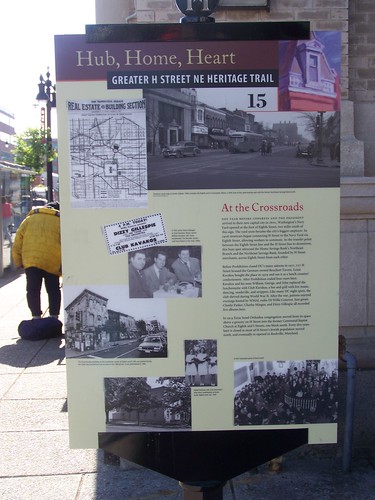
H Street Heritage Trail sign, northeast corner of 8th and H Streets NELeft: CulturalTourismDC trail sign on H Street NE in Washington, DC.

Because cultural tourists spend more time and money compared to other segments of the tourism market, this is seen as a particularly desirable segment of the market.
    Urban Cultural Tourism and DC (and Salt Lake City)

    In DC, CulturalTourismDC is the leading organization focused on strengthening local history interpretation.  In fact, this past weekend was WalkingTownDC (it continues throughout this week), their annual event of tours across the city.

    CTDC gets a great deal of funding from city sources, although I would argue that the local tourism destination marketing organization, Destination DC, ought to do more focused funding of development activities for cultural destinations. 
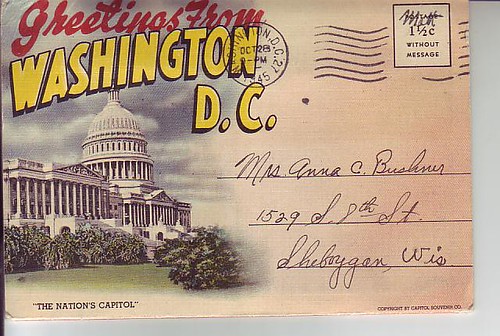
    Greetings from Washington, DC 1945 Postcard Folder Linen Vintage (item 230017469602While I am not into calling anything "unique" in terms of comparability, but this is an exception, DC (and Salt Lake City) has a unique tourism marketing problem in that it is defined globally as the Federal City, the US National Capital, and this shapes very specifically what visitors want to consume when they come here:

    - US Capitol
    - White House
    - Museums on the National Mall, especially the Air and Space Museum, but also the Museums of National History and American History
    - the Monuments on the National Mall
    - Mount Vernon, George Washington's plantation
    - Alexandria and Georgetown as old port towns but mostly as commercial districts with historical references
    - maybe the Kennedy Center
    (and for certain audiences, the Franciscan Monastery and the Shrine of the Basilica of the Immaculate Conception, both in Brookland).

    That doesn't leave much time, space, and interest for visiting "local DC."  Note how the souvenir postcard folder pictured above doesn't feature "local" historic landmarks, but landmarks related to the federal city.

    One of the problems of neighborhood-based tourism in the city is that while you can walk around attractive neighborhoods and appreciate the architecture, or follow a heritage trail, there are few attractions to visit and the retail and restaurant options are limited. 

    Fortunately, as the city's population increases, it supports more interesting local businesses and a restaurant scene is developing ("In DC, a Street's Grit Gives Way to Glamour" and "A Trendy Turn in Obama's Town" from the New York Times and "DC's Diverse Cuisine," from the Cooking Channel show "Chuck's Eat the Street").

    Eastern Market is one of the few neighborhood attractions, but is more likely visited in association with the out-of-town visitor market associated with people who live here.  The National Zoo has a mix of local and out-of-town visitors.  Union Station is called the city's #1 visited place, with more than 20 million visits each year, but the majority of these visits are associated with local transportation (subway and commuter related railroads) and aren't really tourist visits.

    Salt Lake City has a similar marketing positioning problem in terms of how it is perceived as the home and headquarters of the Mormon Church and therefore "everything there to see must be related to the Church."  That is decidedly not true--and Utah more generally has been very successful at marketing its outdoor activities as part of its tourism offer.

    With the failure of the City Museum here in 2004, and my realization that we don't have a "local" art museum devoted to local and regionally relevant art, I have come to realize how problematic it is that we don't have a wide ranging cultural plan and our funding scheme for local attractions is disjoint--we spend a lot of money, but we don't spend it very well. 

    I can't even count the number of entries I've written on the topic, but here are some:

    -- "Town-City branding or 'We are all destination managers now'"
    -- "Tourism Marketing and DC"
    -- "You (Don't) really like me--DC and its suburbs"
    -- "Who DC? -- More about DC tourism"
    -- "Civic Tourism"
    -- "Central Library Planning efforts and the City Museum, how about some learning from Augusta, Maine, and Baltimore"
    -- "Cultural resources planning in DC: In the land of the blind, the one-eyed man is king"

    Visitability

    Last week's New York Times reported about how the local Convention and Visitors Bureau, NYC & Company, has put a visitor center in Macy's, because the store gets a huge number of tourist visits, more than six million annually.  See "Tourist-Hungry New York to Put Visitor Center in Macy's."

    Over the summer I came across some interesting work from Australia (via the Australian National Tourism and Events Excellence Conference website), including how Destination Melbourne is refocusing their work on the elements which make cities great places to visit, which they call "visitability."  The concept is based on a presentation to the organization by Rick Antonson, CEO of Tourism Vancouver, and focuses on five elements equally important to residents and visitors:
    • Safety
    • Access and transport
    • A sense of community – no matter where you are from
    • Confidence
    • Good infrastructure that serves the people
    These elements comprise the offer by the "place" and end up being "packaged" and consumed through experiences at particular places and destinations.  Personal, unique, and memorable experiences allow people to make deeper relationships with the place.

    Bad experiences are memorable too... 

    Destination Melbourne is creating a "visitability framework" to focus their efforts in making Melbourne a "compelling destination" and driving continuous "improvement in services and experiences" offered to residents and visitors.
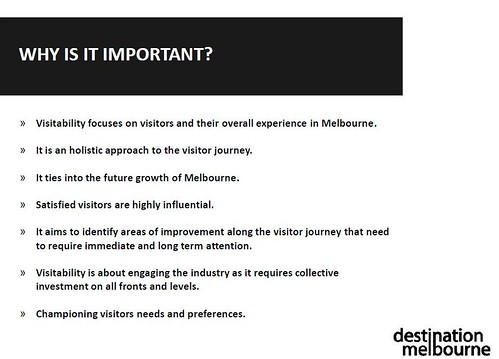
    Visitability, from a Destination Melbourne presentation
    Slide from a presentation by Destination Melbourne at the TEE Conference.

    NOTE that in the urban planning world, especially relating to transportation and the built environment--although because of a strong bike helmet requirement, bike sharing has basically failed there, and livability, Melbourne is highly touted and has been picked by The Economist Magazine as the world's most livable city for three years in a row.  See "Melbourne ranked world's most liveable city - again" from the Melbourne Age.

    So they must be doing something right.  Even so, clearly they aren't satisfied with resting on their laurels, and partly this is because when the compare their city to others, "they have no great icons - no Rock, Reef, Opera House, SeaWorld, Disneyland or Giant Pineapple."  This motivates them to work harder.

    But the visitability concept is applicable to tourism entry points at all levels: sub-local; local; regional; state; and national/international. 

    Visitor Center policies and case studies
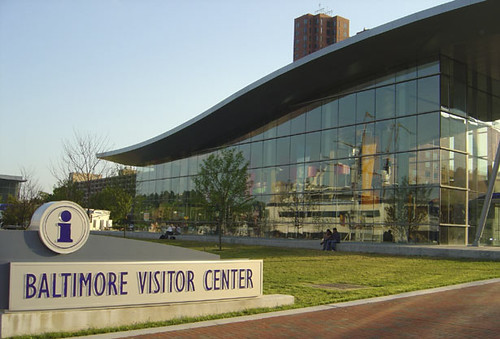
    Baltimore_VisitorCtrLeft:  The Inner Harbor is Baltimore's #1 visitor attraction and the Visitor Center is located in a building on the waterfront.  

    Most states have a network of visitors centers, which are typically run by the state tourism agency (which is usually part of the Dept. of Economic Development) in conjunction with local destination marketing organizations.

    Cities may have more than one visitors center, a main location definitely, and sometimes subsidiary centers.  New York City has main tourist centers and certain business improvement districts, like Chinatown and the Fashion District, run local visitor centers.  Pittsburgh has a main center in the Golden Triangle and secondary centers at highly visited attractions such as the Pittsburgh History Center (a great local history museum).  Petersburg Virginia has a main visitors center in the city, but they also run a "state" visitors center on I-95, and include some artifacts displays there as well.
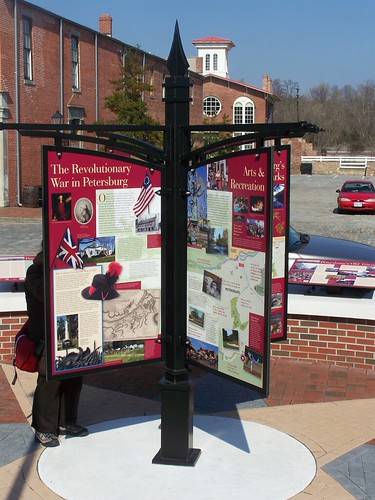
    Kiosk, historic/history interpretation, Petersburg, VARight:  Petersburg has a great set of cultural-historic interpretation signage in the plaza across from their visitor center (which is located in an old railroad station).

    For the most part, DC proper doesn't really have a visitor center, while most other big cities do.

    At the state level the hierarchy is bigger centers at main entry points and in big cities, and smaller centers at the city/county level.  A third level is information racks that are placed at hotels and other places, and to be included organizations pay for their information to be distributed. 

    Most US states and the largest cities have excellent tourism development programs, as do many foreign nations, such as the Provinces of Canada.

    For example, I use a resources from Canadian provinces such as Nova Scotia (Tourism Destination Assessment Workbook) but there are plenty of good resources and tourism studies from across the US as well, such as this recent study from San Francisco (SAN FRANCISCO ARTS & CULTURAL TRAVEL STUDY), and this report from NYC, New York City Tourism: A Model for Success.


    While DC doesn't have a main visitor center comparable to other large cities, there are a number of "main" visitors centers run by federal agencies.  The Smithsonian has one.  Congress has one (the Capitol Visitors Center).  The National Park Service runs the visitors center associated with the White House.  It's highly possible that Events DC has created a visitors center in the Carnegie Building--they are supposed to have done so, but I haven't been there for awhile.  There is a visitors information desk in the Convention Center.  In the past, the DC Chamber of Commerce ran a visitors center buried in the Ronald Reagan Building.

    An interesting wrinkle is that compared to traditional visitors centers which are "codification points" for a wide variety of information about nonprofit and for profit visitor experiences, ranging from museums and parks to antique stores, restaurants, and hotels, federal laws preclude at least the CVC and the White House center from providing any other "local" information.  (I can't remember the set up at the Smithsonian.)  This makes them singularly un-useful from the standpoint of promoting "local DC" to people visiting the city, other than their visits to federal facilities.

    In my opinion, DC should have a main visitors center at Union Station as well as the Carnegie Building downtown, across from the Convention Center, and should provide support to permanent secondary centers in certain key commercial districts like Georgetown and Capitol Hill, with the ability to have more temporary set ups (Arlington County has a mobile vehicle, Downtown Bethesda has a rolling kiosk, Montreal supports both permanent secondary centers such as at the Mont Royal Metro Station and temporary movable kiosks such as in the summer months in "The Village").  The federal visitor centers should be integrated into this system, and an attempt should be made to get these facilities to carry other information relevant to visitors.

    I have written about this more extensively: "A National Mall-focused heritage (replica) streetcar service."

    Left: the Silver Sightseer streetcar in front of the US Capitol, sometime before October, 1962.

    Besides marketing their state and providing information to potential and actual visitors,Tourism Queensland offers a wide variety of resources to the industry, including an active support and research program for "Visitor Information Centers."

    -- Visitor Information Center Policy Resource Kit, Tourism Queensland
    -- Visitor Information Center case studies, Tourism Queensland

    DC does get from 13 million to 17 million visitors annually, and while that is only about 1/3 of the number visiting NYC, it's still a lot.  It would be good to benchmark the area's visitor centers, and DC's offer against what it argues are peer cities.

    Consideration of the findings by Tourism Queensland can inform improvement efforts here.

    Airports, visitability and international visitors: 
    Bureaucracy dooms the brand promise of Brand America

    Another "problem" is that three of the main entry points into "Washington" aren't in DC proper-- National Airport and Dulles Airport in Virginia and Marshall-BWI Airport in Maryland.  Each has a visitor information desk, but none of the services are comparable to the airports with the best visitor information set ups.

    Plus, at Dulles Airport especially, the experience for visitors leaves a lot to be desired, which is something that Tyler Brule of Monocle Magazine mentions from time to time, especially in his weekly column in the Financial Times, where he has been very negative about Dulles Airport, because of big problems with the customs entry process.  From "Let’s play ‘Guess where I am?’":

    I’ve just come off an airliner and it’s absolute pandemonium. There are gate agents screaming for transfer passengers, there are sniffer dogs, there are loads of immigration officers and there’s a general sense of disorganization. My fellow passengers look bewildered and flustered after their eight-hour, 45-minute flight from Frankfurt, and there’s a lot of huffing and puffing as we’re divided up into groups of arriving passengers and “connectors”. ...

    [description of 1,000 people waiting to go through ICE at shift change, when many people leave their posts, with the result that even fewer agents are there to work with the passengers.]

    As I approach the desk, I feel like giving the young gentleman a lecture about how bad this whole performance is for Brand USA – particularly on top of a whole week of television reports about the new fee that visitors will have to pay to get a visa and how these funds will be used to create a campaign to encourage more tourism to the US. I want to ask him if he (and his bosses not far away in the District of Columbia) think a 90-minute wait in a dumpy airport is any way to welcome the world and if his department is really that interested in having people visit the US.

    Combine this experience, plus the then less than sterling experience of getting to the city from the airport--this will change in a few years when there is subway service there, but the location of the subway station will be less than ideal--and then think about what this says not only for BrandAmerica ("Brand USA, a campaign to lure back foreign tourists — and their money" Washington Post and "Re-branding America" from the Sunday Boston Globe) but BrandDC (see the blog entry "Creating Brand Washington"), and is it any reason that the number of international visitors to the US is falling?

    Note that while the FT piece is from 2011, the problem at Dulles continues.  See "Editor's note: BWI is the big winner in the battle for passengers" from the Washington Post.  And the MWAA has responded with a advertising campaign.  But I would aver the problem is more structural and fundamental--something that marketing can fix, but advertising can't.

    An evaluation of area airports in terms of the "visitability" approach is long overdue.  Also see the past blog entry, "More on transportation to the DC area airports." which discusses airports planning at the regional scale.

    Local airports and the provision of visitor information

    That the area's major airports are in Maryland and Virginia and not DC complicates the realization of my recommendation that there should be a coordinated set of visitor centers at the region's airports, as part of the DC city network of visitor centers.  There are information desks at each of the airports with some visitor information.  But there should be a much better offering than there is currently.

    But I don't claim it would be easy to get the airports and Destination DC to come together and do this.  Also, Maryland has visitors centers north and south of Baltimore on I-95 and they might think that this suffices, although such facilities only target automobiles, and miss out on reaching people on mass transit of various sorts.
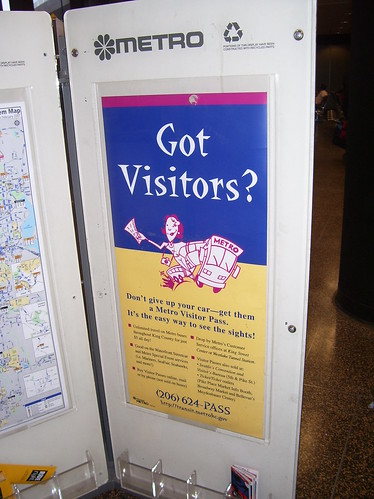
    King County Metro Bus promotional poster at an information rack at the Seattle-Tacoma Airport
    Right:  King County, Washington Metro used to have a kiosk in the airport terminal promoting bus transit use.  Now that they have a light rail station at the airport, they seem to have removed marketing materials from within the airport terminal.

    Airports and transit

    Transit wayfinding needs to be improved at all the airports, especially to be able to reach people who are less accustomed to riding transit, and therefore need more information in order to be comfortable in choosing it.

    That's discussed here, "More on airport-related transit/transit for visitors."

    Comprehensive airports planning at the regional scale would address public transit issues as well.  It's really a surprise (not) that this isn't done.  

    A key element of appealing to international visitors is a reasonably efficient transit system for getting to the major lodging centers in the metropolitan area.  This will improve for Dulles Airport with the extension of Silver Line service there sometime within the next 5-6 years.

    Transit service to BWI Airport is decent, considering the distance from DC and it is improving as the regional commuter railroad service MARC will be adding weekend service starting later this year--currently MARC serves the airport during the week and Amtrak all the time.  Light rail service to the airport is available from Baltimore, and WMATA runs a bus from the end of the Green Line Metro at Greenbelt.
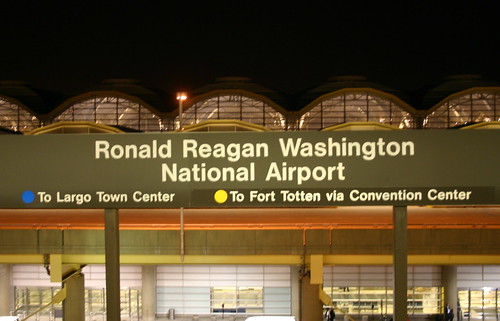
    07.WMATA.RRWNA.VA.08mar07Left:  Flickr photo by Elvert Barnes.

    National Airport has great transit service when the Metrorail is running--the subway station is conveniently located for reaching both terminals--and paltry service when the subway isn't running and airplanes are still landing and taking off.

    Fortunately, WMATA is proposing changes to bus service, by extending service from a DC-based bus line when Metrorail is closed, to address this problem.


    Conclusion


    DC needs to truly up its game as far as visitability, cultural tourism, and visitors centers are concerned.  World Tourism Day and other tourism promotion activities are a way to call attention to the need for better tourism planning, development, and management activities in DC.

    Labels: , , , , , , ,

    Thursday, September 12, 2013

    Broadway Avenue Rite Aid Pharmacy in Seattle uses their marquee as intended

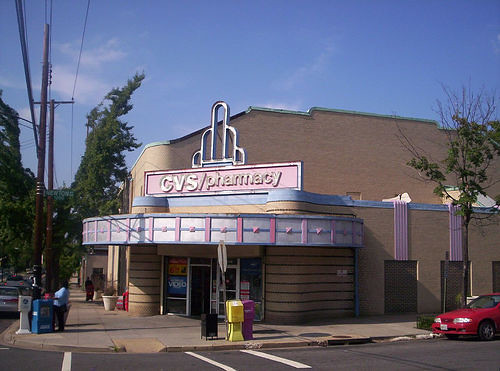
    In DC, CVS has bought and converted many former theaters into pharmacies.  While they've kept the marquees to many of the buildings, they have de-theaterized the marquee for all intents and purposes.  They certainly don't use the marquees to communicate "current" and "coming" attractions like flu shots.

    The CVS in the Brookland neighborhood of DC is located in the old Newton Theater.
    Newton Theater, Brookland

    Newton Theater back in the day.  Note that movies were listed in an information display under the marquee.
    newton[1].jpg

    That's not the case, fortunately, with this Rite Aid Pharmacy on Broadway Avenue in Seattle.
    Broadway Rite Aid, Seattle, using the old movie theater marquee

    Labels: , , ,

    Thursday, July 19, 2012

    Brandalism: UK public art-public space project

    See "Brandalism: Street artists hijack billboards for 'subvertising campaign'" from the Independent, the Brandalism website, and "Brandalism,” The World's First Collaborative Act Of Ad Subversion" from Fast Company Magazine.
    Space Hijackers, Olympic Village, East London, brandalism billboard
    Space Hijackers, Olympic Village, East London. One of the complaints about the Olympics in London is that people and organizations who don't pay big fees to the Olympics can't use Olympics-related words in advertising and other settings. E.g., see "Who’s ripped off now?: Sponsors get very, very angry about other people being allowed to play with words" from the Financial Times.

    Just loot it, Bill Posters brandalism billboard
    Just Loot It, Bill Posters.

    Labels: , , , ,