Rebuilding Place in the Urban Space

"A community’s physical form, rather than its land uses, is its most intrinsic and enduring characteristic." [Katz, EPA] This blog focuses on place and placemaking and all that makes it work--historic preservation, urban design, transportation, asset-based community development, arts & cultural development, commercial district revitalization, tourism & destination development, and quality of life advocacy--along with doses of civic engagement and good governance watchdogging.

Friday, May 01, 2026

National Bicycle Month | Rennes, France: a national model

May is National Bicycle Month.  I always try to do some entries then.  Sometimes I am more successful than others.  Here goes the first.

============

Years ago I did what I consider to have been at the time a best practice bicycle plan for a suburb, Baltimore County, in Maryland.  I wrote about the process here ("Best practice bicycle planning for suburban settings using the "action planning" method," 2010).  

Some of the key elements were: (1) creating a county-wide bicycle route network; (2) secure bicycle parking; and (3) support facilities such as repair services.  

 Plus bicycle wayfinding and map systems, teaching people how to commute and opportunities to try out biking without having to buy all the equipment first ("Revisiting assistance programs to get people biking: 26 programs"), and community promotion.

Sure we all know about cities in the Netherlands and Copenhagen as being best practice for bicycle ridership as a high proportion of total trips traveled, but many places in the US have a hard time grappling with best practice examples from large cities.

I wonder if Rennes, France is a model that is more graspable.  

Covid helped to push policies forward as people were less willing to be corralled on buses.  The city has best practice secure bicycle parking--free at transit stations and in conurbations, and for €40 per year for special bicycle garages in neighborhoods, a protected bicycle lane network in the city and suburbs, the Express Bike Network, "Reseau  Express Vélo." 

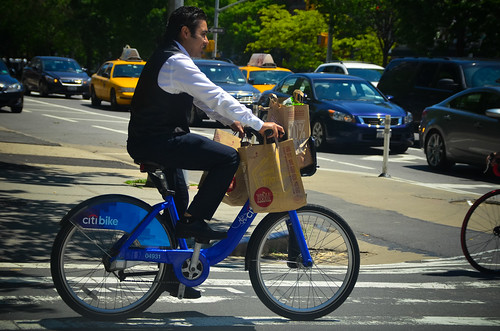
Bicycle sharing called LE vélo STAR that can be bundled with transit, and with options besides standard bikes--electric bikes, electric assist cargo bikes, and "longtail" bikes with a backseat child carrier--trailer and child seat rentals, etc.  

Of course, like most of these systems, at a certain price per year it makes sense to buy your own.  But it does offload security and parking costs.

Plus, repair cafes with both bike and food services, and community repair support through the area's bicycle promotion group.

Best practice bike parking in Rennes, France ("Rennes: The metropolitan area is trying out residential bicycle parking to combat theft," 20 Minutes).  It's branded C-Park, for the municipal parking system, which also offers the bike parking services (car sharing and EV charging too).

The news was announced discreetly, during a routine discussion on pricing for the new parking facilities at Hôtel-Dieu and La Courrouze. Adopted unanimously, the proposal put forward by Matthieu Theurier is nonetheless eagerly awaited by thousands of cyclists , particularly those living in apartments. In the second half of the year, four residential bicycle parking facilities will be created in the Breton capital.

Offered by subscription, these bike boxes will be installed in place of car parking spaces to provide a storage solution for cyclists who do not have a garage or a secure place to park their bikes. "The law requires co-owned properties to have a bike garage. But in reality, we know that this is not always possible. We wanted to offer a secure option for residents who don't have one," explains Matthieu Theurier, Vice-President of Rennes Métropole for Mobility.

... Access to these parking spaces will be possible through a paid subscription offered by Citedia via the Korrigo card. On Thursday evening, a rate of 40 euros per year was unanimously adopted by the Rennes Métropole council to launch this trial in the second half of 2022. "C-Parks like the one at the train station are free and will remain so . We will offer 500 additional spaces along the route of metro line B. But we needed a complementary offering," concluded Matthieu Theurier.

Metropolitan bike route network, Rennes ("In 2022, the Rennes metropolitan area's express bike network will move to the high plateau," Ouest France, "Express bike network in Rennes: these three towns are less than 20 minutes apart," Le Telegramme).  From the latter

The number of cyclists is already booming in Rennes, with a 50% increase in the city over the past four years, Valérie Faucheux, Deputy Mayor of Rennes in charge of mobility, told us . This is despite some users' concerns about road safety. The Express Bike Network helps to increase their sense of security on the sections concerned, since the deployment is "accompanied by appropriate signage to ensure the legibility and identification of these cycle routes: road markings with a white bicycle and blue chevrons, and directional signs."

Repair stands and air pumps (inflation stations).  The Rennes area uses participatory budgeting processes where citizens come together and prioritize items and issues which they want local government to fund.  

The network of repair stations is growing as a result of this program ("Even more bike repair and inflation stations!").

(I will say that in my experience in the US, these often get vandalized, and cities aren't good on keeping them in good repair.  It's one reason why I suggest they be placed outside transit stations, where they can be better monitored.  Plus, with electricity connections, you can also have air compressors for pumps.

Bike washing.  Not in Rennes, but there's a free bike washing station in the Avoriaz ski resort community, called Hakken, produced by a company called Wintersteiger, which even has a US branch in Utah.  They brand the equipment as Veloclean.

Repair cafes and a community bike shop (bike hubs) ("Cycle paths, repair workshops…: Rennes, the new cycling Eldorado?" "A Café Citron before getting back in the saddle?," "In Petite Rennes, "assisted self-repair" for cyclists on a budget," "At Ta grand-mère à vélo, a coffee while you study," OW).

Repair shops are flourishing With the increasing number of cyclists, bike repair workshops of all kinds are springing up: traditional or community-based, repair cafes where you can have a drink or a bite to eat while your bike is being serviced, and even self-service repair workshops. Like the Petite Rennes association, which has just opened a 250 m² open-access workshop in La Courrouze, where you can get free advice and, if needed, assistance (only parts, new or used, are charged).

Best practice bicycle promotion:  Bike House and Mobile Bike House (also (Destination Rennes).

When I was with a small group of sadly undercapitalized folks trying to sell bicycle sharing systems, I came up with the idea of a front end Bicycle Center promoting biking, tourism, cafe, etc., modeled in part on the headquarters for VeloQuebec in Montreal, with the bike repair support facility for the bike sharing system as the back end. 

Rennes' bike sharing does that, as part of the region's commitment to sustainable mobility .  From the webpage:

The Rennes 2020 Cycling Plan aims to develop cycling throughout the metropolitan area. The objective is a 20% market share. It relies on four main levers: speed reduction, network improvement, service enhancement, and cycling promotion . The Maison du Vélo (Bike House) plays a key role in this initiative.

Opened in November 2017, the Maison du vélo (Bike House) moved to its new premises on Place de la Gare in Rennes in October 2020. It offers a wide range of services for cyclists, both residents of the Rennes metropolitan area and those just passing through. It has become the go-to place for cycling information within the metropolitan area.

Electric bike rentals, a self-repair workshop, bike marking to combat theft, a cycling school, conferences, exhibitions… The program of activities is co-developed with various partners: associations, bike shops, Destination Rennes, and road safety organizations. A true hub for activities and information dedicated to cycling, the Maison du Vélo (Bike House) is also a permanent space for meetings, advice, prevention, and training on cycling.

They collaborate with area bike-related groups, and using a transit bus specially outfitted, the mobile bike house takes the services on the road, promoting bike sharing subscriptions and other programs ("What can be found in the mobile bike house that travels around the Rennes metropolitan area?," OF).

Conclusion: Cycling as a System. These examples show the value in having such services in house, rather than contracting them out, which allows for integration.  For example, a municipal parking system provides an enterprise platform that can also support bicycle parking and car sharing.

The Metropolitan government can provide services like a metropolitan scale bike path network and the Bike House and the Mobile Bike House, which over the course of the year, stops in most of the region's 43 individual jurisdictions.

Rennes the city can build its bike path network and provide other supports, centering and backstopping regional efforts.

It's a focus on creating a bicycle mobility system equal to the system that supports automobility, along the lines suggested in a past German Federal Bicycle Plan, from where this graphic is derived.

Toronto's parking system runs bike sharing, but they took it over once it was on the verge of failing. 

I've suggested that government parking systems could be the backbone of a metropolitan scale system of secure bike parking ("Bike to Work Day as an opportunity to assess the state of bicycle planning: Part 2, building a network of bike facilities at the regional scale").  That the expense of e-bikes means secure parking is necessary to support widescale use ("If you're going to promote electric bikes at scale, there needs to be complementary investment in secure bicycle parking and charging").  

(Baltimore uses its parking garage revenue to support free transit on the Baltimore Circulator bus program.)

A number of cities have bits and pieces of this, but as my writings over the years indicate, an integrated system is way better.

Labels: , , , , , ,

Monday, March 16, 2026

How Paris Beat the Car

 Is an article in the Financial Times.  The author discusses the Paris Mayoral election in term of a pro-sustainable mobility versus car-centric dynamic.  The leading left candidate supports sustainable mobility, the conservative candidate wants to be more car friendly

The author sees car friendliness as a step backward, not just for Paris, but for how Paris enables other cities to adopt similarly aggressive policies--an example of how I say "world class cities don't just take, they give"--in that their willingness to be more boldly innovative enables other cities to maybe not be so bold, but to be innovative, with a successful example they can point to.  From the article:

The city’s transition away from the car, though fantastically chaotic, has become a global role model. Under mayor Anne Hidalgo, Paris was “the most influential city in the world”, says Canadian urbanist Brent Toderian. Parisian car traffic fell by more than half between 2002 and 2023, while cycle lanes expanded sixfold. Bikes now make more than twice as many journeys as cars. Hidalgo, stepping down after 12 years, exulted: “The bike beat the car.”

First, pushing out cars improves life for most inhabitants. Paris has reduced traffic accidents, noise and air pollution. More than 300 “school streets” have been pedestrianised; kids play there after school. More than ever before, Paris is a sea of terraces: from April to October, cafés and restaurants can put tables on parking spaces outside their premises. Cities shouldn’t be storage spaces for heaps of metal.

Avenue Lamoricière in the 12th has introduced play areas © Joséphine Brueder/Ville de Paris

Lesson two is that banishing cars doesn’t hurt an urban economy. Retailers often worry it will deter their customers. Studies repeatedly show it doesn’t. More broadly, French Hidalgo-haters need to explain why Paris is in the global top four of business-focused rankings of cities...

Lesson three: car-free cities must offer people good alternative ways to travel. Paris itself does: it has world-class public transport plus cycle lanes. Only 28 per cent of Parisian households own a car. But Paris is a relatively small city of 2.1 million inhabitants. The five million people living outside the ring road in the “Grand Paris” metropole are less well served.

Lesson four: a city needs to control deliveries (typically made in Paris by double-parked vans). A study by MIT found that delaying deliveries by five minutes could cut the kilometres travelled by delivery vehicles by about 30 per cent, because that lets transporters bundle parcels. To do this, cities need to meet a bigger challenge: get a grip on tech firms operating in their streets, and get those firms’ data. Firms like Waze or Google often possess the deepest knowledge of a city’s workings, says Missika.

Lesson five: cities must discipline bikes. Aggressive cyclists terrorise pedestrians. Early motorists were just as wild until laws came in. Grégoire (himself once fined for cycling with earphones on) promises stricter policing.

Note, he doesn't mention the Velib' (Velo Liberation=Freedom) bike sharing program which predates Hidalgo and ushered in a more bicycle-centric mode in a big way--one that "gave permission" to cities across the globe to do something similar.  

Other actions built from this one, the same way that Portland has incrementally built its sustainable mobility infrastructure ("A summary of my impressions of Portland Oregon," 2005).  While that entry is 20 years old, Portland furthered incremental positive change with streetcar expansion, the transit-bike-walking only bridge, the Aerial Tram, promotion of EVs, etc.

The UK has adopted the Paris school street model; NYC also.

I think lessons two and three should be reversed.  You can't have a sustainable mobility dominated transportation policy if you don't have great transit, let alone infrastructure supportive of walking and biking.  I consider it a privilege to have lived in DC where this kind of mobility paradigm is doable.  I biked to work and for most of my errands for 30+ years.

Salt Lake is developing bike infrastructure to the point where the State Legislature is pissed, seeing it as making it hard for them to drive to and from the Capitol ("After a brush with death, a bill to give Utah more control over SLC streets awaits Cox’s signature. Here’s what it would do.," Salt Lake Tribune).  But I was thinking about this and what Salt Lake isn't doing, which is true for just about every jurisdiction in the US, is proactively building the base of every day cycling.

Salt Lake in its core is flat and very hilly (foothills) on its east and northeast sides.  Start by promoting the hell out of biking in the core where it's relatively easy to do ("Revisiting assistance programs to get people biking: 26 programs").

9 Line adjacent to Liberty Park, Salt Lake City.

The state law affects Sugar House Park, where I am on the board.  We want to replace the right most lane of 2100 South into an enhanced bike lane, which the city is doing by other parks.  And add bike share stations.  

And I would like to have national best practice bike parking in the form of Biceberg underground kiosks (although the water table is an issue in some areas of the park).

Labels: , , , ,

Tuesday, June 29, 2021

Special event bicycle parking and the Chicago Cubs

Twitter photo by Jim_barista.

I mention from time to time that the Chicago Cubs baseball team appears to be one of the only sports teams required to do transportation demand management planning as part of their zoning and occupancy permit requirements with the city.

-- "Framework of characteristics that support successful community development in association with the development of professional sports facilities" (section on transportation)

And I have written about secure bike parking organized at the metropolitan scale ("Another mention of the idea of creating a network of metropolitan scale secure bicycle parking facilities"), special event bike parking and bike share.  

Often, bike share operations will set up special valet parking and corrals to hold the bikes (Cabi DC).

That being said, even though the Cubs don't control Divvy, the bike share program in Chicago, they may want to work with them to offer valet parking/corrals to better handle game day needs ("Behold this Divvy bike mountain near Wrigley Field after a full-capacity Cubs game," Chicago Sun-Times).

(Also as an element of creating "bicycle friendly business districts.")

=======

And crime, in Chicago "Divvy bike gangs" have car jacked people and stolen bicycles.  I haven't looked into this more deeply.  I wonder if the GPS can help identify the miscreants (provided they aren't using the bikes illegally, so would be unidentifiable).

Labels: , , , , , ,

Sunday, April 07, 2019

This was a bicycle mobility promotion concept I tried to sell to one of the DC area's biggest apartment managers*, to no avail

* They are also a big developer

====
After the failure trying to push this idea of what I call "bike provision" -- the bundling of a bike, lock, and helmet into a lease for an apartment, along with some sort of on-site access to bike maintenance and high quality bicycle parking -- to a major apartment development and management firm, located on a multi-use trail, starting in 2011, but with a couple of iterations later, I was really pissed to (1) go to an Urban Land Institute presentation and see the mention of a related program in Seattle; (2) followed by the publication of a report by the Urban Land Institute on best practice bicycle related elements in development projects, Active Transportation and Real Estate: The Next Frontier. (Although the Seattle project did do one thing I didn't suggest, was to include extra large elevators, the better to accommodate bikes.)

... I struggle over thinking that I must just be absolutely terrible at explaining things (selling), because I push ideas to seemingly leading, innovative companies and they don't bite.

Although I did learn some important stuff about (1) how when you try to talk to a company about this in advance of ground breaking it's too early; (2) by the time they're ready to talk about it, near the end of construction, it's too late; (3) especially because of how they contract for interior finishings, e.g., bike racks are "metal" and they contract with one firm to do "all the metal"; and (4) by that time, various buildings may be sold off even though they are managed under one name and management firm, but each new owner needs to sign off on something like this and usually they aren't in the mental innovation position of being able to do so.

Baltimore Collegetown Bicycle Route sign (cropped)... Notions Capital calls our attention to the new Wheelhouse Apartments building in Baltimore, ("Rent an apartment, get a bike: Baltimore developers pitch a new, carless way to live," Baltimore Sun). From the article:
When tenants begin signing leases for apartments in the Wheelhouse in Federal Hill this July, the landlord plans to give them a bike along with the keys.

The developer of the 28-unit, five-story complex on South Charles Street, 28 Walker, hopes to discourage tenants from even owning cars and needing a place to park.

“We’re taking a step further than providing a bike room,” said Scott Slosson, development director for 28 Walker. “We’re giving everyone a bike.” Slosson said that will remove “a major barrier for people who maybe just moved here, haven’t ridden in awhile, want a bike but don’t know what to buy. ...We don’t think anyone living here will have a car.”

Around the country, developers like 28 Walker have decided it’s good business to build close to bike lanes and trails, as well as public transit. Their buildings often offer places to store, fix and wash bicycles as amenities beyond a pool, pool table — or parking space.
Ironically, the same company I am complaining about had two projects in Baltimore around the same time, for which I also suggested this kind of implementation.

All of the projects were a minimum of 10x larger than the Wheelhouse Apartments.

I've also made the same suggestion to some big public/social housing operators too, with a similar lack of understanding/response.

Labels: , , , ,

Wednesday, February 27, 2019

Why not make bike share "free" for seniors, college students, high school students, etc.?

Curbed DC reports that at the DC Streetcar 3 year anniversary press conference, it was announced that Capital Bikeshare membership will now be free for veterans and also that "D.C. Circulator service will now be free through March."

I don't know how many veterans there are in DC but think this will have almost zero impact on increasing uptake of transportational cycling.

If you're gonna give free memberships, and you want to have a substantive impact on transportational cycling, rather than merely score political points, provide them to demographic segments where there are large potential benefits for uptake.
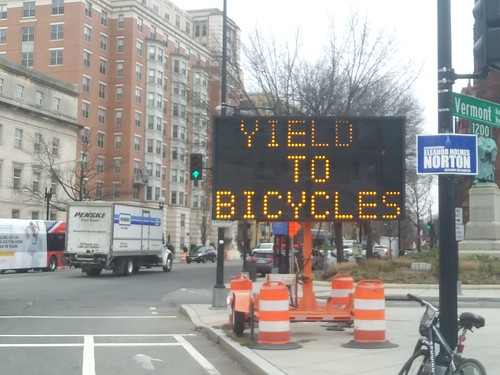
Yield to Bicycles road construction sign, 14th Street NW, D.C.

1.  DC (and Arlington) already has a program to provide very low cost membership, $5, to low income residents (Community Partners Program).

2.  Seniors lag in bicycling, and often in DC are vociferous opponents of adding bike facilities.  Why not work in specific ways to boost senior usage.

3.  High school students 16 years or older--DC already funds a free youth transit pass ( | WMATAWashington, D.C. Kids Ride Free Program, WMATA). Adding Capital Bikeshare access could be a boon--16 years old is the minimum age under the Capital Bikeshare User Agreement.

4.  College students are a great demographic for building in as routine long term positive behaviors.  Promoting transportational cycling to this group would be huge and a way to communicate to the city's colleges that they are valued.

=======
One of the problems of having a dis-integrated mobility system ("The answer is: Create a single multi-state/regional multi-modal transit planning, management, and operations authority association") is that each service tends to be siloed off from the others. For example, bikeshare is run by the local jurisdictions separate from the metropolitan transit system. If you start or finish your trip by bike share you have to have a separate membership/pay a fee in addition to your transit trip.

By contrast, in Medellín, use of bikeshare is integrated with the transit farecard and is free.

Promotion. Ranchi City, India is launching dock based bike share. The inaugural launch will include a 4.5km "Cyclothon" as one of the promotional events ("Go green, join the 4.5km cyclothon for free," Telegraph of India).

Most bike share programs launch with that kind of event. Why not do it monthly, at least in the temperate months, say from May to September, as a promotional event, to constantly build and maintain interest in a program that needs to be continually marketed?

Free Days. In conjunction with local sponsors, both the Bixi system in Montreal and Divvy in Chicago offer free day access for a few days each year.

Labels: , , ,

Tuesday, July 03, 2018

Holy s***! Lyft acquires bike share operator Motivate + other bike sharing news

Lyft buys Motivate.  When I discuss in job interviews my sojourn in trying to sell bike share systems, I make the point that we produced good proposals and had a lot of great ideas about marketing and making bike share a true membership kind of program, but that we were undercapitalized and therefore unable to compete in the marketplace -- we didn't have money to subsidize systems, or enough staff, a demonstration system to be able to truck around and show, etc.

Yesterday, it was announced that Lyft, the venture capital supported ride hailing business, has acquired Motivate, the company funded by large firms ("Love Citi Bike? You Have A Real Estate Developer To Thank," Fast Company; "Citi Bike's complicated ownership structure masks a brilliant business strategy," Ross Garlick blog; "Meet Bike Sharing's Mystery Money Man Jonathan Schulhof," The Active Times) to take over the bike share firm that had originally been created by Alta, the bike planning and consulting firm.

From the Washington Post article, "Lyft gets into bike-share business, acquiring operator of Capital Bikeshare and Citi Bike":
The ride-hailing company acquired Motivate, the operator of Capital Bikeshare and New York’s Citi Bike, among other bikeshare services, in a deal believed to be valued at least $250 million. The company will introduce “Lyft Bikes,” seizing on the momentum around dockless and pedal-assist e-bikes in major U.S. cities, and inject resources into the bikeshare operator to expand those offerings around the country.
That puts undercapitalization in perspective...

(Alta was undercapitalized too, comparatively speaking.  And Motivate probably recognizes that there isn't a whole lotta profit in bike share and better to sell it to a company that has non-market reasons to pay a lot of money for a bike share system.)

2.  Participating in multiple segments of the market for mobility services. In 2016, Ford took over sponsorship of bike sharing in the San Francisco Bay region, which I argued was a branding exercise to promote the company to IT types as a place to work ("Ford Motor Company as a transportation company not a "car" company: bike share and small scale transit"),

More recently, Uber purchased Jump, the dockless e-bike system.

I guess from the standpoint of "mobility as a system/transportation as a system" (MaaS/TaaS) the companies see a need to be present in more segments of "the Sustainable Mobility Platform" ("Further updates to Sustainable Mobility Platform Approach).

3.  Mobility as a system ("integrating payment systems in the Sustainable Mobility Platform")/Sustainable Mobility Platform.  Charlie and I have been discussing this in various comment threads.

Some people don't want to construct their MaaS platform themselves, they want it to be constructed for them.  But you pay a big premium for it.

But the average sustainable mobility consuming resident of DC has three or four payment systems already that they use frequently: e.g. a stored value transit fare card; membership in a one-way car share program, membership in a two-way car share program, maybe a bike share membership.  Some people have the Uber and/or Lyft apps. Or Via.

Various entities think they'll be able to make a lot of money stitching all those services into one app. ("MaaS app Whim 'to cover 60 countries in next five years'," ITS International). Personally, I don't think that's an absolute necessity, especially when it means premium pricing.

In fact, DC is probably a leader in MaaS as it is, it's just that the industry hasn't realized it.

-- walking and biking as "free" services
-- transit
-- dock-based bike share
-- dockless bike share and e-scooters
-- one way car share
-- two way car share
-- shared taxi services (Via, DC's own system)
-- ride hailing apps

4.  Dockless bike share experiencing high rate of vandalism and theft.  Speaking of dockless bike sharing, the Post has an article about the high rates of vandalism and theft in DC ("Theft and destruction of dockless bikes a growing problem").  (And we have also seen e-scooters with tracking devices ripped out.)

What surprises me is the surprise.

First there is the experience in Asia, although there the issue is less vandalism and more about abandonment ("Chinese bike share graveyard a monument to arrogance," Guardian).

Second is why dock-based systems were invented in the first place--because of vandalism and theft in response to the earlier versions of non-dock based bike share starting in Amsterdam ("From Amsterdam to Beijing: The Global Evolution of Bike Share," Smart Cities Dive).

Which reminds me that I forgot I was tangentially involved in a such an attempt in Ann Arbor c. 1984, and yes, the bikes were stolen or vandalized and "the system" stopped operating.

Labels: , , , ,

Friday, May 18, 2018

Another example of the need to reconfigure transpo planning and operations at the metropolitan scale: Boston is seizing dockless bike share bikes, which compete with their dock-based system

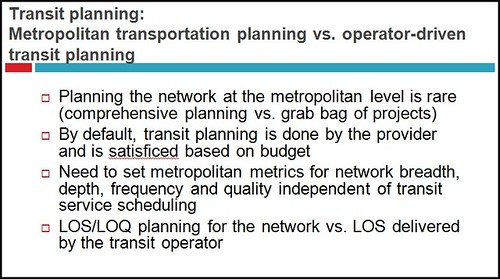
For going on 10 years, I've been writing about how the DC area doesn't really do metropolitan scale mass transit planning.  I did a presentation about it at the University of Delaware planning school in 2010.

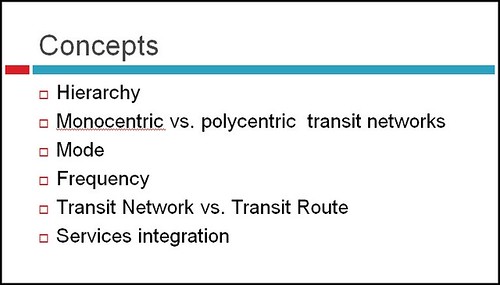
-- Metropolitan Mass Transit Planning: Towards a Hierarchical and Conceptual Framework
-- "Route 7 BRT proposal communicates the reality that the DC area doesn't adequately conduct transportation planning at the metropolitan-scale," 2016

Slide, Metropolitan Mass Transit Planning: Towards a Hierarchical and Conceptual Framework

Slide, Metropolitan Mass Transit Planning: Towards a Hierarchical and Conceptual Framework

What I advocated for originally was that the area's designated Metropolitan Planning Organization should be tasked to do true cross-jurisdiction transportation planning, and that separately the jurisdictions should contract for transit operation.  (Now though I have broadened this concept from "mass transit" only to a more complete "sustainable mobility platform" that includes walking, various forms of biking, car sharing, delivery, taxi services and microtransit, etc.)

State-designated road signs in Maryland.  Photo: alpsroads.

States do a form of this with "state-controlled" roads that serve multiple jurisdictions. 

For example in Maryland, for the most part all the major arterials are controlled by the State Highway Administration, even though the counties still do separate transportation planning, which also provides guidance for these roads.

This would make the MPO, not WMATA, the operator of Metrorail and today the default heavy rail transit planner, the planning organization. (Note that this is a problem in other areas, but not others, depending on how strong the MPO is, whether or not the planning area covers multiple states, etc.)

The idea is that the breadth and depth of the network would be defined as a planning condition, with Level of Service (LOS) and Level of Quality (LOQ) metrics set independent of the transit operators, and that the jurisdictions working together would then contract for the services, from either government agency or for profit providers.

Rather than WMATA doing this, and then "satisficing" service on Metrorail and in the case of Metrobus eliminating various bus services because of budget shortfalls, the MPO would "contract" for service.  If the service can't be met because of budget reasons, there is the justification for adding to the budget.

Probably the best model for this is the "transport association" model in Germany, where the jurisdictions combine into one integrated transportation planning and operations group, with common planning, scheduling, coordinated operation, and an integrated fare system. 

-- "The answer is: Create a single multi-state/regional multi-modal transit planning, management, and operations authority association," 2017

In the case of Hamburg, a few dozen different operators provide service, and the organization extends its transport planning practice beyond the border of the City-State to include portions of two adjoining states.    Note that this is how it works in London and Paris also (and probably other areas I don't know about).

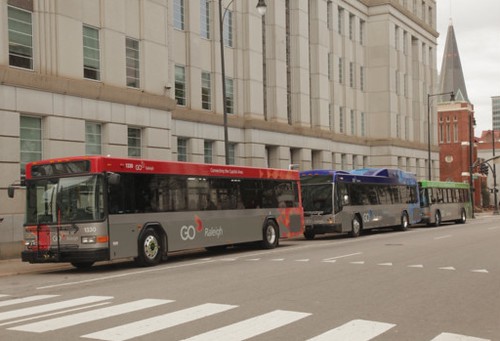
GoTransit buses in Raleigh: red = Go Raleigh; blue = Go Cary; green = Go TriangleRed = GoRaleight; Blue = GoCary; Green = GoTriangle.

But in 2016, I learned that a similar kind of system exists the Raleigh-Durham area of North Carolina, where there is a lead transit agency, Triangle Transit, comparable to WMATA, but it acts as the big brother/sister, and over the past 15 years it and the other jurisdictions have increased their level of collaboration in terms of scheduling, fare policy and systems, customer service, and design of the buses in a way that functions pretty close to the German model.

-- "Will buses ever be cool? Boston versus the Raleigh-Durham's GoTransit Model," 2017

2. Moving the MPO model to the next level, by creating Metropolitan Transport Associations, integrating planning and contracting for operation in one organization. Now I would probably argue that the MPO form in the U.S. needs to be revamped and expanded along the lines of the German transport association model, not just for the DC area, but in all major metropolitan areas, depending on how close they are to that model now.

(Greater San Francisco and the Puget Sound region are the closest to this model.  Although in Minneapolis the MPO also runs the transit system.  And many California counties are single county MPOs, some have single county transit systems, like Orange County, others have just a couple transit providers, like San Diego, and others are a polyglot, like Los Angeles County.

NJ and New York City are separate MPOs but they need to integrate as a cross-MPO transport association to better integrate and coordinate transit services.  Etc.)

I wrote about this yesterday, "Integrating payment systems in the Sustainable Mobility Platform," wrt the DC area, and the suggestion that new transit fare collection systems include the various forms of "new sustainable mobility" modes being offered these days including car sharing, and dockless bike sharing and dockless e-scooter sharing.

I am of two minds. I think it should be done, but at least in the intermediate run, many of those firms are likely to go out of business at some point (cf. Hailo, Bridj, various ride hailing competitors, Sliide, etc.) so how much energy should be spent on fare collection integration, especially when most of the new firms don't have the legacy system integration problem, and are mobile-digital native apps. With native apps, the user is probably comfortable "integrating" payment systems on their own--connecting the app to a debit card/bank account.

Note that the Montreal transit agency, unique in North America, has integrated bike sharing and car sharing access into their fare card system. Although LA MTA does have bike share access for their system somewhat integrated into their contactless transit media card also.

But the point that isn't being discussed, despite all the talk about mobility as a service/transportation as a service--which I call the Sustainable Mobility Platform, at least for the sustainable modes that are a subset of the MaaS/TaaS concept, is that in terms of transportation planning at the metropolitan scale, the for profit providers in car sharing, bicycle sharing, scooter sharing, and other modes mostly aren't sitting at the same table with the nonprofit transit agencies and bike sharing groups.

And too much decision making is happening at the jurisdictional level, which can create big holes within what ought to be a platform that works at the metropolitan scale.

3. MTAs need to include a place at the table for for profit transportation service providers. Not only do we need to shift MPOs towards becoming MTAs or Metropolitan Transport Associations, we have to provide a way for the for profit transportation mode operators to participate in these groupings.

Of course that will be hard, because the dockless providers (not the car sharing providers) and to some extent some of the ride hailing operators especially Travis Kalanick ("The Fall of Travis Kalanick Was a Lot Weirder and Darker Than You Thought," Bloomberg) are "anarcho-capitalists" who are libertarian and anti-regulation, making it very difficult to integrate them into metropolitan scale transportation planning. From the Bloomberg article:
Conclusions drawn from the survey were printed and hanging on the walls. About half the respondents had a positive impression of Uber and its convenient ride-hailing app. But if respondents knew anything about Kalanick, an inveterate flouter of both workplace conventions and local transportation laws, they had a decidedly negative view.

As usual with Kalanick, the discussion grew contentious. Jones and his deputies argued that Uber’s riders and drivers viewed the company as made up of a bunch of greedy, self-centered jerks. And as usual, Kalanick retorted that the company had a public-relations problem, not a cultural one.
Dockless bicycle and scooter sharing firms operate similarly, even if they are moving into some cities under various forms of licensing and/or pilot testing.

Although ideally, at the same time, MPOs as MTAs could increase the focus on sustainability and adopting policies on sustainability grounds.

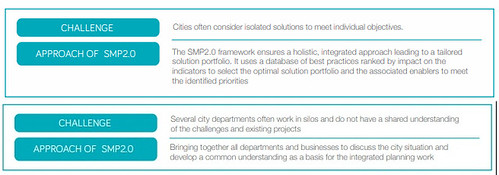
-- Integrated sustainable mobility in cities - a practical guide, Sustainable Mobility Project 2.0, World Business Council for Sustainable Development

While many large cities and metropolitan government coordinating organizations espouse sustainability principles, when it comes to transportation policy and practice, most US cities with some exceptions continue to prioritize the motor vehicle.
Sustainable mobility planning challenges
Sustainable mobility planning challenges in cities.


4. Boston. An example of the necessity of figuring out how to integrate for profit providers  is the introduction of dockless bike sharing to the Boston area.

The City of Boston created the Hubway bike system, originally serving Boston, Brookline, Cambridge, and Somerville in 2011 -- now it's called Blue Bikes with Blue Cross as the primary sponsor.

Boston's bike sharing program has been exemplary in at least two dimensions.  They've been pioneers in providing discounted access to low income residents.  And somehow they've gotten universities like Harvard to buy into the program and pay for stations, thereby expanding the reach and value of the program.

This year, various dockless firms have entered the Boston metropolitan market and while LimeBike and Spin have avoided placing bikes in those communities that offer Blue Bikes, Ant Bicycle, a firm local to the region, hasn't, and Boston has been seizing Ant bikes that are deposited in the city ("A bike-share border war has started in Boston," Boston Globe).

First, this raises the general problem that the local government bike sharing programs are seemingly cross-jurisdictional but aren't. There is a common brand, but each jurisdiction joins and operates separately, independent of the MPO.

AntBicycle.  Jessica Rinaldi, Boston Globe photo.

Second, from a MPO/MTA standpoint, planning for bike sharing should be done at the metropolitan scale.

Third, with the anarcho-capitalist introduction of dockless bike sharing and e-scooter sharing, somehow these anti-regulation types need to be bridled and brought to the MPO/MTA table, because transportation modes are supposed to be integrated into a system.

Fourth, the traditional bike sharing programs probably ought not to be allowed to be super anti-competitive like Boston seizing bikes.

Although that being said, there are many problems with the dockless bike sharing business model ("Shared Economy Business: Fixing Its 'Genetic Disorder'," Eurasia Review) and it's not necessarily clear that any of these businesses will be around in the intermediate to long term, without venture capital subsidy--plus they are an expensive way to get around comparatively speaking, and they aren't likely to be used much for regular transportation, therefore obviating the need to support their introduction.

=====
Reorganizing governance at the metropolitan scale.  Note that the problem with MPOs and MTAs is a subset of a bigger problem, that "center cities" have reorganized as metropolitan areas (what Brookings Institution calls the "Metropolitan Revolution (book review)," Peter Muller, "Transportation and Urban Form: Stages in the Spatial Evolution of the American Metropolis") but political and governance structures of these communities, except for those with merged counties and center cities like Indianapolis and a few others, haven't caught up (Toronto, but it has a big center city-suburban divide).  State legislatures and various jurisdictions aren't disposed to be supportive of such mergers.

Note that in cities like Montreal, London, Paris, and Thessaloniki, there is a hybrid form of this.  There is the "center city" as a whole, but it is also broken up into boroughs/arondissements, so that citizens are represented both city and borough governments.

Labels: , , , , , ,

Wednesday, April 18, 2018

Maybe New York City just needs to invest in public secure bike parking (re: dockless bike sharing)

Lower ManhattanCrain's New York Business reports ("12 bike-share companies bid to serve non–Citi Bike neighborhoods: City unveils list of dockless operators vying for pilot program") that many firms are bidding to offer dockless bike share--big known firms and small ones too (including one from this area).

I don't really understand the business model for dockless bike share. I mean I do. If you can get someone to pay $1/ride 4x/day that's $120/month from one user. If you can get four people per bike, that's $480/month. The bikes don't cost that much, etc.

Depending on the nature of where you conduct most of your trips, bike share can make a lot of sense in terms of offloading the cost of owning a bike in terms of maintenance, security, and storage. That's easily worth the $75 to $150/year it costs to use bike share in major cities.

But charging 5x or more than traditional bike share for the privilege of making money for the corporation owning the system, that I don't understand.

Suzanne coined the term "paying for the process."

Dockless in SeattleThe reason that governments are receptive is because unlike traditional bike share, companies, at least at this stage of the venture capital and business development process, are willing and eager to bear all the costs, so the cities don't have to spend any money on it.

They can feel good about it, so long as they don't ask the question whether or not it's a good deal for the user.  (Not having to pay for anything is why universities are interested.)

But the mistake is believing that the reason that people aren't biking for transportation is because of lack of access to bikes.

Sure, many people don't own bikes, but they could if they were motivated to do so. Access isn't the issue, it's willingness to bike for transportation on an almost daily basis.

In the US, with a land use and mobility planning paradigm firmly centered upon automobility most people look at bikes as toys and riding them as strictly recreational.

Even with dockless, my sense is that most of the users are "casual" users not regular cyclists, and many of the rides are recreational.

That's fine--recreational riding--but is it enough to build a successful business around it? Probably not.

You just don't see that many people biking to make sense of there being multiple competitive services for dockless bike share.

It reminds me more of the "gold rush" days at the start of the creation of railroads or interurbans--many competitive systems were announced, but most failed, and those systems that had at least some track either were abandoned or consolidated.

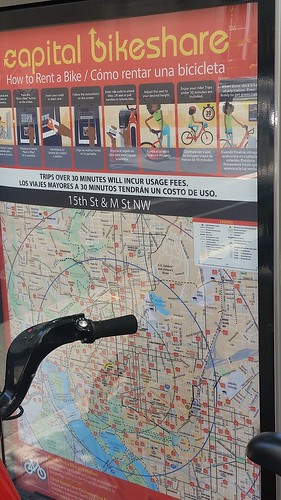
New Capital Bikeshare map kiosk shows bikesheds in 5 minute increments, and pictograms about the processNew Capital Bikeshare map kiosk shows bikesheds in 5 minute increments, and pictograms about the process

But if many of your trips are outside of the bikeshare mobility shed, it makes sense to have your own bike.

Hell, a couple weeks ago I bought a used bike for $100 and he included a helmet, lock, and basket.

Still, it's possible to buy a new bike for less than $400 (some credit unions even provide loans) and the cost to maintain a bike is probably about $150/year, more if you get a lot of flat tires.

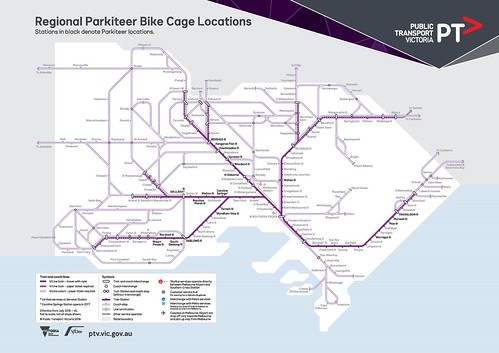
I mention bike parking because no community in the US has a network of secure bike parking comparable to the Parkiteer network in Greater Melbourne.

Probably if NYC focused on creating high quality bike parking, using models from the Netherlands--of secure, indoor, often underground parking-- so that the costs to store and secure bikes are lower, more people might consider biking for transportation on a regular basis.

-- "New bike parking facility at Maastricht train station in the Netherlands reminds me of the need to create high profile bike hubs in the US"

Parkiteer bicycle parking network, Greater Melbourne
So far there are more than 100 Parkiteer bike cages operational, with more added eacy year.

===
Last week, Uber bought Jump, the e-bike dockless startup for $100 million. Given that the bikes alone cost $24 million (12,000 bikes @ $2,000) that's a decent return for the creators.

Note that the Transit Cooperative Research Program just released a report on Public Transit and Bike Sharing (registration required to download).

Labels: , , , ,

Tuesday, January 30, 2018

New bike parking facility at Maastricht train station in the Netherlands reminds me of the need to create high profile bike hubs in the US

In October, based on the example at Heathrow Airport, I wrote a piece, "Why not a bicycle hub at National Airport?," suggesting that there is a great opportunity to create a high profile bike hub at National Airport in Northern Virginia, which is adjacent to the Mount Vernon bicycle trail.

I wrote similar pieces in 2015/2016, including comments on the Environmental Impact Study for DC's Union Station's expansion, making the point that Union Station should have a high profile set of bicycle accommodations, far beyond what is available in the current small bike station facility ("D.C. Bike Shelter Gives Commuters A Ticket To Ride," NPR), in part because Union Station is owned by the Federal Railroad Administration and this site could serve as a demonstration project for creating the kinds of bike support facilities at train stations that are common in Europe (e.g., the Cycle Hub program in the UK).

-- National Cycle-Rail Awards, Rail Delivery Group
-- Cycle Facilities at Interchanges, EU
-- Leeds Cyclepoint, Ned Railways

British cycle resources are "more relevant" to the US case than are those from Northern Europe, where cycling take up is significantly higher, whereas US and UK cycling rates are comparable.  That being said, the UK has a big program of adding high quality, protected and secure bicycle parking to train stations, while the US does not.

The EU publication, Cycle Facilities at Interchanges, is particularly good and the kind of "guidance" we need in the US, although I would argue that the issue isn't just cycle facilities, but a broader and more complete approach to sustainable mobility facilities more generally (along the lines of what I discussed in reviews of the Silver Spring Transit Center and the Takoma Langley Crossroads Transit Center).

The cycle point at Leeds Station


The Bicycle Dutch blog alerts us to the grand opening of one such facility, "New underground bicycle parking facility in Maastricht" (pictured).
Maastricht train station bicycle parking

From the blog entry:
It has room to park 3,000 bicycles, 5.5 metres under the station square. It is guarded, has a repair service and parking your bicycle is free for the first 24 hours.

That total number also includes 100 rental bicycles of the OV-Fiets scheme and the special places for bicycles of types that wouldn’t fit in a rack. There is room for 80 such “extraordinary bicycles”; cargo bikes, tandems, bicycles with baskets or the heavy e-bikes. The Maastricht facility has a completely separated room for 40 mopeds or scooters, which is not something you often see in other facilities.

The first 24 hours of parking are free. This has become the norm in the Netherlands at railway stations. After that initial day parking a bicycle costs €1.25 per day. If you plan to park your bicycle for longer periods, an annual subscription might be more attractive, at €75,00 per year. You check your bicycle in by swiping your public transport chip card. If you don’t have such a card you can buy an anonymous one for €7.50, that you can then always use. You check out with the people who are guarding the facility. The same people who can also do repairs and take care of the rental bicycles. The parking fee for cargo bikes and mopeds is €2.50 per day and €150,00 for a one-year subscription.
Maastricht train station bicycle parking

Think of a "travellator" as a stepless escalator.
This facility is open daily. In the morning from 15 minutes before the first train leaves Maastricht, until late in the night, 15 minutes after the last train arrived. The closing hour is a bit dynamic. When the train is delayed, this facility stays open until 15 minutes after the actual arrival time of the last train that day. These opening times mean that the garage really only closes for a little under 4 hours of the night during the week.

Two 30-metre-long travelators (one going down and one going up) give an easy access to the parking garage at 5.5 metres below the surface. The purpose of this garage was to increase the amount of available bicycle parking racks. A second aim was give the station area a “quality impulse”. In other words, to get the sea of bicycles, that were parked in front of the station up to now, out of sight.
Granted, today we don't have demand for such a large bicycle parking facility in the US, let alone DC, but to promote multi-modalism and sustainable mobility, and given that the expansions of Union Station are expected to accommodate growth for the next 100 years, it makes sense to think more grandly about this element of the station, and build a facility on the scale of those in Europe, even if they aren't nearly as big.

Except for the indoor facility, the outdoor bicycle parking at the Union Station is sub-standard, it's not particularly secure or protected and one main area also serves as an ersatz smoking lounge, which sucks.
Outdoor bicycle parking at Washington DC Union Station
Outdoor bicycle parking on the west side of the station (the parking on the east side of the station is more visible, and in better condition, but still is not secure nor protected from the weather).

Labels: , , , , , ,

Thursday, October 19, 2017

Quote of the day, revisiting "when you define everything as a success"

Mainly Macro is a blog by Oxford University economist Simon Wren-Lewis, which I read to try to upgrade my knowledge about economics and the UK. In a recent post, "The lesson monetary policy needs to learn," he refers to the writings of economist Martin Sandbu at the Financial Times--unfortunately only available to subscribers--where the final point in a recent column is:
"admitting one has got things badly wrong is a prerequisite for doing better”
Revisiting bicycle sharing as an example of policy making and program implementation that needs to be better evaluated.  I wrote "The problem when you define every outcome as a success, you don't learn, and therefore failure is more likely: bike share as examples" over my frustration (not limited to) in discussions about bike sharing programs how everything is defined as a success, making it difficult to do better, or assess whether or not large investments in bike sharing are the best use of resources in fostering greater take up of biking for transportation as a significant element of sustainable mobility policy and practice.

I was thinking about this a couple weeks ago, not just because of the entry of "Chinese bike share" into the U.S. and specifically into DC where five different bike share companies have entered the market on a test basis, but because I had to get my bike fixed, and while in the shop I read through the current issue of Adventure Cycling Magazine, a publication from the Adventure Cycling Association, which is focused on promoting bike touring (something I don't do, because I don't really ride for recreation but for utilitarian purposes).

Atlanta and bicycle sharing.  One of the articles focused on an increased promotion of bicycling for transportation in Atlanta and quoted the city's director of bicycle planning and discussed her satisfaction there with their bike share program--they have at least 500 bikes--because they are used at about the rate of 0.7 times per day per bike, and "that is the rate we were aiming for."

Because the most successful systems in Europe have 10 to 15 times that rate of use, and the most successful system in North America, New York City, has about 8 uses per bicycle per day ("Citi Bike Sets New Ridership Record In 2016, With Nearly 14 Million Rides," Gothamist), which is more than double the rate in DC, this strikes me as an incredibly low bar to reach -- comparable to the metrics most cities set for achieving various milestones, what we would call a C- (or lower) grade in school.

That grade isn't really passing.

College student bike sharing. Separately, I have been e-talking with an instructor at a university that is looking to launch bike share, and because "they have no money," they are in talks with a company that will provide bikes on a basis similar to the "Chinese bike share" companies at $1 per ride.

I said that won't serve your students very well, nor broader transportation demand management practice, because it won't promote regular use both daily and multiple times per day.

Instead, I recommend what is called a "bike library" or "bike fleet," how schools like UCLA or North Central College provide a bike to a student for the entire semester for either free or a "low price" (UCLA's price has more than doubled over the past couple years) along with a lock, helmet, and repair services -- the point being that you want to support the use of biking as a routine behavior rather than as a casual less committed practice.

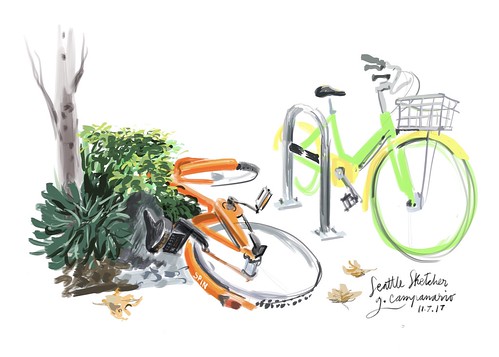
Lime Bike bicycle sharing bicycles parked/abandoned outside a small apartment building on the 700 block of Irving Street NE in the Brookland neighborhoodPer ride priced bike sharing services. I am fine with the per ride bike sharing services being offered.  My problem with these services is two-fold.  First, they are somewhat chaotic as many of the users deposit the bikes when they are done in ways that aren't properly respectful of the public space.

(Although some riders do park the bikes at bike racks.  Suzanne also points out that maybe some of the bikes are left askew because someone tried to ride it without paying, and the bike wouldn't move, so they just abandon it.)

Second, it's that these services vastly re-price upward the use of a bike--if you were to ride twice a day, it would cost over $700/year--it's only comparatively cheap if you compare a single use to a transit fare or taxi ride.

But if you buy a bike for between $300 and $400 (used bikes can be had for much less) and use it for 5 to 10 years, even spending $200/year on maintenance means the cost for use, no matter how many trips you take, is less than $1 per day.

Lessons.  The primary question we need to be asking is what is the purpose of bicycle planning? 

1.  Is it to promote the development and support of people making a choice to predominately cycle for at least some (but a significant number) of their transportation needs/trips? 

2.  And should cost for use and access be an element of  the program?

3.  Or is the purpose of bike planning primarily to support occasional, casual use on the part of people with a very limited interest in biking for transportation?

If 10-15% of trips by bike is a reasonable goal for Washington, DC's transportation mix, then the city has a long way to go.  Is bicycle sharing the best way to more than triple bicycling as a element of DC's transportation mode share?

From a transportation demand management standpoint, it is the first--to make bicycling a significant and real form of (sustainable) transportation that is efficient and effective and regularly used.

For discussion about biking to work in the DC metropolitan area, see "Surprising stats: How many people bike to work around DC and more," WTOP-radio).

That choice should then shape the agenda, planning, and implementation process of various infrastructure, facilities, and programs developed to support biking for transportation.  It should shape the choice of programs you want to support and promote.

If you want to make biking visible, but not a substantive mode (except in places with the right pre-conditions for success) focus on bicycle sharing.  Because the way bike sharing is implemented now, it likely doesn't lead to substantive take up of bicycling for transportation.

But, if you want bicycle sharing to work as an entrypoint to regular bicycle use, then complementary programming needs to be developed to encourage people to shift from occasional, casual use to regular, frequent use, to leverage the visibility of bicycle sharing for "a greater purpose."

But that question isn't being asked either.

And so bicycle sharing is one of many examples of how defining every program as a success without regard to objectively setting and measuring outcomes is problematic.

Doing bicycle planning without enough attention to "transportation demand management planning."  Part of the problem is that sustainable mobility needs to be planned as a system, what I call the "sustainable mobility platform," where bicycle sharing is an element in a complete set of "technologies" or modes.  Bike sharing has a place in the panoply of services, but perhaps not as great a role as has been assigned.

By looking at TDM/SMP planning more broadly, better decisions and outcomes can be realized.

Labels: , , , , , ,

Monday, October 09, 2017

Why not a bicycle hub at National Airport?, focused on capturing worker trips but open to all

Image from Bike the Gap.

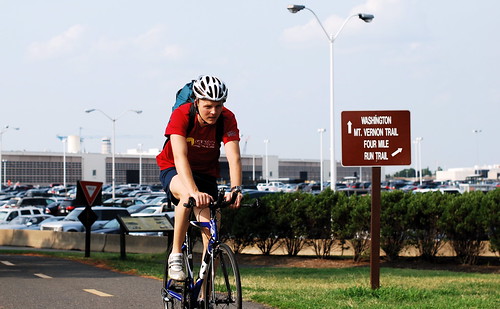
National Airport in Arlington County, Virginia is unusual for a large active airport in that it is in the core of the Washington metropolitan area, only 5 miles from Downtown DC and is bikeable from many points across the area--and is well  served by the Mount Vernon Trail, one of the area's foundational long-distance serving bikeways, connecting Alexandria, Arlington, and DC, with a connection to the Capital Crescent Trail and Suburban Maryland.

It has just been announced that bike share stations will be added to the Airport ("Capital bikeshare gears up for another expansion," Washington Post).

While that's a nice step, we need to be looking more comprehensively at sustainable mobility services and the area's airports more comprehensively, something I've argued for a long time:

-- "Night moves: the need for more night time (and weekend) transit service, especially when the subway is closed," 2013
-- "More on airport-related transit/transit for visitors," 2013
-- "More on transportation to the DC area airports," 2013

Besides general recommendations in the cited entries that also pertain to National Airport, specific suggestions I've made are specifically for National Airport:

(1) have bus service for when the Metrorail subway doesn't run, ideally integrated into a larger Nite Owl bus network ("Slight revisiting of the issue of overnight transit service: San Francisco," 2016

(2) set up a program to accommodate Car2Go one way car sharing, the way that Montreal's Trudeau Airport does ("Car2Go agreement with Montreal's Trudeau Airport could be a model for other jurisdictions") --the airport accommodates Uber and other similar services now ("The popularity of Uber, Lyft boosts airport revenue, but there are trade offs," Washington Post), why not car share?

(3) take responsibility for integrating ground transportation connections between the Crystal City railroad station and the airport ("A brief comment on ground transportation at National Airport vis a vis VRE rail service"), the way that BWI Airport serves the nearby railroad station.

I've probably mentioned that the bike accommodations at National Airport are paltry, one lone rack not up to best practice next to a distant administration building, even though the Airport abuts the Mount Vernon Trail.
Leaving the Airport
Photo by M.V. Jantzen of a cyclist on the Mount Vernon Trail abutting National Airport.

But in an e-discussion with Nigel, my correspondent from New Zealand, we've been talking about airport transportation connections. 

I suggested it would be useful to have a set of case studies on best practices for sustainable mobility comparable to an old Volpe Transportation Center study on urban tourist transportation systems.

One of the things I do look at from time to time is how well or how poorly airport websites provide information on sustainable ground transportation options, and so I was looking at the Heathrow Airport website, and discovered its webpages on ground transportation are superb, probably the best I've come across.

WRT bicycling, as part of the discussion of bicycle parking, it offhandedly mentions the Heathrow Cycle Hub, without discussing it.

According to Cycling Weekly ("Heathrow Cycle Hub a success"), the Heathrow Cycle Hub is a multi-faceted facility aimed at encouraging airport workers to cycle to and from work, while also providing services for airport users.  From the article:
... in 2011 Heathrow became the first airport in the UK to offer its 76,000 employees a cycle to work scheme and their own onsite bike shop. And in the two years it has been open, there’s been a 45 per cent increase in Heathrow employees cycling to work, with around 570 doing so every day. ...

Inside there’s a workshop and retail space open all day and manned by full-time, fully trained bike experts. Heathrow employees can sign up to the hub for free and get 10 per cent discount on products in the shop, free bike servicing, free maintenance classes and bikeability training. There’s even an emergency call-out available for anyone that has a breakdown in the airport. ...

Heathrow has been striving to improve sustainable travel for the last decade. In 2002, a car share commuter scheme for employees was launched. Heathrow also effectively exists in its own London travel zone, where bus transport in the airport and surrounds is free.
I remember an e-conversation years ago with someone from the University of California Institute for Transportation Studies who mentioned that dealing with airport worker travel to and from work was a major opportunity for shifting people to sustainable modes.

Heathrow Airport demonstrates how to do so, not just in having superior transit connections (subway, bus, railroad service), but also providing support for car sharing, car pooling, and cycling.

Since the launch of the Bike Hub, the airport has appointed a staff member to focus on employee bike transportation ("Healthrow appoints cycling officer to get local staff riding to work," Road.cc) and is advocating for better cycleway connections to the Airport.  The CW article discussed creating an airport area cycling map, but I don't know if that has been carried out.

National Airport, being so close to Downtown and other population centers, would be a natural for such a program in the US -- as would La Guardia Airport in Queens, O'Hare and Midway Airports in Chicago, Newark International Airport, Logan Airport in Boston, among others.

====
In future coverage of necessary steps to build the system for cycling at the metropolitan and regional scales ("Bike to Work Day as an opportunity to assess the state of bicycle planning"), I will add airport bike hubs as an item.

Of course, it goes without saying that secure bike parking at National Airport should be part of a metropolitan and regional secure bike parking network, as suggested in item #5 of the BTWD entry, modeled after the Greater Melbourne Parkiteer bicycle parking network.

Cycle Hubs, like the one at Heathrow, those in the LA MTA system ("A parking garage for bicycles just opened at El Monte Bus Station," San Gabriel Valley Tribune) and other places need to be integrated into such a system, which is item #8 in the BWTD entry.

Melbourne, which is a world class best practice example of integrated sustainable mobility services, has a Parkiteer station at the public transit station serving Melbourne Airport, as indicated on the map below. Separately, the Airport provides bike parking too.
Parkiteer bicycle parking network, Greater Melbourne

Labels: , , , , , ,