Rebuilding Place in the Urban Space

"A community’s physical form, rather than its land uses, is its most intrinsic and enduring characteristic." [Katz, EPA] This blog focuses on place and placemaking and all that makes it work--historic preservation, urban design, transportation, asset-based community development, arts & cultural development, commercial district revitalization, tourism & destination development, and quality of life advocacy--along with doses of civic engagement and good governance watchdogging.

Monday, October 12, 2020

One thing that Portland doesn't get accolades for: Getting S***/Stuff Done when it comes to sustainable mobility infrastructure

There is a to do time management program called "Get S*** Done" which I first saw at the independent, locally-production of goods focused Steadfast Supply retail store in DC's Navy Yard district.

In the comment thread on "Community planning, capitalism, and housing/real estate development," charlie coined the term "state capacity" as a way to describe the ability or inability within various US jurisdictions to create infrastructure.  

While the US was amazingly successful at building infrastructure up to the 1970s, creating railroad networks in the late 1800s and into the early 1900s, canal systems before that, streetcar networks from about 1880 to 1920, subways and elevated railways starting just a little later, dams, electric power and distribution systems, and buildings of all types during the New Deal, and a national, state, and local system of roadways culminating in the Interstate Highway System--it's sputtered since then.

New rail transit systems--heavy rail, light rail and streetcar--have been built starting in the 1960s, but mostly it's been a slog.  Maintaining those systems has been problematic and growing them has been exceedingly difficult.

Purple Line failure.  A perfect example is the massive screw up by the State of Maryland vis a vis the Purple Line light rail program, where the construction team has opted out of the project because of a dispute with the State over cost overruns ("Maryland takes over contracts on Purple Line construction after contractor quits," Washington Post).  

Maryland now has to pick up the pieces to keep the project going, which is pretty precarious.  Ironically, the program had been touted as a great example of "public private partnerships" and included $1 billion of financing provided by the concessionaire, money that the State now must replace.

The more general DC area failure to expand high capacity transit.  In response to charlie, I made the point that transit expansion--separate from the initial decision to build the subway system, Metrorail, which was a difficult process as it linked two states and the District of Columbia, as well as the federal government--has been an example of failure or under reaching. 

(Zachary Schrag argues in The Great Society Subway: A History of the Washington Metro that it should be considered an element in the Great Society program of LBJ.)

First, the Silver Line wasn't constructed by WMATA, but by the State of Virginia, and there have been many problems with it, including how the addition of the line stressed the core system, contributing significantly to the past few years of subway system failure.

Second, there has been virulent opposition to the Purple Line.  Third, Arlington--considered a national best practice example of the promotion of sustainable mobility, scuttled its attempt at a streetcar line.  

Fourth, DC's creation of a streetcar line has been fraught with problems--the line is severely truncated, took 13 years to come to fruition, and is going to be very difficult to extend to become useful, because of planning and support failures on the part of the transportation department, planners, and elected officials.

(Note that streetcar was a satisficed decision--a mode chosen out of a belief that it would not be possible to expand Metrorail within DC or in the Columbia Pike corridor of Arlington, even though subway service would probably be a better choice.)

You'd think given the previous success of Metrorail + surface transit (bus) in the metropolitan area -- Metrorail had been the second most successful subway system in the US and the bus services, such as Metrobus and Montgomery County's RideOn service, were reasonably successful--MoCo's bus program is considered a national best practice for suburb, that DC proper has 50%+ of work trips performed by sustainable modes (transit, walking, and biking), which is one of the best rates in the US, people would understand the value of transit to community success, and would advocate and support transit expansion and the addition of new modes (streetcar, light rail, ferry, gondola?) as appropriate.

It's an incredible failure of vision--in part the fault of the jurisdictions and elected officials, also of the operator of Metrorail and Metrobus--WMATA, the Washington Metropolitan Area Transit Authority, and metropolitan governance and planning organizations, and other stakeholders like the business community and its lobbying organizations like the Federal City Council and the Greater Washington Board of Trade, although its abetted by the region being split up between Maryland, Virginia, and DC, and the different political interests among them.

(In the 2009 post, "St. Louis regional transit planning process as a model for what needs to be done in the DC Metropolitan region," I argued that it was necessary to rebuild the regional consensus in support of transit, but this did not occur.  Also see "WMATA 40th anniversary in 2016 as an opportunity for assessment.")

Portland: Simultaneously incremental and visionary.  That's why I think we need to be even more respectful of what Portland has accomplished.  
It's frustrating as a planner when people bring up Portland as an example -- "Why can't we be like Portland?!" followed by a deep sigh -- because  they don't understand Portland's "secret," which is that what they see today is built on 50 years of tough, visionary, bold yet incremental decision making. 

In short, they were bold and they continued to be bold, through decisions that built on and extended previous decisions. 

It's a perfect example of what I call "Transformational Projects Action Planning," although it was more incremental and somewhat unintentionally a process where the sum of the parts ended up being even stronger than the individual pathbreaking efforts.

In a 2005 post I discussed Portland's path of incremental but visionary improvement, starting with the Downtown Plant:

  • starting with the decision to remove the freeway along the Willamette River--the planning process started in 1968 
  • in 1970 the planning commission did not approve a proposal to build a 12 story building and parking structure on Pioneer Courthouse Square--the square became a key element in the public space/urban design network in the core of the city
  • the passage of the Downtown Plan (1972) prioritizing commerce in the core of the city, to be served by transit, not the automobile with severe restrictions on the provision of parking
  • State creation of an urban growth boundary program to restrict sprawl (1973)
  • Decisions to remove a freeway along the waterfront and to create a parkway and community district in its place, and then to not move forward with the Mount Hood Freeway (1974), and to use the money to add a bus-focused transit mall to Downtown
  • Creation of a downtown free transit zone, called Fareless Square, starting in 1975, lasting until 2012 when it was ended because of post-recession budgetary problems
  • light rail was added to the city's development program (1978 approval, construction started in 1982, first service in 1986)
  • creation of the Metro Government, to coordinate land use decisionmaking for the three county metropolitan area (1979)
  • light rail was first extended in 1998 and continues to be extended, with funding for further extensions on the November 2020 ballot

  • the addition of streetcar to the transit program (entering service in 2001, boosted in part by running heritage streetcars on the light rail line on weekends), as part of the program to facilitate the redevelopment of a deaccessioned railyard which became the "Pearl District." Portland is the first city in the US to deploy "modern" streetcars, rather than heritage or heritage replica vehicles
  • the addition of support for biking and walking--Portland now has one of the highest uses of the bicycle for transportation in the US
  • the strengthening of Portland State University as urban and sustainability focused ("Universities as elements of urban/downtown revitalization: the Portland State story and more")
  • the creation of the aerial tram to serve the difficult to reach campus of the Oregon Health Sciences University across the Willamette River (2006)
  • the addition of a (lightly used) commuter rail line, commencing service in 2009
  • the expansion of the streetcar to East Portland (2012)

  • the Tilikum Crossing Bridge, which opened in 2014, which is only for transit, walking, and biking, not cars (except for emergency vehicles)
  • a focus on sustainability including electric vehicles, including the creation of Electric Avenue in 2016
It hasn't been perfect.  They haven't been able to extend light rail to Vancouver, Washington, across the Columbia River, because of complicated politics involving both Washington and Oregon state politics.  

This was true both for attempts in the 1990s (the Yellow Line was originally intended to go to Vancouver), as well as in the aborted and more recent Columbia River Crossing project, which would have rebuilt I-5 bridges over the Columbia River--involving both states because the boundary is in the middle of the river, and added light rail service to Vancouver and Clark College as a transportation demand management measure.  (They still will have to replace the bridges.)


Portland also tried to build an industrial production business around streetcars, licensing the Czech design for manufacture in the US.  But because transit is so political in the US, it turned out that there wasn't enough demand to make a go of it ("Before shutdown, how many jobs did United Streetcar deliver," Portland Oregonian). 

But think of the Purple Line, an idea that has been around since before 1987--I first read about it in a cover story in the Washington City Paper in December 1987, if I recall correctly.

A single section of the full concept (the segment from Bethesda to New Carrollton) will open starting in 2024--a falling behind of the original date of 2022, while no more sections of the full circle concept are even being planned.

This demonstrates the impressiveness of what Portland has accomplished thus far and demonstrates the importance of continuing to strive for improvement:
transit mall + light rail + biking/walking + streetcar + aerial tram + commuter rail + sustainable mobility bridge.

Granted, Seattle is doing impressive work along the same lines ("Portland Oregonian says that Seattle is now far more innovative concerning sustainable mobility than Portland").  LA is expanding its rail transit system in impressive ways.  

Oklahoma City's Metropolitan Area Projects program and process is national best practice (and included a streetcar in its third phase).

But most places show as many failures as successes, like DC and the streetcar, Maryland and the Purple Line, NYC Transit's inability to expand subway service in a cost effective manner, the need for positive train control because of so many railroad passenger service crashes that resulted from operator error, California's seeming failure with HSR, the financial failure of the Las Vegas Monorail system, etc.

Sometimes, but not often enough, there can be consequences for failure ("Gov. Larry Hogan’s legacy is threatened by Purple Line ‘fiasco’ and concerns about toll lanes project," Washington Post).  From the article:

Maryland Gov. Larry Hogan differs from President Trump about as much as possible for a Republican, but they share one characteristic: Both won their offices in part by selling themselves as experienced business executives who would run government efficiently and cheaply. 
Hogan has applied that approach to his two biggest transportation projects, the light-rail Purple Line and a plan to add toll lanes to the Capital Beltway, Interstate 270 and the American Legion Bridge. He brought in private companies to share responsibility with the state for the enterprises, saying they would complete the work more efficiently than the government and save taxpayers money. 
It isn’t working out that way, and the difficulties threaten to tarnish Hogan’s legacy as he approaches the midpoint of his second and final term as governor. (Maryland governors are limited to two terms.) 
The construction contractor for the Purple Line quit mid-project in a dispute with the state over a reported $800 million in unpaid cost overruns. The Maryland Transit Administration has taken over hundreds of subcontracts to continue the work while the state negotiates with the consortium of companies managing the project over whether the larger $5.6 billion partnership can be salvaged. 
The Purple Line problems raise fresh questions about whether the much larger toll lanes project will fare any better.

Portland's ability to "get s*** done" when it comes to expanding its sustainable mobility platform needs to be studied in greater depth.  They are much more like Bilbao than they are like DC.

Labels: , , , , , ,

Wednesday, January 08, 2020

Maglev as an opportunity for DC to underground through traffic on New York Avenue

Despite the existence of what are called "metropolitan planning organizations" which were created by the US Department of Transportation in association with local metropolitan areas, to coordinate transportation planning across jurisdictions in a metropolitan area and to some extent between metropolitan areas, this may not really happen if the MPO is relatively weak relative to other transportation agencies, or when borders cross state lines, etc.

Even different agencies within a state or local government may not coordinate very well or have such different agendas that they don't coordinate.

Dis-coordination.  Not quite 20 years ago, a colleague Steve Pinkus used the term "dis-coordinated" to refer to how transit "works" in Baltimore, and I've never forgotten his use of that term.

Baltimore's problem is that it has one truncated subway line and one light rail line that mostly follows an old industrial railroad right of way.  They have a couple lines, but not a network ("From the files: transit planning in Baltimore County").

For profit transportation firms aren't interested in playing well with others.  Besides the example of how hard it is for passenger rail to co-exist with freight railroads, now that for profit entities are more involved in pushing new transportation technologies and modes things are even more complicated, because for profits focused on their mission have zero interest in working with others, unless there are marginal economic benefits to doing so.

Contributing in ways that make the entire transportation system work better is as they would say in the UK, "not in our remit."

I've been meaning to write about this in terms of a couple of examples.  In Boston, The Federal Realty paid for a station on the Orange line to serve their development but it turns out that they didn't configure the station to be very accessible from the other side--the side where New Balance isn't, making it hard and expensive to open up that side of the station to other users ("Plans to connect Encore property with Orange Line move closer to reality," Boston Globe). From the article:
The Assembly Station was subsidized by Federal Realty Investment Trust, the main company behind the massive — and massively successful — Assembly Row development. So the station opens inward, next to Partners HealthCare’s new tower, and not to the riverside park on the other side of the tracks.
And Brightline/Virgin Trains in South Florida, which I want to write about in another context in terms of promoting railroad passenger services, is expanding stations in a number of places in Dade County, but this then diminishes opportunities for the regional commuter railroad ("Amid Brightline's new flash, whither Tri-Rail?," Palm Beach Post; "Tri-Rail into downtown Miami awaits Brightline's action," Miami Today News).

Government may not work well with for profit competitors either.  But governments aren't very good either at integrating the for profits into the transportation planning and operations mix either ("Another example of the need to reconfigure transpo planning and operations at the metropolitan scale: Boston is seizing dockless bike share bikes, which compete with their dock-based system"), at least in Boston.

German style transport associations bring all actors together.  What I recommend is that regions create German style transport associations, bringing all the transportation operators and planners together in one body ("The answer is: Create a single multi-state/regional multi-modal transit planning, management, and operations authority association") so that coordination and integration can happen.

Maglev. This brings us to maglev in the Baltimore-Washington corridor.

While Governor Hogan of Maryland isn't particularly supportive of intro-metropolitan area transit, judging by his unwillingness to fund Metrorail in the DC area, grudging agreement to continue the Purple Line light rail project, but cancelling the Baltimore Red Line, and his general interest in promoting road projects, cutting tolls, etc., he is interested in Maglev ("Hogan calls maglev ride 'incredible,' says state will seek $28 million grant to study," Baltimore Sun).

The Northeast Maglev company is aiming to create a Maglev system in the Northeast and they've got Gov. Hogan on board to start with a segment between Baltimore and Washington. 

The study for federal approval is underway ("Federal review of Baltimore-Washington high-speed maglev project ‘paused’," Washington Post). Recent media reporting has focused on growing opposition ("Maryland towns gear up to fight proposed high-speed train," WP).

Could a double stack tunnel be used for maglev and freeway through traffic on New York Avenue?  But the first thing I thought of when I read the article on the postponement of the federal study, and the mentioning of how the main station for the line in Washington, DC would be in the Mount Vernon area, meaning the line would come through DC under New York Avenue (which connects to the BWI Parkway, where the line would run underneath), was how the initial recommendation in the c. 2006 DC Department of Transportation New York Avenue Corridor Study for the "undergrounding" of how New York Avenue in DC connects I-95 in Maryland to I-395/I-95 in Virginia could be realized through a doublestack tunnel for the maglev trains and the freeway.
New York Avenue Corridor Study


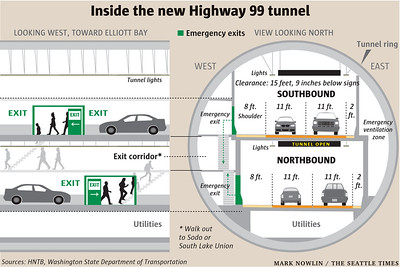
The Highway 99 Tunnel in Seattle is double stacked, with northbound traffic on one level and southbound traffic on the other.
Graphic of Highway 99/Alaskan Way Tunnel, Seattle

Many years ago,  concerning the Silver Line Metrorail in Northern Virginia, advocates proposed a double stack tunnel configuration which could have supported express services.
Tysons Tunnel diagram

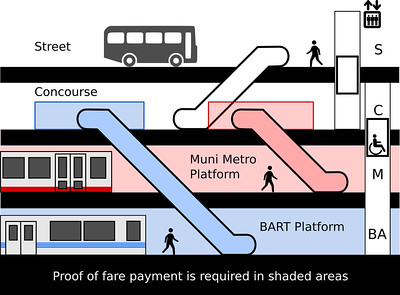
In Downtown San Francisco, the Muni Metro and BART run in a double stack tunnel called the Market Street Subway.
Diagram, Muni Metro and BART double stack tunnel

I am not an engineer. I don't know if the requirements for maglev and vibrations make such a double stack tunnel proposal out of reach.

Yes it would be expensive.  But it would probably be cheaper to do "two projects in one" rather than either or neither.

Too rarely, big projects position themselves around complementary benefits. But separately, were I running the project, to ward off opposition, I'd be discussing benefits to the existing residents from the project.

While we can tout benefits from being at the forefront of implementing new transportation technologies, that doesn't really add much value to the lives of average citizens.

But tunneling through traffic for New York Avenue in DC, and similarly, using the Maglev project in Maryland as a way to drive forward comparable improvements to the BWI Parkway ("Hogan wants Maryland to take over Baltimore-Washington Parkway," Sun) ought to be seen as big benefits for those respective communities.

But unfortunately, our planning system now doesn't aim to leverage and create such opportunities.

Labels: , ,

Friday, May 18, 2018

Another example of the need to reconfigure transpo planning and operations at the metropolitan scale: Boston is seizing dockless bike share bikes, which compete with their dock-based system

For going on 10 years, I've been writing about how the DC area doesn't really do metropolitan scale mass transit planning.  I did a presentation about it at the University of Delaware planning school in 2010.

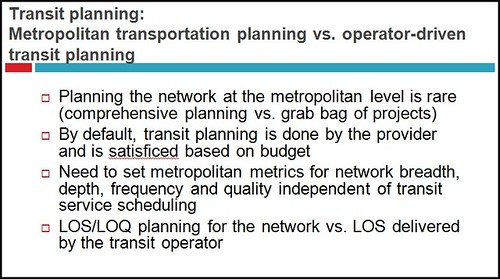
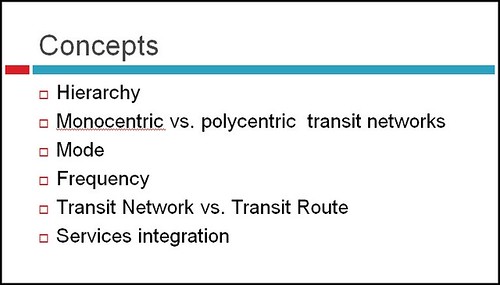
-- Metropolitan Mass Transit Planning: Towards a Hierarchical and Conceptual Framework
-- "Route 7 BRT proposal communicates the reality that the DC area doesn't adequately conduct transportation planning at the metropolitan-scale," 2016

Slide, Metropolitan Mass Transit Planning: Towards a Hierarchical and Conceptual Framework

Slide, Metropolitan Mass Transit Planning: Towards a Hierarchical and Conceptual Framework

What I advocated for originally was that the area's designated Metropolitan Planning Organization should be tasked to do true cross-jurisdiction transportation planning, and that separately the jurisdictions should contract for transit operation.  (Now though I have broadened this concept from "mass transit" only to a more complete "sustainable mobility platform" that includes walking, various forms of biking, car sharing, delivery, taxi services and microtransit, etc.)

State-designated road signs in Maryland.  Photo: alpsroads.

States do a form of this with "state-controlled" roads that serve multiple jurisdictions. 

For example in Maryland, for the most part all the major arterials are controlled by the State Highway Administration, even though the counties still do separate transportation planning, which also provides guidance for these roads.

This would make the MPO, not WMATA, the operator of Metrorail and today the default heavy rail transit planner, the planning organization. (Note that this is a problem in other areas, but not others, depending on how strong the MPO is, whether or not the planning area covers multiple states, etc.)

The idea is that the breadth and depth of the network would be defined as a planning condition, with Level of Service (LOS) and Level of Quality (LOQ) metrics set independent of the transit operators, and that the jurisdictions working together would then contract for the services, from either government agency or for profit providers.

Rather than WMATA doing this, and then "satisficing" service on Metrorail and in the case of Metrobus eliminating various bus services because of budget shortfalls, the MPO would "contract" for service.  If the service can't be met because of budget reasons, there is the justification for adding to the budget.

Probably the best model for this is the "transport association" model in Germany, where the jurisdictions combine into one integrated transportation planning and operations group, with common planning, scheduling, coordinated operation, and an integrated fare system. 

-- "The answer is: Create a single multi-state/regional multi-modal transit planning, management, and operations authority association," 2017

In the case of Hamburg, a few dozen different operators provide service, and the organization extends its transport planning practice beyond the border of the City-State to include portions of two adjoining states.    Note that this is how it works in London and Paris also (and probably other areas I don't know about).

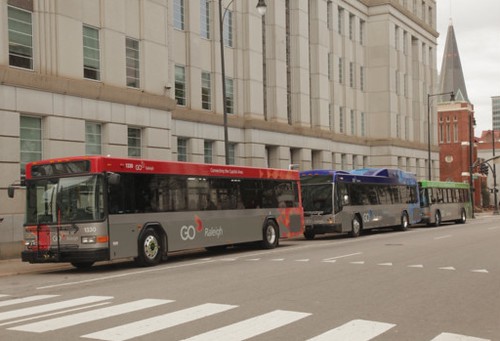
GoTransit buses in Raleigh: red = Go Raleigh; blue = Go Cary; green = Go TriangleRed = GoRaleight; Blue = GoCary; Green = GoTriangle.

But in 2016, I learned that a similar kind of system exists the Raleigh-Durham area of North Carolina, where there is a lead transit agency, Triangle Transit, comparable to WMATA, but it acts as the big brother/sister, and over the past 15 years it and the other jurisdictions have increased their level of collaboration in terms of scheduling, fare policy and systems, customer service, and design of the buses in a way that functions pretty close to the German model.

-- "Will buses ever be cool? Boston versus the Raleigh-Durham's GoTransit Model," 2017

2. Moving the MPO model to the next level, by creating Metropolitan Transport Associations, integrating planning and contracting for operation in one organization. Now I would probably argue that the MPO form in the U.S. needs to be revamped and expanded along the lines of the German transport association model, not just for the DC area, but in all major metropolitan areas, depending on how close they are to that model now.

(Greater San Francisco and the Puget Sound region are the closest to this model.  Although in Minneapolis the MPO also runs the transit system.  And many California counties are single county MPOs, some have single county transit systems, like Orange County, others have just a couple transit providers, like San Diego, and others are a polyglot, like Los Angeles County.

NJ and New York City are separate MPOs but they need to integrate as a cross-MPO transport association to better integrate and coordinate transit services.  Etc.)

I wrote about this yesterday, "Integrating payment systems in the Sustainable Mobility Platform," wrt the DC area, and the suggestion that new transit fare collection systems include the various forms of "new sustainable mobility" modes being offered these days including car sharing, and dockless bike sharing and dockless e-scooter sharing.

I am of two minds. I think it should be done, but at least in the intermediate run, many of those firms are likely to go out of business at some point (cf. Hailo, Bridj, various ride hailing competitors, Sliide, etc.) so how much energy should be spent on fare collection integration, especially when most of the new firms don't have the legacy system integration problem, and are mobile-digital native apps. With native apps, the user is probably comfortable "integrating" payment systems on their own--connecting the app to a debit card/bank account.

Note that the Montreal transit agency, unique in North America, has integrated bike sharing and car sharing access into their fare card system. Although LA MTA does have bike share access for their system somewhat integrated into their contactless transit media card also.

But the point that isn't being discussed, despite all the talk about mobility as a service/transportation as a service--which I call the Sustainable Mobility Platform, at least for the sustainable modes that are a subset of the MaaS/TaaS concept, is that in terms of transportation planning at the metropolitan scale, the for profit providers in car sharing, bicycle sharing, scooter sharing, and other modes mostly aren't sitting at the same table with the nonprofit transit agencies and bike sharing groups.

And too much decision making is happening at the jurisdictional level, which can create big holes within what ought to be a platform that works at the metropolitan scale.

3. MTAs need to include a place at the table for for profit transportation service providers. Not only do we need to shift MPOs towards becoming MTAs or Metropolitan Transport Associations, we have to provide a way for the for profit transportation mode operators to participate in these groupings.

Of course that will be hard, because the dockless providers (not the car sharing providers) and to some extent some of the ride hailing operators especially Travis Kalanick ("The Fall of Travis Kalanick Was a Lot Weirder and Darker Than You Thought," Bloomberg) are "anarcho-capitalists" who are libertarian and anti-regulation, making it very difficult to integrate them into metropolitan scale transportation planning. From the Bloomberg article:
Conclusions drawn from the survey were printed and hanging on the walls. About half the respondents had a positive impression of Uber and its convenient ride-hailing app. But if respondents knew anything about Kalanick, an inveterate flouter of both workplace conventions and local transportation laws, they had a decidedly negative view.

As usual with Kalanick, the discussion grew contentious. Jones and his deputies argued that Uber’s riders and drivers viewed the company as made up of a bunch of greedy, self-centered jerks. And as usual, Kalanick retorted that the company had a public-relations problem, not a cultural one.
Dockless bicycle and scooter sharing firms operate similarly, even if they are moving into some cities under various forms of licensing and/or pilot testing.

Although ideally, at the same time, MPOs as MTAs could increase the focus on sustainability and adopting policies on sustainability grounds.

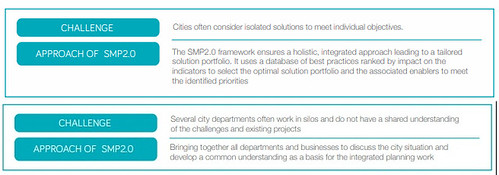
-- Integrated sustainable mobility in cities - a practical guide, Sustainable Mobility Project 2.0, World Business Council for Sustainable Development

While many large cities and metropolitan government coordinating organizations espouse sustainability principles, when it comes to transportation policy and practice, most US cities with some exceptions continue to prioritize the motor vehicle.
Sustainable mobility planning challenges
Sustainable mobility planning challenges in cities.


4. Boston. An example of the necessity of figuring out how to integrate for profit providers  is the introduction of dockless bike sharing to the Boston area.

The City of Boston created the Hubway bike system, originally serving Boston, Brookline, Cambridge, and Somerville in 2011 -- now it's called Blue Bikes with Blue Cross as the primary sponsor.

Boston's bike sharing program has been exemplary in at least two dimensions.  They've been pioneers in providing discounted access to low income residents.  And somehow they've gotten universities like Harvard to buy into the program and pay for stations, thereby expanding the reach and value of the program.

This year, various dockless firms have entered the Boston metropolitan market and while LimeBike and Spin have avoided placing bikes in those communities that offer Blue Bikes, Ant Bicycle, a firm local to the region, hasn't, and Boston has been seizing Ant bikes that are deposited in the city ("A bike-share border war has started in Boston," Boston Globe).

First, this raises the general problem that the local government bike sharing programs are seemingly cross-jurisdictional but aren't. There is a common brand, but each jurisdiction joins and operates separately, independent of the MPO.

AntBicycle.  Jessica Rinaldi, Boston Globe photo.

Second, from a MPO/MTA standpoint, planning for bike sharing should be done at the metropolitan scale.

Third, with the anarcho-capitalist introduction of dockless bike sharing and e-scooter sharing, somehow these anti-regulation types need to be bridled and brought to the MPO/MTA table, because transportation modes are supposed to be integrated into a system.

Fourth, the traditional bike sharing programs probably ought not to be allowed to be super anti-competitive like Boston seizing bikes.

Although that being said, there are many problems with the dockless bike sharing business model ("Shared Economy Business: Fixing Its 'Genetic Disorder'," Eurasia Review) and it's not necessarily clear that any of these businesses will be around in the intermediate to long term, without venture capital subsidy--plus they are an expensive way to get around comparatively speaking, and they aren't likely to be used much for regular transportation, therefore obviating the need to support their introduction.

=====
Reorganizing governance at the metropolitan scale.  Note that the problem with MPOs and MTAs is a subset of a bigger problem, that "center cities" have reorganized as metropolitan areas (what Brookings Institution calls the "Metropolitan Revolution (book review)," Peter Muller, "Transportation and Urban Form: Stages in the Spatial Evolution of the American Metropolis") but political and governance structures of these communities, except for those with merged counties and center cities like Indianapolis and a few others, haven't caught up (Toronto, but it has a big center city-suburban divide).  State legislatures and various jurisdictions aren't disposed to be supportive of such mergers.

Note that in cities like Montreal, London, Paris, and Thessaloniki, there is a hybrid form of this.  There is the "center city" as a whole, but it is also broken up into boroughs/arondissements, so that citizens are represented both city and borough governments.

Labels: , , , , , ,