Rebuilding Place in the Urban Space

"A community’s physical form, rather than its land uses, is its most intrinsic and enduring characteristic." [Katz, EPA] This blog focuses on place and placemaking and all that makes it work--historic preservation, urban design, transportation, asset-based community development, arts & cultural development, commercial district revitalization, tourism & destination development, and quality of life advocacy--along with doses of civic engagement and good governance watchdogging.

Saturday, September 28, 2019

National Public Lands Day, Saturday September 28th, 2019

(Always the last Saturday in September.)

-- National Public Lands Day

Separately from the book, This Land: HOW COWBOYS, CAPITALISM, AND CORRUPTION ARE RUINING THE AMERICAN WEST, mentioned in the previous post (also see the LA Times review, "Review: The American West is dying. Christopher Ketcham’s ‘This Land’ is a rallying cry to save it"), musician Gary Clark, Jr. has a song out called "This Land."  It's powerful  (Gary Clark Jr. talks Hollywood Bowl debut and making ‘This Land’: ‘I want to push all the buttons’," Orange County Register).".


And there is the famous Woody Guthrie song, "This Land Is Your Land" that we grow up learning and singing too.


Labels: , ,

Friday, September 27, 2019

National Public Lands Day: Saturday September 28th

Tomorrow is National Public Lands Day.

For most people, it matters most maybe because it's one of the days when entrance to National Parks are free ("You can go to national parks for free on Saturday. Or, you can volunteer. Perhaps both," Denver Post).

I've always wondered why this day isn't better leveraged in the DC area to drive volunteerism.

Many federal agencies own/manage public lands.  While public lands are all publicly-owned lands, perhaps when we hear the phrase "National Public Lands" we're most likely to think about lands controlled by the federal government, in particular National Parks and Monuments, lands controlled by the Bureau of Land Management, and national forests, managed by the Forest Service which is part of the US Department of Agriculture, wetlands managed by the US Fish and Wildlife Service.

But there are sites run by the government, facilities and recreation spaces in association with waterworks managed by the US Army Corps of Engineers, etc.

(Many states have state forest units as well as state parks groups.)

Trump Administration moves away from a conservation ethic.  Public lands been controversial for a long time.  Federal lands are caught up in various hard right disputes about the relationship of people to government, etc.

Some locals see federal rule as an intrusion, and economic interests outside of tourism agitate for cheap or free access to the land to support their various business endeavors (mining, logging, oil extraction, grazing).  Meanwhile, environmental and conservation interests prefer the lands be stewarded.

And the Trump Administration, which is vociferously implementing the anti-government agenda of the hard right,has made monetization of public lands a key element of its agenda.

One of the first acts of the Administration was to embark on a process to make certain national monuments smaller, to increase access to these lands for minerals extraction, logging, "recreation" that can damage lands (off road vehicles, etc.). .

Besides working to reduce the size of national monuments, open up lands and seas to oil drilling, redefining more narrowly the Endangered Species Act ("17 States Sue Trump Administration Over New Rules Weakening the Endangered Species Act," AP), narrowing the definition of "U.S. waters" to allow more pollution ("EPA announces repeal of Obama-era clean water regulation," CBS), they aim to relocate the BLM out west, to encourage regulatory capture by lands interests ("This federal headquarters is moving from D.C. to Colorado. Some Democrats are not happy," Washington Post)..

There is a new book out on the subject, This Land: How Cowboys, Capitalism and Corruption Are Ruining the American West. I haven't read it yet, but there's a great interview with the author, Christopher Ketcham, at The Intercept, "HIKERS, TRUMP, AND THE CAPITALIST CONSPIRACY TO RUIN PUBLIC LANDS."

Climate change and public lands.  Public lands and waters are "the lungs of the earth," and climate change severely stresses our environment (an understatement).  Further stressing the environment by allowing more pollution, etc., makes things worse.

One way this is evident is toxic algae blooms in lakes.  The algae is stoked by fertilizer runoff, mostly from agriculture.  The water becomes unusable as a result.  Not just for recreation, as has been the case with some lakes in New Jersey this past summer, but for drinking water.

Misuse of public lands, places, and resources.  In response to celebrity selfies showing a disregard for heritage trees by Miley Cyrus ("Photos of Miley Cyrus raise concern about Joshua trees," Newsday), an Instagram stream #publiclandshateyou and website was created to draw opprobrium to similar cavalier treatment of public lands ("The vigilante shaming influencers for bad behavior in national Parks," Guardian).

But there are plenty of other examples.

Public Lands Day could be a good day to bring more attention to "Adopt-A-Space" programs, be it trails, roadways, streams, channels (Orange County, California has an Adopt A Channel program), transit stops, or bike routes, an idea I recently proposed, etc.

Labels: , ,

Saturday, October 06, 2018

Commodification of the public realm: when does incorporating advertising into government/public spaces and programs cross the line?

======
Update: Over the weekend, riding past the old Carnegie Library in DC, which is being converted to an Apple Store on the ground floor, although public uses will remain on the second floor, is another example of a community ceding control of a premier civic asset and element of the public realm to the private sector.

-- "Apple offers first peek at plans to convert D.C.’s Carnegie Library into new store," Washington Post

Washington Public Library
======

I was going to write something about this last month, hearing that NASA was looking at advertising and other forms of sponsorship around the space program ( "Corporate Sponsors for NASA? Agency to Study Making Space for Advertising," New York Times and"Commentary: Should NASA Sell Ads?," Air & Space Magazine)

Alongside the campaign of Dominos Pizza to fill road potholes "so the pizza in your won't get bumped by a poor quality ride" ("Why Domino’s Pizza Is Fixing Potholes Now," CityLab).

While the ad campaign shows the company doing the work, it's actually a grant program offering $5,000 to as many as 20 locations. They're getting a lot of press for $100,000.

-- Domino's Paving for Pizza

It reminds me of the old line during the Vietnam anti-war campaign: "t will be a great day when our schools get all the money they need and the air force has to hold a bake sale to buy a bomber."

Both are indicators of failure to support through taxes and programmatic priorities public programs and priorities.

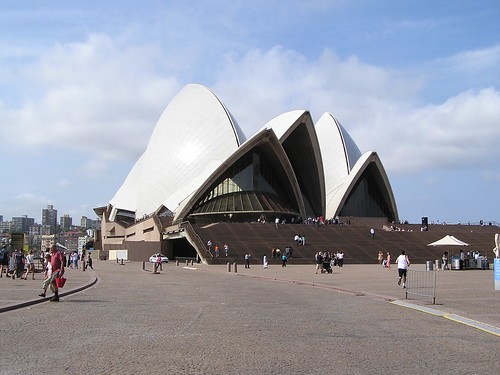
But the Sydney Opera House being forced as the result of a campaign by a radio shockjock DJ and the local newspaper which publishes a newspaper on horse racing to display promotions on the facade of the building might take commercialization and commodification of the public space to a new level ("'It's not a billboard': anger at use of Sydney Opera House for horse racing ads" and "Sydney Opera House ordered to display horse racing advertising on its sails," Guardian). From the second article:
The NSW government has ordered the Sydney Opera House to display a racing trophy with the word Everest on it and jockey numbers and colours on its sails in contravention of a policy to prevent the commercialisation of the building.

The decision by premier Gladys Berejiklian came late on Friday afternoon after intense pressure from the Daily Telegraph and 2GB’s Alan Jones to accept a plan by Racing NSW to promote the Everest Cup on the iconic landmark.

Racing NSW applied to the Opera House to use it as a venue to promote a horse race on Saturday 13 October, but Sydney Opera House chief executive Louise Herron drew the line at projecting horses’ names, the name of the race and the numbers of the barriers onto the Opera House sails.
The building is an architecture icon of the brutalism style and is a UNESCO designated heritage site.

The building
Sydney Opera House

With an artistic projection
Sydney Opera House, "77 Million Paintings," by Brian Eno, projection as part of vivid Sydney Festival
SYDNEY, AUSTRALIA - MAY 27: The Sydney Opera House sails are illuminated on opening night of the 2011 Vivid Sydney Festival on May 27, 2011 in Sydney, Australia. The annual festival offers many free and ticketed events as port of it's program and runs until June 13. (Photo by Mark Nolan/Getty Images)


rendering of the racing promotion
Sydney Opera House with renderings showing horse racing promotion displayed on its sails

The commentary about NASA by Bob Garfield, a journalist covering the ad industry, makes the point that "we should admit how much we allow commercials to intrude in our lives."

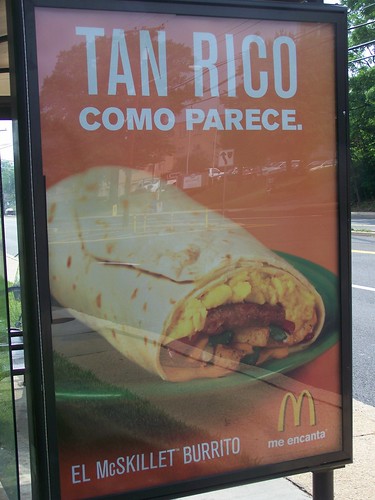
Ad at a bus shelter on Queens Chapel Road in MarylandBut that isn't the point. It's not about all the different places that "commercials intrude" it's about actively inserting commercial messages on public property and public goods.

I argue there is a difference between an ad in a bus shelter--which is a public facility installed in public space--and an ad projected on a rocket being shot off into space, or an advertising message being projected on one of the world's most iconic buildings, one that is publicly owned.

-- Adbusters Media Foundation
-- "Creating Sense of Community: The role of public space," Jacinta Francis, Billie Giles-Corti, Lisa Wood and Matthew Knuiman, Journal_of_Environmental_Psychology 32(4):401-409 (2012)

I made similar arguments when for a fair amount of time, the city argued that the only way we could pay for a full rehabilitation and improvement of the central library was to build market rate space on top of it.

A city's central library, city hall, and a handful of other buildings are the premier facilities defining the public realm and public goods and shouldn't be seen as merely another building nor as an opportunity to make a buck.

That being said, there are plenty of ways to "make a buck" integrating commercial space and activities, when appropriate, when it complements and extends the mission of the program, as I suggested in expanding beyond a straight up library to a major library, media, and cultural center ("Civic assets and mixed use").

Kaid Benfield's CityLab article, "The Important Difference Between a Public Space and a 'Common'," discusses these issues in terms of "the commons." He distinguishes between different types including environmental commons (lakes, rivers, natural spaces, etc.) and urban commons, writing:
By definition, the commons of people habitat is mostly found in urban areas – cities, towns, and suburbs – where about half the world and over four-fifths of Americans reside. Its most visible manifestation is in our shared public spaces: streets, parks and plazas, libraries, schools, waterways, public transportation, public markets, courthouses, and so on. I would certainly include some privately owned and managed sites of public significance such as places of worship, private museums, sports and cultural venues, and university campuses open to the public.
While there is no question that "commerce is the engine of urbanism," and that commercial spaces often comprise our network of "third places" (Ray Oldenburg), there is a hierarchy of spaces in the public realm where "the intrusion of commercials" are seen as intrusions and costs, not benefits.

Labels: , , ,

Tuesday, February 10, 2015

It's reasonable for public space facilities to charge "for profit" space users more money to rent the space

Apparently Neal Schon of Journey who married Michaele Salahi of Real Housewives of DC fame is suing the City of San Francisco because they were charged more money ($240,000) than originally quoted ($58,000) to rent the Palace of Fine Arts for their wedding service and reception, which they then broadcast on pay-per-view.

I don't see any problem in charging the couple more than the standard rate for wedding rental, since they were using public space for pecuniary and private gain. Although they seem to have been charged more than the "standard" for profit rates listed on the rental schedule, which probably needs to be updated in terms of a three-tiered schedule (nonprofit and personal rates, businesses, and people/businesses charging people using the space).

Labels: ,

Friday, August 22, 2014

Commerce as the engine of urbanism and parks

A couple weeks ago the Wall Street Journal had a good article on parks, "Cities' Message to Young Families: Play and Stay--New Features Include Parks, Playgrounds and Beer Gardens," and I was struck by the description of what we might call a blending of business and park, specifically food and beverage service, and that "beer gardens" are the most in-demand feature of new parks.

I guess it makes sense, given the historical connection to beer production, that Milwaukee County in Wisconsin has beer gardens in some of their parks, and a traveling beer garden park promotion program.

This reminds me of the comment by Professor Alex Wall, who wrote a book about Victor Gruen, one of the leaders in the development of shopping malls, which is:

"Commerce is the engine of urbanism."

The flip side is something that they teach in "Main Street Approach" commercial district revitalization training about "events" that there need to be four components:  something to buy; something to do; music; and something to eat.

In short, it's about "activation" but also enabling people to refresh themselves.  Sometimes that means eating.  Other times that means going to the restroom.  But when people can refresh themselves they can also stay longer.

Two entries back I mentioned the Mosaic District in Merrifield/Fairfax.

There is a big green, bracketed by a movie theater with an outside screen for open-air screenings, such as cartoons on Saturday mornings.

The "beer gardens" are on the perimeter, a bunch of restaurants with patios, although the movie theater also has outside food service, plus there is a coffee house building set up separately, supporting the green, and the coffeehouse brackets splash fountains for children and is set up like a beach, but without sand, with Adirondack chairs.

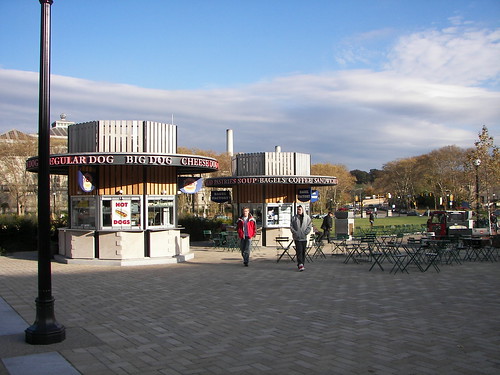
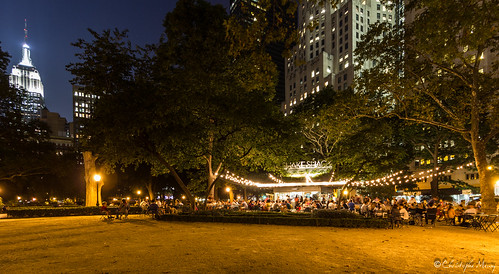
Food booths at Schenley Park, Pittsburgh's Oakland Cultural DistrictThis also reminds me of how food shacks, like Shake Shack in Madison Square Park, food service at Bryant Park, both in New York City, are essential activation elements in those parks.

And in Schenley Plaza in Pittsburgh (pictured at right, but in late fall) as well.

Traditionally, we have been unable to do this in many equivalent spaces in DC because they are run by the National Park Service and subject to various laws and regulations limiting "non-park activity."

Unfortunately, the Park Service has had a difficult time creating a differentiated set of policies for urban parks, which are also complicated by the fact that many park spaces are subject to specific Congressional mandates.

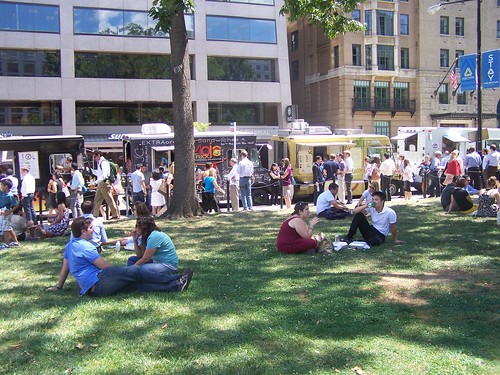
For some of these NPS parks downwotn, the rise of food trucks has filled the breach, and they converge on various downtown parks and set up shop during lunch time.

People lined up for Food Trucks, Farragut SquarePeople lined up for Food Trucks, Farragut Square

I noticed when we were in Salt Lake City that while Liberty Park doesn't have a food stand within, there looks to be a great cafe just across the street, the Park Cafe.

Being more liberal about commercial uses in spaces abutting parks is one way for cities to get around strictures they might have about for profit operations and food services within park spaces.

Salt Lake City's Pioneer Park is also home to the Saturday Downtown Farmers Market, which in my opinion has to be one of the top 15 farmers markets in the U.S., competitive maybe even better than Portland's and better than the Greenmarket in Union Square in NYC.
Shake Shack Madison Square by night

Shake Shack Madison Square by night by Christophe Meusy, on Flickr.

Labels: , , , , ,

Tuesday, July 30, 2013

The Right to the City and Istanbul

Considering the discussion on "the right to the city" in the previous entries, it's fortuitous that Taylor and Francis, publishers of the journal City: analysis of urban trends, culture, theory, policy, action, are providing open access to the journal article, "Reclaiming the right to the city: Reflections on the urban uprisings in Turkey."

It's not absolutely scintillating, but does raise important issues concerning public space, organizing, authoritarian rule, and participation.

Abstract:

The spark that drew Istanbul into a fire of protest and uprising was initially set off by a modest ‘occupy style’ peaceful resistance, staged against the destruction of an historically public park, an urban commons, in order to make way for yet another shopping mall in Istanbul. Following explicit police violence against the protestors, who were openly discredited by the government for being a few looters, the urban centers of Turkey saw a full-fledged uprising, gathering considerable international steam as well. Analyzing the path of this social mobilization flowing from Gezi Park to larger geographical scales of the urban, the national, and beyond, this article situates the urban uprisings in Turkey in the conceptual background of the right to the city, coined by Henri Lefebvre at the time of Parisian uprisings in 1968. The article further argues in the end that, if this revolutionary energy is to be channeled into a lasting social transformation, the Kurdish movement and the labor movement—historically, the two main motors of Turkey's democratization—should catch up with the protestors on the ground.

Labels: , , , , ,

Thursday, July 19, 2012

Brandalism: UK public art-public space project

See "Brandalism: Street artists hijack billboards for 'subvertising campaign'" from the Independent, the Brandalism website, and "Brandalism,” The World's First Collaborative Act Of Ad Subversion" from Fast Company Magazine.
Space Hijackers, Olympic Village, East London, brandalism billboard
Space Hijackers, Olympic Village, East London. One of the complaints about the Olympics in London is that people and organizations who don't pay big fees to the Olympics can't use Olympics-related words in advertising and other settings. E.g., see "Who’s ripped off now?: Sponsors get very, very angry about other people being allowed to play with words" from the Financial Times.

Just loot it, Bill Posters brandalism billboard
Just Loot It, Bill Posters.

Labels: , , , ,

Tuesday, July 12, 2011

Public space as a venue for marketing

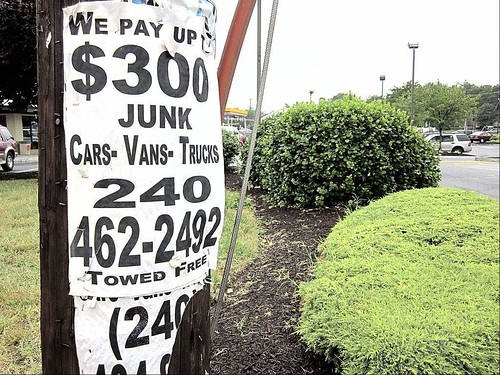
Again, in a capitalist society, we can't expect spaces to be free of marketing, advertising, and other forms of commodification. Some of it is simple if aggravating, such as the illegal posting of signs on telephone poles and other places in the public space.
Illegally posted signs on telephone poles
Natalie McGill/The Gazette Cheverly municipal code enforcement officials say signs like this one found on a Riverdale Road light pole in Riverdale Park are examples of the type of posters their employees try to crack down on with fines and warnings.

While the sign above was in Cheverly (see "Illegal signs slapped with fines, warnings in Prince George’s towns: Companies hard to trace, municipalities say" from the Gazette), I regularly rip down signs like this in my neighborhood.

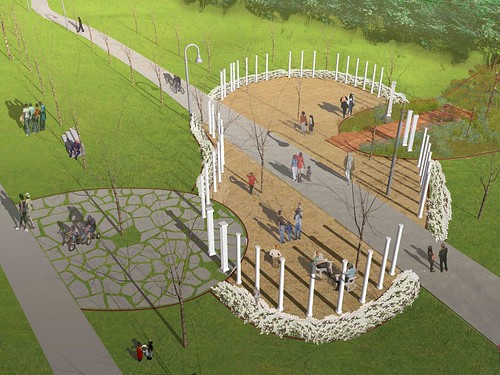
In a more troubling development, a pocket park at 50th Street and Nannie Helen Burroughs Avenue in Northeast DC is becoming the site of a park installation in the shape of a peanut, sponsored and paid for by Planters Peanuts.

From the press release "MR. PEANUT GOES TO WASHINGTON! PLANTERS and The Corps Network “Plant” New Urban Park in NE Washington, D.C.":

As part of Planters 2011 “Naturally Remarkable” Tour, Mr. Peanut arrives in Washington, D.C. – by way of his new biodiesel Nutmobile – to open a new urban park, a Planters Grove, in Northeast D.C. U.S. Congresswoman Eleanor Holmes Norton, Washington, D.C. Mayor Vincent Gray and other local dignitaries join Mr. Peanut and community members to celebrate the new park on Tuesday, July 12, 2011 with a day of volunteer planting.

The Washington, D.C. Planters Grove — located at 50th Street and Nannie Helen Burroughs Avenue, NE — is the second of three peanut-shaped urban parks to be built in the U.S. this year in partnership with The Corps Network, the national member organization for Service and Conservation Corps. As part of its Tour, Planters is transforming underdeveloped and underutilized urban land into vibrant, green spaces in an effort to advance the brand’s values of healthy lifestyles and sustainability.

“Peanuts are truly a ‘naturally remarkable’ food. They have a rich American heritage and, in many ways, are both good for you and good for the earth,” said Scott Marcus, Senior Brand Manager, Planters. “Planters is excited to work with the local D.C. community to create a natural space in our nation’s capital that celebrates the peanut and promotes healthy living and sustainability.”

Ken Smith Planters Parklet for DC
The press release goes on to discuss how the "peanut shaped park" "features unique elements that promote sustainability and reflect the neighborhood's unique culture and heritage."

It's a peanut shaped park designed to promote Planters Peanuts. It's not about local elements, resident involvement (other than helping with the planting), and the neighborhood's unique culture and heritage (other than maybe a commonality of ideas about work and vocational education between Nannie Helen Burroughs and George Washington Carver).

Had Planters Peanuts given money to the park system to make a park, and had there been a public design effort to create the parklet, then it wouldn't be all about corporate marketing objectives.

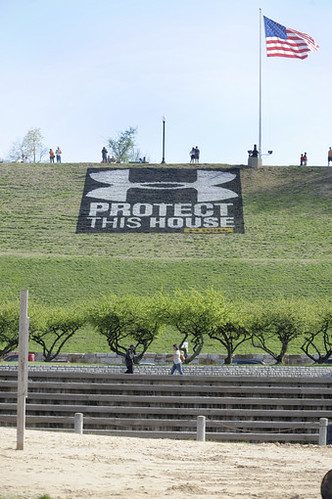
I know that local governments are desperate for money. But projects like these are definitely ones to avoid. Also see "Under attack logo disappears: Under Armour says it will replace paint with grass" and "'Welcome ad' not so welcome: Under Armour logo painted on Federal Hill irritates residents" from the Baltimore Sun, about how Under Armour clothing, a company based in Baltimore, did something similar in the Federal Hill neighborhood, under the guise of promoting a sports event held in Baltimore.

At least in Baltimore, the logo, granted much more blatant, was removed.
The Under Armour logo and slogan painted on Federal Hill in Baltimore.
The Under Armour logo and slogan painted on Federal Hill in Baltimore. Gene Sweeney, Jr., Baltimore Sun.

Labels: , , ,

Wednesday, June 22, 2011

More on privatized public spaces: CityCenterDC

Some day, maybe I will write a magisterial piece on this, maybe not. The issue is how do we plan for and include "public spaces" in communities when most of the development agenda is driven by private property owners, and public spaces under their control are not "free and open" to the public, but are subject to the rules and controls of the property owner.

Today's New York Times love-piece on the coming development downtown, CityCenterDC, "Blocks From the President, Developers Plan Big," does end with some remonstration about the "public space" within the project. From the article:

In their marketing materials, Hines and Archstone say they intend to provide “an authentic place for urban residents to socialize outside their homes.”

But some planning specialists have wondered if people in downtown Washington will view the plaza, which will be situated between the condo and rental buildings, as public space for them to enjoy. “Putting the plaza in the middle of a large development just feels more private,” said David Dixon, who is in charge of planning and urban design at Goody Clancy & Associates, a design firm in Boston.

Mr. Jacobson said the developers planned to offer programs in the plaza and would make it welcoming with public art and landscaping. “People will find it to be inviting,” he said. “I realize we have to convince some people. Hopefully, we’ll do a better job over the next year or so.”

When DC set out the requirements for the site, significant requirements for specialty unique retail were included in the development agreement. The article mentions the developers are seeking a branch of the Apple store, and back in the day, they were trying to land a branch of the Nordstroms Department Store.

Interestingly, and another interesting element of privatization and strictures on operations, because the primary owner of the development is now the real estate arm of the Persian Gulf state of Qatar, certain Islamic strictures are in play. From the article:

Even before the Qatari investors became involved, Hines and Archstone determined that leasing to banks would not help them create lively shopping streets, Mr. Alsup said. But as it happened, their hesitancy on bank branches meshed with the policies of their financial partners, who adhere to the restrictions of Shariah, or Islamic law, including the ban on collecting interest. Restaurants will be able to serve liquor, but retailers whose primary business involves selling alcohol will not be allowed, Mr. Alsup said.

Labels: , , ,

Thursday, June 02, 2011

Ground up (guerrilla) art #2: community halls and music (among other things)

(Image: BloomBars, on 11th Street NW in Columbia Heights, DC, from the Washington Post.)

A grad student has "conscientized" me about planning for the inclusion of spaces for connection and organization that aren't necessarily organized for "consumption" and consumerism and buying stuff. These spaces range from Tahrir Square in Cairo, where the Egyptian people organized, staged, and successfully brought down their disconnected and corrupt government, to a church meeting hall where local youths organize concerts. In DC two of these types of spaces are Electric Maid in Takoma Park and BloomBars in Columbia Heights (also see "D.C.'s BloomBars: An offbeat space where art and community combine" from the Washington Post)." In Brooklyn, there is this incredibly interesting project called 3rd Ward which is a space for all kinds of interesting activities.

In strong real estate markets it's very difficult to maintain these kinds of spaces because of the constant upward pressure on costs and demand, which crowds out these kinds of initiatives in favor of uses, usually for profit, that pay higher rents.

But it is these kinds of spaces that Jane Jacobs was thinking about when she wrote Death and Life of Great American Cities, and listed four key attributes of healthy cities, one being that four) that to be successful, cities require "a large stock of old buildings" which have been paid off and therefore have low running costs and low rents, and can be used to foster new ideas and innovative projects. (E.g., the 3rd Ward outfit calls itself "an incubator for innovation.")

I've written and spoken about this in the past in terms of "the arts" (e.g., "Arts, Culture Districts, and Revitalization") but I think we need to also plan for purposively and support financially these kinds of spaces in order to foster creativity and community outside of the profit imperative.
Hewitt & Jordan - The Economic Function.jpg
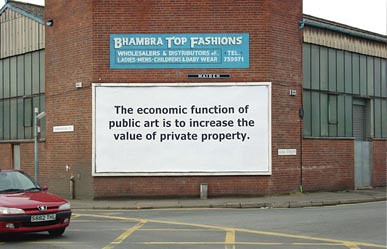
The Economic Function, Billboard text at the corner of Corporation Street & Alma Street, Sheffield S3. 6 April - 20 April 2004. The work by Hewitt & Jordan, 'The economic function of public art is to increase the value of private property' sets out to question the function of art in the public realm within the economic regeneration of post industrial cities.

Since by default the real estate developers are the creators of the world we inhabit, if we don't plan for these kinds of spaces, and provide funding streams for their maintenance, we'll never get them.

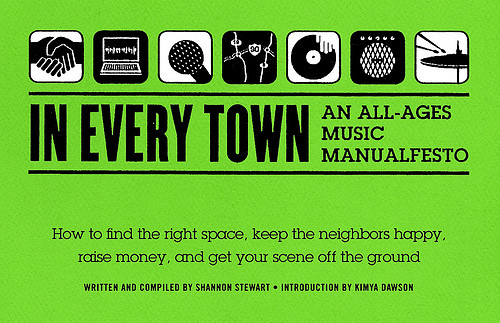
Anyway, I came across a book, In Every Town: An All Ages Music Manualfesto, which is an assistance manual for community music spaces. It looks like a pretty interesting resource.
In Every Town: An All Ages Music Manualfesto book cover

Labels: , , , , ,

Ground up (guerrilla) art #1: Artung ad attack, Montreal

In Montreal, public space activists and artists executed an "art attack" on advertising kiosks in the public space, replacing the ads with images. The project, called Artung, is in part a response to advertising companies suing one of the city's borough governments, Plateau-Mont Royal, for banning the ad kiosks (45 in all) from their streets. (FWIW, this borough has the most number of members in the Bixi system there, and the most progressive local government political party, Projet Montreal, has the majority of seats and control of the borough government.)

From "ARTUNG! TURNS 200 MONTREAL ADS INTO WORKS OF ART" of the This is not an ad collective:

100 ad pillars and billboards across Montreal, owned by Pattison, CBS Outdoor and Astral Media were replaced today with community artwork. Artwork was created by 200 Canadian and International artists and installed by fifty public space activists operating under the name Artung!.

“Today, we transformed Montreal's outdoor ads into public works of art to send a message to advertising giants: to stop threatening residents of the Plateau with an unnecessary legal battle and immediately remove their visual pollution from the whole of Montreal’s cityscape,” said Vanessa Moraless, an Artung! campaigner.

Artung!'s action comes in response to threats made by Montreal's advertising giants to take the democratically elected Plateau Mont-Royal council to court for a November 2010 decision to ban 45 billboards in the borough. Jeannot Lefebvre, the industry spokesperson, argues the ban goes against the advertising companies’ right to freedom of expression and they'll legally pursue it until it is reversed.

According to Projet Montreal, each billboard only generates $1,000 in taxes for the city, an insignificant amount of revenue compared to profits made by these multi-national outdoor advertisers. Artung! supports the borough's decision to take action against billboards and the 78% of residents of the Plateau who favoured the ban.

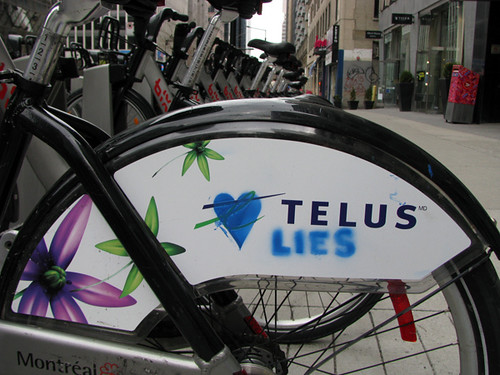
Erkin reminds us that Montreal activists, unnamed, also challenged Montreal Bixi's inclusion of sponsorship identification (advertising) on the bikes (and docks) upon this season's reintroduction of the city's bike sharing system. See "Bixi: from source of pride to target of vandals" from the Montreal Gazette and "Bixi ad backlash" from Spacing Montreal--the latter has a series of photographs of various graffiti attacks on the sponsorship identifications, illustrating a wide variety of messages and ideas that as the author of the piece says "have provided a new, mobile space for Montrealers to spread messages and/or express their creativity."
Bixi sponsorship ad backlash
Bixi sponsorship and vandalism, Montreal. Image from Spacing Montreal.

I'm of two minds about this. I understand why people are upset with "commodification of the public space" and the constant intrusion and escalation of the presence of advertising in more and more spaces in our lives.

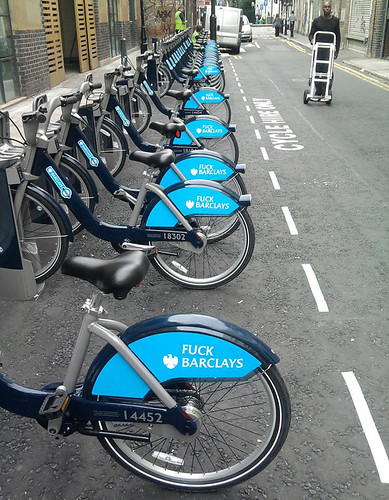
At the same time, part of my business is trying to sell bicycle sharing systems, and that involves, often, the sales of sponsorships and advertising (in fact, I want a map-advertising kiosk with two slots for advertising, not one, to be able to generate more revenue because the systems cost a lot of money to operate). E.g., while we didn't win the bid for the Chattanooga system, we lined up a commitment from a major banking corporation operating in the Southeastern U.S. to sponsor the system... of course, after we saw the first foray against ad sponsorship blocks on bikeshare bikes in London, we've had to add enhanced "graffiti" response plans to our operating programs...
Anti-Barclay protest stickers on bicycle sharing bikes, London

Labels: , , , ,

Saturday, April 30, 2011

Incredibly late notice conference this afternoon

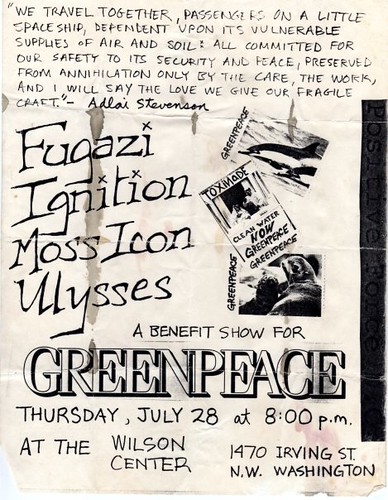
Fugazi, Ignition, Moss Icon punk hardcore flyer

I just got this in email 10 minutes ago. Sorry about the late notice.


When: Saturday, April 30 2011 @ 01:00 PM - - 10:00PM
Contact: Mark A wearefamilydc@aol.com, www.positiveforcedc.org
Where: 15th & Irving Streets NW
Washington, DC
Description: PM Press will be tabling at DIY Punk & Wilson Center: 30 Years of Community, Arts & Protest (1 - 10 pm, Saturday, April 30, 2011)

Often history is made in the unexpected places; the humble hole in the wall that provides space at the right moment for creation to flourish. The basement of the former Central Presbyterian Church at 15th & Irving Streets NW -- long known as the Wilson Center -- is one such location. Among other things, it provided a haven for members of the now globally-influential DC punk underground to hold shows and build community, and inaugurated a broader tradition of DIY shows held in community hall spaces.

In honor of this legacy -- and to continue it -- punk activist group Positive Force DC (now based at nearby St. Stephen's Church) has organized a 30th Anniversary celebration, April 30, 2011 at the former Wilson Center, now operating as the Capital City Public Charter School.

PF aims to both celebrate DC's DIY punk history and build on it through an exhibition of photographs, posters, and videos of past Wilson Center shows, as well as speakers, and, of course, music, all of which would help to raise funds, gather food donations, and recruit volunteers to assist the Capital City Public Charter School and neighborhood non-profits We Are Family and Hermano Pedro, serving seniors and the homeless, respectively.

The evening benefit show beginning at 7pm will include Max Levine Ensemble, Birds & Wires, War On Women, and Regents (all-ages, sliding scale admission $5-10, with food donations encouraged); at 5pm, Ian MacKaye will speak and answer questions on "Playing Underground: The Importance of Community Hall Spaces." (A full schedule of the day's events will be available shortly; except for evening concert, all events are free, with canned food and gently-used clothing donations encouraged for Hermano Pedro and We Are Family.)

This event is not meant to be about nostalgia, but about celebrating and continuing a crucial local tradition of creativity, community-building, and empowerment. Please join us!

TENTATIVE schedule for the day (Free admission except for evening concert, but please bring food and clothing donations for Hermano Pedro and We Are Family - thanks!)

1 pm: Doors open for art/photo exhibition in main hall and video display in back room - available for viewing all day.

2:30-4 pm: panel "Cultural Convergence: The Wilson Center as Multicultural Meeting Ground" (w/ Head-Roc, Lilo Gonzales, Natalie Avery, Wade & Ryan Fletcher, all invited, but tentative)

5-6:30 pm: talk/Q&A w/ Ian MacKaye "Playing Underground: The Importance of Community Hall Spaces"

7-10 pm: Benefit concert with Max Levine Ensemble, Birds & Wires, War On Women, Regents; all-ages, $5-10 sliding scale admission, all proceeds to Capital City Public Charter School, Hermano Pedro, and We Are Family.

PLUS: Special musical guests, vegan bake sale, and CDs, DVDs, and books! ALL EVENTS ARE FREE EXCEPT FOR EVENING CONCERT - BUT PLEASE BRING CANNED GOODS (WHOLE GRAIN CEREAL, PEANUT BUTTER, VEGGIES, BEANS, SOUP) OR CLEAN, GENTLY USED CLOTHING FOR DONATION TO WE ARE FAMILY AND HERMANO PEDRO - THANKS!

Labels: , , ,

Thursday, April 28, 2011

Sitting Outdoors and planning for small public spaces

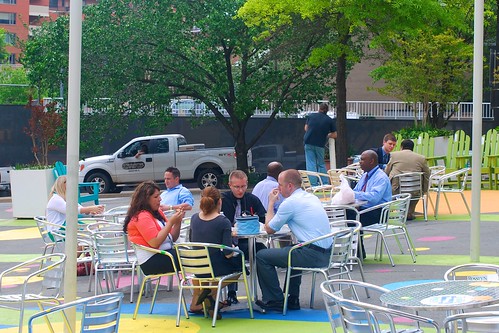
Sitting Outdoors by M.V. Jantzen
Sitting Outdoors, a photo by M.V. Jantzen on Flickr.

People sitting in the CentralSpace to CentralPlace plaza, created by the Rosslyn Business Improvement District in Arlington, Virginia. Flickr photo by M.V. Jantzen.

One of the things we don't seem to do very well is plan for small public spaces as part of our commercial districts and urban neighborhoods.

It's not that there aren't small pocket parks and such, there are, but often at least in DC they are the result of how diagonal avenues meet the more typical street grid of blocks and streets.

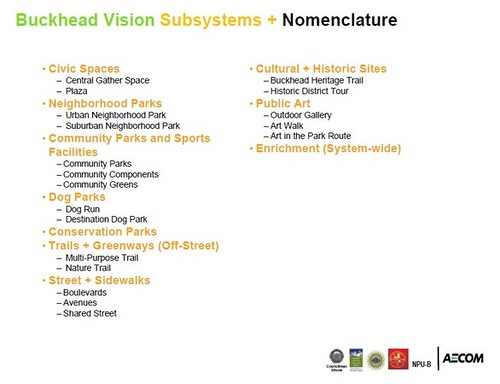
David Barth of AECOM's presentation on "Parks and Open Space System Master Plans: Tools for Sustainable Communities" provides a framework for a complete typology of parks and open spaces that a community should work to plan for.

AECOM is also doing a parks and open space plan for the Buckhead District in Atlanta, which provides a more targeted list of the right kinds of spaces needed in denser, urban places.
Buckhead Collection Parks planning initiative, nomenclature

In retrospect (although before today of course), I realize that we have inadequately planned for such places in NoMA, H Street, and Brookland, among other places, as part of the city's land use planning and transportation planning initiatives. Mostly, we didn't think about how to insert pocket parks and plazas as part of these processes, and now it becomes even harder to find the space, or buy it, as municipal budgets are increasingly stressed, stretched, and under pressure.

(Another dimension of this is incorporation of school playgrounds and greenspaces into the community parks network.)

The Sitting Outdoors photo shows us that the spaces don't have to be complicated or overly designed to be useful and appreciated.

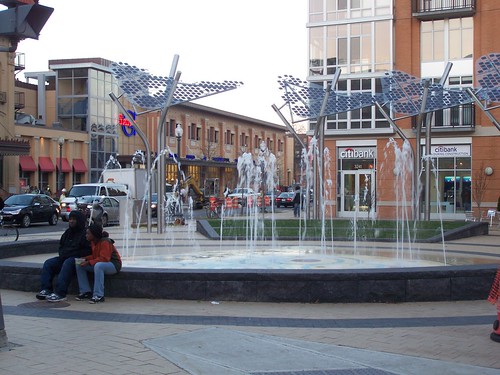
Although one part of the city where they have done a better job with this is in Columbia Heights, in the Columbia Heights Public Realm Framework Plan," which includes a cool public plaza at the convergence of a number of streets at 14th Street, about a block from the subway station and the big DC/USA retail center.
Fountain, Columbia Heights Plaza, 14th Street and Park Road NW, Washington, DC

Still, this becomes an important issue in another dimension in terms of how do we plan for public places and spaces in what are technically privately owned developments, but where the developments are specifically designed to connect to and extend the public realm, and to be for all intents and purposes, "public spaces," albeit privately owned.

One of the problems from a cultural studies or urban sociological standpoint is do all these spaces become privatized and commodified?

How do we maintain the ability for citizens to come together in public, as citizens, not as consumers, to congregate, to aggregate, to communicate, etc.

Or do we have to purchase goods and services to be able to use the space?
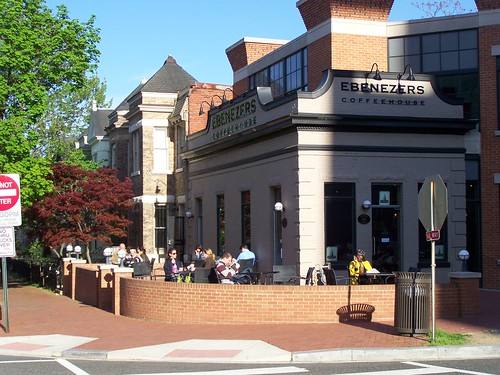
Ebenezer's Coffee Shop, 2nd & F Streets NE, DC
The patio is jumping at Ebenezer's Coffee Shop, at 2nd and F Streets NE, Washington, DC.

Will private property owners and managers only contribute to the quality of the public realm to the extent that the marginal returns from the investment in other revenues is positive?

And are methods for tracking marginal revenue contributions narrowly or broadly construed, which depending on the definition, from the standpoint of private sector expenditures, makes activities profitable or not in the context of the public realm and the public space..

Labels: , , , , , ,

Thursday, August 05, 2010

This filled pothole is sponsored by KFC...

This is an old story, but I just went through a cache of back issues of the Chattanooga Times Free Press and this story, "Chattanooga: In a rut? Chicken to the rescue!" caught my eye. For $3,000 (cities clearly are desperate), Chattanooga got enough money to fill 500 potholes. In return, an ad ("public service message") from KFC was stenciled onto the pavement. KFC offered the same donations to Louisville, Ky., Topeka, Kan., and Warren, Ohio.

Later, PETA offered to give twice as much money to Chattanooga, to be able to stencil their message, but the city refused. See "Chattanooga: PETA doubles the ante on pothole patches."

Photo by John Rawlston, Chattanooga Times Free Press. KFC advertising is stenciled onto a section of Ivy Street where city crews fixed potholes on Wednesday.

Labels: , ,

Tuesday, January 19, 2010

At best, National Harbor is equivalent to a shopping mall

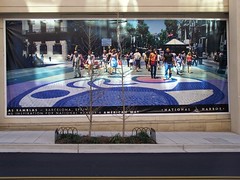
So the claims about the inspiration behind its design being Las Ramblas in Barcelona seem a bit specious.
100_0522.JPG
Large storefront sized banners are displayed on storefronts that haven't yet been leased out at National Harbor. This one compares National Harbor to Las Ramblas in Barcelona.

Finally went to National Harbor yesterday. Granted, in the winter there are many fewer people walking around, they aren't on the water so much, and there are few outdoor special events. (Although I imagine it was hopping during the special ice exhibit; "'Ice!' exhibit at National Harbor" from the Post.)

But it felt uncomfortable. Very little there isn't processed--chain restaurants, chain retail, and corporate stores like Peeps. And I can't imagine that any of the art galleries sell much art.
100_0528.JPG
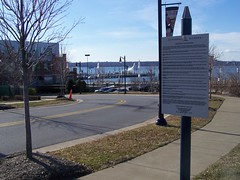
Make sure you follow the rules when you're at National Harbor. (Although to be fair, comparable rules are in place at shopping centers too.)

Afterwards we went to Alexandria, and the contrast was striking. Alexandria is far more interesting. Interestingly, because National Harbor is close to Alexandria and relatively "far" from the core of Washington, the information displays for tourist information, at least in the hotel, are the same ones used in Alexandria, and for the most part, feature attractions in that city, not DC.

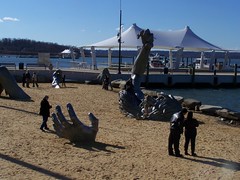
National Harbor, which is marketed as being "Washington, DC" has absolutely nothing related to DC, other than the Potomac River location and the old Awakening sculpture that was at Hains Point. Eventually, it will have DC's Children's Museum too--the museum, after having received tens of millions of dollars of support from DC Government, decamped a few years ago.
100_0493.JPG
The Awakening sculpture on the Potomac River at National Harbor.

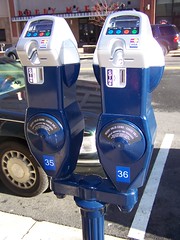
I did like how the parking meters (the complex has tons of parking structures, a couple hotels, and a time share "resort" building) have credit card readers built in.
100_0519.JPG

The commodification and reworking of the normal "National Experience" obtained by visiting to "Washington, DC" to better understand American Government, to instead promote the base sale of goods and service as "celebrating freedom" is pathetic but hardly surprising.
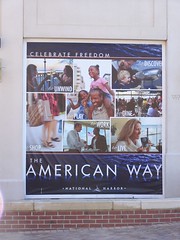
100_0501.JPG
A banner promoting consumerism as the high point of "the American Way." American Way is also the name of "the main street" in the complex.

This visit reinforced my earlier statements that Disney, opening a resort hotel at National Harbor, is doing no favors to DC (despite claims to the contrary by DC tourism officials). It's strictly a move to capture a share of the money people would normally spend traveling to and visiting DC.

Like how the Gaylord Convention Center cross markets the National Harbor property to convention clients that have stayed in their other properties such as in Nashville, like Disney will heavily market their "Prince George's shopping mall is really Washington, DC" location to customers who have visited their other properties, to divert these clients from staying in competitor locations, and spending their money at places like Marriott-branded hotels instead of lining the Disney pockets.
------------
The Las Ramblas comparison is "funny" because that place as an inspiration for National Harbor was suggested in a column in the Washington Post in 2005. The column inspired the following entry: (Why aren't people) Learning from Jane Jacobs, and later this one as a follow up: (Why aren't people) Learning from Jane Jacobs revisited.

This is a reprint of the first entry------------------------------

Michele Dyson is a (once or twice monthly) columnist for the Washington Post, writing about Maryland issues for the back page of the Outlook section. Last Sunday's paper had the column "National Harbor: Think Small to Make It Special," about the gargantuan development coming to Prince George's County along the Potomac River. From her piece:

National Harbor is the largest private investment in the history of Maryland. In essence, it's a $2 billion wager that carries enormous risk. Much of the county's economic future is at stake, along with Peterson's reputation and money. Peterson has said that National Harbor will be his version of Las Ramblas, the grand pedestrian walkway near Barcelona's port district. But Barcelona is Spain's second-largest city. It hosted the 1992 Olympics, and its port is one of the most important in Europe. Along Las Ramblas, a visitor encounters artists, a huge opera house, fabulous food, a red-light district and an open-air pet market. Does this sound like Prince George's County? (...)

Peterson built projects all over the region, but mostly in Northern Virginia. His office park, residential and mixed-use projects have been standard suburban fare -- office buildings off major highways, apartments, condos, townhouses, single-family homes and maybe a church or two. His big-box stores, gas stations and chain restaurants have come accompanied by the inevitable giant slap of a parking lot.


Peterson has built a lot of these cookie-cutter developments, and not much distinguishes one from another. That is until recently. Peterson's work in the revitalized area of downtown Silver Spring has residents and businesses speaking in glowing terms.(**) And his National Harbor model gives reassuring evidence that the prime riverfront property just might be in the right hands. The elaborate 8-by-10-foot model generates excitement.

But if National Harbor is to become a favored destination, like San Francisco's North Beach or Miami Beach's South Beach, it will have to generate a large base of loyal local regulars. It also will need out-of towners who are willing to make a special trip there. People make special trips because they enjoy the ambience and unique qualities of an area. Toward that end, National Harbor should forgo strip mall cuisine. If we are what we eat, National Harbor will be what it serves. Forget Starbucks and ESPN Zone, and think San Francisco's Cafe Trieste and our own Vienna Inn.

Neighborhood vitality and verve can be as long-lived as New York's Greenwich Village or as newly minted as Richmond's Carytown. These places flourish because their status as celebrated destinations helps recruit artisans, artists and small businesses. These in turn plant roots, take risks and build the kinds of enterprises that further enrich the physical setting. National Harbor can do no less. Chain stores won't fill its streets, but an outstanding assortment of accomplished small businesses might.
______
** (Actually I think that the "revitalization" of Silver Spring is no different from traditional urban renewal. It's not pedestrian friendly, and small businesses are losing out, so much so that Montgomery County is suggesting that additional incentives be provided to small businesses to preserve them.)
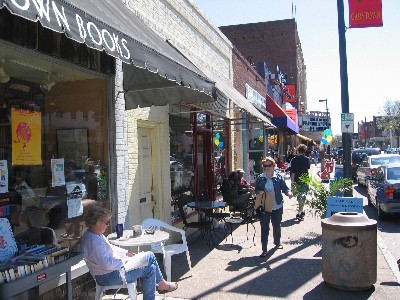
carytown3
Carytown photo by Steve Pinkus.

Like Ms. Dyson, I like Greenwich Village and Carytown in Richmond. In fact, Carytown is one of the more interesting commercial districts in the region--one that I've written about before. Yesterday's Richmond Times-Dispatch happened to have an interesting article on Carytown, entitled "Carytown: Where Change is Constant," about the ebb and flow of the retail businesses there.

And it included an incredibly important statistic--the average retail rent/square foot--In 1990, Carytown commercial rent was $10 a square foot. It's now about $18 to $20 a square foot.

National Harbor will be all new construction, meaning that prevailing rents will need to be a minimum of $60/sq. ft., and probably much higher (upwards of $120/sq. ft.). This makes it almost impossible to attract small businesses without serious subsidy.

One of the particularly grotesque aspects of the Inner Harbor in Baltimore is how, other than a couple local seafood restaurants like Phillips, it is now all chains--from ESPN Zone to California Pizza Kitchen. National chains, attracted by the large number of people-customers, have crowded out local businesses.

Sure the U.S.S. Constitution offers authenticity, but the Inner Harbor is for and about tourists, with little in the way of other authentic experiences.
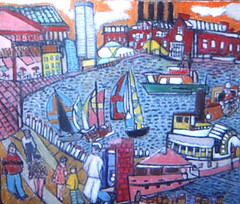
Baltimore.InnerHarbor.jpg
Would that Inner Harbor really looked like this. Title: Inner Harbor Media: Oil on Canvas, 1998. Size: 25" x 30, not framed. By Sy Mohr.

The rent statistic is interesting in another way. Even in "marginal" commercial districts in DC, such as H Street or Brookland, the floor of asking prices for rent is probably greater than $20/sq. ft. And these are for commercial districts far less successful than Carytown. This is why we need to be much more purposive in developing and incubating independent businesses.

One of the four rostrums from Jane Jacob's Death and Life of Great American Cities is the need for "a large stock of old buildings." This isn't because she is a preservationist, but because old buildings have lower carrying costs, particularly debt service, and this allows for the incubation of new businesses--retail, office, and other (it's part of the Richard Florida equation supporting the development of creative businesses).

This gets back to the point I make over and over again--the rule of thumb from the Main Street Approach is that a retail business pays 4%-10% of its annual revenues in rent (restaurants can and do pay slightly more). Figure it out backwards from what businesses can reasonably generate in revenues... yet the asking price for commercial buildings, asking prices for rent, and often the property tax assessments are completely out of whack compared to the revenue stream that successful businesses are likely to be able to generate.

This is why salon shops are dominant in many of the neighborhood commercial district, because they have a customer base that returns again and again, and the average transaction is high (a woman can easily spend $50-$150 getting her hair done) in comparison to the average retail business.

I agree that many of the retail businesses in our commercial districts are marginal, but they need help both to improve to be able to sell more, and the commercial districts need to improve more as well, in order to be able to draw greater numbers of patrons.
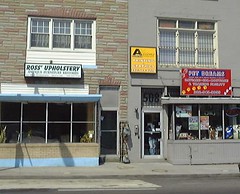
hstreetsign2
The place next store is available for rent! 500 block of H Street. Photo by Michael Berman.

Las Ramblas is a real city built up over centuries. When you build a development all at once, you can't have the ebb and flow of innovation, because high rents are the one uniform condition of such development.
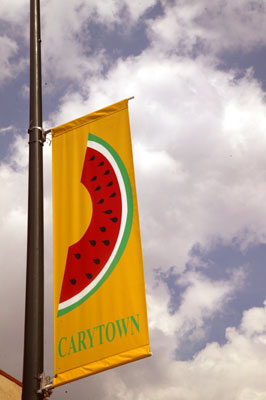
carytownbanner
The Carytown Watermelon Festival is a big street festival involving many of the merchants on the street. It's scheduled for Sunday August 10th.

Speaking of rents, last Wednesday's New York Times had an article, "Columbus Ave. Distances Itself From Broadway," comparing Columbus Avenue to Broadway, and how "more personal unique" chains are locating on Columbus vs. the big chains (Barnes and Noble, etc.) on Broadway. The retail rents on Columbus Avenue average $180/sq. foot. That means that for a 2,000 sf. space, the store needs to generate at least $3.6 million in annual sales...

[Added 7/2008, also see the New York Times article, "Offering Big Spaces, Amsterdam Avenue Is Catching More Retailers."]

------------
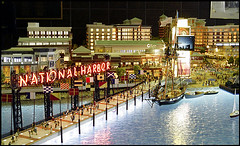
In order to ensure some taste of the center city, National Harbor ought to build and install a model of Washington, DC or some of the monuments and attractions and put it in a window for people to gawk at, just as people were gawking at the model of National Harbor installed in a vacant storefront window on "Fleet Street."
PH2005072201530.jpg
Photo: Preston Keres/The Washington Post. County unveils a $400,000 model of what the National Harbor project will look like.
Labels: , , , ,

Wednesday, September 16, 2009

PARK(ing) Day DC: Friday, September 18th, 2009

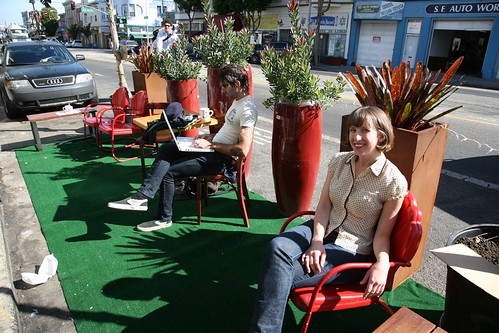
PARK(ing) Day by Laughing Squid.
San Francisco Park(ing) Day, 2006. Photo by Scott Beale / Laughing Squid.

From Justin Young (with editing):

Garden District Saves PARK(ing) Day DC

Washington DC's participation in the international event PARK(ing) Day, has been saved thanks to local garden shop Garden District. The original plan was to turn 4 on-street parking spaces into parks for the day around the city. However, complications with obtaining permits made this plan impossible. (See this entry, "DDOT being narrow-minded and overcautious on Park(ing) Day," from Greater Greater Washington about the debacle. OTOH, if you want to challenge the system challenge the system, and take the space...)

Garden District is in the process of moving to a new location across from its current outpost at 14th and S Street NW. The location was previously an auto shop and includes a large surface parking lot.

The PARK(ing) Day DC team will convert a portion of this lot into a park for the day, between the hours of 11AM and 9PM. This park will be larger than the original 4 spaces combined. Please come by and enjoy the green space with your friends or pet! Listen to music, play games, read a book and enjoy some refreshments.

Park(ing) Day was originally created by Rebar, a San Francisco art and design collective. PARK(ing) Day is an annual, one-day, global event where artists, activists, and citizens collaborate to temporarily transform metered parking spots into “PARK(ing)” spaces: temporary public parks.

PARK(ing) Day DC is being organized in Washington, DC by ReadysetDC and F1rst-n-R. ReadysetDC is a blog + collection of creative projects aimed at creating awareness of everything amazing in DC, including urban development, culture + art. We seek to be a source of inspiration + a spark for discussion. F1rst-n-R is the web site of Brandon Schmittling and exists to centralize his activity in Washington, DC and specifically the up-and-coming area known as Bloomingdale.

Garden District is an urban garden center with two shops located minutes to each other providing quality plants, pottery and solutions. We can help you enhance your landscape, start your herb garden or find the right plant for your home or office.

Labels: , , , , , , ,

Tuesday, August 25, 2009

Gutsy Montgomery County, their art fair and promoting quality public spaces

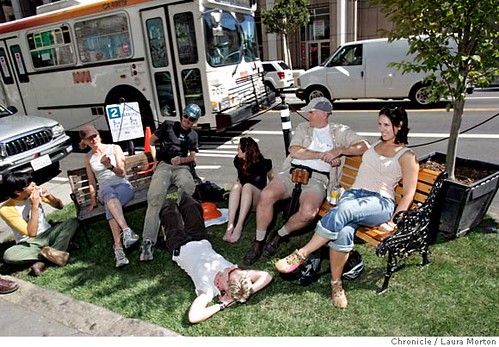
Port-a-park: A temporary park was set up in a parking space on Mission Street by Rebar, an art collective.
Park(ing) Day in San Francisco, 2007. San Francisco Chronicle photo.

Magical Montgomery is the equivalent of Montgomery County's Artscape, an art and crafts fair that also promotes local arts and cultural organizations, and is held in Downtown Silver Spring, on Ellsworth Drive. Here's a gutsy move, promoting the temporary conversion of using public space normally devoted to automobiles for people.

This was pioneered as a "performance art" project of the Re:bar group in San Francisco. I just can't see something this creative being promoted by a government related entity in DC...

From the Public Arts Trust, Arts and Humanities Council of Montgomery County:

Go green.
Create a PARK(ing) spot at Magical Montgomery!

To celebrate Park(ing) Day 2009, the Public Arts Trust would like to invite individuals, groups and organizations to create temporary "parks" in parking spots on Ellsworth Drive during Magical Montgomery Festival on September 26, 2009.

What can happen in a Park(ing) spot? You name it -- it has probably been done: sculpture park, a poetry reading, a finger-painting studio, a public back porch, a DIY lemonade stand, a lawn bowling course, a public beach, a worm composting demo, a public kiddle pool -- let your imagination run wild! The rules are that it all has to fit within a parking space and be open and free to the public!

AHCMC will have space for 3-4 Park(ing) spots alongside the booths on Ellsworth Drive. Funds are available to help with the cost of materials based upon the proposed parks.

Please visit Public Arts Trust or contact Susie Leong for more details.

And Park(ing) Day 2009 website for more information on the general event.

Labels: , , , , , , ,

Street cleaning and city services (eating my words)


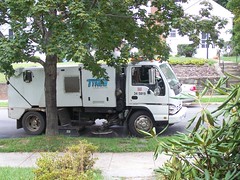
Street cleaning
Originally uploaded by rllayman
Ironically, in a meeting and in email today I discussed how typically cities lack the resources to provide a high degree of services to any particular street or subdistrict, that if you want your commercial district or block to look good, you have to step up and pitch in. And the fact is that it is true. Maybe once a year we get some of this kind of service on our street. In the meantime, I pick up trash virtually every day, when I am out and about between home and the subway station or the bus stop or while running errands.

Still, today the city DPW was out tending to our street.
100_8449.JPG

My general point, especially regarding commercial districts, remains true. If you want regular cleaning comparable to a shopping mall, you better come up with a plan. It's one of the reasons why business improvement districts, funded with an assessment on property taxes, have been created.

In the case of special spaces, such as pocket parks and similar places, you better come up with your own plan and even a landscape plan, because you can't expect the Dept. of Parks and Recreation to regularly maintain the space, or to maintain it according to what's planted there, such as flowers. Expect clearcutting and plan accordingly. Or, develop a memorandum of understanding with the agency and take care of it yourself.

After all, it is your neighborhood or commercial district that has to deal with the consequences of poorly maintained physical spaces. At the end of the day, a failure to execute in your neighborhood or commercial district has little consequence for people who work for local government (at least in a city like DC).

Labels: , ,

Wednesday, March 25, 2009

Streets as advertising places

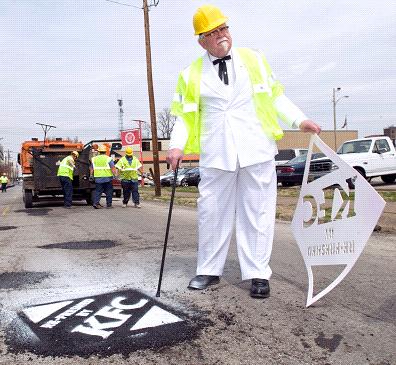
The Reuters blog, in "Pothole filling that’s finger-lickin’ good," reports that the fast food company KFC is offering 5 U.S. cities financial support for filling potholes in the street, provided the filled pothole is branded with the KFC logo and notice that KFC paid for the repair.
KFC fills potholes
Image: KFC via Reuters.

Do desperate times justify more commodification of the public space?

Labels: ,