Rebuilding Place in the Urban Space

"A community’s physical form, rather than its land uses, is its most intrinsic and enduring characteristic." [Katz, EPA] This blog focuses on place and placemaking and all that makes it work--historic preservation, urban design, transportation, asset-based community development, arts & cultural development, commercial district revitalization, tourism & destination development, and quality of life advocacy--along with doses of civic engagement and good governance watchdogging.

Monday, March 09, 2026

10 good things about Metro Transit (Minneapolis) — including one that’s simply priceless

Article 

Chances are if you’re reading about Metro Transit in the Minnesota Star Tribune, it’s because something bad happened. The system’s been plagued by high crime, low ridership, rampant fare evasion and an ever-ballooning billion-dollar budget. But there are good things to be said about the buses and trains, and at the risk of looking for lutefisk at a taco truck, I went out to find them.

My goal was to find 10 such positives — and who would know better than those who regularly ride the system? To my surprise, riders unhesitatingly offered them to me when I asked around one day last week. Here are their responses

  1. Help is never far away
  2. It's sometimes faster than a car
  3. It goes to all the right places and you can track it
Target Field Station.

4.  It's clean and warm
5.  It's clean and there's usually someplace to sit (bus shelter improvements)
6.  Bikes are welcome (bike + Transit a good combo)
7.  Some buses run faster than trains
8.  It runs frequently enough
9.  It gets us everywhere we need to go
10. It's Cheaper than owning a car

Labels: ,

Sunday, August 24, 2025

Las Cruces (NM) Airport Master Plan | Airport Master Planning

 My writings about airport planning are pretty much limited to asking for there to be a transportation demand management plan as an element of a master plan.

-- "Manhattan Institute misses the point about the value of light rail transit connections to airports | Utility and the network effect: the transit network as a platform ," 2020
-- "Airport transportation demand management in flux," 2019
-- "Transportation demand management, transit: Los Angeles Airport (LAX) and Logan Airport, Boston," 2019
-- "London's Stansted Airport provides digital information on transit options," 2019
-- "Why not a bicycle hub at National Airport?, focused on capturing worker trips but open to all," 2017
-- "A brief comment on ground transportation at National Airport vis a vis VRE rail service," 2016
-- "Revisiting stories: ground transportation at airports (DCA/Logan)," 2017
-- "Airports and public transit access: O'Hare Airport and the proposed fast connection from Downtown Chicago," 2018
-- "More on airport-related transit/transit for visitors," 2013
-- "To and from origin stations can be difficult: More on the Silver Line and intra-neighborhood transit (tertiary network)," 2022

The Las Cruces plan is interesting in that they list economic development matters as a primary goal.  That's not that exceptional, but they way they lay it out may be.

A Vision for Las Cruces International Airport (LRU) 

The Las Cruces Master Plan process is built on eight guiding ideas that have been used to develop the overall vision for what LRU will be in the next ten years. Through the implementation of this plan, LRU will be: 

  • Safe for all users
  • Welcoming and supportive of business
  • A hub for regional, national, and international tourism
  • A center of education and job development
  • Supported by the City
  • In position to be an economic development engine
  • Supportive of Aviation and Commercial Aerospace
  • Important to the people of the Las Cruces region

-- "Economic impact of National and Dulles Airports," 2014
-- "Trial balloons in the Washington Post and Dulles Airport as an aerotropolis," 2013
--"Aerotropoli and rethinking the scale of mobility networks in the context of a global economy," 2013
-- "Do tax incentives pay off? : Illinois; Tennessee; Rosslyn + "The Airport Access Factor"," 2017

But the plan mostly covers airport needs like a new watchtower.   Likely that's the "fault" of FAA planning requirements which are pretty much limited to the infrastructure elements of flying in and flying out, just like how previous to the Biden Administration, airport revenues couldn't be spent on transit systems connecting to the airport versus airport-exclusive systems.

There are two mentions of parking and provision of lodging.

But there's no TDM element.

========

Local ad promoting improvements at the Orange County Airport in California.  Art by Darren McArdel.

User/visitor experience.  I have also written about this from time to time about airports, and how the very police like US officials vis a vis international air travelers doesn't show the US too well--it's worse now--a point made by Tyler Brule in a Financial Times column many years ago.  From a past blog entry:

Airports, visitability and international visitors: 
Bureaucracy dooms the brand promise of Brand America

Another "problem" is that three of the main entry points into "Washington" aren't in DC proper-- National Airport and Dulles Airport in Virginia and Marshall-BWI Airport in Maryland.  Each has a visitor information desk, but none of the services are comparable to the airports with the best visitor information set ups.

Plus, at Dulles Airport especially, the experience for visitors leaves a lot to be desired, which is something that Tyler Brule of Monocle Magazine mentions from time to time, especially in his weekly column in the Financial Times, where he has been very negative about Dulles Airport, because of big problems with the customs entry process.  From "Let’s play ‘Guess where I am?’":

I’ve just come off an airliner and it’s absolute pandemonium. There are gate agents screaming for transfer passengers, there are sniffer dogs, there are loads of immigration officers and there’s a general sense of disorganization. My fellow passengers look bewildered and flustered after their eight-hour, 45-minute flight from Frankfurt, and there’s a lot of huffing and puffing as we’re divided up into groups of arriving passengers and “connectors”. ...

description of 1,000 people waiting to go through ICE at shift change, when many people leave their posts, with the result that even fewer agents are there to work with the passengers.

As I approach the desk, I feel like giving the young gentleman a lecture about how bad this whole performance is for Brand USA – particularly on top of a whole week of television reports about the new fee that visitors will have to pay to get a visa and how these funds will be used to create a campaign to encourage more tourism to the US. I want to ask him if he (and his bosses not far away in the District of Columbia) think a 90-minute wait in a dumpy airport is any way to welcome the world and if his department is really that interested in having people visit the US.

Of course, this is even worse now given the "America First" and anti-global rhetoric and actions of the Federal Government as discussed in the previous entry, "National Tourism Week (May 7th - 13th), Public Diplomacy, National Heritage Areas, etc."

When air travel was "taking off", airlines touted airport improvements.  Now flying is pretty much a commodity, although many companies do distinguish service in multiple ways still.

New Pan American Airlines Worldport Terminal, JFK Airport, c. 1960

Combine this experience, plus the then less than sterling experience of getting to the city from the airport--this will change in a few years when there is subway service there, but the location of the subway station will be less than ideal--and then think about what this says not only for Brand America ("Brand USA, a campaign to lure back foreign tourists — and their moneyWashington Post and "Re-branding America" from the Sunday Boston Globe) but BrandDC (see the blog entry "Creating Brand Washington"), and is it any reason that the number of international visitors to the US is falling?

Note that while the FT piece is from 2011, the problem at Dulles continues.  See "Editor's note: BWI is the big winner in the battle for passengers" from the Washington Post.  And the MWAA has responded with a advertising campaign.  But I would aver the problem is more structural and fundamental--something that marketing can fix, but advertising can't.

An evaluation of area airports in terms of the "visitability" approach is long overdue.   

I don't get Airport Planning magazine anymore but a lot of the articles are about the improvement of the visitor experience, throughput, etc., including the quality, range, and cost of retail amenities.  (Remember when it was a big deal that airports upgraded their retail offer?  Pittsburgh was a leader in this, partly because a British firm had the contract to implement what they already were experienced in doing).

-- "Some DC tourism issues (National Tourism Week: May 7th - May 13th)," 2017

This comes up in the NYT article "Airport Lounges Sound Luxurious. I Keep Getting Duped," about the quality (not very) of airport lounges.  That's another element of the visitor experience that smart airport executives and planning teams should consider when developing master plans.

The Wall Street Journal also runs an annual article on the quality of the airport experience.  From "Best Large U.S. Airports 2023":

Each airport is evaluated on 30 factors that span the trip, from buying a ticket to arriving at a final destination. Using data from government agencies, a survey of travelers conducted by our research partner Dynata and other sources, the Journal’s rankings highlight the airports that boast on-time flights, short waits throughout the trip and the amenities that travelers like best.

Labels: , , , , , ,

Thursday, October 05, 2023

Washington NFL team inks agreement with Metrorail to provide late night post game service: for one game? Or for all of them?

Most sports teams don't have transportation demand management requirements ("Framework of characteristics that support successful community development in association with the development of professional sports facilities").  

That's the case for the DC area teams.  The Washington Nationals baseball team has refused to pay for late night transit service when games run late.  With a few exceptions, the Washington Wizards basketball team and the Washington Capitals hockey team have paid for late night transit service when games run late.

The Daniel Snyder managed Washington Commanders (nee Redskins, and Washington Football Team) never were interested in paying extra, pretty much force people to drive, make walking to the stadium from nearby Metrorail stations very difficult.

But now the Commanders aren't owned by Snyder.  And the new ownership has inked a 5 year promotional agreement with WMATA ("Commanders team with Metro for late-night service after Bears game Thursday," Washington Post).

Which interestingly includes the potential for late night transit service after Thursday night's game.

We don't know if that includes similar arrangements for other night games that go late in the future.

If it does--again, we don't know--it is a big step forward for TDM and special event planning in the DC area.

It's unfortunate the author of the piece didn't ask about this in terms of the future.

=====

Some teams, if not required, have set up extraordinary transportation demand management relationships, involving free transit access to and from games.

-- "Seattle, All Star Baseball Game, free transit throughout the city and metropolitan area," 2023
-- "Transperth transit (Perth, Western Australia) provides free transit to certain events, like the Red Hot Chili Peppers concert on 2/12/2023," 2023
-- "Seattle Kraken expansion hockey team sets new standard for transit benefits in transportation demand management: free transit with ticket,"
-- "Sadly, DC won't show so well during the Baseball All-Star Game," 2018

Labels: , , , , , ,

Friday, July 07, 2023

Upholstered cushions affixed to a wall bench by a bus stop on wall by a bus stop on Hackney Road (Bethnal Green/Shoreditch, London) upholstered by the trainees in the Shoreditch Design Rooms upholstery program


Reddit photo. 

Labels: , , ,

Digital ad screens in NYC Subway stations display weekend service closure maps

Reddit photo from r/nycrail.

In 2018, I had a meeting and walking tour of part of London with Ivan Bennett, who had been product design manager for the London bus system--it was a fabulous experience, about 6 hours.  

-- "Thinking systematically about bus transit service improvements: spurred by Columbia SC, Edmonton AB, and Baltimore," 2017
-- "Branding's (NOT) All You Need for Transit," 2018

One of the points he made along the way was about digital screens being able to display different kinds of maps much more easily.  

For example, at night, the display of a digital bus system map could be limited to the night time bus route network.  

This is another example of the positive opportunities offered by digital display screens for transit system maps.  

Previously, NYC Subway used posters to present this information, which had to be printed and put up.

Labels: , , , , , ,

Sunday, May 14, 2023

UTA Free Transit for 3-day Kilby Block Party outdoor music festival + transportation planning requirements for concert facilities

 =====

I re-dated this entry because I forgot to add the last section on transportation demand management planning requirements for concert venues.

=====

There is a big outdoor concert in Salt Lake, sponsored by a local music venue, Kilby Court.  The event is three days at the Fairgrounds, and is called the Kilby Block Party.  It features some big bands.

I wrote how the transit agency in Perth provided free transit to the Red Hot Chili Peppers concert, as a form of transportation demand management.  (Melbourne did too, but without complementary services, and their services paled by comparison to Perth.)

-- "Transperth transit (Perth, Western Australia) provides free transit to certain events, like the Red Hot Chili Peppers concert on 2/12/2023"

That entry discusses how a few arenas in the US in Phoenix, San Francisco, and Seattle also provide free transit to ticketholders of most events.

The Utah Transit Authority is pretty good on providing free transit in association with certain events such as the NBA All Star Game, and the Mormon General Conference, as well as in association with all University of Utah sporting events.  I don't know how much those organizations pay, if any, for this privilege.  

I presume they do, since the Salt Lake Bees minor league baseball team and the Utah Jazz NBA team don't have free transit ("The good and the bad of getting around by Utah Transit," City Weekly) even though they are served by Trax light rail.  Which is why I say that such TDM requiremens should be in the City land use and transportation plans.

Anyway, UTA provides free transit to the Kilby Block Party.

Pretty cool.

======

I forgot to include this section.  A lot of concert facilities locate in a manner disconnected from transit.  For example, the Red Rocks Amphitheatre in Denver, and it doesn't even have bus service ("New proposal aims to bring public transit to Red Rocks Amphitheater: Bus service could make world-class facility much more accessible to locals and visitors," ABC7 Denver), the USANA Amphitheatre in Suburban Sandy, Utah, and the Red Butte Amphitheater which is part of the University of Utah campus, and the Jiffy Lube Live Pavilion in Exurban Northern Virginia--went there once, and never again, or Wolf Trap, run by the National Park Service--for years it was far from Metrorail, now it's within 4 miles of a station and there is a shuttle bus service for $5 round trip. Merriweather Post Pavilion in Suburban Baltimore had never had a decent transit connection.  Etc.

OTOH, there are concert venues that are Metrorail accessible, for example Barclays Center in Brooklyn and Madison Square Garden in Manhattan, New York City or the Verizon Center in DC, which are on top of multiple transit lines and have a fair amount of transit use.

Some arenas take this a step further.  Ticketed music events at Talking Stick Arena in Phoenix, Chase Center in San Francisco, and the Climate Pledge Arena in Seattle include free transit (except ferry).  

Using the Dutch land use and transportation planning paradigm requiring putting high demand transportation uses in places with high frequency transit, it should be a minimum requirement that concert facilities have high quality transit service, in terms of metropolitan land use and transportation planning.

-- "The ABC location policy in the Netherlands: ‘The right business at the right place’

Labels: , , , , , ,

Wednesday, February 15, 2023

Transperth transit (Perth, Western Australia) provides free transit to certain events, like the Red Hot Chili Peppers concert on 2/12/2023

Flyer on a UTA bus.

In the US, arenas in Phoenix, Seattle, and San Francisco include free transit for ticketed events, not just for sports teams but concerts too ("Seattle Kraken expansion hockey team sets new standard for transit benefits in transportation demand management: free transit with ticket").  It depends on the agreement for how many transit services/modes are covered.  For Seattle it's all but ferry service.

The baseball and football stadiums in Pittsburgh are in a special free transit zone that was initially supported by the teams, but now is paid by a parking structure company and a casino.

University of Utah sports events include transit service in the tickets, and this week, with the NBA All Star Game in Salt Lake City, Utah Transit Authority transit services are free ("UTA offering zero fare, extended hours for NBA All-Star weekend,"KSL-TV) with some 24 hour service and expanded service.

That's pretty cool, although last year, the entire month of February was free transit on UTA.

This ad was in a Reddit thread.  

It's already gone from the Transperth website because the concert was on Sunday.  

By contrast, apparently Public Transport Victoria (Melbourne) promoted transit to their concert too, but didn't provide expanded services and there were serious problems ("‘Awful planning’: Unofficial Red Hot Chili Peppers concert after-party lifts commuter spirit," News.com).

But looking at the authority's special events page, a number of future concerts at a variety of venues also have free transit service.

Transperth also offers the "Suburban Event Bus Network" to provide extended service after events end, which few US transit systems offer.

Optus Stadium, where the Chili Peppers played, has a nice webpage on transportation options.  It's pretty much better than any such page I've come across in the US. 

More communities need to build special event transportation into their planning and contractual agreements for stadiums and arenas, not just for sports events, but also for concerts and other ticketed events. 

Parking around Miller Park stadium in Milwaukee.  Photo via Milwaukee Business Journal.

A number of transit authorities do provide special transit service for sports events and sometimes concerts, but it isn't free.

A number of arenas and stadiums are well located for transit service, and as a result may have more than 50% of total trips to and from the facility realized by transit, which significantly reduces the negative effect of trip demand.

Labels: , , , , , ,

Thursday, October 21, 2021

Seattle Kraken expansion hockey team sets new standard for transit benefits in transportation demand management: free transit with ticket

This 2004 photo by San Francisco Chronicle photographer Mike Kepika, of people using MUNI transit to get to a San Francisco Giants baseball game, has left a lasting impression on the value of  the importance of convenient transit access to sports venues.

In "Framework of characteristics that support successful community development in association with the development of professional sports facilities" one of the sections is on transportation demand management and the leveraging of transit to and from sports events.  

Ideally, your ticket would automatically include access to transit.  It turns out that Professor Donald Shoup wrote about this last year too, "Hate Stadium Parking and Game-Day Traffic? An Idea," although I've been writing about it since the outset of the blog in 2005.  He calls it "transit validation."

Few communities require that teams do this.  I recommend that in cases where the locality or state provides significant funding towards the team's arena or stadium, that they obtain TDM requirements in the contract when they have the leverage to do so.   

And even if cities don't fund the facility, they should still require TDM as part of land use and transportation planning anyway, that it should be a condition/requirement of the use.

Twitter photo by Ryan J. Allen, 2019.  See "Baseball World Series in DC #3: Five lessons for transit."

In the DC area, the Washington Nationals baseball team and the Washington Football Team refuse to participate in an arrangement with the local transit system to ensure that the system remains open if the games run late--that just provides access to the system, not free transit.  

The Washington Capitals hockey team and the Washington Wizards basketball team do participate in such arrangements.

When the Nationals put notices on their scoreboard that the Metrorail station will close, people boo the transit system, not the team for not doing transportation demand management planning and user experience planning to ensure that fans will still have access to the system for late games.

Here and there across the country, there are best practice examples, although free transit is pretty rare.  

Sometimes best practice is fortuitous because of the decision to locate the sports facility at a transit station, for example that Madison Square Garden in Manhattan or the Barclays Center in Brooklyn are right on top of major transit centers, or that transit systems like Metrolink in Southern California run promotions, or teams pay towards transit station access improvements.

Until now, the four best examples of "transit validation" that I know of are:

(1) In Salt Lake City, University of Utah sports events--the ticket functions as a transit pass for the UTA system; 

(2) the Golden State Warriors basketball team in San Francisco has an arrangement with the city-specific MUNI system for free transit, although it doesn't include access to the regional BART heavy rail system;  

(3) tickets to events at the Talking Stick Arena in Phoenix, not just the Suns basketball games but also events that are ticketed by Ticketmaster include free transit access on the regional transit system--bus and light rail--automatically.  

(I don't claim this is a full list, it's just the ones that I know).  

(4) This one is a little different.  Various entities pay to extend the Pittsburgh center city "free fare" zone to include the football and baseball stadiums (and a casino) on the North Side, across the river from Downtown .  Separately, the PPG Paints Arena for the Penguins hockey team is located Downtown in the free fare zone, although the nearest station is about three blocks away.

(5) Now the new Seattle Kraken hockey team needs to be added to this reasonably exclusive list. 

This week is the grand opening of the team's new Climate Pledge Arena, with the first game on Saturday and concerts Tuesday (two days ago) and Friday.

The team's tickets cover access to Link Light Rail, the Seattle Monorail, which connects to Seattle Center from the nearest light rail station at Westlake Center, and the King County Metro bus system.   (It doesn't cover the ferry system.)  

Like in Phoenix, it appears that concerts at Climate Pledge Arena will include free transit access ("Getting to Climate Pledge Arena 101: Prepare to ditch the car," KIRO-radio), but I haven't been able to absolutely confirm it.

To facilitate this, the team owner paid for upgrades to the Monorail ticket gates, adding gates and other improvements so that the Monorail is now part of the regional Orca transit farecard media system.  Light rail users can transfer to the Monorail to complete their trip to the arena.  

And two weeks ago, the Link Light rail system in Seattle opened the Northgate extension, with three new stations and travel time from Northgate Station to Westlake Station of only 14 minutes, making the transit benefit more convenient to a greater number of area residents.

Rather than drive in, fans from beyond the Northgate station, like residents of Snohomish County, are encouraged to drive to and park at Northgate Station, and take transit the rest of the way.  (The Climate Pledge Arena app also includes the ability to reserve expensive parking spots.)

The same deal will apply to the Seattle Storm women's basketball team.  The same firm that owns the hockey team bought the Seattle Storm WNBA team.  And according to the app, next year's Seattle Storm tickets will include the same level of transit benefits.

Coordinated transportation improvements in association with new infrastructure/ Transformational Projects Action Planning. In my series on the Maryland Purple Line light rail program ("Revisiting the Purple Line (series) and a more complete program of complementary improvements to the transit network"), and later with the concept of Transformational Projects Action Planning ("Why can't the "Bilbao Effect" be reproduced? | Bilbao as an example of Transformational Projects Action Planning") I make the point that to bring about greater success, new infrastructure like light rail (or by extension, a new hockey team and completely renovated arena) should be complemented with a program of coordinated transit improvements across the system simultaneously.

The Seattle Kraken and the Climate Pledge Arena are a good example of that, in the inclusion of transit benefits with tickets, the opening of the Northgate light rail extension just before the start of the hockey season, improvements to the Monorail so that it is now part of the regional Orca fare media system, and other walking and bike improvements in the Seattle Center area, in advance of the opening, including protected bike lanes, new connections, and secure bike parking ("New travel options: walk, bike, roll, or take transit to the new Climate Pledge Arena in Uptown!," Seattle DOT).

SDOT graphic

Annual TDM survey requirement.  In an interesting wrinkle, the contract with the Climate Pledge Arena requires annual surveying on how people get to events to measure the success of shifting trips to sustainable modes: do fans arrive on foot; by bike; car--gas or electric; car pool; taxi/ride hailing; bus; light rail; etc.  

Labels: , , , , , ,

Sunday, February 16, 2020

World Design Capital 2020: Lille, France



The World Design Organization sponsors the World Design Capital, which runs on a two year cycle in even years, so that this year's World Design Capital is Lille, France. Valencia, Spain is the designee for 2022.

-- Lille Capital of Design website, English
-- Lille Tourism webpage
-- Lille Metropole webpage on the program

Labels: , , ,

Saturday, September 29, 2018

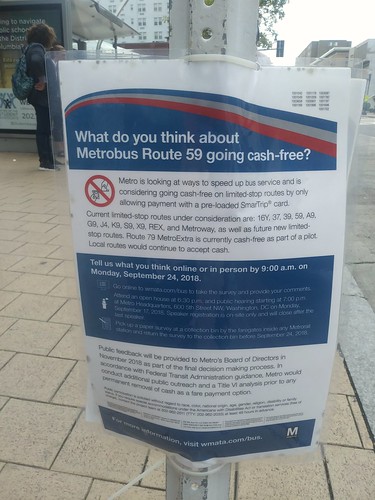
WMATA Metrobus proposes to go cashless on limited stop (rapid) bus services

I didn't write about it, but last Monday was the deadline to submit comments about WMATA's plans to go cashless on the limited stop bus services, to reduce dwell time, both from taking cash for fares or adding cash to a SmarTrip card, which is a cumbersome and time consuming process at the fare machine on the buses.

-- Printed survey

I answered the online survey and submitted a brief set of "comments."  Mostly the submission was photos of marketing by Transport for London about places where people can put money cash or credit on their Oyster cards, outside or or external to transit stations.

WMATA bus public consultation on going cashless for limited stop bus services

User experience.  While I support moving to cashless to speed up bus service, I argued that moving to cashless without having fare card machines outside of train stations and greater attention paid to  locations where riders can put money on their SmarTrip cards in more convenient ways does riders a disservice.  Access to farecard services outside of the Metrorail system is the primary point as it relates to "user experience."

(The sections on:


  • The London Underground (Transport System) as a Design Artifact

  • Transit Systems and Legibility

  • Connectivity and access as questions of usability in mobility planning

  • Wayfinding

  • Overuse of the subway map concept as a way of representing information


  • from the entry "World Usability Day," discuss "transit user experience" matters in greater depth.)

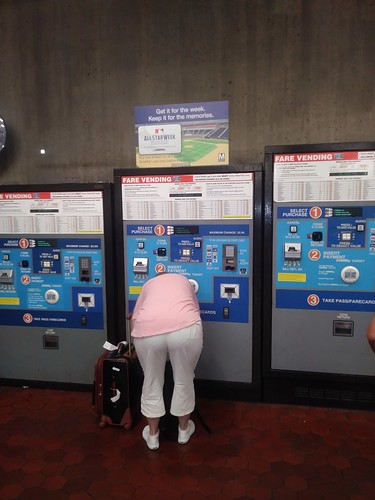
    Machines for buying Metrocards and adding money to them (either cash or credit) are only located within Metrorail stations.
    WMATA fare card machines at Union Station, Washington, DC

    Farecard machines aren't present on the surface at major bus stops where lines intersect--although the big hulking machines could be replaced by smaller ATM-like machines for non-station locations.


    Note the the Transport for London ticket machine in the center of the picture above.  It's small enough to be able to be built into building facades, just like an ATM.  (One issue with stand-alone machines is security.  And admittedly, one issue with machines outside of Metrorail stations is the cost to service and operate them.)

    Some retail stores service SmarTrip cards.  While there aren't WMATA fare machines outside of transit stations, it is possible to put money on cards at CVS Pharmacy, Giant Supermarkets, and Walmart stores, and certain other outlets.  Some sell the cards too (Giant, Walmart primarily).

    Earlier this year CVS threatened to stop doing so because of problems working with WMATA ("CVS Agrees to Continue Selling Metro's SmarTrip Cards," NBC4).

    It used to be that there was SmarTrip signage on some of the storefronts.  Even when present the materials aren't particularly noticeable.

    Yesterday, I looked at the facades of five CVS stores in DC and Silver Spring, Maryland and didn't see any signage for the SmarTrip card program.  And Giant has a decal at the entryway stating all the non-grocery services they provide (selling stamps, etc.) and this decal does not list selling or adding money to SmarTrip cards.

    Transport for London's marketing of off-transit Oyster card services.  That's why I submitted images from London.

    Like this storefront in Hackney Borough on the Mare Street pedestrian mall, about one block from the Hackney Central London Overground Station.  Note the lighted sign reproductions of the Oyster card, communicating very clearly that the store offers Oyster-related services.


    One of the marketing programs for off-site Oyster card money-adding services is called "Oyster Ticket Stop" and TfL provides a variety of graphic design treatments for affixing to storefronts.


    Some materials refer to this service not as a "Ticket Stop" but a "Oyster Card Top-up"

    Other stores even provide walk up windows.


    Note that these are independent stores, not chains, and chain stores, with their own brand design requirements aren't likely to go for the same treatment, which in the examples shown above, tend to be garish.  

    But it is possible to do something tasteful, such as this "Moneygram" sign posted in a window at a CVS store in Silver Spring.


    Oyster Ticket Stop sites incorporated into transit mapping.  Unfortunately, I forgot to mention in the submission that station wayfinding signage and area map brochures for London train stations stations also show the location of Oyster Ticket Stops.  I can't remember if this extends to the maps in bus shelters.  Ticket Stop locations are not included on the Legible London wayfinding signage system (Bus stops are indicated.) 
    Wayfinding Map brochure, Continuing Your Journey from Highbury & Islington London Underground Station

    The ability to put money on fare cards outside of Metrorail stations needs to be heavily and creatively marketed.  One example is the "Orca To Go" program in Greater Seattle.


    Transit marketing materials in St. Louis, by My House of Design

    Billboard on the introduction of limited stop bus service in Los Angeles, branded MetroRapid, c. 2003 

    This bag is offered to retailers, with the map diagram of the London Underground on one side and the option to imprint store information on the other.

    And this should include advertising within the transit system at stations and on buses and trains.

    In the surface transit network, locations where SmarTrip cards can be purchased and/or serviced should be indicated on WMATA maps at bus shelters and in dedicated signage at bus stops.

    Airports.  I neglected to mention that there should be farecard machines at the BWI and Dulles Airports, since both are served by Metrobus but without the ability to buy a farecard.  Although technically this isn't part of the proposed expansion of the cashless bus program, although it is related to the general question of ensuring access to SmarTrip cards at main points within the system.

    Actually at BWI, since there is a light rail station there (I haven't used it, I'll check it out the next time I'm there), you could buy a CharmCard and use it on Metrobus because the CharmCard and SmarTrip cards are inter-operable, meaning they can be used on transit in either Baltimore or the Washington area.

    But that element of the transit card isn't well marketed, e.g., at BWI Airport the transit fare card should be marketed as usable on both Washington and Baltimore local transit systems.

    (Baltimore) MTA farecard machine

    Still, the bus stops at BWI are located away from the light rail station and so additional fare card machines should be made available in the surface mobility service area.

    Like what Montreal's transit system does.  The Trudeau Airport is served by bus but not rail.  They call the bus the "747."


    Of course, when the Dulles Metrorail station opens this won't be an issue any longer.

    Labels: , , , , , , ,