Rebuilding Place in the Urban Space

"A community’s physical form, rather than its land uses, is its most intrinsic and enduring characteristic." [Katz, EPA] This blog focuses on place and placemaking and all that makes it work--historic preservation, urban design, transportation, asset-based community development, arts & cultural development, commercial district revitalization, tourism & destination development, and quality of life advocacy--along with doses of civic engagement and good governance watchdogging.

Monday, July 10, 2023

Opposition to affordable housing in Chevy Chase, DC

Chevy Chase Community Center, Washington, DC.

The Washington Post has an article, "D.C.’s Chevy Chase neighborhood in uproar over affordable housing," about how proposals for a new Chevy Chase Community Center, incorporating a variety of improvements as well as housing above, which could be either 100% affordable housing or partial, are being met by opposition.

What bugs the s* out of me about this, is how DC goes in circles perpetually.  

A fine looking mixed use building with a library on the ground floor and affordable housing above, in Portland, Oregon.

For example, I remember in a DC planning meeting in the very early 2000s, learning about how the Hollywood branch of the Portland library system had a library and cafe on the ground floor, and 47 units of affordable housing above (" Putting housing above a public library, Portland takes another pioneering step toward urban density," Metropolis Magazine, 2002).  That's 20! years ago.

Baldwin Apartments on H Street NE; 37 apartments, 100% affordable, over ground floor retail and building amenities.

Similar proposals were made for some libraries in DC--the West End Library site was redeveloped as high income housing, and high quality affordable housing was built on H Street NE on the site of a modular, dinky library ("All-Affordable Apartment Building Headed to H Street NE," NBCWashington).

A proposal in Tenleytown ("Fenty Announces Development Partner for Tenley-Janney Site," DC press release, 2008) was successfully fought off, and in Southeast DC, in the Benning Road neighborhood, residents fought the idea fearing that pedophiles would live in the housing, and prey on children using the ground floor library ("Mixed-Use Messages," Washington City Paper, 2006).   

Obviously, DC itself has successful examples of doing this, although more with replacing the civic asset rather than including it going forward.  Still you can take the civic asset example from Portland, and the successful housing examples from DC and Portland, and apply it to Chevy Chase.

Although Chevy Chase is also right to be worried.  DC has actively placed Section 8 tenants in apartment buildings up and down Connecticut Avenue, and many of the households have been a scourge, bringing the 'hood to Ward 3 ("D.C. housed the homeless in upscale apartments. It hasn’t gone as planned," Washington Post, "Mayor Bowser meets with Connecticut Ave. tenant leaders," Forest Hills Connection).

But buildings like The Baldwin Apartments show it can be done successfully, in a manner that improves the range of what's available in a neighborhood.  But DC Government shows a lot that its management capacity is weak.

Normally, I'd not recommend such a location because it's practically in Maryland, and low income residents need good transit access.  OTOH, it would provide options for DC residents who might work in Montgomery County, and there is decent bus service on Connecticut Avenue, and the Friendship Heights Metrorail Station is a 15 minute walk to Wisconsin Avenue (and even faster by bike).

Labels: , , , ,

Friday, May 13, 2022

Takoma Park resident vows to vote against all local public officials this fall, because of the failure of the Purple Line light rail, but the failure is because of the Governor, who is termed out

Rick Scheer of Takoma Park writes in a letter to the editor of the Washington Post:

Those of us who live, work or shop in east Silver Spring have mostly concluded that the Purple Line project is something between a major disappointment and a total fiasco. Based on the interviews in the May 8 Metro article “Maryland Purple Line construction will resume in August, officials say,” I’m now leaning toward fiasco. 

We’ve been suffering from torn-up streets, unfinished tunnels and bridges, and other public eyesores for more than two years, and ongoing work to move utility lines for the project routinely causes local traffic snarls. 

Officials said that with the new contract, work would commence this spring. I learned from the article that they really meant late summer. Even that work is focused on the Purple Line’s end points in Bethesda and Prince George’s County. The road-widening efforts affecting east Silver Spring are not scheduled until spring 2023, a full year from now, assuming the effort ixxxs on schedule (ha!). And this construction will be wildly disruptive, so say the new project managers. 

In all local elections this November, for me the Purple Line will be the primary ballot consideration. I plan to hold all local officials accountable for this fiasco, and not a single incumbent will get my vote.

But the Purple Line fiasco is all a result of the Executive Branch of the State Government, specifically the Republican Governor, Larry Hogan, and his directives to the State Department of Transportation.  

Scheer will be punishing the wrong people. It's all Hogan's fault. 

No local officials at the city and county level, and even the State Senators and Representatives have anything to do with it.

First Hogan delayed the Purple Line with another review when he first got elected.  This led to delays with the Federal Transit Administration approving funding. 

Then the Republican emphasis on pushing the selection of a public private partnership to do the project, including providing some financing:

-- "Purple Line moves forward," 2017
-- "A Purple Line update: the downside of "Public Private Partnerships" -- they are contracts, not partnerships," 2017
-- "Public-private "partnerships" aren't partnerships but contractual relationships," 2017 

The partnership picking a less suitable construction group. 

The state being unwilling to renegotiate certain elements of the contract when costs rose and then the construction company quitting as a result.  And needing to find a new construction group.

-- "Sometimes you have to wonder if transit/transit projects are being deliberately screwed up to make transit expansion almost impossible," 2022

The various lawsuits etc. 

But Republican Governor Hogan is termed out.  He can't be punished at the ballot box.  He's the one who needs to be held accountable, but there is no accountability.

I understand Scheer's frustration.  I first read about the concept of the Purple Line in a cover story in the Washington City Paper in December 1987.  It will be almost 40 years before the first segment, from Bethesda to New Carrollton, comes to fruition.

No planning is underway for any of the other segments.  At this rate it will take more than 100 years to bring it to fruition.

Labels: , , , , , ,

Thursday, January 27, 2022

A tenure of failure doesn't deserve encomiums: Paul Wiedefeld, WMATA CEO

WRT the encomium, maybe Wiedefeld did the best he could do.  But it's not enough.

====

Almost two weeks ago, I wrote about how transit failures in the DC metropolitan area don't just have negative impact on transit within that area, but nationally, as transit opponents use failures in one place as justification for opposition for transit creation in other communities.

-- "Sometimes you have to wonder if transit/transit projects are being deliberately screwed up to make transit expansion almost impossible"

WMATA, the Washington Metropolitan Area Transit Authority, operator of the Metrorail subway/heavy rail system serving DC, Northern Virginia, and Montgomery and Prince George's Counties in Maryland, has been in failure mode for more than ten years.  

Brochure, February 2000

Part of it wasn't the system's fault per se, but the failure of board members and jurisdictions to fund necessary quantum system maintenance as the system aged--they were warned.  In the 1990s, system planners warned leaders and stakeholders that this would be required in the coming years.

But nothing was done until the system started failing.

Since 2009 the system has been in perpetual crisis, when a signals failure resulted in a train crash killing 9 people--and the crash was "merely" the denouement after multiple signal failures over preceding years that fortunately hadn't resulted in death, but weren't seen as an indicator of system failure.  

But the problems haven't stopped, system service degradation as a repercussion of the system failure, tunnel fan failures (abetted by inspection failures) leading to another death, operational failures of various types, and over the past few months, a failure to address derailment/wheel problems in the 7000 series of cars which resulted in 748 cars being taken out of service, and the Metrorail system basically grinding to a halt.

Although WMATA did respond to the signals failures and need for substantive overhaul by creating the SafeTrack program to execute various system improvements (although at short term cost of closing sections of the system while repairs were made).

But the failure of the 7000 series cars is an illustration that the problems in WMATA operations go far beyond "a state of good repair."  The problems are structural, systemic.

Just after I wrote the piece, the CEO of WMATA announced his forthcoming retirement ("Metro’s general manager to retire after six years as top executive") and a few days later the Washington Post editorialized that he's great and restored the capacity, confidence, and the ability of the system ("Paul J. Wiedefeld’s tenure at Metro").

I don't think the writers ride the system much.

Wiedefeld is an experienced airport manager, but I think his tenure at WMATA demonstrates the necessity of a highly experienced rail transit professional to run the system.  

Just like his predecessor, a super experienced bus administrator, demonstrated the need for a highly experienced rail transit professional to run the system. 

(And maybe commenter charlie is right that we can't expect WMATA to run both rail and bus service excellently, that buses will always be second to rail.  See "Reviving DC area bus service: and a counterpoint to the recent Washington City Paper article," 2019).


I think this headline from a WTOP radio story is more accurate.  

At best the system is in stasis, with a repeated track record of failure over the past 10+ years, and rebuilding the confidence in transit and the consensus of the importance of transit is key.

The subway had been key to DC and Arlington County's resurgence, including residential and business attraction, and significant reductions in automobile traffic.

DC especially should be worried, not only about covid and its impact on the qualities that make urban living attractive, but about the likelihood of Metrorail recapturing its capacity to be successful.

Conclusion: What is to be done?

1.  Fix WMATA.  The first order of business is to hire top notch executives to run the system, people with experience in heavy rail, high volume transit service.  And then overhaul the agency from top to bottom.

-- "Getting WMATA out of crisis: a continuation of a multi-year problem that keeps getting worse, not better," 2015
-- "More on Redundancy, engineered resilience, and subway systems: Metrorail failures will increase without adding capacity in the core," 2016
-- "Reviving DC area bus service: and a counterpoint to the recent Washington City Paper article," 2019

Note that the first two entries were written at the outset of Wiedefeld's appointment, and I wouldn't say that WMATA is more stable and effective compared to 2015.

In Philadelphia, NBC10 is running a survey on the quality of the local transit service there ("SEPTA Riders: Tell Us What It's Like to Take Public Transit").

2.  Rebuild the regional consensus about the value of transit.  In 2009 after the crash, and in 2014, I suggested that the region needed to rebuild its consensus on the importance and value of transit.

-- "St. Louis regional transit planning process as a model for what needs to be done in the DC Metropolitan region,"
-- "WMATA 40th anniversary in 2016 as an opportunity for assessment"

This need is even greater now.  

3.  Create a regional transport association to plan, manage, and deliver transit and mobility services.  Also, I've argued that the metropolitan area/region should reconfigure how it manages, plans, and operates transit, along the lines of the German VV model.

By default WMATA is the main transportation planner and it shouldn't be.  

-- "Don't over focus on "fixing" the WMATA Compact. Instead create a new Regional Transit Compact, of which WMATA is one component," 2017
-- "The answer is: Create a single multi-state/regional multi-modal transit planning, management, and operations authority association," 2017
-- "Route 7 BRT proposal communicates the reality that the DC area doesn't adequately conduct transportation planning at the metropolitan-scale," 2014

Although in the US, I've argued that such associations need to have a more expansive membership, and include for profit providers when appropriate ("Another example of the need to reconfigure transpo planning and operations at the metropolitan scale: Boston is seizing dockless bike share bikes, which compete with their dock-based system," 2018), airports ("Transportation demand management gaps, Salt Lake City International Airport and car sharing," 2021), and even highway operators ("Washington Post letter to the editor on repair-related closure of Rockville and Shady Grove Stations and corridor management," 2021).

-- "DC is a market leader in Mobility as a Service (MaaS)," 2018

4.  Elect the Board of Directors.  And that WMATA's board should be popularly elected, and treated as members of local government systems ("Why not elect DC's representatives to the WMATA transit agency board?," 2019, "Should DC's representatives to the WMATA Board be popularly elected?," 2014).  Eg., DC's elected board members to WMATA should serve on DC Council's transportation committee as ex officio members, and on a city transportation commission if one existed (item 9, "How I would approach organizing the DC master transportation planning process and plan," 2013)..

But this should be extended to the entire board, and include the representatives from Maryland and Virginia too (Virginia jurisdictions in the WMATA Compact mostly have transportation commissions already. Rockville, a part of Montgomery County, does also.)

5.  Fix funding.  I have also written that it was unfortunate that when the system was successful, the jurisdictions didn't come together and vote for permanent sales taxes to fund the system (""Let's Talk" -- What to do when your transit authority needs more money?: Washington region edition," 2014).  Now with the system's repeated failures, not to mention Republican Governors in Maryland and Virginia, it's almost impossible to believe that this could be accomplished.

6.  Expand and intensify the transit system.  You can't have a transit city without continuing to expand and intensify the system.  But WMATA only cares about Metrorail, and to some extent regional bus service.  That's why a transport association is key.

WMATA isn't interested in other modes, be they streetcars, light rail, railroad passenger services, etc.   For example, the light rail Purple Line will be run by the Maryland Transit Administration (as is the Takoma Langley Crossroads Transit Center) because WMATA wasn't interested.  (To extend the point made by Ted Levitt about GM in the book Marketing Imagination--WMATA isn't a transit/transportation "agency" but an operator of heavy rail and bus services.)

-- "Update to the Paul J. Meissner produced integrated high capacity transit map for the Washington metropolitan area," 2017
-- "One big idea: Getting MARC and Metrorail to integrate fares, stations, and marketing systems, using London Overground as an example," 2015
-- "A new backbone for the regional transit system: merging the MARC Penn and VRE Fredericksburg Lines," 2015
-- "Setting the stage for the Purple Line light rail line to be an overwhelming success: Part 2 | proposed parallel improvements across the transit network," 2017
-- "Using the Silver Line as the priming event, what would a transit network improvement program look like for NoVA?," 2017
-- "A "Transformational Projects Action Plan" for a statewide passenger railroad program in Maryland," 2019
-- "A "Transformational Projects Action Plan" for the Metrorail Blue Line," 2020
-- "Metrorail shutdown south of AlexandriaNational Airport would have been a good opportunity to promote ferry service," 2019 (speaking of ferry service, "Ferry to D.C.? New analysis underway," Inside NoVA; note fwiw, there have been ferry studies off and on since 1992)
-- "Will buses ever be cool? Boston versus the Raleigh-Durham's GoTransit Model," 2017

-- Georgetown Gondola proposal (which isn't necessary with a separated blue or silver line)

WMATA has come up with some ideas of its own for Metrorail expansion ("The Blue Line Could Go to National Harbor One Day," Washingtonian), and they're better than previous iterations, but not expansive enough.

=====

What's a transport association?  In 1960, transportation planners in Hamburg realized that transit riders didn't care who provided what service, whether it was a bus, subway, train, or ferry in the core of the city or in the suburbs, that riders wanted an efficient and inter-connected set of transit services that was logically and comparatively easy to use.

At the time they started--and it took five years to get the organizations to agree to work together--it took as many as seven different providers and fares to get from one end of the region to the other.

-- HVV, Hamburg Transport Association
-- "HVV Celebrated 50 Year Anniversary, City of Hamburg
-- "Verkehrsverbund: The evolution and spread of fully integrated regional public transport in Germany, Austria, and Switzerland," Ralph Buehler, John Pucher & Oliver Dümmler, International Journal of Sustainable Transportation (2018)
-- Transport Alliances - – Promoting Cooperation and. Integration to offer a more attractive and efficient Public Transport, VDV, the association of German transportation associations. (NOTE: clicking on the link triggers a file download.)

The city planners organized the transit providers into a single association and began the process of integrating services, schedules, and fares, and creating a separate planning and coordination system. Who offered what service was determined by who could do it best--in any case, transit planning was separated from transit operations.

Two agencies, Hamburg Hochbahn (subway and bus) and Deutsche Bahn/S-Bahn (commuter railroads) provide the bulk of the service, and a third, HADAG, ferry services. But 30+ operators provide services within the system, mostly bus, but also exurban rail services--the City-State of Hamburg is a partial owner of many of these services.

Labels: , , , , , , ,

Thursday, January 13, 2022

Sometimes you have to wonder if transit/transit projects are being deliberately screwed up to make transit expansion almost impossible

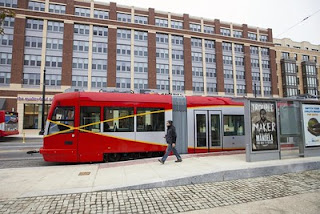
1.  DC streetcar.  I've often made the point that DC and Seattle started "streetcar planning" at the same time in 2003.  Seattle's streetcar line opened in 2007.  DC's in 2016.  

In fact, in 2016, Seattle opened its second streetcar line, on First Hill.  Work is underway to connect the two lines, and further extend the streetcar, which complements light rail and bus modes within the city.

DC's failures in streetcar planning contributed to Arlington's decision to drop its parallel streetcar effort in 2014 ("5 years later, battle scars over Columbia Pike streetcar are still healing," Sun Gazette/Inside NoVA).  If only Arlington was near Seattle.

It certainly helped opponents to the Purple Line light rail program in Suburban Maryland.

And the failures of DC in planning for and implementing the streetcar is often held up by opponents to streetcar and light rail projects elsewhere as an example of failure, incompetence, and by extension, the likelihood of failure of in their own communities ("A streetcar not desired," Politico, 2014).

In fact, I've since made the point that planning and transportation officials have a duty to not fail as part of their overall professional responsibility, because of how their failures can have unintended negative impacts elsewhere.

Since these failures, DC has decided to not extend the streetcar west to Georgetown ("D.C. drops plan to extend streetcar line to Georgetown," Washington Post), crippling its potential to be useful, although they are willing to extend it eastward.  

Planning for other lines has long since ended, making the line a one-off making the mode generally un-useful ("DC and streetcars #4: from the standpoint of stoking real estate development, the line is incredibly successful and it isn't even in service yet, and now that development is extending eastward past 15th Street NE," 2015).

Ironically, even as a failure, the streetcar has shaped as much as $1 billion in new development on the H Street NE corridor, and further extending development up Bladensburg Road and beyond 14th Street to Benning Road.

I guess not.

2.  Suburban Purple Line light rail project, Montgomery and Prince George's County, Maryland.  This project has been going on for a couple decades all told.  It was junked during the Republican Ehrlich Administration (2003-2006) in favor of a toll road.  Then it was revived under Democratic Governor Martin O'Malley (2007-2014).  Then new at the time Republican Governor Hogan threatened to eliminate it once again (2015), but at the expense of a similar project in Baltimore ("Five years later, many across Baltimore bitterly lament Gov. Hogan’s decision to kill the Red Line light rail," Baltimore Sun).

But the Republican Governor, eager to have the private sector fund it, created a "Public-Private Partnership" to partly finance, design, engineer, build, and operate it.  Disputes over cost overruns led the construction group to bail out.  

(I tried to get a job with one of the bidders.  But they lost, and the experience was so bad they decided to shut down the unit of the corporation that was to bid on similar projects across the country.)

Now Maryland has found a new construction "partner" but the line will be delivered more than 4 years later than initially planned ("Purple Line will open 4½ years late and cost $1.4 billion more to complete, state says," Washington Post).

The ongoing debacle of the Purple Line certainly doesn't help the arguments of proponents of transit.

Maybe that's what Governor Hogan planned all along? (After all, he prefers high occupancy toll road projects, expanding freeways, "County officials say Maryland governor made ‘empty’ threats to get toll lanes plan approved," Washington Post).

How's that partnership working out with the private sector?

... recently I saw an article recently making the point that in privatization and outsourcing we redefine transactions as partnerships.

3.  DC area Metrorail (Washington Metropolitan Area Transit Authority) and the failure to proactively deal with faulty wheels.  I haven't written about this even though it's been a problem for months because it's just so depressing.  

The Metrorail Safety Commission ordered WMATA to pull 60% of its train fleet on Sunday, October 17, 2021, leading to long delays Monday morning. yrone Turner/WAMU/DCist

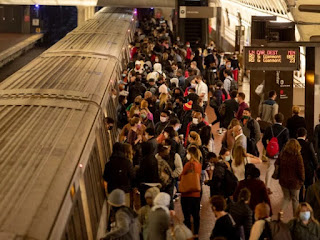
The tragic thing is they knew about the problem, had frequent derailments, but kept letting it slide, until they were forced to take the trains out of service ("WMATA Experiences Continued Delays Following Train Derailment, Inspection," Georgetown Hoya, "Metro 7000-series safety problems 'could have resulted in a catastrophic event'," WAMU/NPR), "Washington Metro Pulls Most Train Cars From Service After Derailment," New York Times) so many that on most lines they operate fewer than 3 trains per hour, making transit completely unusable as a single train has capacity of about 1,200 to 1,800 passengers.

WTF?  WTF!

It makes the "service" completely unusable.  Forcing people to drive, to buy car even..

4.  WMATA is systematically failing.  Worse, the derailments are merely one and the latest problem in a long list of severe safety failures, evidence of ongoing systematic failure:

As they say, the fish rots from the head. 12+ years of systematic failure ought to have consequences.

Much of the top management should be canned.

=======

All of these incidents remind me of the discussion in the Asimov Foundation book series, in the discussion about the decline of the Empire, the inability of people to manage and operate things:

Mallow goes spying at a Siwellian power plant, noting that it is atomically powered (atomic power is the benchmark of technical civilisation in the Empire) but that the technicians – the tech-men – don’t actually know how to maintain it.

Note that despite funding problems which will lead to severe delays in building out the system, Sound Transit continues to expand the Seattle area light rail system, with the newest extension just having opened in October.  Each expansion results in significant increases in ridership.

And Seattle's new Climate Pledge Arena includes free transit use (except ferries) with tickets for hockey and women's basketball games, and other ticketed events, like concerts.

Streetcar in Tucson is seen as successful ("PLANNING PROFESSOR ARTHUR C. NELSON SHARES ANALYSIS AND LESSONS FROM DEVELOPMENT AROUND TUCSON’S SUN LINK MODERN STREETCAR," University of Arizona).  Same in Cincinnati--despite some construction issues, and Kansas City.

Oklahoma City 's streetcar opened in 2018 and seems to be supported ("Development, rather than ridership, a measure of success for Oklahoma City streetcar," Daily Oklahoman).

But the failures seem to garner a lot more attention.

Labels: , , , , , ,