Rebuilding Place in the Urban Space

"A community’s physical form, rather than its land uses, is its most intrinsic and enduring characteristic." [Katz, EPA] This blog focuses on place and placemaking and all that makes it work--historic preservation, urban design, transportation, asset-based community development, arts & cultural development, commercial district revitalization, tourism & destination development, and quality of life advocacy--along with doses of civic engagement and good governance watchdogging.

Tuesday, September 01, 2020

Hurricanes and the preponderance of chemical and oil company facilities on the Texas coast: How to mitigate the risk?

Hurricane Katrina and the devastation of New Orleans.  This is the 15th anniversary of Hurricane Katrina and I've been thinking about how the failure of the levees in New Orleans and the subsequent inadequacies of the disaster management response are some of the first major catastrophic failures of the US federal government in the neoliberal age.

Federal government failure becomes more routinized.  It's not been until the chaos presidency of Donald Trump that catastrophic failure of federal government operation has become an almost daily occurrence, with the denouement in the over 180,000 deaths associated with the coronavirus.

But it's also the logical result of underfunding government activity for the past 40 years as a result of a market (neoliberal) approach to the philosophy of government, and the press to continually lower taxes.

-- "We Are Living in a Failed State," The Atlantic

Photo: Robert Sullivan/Agence France-Presse — Getty Images. There are hundreds of chemical plants and 7 major oil refineries in the Galveston Bay and along the Houston Ship Channel.

The disaster risk presented by Galveston Bay and the Texas coast.  So an op-ed in the New York Times, "Texas Is Running Out of Near Misses," by Professor Jim Buchanan of the Rice University Severe Storm Prediction, Education and Evacuation from Disaster Center, about the risk from presented by the conglomeration of oil and chemical production facilities on the Texas coast, is particularly prescient.

Note that last year, a fire at a petrochemical plant, which led to the closure of part of the Houston Ship Channel for three days was said to cost petrochemical firms $1 billion in lost economic activity--that's three days, for part of the channel ("Houston Ship Channel closure could cost energy industry $1 billion," Houston Chronicle).

High water and heavy industry on Lake Charles on Thursday. Credit: William Widmer for The New York Times

Both in terms of the anniversary of Katrina but also the current Hurricane season, where as an example, Hurricane Laura caused major damage in Louisiana just last week.

-- "Laura Hits Petrochemical Region, and a Factory Goes Up in Smoke," New York Times

Besides taller barriers (perhaps using the Thames River barrier in London as a model), the Rice Center proposes a system called the Galveston Bay Park Plan, of newly constructed islands, parks and open space as "soft" responses as a way to mitigate flooding.

According to Professor Buchanan, there are at least three problems with how the Army Corps of Engineers is dealing with the problem.

1.  Failure to plan for extremes.  They aren't planning for more extreme storm surges ("Texas, Corps Outline $31 B Plan to Protect State's Coast," Engineering News-Record), even though storms in the present and future are likely to be worse than the storms from the past 100+ years ("Climate change didn't cause Hurricane Laura but it did make the storm worse," CNN), and existing models tend to be based on past storms ("risk of 1 in 100 year flood, etc.).

From the op-ed:
In its continuing studies to design protection for these facilities, the methodology used by the Army Corps of Engineers substantially restricts the size of storm to be used in the design of protection structures. This methodology is outdated, does not adequately address the environmental and economic risks associated with such storms and does not factor in climate change and its impact on storm intensity.
Houston Ship Channel.  Photo: Brett Coomer, Associated Press
By contrast, the Nuclear Regulatory Commission accounts for extreme surges in its safety guidance for nuclear plants. The commission has been doing this since 2012, after the Fukushima disaster, when it issued a letter recommending that an estimation of low-risk surges be incorporated into the design and permitting of nuclear power plants.

The comparison of these policies with those currently used by the Army Corps of Engineers is revealing. The nuclear agency evaluates the hurricane surge for a plant near Bay City, Texas, and concludes that it would have to design for a surge of more than 30 feet above sea level.

By contrast, the coastal spine, a set of 14-foot-high barriers and a two-mile-wide gate structure designed by the Army Corps of Engineers to protect the Galveston Bay system (an area comparable to Bay City) is meant to protect against a 17-foot surge at the coast — insufficient for the surge generated by either a Category 4 or Category 5 storm. Indeed, with a category 5 storm, over 100 separate chemical plants or refining facilities would be flooded, assuming the construction of the $20 billion coastal spine federal project.
Given what happened in Fukushima and how going forward it's more reasonable to expect more virulent storms compared to the past, this severe disconnect between the agencies illustrates the need for more robust and resilient planning schemes across the federal government and between federal agencies. 

During Hurricane Katrina, the floodwall and levee on the 17th Street Canal in New Orleans collapsed without being overtopped. It was one of about 50 breaches in the flood protection system that was supposed to repel "the most severe storm" that could be expected in the area.

When given the choice, the standard practice should be to adopt stronger, rather than weaker, protections

2.  Inadequate cost-benefit analytical frameworks.  Because of the failure to acknowledge the likelihood of higher storm surges, based more on future predictions rather than past experience, the ACE cost-benefit analytical calculations don't support building a more robust system of barriers.

3.  How to pay for it?  Given Republican opposition to funding infrastructure, it will be difficult to get federal funding.  A more robust storm surge protection project for the Texas coast could cost upeards of $60 billion.

I took issue with one of the suggestions in the op-ed, identifying "social impact bonds" as a way to help finance the system.

Social impact financing involves monetizable revenue streams with the potential for extranormal returns and for financial savings compared to current program expenditures. While the use of social impact bond financing is still very new, it doesn’t lend itself to funding the arts which very rarely has the ability to generate extra-normally positive cash flow or cost reductions in programs.

The examples I am familiar with, such as Salt Lake County’s funding of early childhood education, tend to involve social programs expected to reduce government expenditures over time if successful, but the government lacks the money and/or appetite for risk necessary to finance the program through on its own.

Unless insurance companies are going to be willing to pay social impact investors a return on disaster effects foregone, I can't see how a social impact bond investor can see how there will be returns on using SIBs to fund flooding defense systems.

It's not like the Thames River barrier in London was funded by the private sector.


But thinking about it more, some kind of program for paying into a fund to mitigate the potential risk is in order.

Do insurance companies, reinsurers and capital markets help finance it ("Insurers Are Going High-Tech to Mitigate Risk This Hurricane Season," Fortune Magazine, Insuring hurricanes: Perspectives, gaps, and opportunities after 2017," McKinsey) since they'd be saving so much money by avoiding disaster?

Levees are paid for in part by the creation of special service districts which assess an add on property tax.  How about a special tax on the major property owners likely to be catastrophically affected by storm surges?

Given the environmental and economic disaster that would result from storm surges and catastrophic rains, it seems clear that a much taller barrier system needs to be created.

And that it should be considered a high priority given the risk.

Labels: , , , , , ,

Tuesday, June 06, 2017

Pittsburgh area elected leaders publish ad in local newspaper, affirming commitment to addressing climate change

PennEnvironment, a statewide citizens advocacy group focused on environmental matters in the State of Pennsylvania, alerts us to how elected officials from the City of Pittsburgh, Allegheny County,  local representatives in the State Legislature, and the Congressman representing Pittsburgh, Mike Doyle, put together an advertisement running in today's Pittsburgh Post-Gazette, affirming their commitment to addressing climate change through responsible and responsive local actions. 

Below is an image of the ad.


I'm not always a fan of federalism and subsidiarity, because "state's rights" can be used as a way to restrict freedoms and do the wrong thing, rather than to respect freedoms and do the right thing.

Fortunately, the reality is that despite President Trump's repudiation of the Paris Climate Agreement, federalism and subsidiarity the basic economics of energy production and renewable energy, and the risk management necessity of planning for resiliency in the face of more severe weather events, most reputable businesses many of our states, cities, and counties, and us as individuals will continue to take actions that aim to reduce greenhouse gas emissions.

But it does mean at least in the intermediate term that we're not likely to see an increase in the federal gasoline excise tax--which could be the biggest force for change in terms of fuels used for motor vehicles--cars and trucks account for 25% of oil consumption, nor advances in regulations and programs aimed at generating pro-environmental outcomes:

- the Trump Administration reversed a regulation that forbade coal ash discharges into rivers--and rivers are the primary source of the nation's drinking water
- the Trump Administration aims to shrink the EPA
- the Trump Administration keeps proposing to practically eliminate programs to improve the water quality and other environmental elements of the Chesapeake Bay and the Great Lakes
- the Trump Administration proposes to give federal lands to the states, so that these public lands can be "developed"
etc.

Pittsburgh's history of environmental degradation.  Ironically given the ad mentioned above, and not mentioned in the ad at all, is Pittsburgh is a classic historical example of the impact of industrial practices which paid no heed to environmental protection. 

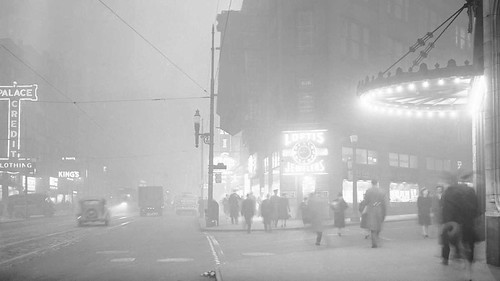
The city's air quality was so bad as a result of the release of pollutants into the air from steel production that typically, stores and streetlights had to be used during what should have been daytime.

See "A Revitalized Pittsburgh Says the President Used a Rusty Metaphor," New York Times.
Day time smog in Pittsburgh, !944
Midday in downtown Pittsburgh in 1944. As thick smog blanketed the city, drivers used their headlights, and storekeepers switched on their signs. Photo: Walter Stein, Associated Press.

Labels: , , , ,

Tuesday, January 26, 2016

Fully underground subway systems are more resilient

The Metrorail heavy rail transit system is a mix of underground and above-ground sections.  In the worst winter weather conditions, in the past they have hunkered down and only run the part of the system that is fully underground, within DC (although some sections in the suburbs are also underground, primarily the Orange Line in Arlington County, Virginia).

The last couple storms, including the one this past weekend, they have shut down the entire system for a time, not even running the underground section, because of fears that potential power outages could strand trains and riders.

The underground portion of the Metrorail system that can run during major snow events.  Map graphic by Peter Dovak for Greater Greater Washington.

I am not criticizing WMATA for shutting down, even though it turned out we didn't have widespread power outages (likely because the snow was soft and powdery).

You can try to keep the system running for as long as possible but on the backside, it means more downtime as the system works through the recovery period.

With an anticipatory shutdown, there is more uptime overall.

Still, with the benefit of hindsight, it's unfortunate that more parts of the system weren't built underground.

For example, if the section of the Red Line from Union Station to Silver Spring (between Silver Spring and Wheaton actually) had been built underground, then the entire east leg of the Red Line could operate during the worst of winter storms.

Light snow on Metrorail tracks in the median of Rte. 7 in Fairfax County, when the system was under construction.  Photo by Chuck Samuelson, Dulles Corridor Metrorail Project.

Similarly, the new Silver Line segment in Fairfax County was built above-ground and in aerial sections for great lengths.  In the snowstorm--at least 20 inches in most places, and more than 2 feet in others--It turned out to be the most vulnerable section of the system and will be the last to be fully operational as the system reopens.

Too bad that winter-time resilience wasn't one of the factors considered in the debate over whether or not to build the Silver Line underground ("Rail Tunnel Debate Raises Larger Issue," Washington Post, 2006).  It would have cost much more, true, but would have been able to operate in adverse conditions.

STM in Montreal is the best example in North America of building a heavy rail system completely underground, which they did in part because the city experiences some of the worst winter weather conditions on the continent.   As a result, the Montreal heavy rail system is much more resilient than heavy rail systems like DC's.

The system has 68 stations over 40 miles of track and mostly operates within the City of Montreal, although there are two extensions outside of the city, to Laval and Longueuil. The system has about 1.25 million riders daily.

-- Using public transit in winter | Société de transport de Montréal

Ironically, because the system was built entirely underground and train cars are not exposed to weather--rain, snow, or sun--the cars were not built to be weatherproof.  (That means no air conditioning either.)

Two lessons for transit system design engineering derived from hindsight concerning the Metrorail system. (1) Fully underground systems are more resilient in adverse winter weather conditions. (2) Two track systems--one in each direction--lack redundancy, at least one additional track would allow for express service and more efficient operations when tracks or trains are not functioning.

Labels: , , , , ,

Tuesday, December 11, 2012

Lesson from Sandy: Better Disaster Planning Needed for public housing authorities

This tragic article in yesterday's New York Times, "Housing Agency's Flaws Revealed by Storm," reminds me that I intend to write a long overview post-Superstorm Sandy piece, in addition to this entry that was first posted last week at Rooflines, the blog of the National Housing Institute.


The terrible impacts of Superstorm Sandy and its aftermath demonstrate the need for more robust disaster planning, not to mention a reconsideration to some extent of various waterfront redevelopment schemes in storm zones.
Besides the terrible reality that many people died, some because they ignored evacuation warnings—and how many times have we ignored such warnings ourselves having been lulled so many times by "sky is falling" warnings that never came to pass, especially by seemingly hysterical weathercasters on television news programs?—we see that many cities and states lack the resources to step in and replace lost housing when public housing, homeless shelters, hospitals, and nursing homes are damaged as a result of storms and other disasters.
According to the New York Daily News many public housing complexes in New York City were damaged by Superstorm Sandy, tenants were left with very few alternative housing options, and the agency hasn't appeared to be very empathetic to their plight. [Ed. Note: In fact, NYCHA residents are still being charged full rent for units with no heat or services. And they are not happy about it.]
The New York Times reported  that, five days after the storm, almost 10 percent of the 2,600 buildings operated by the New York City Housing Authority were without power or other critical services. Most of these buildings were located in low-lying areas and/or near water, with boilers most often located in basements and susceptible to flooding.
Cities where a large number of people are housed in multiunit residential buildings have limited alternatives if those buildings go out of service. Temporary trailers from FEMA work fine for single family housing dwellers but don't scale well for the number of tenants typically housed in apartment buildings. (See Superstorm Sandy leaves many homeless.)
The GAO report DISASTER ASSISTANCE: Better Planning Needed for Housing Victims of Catastrophic Disasters indicates that federal disaster planning for housing provision and public housing after disasters doesn't address multiunit housing to the degree that it is necessary.
To better prepare, especially as storms become more violent and damaging, even if not necessarily more frequent, public housing organizations are going to have to update their disaster planning activities and build more resiliency into their organizations. For example,the disaster plan for Alabama's Boaz Housing Authority addresses extreme heat, flooding, tornadoes, and winter weather.
Some lessons from Superstorm Sandy:
Finding the money to do this will likely be difficult, and disaster preparedness is yet one more item that needs to be added to a long advocacy agenda for public/social housing stakeholders. But given the attention to the issue in the wake of Superstorm Sandy, agencies and organizations should push forward, while people are concerned and aware.
Photo: list of needs at an aid station in Red Hook, Brooklyn by Flickr user Shelley Bernstein, CC BY-NC.

Labels: , ,

Monday, June 11, 2012

Brilliant piece on Chicago's woes by Aaron Renn


Speaking of why I have so much respect for the Urbanophile blog (I had the privilege of meeting "Chicago" bloggers Aaron Renn and Lynn Stevens of Peopling Places when I attended the Main Street conference there in 2009-- Lynn and I were going to meet anyway and she brought Aaron along), Aaron has a piece in the City Journal (yes, the publication of the "conservative" Manhattan Institute).

It's on how he sees Chicago's situation--a city deeply in debt, with a shrinking population both for the city and regionally, lack of a particularly strong business sector powering claims to being a "global city," comparatively low per-capita GDP, and its role really being the center city (from the standpoint of center-periphery concepts in underdevelopment studies, although he doesn't cite this work) of the still declining Midwest (with the exception of those areas experiencing booms related to oil and natural gas production).

-- The Second-Rate City?:Chicago’s swift, surprising decline presents formidable challenges for new mayor Rahm Emanuel


He also mentions bureaucracy as stultifying local business development (he doesn't mention contracting, my bicycle facilities systems integration firm ran into the buzzsaw of Chicago contracting last fall), and the failure to systematize laws and zoning practices, but instead preferring the very personal practice of law and action according to "aldermanic privilege" -- kind of like so-called "state's rights" arguments to allow states to do mostly really terrible [and yes, occasionally good things, but very rarely] things like discrimination, instead each Aldermanic district does its own thing, mostly badly.  Along with corruption and the power of the political machine, these ways of dysfunction make it hard to re-generate organic growth.

It's kind of a Chicago specific chapter that would be great to include in an update of the book, The Future Once Happened Here, coincidentally authored by a Fellow of the Manhattan Institute, Fred Siegel.

A lot of people criticize Siegel's work, but I think it's not just inciteful but insightful, and if you don't understand what's up, and you're just focused on cheer-leading, you'll never really be able to improve your city and its economic position, in either its metropolitan, regional, or national context.

Likely people will take Aaron's article as personal criticism rather than critical analysis, and the problems present will continue to fester and only get worse.

Labels: , , , , , , ,

Friday, January 27, 2012

Reprint: Bringing buildings back is really about bringing urban neighborhoods back

-------
From September 2006.

It will be awhile before I have to chance to write in depth about the book that was launched last night by the American Assembly. (See previous entry.) Some of the discussion at the presentation troubled me, the overview was very powerful. The book is an extension of the report, "Reinventing America's Legacy Cities: Strategies for Cities Losing Population" which states 6 priorities for "legacy" cities that face long term shrinkage but also opportunity:

Building a Framework for Change
Understanding that one size does not fit all places, in this report attendees of the American Assembly lay out the following recommendations for fostering transformative change in cities that have lost substantial portions of their population:

1. Develop a creative vision for the future of the city, grounded in a thorough understanding of the city’s economic geography, the role it plays in its region, and its function in the global economy

2. Rigorously and objectively analyze the city’s assets, understanding both opportunities and constraints

3. Design strategies tailored to areas and opportunities with the greatest market potential, informed by social, environmental, and other values

4. Recapture surplus land for public uses in areas where private markets are not functioning

5. Build the city’s ability to execute complex revival strategies by:
• Strengthening governance and leadership
• Growing financial capacity
• Investing in information infrastructure

6. Forge supportive partnerships among federal, state, and local governments by:
• Targeting resources
• Revisiting regulatory policies
• Incentivizing regional collaboration


Alan Mallach was the editor for the project, and he is the author of the book discussed in the entry reprinted below.

The basic point is focus your revitalization strategies on your assets. The problems are bad enough that starting from what strengths you have is your most cost-effective opportunity.
-------

Bringing Buildings Back by Alan Mallach

Yesterday, I wasn't going to go to the Smart Growth talk at the National Building Museum by Alan Mallach, about his new book, Bringing Buildings Back, because I have too much to do.

I'm glad I went.

Frankly, it's not like it was anything new. I've figured out most of what he said, based on 7 years or so of pretty serious involvement and analysis of urban revitalization, mostly in DC. But it would have been a lot easier and quicker to have had this book (just like I wish I had been able to read Code of the Street: Decency, Violence, and the Moral Life of the Inner City before moving into the city).

But since you don't hear this from just about anybody else, it was great to have him confirm it (it also parallels the work done by organizations like NeighborWorks and the Casey Foundation in working to indentify the factors that influence comprehensive, successful neighborhood stabilization and improvement).

So I bought the book, which I don't often do.

His thesis, based on a lot of field experience and research, is that vacant buildings--I was impressed that he never used the words "blight" or "dilapidated" but called the buildings "abandoned" or "nuisances"-- are a tremendous underutilized asset providing cities with great opportunities.
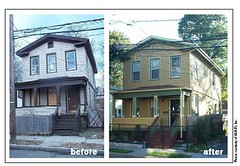
Bringing Buildings Back illustration
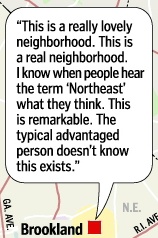
We talked for quite a bit after he was finished with his book signing, and he used the phrase minimally acceptable market threshold, referring to how you augur urban revitalization, neighborhood by neighborhood, in ways that attract the people who have choices, the ability to live wherever they want. This dovetails with the quote from Richard Florida in yesterday's Post article, "The City as Modern Muse," about Brookland:
Capture-09-19-00003
Extracted from a Washington Post graphic produced by Nathaniel Vaughn Kelso.

The reality is that you have to attract residents with choices because you need property, sales, and income tax revenues to fund city activities. (Another perspective on this is Rolf Goetze's Building Neighborhood Confidence, written in the late 1960s.) I had written a few comments about this in a thread on the blog Urban Commons last week:

Center cities only having "neighborhoods of and for people who have no other choices" well, it's not a competitive advantage. I will say that his argument in some respects parallels some of the discussion in Logan and Molotch's Urban Fortunes about historic preservation.

I think the point that they missed is the necessity of stabilizing urban neighborhoods, including downtown, vis-a-vis the suburbs. You have to have viable neighborhoods (which requires "place-based" investments) in order to retain residents, residents paying property, sales, and income tax (if the jurisdiction assesses it). Retaining low income residents isn't great for either the revenue or expenses side of the city government financial statement...

The more people you retain in the city that are middle and upper income the better, because you need the revenue, badly. Detroit has such a tremendous infrastructure left over from its days as a city with 2 million residents that its property taxes are sky high. A house assessed for $200,000 pays $8,000/year in property taxes. That's 3x higher than DC! And it's not like Detroit is full of amenities. (Although a house assessed for $200,000 in Detroit could be worth $600,000 in the right neighborhood in a strong market city.)

The problem is that while strategic investments are required in downtown and other areas, too often the bulk of the investments go downtown, or to big projects, that in the great stream of things, aren't necessarily strategic in terms of generating additional private investments and in-migration of residents.

It's a hard issue to work through. "Neighborhoods first" policies often don't generate the kinds of revenues cities need, especially if cities are still leaking business and population, particularly residents that pay more in tax revenues than they consume in services.

But too often, the downtown first interest groups have hogged the majority of the public investments.

The other problem, and in terms of Mallach's talk yesterday, it was the one thing he didn't discuss and his presentation suffered for it:

Most elected and appointed municipal officials still focus on big projects, with an urban renewal mentality, even though for the most part, as a theory of revitalization practice it is safe to say that it hasn't worked and is discredited. (Also see Peter Drier's nice piece on Jane Jacobs, "Jane Jacobs' Radical Legacy," from Shelterforce, the magazine published by the National Housing Institute, where Alan Mallach is the research director.)
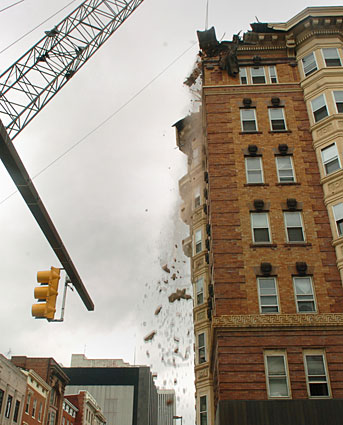
Demolition of the Rochambeau, Baltimore
A giant wrecking claw releases a torent of debris as demolition of the 100-year-old apartment building begins. It will take six weekends to complete the razing.(Sun photo by Doug Kapustin) Sep 16, 2006

This is a particular problem in Baltimore. I have been meaning to write a blog entry about how demolition of the Rochambeau building started last weekend, see "Building gives up ghost: The Rochambeau feels the wreckers' touch as a long battle to preserve the structure ends," as well as this story, "City houses to be razed," both from the Baltimore Sun. The latter story is about how 400 houses will be demolished across the city, to assemble land and develop larger parcels for development.

Crazy. Rehabilitating the houses and renting or selling them, or putting them into a community land trust would more likely "produce" affordable housing than their strategy. Plus it would likely be cheaper, especially given the quality and longevity of new construction, have higher appreciation possibilities, and it would maintain historic building stock in a way that strengthens Baltimore's identity.

See the National Trust report Affordable Housing and Historic Preservation: The Missed Connection by Donovan Rypkema, for more about this issue.

It makes me concerned about Martin O'Malley as governor of Maryland... Although from a "smart growth" and pro-transit standpoint, it'd be hard to be much worse than Governor Erhlich.
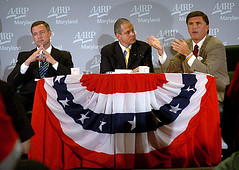
Debate for Governor, Maryland
Mayor Martin O'Malley, left, and Gov. Robert L. Ehrlich Jr. debate at an event today hosted by the Maryland AARP in Timonium. At center is Joseph DeMattos, state director for AARP. (Sun photo by André F. Chung) Sep 14, 2006

See today's Sun editorial, "Smarter treatment." From the editorial:

But these upgrades can also allow sewage treatment plants to expand capacity. Reducing pollutants is good. Even expanding capacity is probably helpful. After all, if Maryland is going to have growth, better to have it hooked to a public sewer than a septic tank. Unfortunately, that's where matters get complicated.

Chesapeake Bay restoration grants are designed to clean up the worst polluting plants. The Maryland Department of the Environment doesn't factor in how the communities may potentially misuse any increased capacity. As a spokesman for the department told The Sun, "We don't look at what they do afterward." Controlling growth is considered a local matter.

That's a mistake. And it's another example of how the Ehrlich administration has repeatedly missed opportunities to build on Maryland's Smart Growth legacy. The Smart Growth concept demands that the state take a more active role in planning; without it, the MDE and other state agencies are merely enablers of bad local planning decisions.

The competitive advantages that cities have are centered upon historic architecture, urban design, and history (along with good transit). When you destroy historic architecture, you diminish your identity and your ability to compete. Granted if Baltimore were Detroit, the situation would be different. But it is well located, on the East Coast, well connected to other cities with rail, and in the core of a growing region, not to mention convenient to people priced out of Washington--the commuting distance by railroad to DC from Baltimore is less than that of many people who work in New York City but commute from other parts of New York State, New Jersey, and Connecticut.

But the average city official or planning department employee is shell shocked, and think that their best course of action is demolition. Sure their city has shrunk greatly. But nothing like Detroit.

As Alan Mallach said, "People aren't really buying houses, they are buying location."

If you wreck the advantages of your location, people won't be buying houses and choosing to live there.

Labels: , , , , , ,

Friday, August 05, 2011

I'm starting to worry, a lot, about the local economy of the Washington, DC region

Image: mapping the Regional Capacity Index (UC Berkeley).

The health of the DC economy over the past few years has been pretty good relatively speaking. Currently, the real estate market within DC proper is one of the strongest in the United States, and while housing prices have dropped down from the stratospheric heights of a few years ago, relatively speaking the city is reasonably healthy economically, rising in population after decades of decline, and adding a significant number of new housing units.

At one level DC specifically remains somewhat steady economically, a function of (1) the relatively steady employment generation of the federal government; (2) the desire of trade associations, key contractors, lobbyists, and law firms dealing with the federal government to locate close by; (3) the building height limit in DC, which constrains supply and keeps commercial property values and rents high; and (4) an improving quality of place within DC, complemented by attractive neighborhoods, especially those with historic building stock, which attracts new residents. (Generally, the region does well too, with Northern Virginia having an edge from defense spending, but there are problems, and the real estate downturn and the rise in foreclosures has debilitated some counties such as Prince George's.)

But this is a relatively recent phenomenon. During the long period of declining quality of local government, the city stagnated, even if the central business district has performed relatively well for commercial office space. This was definitely the case from the late 1980s until Anthony Williams became Mayor in 1999, when the investment climate and perceptions of the city changed significantly, compared to the long period where Marion Barry led and/or shaped the city's politics, management, and operations.

The other day papers reported that for the first time in awhile, job generation in the region declined and unemployment rates are up ("Washington's employment bubble bursting" from the Examiner).

With the dominant theme in national government being debt reduction, including shrinking the military budget, and major cutbacks across all types of government agencies, it may well be that the steady employment engine of the federal government will no longer be such a reliable characteristic of the regional economy, especially in Northern Virginia, which is heavily oriented to defense (not unlike Gov. Dukakis' "Massachusetts Miracle") and in DC and Montgomery County, Maryland, where there are many federal agencies.

This probably means that the center city's value as a residential location will continue to improve, comparatively speaking, because of the quality of life factors, and younger household preferences for urban living, but the real estate development market may slow down again, as there will be less demand for office space, even as the demand for multiunit housing remains strong as the ownership segment of the housing market continues to decline.

I've been meaning to write about a bunch of interesting work on resilience in local economies, including the Resilience Capacity Index ("Measuring ‘resilience’ of U.S. metro areas" from the University of Buffalo Reporter), the Building Resilient Regions initiative of the Institute of Governmental Studies at the University of California Berkeley, and initiatives at the Center for Local Economy Studies in the UK work on "Place Resilience" and the UK's Urban Forum Guide to Community Resilience.

The Washington region is ranked 10th on the RCI according to data compiled in 2010, but with the recent debacle over the national debt ceiling, I think that this ranking position will change, relatively, at least, and there will be significant differences between jurisdictions intra-regionally.


... we measured resilience as a capacity to do well, a capacity to cope with an unknown future challenge. It was a generalized index of the kind of factors that have been hypothesized to matter for responding well to a crisis. The resilience capacity index identifies and uses 12 factors that are thought of as the kinds of factors that would make you more resilient in the face of a crisis. ...We made three categories and there are four factors in each category:

Regional Economic Capacity

Diversification - The familiar notion that if you’re going to be resilient, you don’t want to put all your eggs in one basket in terms of the economy. It gives preference to the economy that is diversified, rather than specialized.

Business Environment - This is a general index that incorporates factors such as small business churn, venture capital and characteristics that have to do with broadband access. It’s a general index for innovation.

Regional Affordability - This is a measure that relates housing costs to median income, so you get a sense of how affordable this place is. More affordable places tend to be more resilient because you don’t have so many people stretched to the limit.

Income Equality - This is a measure of the degree to which the distribution of incomes in your region isn’t skewed.

Socio-demographic Capacity

Educational Attainment - The degree to which you have people that have an education tends to mean more opportunities available to them.

Without a Disability - The percentage of the population that does not have a disability. A disability can be, especially for an acute crisis, particularly challenging.

Being out of Poverty - People with more means, more resources at hand, will have more opportunity to cope in a challenge.

Proportion of Population that has Health Insurance - This is a generalized measure. In the moment of a crisis, if you have health insurance you have more availability of care. Also, it’s a general measure of how stable people are in that region. A large proportion of the population without health insurance is a vulnerability for that region.

Community Connectivity

Civic Infrastructure - A measure of the civic organizations in the community. It’s a proxy for civic engagement for the people in that area.

Home Ownership - This is a basic measure for connectivity. As a general rule, home ownership signals a real commitment to place.

Voter Participation - A standard measure that’s often used to signal activity and interest.

Metropolitan Stability - This is the measure of the stability in one residence in a place for a number of years. Places that have a lot of mobility, or people moving around, tend to be less resilient. You’re not as familiar with the place, so in a shock you might not know the escape route. Also, metropolitan stability lets you know who your neighbors are.


Note that I do think that measuring this data at the metropolitan scale is too gross-grained, and measurements at the jurisdictional level could be more useful, at least in terms of regional planning.

Labels: , , , , , ,

Tuesday, April 19, 2011

The qualities of Livable Cities

The Philips Center for Health and Well-being is creating a series of infographics called the “Insight Series on Livable Cities”, in which snapshots, concepts or statistics about the livability of cities are explained graphically.
Insight Series - Livable Cities - 1

Be sure to click through either on the Flickr image or to the Philips Center for Health and Well-being website. It's an excellent summation of how we need to think about cities, sustainability, and the idea of an integrated public realm.

Labels: , , , ,

Wednesday, March 16, 2011

In complex society, even great disaster planning isn't enough

In today's Post Steven Pearlstein ("Lessons from the long tail of improbable disaster") and Howard Meyerson ("We're not infallible ") have good pieces about the impact of disasters such as in Japan, on society and resiliency. From the Pearlstein piece:

Many scholars now think that the very complexity of modern life - including our transportation and communication systems, our economy and our social interactions - is directly implicated in the severity of catastrophes. In more complex systems, even small changes or perturbations can have disproportionate and unpredictable effects. The things that make our systems more efficient also make them more effective in spreading the impact of a catastrophe.

The lesson to be drawn from all this is not that we should roll back the clock and return to a simpler and less interconnected existence. It is, rather, that more attention must be paid to the extra risks that come with all the advantages of modern life. There may be a significant cost involved in preventing low-probability disasters, or having sufficient infrastructure to deal with them when they cannot be prevented. But as we are reminded by this week's events in Japan, that cost is likely to be less than the cost of ignoring those risks and doing nothing at all.

It seems obvious now that in areas subject to tsunamis, such as coastal Japan, that you shouldn't build nuclear plants in such locations. Of course, that wasn't what people were thinking 50 years ago, when they planned the plants at Fukushima.

On an e-list, Ian Perry sent this (reprinted with permission), in response to a conversation he had with a Japanese friend:

“Everything’s different”, are the words of my Japanese friend in Tokyo to describe the current situation there.

When I lived in Tokyo, I’d adjust my watch not by other clocks, but the train as it arrived at the station platform. Only twice in the year I was there was my train, which ran on 8 minute frequencies, not bang on time, being 4 minutes late on both occasions.

Today, my friend tells me that the trains are chaotic. They run not to timetable, but to the amount of available energy they have, and trains are also subject to the rolling blackouts, closing lines for parts of the day. My friend, who on the day of the quake spent 3 hours walking home (probably it would have been two hours or less walk for me) is working half days due to the lack of trains.

A fellow employee has like many Japanese started cycling. One lady at my friends’ office spent 4.5 hours cycling to work on a newly purchased bicycle, though my observations of Japanese cyclists was when I was overtaking them whilst walking... so the distance might not be so great.

My friend says that bicycles are too expensive for her to purchase, but many did purchase bicycles to get home after the quake and bicycles can be seen on the streets cleared of tsunami debris.

Petrol is being rationed where it is available, oil refineries have been devastated as well as the nuclear energy supply. This is making driving difficult. I’m informed that the car plants that make the Prius and other “green” Japanese cars are no longer functioning and the Just In Time (JIT) supply chain is in ruins. This affects car assembly throughout the world, so expect to see less new “greenwash” vehicles on our streets once the stockpiles are gone.

But... before you think that this will boost bicycle sales, Shimano, the world’s leading supplier of bicycle components/parts is Japanese. Although based in Osaka, it is possible that some of their components are made in the affected region of Japan, and if not, their production is likely to be affected by the lack of energy. Shimano has such a massive market share that we are likely to see changes in the bicycle market over the next months.

What is clear is that Japan will not have so much energy for many, many years as it did before the quake and tsunami. In all aspects of life, changes will need to be made to live of what can be produced safely, though Japan is “blessed” with the possibility of much geothermal energy. If Japan redesigns itself as it did intercity rail in the 1960’s we could see some fascination innovations. Interestingly, the Maglev train might be part of the solutions, apparently requiring less energy to run than trains on rails and this summer, the trains will not be "ice-cold". People will be moving much more in high humidity without air-conditioning.

Trains, cars, the fishing fleet that provides so much food to the nation, famous neon signs, escalators, moving walkways, the levels of electrical gadgetry are all affected (phones, heated toilet seats, etc.) and levels of air-conditioning are all affected. Even in 2003 Japanese office workers were being asked to turn off their air-conditioning as Japan did not have enough energy to run everything people had purchased and wished to use. Even in 2003, Japanese people believed Japanese nuclear power plants were dangerous and they had a poor reputation for safety and had tried to cover up a number of incidents... though a sloppy UK newspaper has only found concerns from 2008.

As we witnessed in Christchurch when a newly discovered fault destroyed that once beautiful city we do not know much about this planet. Hopefully the Japanese will take into account what we don’t know and what we don’t know we don’t know when rebuilding their infrastructures and systems.

The one thing that is clear is that the streets of Japan will be very different following the recent events and we may be able to learn many things from them.

--------

One of the big reasons that I favor sustainable transportation is that it can be more resilient in the face of oil shocks, although as the Japanese experience suggests, having transit systems being reliant on electricity does put them at risk from catastrophic failure as well.

Bicycling and walking give people options, but they need to be placed within a spatial pattern where tasks, errands, and trips can be accomplished relatively conveniently. This is what's called compact development.

Still, compact development is resilient in one sense--you can get around by walking or bicycling and energy use is quite efficient (see the argument by David Owen in Green Metropolis)--but is dependent in another, in that energy and water systems are vulnerable, and food typically comes from outside of the immediate area.

This is the crux of the James Howard Kunstler argument against skyscrapers in an era of diminishing energy resources, that you are intensifying the possibility that negative consequences can be catastrophic in the face of real disaster.

Labels: , , , , , ,

Wednesday, July 21, 2010

Creating systemic-structural change

For most of my life, I have been interested in organizational systems, be it newspapers and media when I delivered newspapers as a child, or restaurants and restaurant chains when I worked in restaurants, universities and colleges when I was in college, and local government as an interested and involved citizen.

In college, I came across the field of organizational development, and crossed paths with one of the founders of the field (Ronald Lippitt). The textbook Social Psychology of Organizations was probably one of the more important books I've read, along with Diffusion of Innovations by Everett Rogers and Change: Principles of Problem Formation and Problem Resolution which distinguishes between "first order" and "second order" change.

My focus on systems only increases with each new experience. Working for the Baltimore County Office of Planning over the last year was particularly instructive because I had never worked for a local government before (I worked for a Main Street program funded by DC, but there was still somewhat of an arms length distance), and while on the "inside" I learned that it was a whole lot harder to push change forward than I had thought. (At the same time, it was a great experiment for me to figure out the various levers of different agencies, the barriers to improvement, and try to come up with a way of dealing with all that--many different agencies, the executive leadership, elected officials, and state agencies too.)

The pedestrian and bicycle access plan draft I produced is all about building a system and structure for bringing about structured, structural and behavioral change--in an environment, the suburbs, where creating a positive environment for walking and bicycling is very difficult, because of how the suburban transportation system was set up to optimize automobility. We'll see what happens with it. (The draft should be released within the next couple weeks, although my contract ended and it's somewhat out of my hands although I'll still have input.)

Anyway, I was reading the Sunday New York Times Magazine yesterday and I had seemingly no interest in this article, "The New Abortion Providers," but I was eating a meal by myself and I ran out of things to read so I read it and I'm glad I did.

It's a textbook description of how to build a system to bring about structural change, in this case, providing and systematizing education and training for family physicians and ob/gyn doctors in how to do the procedure, and how to build a more supportive environment within the health care system (clinics and hospitals) so that providers aren't considered pariahs and marginalized.

----
Just how I am not in favor of "expanding choice" in transportation, instead I focus on optimality, in many instances, while I favor the idea of "nudge" and incentives (see e.g., "Gentle Nudges Work to Get People Exercising" which I discussed in the Baltimore County plan, in terms of building a system of education and encouragement to assist people in their move from automobility to walking and biking), I think it's better to focus on building a system that produces the right outcomes. See the introduction to the past blog entry, "System transformation or people vs. systems and structures," as well as "Stultified vs. flat organizations, democracy vs. autocracy" for more on this point.

Labels: , , , ,

Thursday, November 13, 2008

I didn't even know that today is World Usability Day

which is related to the idea of robust systems....

Sara Snyder, a webdesigner for a Smithsonian unit, writes:

Wishing you all a very happy World Usability Day today!

This year’s theme is transportation, which highlights the fact that usability is not just about the web. Usability is about making all sorts of everyday designs more user friendly, from trains and city signage to cellphones, cameras, voting machines, coffee pots, seatbelts, and yes, web sites.

In honor of
World Usability Day, I’d like to share the “Top 5” on my own personal usability greatest hits reading list:

--
Don't Make Me Think: A Common Sense Approach to Web Usability, by Steve Krug (book)
--
The Design of Everyday Things, by Donald A. Norman (book)
--
Alertbox: Current Issues in Web Usability, by Jakob Nielsen (online newsletter)
--
Usability.gov, a primary government source for information on web usability and user-centered design (web site)
-- A tie between 2 online magazines:
UX and A List Apart: User Science

Let me know if any of you have questions or thoughts about usability. It’s all about making people’s lives just a little bit easier…

Labels: , ,

More thinking about robust systems

(these days I am thinking I should be a organizational-systems analyst, not a planner)...

One of the things that sucks in dealing with municipal issues is the level of discourse. If you look at how various agencies work from a systems standpoint, when negative events occur on a regular basis, or generate additional work for other agencies, then you can argue soundly that the system-result is flawed.

1. One such example is the sales of singles, and the resultant problems with loitering, littering, petty crime etc. Rampant sales of such products creates more work for police officers. But the cost of providing this service isn't borne by the licensee nor paid by the agency that oversees alcoholic beverage licensing. Doing something that generates the need for police enforcement is the mark of a flawed system.

2. Similarly, the "take it outside" approach to crowd control and security in nightclubs. When problems arise. The perpetrators should be detained, and the police called to cart them off. Putting them outside merely displaces and doesn't interdict (stop) the problem. That's why people get kicked out and then shoot guns and kill people. This is an example of another flawed system.

3. Another example is road engineering. I wrote this on a list today, in response to this article, "Shocker: Speed Limits Are Useless Without Enforcement" from New York's incredible Streetsblog.

A number of us have made this point for some time, that roads typically are "over"engineered to allow high speeds, as are cars. Therefore, for areas where you don't want to encourage people to drive fast (on a road on the edge of Greater Capitol Hill in DC--still urban--a car was clocked by a speed camera going over 90mph late at night, in a zone with a posted 25mph speed limit), change the materials of the road. I myself am fond of stone Belgian Block. With it, you get physical, visual, and aural cues that you should drive more slowly. And it's not likely to be supportive of 90-100mph speeds.
Monument Avenue, Richmond
Monument Avenue, Richmond.

Using Belgian block/appropriately engineering roads based on the desired speed in many cases would eliminate the "need" for speed bumps, speed tables, and other road pimples.

So yeah, a truly "robustly" engineered road system wouldn't require secondary enforcement (police writing tickets) to optimize the system, it would engineer the system of pavements to generate the optimal result from the outset.

Labels: , ,

Saturday, October 18, 2008

Blog direction... towards the robust and resilient city

Over the 3.5 years that I have been writing regularly in this blog (it took til February 2005, even though the blog was created in November 2004 before I started writing regularly and in-depth), I have produced about 5,500 entries. Granted some are only photographs, but overall it represents a great deal of writing. So more and more, I don't feel compelled to write something about an issue of the day if I have written about it (especially more than once) before i.e., discussion of the height limit, certain aspects of historic preservation, or even the new direction of parking policy in DC (which seems to be moving in the right direction in some substantively transformational ways).

2. Similarly, I am more interested in broad issues concerning the development, maintenance, and extension of robust systems, structures and processes, rather than the specific example/event that may illustrate some point.

3. Within cities/within DC proper, I am more interested in the citywide and regional ramifications of issues, rather than specifics within a neighborhood, even my own.

4. The introduction to the blog states that it is about:

place and placemaking and all that makes it work--historic preservation, urban design, transportation, asset-based community development, arts & cultural development, commercial district revitalization, tourism & destination development, and quality of life advocacy--along with doses of civic engagement and good governance watchdogging

based on the realization that

A community’s physical form, rather than its land uses, is its most intrinsic and enduring characteristic.

Is that about "Rebuilding Place in the Urban Space" or is it about more than place, urban design and placemaking?

5. In email the other day, from the Resource Centres for Urban Agriculture and Food Security (based in the Netherlands), they used the phrase the resilient city. This phrase is being used in academic writing (such as in the title to the book, The Resilient City: How Modern Cities Recover from Disaster) about urban disaster planning and recovery.

But I think the resilient city is about building robust systems, processes, ways of thinking and acting and being that go beyond disaster. Resilience should be about sustainability, not "green" per se but about "sustainable land use and resource planning," which isn't a phrase or acronym ("SLURP") that has caught on. Resilience should be about creating and building value rather than merely spending money.

6. Resilience is about robust systems. Or as Pasteur was fond of saying: "chance favors the prepared mind."

In the entry "System transformation or people vs. systems and structures" from 2007, I wrote:

There is an interesting article in a back issue of the National Journal comparing Gov. Schwarzenegger to President Bush. ("Yes, He's Back," by John Maggs in the 2/17/2007 issue.)

The major thesis is that Arnie focuses on a flat organizational structure--promoted by business types such as Jack Welch--and capturing the knowledge and leadership within (in the case of politics, regardless of political stripe, at least to some extent), while President Bush believes in democracy and participation as far as the election is concerned, and then autocracy afterwards.

This comes closest to describing my discontent with how government and civic engagement works in Washington, DC at the local level. Democracy during the election cycle; autocracy afterwards.

So a lot of ability and insight ends up being ignored, and the achievement of excellence, best practices, innovation, and transformation appears to be more and more remote.

From the article:

...the nature of leadership shouldn't change just because of the size and complexity of an organization... As organizations become vastly more complex, the need for flatness actually increases... To avoid being strangled by bureaucracy, complex, "networked" organizations must simplify management. (34)

According to the prevailing management theory, two conditions are crucial for running a large organization through delegation--fostering debate and holding subordinates responsible. (35)


7. I think resilience and robustness is about transformation of programs and service delivery, versus doing the same thing over and over again, and failing to look at and address the fundamentals of the problem. A way to do this is to marry design-based thinking and social marketing, as described in the blog entry "Dispuptive innovation (once again)" instead of the more traditional "rational planning" method, which in reality, ends up being a somewhat static approach.

8. In times of limited resources, governments need to think about what is done in terms of added value, neutral value, and destruction of value. Government expenditures should prime the pump and make things better, while encouraging people and organizations to invest--in terms of all types of assets including time/volunteerism, not just money--indepedently of and in addition to government action. Spending government monies on system maintenance, when the system is flawed, doesn't move us forward.

There is an interesting example of this in terms of police departments, comparing DC to Baltimore. DC has experience a spike in violent crime, including murder. DC's response has been checkpoints (see "As city homicides decline, special police team gets most of the credit" and the follow up editorial, "Reducing homicides," both from the Baltimore Sun and "Liberty Takes a Holiday in Occupied Trinidad" from the Washington Post and "Crime-fighting All Hands initiative launched" from the Washington Times) of a manner that is seen to be restrictive of civil liberties and "all hands on deck" operations adding police personnel to the streets in times of crisis.

Instead, Baltimore has focused resources of multiple agencies on the most violent/people with propensity to violence in the three most violent police districts in the city, and while DC's murder rate has increased in 2008, during the same period, Baltimore's has dropped by about 40%.

From the Sun article:

Police said there are many possible explanations for the decline in homicides this year, including greater coordination between local, state and federal authorities. But they believe the city's new approach to these perennially dangerous corners of the city has been a factor.

In the past, they said, there was a tendency to shift resources in response to developing crises, a temporary solution that sought to prevent incidents from spiraling out of control but which potentially left other areas vulnerable. And leaders say such rapid deployments are still a useful and necessary strategy as police evaluate crime trends on a day-to-day, sometimes hour-by-hour basis.

The geography factor

But members of the recently formed Violent Crime Impact Division's enforcement team remain rooted in the Eastern and Western districts, along with the Northwest District. Police declined to disclose the number of officers in those teams, which supplement beat officers and other units operating in the area.

"The thinking behind it is, if you map out violent crime and look at homicides and shootings in general, you'll see they occur in the same geographical areas," said Col. Dean Palmere, who heads the VCID unit. "Once you identify and learn those individuals in those geographical boundaries, and you work up historical information, it gives you a guide - it gives you what window you should be looking in."


9. Building the robust and resilient city is the direction that I am moving towards in my thinking and writing, and where I hope to lead the consulting work that I do, which tends towards commercial district revitalization and destination development.

Labels: