Rebuilding Place in the Urban Space

"A community’s physical form, rather than its land uses, is its most intrinsic and enduring characteristic." [Katz, EPA] This blog focuses on place and placemaking and all that makes it work--historic preservation, urban design, transportation, asset-based community development, arts & cultural development, commercial district revitalization, tourism & destination development, and quality of life advocacy--along with doses of civic engagement and good governance watchdogging.

Monday, May 04, 2020

Just a reminder that what are called "public private partnerships" are contracts, not partnerships

-- "Design-Build Team Makes Decision to Leave Maryland Purple Line Rail Project," Engineering News-Record

The State of Maryland signed a contract with a group of various firms to design, build, operate,  maintain and partly finance the forthcoming Purple Line light rail line in Suburban Maryland.  In turn, the group created a separate subsidiary to construct the line.

Washington Post graphic showing the route of the line.

There are various disputes between the State and the consortium over delays and changes that result in greater costs and who is responsible for paying.

Because negotiations up to now haven't resulted in resolution, the construction firm has given notice per the contract to walk away.

Um, despite all the happy talk about "public private partnerships," in normal circumstances, that's not how "partnerships" are supposed to work.

Although this is not new.  The reality is that these are contractual agreements, and very hard to change once underway.  And as contracts, there is little interest in flexibility and changes and improvements once the construction is underway.

From "The Theory and Practice of Infrastructure Public-Private Partnerships Revisited: The Case of the Transportation Sector":

PPPs are widely promoted based on a narrative of improved collaboration between different stakeholders. By aligning the interests of the multiple parties to encourage closer and more productive working relationships, it is argued that public-private partnerships support innovative project designs and deliver value for money by better controlling project risks. Despite the promises, however, relationships between the various partners in PPPs have often turned from collaborative to confrontational, threatening the success of the project.

This is reality. And as a result, I think it's better to call these kinds of arrangements contracts, not partnerships.


I was trying to hook up with one of the teams that bid on this project. They didn't win. And the experience led them to abandon future efforts on such large scale projects (although the firm remains one of the nation's largest construction firms).

One of the problems with projects like this is that they are so few and far between (the same goes with manufacturing passenger transit vehicles of all types) that it's hard to build economies of scale.)

And early on in the post-bid acceptance process, I learned there was no room for innovative station area planning and development, etc., because "it's not in the contract."

-- "A Purple Line update: the downside of Public Private Partnerships" -- they are contracts, not partnerships," 2017
-- "It's not like transit "outsourcing" I mean "public-private partnerships" are necessarily smooth sailing," 2018

Which is one of the reasons why my brilliant writings around the Purple Line will have no effect.

-- "Revisiting the Purple Line (series) and a more complete program of complementary improvements to the transit network," 2019

-- Setting the stage for the Purple Line light rail line to be an overwhelming success: Part 1 | simultaneously introduce improvements to other elements of the transit network
-- Part 2 |   the program (macro changes)
-- Part 3 |   influences
-- Part 4 |   Making over New Carrollton as a transit-centric urban center and Prince George's County's "New Downtown"
-- PL #5: Creating a Silver Spring "Sustainable Mobility District"
-- Part 6 |  Creating a transportation development authority in Montgomery and Prince George's County to effectuate placemaking, retail development, and housing programs in association with the Purple Line
-- Part 7 | Using the Purple Line to rebrand Montgomery and Prince George's Counties as Design Forward

-- PL #5: Creating a Silver Spring "Sustainable Mobility District"
- Part 1: Setting the stage
- Part 2: Program items 1- 9
- Part 3: Program items 10-18
- Part 4: Conclusion
- Map for the Silver Spring Sustainable Mobility District
- (Big Hairy) Projects Action Plan(s) as an element of Comprehensive/Master Plans
- Creating the Silver Spring/Montgomery County Arena and Recreation Center

Labels: , , , , ,

Friday, September 21, 2018

It's not like transit "outsourcing" I mean "public-private partnerships" are necessarily smooth sailing

WMATA has released an RFP for the operation of the second phase of the Silver Line ("Metro will outsource operation of Silver Line's second phase," Washington Business Journal). 

The Union announced they are opposed, seeing outsourcing as leading to safety and other issues,  although most comments on that score make the point that it's not like WMATA is running great now, with virtually all non-construction operations provided in-house.

While I do agree that WMATA needs to consider outsourcing as a way to reduce costs, and that needs to be seen in part as a shot at the major unions for their unwillingness to be more collaborative in considering system improvements and cost reductions, it shouldn't be seen as a smooth path.

Photo: Aaron Ontiveroz, The Denver Post A-Line flagger Chris Dugent holds a stop sign as the train passes at Steele Street on Tuesday, June 19, 2018.

Denver Transit Partners, the major example of finance-design-build-operate-maintain transit operation--this consortium got the contract for the Maryland Purple Line light rail too--is suing the transit agency in Denver in a dispute over charges against payments concerning certain aspects of operation of the A Line train ("Regional Transportation District sued by Denver Transit Partners," Denver Post). From the article:
Denver Transit Partners, through the lawsuit, is trying to force RTD “to reimburse them tens of millions of dollars for the crossing gate attendants that DTP has been paying for all along,” according to a RTD news release.

The transit consortium is citing a change in law, or a change in the interpretation of law, by federal and state rail safety agencies as being the reason for its failure to get final approval of grade crossings and quiet zones on RTD’s commuter rail system, according to RTD’s news release. Denver Transit Partners is attempting to recoup lost revenue, because of continual grade crossing failures, by suing the district, the release said.
That might be. I don't know the ins and outs of the safety regulations.

And in this case, maybe the change requires a mutual response from both DTP and the transit agency.

 And at least with there being flaggers in Denver, people aren't dying, as is the case in South Florida with the introduction of the Brightline railroad service ("Brightline train crashes into car in Hallandale Beach," WPLG-TV).

But usually it's on the other side, and the transit agency is left holding the bag.

When I was talking with an ex-Transport for London official when I was there in June, we discussed these kinds of issues, how such projects become 100% contractual, they aren't "partnerships." There, because of various national laws, transit services have to be operated by the private sector, with the exception of the London Underground, and services where the private sector will not bid, therefore requiring that the transit agency be the "Operator of Last Resort."

He commented on how the Crossrail concession wouldn't allow a change in technology which was developed after the contract was signed.

Using it will be cheaper and more reliable, but because it's not in the contract, they refused to change the specifications.  So the change will be installed after the trains are delivered, costing more money, and adding to the delays of opening the system--which has moved back by one year ("Crossrail delay: New London line will open in autumn 2019," BBC News).

I've written too about how the Purple Line is now a "contract" and there isn't much room for change or flexibility as a result ("A Purple Line update: the downside of Public Private Partnerships" -- they are contracts, not partnerships").

Even without complex financing-design-build-manage-operate-maintain contracts, lawsuits between government agencies and construction firms are pretty common.

Labels: , , , ,

Tuesday, February 24, 2015

Shocking semi-example of accountability with DC charter school corruption (but still mishandled)

Last week, DC's Public School Charter Board voted to rescind the charter of the Community Academy Public Charter School group ("DC Charter School Board revokes charter for Height Community Academy Public Charter Schools," Post) because Kent Amos, the founder-director, was using related corporations to "manage"' the school and pay himself about $1 million/year ("D.C. officials allege improper diversion of charter funds," Post).   Sadly, parents were advocating for Amos and the schools, in face of the corruption.

While I think that was a somewhat sound move because of the corruption, rather than withdrawing the charter, if the schools are in fact high quality, I think they should have been able to put the school in receivership, keep it going, and put out for bid new management.

2.  Today's Post has an article ("DC charter school executive salaries vary widely, Post analysis shows") about varying salaries, many outlandish, of charter school personnel.  Many principals/school leaders make significantly higher salaries than DCPS equivalents, including school leaders who make more than the Chancellor (who is overpaid too, given that DC's student population is about 1/3 of that of the area's largest school districts).

3.  Note that this issue of related businesses and management contracts of various sorts to mis/direct money for private gain is not new.  It's been around probably since the beginning of the schools (e.g., I know of a case where the Charter School's founder has a separate company that handles the transportation needs for the school, and I can't believe that's the only example).

But the Charter School Board claims that they can't force private entities to disclose information about their financial arrangements with the schools ("Charter board could close school amid allegations that leader diverted money," Post).

The basic problem seems to be that the "contracts" between the school and "the city" which are not between "the city" and the charter schools but are with the Public Charter School Board--which is appointed, with limited oversight--FAIL TO INCLUDE SOME OF THE MOST BASIC PROVISIONS TO PROTECT LOCAL INTERESTS.

Since the bulk of school funding comes from "the city" and the schools are public, there should be protections and standards in place to protect the city's interest.  This should include:

- ownership of the building
- ceilings on salaries
- restrictions on the creation of allied but "separate" corporations to provide services and siphon funds
- financial disclosure requirements
- etc.

Labels: , , ,

Thursday, August 30, 2012

What the? Why is a local councilmember the one to notify the DC Dept. of General Services that construction in an elementary school building is defective?

See "$25 million renovation 'defective' at DC elementary school" in the Examiner.  From the story:

With ground broken in January 2010, the project included a 35,000-square-foot addition, modernized classrooms, and updates for the cafeteria and hallways. One of the highest-performing DC Public Schools campuses, Janney has attracted a healthy student enrollment over the years, requiring an expansion.

But when Ward 3 Councilwoman Mary Cheh visited Janney recently, she said she discovered "defective" work. "The flooring was cracking and lifting up and things of that nature -- buckling and lifting up in places," Cheh said. "There were leaks in the entranceway, all the trees had died and the gym -- which is on top of the library -- was supposed to be insulated. The principal described it as listening to a herd of buffalo when kids are in the library."

After being alerted by Cheh, the General Services Department dispatched workers to Janney, who put in temporary flooring and are planning to install a more permanent fix during the school year. Officials are seeking a recommendation regarding the gym from a consultant.


This parallels an entry in GGW about the expense of transportation projects ("Are contractors wasting public money? We don't know").  While the article didn't say much, the comments were pretty good, and among other areas, focused on project management and the capacity of government agencies to monitor projects (also see "Contractor denies concrete error at Silver Spring Transit Center" also from the Examiner).

Construction project management is difficult in any circumstances and typically the private sector pays better so it's hard for government agencies to retain good people, not to mention the fact that frequently, paying good people what they are worth and retaining knowledge and skill isn't a priority for government anyway.
Eastern Market Fire
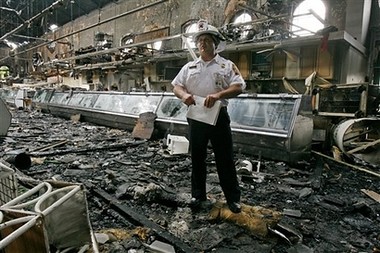
Bruce Faust, battalion chief for the District of Columbia Fire and EMS, looks over the damage inside of Eastern Market in the Capitol Hill neighborhood of Washington on Monday, April 30, 2007. An early morning fire ravaged Eastern Market on Monday, gutting part of the 134-year-old Capitol Hill landmark and devastating many vendors and residents who consider the historic public market the soul of the neighborhood (AP Photo/Jacquelyn Martin).

People at Eastern Market
Eastern Market today.

Curtis Clay, no longer with what was then called the DC Department of Real Estate Services, was the construction project manager for the rebuilding of DC's Eastern Market, the public market building that was wrecked by a devastating fire in April 2007.  The building re-opened in September 2009.  He left a few months later.  But at the grand opening press conference, I commented to him that despite all the politicos speaking, he was the true and unheralded hero of the day, because he did a damn good job shepherding and overseeing the project.

Skills like that are rare.

In the case of DC oversight of real estate generally, while I thought that the move by the Fenty Administration to consolidate services, such as have all the lawns at government agency facilities be cut via one master contract rather than through separate contracts with each agency, was a good idea and lowered costs, I was really leery of the Gray Administration's creation of a Department of General Services, modeled after the federal government GSA--and you know they've had some problems...--although other local governments do something similar, because it creates a very large agency with a lot of responsibilities in a government that has had some very serious problems with the quality of execution.

If you haven't demonstrated robust capacity already, stretching capacity further by creating a massive consolidated agency (e.g., like all the issues with DC Department of Consumer and Regulatory Affairs, which suffers from similar problems) is likely a mistake, unless it is used as the opportunity for significant improvements in management, staff, focus and business process redesign.

Obviously, if it doesnt work at the scale of one relatively small project, it doesn't bode well for the overall approach.

Still, the project managers at DGS should have been all over the problems at Janney Elementary, long before complaints would be percolating up to the local Councilmember.

Labels: , , , , , ,