Rebuilding Place in the Urban Space

"A community’s physical form, rather than its land uses, is its most intrinsic and enduring characteristic." [Katz, EPA] This blog focuses on place and placemaking and all that makes it work--historic preservation, urban design, transportation, asset-based community development, arts & cultural development, commercial district revitalization, tourism & destination development, and quality of life advocacy--along with doses of civic engagement and good governance watchdogging.

Tuesday, June 02, 2020

Taller buildings constructed with wood

For fire code reasons, wood construction has been capped at about 5 floors-stories, although when constructed on top of a one or two story concrete podium, the total height can be 6-7 floors.

At 18 stories, Mjøstårnet in Brumunddal, Norway was for a time the tallest timber building in the world.  It's now second tallest.

For the past few years, there's been a great deal of research and change in standards allowing for the frame construction of taller buildings ("Rethinking Code Requirements for "Tall Wood" Buildings," Architect Magazine; "Could Tall Wood Construction Be the Future of High-Rise Buildings?," ArchDaily).

Asian and Nordic countries have been leaders in pushing the changes forward ("Voll Arkitekter's Mjøstårne in Norway becomes world's tallest timber tower," Dezeen).

Constructing buildings in wood instead of concrete and metal creates fewer greenhouse gas emissions, and as a cost advantage requires less labor and can be done in part using modular construction techniques in off site facilities.


Rendering: Imagefiction.

The Wall Street Journal reports ("Country’s Tallest Wooden Building Rising in Cleveland") that a building is being constructed in Cleveland.

-- Presentation
-- "Harbor Bay's Intro project: Here comes the neighborhood," Crain's Cleveland Business

At 9 stories, it's not so much "tall" as it is wide. From the article:
The nine-story development, dubbed Intro, will include 298 apartments, retail space and an event venue. It is being built primarily with mass timber, a type of pressed wood that is gaining popularity as a climate-friendly alternative to steel and concrete.

The developer, Harbor Bay Real Estate Advisors LLC, hopes that the new Cleveland building will become a blueprint for others to follow. It is also betting that the pandemic won’t cool demand for transit-oriented apartments in big cities. ...

The nine-story development, dubbed Intro, will include 298 apartments, retail space and an event venue. It is being built primarily with mass timber, a type of pressed wood that is gaining popularity as a climate-friendly alternative to steel and concrete.

The developer, Harbor Bay Real Estate Advisors LLC, hopes that the new Cleveland building will become a blueprint for others to follow. It is also betting that the pandemic won’t cool demand for transit-oriented apartments in big cities. ...

If done right, making beams and floors from wood emits about half as much carbon dioxide into the atmosphere as the production of steel and concrete, said Galina Churkina, a senior scientist at the Potsdam Institute for Climate Impact Research in Germany. Trees also remove carbon from the atmosphere, turning wooden buildings into carbon vaults. That could help slow down global warming.

But there is also a risk that a boom in timber construction could accelerate global deforestation if the wood isn’t harvested in a sustainable way, she said.
A couple months ago I wrote about the sameness and architectural homogeneity of podium-based buildings ("Why new apartment buildings all look the same"). Wood construction might foster more attractive design.

As importantly, it can allow for taller buildings and greater density compared to current techniques, and over the long term, lessen housing appreciation.

Labels: , , , , , ,

Wednesday, April 03, 2013

Silver Spring Transit Center as an example of the perils of privatization

I'm writing an analysis of a project right now, and a point I make is that the first organization can't expect the simultaneous planning efforts of the two other major players to necessarily represent the first organization's interests at the expense of their own.

There has been a lot written about the debacle of the Silver Spring Transit Center in Silver Spring, Maryland, so much that I am not going to discuss it in depth here.

The station is designed to be intermodal, and to provide a structure (but modeled more after a parking structure than a grand railroad station) to provide bus service connections to the adjacent subway station, along with improved rail, bus, and inter-city bus connections (Greyhound, etc.) with a connection to the Metropolitan Branch Trail-Capital Crescent Trail for walking and biking (but no allied bike station on-site).

Problems with the station's construction (detailed in this Post article "Silver Spring Transit Center's inspectors ran poor concrete tests, report says") ended up being the result of design failures that went undetected, improper construction, and failures in the inspection and certification process--at least four parties, Parsons Brinkerhoff, the architect for the project, Foulger-Pratt, the construction manager, the concrete provider, and Robert Balter Company, the inspection firm, are all likely to end up paying out big dollars for the failures, even if Foulger-Pratt is trying to declaim their responsibilities for the debacle ("Foulger-Pratt 'disturbed' by county behavior" and "Contractor on troubled transit center blames Montgomery County officials" from the Post).

While it's typical for local governments to contract out the design and construction of buildings and structures, this doesn't usually extend to the inspection of a building, although it's not out of the question, if the structure is not one that is typically constructed in a community.

For all the talk about the benefits of capitalism, be it market democracy, neoliberalism ("March of the neoiberals" from the Guardian), or "democratic capitalism" ("The Empirical Kids" from the New York Times) at the end of the day, it's a bad idea to expect the market and the service providers to be focused on representing the client's interest at the expense of their own interest.

This is a good example of why relying on "competition" and "the market" isn't always a good strategy (see "Montgomery approves $7.5 million more for transit center" from the Post).

And why giving contracts to local firms like Foulger-Pratt, who are unaccustomed to building transit facilities, might be a bad idea also.

The County is getting a lot of criticism for what happened, but at the same time, officials get lots of push in terms of market-based "solutions" and supporting local business.

Too often, public-private "partnerships" are not partnerships at all.

Labels: , , , , , ,

Thursday, August 30, 2012

What the? Why is a local councilmember the one to notify the DC Dept. of General Services that construction in an elementary school building is defective?

See "$25 million renovation 'defective' at DC elementary school" in the Examiner.  From the story:

With ground broken in January 2010, the project included a 35,000-square-foot addition, modernized classrooms, and updates for the cafeteria and hallways. One of the highest-performing DC Public Schools campuses, Janney has attracted a healthy student enrollment over the years, requiring an expansion.

But when Ward 3 Councilwoman Mary Cheh visited Janney recently, she said she discovered "defective" work. "The flooring was cracking and lifting up and things of that nature -- buckling and lifting up in places," Cheh said. "There were leaks in the entranceway, all the trees had died and the gym -- which is on top of the library -- was supposed to be insulated. The principal described it as listening to a herd of buffalo when kids are in the library."

After being alerted by Cheh, the General Services Department dispatched workers to Janney, who put in temporary flooring and are planning to install a more permanent fix during the school year. Officials are seeking a recommendation regarding the gym from a consultant.


This parallels an entry in GGW about the expense of transportation projects ("Are contractors wasting public money? We don't know").  While the article didn't say much, the comments were pretty good, and among other areas, focused on project management and the capacity of government agencies to monitor projects (also see "Contractor denies concrete error at Silver Spring Transit Center" also from the Examiner).

Construction project management is difficult in any circumstances and typically the private sector pays better so it's hard for government agencies to retain good people, not to mention the fact that frequently, paying good people what they are worth and retaining knowledge and skill isn't a priority for government anyway.
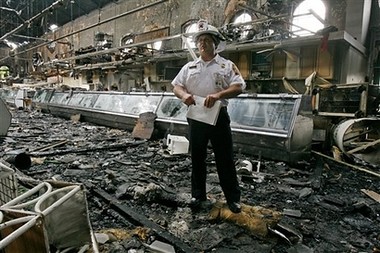
Eastern Market Fire
Bruce Faust, battalion chief for the District of Columbia Fire and EMS, looks over the damage inside of Eastern Market in the Capitol Hill neighborhood of Washington on Monday, April 30, 2007. An early morning fire ravaged Eastern Market on Monday, gutting part of the 134-year-old Capitol Hill landmark and devastating many vendors and residents who consider the historic public market the soul of the neighborhood (AP Photo/Jacquelyn Martin).

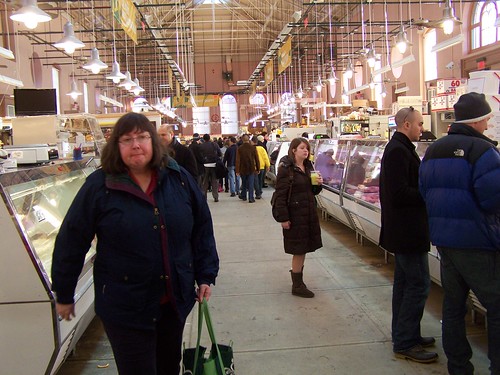
People at Eastern Market
Eastern Market today.

Curtis Clay, no longer with what was then called the DC Department of Real Estate Services, was the construction project manager for the rebuilding of DC's Eastern Market, the public market building that was wrecked by a devastating fire in April 2007.  The building re-opened in September 2009.  He left a few months later.  But at the grand opening press conference, I commented to him that despite all the politicos speaking, he was the true and unheralded hero of the day, because he did a damn good job shepherding and overseeing the project.

Skills like that are rare.

In the case of DC oversight of real estate generally, while I thought that the move by the Fenty Administration to consolidate services, such as have all the lawns at government agency facilities be cut via one master contract rather than through separate contracts with each agency, was a good idea and lowered costs, I was really leery of the Gray Administration's creation of a Department of General Services, modeled after the federal government GSA--and you know they've had some problems...--although other local governments do something similar, because it creates a very large agency with a lot of responsibilities in a government that has had some very serious problems with the quality of execution.

If you haven't demonstrated robust capacity already, stretching capacity further by creating a massive consolidated agency (e.g., like all the issues with DC Department of Consumer and Regulatory Affairs, which suffers from similar problems) is likely a mistake, unless it is used as the opportunity for significant improvements in management, staff, focus and business process redesign.

Obviously, if it doesnt work at the scale of one relatively small project, it doesn't bode well for the overall approach.

Still, the project managers at DGS should have been all over the problems at Janney Elementary, long before complaints would be percolating up to the local Councilmember.

Labels: , , , , , ,

Wednesday, August 01, 2012

The DC Office of Planning Wants to Hear Your Views on the District’s Present and Future

(I have some reservations about this initiative, which I'll write about later. Interesting that an initiative to improve urban planning involves the American Institute of Architects, but not the American Planning Association and the American Society of Landscape Architects.

More importantly, participation and engagement is a two-way street. The city generally doesn't have very open practices or a commitment to substance in civic engagement. A citizen planner initiative ought to provide significant insights that the city acts upon in order to improve the way it works and functions, along the lines I wrote about here, "All the talk of e-government, digital government, and open source government is really about employing the design method.")

From email:

Washington, D.C., has seen significant changes over the past ten years. After decades of population decline, the District has seen a solid decade of population growth, and that growth is continuing. New services such as the Circulator bus, bikesharing and carsharing make it easier for residents to get around the city. At the same time, the historic character of our city makes the District of Columbia a place of great attractions and destinations, unique and vibrant neighborhoods, and interesting streetscapes and public spaces. Because the greatest assets of our city are its residents and neighborhoods, the D.C. Office of Planning wants to hear from you—as the District moves into its future, what do residents across the city care about most? What are the best ways to engage you and other residents to discuss the impacts of future growth in the District, its preservation and stewardship, and prosperity for all residents?

In a partnership with The American Institute of Architects (AIA) DC Advocacy Committee, the D.C. Office of Planning is hosting a series of informal forums to explore these questions. These discussions will bring together groups of 12 to 15 residents to share their experiences and ideas. Thoughts shared in these discussions groups will help the Office of Planning improve how we reach out to residents during planning processes, give us a better idea of what issues to focus on, and inform how we develop our upcoming Citizen Planner initiative.

Please provide us with the following information and submit it to the Office of Planning no later than August 8, 2012 to be considered. If you are selected to participate in a focus group you will be contacted by August 13, 2012.

1. Name:
2. Contact Information: (phone number, or email address)
3. Ward where you live:
4. How long have you lived in the District of Columbia?
5. Have you ever attended a community meeting or participated in a community organization and/ or activity?

Labels: , , , , , ,

Sunday, October 30, 2011

Understanding suburban poverty demographics (a/k/a "the times, they are a changin'")

Levittown Photographs from the Tekula Family.jpg
Levittown, Long Island photograph from the Tekula Family.

Historically, poverty has been (and is still centered) in center cities within metropolitan areas because outmigration of those better off financially left behind the people living in concentrated poverty, which became even more concentrated as income dynamics within the center city became less diverse.

Today the rise in poverty in the suburbs is not just a function of a greater diversity of destination choices on the part of immigrants, it's also a function in a significant exogeneous shock to the economic calculus of the U.S.

-- Suburbanization of poverty report, Brookings Institution

Suburban development ("sprawl" etc.) has long been a function of ideas about "the American Dream" of having your land, but fueled by mass production and cheap gasoline.

When gasoline is no longer cheap, and it won't be because of increased demand on the part of emerging economies such as China and India coupled with relatively tight supplies, a real estate development economy based on constructing new houses farther and farther away from primary activity centers no longer makes financial sense.

The farther out you are the more you are at risk, both because of increases in cost of gasoline, and the repricing of housing to take into account proximity to activity centers.

Instead of a house being a primary asset within a household's wealth portfolio, it's potentially a time bomb, if located in a place that is no longer desirable.

Yesterday's article in the Post about exurban school districts going to four day weeks, "In trimming school budgets, more officials turn to a four-day week," makes this point about the North Branch school district in the Minneapolis region. From the article:

North Branch is a city of about 10,000 people 50 minutes north of St. Paul and Minneapolis. The community was booming a decade ago, attracting families in search of good schools and affordable homes within commuting distance of the Twin Cities.

But the recession knocked North Branch onto its heels. Its downtown is forlorn, with vacant storefronts tucked between the taxidermist, coffee shop, barbershop and a thrift store. The dearth of commercial properties means homeowners shoulder a great deal of the tax burden. Last year, the county had one of the highest unemployment and home-foreclosure rates in the state. The drop in property values and taxes has had a profound effect on money for the schools.

Seven times in six years, the North Branch school board has asked voters to approve a local levy for schools. It’s failed each time, last year by a 2 to 1 margin.

The school board will try again Nov. 8, seeking a levy to raise $1.5 million annually for the next three years. The district is predicting a shortfall of $2.5 million next year, so the levy would only soften future cuts, not eliminate them. The average homeowner would pay $122 a year. Chances for passage appear slim.

“People here are angry,” said board member Randy Westby, who supports the levy even as he shares others’ economic worries. His three-bedroom home, purchased in 2004 for $500,000, is now worth $233,000. “I’m 61 years old,” said Westby, who owes the bank $400,000. “I’m not going to live long enough to see the market come back.”


People can be angry, but the real problem is making a series of choices depending on cheap oil and an ever escalating housing market.

Now that location valuation is a product of reduced dependence on cheap energy, more and more people and places are going to face this kind of predicament.

Labels: , , , ,

Masonry history primer: manual for teaching

Masonry History Integrity: An Urban Conservation Primer, written by Tom Russack, an instructor in the YouthBuild program sponsored by the Abyssinian Development Corporation ("Powerful Harlem Church Is Also a Powerful Harlem Developer" from the New York Times) in New York City, has just been published by the National Center for Preservation Technology & Training. From the entry:

This textbook has been developed as a primer and practical teaching manual for young people interested in construction, masonry preservation, green technology, building repair and the conservation of the urban environment. Each chapter is built around a particular masonry material, such as mortar, brick, stone, or stucco; or an aspect pertaining to the masonry trade, such as maintenance or green building technology. ...

According to the United States census and the NYC Department of Buildings, there are approximately 8.2 million people and over 975,000 buildings in New York City. Many of the buildings are over one hundred years old. Most are constructed with some sort of masonry material, to meet fire code regulations, and to endure the effects of time, weather and aging.

It is also noted that amongst the construction trades, there is a generally accepted understanding that the preservation, repair, conservation and maintenance of older buildings requires a different set of skills than those required for new construction. Presently, there are a half dozen college programs offering specialized hand-on masonry conservation training. But, there are no schools or programs in the United States providing an introduction to masonry conservation at the high school level.

There is however, one such program in New York City, provided by the Abyssinian Development Corporation (ADC). It offers young men and women the opportunity to obtain a high school general equivalency diploma (GED) and learn about various construction careers, including masonry, masonry conservation and green building technology. ...

The (ADC) Workforce Development/Youthbuild Masonry Preservation program teaches general masonry, masonry conservation and green technology skills for students to gain pre-apprenticeship level trade skills. These basic skills enable them to enter the NYC building restoration and energy conservation work force.

To help develop the student’s self-confidence, personal integrity and an appreciation for quality craftsmanship, the hands-on masonry training activities are combined with stories from U.S. history and life skill lessons.

This textbook is the culmination of the ADC training program and curriculum. It has been developed as a primer and practical teaching manual through a grant from the National Park Service and the National Center for Preservation Technology and Training. It serves as the first step of exploration for young people interested in construction, masonry preservation, green technology, building repair and the conservation of the urban environment.

Labels: , , ,

Wednesday, September 07, 2011

Engineering Ground Zero PBS Nova show tonight

Image: looking to West Street from the World Trade Center site. The 90 West building is in middle right of the photo. Photographer unknown.

Tonight, PBS's Nova program has an episode on the construction of buildings in the place of the destroyed World Trade Center in NYC. Yesterday, a 10 minute piece on the topic ran on the PBS News Hour, "How Has Skyscraper Design Changed Since 9/11?."

A major point is that 90 West Street, across the street from the WTC. The building opened in 1907 so it was better constructed to withstand fire than modern buildings, therefore it survived the fire that engulfed it as a result of the WTC destruction. But the cost of construction of that style and bearing is two times or more the cost of buildings in the present day.

Also see "NOVA turns its scientific spotlight on the rebuilding of ground zero" from the Blair Kamin Chicago Tribune Cityscapes blog.

Labels: ,