Rebuilding Place in the Urban Space

"A community’s physical form, rather than its land uses, is its most intrinsic and enduring characteristic." [Katz, EPA] This blog focuses on place and placemaking and all that makes it work--historic preservation, urban design, transportation, asset-based community development, arts & cultural development, commercial district revitalization, tourism & destination development, and quality of life advocacy--along with doses of civic engagement and good governance watchdogging.

Thursday, June 04, 2020

Innovation infrastructure as an element of community economic development: BioSpaces; TechShops; Maker Spaces; Arts spaces

The response to the pandemic has engendered a wide variety of "innovative responses" by people, businesses, and nonprofits, to address gaps of all sorts--lack of personal protection equipment, food, access to cultural resources, schooling, etc., which has been a surprise compared to a general "hardening of the arteries" when it comes to the ability of organizations to respond and transform.

-- "Innovation in Response to the COVID-19 Pandemic Crisis," Academic Medicine
-- "FDA Oversight Emerges For Additive Manufacturing," Forbes
-- "How 7 local businesses are pivoting to PPE production," Boston Globe
-- "7 Weird And Unexpected Business Pivots During The Coronavirus Pandemic," Forbes

Jane Jacobs and Urban Innovation. In Death and Life of the Great American City, JJ argues that "a large stock of old buildings" is one of the four key requirements for healthy cities, because old buildings, paid off and with low running costs, offer cheap rent, and startups (and artists) are fostered by low cost space.  This argument was extended in her second book, The Economy of Cities.

Note that JJ didn't anticipate that there would be a serious disconnect between supply and demand of space in cities and that even old buildings would end up being significantly repriced upward in strong market cities.

Space and facilities as infrastructure for innovation. My arts-based revitalization writings ("Arts, culture districts, and revitalization"), citing John Montgomery's crucial distinction between arts as consumption and arts as production, reference a publication by the Creative City Network of Canada, Cultural Infrastructure: An Integral Component of Canadian Communities, which provides a framework categorizing the types of spaces and facilities that artists and arts organization need to have a functioning arts production system.

Using that framework, I argue that within cultural planning, space needs for artistic disciplines must be differentiated, and that we should endeavor to ensure the availability of the variety of spaces needed to support a healthy and functioning local arts ecosystem.

Best practice discipline-specific arts center examples include Baltimore Clayworks,  London Sculpture Works, UK, Pittsburgh Glassworks, Podcast Garage, Boston, Pyramid Arts Center (printing) in Hyattsville, Maryland, and The Writing Center in Bethesda Maryland

Multidisciplinary examples include BRIC House in Brooklyn, Cabelfactory in Helsinki, GoggleWorks in Reading, Pennsylvania, La Friche in Marseille, and Symphony Space in NYC.

Hackerspaces as infrastructure for innovation.  One type of space not included in the CCNC Cultural Infrastructure framework are hackerspaces.  The framework needs to be extended outward from the arts, for innovative business, various creative endeavors, nonprofits, etc., to provide spaces, technical assistance, and access to specialized equipment.

Hackerspaces are non profit, community run spaces where people with a common interest and a need for specialized equipment, such as computing, machining, technology, digital media, and science can have access to workspaces, equipment, and meeting and collaboration spaces.  Training, classes, talks and other programming may be offered.

The types of spaces and range of equipment vary.  Universities often have such spaces, although access is typically limited to people affiliated with the school.  These days, "maker spaces" in public libraries are in vogue, with some interesting resources, from 3D printers to sewing machines, but not highly technical equipment.

Woodworking.  An early example is the creation of woodworking clubs, which have a wide variety of specialized equipment.  People can become members and be certified and then able to work with specialized machinery.

People like me without that kind of interest or skill can usually take pieces to such places to be worked on, at a reasonable cost. For example, I didn't have the equipment to do a precise cut for butcher block kitchen counters.  So we took the counter to Woodworkers Club of Rockville and they did the cuts.

Community Kitchen.  As a way to support local food production and business development, the Appalachian Center for Economic Networks created a food production kitchen with a food safety manager and other technical assistance programming to support local business development around agriculture.

Other places have developed similar operations, including La Cocina in San Francisco ("What Are Food Incubators and Do They Create Viable Businesses?," Eater), which is focused on supporting immigrants and Spice Kitchen Incubator in Salt Lake City, which is focused on job training and business development.

In DC, Union Kitchen operates similarly but on a for profit basis ("Food Entrepreneurs Have Much to Weigh Before Tying Their Fates to Union Kitchen's Accelerator," Washington City Paper).

Business Incubators.  On the economic development side, business support organizations and/or government agencies or universities create incubators to support business development.  There are various types, depending on the area and what business specializations a community might have.

Incubators sponsored by economic development organizations usually offer other technical assistance and programming.  One distinctive element is that business incubators usually have an "up and out" approach, putting a limit on the amount of time a business can be housed at low rents.

There can be for profit variants.

-- InBIA: Global Network of Entrepreneurial Ecosystem Builders

BioCurious Lab.

BioSpaces.  This entry is sparked because a recent issue of New Yorker Magazine has an article ("The Rogue Experimenters") about hackerspaces or "community labs" for biology, such as the Baltimore Underground Science Space, which has lab equipment, storage freezers, and a PCR machine to duplicate DNA.

The article discusses the DIY-bio movement, which even includes an effort to create nonprofit insulin production, because of increasingly high cost of insulin sold by traditional pharmaceutical companies. e-NABLE is a 3D printer-supported network of volunteers creating low cost or no cost prosthetics.

-- Just One Giant Lab network
-- GenSpace, Brooklyn
-- BioCurious, Santa Clara, California
-- Counter Culture Labs, Oakland, California
-- Harlem BioSpace

Photo by Leonard Ortiz, in This Village is Orange County's first building dedicated to housing nonprofits," >Orange County Register.

Nonprofit Centers Network.  NCN supports shared facilities for nonprofit organizations ("BTMFBA revisited: nonprofits and facilities planning and acquisition," 2016). In Philadelphia, Cultureworks provides space, back office support, and other technical assistance and support to nonprofit cultural organizations.

For profit attempts

Third Ward/Brooklyn and Philadelphia.  Third Ward was an for profit attempt at a broader type of maker space, with equipment beyond wood, and a combination of a co-working space.  But the reality is that there isn't tons of profit in such facilities (cf. WeWork), and investors looking for quick returns end up pushing such facilities to bankruptcy.  That's what happened to Third Ward ("What happened to Third Ward," New York Observer).

Philadelphia Sculpture Gym.  Technically was a for profit too, but more like a community facility including a gallery. It had a wood shop, metal shop, jewelry shop, forging area, ceramics area and a mold making and casting area.

But the owner decided to sell the building and there wasn't a system in Philadelphia able to assist the organization in moving, especially to equally cheap space (they were paying about $4/s.f.) and the organization folded ("A FOND FAREWELL TO THE PHILADELPHIA SCULPTURE GYM," Knight Foundation).

Shepard Test Stand, TechShop Arlington.

TechShop.  Like Third Ward, TechShop was a for profit maker space.  Started in the Silicon Valley, it expanded across the country, stoked by venture capital.

But after a few years, it failed also ("Sad but not a surprise: bankruptcy and shutdown of TechShop MakerSpace chain." 2017 blog entry).

Shared Office Spaces/WeWork. One way to address the need for lower cost space but providing greater opportunities for networking ("agglomeration economies") are shared work spaces like WeWork or business incubators, where participants pay a fee for access to shared space and business equipment (printers, etc.), meeting rooms, a mailbox (ideally with a more distinguished address), etc.

For Profit Business Incubators.  Venture capitalists, property owners seeking active uses for their spaces, and others create business incubators too.

And like with TechShop and Third Ward some fail, like 1776 in DC ("Why 1776 is closing its original incubator location, and thoughts on its future in DC," Technical.ly).  For communities focused on community economic development, nonprofit approaches may work better.

Conclusion.

(1) Community economic development planning needs to include the creation and maintenance of "hackerspaces" as an element within facilities and entrepreneurship development planning.

(2) Hackerspaces need to be included in cultural facilities planning frameworks like that of the Creative City Network of Canada.

(3)  Frequent examples of failure of for profit maker space type ventures demonstrate that expecting such facilities to be wildly profitable are unrealisttic.  A nonprofit approach may work best.

(4) If for profit hackerspaces/incubators exist, they should be monitored and like in the case of TechShop or Philadelphia Sculpture Gym, scenarios for stepping in to ensure continued organizational existence should be developed.

(5)  In high cost markets, the primary need isn't "start up" space per se, it's relatively permanent--or at least long term--access to lower cost space and equipment.  Community development corporations could be an avenue for creating and maintaining making spaces within a broader network of spaces and capacities.

(6) A focus on incubation as a start up initiative may be too limiting.  To me, too many people are focused on helping people "start up" organization be they for profit or nonprofit, when the longer term need is for maintenance.  People focused on creating incubators offering short term space miss the point.

The same goes for "up and out" approaches to business incubation.  Artificially short time limits on participation may be unrealistic and more flexible approaches are required.

Labels: , , , , , , ,

Wednesday, January 30, 2019

If you want legitimate small and minority businesses operating in the government side of the construction trade you have to build the infrastructure for it

Photo by Darrow Montgomery, WCP, showing a small house-based office building used by multiple contractors.

The cover story in last week's Washington City Paper, "Construction Companies Open East-of-the-River Offices to Win Lucrative Contracts," is a nice piece about how despite claims by Events DC about how. in building the new professional basketball practice facility in Ward 8, large amount of work directed to contractors and workers based in the city's most economically impoverished areas, the reality is more nuanced.

It turns out that the companies are usually based elsewhere with only minimal ancillary operations in Wards 7 or 8, often having little more than a desk or two in small buildings shared by one half dozen or more businesses. And only small numbers of employees end up coming from the immediate area of the project.

From the article:
A City Paper review of DSLBD’s quarterly Entertainment and Sports Arena reports identified millions of dollars’ worth of contracts that went to businesses that are local by the District’s standards, but are actually headquartered outside of wards 7 and 8. Some of their D.C. locations are sparse, if they exist at all.

One company, JJ Prime Services, received a $1.7 million contract for work on the Ward 8 arena. The business does not appear to have a website—just a Facebook page, which does not describe what kind of work the company specializes in. But a quarterly report from DSLBD shows that JJ Prime Services was hired for “excavation” at the Entertainment and Sports Arena.

Public records from D.C.’s Department of Consumer and Regulatory Affairs show that the company is a Maryland-based LLC, with headquarters in Silver Spring and a separate office in Prince George’s County. But D.C.’s DSLBD records show that it’s also registered as a Ward 7 local business. City Paper visited the company’s Ward 7 address, an office park off of Bladensburg Road NE, just shy of the Maryland border.
The article features an extended interview with Adam Sacks of Saxon Collaborative, and he outlines the various difficulties in the way of truly small businesses making a go of it from construction contracts on government-funded projects and problems with basing offices East of the River:
Sacks says that, in his experience, it’s difficult to find CBEs based in Ward 8 that are financially stable enough to navigate the obstacles involved in working on larger D.C.-funded projects, which are often slow in reimbursing general contractors for work and stacked with burdensome hiring requirements. (“We know that’s been an issue,” McDuffie says of delayed payments.)
Sacks cites infrastructure work Saxon has completed on the St. Elizabeths East campus, and the beleaguered Parkway Overlook project (“truly a disaster,” Sacks says) as examples of poorly run D.C. projects in terms of timely repayment and subcontractor hiring.
Creating different business forms to support business development. In culture planning, I have discussed a report, Cultural Infrastructure: An Integral Component of Canadian Communities, by the Creative City Network of Canada, outlining the necessary infrastructure for artistic endeavor.  It outlines six elements including multi-use hubs, incubators, and creative production habitats.

Similarly, public market type buildings and retail cooperatives are ways to support the development of small retail operations or ways to provide the equivalent of grocery stores but through bringing small businesses together.

Similarly, in start up business development, there are all kinds of various business incubator operations.  Although a big problem with "incubators: is that they focus on providing assistance for a relatively short period of time, and often most businesses need more time and support in order to become successful and as importantly, stable, especially those working in the government sector, where margins can be very small.

-- "Business incubators models of the USA and UK: A SWOT analysis," World Journal of Entrepreneurship, Management and Sustainable Development

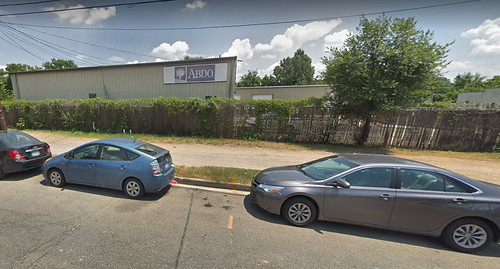
Abdo Development incubator building, 8th Street NEBut traditionally there aren't such initiatives in construction. More than ten years ago, the Abdo Company of DC didn't create an incubator exactly, but in a city where it is hard to find industrial space, they purchased a site for staging and storage, and made it available to their contractors. 

This provided the contractors an in-city place to locate their businesses that was stable and at a lower cost than finding or buying space elsewhere in the city or the region.

Construction business incubator in Greater Indianapolis.  While incubators primarily focus on development of new technologies, and some exist in the construction industry too, in Fishers, Indiana, there is a construction business incubator under development called the Hub & Spoke Design Center ("Indiana's skilled-trades workers are in short supply. A Fishers jobs incubator could help," Indianapolis Star).

It has multiple goals: (1) to provide lower cost space for businesses in the construction and design fields; (2) to provide access to peers for business development, technical assistance, and innovation; and (3) to provide training for potential employees to address labor shortages in the trades. From the article:
The center will be anchored by about 10 home-building-related businesses, with four scheduled to move in first: OnPoint; About A/Co, a Carmel-based flooring and cabinet dealer; Franklin Window and Door, of Carmel; and Battersby Danielson Azbell and Associates, of Westfield.

Decker said the center will offer a potpourri of goods and services.

“There will collaborative desks and offices, event space, showroom space where people can see the latest best projects and a dedicated “maker” space with tools where visitors can build things,” Decker said.

The tenants will work with higher education institutions and Hamilton Southeastern High School to develop a teaching curriculum that is likely to include students working on projects or gaining internships at a company at Hub & Spoke or elsewhere.
Government contractors also need help with finance.  Given the delays that are often experienced with payment, and the reality that payment isn't made in advance, so businesses need money to front operations and performance, there also needs to be access to financing and related technical assistance too, perhaps with the aid of what are called CFDIs, Community Development Financial Institutions.

But different from construction project finance, which many CFDIs already do, construction vendor finance and support, which I don't think any CDFI is doing.

Performance bonds.  Although there are some programs that assist with bond financing--performance bonds are one of the requirements for government contractors.

Microenterprise development.  Another way of looking at this is termed "microenterprise development" as part of the five step model outlined in the Community Economic Development Handbook by Mihalio Temali.  (Another of the steps is "workforce development.")

If you want local employees and local employers, provide contracts isn't enough, partly because the system is gamed, but also because the capital and organizational requirements are considerable and onerous, even if you're getting special considerations as a certified (minority) small business enterprise.

Labels: , , , , , ,

Wednesday, November 15, 2017

Sad but not a surprise: bankruptcy and shutdown of TechShop MakerSpace chain

In my piece, "Arts, culture districts, and revitalization" I argued that cultural infrastructure is comprised of at least five elements:

- Place;
- Space and facilities;
- Artists;
- Cultural organizations and support networks;
- Cultural-creative businesses;

and we should differentiate between hard (buildings/the physical), squishy (organizations) and soft (people) infrastructure. These five elements—place, space, artists, organizations, and businesses—are the components of cultural clusters or cultural quarters.

I said that artists/artistic disciplines needed to create their own plans (in association with cultural planners) and it was essential for such plans to include a facilities and space element, and I used the Creative City Network of Canada thought paper, Cultural Infrastructure: An Integral Component of Canadian Communities as a starting point.

The paper outlines six types of creative space, and four of the six: multi-use hubs; incubators; multi-sector convergence projects; and production habitats; are anchors, a set of either cross-disciplinary or discipline-specific facilities and programs that support the development of art, artists, partnerships, networking, connections, and cultural production.

Building the capacity of artists and organizations through these types of investment supports local economic and community building objectives, and improves the likelihood of success for all types of cultural initiatives. There are many examples of these types of facilities across North America, although no one community has developed a full set across disciplines.


The CEO of TechShop authored a book, The Maker Movement Manifesto: Rules for Innovation in the New World of Crafters, Hackers, and Tinkerers (article).

While I haven't exactly thought through this in all the elements in terms of supporting innovation and business development in the context of "building a local economy" ("Naturally occurring innovation districts | Technology districts and the tech sector," 2014), maker type spaces are an element, as are collaborative workspaces like WeWork, and business incubators of various sorts.

Until the opening of the TechShop in Crystal City a couple years ago, the only one that I really knew of in the area is the Woodworkers Club in Rockville. I'm not a woodworker, but when we were installing a new kitchen in 2008, we took the butcher block counter top there to be cut, because we needed a highly precise cut that a typical radial saw couldn't necessarily produce. They've managed to stay open for 21 years.

While no one reasonable (cf. Artisphere in Arlington County) would expect these kinds of spaces to be wildly profitable, because the modern maker movement is a spinoff of the digital economy, people had different expectations concerning large scale maker spaces.

The very cool Third Ward project in Brooklyn (and for a time in Philadelphia) went belly up pretty quickly ("Why Did 3rd Ward Close?," Observer), because "investors" were looking for quick returns.

As reported by the Washington Business Journal ("TechShop to declare bankruptcy, shuts down suddenly") it seems that a similar problem has developed for TechShop, a digital and analog makerspace with ten locations across the country, including in Crystal City.

-- TechShop history document

When a sort of nonprofit but technically for profit space in Philadelphia, Philadelphia Sculpture Gym shut down a couple years ago, I lamented that the Philadelphia nonprofit and arts community didn't step in to ensure its continuation, unlike how the Baltimore arts community rallied and saved Baltimore Clayworks, after its board had voted to shut down; "Baltimore Clayworks to reopen with new board, old debt," Baltimore Sun).

Note that libraries have been getting into the maker space movement, but the spaces tend to be pretty simple compared to a TechShop, with a 3D printer or two and some graphic design software applications and workstations but probably not CAD and related software. According to the WBJ, the TechShop is pretty elaborate:
With more than $1 million in equipment and software and up to 70 classes each week, TechShop gave access to industrial equipment too expensive for many people and early-stage businesses, for $150 per month or $1,650 for the year. The 22,000-square-foot Crystal City location, with 2016 revenue of nearly $1.5 million and a goal of 20 percent year-over-year growth in 2017, opened in April 2014 and had 700 members.
But I can't see how gross revenue of $1.5 million is nearly enough to run such a facility, let alone provide economic returns to investors.

Shepard Test Stand, TechShop Arlington.

While it is common for city and county economic development agencies to create and support "business incubators" of various types ("Where entrepreneurs work: Inside D.C.'s business incubators," Washington Post), such agencies ought to begin thinking about creating and operating larger scale maker spaces like the equivalent of TechShop, to help foster business development and innovation within the local business and research ecosystem, as a capacity building element of business infrastructure and entrepreneurship development.

Such facilities can help to brand communities as pro-"maker". 

Recommendation.  Ideally, the Arlington County Economic Development agency and the Crystal City Business Improvement District could step in and possibly acquire the assets of the Crystal City branch of TechShop, and continue the operation as an element of the county's commitment to supporting local business development.  From the WBJ article:
The company’s site also links to a form for individuals, organizations or institutions interested in acquiring its assets or one of its locations.
Baring action by Arlington County, another jurisdiction should swoop in, buy all the equipment, and set up a similar operation.

In DC, I'd consider doing that at the Walter Reed campus, Howard University, Catholic University, or at the St. Elizabeths East Campus, as a way to seed its redevelopment.

In Silver Spring, it could be something the County could do with Montgomery College (see item #16, "Positioning Silver Spring as an innovation district and/or an Ecodistrict," "PL #5: Creating a Silver Spring "Sustainable Mobility District" | Part 3: Program items 10-18").

In New Carrollton, it would be a way to seed a new direction for that Prince George's County city ("Setting the stage for the Purple Line light rail line to be an overwhelming success: Part 4 | Making over New Carrollton as a transit-centric urban center and Prince George's County's "New Downtown"").

Etc.

Labels: , , , , ,

Wednesday, June 17, 2015

Investing in local businesses as a missing piece of community development: Takoma Notes local financing as an answer

When the Popularise and Fundrise real estate crowdfunding platforms were created, I argued that while it is great to offer local residents the ability to make recommendations on property development -- "the kinds of businesses you want" -- and the option to invest in local properties, the more significant need was financing for retail and service business startups.

-- Retail: what you want vs. what you can build vs. what you can create

The issue is how to make what you want happen.

Booths set up at the Takoma Park Jazz Festival.

Apparently, the Old Takoma Business Association in Takoma Park, Maryland, which runs the Main Street Takoma commercial district revitalization program that serves the commercial areas of Takoma in both Maryland and DC, has created such a vehicle, according to this press release:
Old Takoma Business Association Launches New Takoma Notes Local Investing Program - Shop Local, Eat Local now Invest Local Too!

The community known for its strong support of local businesses, will be able to invest in its businesses through a new local investing program, called Takoma Notes, created by the Old Takoma Business Association (OTBA). Through the program, local investors will be offered the opportunity to invest in local businesses, new and established, and watch their money in action in the community.

The Bristol (UK) pound local currency.  See "Barter, sharing, local currencies: formalizing the informal economy as a response to economic downturn."
Working for over a year with a group of dedicated volunteers and representatives from Colombo Bank, the Old Takoma Business Association created a program which identifies local businesses that would benefit from additional capital and develops specific loan packages to meet their needs.

Through the program, the OTBA vets the businesses then raises the money to make the loan by issuing Takoma Notes to local investors. When the OTBA raises the necessary amount within the established time period, it then lends the proceeds to the specified Takoma business. The business will pay interest and principal to OTBA which will in turn pass those payments to the Takoma Note investors. This program is offered to all Maryland and Washington, DC residents that want to support local businesses and see
their money contribute to the vibrancy of the community.

The first recipient selected for the program is one of Takoma’s newer businesses, MAD Fitness, a fitness studio in Takoma Park, MD which offers functional fitness classes and personal training. The Old Takoma Business Association will be offering $10,000 in Takoma Notes, available in increments of $100 and higher to MD and DC residents. The MAD Fitness series of Takoma Notes has a stated interest rate of 3%.

Info about how to invest in the MAD Fitness series of Takoma Notes coming soon! Open to all MD and DC residents. Sign up here to be notified of the MAD Fitness series and other future series.

Labels: , , , , , ,

Monday, October 28, 2013

Urbanophile on microclusters as an economic development concept

I write from time to time about "agglomeration economies" which is a concept from urban economics.  The Geography of Transportation webpage at Hofstra University defines them thusly:
Agglomeration economies are a powerful force that help explain the advantages of the "clustering effect" of many activities ranging from retailing to transport terminals. There are three major categories of agglomeration economies:
  • Urbanization economies. Benefits derived from the agglomeration of population, namely common infrastructures (e.g. utilities or public transit), the availability and diversity of labor and market size.
  • Industrialization economies. Benefits derived from the agglomeration of industrial activities, such as being their respective suppliers or customers. This favors the emergence of industrial clusters.
  • Localization economies. Benefits derived from the agglomeration of a set of activities near a specific facility, let it be a transport terminal (logistics parks), a seat of government (lobbying, consulting, law) or a large university (technology parks).
Often, we think that these clusters have to be extremely large--like DC and the federal government; MIT and Draper Laboratories and military-related tech industry; what Michigan, in particular the Detroit area used to be, for the automobile industry; Houston and oil; Calgary and Edmonton and oil; Pittsburgh's former role vis-a-vis the steel industry; NYC and finance; the SF Bay area-Silicon Valley and technology; but also Seattle and Austin as big technology centers as well; etc.--not unlike Jack Welch's desire for General Electric to participate in industries where it was the preferably the #1 player but maybe #2.

In his Urbanophile blog post "The Magic of Microclusters," Aaron Renn makes the argument for "microclusters." After giving an example of a tech start up in Des Moines Iowa, seemingly a backwater (but I note, historically an important center for the US insurance industry), he writes:

... in a sense everybody can play right now. At some point though, there will inevitably be another shakeout of sorts. If you want to be a long term survivor, have a claim to fame that will make you stand out from the crowd, generate above average returns, etc., you need to have something that makes you distinct.
One way to do that is to be sub-specialized. “High tech” is an extremely broad category. A city could have a large number of nominally high tech companies that are totally unalike, and which do not form any type of real ecosystem, integrated supply chain, etc. This is a cluster in name only.
One way to stand out is a concept I’ve called “microclusters”. That is, rather than simply saying “We’re high tech”, you have some specialty within the broader tech industry where you can be a real national leader.
He goes on to give a couple of examples of micro-clusters in Indianapolis, in e-commerce marketing and motorsports, to illustrate his concept.  Another would be how Pittsburgh still has a number of smaller innovative businesses focused on steel manufacturing processes and improvements, even though the area now has few steel production operations of any scale.  See "Government financial incentives and business evolution and maintenance."

I think he makes a very good point that microclusters are about being able to compete on the national, but really, global scale, because now most business sectors function as part of one global market, but you don't necessarily have to be in Silicon Valley to do it.

Soft infrastructure is necessary to foster microcluster development
 
But one element that he doesn't discuss is the kind of infrastructure you need to have in order to support the development of microclusters. 

1.  At least one or two anchor firms.  Which usually grow out of connections to other businesses or

2.  Universities: it helps to have some universities with some decent academic departments that attract talented professors, researchers, and students.  For example, I mentioned Des Moines has had a strong cluster in insurance.  In part this derives from Drake University having a strong actuary program, or maybe the actuary program developed in response to the development of an insurance firm or two in Des Moines.

3.  Flexible buildings/office spaces that are cheap to rent.  This goes back to the point Jane Jacobs made in Death and Life of Great American Cities about the need for a large stock of old buildings to support innovative uses.

4.  Money that can be tapped for investment capital.  Detroit became an auto center developing out of the carriage industry.  Great forests in Michigan provided raw material for Grand Rapids-based furniture companies and carriage manufacturers in Eastern Michigan.  But the lumber companies generated high financial returns which they had available to invest in other industries.

Because capital is mobile and global, you can get money from a wide variety of places that aren't necessarily local.  An article I read recently on the Sweetgreen food chain demonstrated that capital connections transcend place.  Until that time all of the articles on the firm highlighted it as a super special example of a startup.  It turns out one of the founders is from a family of prominent restauranteurs and they used those connections to raise money. 

But it helps to have local money around to support business development.  cf. the idea of the lean startup

5.  Networking-capacity building organizations.  Organizations and media that connect people across the cluster and to support the various nodes within the cluster are important, help to brand the microcluster and to stabilize and built it up.  Business incubators are an example of such organizations focused on individuals  Social-business-commerce organizations and events are another.  

In the DC area, the Washington Business Journal and the Capital Business supplement of the Washington Post, along with various website and trade media are media examples.  There are a bunch of technology councils and angel investor groups like Angel Venture Forum DC, etc.

Why the microcluster concept is important

1.  It's pretty simple.  If you think that you can only compete if you are Silicon Valley, why bother getting into the game as the leading clusters are already so far ahead?  Alternatively, the microcluster concept provides an entree into the field and framework for understanding how smaller clusters fit into the overall ecosystem of a business sector.

2.  It's also important that the rise of the e-commerce and Webubiquity has trumped to some extent the absolute dominance of the dominant cluster within an industrial sector--ten years ago, you had to be in Silicon Valley to make a tech business work.  

The example of DC's Fundrise/Popularise, a platform for gathering community input and funding for real estate projects (crowdsourcing/crowdfunding) is but one example.  So is CoStar, a real estate information firm developed by the son of one of DC's leading architects.

Although using Aaron's concept of microclusters, I would argue that both Fundrise (developed by scions of a prominent real estate developer) and CoStar are products of DC's microcluster in real estate development and finance.  

This cluster has developed around the strength of the "local" real estate market, which over the years has been integrated into the national-global real estate development and finance market, as key companies from around the country (e.g., Hines Interests) and globe (Skanska USA, a division of a Swedish firm) have come here to take advantage of big opportunities, as "local" real estate firms have been merged into national companies (like Charles C. Smith into the Vornado Companies) and as all of these firms, including local firms, tap national and international financing to build their projects.

Microclusers and recommendations for local policy

I think it's probably more important to not have cities focus on providing tax incentives to individual businesses (something that DC has been big on, both to CoStar and to Living Social), although I suppose there are always exceptions to the rule (CoStar definitely didn't need a tax break, and Living Social isn't really a tech firm as much as it is a marketing firm), as much as it is to focus attention to building, strengthening and extending the value and quality of the soft infrastructure that supports specific microclusters.

Typically, tax incentives and local industrial policy are focused on providing payments and tax breaks to specific firms.  While that can be successful with certain examples, mostly it's a zero sum game.  See the New York Times series, "As Companies Seek Tax Deals, Governments Pay High Price."  Links to other stories in the series are embedded in the article.

Labels: , , , , ,

Monday, March 05, 2012

Public markets and pop up restaurants

I have advocated for years that virtually all public markets should have demonstration kitchens, and ideally "community kitchens" to serve as business incubators.

Why not also have a kitchen space that supports so-called "pop up" restaurants? Give the restaurant space for one month, not unlike "Restaurant Wars" on Top Chef, and they can work out their concepts, develop a following, and maybe "graduate" to more permanent spaces?

USA Today has an article on pop up restaurants, "Pop-up restaurants serve specialty food on the go," which made me think of this as an idea.

From the article:

A trend that has been flourishing in big urban centers such as Los Angeles and New York for several years, pop-up restaurants are, ahem, popping up all over. Temporary and often culinarily avant-garde, they spring up for a short period of time, be it a single night, a week or several months, promoted via social media, e-mail lists or simple word of mouth.

They have been known to take over empty lofts, airplane hangars, and restaurants during off-hours — pretty much anywhere the imagination dares to go, but with access to a working kitchen. As evidenced by their proliferation, pop-ups can indeed be profitable. In fact, their popularity is only enhanced by their fleeting nature, creating even more demand and perhaps an air of exclusivity.

A pop-up's emphasis is often on pushing the envelope — be it with the food, the venue or the entertainment. That said, most pop-ups tend not to be fly-by-night enterprises, as they want to build a loyal following, and are required to abide by restaurant or catering health-department regulations in their town.


Probably you could argue that the DeKalb Market in Brooklyn supports pop up type operations as does the food truck phenomenon.

In any case, this would be a natural extension of the public market and food markets as food-related business incubators. See the report, Public Markets as a Vehicle for Social Integration and Upward Mobility.

Labels: , , ,