Rebuilding Place in the Urban Space

"A community’s physical form, rather than its land uses, is its most intrinsic and enduring characteristic." [Katz, EPA] This blog focuses on place and placemaking and all that makes it work--historic preservation, urban design, transportation, asset-based community development, arts & cultural development, commercial district revitalization, tourism & destination development, and quality of life advocacy--along with doses of civic engagement and good governance watchdogging.

Friday, August 21, 2026

Factors undergirding the decline of economic clusters

Having the throne doesn't make your firm impregnable.  One of my lines is that once McDonalds made it to the top of the fast food restaurant industry, they were always going to lose market share as the segment was vulnerable to niche operators and new business models.  

They're still the King, but always on the defense.  It's difficult to come up with huge breakthroughs that maintain preeminence in the face of constant competition.

Agglomeration economics.  Business clustering, or agglomeration economies, occurs because a firm develops in a place for particular circumstances--access to resources, capital, transportation efficiency, etc.--and as the economic segment develops, support businesses, financing, and other firms are created, strengthening the place as the center of that industry.

But over time, other places compete for pieces of that industry, diminishing the strengthen and preeminence of the original cluster.  This is abetted by how older firms have higher costs, such as pensions and wages, because of a more mature workforce, etc.

There are a couple of good articles about this.  

Washington, DC as a center for business around government.  One is in Greater Greater Washington, "DC has officially lost over 83,000 jobs. The reality is even worse," about Washington DC's economic decline, which results from three things: (1) work from home as a response to covid meant people left the city for cheaper places to live while retaining their high "in Washington DC" incomes, shrinking the local economy and the demand for housing; (2) federal government shrinkage; and (3) decline in international business and tourism.

This is abetted by what is called the multiplier effect, how each direct job supports indirect jobs either within that industry, or in consumption related jobs.  So the 22,000 jobs cut by the federal government has a total effect of 66,000 to 88,000 lost jobs.

DC's competitive advantages.  When I first got involved in revitalization 25 years ago, I identified what I believed were DC's primary competitive advantages.

These were, before covid and work from home, the city's competitive advantages.  WRT the federal government, the city also has to contend with the disinvestment agenda of the Republican party, including relocation of agencies to other parts of the county.

  1. The steady employment engine of the federal government.
  2. Historic residential, commercial, and civic architecture
  3. Historicity (the nexus of people and place)
  4. Walking City Urban Design.
  5. Transit Network allowing for mobility without automobile dependence

Foremost was the steady employment engine of the federal government, even though long before the Trump Administration, other states and Congressmembers cherry picked agencies for their communities, like West Virginia at the behest of Senator Robert Byrd, a bunch of agencies are in Maryland, etc.  

Wholesale dismantling of agencies and bureaus like the Agency for International Development or the Department of Education both reduce the capacity of government to perform--which supports the neoliberal principle that government is less effective than market-based solutions--and the employment advantages to DC.

Just as bad, both Trump Administrations have moved agencies out of the city as a stratagem to reduce government capacity and employment, in moves like placing the USDA Economic Research Service in Kansas City or BLM to Grand Junction, Colorado--a majority of the extant employees didn't move. 

This is happening with the Forest Service division of USDA, which is consolidating, firing people, and moving its headquarters to Utah--a state at the center of fighting for the sale of public lands or their use for mining, oil production, etc., rather than for conservation.

The destruction of the US Agency for International Development wiped out the "international organization and contractor" economic cluster.  Etc.

Hollywood: LA and film and television production.  Los Angeles became the center of film production because it had a lot more sun than most places, which meant filming was rarely interrupted by negative weather.  But even Greater LA couldn't "stand in" for all environments, which led to Vancouver, British Columbia becoming an alternative.

And like McDonald's, Hollywood, the King of media production, always was vulnerable to losing elements of its business environment.  More and more places began offering tax incentives and other inducements that California didn't think it needed to provide.  To the point where the loss of business was substantial and too far along to reverse.

The LA Times covers this in "How L.A. stopped being Hollywood’s leading star."  From the article:

Film activity in the L.A. region plummeted in the second quarter of this year, with shoot days for feature films and TV productions falling 20% and 30%, respectively, compared with already anemic levels from a year ago, according to FilmLA.

The fallout has been devastating for local film crews and businesses. L.A.’s signature industry has shed some 57,000 jobs in the past four years, while more than 80 film and television production services businesses have closed since 2022. The production crisis has even become a political flashpoint alongside affordability, crime and homelessness in the race for mayor and governor.

The story of how L.A. steadily lost much of its homegrown industry to other locales is a tale of hubris, escalating costs, political inaction and fierce competition from states and countries hungry for a piece of the Hollywood pie. California eventually adopted a very limited film tax credit plan in 2009, but even then production had already gone elsewhere.

Additional lessons: changes in production and technology are "earthquakes" in industry tradition that support industry shake up and relocation.

-- "Next Level Clustering of Business away from the Midwest" (2022)

Emerging versus mature markets.  There are many ways to look at how to assess vulnerability.  One is the Alexander Gerschenkron thesis of "the economic advantages of backwardness."  His point is that established economies have vast investments in maintaining legacy systems of production.  While emerging economies can adopt the latest technologies without having to strand billions of dollars in previous investments.

The perfect example is China and electric cars.  Its automobile industry was nascent and did focus on traditional technology at first.  But as the new technologies of EVs were developed, just on the basis of the size of its market, it was well positioned to be a first mover in the field.  This was probably furthered because China isn't a large oil producer and therefore centering its car industry on alternatives to the internal combustion engine had other benefits of reducing demand and dependence on oil for transportation.

New technologies within industries.  This is an issue within industries as well.  The US automobile industry is a good example as the development of electric cars has allowed new entrants, although Tesla is the only real successful firm in the car market.  The truck sector, the most profitable for the old Big 3, faces competition from new entrants like Rivian.  But even so, because the US automobile market is so mature, with demand for "only" a few million vehicles per year, it can't compete with China.  

Film and video is another example.  Not only was Hollywood vulnerable to other states angling for a piece of the production pie, but as the industry atomized and vastly expanded from four main broadcast channels to hundreds, and then from centralized to decentralized distribution such as through streaming via the Internet IT infrastructure.

Now the big companies are all Internet based--Netflix, based in the SF Bay as is Apple, and Amazon, using its Prime platform as a media delivery system, is based in Seattle.  The traditional firms keep merging, and none seems to have the heft to make video streaming content profitable, unlike Netflix.

Centralized versus decentralized distribution.  This repeats from above.  Video media is a primary example.  But its enabled by the Internet and its massive "back of the house" information technology infrastructure.

It's comparable to the difference between "big iron" more centralized computing as typified by Boston and Route 128 businesses like Data General versus the microcomputer oriented Silicon Valley.  This is discussed by AnnaLee Saxenian in Regional Advantage: Culture and Competition in Silicon Valley and Route 128 (review).

Which has also spawned "cloud computing," although the foundations of such systems, starting with ADP payroll processing, are quite old. Amazon and Microsoft make a majority of their profits from cloud computing services--which is also driving the demand for data centers.

The Internet as a platform has similarly made direct distribution, complemented by extensive package delivery systems, much cheaper than before, allowing companies to sell products directly to customers with minimal transaction costs.

Previously, wholesale and large scale retail stores were the primary distribution points for goods, because this minimized transaction costs for the producer and the customer.

Electricity is now proving vulnerable to decentralized delivery through the adoption of solar energy systems and distributed energy resources (batteries) at the point of individual households and businesses ("Are plug-in DERs going to spark a grid revolution?," Volts).

New versus old companies and legacy cost structures.  New companies have the advantage of small workforces earning less money and benefits than established companies.

High fixed costs, e.g., for the automobile industry pensions and insurance for current and retired workers, make it harder to take risks.  

Marketing's Five Ps: Product, Price, Place, Promotion, and People.  There's a maxim in business: your choice of price, quality, or speed of delivery, pick any two.  The 5 Ps are the shorthand for how products have been developed and promoted.  Changes in the conditions of any of those Ps provide a space for business opportunities to develop, threatening existing agglomeration economies of various business segments.

Source: Corporate Finance Institute.

For example, place means where a product is sold, but also how it gets there.  Cheap gas and the highway network trumped railroads.  Before railroads, many industries developed across the country, such as stove production, because the cost of transporting heavy items was so high.

Promotion no longer means the newspaper or broadcast television, but all sorts of digital media.  This has made Facebook and Google the largest sellers of advertising, supplanting traditional firms.  And social media--yes there are paid influencers--mean businesses and products can get great exposure without payment of any kind.

Labels: , , , , ,

Monday, January 13, 2025

Know your market

Utah has the lowest incidence of smoking of any state, because of the dictum against tobacco use on the part of the LDS church, which dominates the state.  Speedway, once owned by Marathon, now 7-11, promotes its cigarettes as the lowest price in town.


The Mormons also have potentially the blandest palate in the U.S.  I joke about "Utah hot" versus "hot" when it comes to spicy foods.  The dish at St. Marks Hospital that I thought was restaurant quality, gets the most complaints for being too spicy.

Houston TX Hot Chicken is a food chain brand owned by private equity, one of those companies that owns multiple brands.  They had a different chicken banner here, but changed it to "hot chicken."  Whenever I look in the windows of the store, it seems empty.  I imagine it will remain so.  I wonder what will replace it.

Salt Lake City's 9th and 9th neighborhood.

In both instances, I suppose the firms could be aiming for a strategy of control of the market/dominance--all the paltry sales of cigarettes that exist in Salt Lake City, and an urban market with a greater diversity of population than the state majority Mormons, who may like spicy food disproportionately.

Labels:

Saturday, December 11, 2021

Revisiting older writings on the success of independent retail and neighborhood commercial districts

Sitting in the car at 15th and 15th earlier today ("Thinking about the opportunities for success with neighborhood commercial districts: comparing Manor Park in DC to 15th and 15th in Salt Lake"), I was thinking about my experiences around 2006-2008, when serving as a Main Street program manager in the Brookland neighborhood of DC (near Catholic University, with 12th Street NE as the spine of the commercial district) and in 2008, doing commercial district revitalization studies in Pittsburgh and the small town of Brunswick, Georgia.

The failure of some businesses in Brookland--seized by "opponents" to the Main Street program as proof of failure--as well as reviewing conditions in the Strip District, Lawrenceville, Penn Avenue Arts District, East Liberty, and Shadyside commercial districts in Pittsburgh led me to write three blog entries which still read quite well.

-- "The "soft side" of commercial district competition" (2006) jumps off from the concept of the Reilly Law of Retail Gravitation which I summarize as "people choose to shop at places with more and better stores."  

Retailers, especially independent businesses, need to think more broadly about both their business and their place as part of a commercial district, and they need to focus on those elements of the commercial district that influence perceptions of potential patrons.  From the article:

As long as a particular urban commercial district is deficient compared to nearby shopping alternatives, it won't be able to attract new customers, until it starts providing some decent options. You can put any kind of sugar coating on it that you want, but it's these factors that must be addressed: 

  1. the quality and condition of the buildings
  2. the cleanliness of the street and sidewalks
  3. the condition of the street furniture, treeboxes and other aspects of the physical environment
  4. the signage and windows of the businesses 
  5. the quality and organization of the store interiors.

Points 4 and 5 aren't about the broader commercial district, but factors directly under the purview of the business owners, and I expanded on those elements in later entries.

-- "Why ask why? Because" (2007) was a response to criticism of the Main Street program when some businesses failed on the Brookland commercial corridor.  The point I made was that business failure needs to be understood not merely a declarative statement, and that a business support program can only do so much.  

The article outlines what a journal article called "retail mixes" but what I prefer to call retail store subsystems (using the concept of organizational subsystems as discussed in Social Psychology of Organizations by Katz and Kahn).    To the three mixes outlined in the article:

  • goods and services
  • communications
  • physical distribution
I added:
  • store operations
with the aim of helping retailers create more robust and successful business concepts and models.  The reason that the stores failed in Brookland had to do with weak systems and business models mostly, but also some certain stores needing a larger customer base (a/k/a "retail trade areas") than was proximate in the neighborhood.   From the entry:
The Rosenbloom article discusses the Trade Area Mix, linking broad market demand to the possibility of store (and commercial district) success: 
  1. Trade Area Geography: the geographical extent of the trade area
  2. Trade Area Demand: the level of consumer demand within the geographically delineated trade area
  3. Trade Area Heterogeneity: the mix of consumer market segments within the trade area and the diversity of consumer demand for products and services. The greater the demand, the higher degree of heterogeneity, characterized by more offerings.
When someone says "That store closed, the X commercial district is a terrible place to do business," the reality is a lot more complicated. Was it the owner [and management]? The concept? The commercial district? The property? Access to capital? 

And it's not either/or, it can be and/and/and... For example, the Brookland commercial district has some significant spatial and access issues. Just like I write about "intra city sprawl," commercial districts need to ensure intensity and critical mass.

-- "Indepependent retail businesses can succeed and thrive" (2008) outlines elements of robust retail business concepts and identity systems, extending concepts laid out in Designing Brand Identity.  (Although this table is updated, from the 2009 blog entry, "Retail and Restaurant Check Up Surveys.")

----------------------------------------------------------------------------------------------

Principles for creating complete concepts/identity systems for retail businesses*
--------------------------------------------------------------------------------------------- 
Overall
• Understand the needs, preferences, habits, and aspirations of the target audience. 
• Experience and study the competition and learn from their successes and failures. 
• Understand traffic flow, the volume of business, and economic considerations of your location. 
• Create an experience and environment that makes it easy for customers to buy, and that inspires them to come back again and again. 
• Good design sells. It is a competitive advantage. Design is systems and processes, not just graphics. 
• A disciplined, coherent approach leads to a unified and powerful brand presence. 
• Create a distinct position and complete identity for your store/concept. 

Facade/Exterior
• The storefront is a mass communications medium that works 24/7 and can attract new customers, influence purchasing decisions, and increase sales. 
• Logo and signage expresses the brand and builds on understanding the needs and habits of users in the environment. 
• Exterior signage must consider both vehicular and pedestrian traffic. 

Interior
• Design an interior space that is sustainable, durable, easy to maintain and clean, and is energy efficient.
• Consider the dimensions of space: visual, auditory, olfactory, tactile, and thermal. 
• Understand the psychological effect of light and lighting sources. 
• Align merchandising strategies with displays, advertising, and sales strategies. 
• The shelf is the most competitive marketing environment that exists. 
• Consider the needs of handicapped customers and those of different ages. 

Service/Business operations
• Consider all operational needs so that the store delivers on the brand promise. 
• Create an environment that helps the sales force sell and makes it easy to complete a transaction. 
• Align the quality and speed of service with the experience of the environment. 
• Benchmark the quality and speed of service against the competition. 

Plan for the future
• Anticipate future growth. 
• Measure, evaluate, change. 
• Constantly ask: is the message clear?; is the content accessible?; is the experience positive? 

Labels: , , , ,

Friday, October 11, 2019

October is Co-op Month

I visited a food cooperative, Coopportunity Market and Deli.

The store in Culver City, California is part of a two-store group with the other in Santa Monica (which I haven't visited) and something in the store reminded me.

 -- 2019 Co-op Month

Part of a mixed use development with housing above, and proximate to freeways, major arterials but also across the street from the Expo Line Culver City Station and visible from the line, it was a knock out store.

The nicest (or another way to put it might be "the most upscale") food cooperative I've ever seen, with the way the store was organized being superior even to the group of PCC Community Markets food cooperative stores headquartered in but not limited to Seattle or the separate Central Co-op in the Capitol Hill neighborhood of Seattle. (Greater Minneapolis also has a preponderance of food cooperatives but I haven't been there in years.)

It had great deli, bakery, produce, and beer and wine sections, and fabulous indoor and outdoor seating areas.

Maybe because they had a traditional and well-respected retail design firm help them.

I haven't been to the Common Market co-op in Frederick, Maryland, but the store promotion materials they produce, including a regular bi-monthly newsletter called Spoonful, are excellent.

Most of the other food cooperatives I've been to merely distribute materials like the Delicious Living magazine which heavily hypes vitamins and supplements (natural foods markets make a lot of money off this stuff, even though research tends to indicate they don't have much positive effect).

So it's worth revisiting some past writings on food cooperatives:

-- "Food co-ops as potential anchors of "ethical commercial districts," 2011
-- "Pogue's Run Grocer food cooperative, Indianapolis," 2018
-- "The lost opportunity of the Takoma Food Co-op as a transformational driver for the Takoma Junction district," 2018

And on Cooperative Month in general, this round up piece from last year:

-- October is Co-operative Month

Saturday October 19th is Food Cooperative Day in Philadelphia ("Cooperative businesses foster human connection in an increasingly isolated world," Grid Magazine).

Labels: , ,

Friday, October 05, 2018

October is Co-operative Month

Only because I came across a recent edition of the Greenbelt News-Review community newspaper did I learn that October is 2018 CO-OP Month.

There is an exhibition on the National Mall in Washington DC this weekend called the

-- 2018 Co-op Festival

They expect 20,000+ attendees and more than 25 exhibitors.

From time to time I write about co-operatives in the context of retail, not so much in planning.  There are two types of co-operatives.  Business cooperatives organize people/firms together to conduct business, while community cooperatives organize individuals together to conduct joint activities on a non-profit basis.

-- Cooperatives for a Better World

1. Communities as cooperatives: Greenbelt, Maryland.  But with planning, Greenbelt, Maryland has an interesting history in both cooperative housing and the development and maintenance of cooperative businesses, such as the community supermarket.

-- The Greenbelt Cooperative: Success and Decline, Cooper and Mohn, University of California Center for Cooperatives, 1992

The Greenbelt Museum is a public museum interpreting the history of the community.

2. Housing cooperatives.  The University of Michigan in Ann Arbor has a strong co-operative housing network for student housing, which in turn has helped to support the development of non-student housing cooperatives elsewhere in the city. For a long time, the "trade association" North American Students of Cooperation (NASCO) was based in the University of Michigan Student Union, although now it's based in Chicago.

The famous Dakota "apartment" building in Manhattan is a cooperative.

Multiunit buildings organized as cooperatives are a form of high-income housing that tends to be present in larger cities like New York City.

It's also seen as an opportunity as a way to deliver permanently affordable housing.

-- National Association of Housing Cooperatives
-- "Housing cooperatives in the USA," NAHC
-- "Limited Equity Housing Cooperatives: A review of the literature

3. Utility cooperatives.  Some rural areas created utility cooperatives to deliver electricity and phone service.

4.  Business-to-business cooperatives.  In many places, farmers have organized cooperatives to conduct business activities on behalf of all the members. Land O Lakes butter is produced by a cooperative.  So are Sunkist citrus fruits.

The Bike Cooperative is an organization that supports independent bicycle retailers.

Retail buying groups are a form of business cooperative.

5.  Coops as a way to maintain retail businesses in rural communities.  In the UK, the Plunkett Foundation and in the US the Center for Cooperatives at University of Nebraska Extension have active programs promoting community cooperative organizing efforts as a way to maintain rural retail.

-- "The need for a new rural community cooperative movement," 2017

6.  Food cooperatives are probably the most widespread example of retail-community focused cooperatives.  Supermarket business organizations like Wakefern (Shoprite), IGA, and Associated Food Stores of Utah are examples of business cooperatives serving individual members, although sometimes these organizations own stores as well as supply members.

-- books

Retail/community food cooperatives that people think of when they think of such things are more like the Park Slope Food Co-op in Brooklyn ("History of the Park Slope Food Coop," Grub Street), Weavers Way in Philadelphia, etc.  Minneapolis-St. Paul and Seattle are known for having a large number of attractive and successful food co-ops. In Seattle, it's mostly the Pacific Consumers Co-p, although there are others.

-- National Cooperative Grocers Association

They aren't easy to organize.  I remember one effort that came to nought in the H Street neighborhood c. 2003-6.  A group is trying to organize one in Salt Lake City currently, the Wasatch Cooperative Market.

7.  Bike co-ops are another type of community organization effort, where people come together to operate programs to provide bike repair and service to community members.

8.  Co-ops as an option for retail delivery in urban underserved communities.  I've argued this can be a way to seed retail in revitalizing communities of all types, including large cities.

The Pogue's Run Co-op in the neighborhood of East Indianapolis and Mariposa Co-op on Baltimore Avenue in Philadelphia are examples.

-- "Pogue's Run Grocer food cooperative, Indianapolis," 2018

9. Food co-ops as anchors of mixed use development. Seattle, Rochester and Minneapolis in Minnesota, and other cities are prominent examples of food co-operatives as anchors of mixed use developments. Sadly, that's not likely to be happening with the Takoma Park-Silver Spring Food Co-op here.

-- "The lost opportunity of the Takoma Food Co-op as a transformational driver for the Takoma Junction district," 2018

10.  Food cooperatives as anchors for fair trade retail districts.  Although, generally, food cooperatives tend to be located in higher income neighborhoods as their organizers tend to be values-driven consumers.

I've written about Weavers Way Co-op in the Mount Airy neighborhood of Philadelphia and how it demonstrates that cooperatives can be anchors of fair trade oriented commercial districts.

-- "Weavers Way co-op looks back at 40 years in Mt. Airy," WHYY-FM/NPR
-- "Food co-ops as potential anchors of "ethical commercial districts," 2013

11.  Employee-owned retail business cooperatives: formal.  Interestingly, the Glut Food Co-op in Mount Rainier, Maryland is a business cooperative, organized by the original founders as an employee owned business functioning as a cooperative. Red Emma's Bookstore in Baltimore is organized the same way.

12.  Employee-owned retail business cooperatives: informal. It's no longer in operation, but the way that the old Silver Spring Bookstore was organized was like an employee owned coop.  Three people came together, recognizing that they couldn't mount a successful store on their own. What they did was coded each book to who "owned it" and shared responsibilities for operating the store during working hours, and split the proceeds depending on whose books sold.

13.  The National Co-operative Bank as a lender.  The NCB lends money to business coops, housing coops, etc.  I've argued they're a potential resource for mixed use developments involving food cooperatives.

-- "Strengthening Communities through the Power of Cooperation: National Cooperative Bank," Cooperatives for a Better World

Labels: , ,

Monday, July 10, 2017

The need for a new rural community cooperative movement

A shuttered Walmart store in West Virginia, Getty Images photo.

The Guardian has a story, "What happened when Walmart left?," about the impact of Walmart closing its store in McDowell County, West Virginia, not only in terms of jobs but in reduced access to food and other consumer goods. 

From time to time I've written about this issue and the very rare response in some communities to create community owned businesses to replace closed stores.

In terms of economic development planning, this is what I term the difference between "building a local economy" and "economic development planning."  Traditional economic development planning looks to others for solutions, and focuses on recruiting for profit businesses. 

By contrast, building a local economy focuses on building solutions that have greater local economic impact.  In the case of McDowell County, West Virginia, they shouldn't be looking to Walmart for their salvation.

Just last week, the Christian Science Monitor did an update ("A former exec at Trader Joe's grows another kind of grocery store") on the "salvage food store" Daily Table, created by Doug Rauch, former president of Trader Joe's, in Boston, aiming to bring more healthful food options to an under-stored neighborhood in Boston.

The article mentions there are eight "non-profit" food stores in the US, but didn't name them, although I am familiar with Fare & Square in Chester, Pennsylvania. A couple years ago, I came across a story of a for profit supermarket owner helping a low income community create a food store. 

And there is the UpLift Solutions consulting firm division of Brown's Supermarkets, a ShopRite member based in Philadelphia ("Why A Philadelphia Grocery Chain Is Thriving In Food Deserts," NPR). 

UpLift assists supermarket firms in working in urban markets, which are problematic because costs tend to be 30% higher than suburban stores ("Access to Affordable Food is Key for UpLift Solutions," AARP).

The CSM story didn't mention cooperative grocery stores, which are another category of community retail. The University of Nebraska agriculture extension program has a unit focused on helping communities create retail cooperatives.

When I read these kinds of stories, I keep wondering why there isn't a systematic response in the US to provide more focused rural retail economic development assistance--although I first thought about this in terms of under-stored low income urban communities--comparable to that of the UK's Plunkett Foundation.

The Plunkett Foundation is focused on quality of life in rural communities and because of the shrinking population in many rural areas, they have a number of programs promoting co-operatives, community shops, community pubs, and other enterprises.

--  Community Shops, Plunkett Foundation
--  Community Pubs, Plunkett Foundation
--  Community Food Enterprises, Plunkett Foundation
--  Publications, Plunkett Foundation

At the same time, I think community owned retail might be an option for impoverished urban areas, or some kind of hybrid social-public-private ownership scheme, because these areas have the same problems that rural areas have in terms of reduced economic circumstances making their areas unattractive to traditional retailers and restaurants.

I'm not saying it would be easy to do.  Urban stores have real problems in terms of attracting quality staff and have big problems with what is called "shrinkage" or stolen goods--not just by "patrons" but also employees.

But it's a way to offer retail coverage that might not otherwise be obtainable.  Combining public sector elements, like a community health clinic with a pharmacy, or a WIC/food stamps center and community kitchen with a supermarket, might be a way to pull it off.

But social entrepreneurialism on the part of nonprofits is rare, although it does exist, from the retail operations of Goodwill and Salvation Army, to a few nonprofit restaurants and the retail activities of NYC's Housing Works organization.

Similarly, restaurants could be run by food service training programs as part of high school and community college vocational programs.  Etc.

The Plunkett Foundation offers a membership program for such shops, which includes bulk buying schemes and technical assistance.

Food cooperatives have the advantage of being able to lean on the resources of the National Cooperative Grocers Association and the National Cooperative Bank.  But without strong support systems, food co-ops have a tough time in low income areas, since they are funded by capital from members.

Nonprofit supermarkets.  In Chester, Pennsylvania, a nonprofit supermarket called Fare & Square was launched by the Philadelphia area food bank Philabundance, and has been open for more than four years ("Nation's First Non-Profit Supermarket Is Picking Up Steam,"Next City; "Q&A: Fare & Square, an oasis in a U.S. food desert," FreshFruit Portal).


Unlike the fairly grim stores that are typical of PriceRite and Sav-A-Lot and other firms focusing on low income consumers, the interiors of the Fare & Square store are attractive, and the organization has strong branding and identity systems.

I believe it would make sense for other cities to work with Philabundance and create a platform out of this store that could be opened in other locations, a kind of franchise for social entrepreneurialism in the grocery sector.

According to the CSM article, cities like Providence, Rhode Island and the Bronx borough of New York City are clamoring for Doug Rauch to open Daily Table stores there.  But there are other options, as the Fare & Square and cooperative grocery models demonstrate.

Soft goods.  Selling other goods is tougher.  There aren't many models I don't think in the US, but working collectively, I don't see why such a model couldn't be created, comparable to Fare & Square.

Labels: , , , , , ,

Tuesday, October 25, 2016

General Motors bus ad from 1968 promotes a type of bus rapid transit

I don't know much about the history of dedicated transitways in the United States.  In the days of streetcars and interurbans, the former were typically constructed within the street right of way while interurbans, at least in the suburban and exurban portions, tended to have dedicated right of way, as did traditional railroads.

It turns out that the 1950 DC Comprehensive Plan recommended the creation of a set of dedicated busways in the city, and in association with the creation of I-395 and HOV lanes, there was a busway network.

 According to a blog entry in the PlanIt Metro blog ("We had bus lanes a half century ago and we can again"), the network included streets in DC as well as Virginia, but starting in the early 1980s, for the most part these lanes were given over to cars.

DC busway map, 1976.

I was doing some image research over the weekend, and I came across this 1968 ad for the GMC Coach division, which manufactured buses until pretty recently.

It discusses their  work on a proposal in Southeast Wisconsin (which is part of Greater Chicago) for dedicated lanes for transit buses within the expressway system.  (GM sold off its bus division in 1987 to MCI/Motor Coach Industries.)

It's an illustration of my point in this blog entry that GM in fact did see itself as a transportation company, even if for the most part it was focused on vehicles that run on roadways rather than rails.

As most people in the field know, until recently, GM was one of the largest producers of locomotives in North America.  But in 2005 they sold off the company to private equity firms.  In 2010, Caterpillar Corporation purchased the company.

General Motors bus ad from 1968 promotes an early form of bus rapid transit

Perhaps if GM had also manufactured streetcars (like GE), GM wouldn't have been so focused on buses as their primary interest when it came to local transit programs, and wouldn't have been so interested in buying streetcar lines and shutting them down in favor of replacement by buses ("General Motors and the Demise of Streetcars," Transportation Quarterly, 1997).

This ad was pretty interesting and it made me realize that while we talk about bus rapid transit as deriving from the first BRT transit network in Curitiba, Brazil, created by Jaime Lerner in 1974 ("How Curitiba's BRT stations sparked a transport revolution," Guardian), the reality is that you can argue that BRT builds on the concept of transitway networks, including express bus service using freeways, and that transit malls are another kind of derivation of transitways.

-- Los Angeles conducted a study of "Express buses on freeways" in 1953.
-- Bus Facilities on Limited Access Highways, Guide for Geometric Design of Transit Facilities on Highways and Streets
-- Transit Mall Case Studies, San Francisco MTA
-- Pedestrian and Transit Malls Study, Center City Commission, Memphis
--
PORTLAND TRANSIT MALL: Urban Design Analysis & Vision, City of Portland
-- What is BRT?, Institute for Transportation and Development Policy

However, the importance of the innovations that Jaime Lerner introduced to bus transit service can't be understated.

The first was physical, a complete dedicated road network for the bus-based transit system. Relatedly, the system was based on the use of high capacity buses--first a one-section articulated bus, then a two-section bus capable of carrying 300 people

The second was operational, pre-payment, comparable to subway systems, which significantly reduces boarding time, because people don't have to pause to pay as they enter. Because of pre-payment, all doors can be used for entry, further reducing the time to board or exit (dwell time).

Curitiba’s 357 tube-shaped stations serve the city’s bus rapid transit system. Photograph: Rodolfo Buhrer/Fotoarena/Corbis.

The third is equally important, when the BRT station was introduced in 1991 it was of a startling, forward design.

High quality design of the vehicles and stations, and the graphic design surrounding and complementing these elements is another mark of distinction that Jaime Lerner introduced to bus-based transit systems, which traditionally had been pretty dowdy when it came to design.


Image from Transit Toronto.

Interestingly, it turns out that GM created some test versions of articulated bus designs but never put them into production, although 12 buses were tested in Toronto-area transit systems from 1982-1984.

Labels: , , , ,

Tuesday, February 02, 2016

DC, Anacostia, Skyland, and food deserts

Yesterday's Post discusses ("Without Walmart, the long wait for more groceries continues in east DC") the cancelling of two Walmart stores in Ward 7 as a continuation of those areas being under-stored with limited access to fresh foods.

The problem with this argument, and it is true that compared to higher income areas, the area has fewer options and a narrower range of the types of stores close by, the fact is that DC residents, "even" in Wards 7 and 8, are not limited to DC or their immediate neighborhoods when they choose to shop.

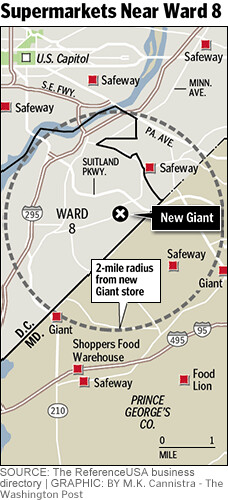
Supermarkets agdjacent to Wards 7 and 8
Note that most urban supermarkets plan for a "retail trade area" of a 3 mile radius, which covers an area of about 28 square miles.  This is out of sorts with advocate assertions that people should be able to buy groceries within a 3/4 mile walk from home.

In 2008, I wrote a blog piece in response to a similar article in the Washington Business Journal, written by the same journalist when he worked there.

"Food deserts are complicated places" discusses the reality that people's shopping options aren't limited to DC--for example, there are many grocery stores in the part of Prince George's County that abuts this part of DC, and there are Giant and Safeway supermarkets located within one mile of the Skyland location.

A follow up entry reprinted a Washington Post graphic from a story about the Congress Heights shopping center, showing how many supermarkets are nearby in PG County--although that graphic is 7 years old now and things have changed somewhat.

Eight options for supermarkets other than Walmart.  That being said, there are many options other than relying on Walmart to expand the array of choices available in under-stored areas that are distressed neighborhoods Anacostia.  Even if the Mayor believes that Walmart is the only choice.  From the Post article:
Days after the retailer’s announcement, officials said Mayor Muriel E. Bowser (D)– who described herself as “blood mad” upon hearing the news — tried a last-minute save by calling Greg Foran, president and chief executive of Walmart U.S., to “communicate frustration and the importance of these two projects” according to Brian Kenner, deputy mayor for planning and economic development.

Kenner said the mayor was told a reversal was unlikely.

“His response there’s really nothing he could do,” Kenner said. “It’s not like this is a cost issue. This has to do with their larger issue nationally in particularly paring down urban markets, which they have been very specific about.”
Some are discussed in this entry, "In lower income neighborhoods, are businesses supposed to be "community organizations" first?," from 2012.

Like the points made in the piece last week on how a ground up redevelopment approach would have ultimately worked a lot better for Skyland ("Ground up commercial revitalization and the Skyland Town Center project"), the problem for cities with "options other than Walmart" or other chain stores is that they are a lot more work and more risky--not that working with chains isn't time consuming or risky also.

Admittedly, fostering retail openings in underserved areas is risky.  And many independent grocery ventures fostered by cities do fail--one did on H Street NE back in the late 1980s.  Although I argue this happens most often because poor business fundamentals were ignored for political reasons, with various reasons--stores being opened in the wrong places, being underfinanced, paying high rents, etc.--leading to failure.

One example that comes to mind is the failure of a grocery in New Brunswick, New Jersey, which was opened in a business and transit district with limited business and transit activity and few nearby residents ("Fresh Grocer supermarket opens in New Brunswick, addressing 'food desert' challenge," NJBiz, "Owing $1 Million to NBPA, New Brunswick FreshGrocer Closes After Just 18 Months in Business," New Brunswick Today).

Part of a mixed use project, it was located on the ground floor of a parking structure adjacent to the NJ Transit station in New Brunswick, which is home to Rutgers University.

Other problematic examples include Portland ("Revitalization in impoverished neighborhoods can be very difficult because different "stakeholders" have different understandings of what's at stake") and Los Angeles ("How a South L.A. supermarket proposal fell apart, after a decade of effort," Los Angeles Times).

Revitalization in distressed and emerging commercial districts is very hard.

Create a "public market."  This would be similar to the old DC Farmers Market building that focused on serving the needs of low income consumers--that building is now the upscale Union Market food hall.

A public market could also be used as a business development initiative, because it's easier for individual entrepreneurs to run sections of a market (e.g., meat, seafood, produce, dairy, deli) but not able to take on, launch and run an entire store.

To spur local economic development in low income communities, communities elsewhere are adapting the public market/market hall model as a way to spur business development and retail offerings in otherwise underserved communities.

Image of La Marqueta from Manhattan Times.

The Thai Town Marketplace in Los Angeles and the Portland Mercado are examples of such efforts.  La Marqueta in Spanish Harlem is a repositioning of an older public market with a decided focus on business incubation and serving the otherwise underserved.

There is no reason why a public market couldn't be anchored by a vendor selling "center store" nonperishable products (canned, boxed, and bagged items).  Baltimore wholesaler B. Green could be the wholesaler supporting such a venture ("Changing with the times," Progressive Grocer).  For decades, Baltimore's Lexington Market has had such a store as part of the retail mix there.

The business development opportunities make this a good model.  And business development could be furthered by setting up a commercial kitchen/incubator to support small business food production and catering organizations, and this could also support pop up restaurants both as a business development and support effort and as a way to boost  customer activity during different dayparts.

Similarly, the school system could shift a high school culinary education program (and add an adult education component) to such a facility which would provide training opportunities, could support the provision of better and more equipment for the incubator, and could support a restaurant too with the students operating it, which is another way to extend the ability to open more diverse restaurant options to otherwise emerging commercial districts.

Franchise a Sav-A-Lot.  Many years ago, the Anacostia Economic Development Corporation indicated they were looking to open a supermarket, replacing the old Anacostia Supermarket independent store.

Sav-A-Lot, a division of Supervalu, is a mix of company-owned and franchised stores.  There is at least one Sav-A-Lot store in DC, although compared to a nearby location on Chillum Road in Hyattsville, the DC location has a hyper-limited selection of fresh fruit and vegetables.

-- Sav-A-Lot franchise information

Recruit PriceRite.  PriceRite is the discount supermarket banner of the Wakefern organization, which also supports traditional supermarket stores (ShopRite and Fresh Grocer).

Probably PriceRite has been developed as a way for the organization to compete with Sav-A-Lot and other discounters (Aldi, Walmart).

The company has been expanding in the region, and has stores nearby in Prince George's County ("PriceRite makes regional push with store in Prince George's," Washington Business Journal).  Also see "Price Rite to open grocery store in Syracuse 'food desert'," Syracuse Post-Herald.

Recruit ShopRite.  While there aren't ShopRites in DC, there are some in Maryland, and one Wakefern member, Brown's, operates stores in urban neighborhoods in Philadelphia.

Brown's has a consulting unit, UpLift Solutions, which works with supermarkets opening stores in center city locations.  The group facilitated the opening in Baltimore City of a unit by an otherwise suburban focused ShopRite affiliate ("City says it's largest supermarket to open in Howard Park," Baltimore Sun).

Create a member-owned food cooperative.  The Glut Food Cooperative in Mount Rainier, Maryland is owned by the workers, and so is a business cooperative, while the Takoma Park and Greenbelt Food Cooperatives are owned by members.  Either type qualifies for loans and business support from the National Cooperative Bank.

Philadelphia Weekly photo.

The Mariposa Food Cooperative, a member co-op in Philadelphia, was organized to mitigate "food desert" issues and has been in operation for going on six years ("Philly's Mariposa Food Co-op Focuses on Outreach Along Baltimore Avenue," Philadelphia Weekly; "Food co-ops on rise in Philly area," Philadelphia Inquirer).

But without strong support systems, food co-ops have a tough time in low income areas, since they are funded by capital from members.

For example, the Elm City Market Food Co-op was created in New Haven ("Food co-op to save New Haven's crisis?," Yale Herald), "Elm City Market Food Co-op - A Model for Downtowns") to deal with lack of supermarket options in the core of the city.

But poor decision making led to financial problems because the group agreed to large rent increases as sales rose, despite the fact that supermarkets have low profit margins (one to three percent) and in the short run, growth increases costs ("Elm City Market auctioned off," Yale Daily News).  The store faced closure, but was purchased by a private investor, and converted to a for profit enterprise.

Support the creation of an independently-owned supermarket.  Many independent grocers are affiliated with business cooperatives.  The business cooperative is owned by the members, and it supports their individual operation.  While there are many supermarket business cooperatives across the country, Wakefern is the major group operating in the Mid-Atlantic.

There is an alternative however. IGA is a supermarket business cooperative operating nationally and could support an independent operation operating East of the River, for a group not interested in working as ShopRite, but still wanted the advantages of a national brand and marketing support.  IGA affiliate stores operated in the city in various locations into the early 2000s.

-- Why IGA? marketing brochure for supermarket operators


Contact small supermarket firms already operating in the metropolitan area.  There are some small grocery companies operating in the area, focusing on ethnic communities, primarily Latinos (PanAm, Megamart, Bestway) that theoretically could be interested in opening a store in the currently under construction site on East Capitol Street that was abandoned by Walmart. A new Megamart at New Hampshire Avenue is more upscale than their nearby store on University Blvd. near Piney Branch Road.
Note that the old District Grocery Stores group of neighborhood corner store markets was a business cooperative supporting individually owned stores.  At one point there were 300 stores in the group, most serving DC, but also with locations in the suburbs.

The group had a warehouse allowing the organization to buy food more cheaply by amalgamating the orders of individual stores and provided marketing support.  In the face of changes in the city and the industry, the group dissolved in 1972. Note that the still extant Sniders Supermarket in Silver Spring started out as a DGS affiliate.

Note that technically, Yes Grocery is an independent and did open a store in Ward 7 which proved unsuccessful ("Organic Verses," Washington City Paper).  But I would argue that was because their business model was incongruent with the market demographics present in that location.

Image from the Chester City Blog.

Open a nonprofit supermarket.  In Chester, Pennsylvania, a nonprofit supermarket called Fare & Square was launched by the Philadelphia area food bank Philabundance, and has been open for more than three years ("Nation's First Non-Profit Supermarket Is Picking Up Steam,"Next City; "Q&A: Fare & Square, an oasis in a U.S. food desert," FreshFruit Portal).


Unlike the fairly grim stores that are typical of PriceRite and Sav-A-Lot and other firms focusing on low income consumers, the interiors of the Fare & Square store are attractive, and the organization has strong branding and identity systems.

I believe it would make sense for other cities to work with Philabundance and create a platform out of this store that could be opened in other locations, a kind of franchise for social entrepreneurialism in the grocery sector.

These suggestions only cover food: what about general merchandise categories?  Granted, Walmart is food+general merchandise, while the eight options discussed above only cover food.

WUSA-TV photo.

There are other discount store options too, but they are limited.  The locally-owned Discount Mart, which had already operated at Skyland is one.

Maxway operates in DC's suburbs and is owned by a company with a wide variety of discount merchandise stores active in the Southeastern United States.

The firm opened one of their bigger banners, Rose's, in Prince George's County ("Largest Roses store in the US opens in Prince George's," WUSA-TV).  Plus, there are big dollar stores.  Five Below.  Ollie's Bargain Outlet which operates as close as Baltimore.  Etc.

In other entries, I've mentioned that Kroger has a Marketplace model that adds general merchandise to grocery stores--like Walmart Supercenters but smaller.

Harris-Teeter is owned by Kroger but has no plans as of yet to open any of these kinds of combination stores.  In any case, my sense is that Kroger opens Marketplace stores as a way to ward off Walmart and other discounters from opening stores, and likely the company isn't interested in opening these kinds of combination stores in what we might call "retail deserts."

The Fred's discount store chain does not operate in Virginia or Maryland, but does operate as close as North Carolina.  The Beall's Outlet chain, operating as Burke's Outlet, does have stores in Virginia and West Virginia, but not Maryland.  The latter is focused on clothing, although they also sell home goods and electronics, while Fred's is more of a full line discounter.

Shoppers World is a general merchandise discount store based in the region also.  They have a store at the Boulevard at Capital Centre in Landover, Maryland (Prince George's County).  They could be an option too.

While the old Value City discount chain is no more, they still have the Value City Furniture company, selling furniture, but the store has suburban locations and isn't likely to be interested in a store location in DC, figuring that would merely cannibalize existing customers.

Labels: , , , , ,

Wednesday, October 14, 2015

The future of riding on Metrorail: Part One, what some stakeholders said in last week's City Paper cover story

WMATA farecard, The Future Is Riding On MetroWMATA, the transit authority in the DC metropolitan area, is admitting that poor service is affecting ridership and revenue ("What it looks like when Metro riders reach their breaking point," Washington Post; "Why D.C.-Area Commuters Say They Are Dropping Metro," WAMU-FM).

I was reading an article  (Stress Testing: How Can You Ensure Your Institution's Fiscal Health?," ) in Trustee, the magazine for the Association of Governing Boards of Colleges and Universities) whose members sit on college boards, about metrics for staying on top of the financial health of your school.

Given the fact that over the past five years, while Metrorail ridership has declined, most other peer transit agencies across the country have experienced ridership increases ("Use of public transit in U.S. reaches highest level since 1956," New York Times ), especially for rail-based services, ridership decline ought to have been an indicator that the system was experiencing problems, which without correction, would only get worse.

(Note that much of the transit ridership increase has been in NYC.  However, it is the largest cities, with heavy rail transit systems that have the most transit usage anyway.)

Last week, the Washington City Paper did a nice cover story, "How to Fix Metro: Thirteen proposals from riders, advocates, and experts," featuring interviews with experts and riders about "how to fix Metrorail." The idea behind the story was good, although I didn't think there was enough meat in maybe half of the responses.

But I was super-surprised to see that the two best comments, in my opinion, were from DC Councilmember Jack Evans and former director of the DC Office of Planning, Harriet Tregoning. And right up there was Stewart Schwartz, director of the Coalition for Smart Growth.

Plus Darrin Nordahl.  In the past, I've pooh poohed his ideas focused on making transit fun, but he didn't discuss that, instead focusing on the role of transit in making great places, that transit is the foundation of great cities.

And Ashley Robbins of the newly formed advocacy group, WMATA Riders' Union ("Metro riders form union to serve as platform to address service," Washington Post.

Part Two will be my response to the piece.


The thirteen people's comments can be summarized thusly:

Dan Tangherlini, former director of DC Dept. of Transportation, interim director of WMATA for short period

-- "focus on the rider"

Gabe Klein, former director of DC Dept. of Transportation, and author of the newly published Start Up City

-- WMATA shouldn't try to do everything itself, be open to innovation, contract services (such as transportation information displays) from the best providers, consider contracting transit services

Jeff Larrimore, Save the Blue Line co-founder

-- WMATA needs to make big capital investments and those are long term projects.  In the short run, to repair the relationship with riders, provide refunds for significantly delayed trips, and stop charging rush hour rates for times when the number of trains provided is paltry.

Jack Evans, DC Councilmember and WMATA Baord member
Public transportation only works when it’s cheap and convenient. This is especially true in today’s world when anyone can press three buttons on their phone and order a clean, quick, and fairly inexpensive car service to pick them up within minutes.

Unfortunately, WMATA is struggling to be either right now, with constant service interruptions and delays making it unreliable for people and rising fares making it more expensive year after year. If you live near the end of one of the lines and have to park at the station to get in the system, you’re easily spending $15 a day to commute into D.C.

The system isn’t working well right now, but it can be fixed. It’s going to take immediate, serious action, but we can, to use the common expression, “unsuck” the Metro system.

In the short-term, we need to hire a general manager who can motivate the workforce to be proactive about improving the system and strike fear in his or her leadership team that if they don’t get things done or make this a system that works for riders, there will be consequences. We also need to continue to get the financial and operational house in order. We need to get an audit done quickly enough that it is actually helpful to improve our finances, we need to create enough maintenance time to keep the system running, and we need to have a sense of urgency to do these things now.

Longer-term, we need to decide as a region if we want an OK system that runs every eight to 12 minutes, has decent but not exemplary geographic coverage, and is one of the more expensive systems in the country. If we decide instead that we want a first-class system that is conveniently located with more stations, has reliable and short headways, and has a cheaper fare structure, then we as a region need to pay for it.

It’s going to take dedicated or at least increased funding—on the order of $25 billion over the next 10 years—to build a system that works for the Washington region in 2025, not 1975. Regional leaders and the public need to decide if that’s what they want, and then pay for it. Raising fares and being inconvenient is a recipe for obsolescence.

My ideal system has a single fare for all riders, never stops building or expanding stations, and is more convenient to use than a mobile car service.
Ashley Robbins, WMATA Riders' Union chair

-- engage riders, improve the safety culture, have an approach to quickly handle service disruptions, don't use WMATA's problems as an excuse not to fund WMATA.
WMATA belongs to all of us—the Board of Directors and local jurisdictions, but most importantly, the riders. Reforming the system is an opportunity to ensure that the agency provides safety, customer service, and communication to its most important stakeholders, those of us who use the system every day. Effective reforms will ensure a strong future for the agency and the vitality of the region.
Darrin Nordahl, author of Making Transit Fun! and My Kind of Transit
Transit planners note that transit has to be safe, clean, convenient, and reliable. And certainly D.C.’s Metro can improve in each of these areas. But there are other factors that Metro—and transit agencies across America—need to consider if they are to be successful in the coming years.

When you examine the most livable cities in the world—Vancouver, Copenhagen, Melbourne, Portland—what you find are multiple modes of mobility, all seamlessly integrated. Streets are chock-a-block with pedestrians, cyclists, bus riders, and straphangers. This isn’t by happenstance. It’s by design. The transportation network in these communities is not just an extension of great urban living, but a reflection of it. The streets are comfortable and compelling for strolling along, biking along, or even just wiling away a couple of hours. The design features that comprise the great streets in these cities—wide, comfortable sidewalks and bike lanes, trees, shade, places to sit so we can read the paper, sip a cup of coffee, or just watch others—need to be included in the overall transportation network. Why? Because every transit trip begins and ends with a short walk or a bicycle ride. ...

Giving attention to all the environments that transit riders will occupy or pass through on their journey—the walk from their office to the train station; the streets they have to cross to get to the bus stop; the street corner itself where we will wait five or fifteen minutes (or more) for the bus; the bus and train itself—and asking questions—like what is the lighting like, are the seats comfortable, and can I sip a cup of coffee without being harassed by rule-mongers wagging their fingers about “no food or beverages onboard”—help create a transit network that lures even the most entrenched motorist from his or her car.
Roger Bowles, WMATA Riders' Union

-- Break up WMATA, the WMATA Board is political and should be dissolved.  Create a new authority run by top transportation officials from DC, MD, VA, and the Federal Government. Devolve bus operations to the local jurisdictions

Stewart Schwartz, Executive Director, Coalition for Smarter Growth

-- Transit is fundamental to the region's growth.  Fix Metro and expand regional transit service.
Before Metro, the federal government had to work on a shift basis to deal with traffic. Before Metro, the city and older inner suburbs were experiencing economic decline as we sprawled outward. With Metro, they boomed. Without Metro and continued transit expansion, we would need thousands of lane-miles of new highways, and tens of thousands of additional parking spaces, impacting homes and neighborhoods and taking the life out of communities.

Metro has fueled billions of dollars in real estate investment and the walkable, transit-oriented centers that are so much in demand today. Recently, 84 percent of new office development in the pipeline has been within a quarter-mile of Metro. Marriott’s CEO says the company will move to a Metro station location, joining Hilton, Choice Hotels, Intelsat, and dozens of other companies seeking Metro station locations. Office parks are dead. No one wants to work there anymore.

We must unite in a commitment to fix Metro and expand regional transit service. This means that instead of pointing fingers and fighting over who pays what, every elected official—our governors, congressional delegation, mayors, councilmembers, and supervisors—must unite to provide the shared vision, the funding, and the oversight needed to put Metro back on track. They need to hire a new general manager who has the experience and management skills to run a large technologically complex organization, but also the leadership skills to inspire and to change organizational culture. Metro must become much more transparent, improve communications, and engage the public. It must become a customer-focused organization.

Metro planners recently determined that completing transit-oriented development at all existing Metro stations would increase the ridership and efficiency of the Metrorail system, eliminating the need for an operating subsidy and even generating an operating surplus. But we can’t get there without fixing the aging infrastructure; addressing management, communications, and safety issues; and investing in the capacity needed to handle future growth. Let’s get on with it!
Randal O'Toole, anti-transit advocate, Cato Institute

-- Rail was the wrong choice. Should have been buses. Self-driving cars are the future.

Rod Diridon, former director of Mineta Transportation Institute, former chair, American Public Transportation Association
You can’t privatize a program that doesn’t make money, and no mass transportation systems in the world—except for a line here and there and high-speed rail—make a profit. So you can’t privatize Washington Metro, unless you subsidize it and give that tax dollar subsidy to a private company… If you’re going to give a lot of money to a private company, why not give it to Washington Metro and let them rebuild their system and operate it properly? They have the ability. You’ve got people like Mort Downey on that board who are outstanding managers, they just need the money to do the job.

First, you have to provide an outstanding transportation experience, and a lack of maintenance on Metro because of a lack of funding precludes you providing an outstanding experience. So you need to have, first of all, a superior product and you need to marry that with an outstanding management team.

Often times, when you have a lack of funding, those who are loathe to give you money because they don’t have it or because they’re cheap will pit the riders against the managers and against the unions in order to distract you from the fact that you don’t have enough money. The riders, the managers, and the unions need to get together here, realize you don’t have the money to operate an outstanding system, and go to your funding source and ask them, either politely or rudely, for adequate funding.
Tim Krepp, tour guide, former candidate for Congressional Delegate, DC

-- WMATA needs long term fixes.  But right now WMATA sure needs to improve how it deals with riders.  Announcements usually don't provide substantive information.  Top executives should be out on the front lines.  The WMATA twitter feed sucks,  Improve.

Jim Hall, former chairman of the National Transportation Safety Board

-- US DOT needs to regulate WMATA to ensure safety.

Harriet Tregoning, Head of the Office of Community Planning and Development, HUD, former director of the DC Office of Planning
... We have typically had general managers, it was their last stop before retirement. You’re not going to get the most innovation or commitment to changes when you’re thinking about retiring. I’ve suggested that our peer group is not limited to the United States, to U.S. transit systems. Many, many other transit systems around the globe might be more comparable both in terms of the development patterns and the degree to which those cities are able to have the non-automobile mode-share that we have in the District.

The second thing: We benefited for 40 years from being one of the most recent heavy rail systems in the country. I think we haven’t really come to grips with what it requires to keep a clearly aging system like ours in a state of good repair. I don’t think we’ve been straight with anybody, including ourselves or our riders, about what it really takes to have that state of good repair, and it’s really hurt the reliability of the system. We need to be honest with ourselves and we need to have a straight-up discussion with our riders very explicitly about what the tradeoffs are and what the needs really are.

Speaking of our customers: We need to have a very different relationship with them than we do right now. We need to be much more transparent and open and communicative with them. We have more than a million riders daily; they are our eyes and ears in the system. We should be creating all kinds of panels for them to give us feedback about how the system is working, what things aren’t working, what their priorities are… So, what do our customers say we should be paying attention to? That’s really important.

If you go to other cities... the Tube in London is a part of the experience in living in and visiting the city. People have such a fondness for the system, even though it’s a very old system and it breaks down sometimes. It’s part of their daily experience, and I don’t think we’ve really cultivated that kind of relationship around Metro. We’ve been kind of formal, standoffish, and bureaucratic as an organization, and I do think we need to talk more about what it means to have Metro choices.

I certainly hear tourists talk about how great it is, but boy, I see things every day that could be improved in terms of how easy it is to navigate the system, what we do to make it as user-friendly as possible, especially when there’s a disruption.

Part of having a better relationship and a more transparent relationship with our customers, I think we need to do more to innovate within the system. That means also being willing to try different approaches and occasionally to fail; but if we manage our customers’ expectations, we can study something for years or we can try something for a couple of months and see how it works, and use that as a way to make an adjustment to service and other things.
-- + hire a CEO and put in place dedicated funding

Labels: , , , , ,