Rebuilding Place in the Urban Space

"A community’s physical form, rather than its land uses, is its most intrinsic and enduring characteristic." [Katz, EPA] This blog focuses on place and placemaking and all that makes it work--historic preservation, urban design, transportation, asset-based community development, arts & cultural development, commercial district revitalization, tourism & destination development, and quality of life advocacy--along with doses of civic engagement and good governance watchdogging.

Thursday, April 25, 2019

Fusion voting and political competition: and a way to make third parties relevant in the US

The US political system (and in reality, the UK and Canada) is set up for two parties, not a multi-party system led by a majority coalition, which is more typical in European countries.  In Europe, while it can take decades, it's possible for third parties to grow to the point where they can lead governments ("How Germany's Green Party Keeps Winning,"NPR).

Shaped by capitalism and the concept of market forces and competition, many people argue that cities dominated by one political party "need competition."

While they didn't mention this specifically, the Post's recent editorial, "Businesses need predictability to thrive. That's not happening in DC," about the over-taxing approach to business on the part of DC's elected officials is a short step from that kind of argument, and sheds light on why the paper so often endorses candidates with strong ties to the business community.

In our two party system, that means the answer is Republicans in local government, to counter overly progressive tendencies in center cities.

Just like Howard Schultz finds a presidential candidacy a tough slog because his message of social liberalism and conservative finances especially low taxes doesn't resonate with much of the electorate, progressive-leaning cities aren't likely to vote for a traditional Republican message, although there are examples of "Republican" mayors doing some interesting and progressive stuff, albeit mostly around infrastructure, in cities like St. Petersburg, Florida (Rick Baker), Oklahoma City (Mick Cornett), and Carmel, Indiana (Jim Brainard).

It's possible to add political competition within of two parties 

But recently, both with the election of Alexandria Ocasio-Cortez in New York City and the almost success of the Green Party in provincial elections in Prince Edward Island, Canada earlier this week--they led in polling but on Election Day they garnered 9 seats, losing to the Progressive Conservatives who won 12 seats, while the Liberal Party ended up with 6 seats--I am thinking that maybe the solution, or at least a step forward, is to add New York State's "fusion voting" approach to the mix.

What AOC's election made me realize that we can create a typology of districts, and work to elect particularly left candidates from those districts where this is possible--and in fact, that has been the case for years, where many of the Democratic Party's most progressive Representatives came from such districts in states like California and New York.  AOC just pushes this a bit more leftward, and is more focused on organizing and media at least now, than people like Henry Waxman or Ted Weiss, who got into the nitty-gritty of legislation and oversight.

Fusion voting as an alternative

Fusion voting is a system of multiple parties, and candidates can run for election with more than one party affiliation.

Historically, fusion voting was an important way for the Populist and Socialist Parties to stay relevant and influence the issue space, which is why most State Legislatures outlawed the practice.  Now just a handful of states allow for it.

In New York, fusion voting would be a more formalized way of taking the "Democratic Socialist" message out to those districts where they have a good shot at winning.  Still, many interests would rather it go away (Is fusion voting going to be eliminated?," City & State New York).

New York is still dominated by Republicans and Democrats.  But there are multiple and smaller third or minor "parties" that participate in the election system.  We can think of them as "caucuses" (or professionally speaking, "practice groups") focused around a particular set of principles.

In New York there are many: Conservative as opposed to Republican; Working Families which is more left; Greens; Libertarians; etc.

Fusion voting would provide a way for cities that are dominated by one party to add "competition" in a way that's meaningful.

And at the state level, for the Green Party.

But it's probably not a way to add more conservative voices in progressive settings

But for entities like the Washington Post or Seattle Times looking for more conservative voices to be represented in local government in Washington, DC and on the Seattle City Council respectively, this won't satisfy them, because in progressive areas, it's a way to empower an even more progressive agenda.

Labels: , , , , ,

Tuesday, January 15, 2019

A brief comment on the connection between newspapers and civic affairs with the offer by a vulture hedge fund to purchase Gannett Newspapers

It's a bit ironic writing a piece in favor of keeping the Gannett Newspaper group intact, because historically they were known for buying newspapers and cutting staff to increase profits.

But in the context of a chained up newspaper sector, they do support enterprise reporting on the part of the various newspapers, for example, the Indianapolis Star did an incredible series on the impact of selling tax liens and losing control of area housing stock to non-local firms, the Sioux Falls Argus-Leader did a great series on the importance of learning to read by the age of nine and the various efforts in local school systems, and the Arizona Republic does great reporting on water issues.

And USA Today, criticized as McPaper, does some important reporting too, ranging from test cheating in the DC Public Schools, to treatment of truck drivers at the Ports of Los Angeles and Long Beach, and just recently, a great digital feature on the various security measures deployed along every mile of the US border with Mexico.

-- "The Wall – An in-depth examination"

But I do find troubling the announcement that Alden Global Capital wants to acquire Gannett ("Newsonomics: Let the 2019 Consolidation Games begin! First up: Alden seeks to swallow Gannett," Nieman Media) because the newspapers that the firm acquires have fewer staff and less local reportage afterwards.

In response the Journalist's Resource initiative of the Shorenstein Media Center at the Harvard Kennedy School offers a couple of interesting articles:

-- "Political polarization increases after local newspapers close"
-- "Civic engagement declines when local newspapers shut down"

The Newsonomics post makes the point that Gannett is now in play, regardless of what happens with Alden. Hopefully, it would mean that Gannett and Tribune Newspapers hook up and remain out of the clutches of private equity. Even in their reduced form, the newspapers owned by Gannett and Tribune "show better" than those owned by Alden, which include the Orange County Register, Denver Post, San Jose Mercury News, and the Boston Herald.

=======
Past entries include:

-- "One more blow against community media: Washington Post drops Thursday "county" news special sections," 2017
-- "Voting vs. civic participation | elections vs. governance," 2016
-- "DC's Current Newspapers introduce weekly e-letter," 2013. Note that post-bankruptcy (last year), the Current Newspaper is a pale copy of its previous form, with almost no news, limited editorials, letters to the editor and op-ed, and what was once the city's best community calendar is now significantly shrunken.
-- "The ongoing tragedy of dying print media, the latest being community newspapers in Montgomery and Prince George's Counties, Maryland," 2015
-- "Grassroots communications capability in the city," 2015
-- "Protest as Civic Engagement and the role of the media," 2007

Labels: , , , , ,

Sunday, February 11, 2018

Some things are beyond understanding (well, not really)

<i>Understanding Trump</i> books for sale at the Ultimate Thrift Shop, Georgia Avenue NW, Washington, DC
Understanding Trump books for sale at the Ultimate Thrift Shop, Georgia Avenue NW, Washington, DC.

In "Civic engagement and governance when facts don't matter in a post-truth environment," I made the point that democracy works based on a set of conditions:

-- that citizens are committed to being informed and willing to educate themselves on the issues
-- that people running for and holding office are committed to being knowledge-driven and open to different viewpoints, and committed to quality governance
-- that political parties are motivated by the greater good, albeit committed to pushing their positions and approach to the best of their ability, but not mendaciously
-- that there is a system of media (newspapers, magazines, television, radio, cable, other) that reports on the issues and campaigns and is objective

It all falls apart if many participants in the process and "system" aren't committed to "the truth" -- facts and honesty.

=====
I didn't feel the need to buy the book.

Speaking of Newt Gingrich, whose tenure as Speaker of the House changed Congress significantly in terms of putting party before country, I wrote this last June:

Making the Congressional Budget Office out to be a political animal against Republicans is about denying factual and objective research and analysis.

The New York Times reports ("Little known agency, striving for neutrality, finds itself under withering attack") on how Republicans are attacking the CBO for telling the truth about the impact of Republican proposals for changing health care legislation, etc.

The CBO traditionally has been seen as a nonpartisan, objective, fact-driven organization. So why should Republicans not want such an organization to be seen as credible? Because they are pushing forward legislation that is mendacious and they want to be able to deny it ("CBO Has Clear Message About Losers in House Health Bill "NYT).

Remember the Congressional Office of Technology Assessment?

I finally understand, 20 years after the fact, why the Newt Gingrich led Congress abolished the OTA ("Bring Back the Office of Technology Assessment, NYT; and "The Much-Needed and Sane Congressional Office That Gingrich Killed Off and We Need Back," The Atlantic).

It's because Gingrich, despite having a PhD and being a college professor, wasn't favoring facts and knowledge, but ideology. An independent assessor of technology and science was seen as a threat, not a capacity builder.

The same is now true of the CBO. Hopefully, the same won't happen to the Congressional Research Office.

Labels: , , ,

Wednesday, June 21, 2017

Words need to be followed by action: DC statehood edition

The Washington Post reports ("Can a change of titles make DC seem more stately? Ask Gov. Bowser.") on legislation put forth by DC Councilmember David Grosso on changing the names of the Mayor -- to Governor -- the City Council -- to the Legislative Assembly -- and Councilmembers -- to Representatives -- to have in place a better nomenclature to help make the argument that DC should be a state.

I've argued for a long long long time that "if you want to be a state, start acting like it, by being exemplary in all that you do in terms of governance and legislating."

We can call a Councilmember a Representative, but the city still mixes up capital budgeting in the annual appropriations process and Councilmembers take pride in cutting capital projects to fund current projects.

We waste hundreds of millions of dollars on constructing new buildings that aren't necessary or make poor use of existing facilities.

Or in not creating more innovative buildings and programs to serve the public better.

We claim we want to be "the most sustainable city in the US," but I find it hard to identify any programs (except one, by a semi-independent agency, see "How DC Water Is Using Recycled Sewage " Fortune Magazine) that function at the level of national best practice, let alone best practice on a global scale.

Instead we take great pride in slowly adopting programs that have been in place elsewhere for decades or more.

Among others, we still have serious issues with contracting ("D.C. Council report: Bowser administration favored top donor in contracting," Washington Post; and "How an Underperforming Company Won a Lucrative Energy Contract," Washington City Paper), electioneering ethics ("Council member Todd gets minor fine for many campaign finance violations," Post) and misuse of position ("Behind the DC school lottery scandal: A 'crisis in confidence '," Post).

Just because Illinois is being run into the ground ("Illinois' budget mess shackling growth," Bloomington Pantagraph) doesn't make DC a great candidate for statehood.

Statehood is both a right within the context of the United States and a privilege.  Territories had to meet conditions to become states, and that included sound governance.

Etc.

======
A couple past entries on reforming local governance:

-- "Ideal Mayoral/City Council candidate campaign agenda: Getting Our City's S*** Together, 2012
-- "Incremental piecemeal fixes to DC politics and governance mostly don't help, 2013
-- "Outline for a proposed Ward-focused (DC) Councilmember campaign platform and agenda, 2015

Labels: , , , , , ,

Friday, March 31, 2017

Time Magazine focused coverage on US Infrastructure needs: Cover date, April 10, 2017 (on sale now)

I still haven't published the follow up piece to "Trump Administration Infrastructure Program Priority List: Part One, the list" although the outline and notes for the piece are constantly being tweaked.

Therefore, it's very timely (no pun intended) that Time Magazine has published a set of articles in their just published issue (April 10, 2017) on the issue.

Interestingly, over the decades their sister magazine Fortune has published many important articles on the broad topic--I've picked up issues from the 1930s, 1940s, and 1950s with pathbreaking articles, especially on highways.

I definitely plan to pick up a copy of this issue.

From email:

DEAR WASHINGTON, WE NEED TO REBUILD. CAN YOU GET YOUR ACT TOGETHER?
25 Smart Ways to Fix Our Infrastructure
(registration required)

Watch an animation of the cover

This week’s issue features a special report on rebuilding and modernizing America’s ailing infrastructure. After President Donald Trump pledged to unlock $1 trillion in infrastructure investments,

TIME reports on the state of his promise—and whether he can persuade Congress to go along with it. TIME writers break down the critical projects we need to invest in now, from air traffic control to internet access, and leading experts share their big ideas.

TIME Editor-at-Large David Von Drehle writes: “When President Trump declared, in his first speech to Congress,
‘The time has come for a new program of national rebuilding,’ the applause was loud and long.

This pledge to spend what it takes to fix roads and bridges, rails and broadband, dams and airports—a staple of his campaign speeches—struck a chord with public opinion. The legacy of past generations that sustained the world’s largest economy is aging and needs repair…..

So if everyone agrees, if the need is great and the will is there, if America’s very quality of life is at stake, as well as safety, jobs and economic competitiveness, then one would think that this is where all of Washington has a chance to step up. An embattled President could prove whether his record as a developer is relevant; Republicans in Congress could practice governing; Democrats could deliver long-promised results….

After the failure by Trump and congressional Republicans to deliver on their pledge to repeal Obamacare, the questions were written across Washington in neon. Does the President actually have a plan, and can he persuade even people who may agree with him to go along with it?”

-- Inside the White House’s infrastructure plan
-- TIME asked leading experts to share their big infrastructure ideas
-- TIME’s Josh Sanburn on why detangling Chicago’s rail mess would benefit the entire nation
-- TIME’s Karl Vick on the need to close America’s digital divide
-- TIME’s Zeke Miller on revolutionizing air traffic control
-- TIME’s Sean Gregory on a plan to fix a critical Hudson River rail passage
-- The state of bridges
-- A safer, smarter electrical grid
-- Guarding coastal cities against the threat of climate change
-- Water and wastewater treatment systems across the nation
-- Fixing outmoded locks and dams to unclog the water highway
-- Improving batteries that could transform clean power
-- A timeline of history of American infrastructure
-- McKinsey & Company proposes four steps on how to get infrastructure investment right

With regard to the infrastructure timeline, it would have been very cool had they linked back file articles and photos from Time, Fortune, Life, and Architectural Forum (a magazine that Time Inc. stopped publishing in 1964, but Jane Jacobs had worked there) to various points on the timeline.

... I've never systematically searched the backfile of these magazines, but I occasionally find back issues of interest.
Spread on ideal highway construction, Fortune Magazine, August 1936
Spread on the ideal design for a network of highways, Fortune Magazine, August 1936

Labels: , , , , , ,

Sunday, January 29, 2017

Trump Administration Infrastructure Program Priority List: Part One, the list

The McClatchy Newspapers Group, led by the Kansas City Star ("List of 50 infrastructure projects used by Trump transition team came from consulting firm") and the Tacoma News-Tribune, uncovered a document listing as priorities 50 different projects.  Later reporting determined that the list was compiled by CG/LA Infrastructure, an infrastructure consulting firm that organizes conferences and conducts other activities promoting a focus on and investment in infrastructure of all types.

(Note that I attended the CG/LA 7th Annual North American Infrastructure Leadership Forum in 2015, which I found very useful, and it led to my writing the post, "Town-city management: "We are all asset managers now"," which discusses at great length how elected officials, "governments," certain categories of stakeholders and definitely citizens need to take responsibility for the long term in terms of infrastructure, civic assets, and "capital budgeting.")

While many of the articles posted the original document, they did not include a graphic of the projects in order of importance, which I have done below. Also most of the coverage focused not on the entire list or what priorities the grouping indicates, but on projects in their community, region, or state, such as the Washington Post reporting on DC-area projects.

Problems with the list as presented.  As someone focused on master frameworks, to me the list has plenty of gaps, and no one seems to be asking "bigger questions," such as the need for a formal capital budgeting process. From the WSJ article "Trump's Infrastructure Mistake":
Infrastructure projects selected in the traditional way, by governments, are chosen based on public benefits, the community’s ability to pay—and sometimes crass political favoritism. It would be nice to get rid of the latter, which is the main argument for a public infrastructure bank.

Under the Trump plan, project selection would be left to profit-seeking investors, using the same criteria they use to decide which hotels to build, for example. Ironically, Messrs. Navarro and Ross criticize President Obama’s modest 2015 infrastructure proposals because, “These will not fix the 237,600 water mains that break each year. Nor will they stop the 46 billion gallons of water lost each day from pipe leaks.” Does the Trump team really think private-equity investors will swoon over repairing plumbing?
Another interesting thing is that some of these projects are already funded and underway.

This list can't be considered to be definitive, in terms of need and impact. And many of the projects are private, such as utility-related, not necessarily requiring public funding, although permitting and access issues could be considerable.

(Separately, there is the issue of the difficulty of complex environmental assessment requirements, which add years to the evaluation process.  There is a need to reduce the complexity and length of these processes.)

Not to mention that one of the reasons that there are a preponderance of certain types of projects here, waterways in particular, is because of the failure for many years of Congress to fund needed projects, although that isn't limited to the Army Corps of Engineers, but includes most federal agencies, especially the National Park Service, and housing programs supported by the Department of Housing and Urban Development.

Priorities.  For example, at #14 the Cotton Belt line, a commuter rail line proposed for Dallas and Fort Worth, is estimated to have a daily ridership of about 16,000 people by 2035.  Given that level of impact, is it really the fourteenth most important infrastructure project we could do in the US?  It certainly doesn't rise to the level of a determination of a federal emergency or national security need.

For example, if the #7 Subway Line in NYC were extended into New Jersey, it would add capacity and redundancy in Manhattan, improved traffic capacity by reducing bus traffic, and simpler commutes for hundreds of thousands of people every day ("7 things to know about the proposed No. 7 subway extension into Secaucus" and "Could extending a NYC subway line to NJ help ease traffic?," Newark Star-Ledger). The estimated cost in 2014 was $5 Billion.

Compiled by CG/LA Infrastructure and shared with the Trump Administration:

Project Location Value
1. Amtrak NY Gateway New York/New Jersey $12 Billion
2. Brent Spence Bridge, I-75 Ohio/Kentucky $2B
3. Nat. Research Lab. for InfrastructureOhio $2B
4. Locks/Dams on the Ohio RiverIllinois $3B
5. I-95 Improvements, NCNorth Carolina $1.5B
6. I-95 Bridges in Philadelphia Pennsylvania $8B
7. Mississippi River Dredging Louisiana $1B
8. New Air Traffic Control System National $10B
9. Plains/Eastern Electric Transmission Lines Oklahoma/Mid-South $2B
10. Cleveland Water Tunnels Ohio $3B
11. South Carolina Dams RepairSouth Carolina $850 Million
12. Hydroelectric Dams Repair/ImprovementNational $4B
13. Texas Central Railway HSR Texas $13B
14. Cotton Belt Commuter Rail Texas$1.1-$2.8B*
15. Cadiz Valley Water Storage California $250MM
16. Trans West Express Elec. Transmission CA/AZ/NV/WY/UT/CO $3B
17. Chokecherry/Sierra Madre Wind Energy Wyoming $5B
18. Second Avenue Subway, Phases 2 and 3 New York City $14.2B
19. Savannah Harbor Expansion Georgia $706MM
20. Atlantic Coast Gas Pipeline WV/VA/NC $5B
21. Champlain Hudson Power Express (Transmission) New York $2.2B
22. DC Union Station Expansion & Rehab DC $8.7B
23. Maryland Purple Line light railMaryland $5.6B
24. Detroit M-1 Rail (light rail)Michigan $528MM
25. Gordie Howe International BridgeMichigan/Ontario $5B
26. Kansas City Airport Missouri $972MM
27. Peace Bridge/New York-Ontario New York/Ontario $700MM
28. MBTA Green Line Extension, Boston Massachusetts $3B
29. Augustin Plains Ranch Power Project New Mexico $600MM
30. I-93 Rebuild, New Hampshire New Hampshire $800MM
31. Lake Pontchartrain Bridge/CausewayLouisiana $125MM
32. Port Newark Container TerminalNew Jersey $500MM
33. Howard Street Tunnel (railroad) Maryland $425MM
34. Red and Purple Line Modernization, Chicago Illinois$2.1B*
35. I-395/I-95 Reconstruction, Miami Florida $800MM
36. Chicago Union Station Redevelopment Illinois $1B
37. Upper Mississippi Locks 20-25 Illinois $1.8B
38. Illinois River Locks - Lagrange and Peoria Illinois $640MM
39. Colorado I-70 Mountain Corridor Colorado $640MM
40. Colorado I-25 Improvements Colorado $1B
41. IHNC Lock Replacement, New Orleans Louisiana $893MM
42. Chickamauga Lock Tennessee $383MM
43. Soo Locks ReconstructionMichigan $580
44. Huntington Beach Desalination PlantCalifornia $350MM
45. Upper Ohio Navigation ImprovementsPennsylvania $1.7B
46. Monongahela River Locks-and-Dams Pennsylvania $900MM
47. Seattle Airport Expansion Washington $2B
48. Arlington Memorial Bridge DC-Virginia $250MM
49. Statewide Energy Storage and Grid Modernization California ?
50. St. Louis Airport MIssouri $1.8B

* The $1.1 Billion figure for the Cotton Belt Line is for single tracking.

Waterway/Port projects
Project Location Value
4. Locks/Dams on the Ohio RiverIllinois $3B
7. Mississippi River Dredging Louisiana $1B
11. South Carolina Dams RepairSouth Carolina $850 Million
12. Hydroelectric Dams Repair/ImprovementNational $4B
19. Savannah Harbor Expansion Georgia $706MM
32. Port Newark Container TerminalNew Jersey $500MM
37. Upper Mississippi Locks 20-25 Illinois $1.8B
38. Illinois River Locks - Lagrange and Peoria Illinois $640MM
41. IHNC Lock Replacement, New Orleans Louisiana $893MM
42. Chickamauga Lock Tennessee $383MM
43. Soo Locks ReconstructionMichigan $580
45. Upper Ohio Navigation ImprovementsPennsylvania $1.7B
46. Monongahela River Locks-and-Dams Pennsylvania $900MM

Roads/Bridges.  Granted, highway agencies can never have enough money for roads and related infrastructure.  But there are many important projects that aren't pursued because of a general reticence to raise gasoline excise taxes.  That's why more state transportation departments are expanding freeways through the creation of High Occupancy Toll lanes.

The list misses some important projects that need to be under consideration despite political issues such as the I-5 Columbia River bridge connecting Oregon and Washington ("Failed Columbia River Crossing in 'rear view,' new I-5 bridge idea," KATU-TV, while listing others that aren't in process either, like the Peace Bridge, which aren't anywhere near being underway ("Despite being on Trump 'infrastructure list,' no new Peace Bridge in works," Buffalo News).  (Definitely, improved connections between the US and Canada are on the list, but not improved connections between the US and Mexico.)
.
Project Location Value
2. Brent Spence Bridge, I-75 Ohio/Kentucky $2B
5. I-95 Improvements, NCNorth Carolina $1.5B
6. I-95 Bridges in Philadelphia Pennsylvania $8B
25. Gordie Howe International BridgeMichigan/Ontario $5B
27. Peace Bridge/New York-Ontario New York/Ontario $700MM
30. I-93 Rebuild, New Hampshire New Hampshire $800MM
31. Lake Pontchartrain Bridge/CausewayLouisiana $125MM
35. I-395/I-95 Reconstruction, Miami Florida $800MM
39. Colorado I-70 Mountain Corridor Colorado $640MM
40. Colorado I-25 Improvements Colorado $1B
48. Arlington Memorial Bridge DC-Virginia $250MM

Rail projects.  Umm, what about high speed rail in Florida ("All Aboard Florida key financing information made public," Treasure Coast Palm)") or California ("California board approves high-speed rail funding as new lawsuit filed," San Jose Mercury News"), not just Texas?

Penn Station? ("Penn Station Reborn," New York Times), the East Side Access Project in New York City to connect Penn Station and Grand Central Station ("$10B East Side Access project falling further behind schedule," Newsday), electrification from Harrisburg to Pittsburgh ("Pittsburgh to Harrisburg Electrification," Pennsylvania HSR blog), electrification from DC to Richmond, the general program for improving Amtrak's Northeast Corridor ("FRA unveils recommendations for faster rail travel in the Northeast," Washington Post," ), the concept out there to expand Metra service in Chicago and to electrify one of the lines ("Revamped Metra Electric could put South Side on the fast track," Chicago Reporter; speaking of which the discussions to do more intra-NYC service via LIRR and Metro-North, "New York Regional Rail: The Central Segments," Pedestrian Observations) not to mention my transformation concept for integrating the VRE Fredericksburg Line and the MARC Penn Line, and extending the Penn Line north to Wilmington (I will be blogging about this in the next few months), and I am sure other projects around the country.

And additional financial support could speed up projects in other cities such as the rehabilitation subway systems in DC and the San Francisco Bay ("After 40 Years of Service — Reinvestment Needed for Major BART Rehabilitation," press release), more subways in San Francisco for the MUNI system ("SFMTA to study Central Subway extension to Fisherman's Wharf," San Francisco Examiner), and the building and expansion of growing systems in Los Angeles, Seattle, Denver, Dallas, Minneapolis, and elsewhere.

Frankly, why not start the planning process to build the entire Purple Line?  Or Maglev maybe?
Project Location Value
1. Amtrak NY Gateway New York/New Jersey $12 Billion
13. Texas Central Railway HSR Texas $13B
14. Cotton Belt Commuter Rail Texas$1.1-$2.8B*
18. Second Avenue Subway, Phases 2 and 3 New York City $14.2B
22. DC Union Station Expansion & Rehab DC $8.7B
23. Maryland Purple Line light railMaryland $5.6B
24. Detroit M-1 Rail (light rail)Michigan $528MM
28. MBTA Green Line Elaxtension, Boston Massachusetts $3B
33. Howard Street Tunnel (railroad) Maryland $425MM
34. Red and Purple Line Modernization, Chicago Illinois$2.1B*
36. Chicago Union Station Redevelopment Illinois $1B

One public water system improvement project. The Deloitte Consulting Group estimates the cost to fully rehabilitate the water utility infrastructure (including water piping, sewer, stormwater capture, and treatment) exceeds $1 Trillion ! ("The aging water infrastructure: Out of sight, out of mind?"). Can we say Flint, or how most major cities and metropolitan areas face massive funding needs to upgrade this infrastructure. (And what about improving the water quality of urban rivers?

Technically, there are two related projects that address water supply issues, the Cadiz Water Storage Project (#15), and the Huntington Beach Desalination Project (#44), which arguably should be included but that muddies the point about not addressing in a substantive way the massive financial need for rehabilitating"aging water infrastructure."

Project Location Value
10. Cleveland Water Tunnels Ohio $3B

Airport projects. What about LaGuardia ("$4B LaGuardia Airport Renovation Plan Wins Go Ahead From Port Authority," DNAInfo), not to mention how FAA funding restrictions prevent use of airport related funding streams to fund projects that integrate airports into the local transit system, which makes it that much harder to improve public transit options at LAX ("Here's the mindblowing plan to unf* LAX transportation," Curbed), a $4 Billion project, etc.  O'Hare too ("Airlines, City Hall are setting a crucial flight plan for O'Hare," Crain's Chicago Business).

Not being discussed is how various stakeholders propose privatizing the air traffic control system because of the failure of Congress to fund improvements ("Don't Privatize Air Traffic Control," New York Times).

Let alone, ideally, a high speed rail program could shift short distance trips from the air to the ground.
Project Location Value
8. New Air Traffic Control System National $10B
26. Kansas City Airport Missouri $972MM
47. Seattle Airport Expansion Washington $2B
50. St. Louis Airport MIssouri $1.8B

Power generation and transmission, including hydroelectric projects already listed above. But not mentioned outside of California's statewide project is the need to invest and improve the national transmission and distribution system for electicity ("Transmission and Distribution Infrastructure," Harris Williams Co.)and investing in new technologies and processes to support distributed power systems "at the edge" ("The Grid Edge 100: Deployment and Opportunity at the Grid Edge).
Project Location Value
9. Plains/Eastern Electric Transmission Lines Oklahoma/Mid-South $2B
11. South Carolina Dams RepairSouth Carolina $850 Million
12. Hydroelectric Dams Repair/ImprovementNational $4B
15. Cadiz Valley Water Storage California $250MM
16. Trans West Express Elec. Transmission CA/AZ/NV/WY/UT/CO $3B
17. Chokecherry/Sierra Madre Wind Energy Wyoming $5B
20. Atlantic Coast Gas Pipeline WV/VA/NC $5B
21. Champlain Hudson Power Express (Transmission) New York $2.2B
29. Augustin Plains Ranch Power Project New Mexico $600MM
49. Statewide Energy Storage and Grid Modernization California ?

Labels: , , , , , ,

Thursday, September 08, 2016

Civic engagement and governance when facts don't matter in a post-truth environment

In the past few months, I've written some posts:

-- "(un?)informed electorates, democracy, and referenda"
-- "Voting vs. civic participation | elections vs. governance"

in part as a result of the Brexit vote, and the current presidential campaign in the US, about democracy from the standpoint of civic participation and healthy local government. The point I made is that democracy works based on a set of conditions:

-- that citizens are committed to being informed and willing to educate themselves on the issues
-- that people running for and holding office are committed to being knowledge-driven and open to different viewpoints, and committed to quality governance
-- that political parties are motivated by the greater good, albeit committed to pushing their positions and approach to the best of their ability, but not mendaciously
-- that there is a system of media (newspapers, magazines, television, radio, cable, other) that reports on the issues and campaigns and is objective

It all falls apart if many participants in the process and "system" aren't committed to "the truth" -- facts and honesty. It's really tough too with the media element because in for profit media, "entertainment" and ratings drive programming and how it is presented, even "the news," and this can diminish significantly the informational content of what is presented. Plus, people point out that the "false balance" promoted by many media outlets gives too much credibility to people who lie.

The Economist's cover story this week is on this post-truth environment (or apocalypse). See "Post-truth politics, Art of the lie: Politicians have always lied. Does it matter if they leave the truth behind entirely?."

From the article:
Mr Trump is the leading exponent of “post-truth” politics—a reliance on assertions that “feel true” but have no basis in fact. His brazenness is not punished, but taken as evidence of his willingness to stand up to elite power. And he is not alone. Members of Poland’s government assert that a previous president, who died in a plane crash, was assassinated by Russia. Turkish politicians claim the perpetrators of the recent bungled coup were acting on orders issued by the CIA. The successful campaign for Britain to leave the European Union warned of the hordes of immigrants that would result from Turkey’s imminent accession to the union.

If, like this newspaper, you believe that politics should be based on evidence, this is worrying. Strong democracies can draw on inbuilt defences against post-truth. Authoritarian countries are more vulnerable. ...

But post-truth politics is more than just an invention of whingeing elites who have been outflanked. The term picks out the heart of what is new: that truth is not falsified, or contested, but of secondary importance. Once, the purpose of political lying was to create a false view of the world. The lies of men like Mr Trump do not work like that. They are not intended to convince the elites, whom their target voters neither trust nor like, but to reinforce prejudices.

Feelings, not facts, are what matter in this sort of campaigning.
Post-truth is oppositional to the idea of positivism, or a focus on societal improvement through the development and application of information and knowledge,

People like me aren't set up to function in such an environment.

Labels: , , ,

Thursday, September 01, 2016

Voting vs. civic participation | elections vs. governance

The Washington Post has a piece, "Most young people don't vote:  Condescending to them isn't helping," on various attempts to try to get younger people, who statistically don't vote in great numbers, to vote in national elections.

Interestingly, this follows by a couple days a story on Manassas Park, Virginia, where two of the five seats up for election to City Council have no one running, and another seat has a candidate running unopposed. WRT the latter, the Post chalks this up to "civic apathy" ("In the heat of election season, political apathy in small Virginia city").

Recognizing that yes, people often don't take the time to get involved in local civic affairs, let alone regional, state, or national politics (let alone international affairs, such as the United Nations), I have always gotten angry at various initiatives focused on and complaints about "civic apathy" because I think they are people-blaming and not focused on how the political and governance system is dis-engaging, not to mention that civic education and involvement is weak and to build involvement people need to be engaged, be it through class projects, community involvement projects (like what Eagle Scouts have to do), community organizations, school groups, etc.

There are costs and barriers to being engaged.  But it's complicated by long working hours, family responsibilities, falling incomes leading people to take second jobs, people working in different places from where they live, leading to long commutes and bifurcated interests, etc.

Other hindrances include the fact that many existing organizations tend to be unwelcoming of new participants, it takes a long time to see progress on a project or issue, etc.  I think about projects I've been involved in that have taken 10 to 15 years to come to fruition.  The Metropolitan Branch Trail bikeway was first conceptualized in 1989--it will take 5 to 10 more years for it to be finished...

Election day as a national holiday vs. voter suppression.  Eliminating hindrances to voting would increase turnout.   Were election day a national holiday, as it is in many other countries, more people would vote.  If the Republicans weren't so focused on suppressing voting, but getting people involved and encouraging people to vote, more people would vote ("Deadlocked SCOTUS Won't Revive N.C. Voter Suppression Law," New York Magazine and "Voting Rights Are Under Attack from Kansas Secretary of State Kris Kobach," Esquire) etc.

-- Voter Participation Project

But there is the issue of elections being about electing people.  And people in office more focused on fundraising for their next campaign.  And ideological positions shaping governance or an unwillingness to address important matters.

Just because you vote doesn't mean that you can improve society.

The long campaign as "too much information" and an element of disconnection.  Plus, the national process is so long.  I envy the British or Canadians who wrap up elections in a process shorter than three months ("Canada Reminds Us That American Elections Are Much Longer," NPR).

Newspapers and media.  With the decline in the number of newspapers and people reading newspapers a key element of civic engagement--information and knowledge development--has been broken. See "The ongoing tragedy of dying print media, the latest being community newspapers in Montgomery and Prince George's Counties, Maryland."

While it's true that it can be difficult in making local issues arresting in a 3 minute report, tv news is mostly a non-starter as a substitute for newspapers as it mostly focuses on reporting crimes, accidents, some sports, fires, the weather and other natural disasters.

(Nationally, shows like "60 Minutes" on CBS and "Real Sports with Bryant Gumbel" on HBO do have public affairs elements.  And C-SPAN, a cable network focused on Congress, does have some broader public affairs type programming on weekends.)

Note that I have been meaning to write about some of the PBS station groups and their creation of some local news programs, but usually such programs have a state-wide focus.

For example, Maryland Public Television produces "State Circle" on state politics, and "Maryland Outdoors," on agriculture, recreation, and outdoors matter. The Idea Stations in Richmond produce "Virginia Currents," a program on various topics within the state.  Note that Northern Virginia is undercovered because its public television station positions itself as a "national" station, rather than being locally focused or connected.

In the old days, for profit television stations used to produce similar kinds of "long form" programming on local civic affairs, but it's very rare now.  Interestingly, the NBC station in San Francisco has that kind of program, but on the outdoors, "OpenRoad With Doug McConnell | NBC Bay Area."

Public radio.  While for profit radio is no different than for profit television in terms of no longer providing much in the way of significant reporting on deeper issues, local affiliates of public radio have often stepped in the breach.  For example, in the DC region, WAMU, owned by American University, is doing serious enterprise reporting these days and its coverage of the area transit system is innovative and fills a real gap.  This complements its various local programs, such as the "Kojo Nnamdi Show."  Most of the NPR affiliates in major cities and those affiliated with universities operate similarly robust news and community reporting operations.

Public television.  While they aren't likely to produce much in the way of on-air news programming, some PBS stations, especially in California markets like San Diego, Los Angeles, and San Francisco, have created robust news operations that operate via the web.

Also some PBS stations, on supplementary digital channels, run gardening and other programming, such as from the Create network, that has some civic affairs elements, although the programs are not locally focused.

-- Public Broadcasting and Public Affairs: Opportunities and challenges for public broadcasting’s role in provisioning the public with news and public affairs, Berkman Center for Internet and Society at Harvard University

Communicating Effectively in English
Communicating Effectively in English (1992), by Patricia A. Porter and Margaret Grant, then of San Francisco State University.

Teaching people how to be productively involved in their community.  In college I used to say that it was unreasonable, after 13 to 17 years of being talked at in school settings that are relatively authoritarian, upon graduation, to expect people to become active, free-thinking, participating members of society.

From time to time I mention a book I came across because it was used in ESL classes.

It shocked me because it teaches English through teaching people how to get involved on issues in their community.

Just as there are frequent articles about how naturalized citizens have to take a test on US government that the average natural-born citizen may not be able pass, I think that expecting people to be engaged on civic matters when for the most part we are taught to be quiet and to accept what we're told is a major disconnect.

I don't envy the non-native English speakers who are assigned this text. It's a great book but it's written at the high school level, or beyond. The preface is written for teachers, not students.This textbook looks like a basic text in citizenship-involvement--it teaches communications skills through participation in civil society. It's really quite interesting and amazing and worth your looking up.

The units are:

1. Understanding your audience and being understood
2. Getting Information: Interviews and Conferences
3. Providing Information: Instructions and Demonstrations
4. Providing Information: Group Discussions and Presentations
5. Proposing Changes: Solving a Problem
6. Persuading Others: Taking a Position.

From the preface:
In the first three units, students work with information that is known to them or learned through interviews. In the last three units, students must work with information from more challenging outside sources, such as articles and reference materials in the library. The first four units focus on informative presentations, while the last two include expanded guidelines and practice in argumentation.
Having a course like that in high school, with various projects, seems like a useful step.  (I never had such a course.  It wasn't until college when I started getting involved in "student organizations" and then city matters.)

Process and design method.   Similarly, I am somewhat skeptical of digitally-enabled involvement techniques ("All the talk of e-government, digital government, and open source government is really about employing the design method") because most of the time, they aren't set up to allow people to question the process, or set up their own questions, or lay out different directions for inquiry.  It's a different method, but the process isn't different.
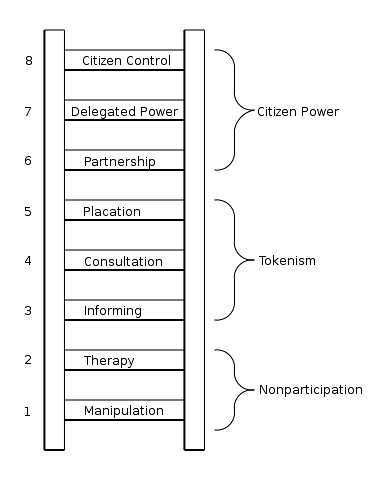
A Ladder of Citizen Participation, Sherry Arnstein
Robust civic engagement processes. There is an almost 50 year old planning journal article, "A Ladder of Citizen Participation," >Journal of the American Institute of Planners, 35: 4, July 1969," by Sherry Arnstein on this topic but since then many more processes for more involved and substantive methods for civic engagement have been developed. Not to mention the points made in the article about true engagement are mostly ignored even today.


Charting stages of psychosocial development as hypothesized by Erik Erikson.

Unfortunately, a lot of people aren't interested, and many of the people who are end up being self-interested. It took me a couple decades of involvement to recognize and accept that for the most part, elected officials and engaged residents, aren't in Erikson's "generativity phase." Instead they only care about the now. Therefore, decisions are rarely made with an eye towards building a better society for tomorrow. Instead they are more about stasis and warding off change as much as possible.

Friedmann.  John Friedmann's work on "planning in the public domain" focuses on how to do more "radical" planning in the context of relatively fixed government agencies and processes.

Friedmann differentiates between system maintenance, system change, and system transformation.

Maintenance is about bureaucracy and keeping things as they are. Transformation is about challenging the way things are, by working through political means. But ultimately, all change is about maintaining the political system, which occurs through the integration of change into existing institutions. At first proposals are radical but get bounded and mediated in the process of getting adopted. In the end, radical becomes bureaucratic.

Action planning.  From my disgust with groups like America Speaks (see "Can't seem to face up to the facts... or citizens/public meetings as 'arm candy'") comes what I call the Action Planning approach. This entry, "Social Marketing the Arlington (and Tower Hamlets and Baltimore) way," discusses the approach, although the idea continues to be further developed.
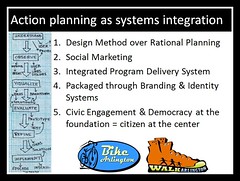
Slide, action planning as systems integration
But I have to admit that the Action Planning approach has a fatal flaw too. It expects that everyone comes to the table with a basic consensus on some foundational processes:

- that public participation is a good thing
- that democracy is to be respected
- that participants also have a responsibility to learn and be knowledgeable about the matters at hand
- that it will take some time
- and that people will have to make some compromises.

I guess another lesson from this is that for the most part, zoning and planning processes and the rights involved with property ownership mean that development will happen. So it's best to shape that development in ways where all the stakeholders benefit to the greatest extent possible.

But action planning won't work when people don't come to the process with a commitment to that basic value set.

And it doesn't work very well when people have pretty mediocre expectations, or can be mollified pretty easily with bullshit and scraps or armed with the idea that all new development and developers themselves are no better than criminals.

Conclusion.

1.  Fix civic engagement systems
2.  Teach civic engagement starting in the schools
3.  Because if people aren't involved in their neighborhoods, public institutions, and communities to begin with, it's a big step to expect them to vote
4.  Support locally-focused media

5.  Make national election day a national holiday.
6.  End voter suppression initiatives.

Labels: , , ,

Wednesday, January 01, 2014

New Year's Post #1: Defining mediocrity up and the 2014 elections in DC

These days, DC ought not to be such a bad place to be an elected official.  The population continues to grow, DC now has a population of 646,000 ("[National] Population gains at near-historic lows," Washington Post); crime isn't such a big problem; the real estate market is reasonably strong although not perfect because of a diminishing role in the federal government's place in the market; and the city is in a pretty good place financially, although most of its loan capacity has been encumbered--it helps that DC is the only city in the US that collects and keeps 100% of the "state" income tax.

That being said, DC is no city on a hill.  Plenty of politicians have been brought down by corruption over the past few years and DC doesn't really stand out as a special example for other cities to emulate, with an exception or two on particular programs (like bikeshare).

When everyone's party affiliation is Democrat, there is no platform or party discipline.  I read an article about Massachusetts after Scott Brown was elected to the Senate that made the point that because the state is dominated by Democrats, everyone who wants to win runs for elective office as a Democrat, but the reality is that the issue positions are all over the map and encompass for some people what would be Republican positions, although my lesson from the story is more about the dearth of a basic position or platform.

DC has the same problem.  It's a city-state even though it isn't recognized legally as a state.  For the most part, DC can do what it wants, with some limited oversight from and restrictions by the federal government, which waxes or wanes depending on which party is in office--generally the Republicans like to use DC for political points so that's why we have such a strong charter school movement here (put in place as a deal between the Newt Gingrich Congress and President Clinton), Sen. Shelby put a death penalty sentencing proposal on the local ballot, etc.

But at the local level, it means that because of the dominance of liberal sentiment, as expressed by affiliation with the Democratic Party, there is no "party discipline" and no real platform. 

Candidates for office running as Democrats are more about creating and maintaining personal fealty than they are developing an overall platform and a progressive agenda, as opposed to a putting together a variety of incremental positions.  Basically they produce a grab bag o' stuff as opposed to a platform.

Image from Unpunk.

So suffice it to say that I am bored by the 2014 election.  It could get shaken up some by a strong independent run for Mayor to challenge the Democratic winner from the way too early primary in April, but I am not holding my breath.

I have a couple of pieces from the last two years which are evergreen when it comes to the topic of improving DC governance and politics.

1.  "Continued musing on restructuring DC's City Council (mostly)," discusses a broad number of systemic changes that I propose to increase democracy and openness in local government.  As Matthew Frumin said in the special election campaign last year, the Home Rule Charter is going on 40 years old and it's time to review where we are and where we've been.

Summary recommendations

1.  Increase the number of wards.
2.  Increase the number of councilmembers
3.  Move the legislature to part-time service and reduced pay
4.  Reduce the size of councilmember staff
5.  Increase the research capacity of local government
6.  Institute term limits for elected officials.
7.  Change the date of the primary election to extend the electioneering period.
8.  Institute ranked choice voting for local elected officials.
9.  Institute additional campaign finance limits for local elections.
10. Create an elected public advocate/ombudsperson.
11. Reconstitute a school board with oversight over pre-K to 12 public education, traditional and charter schools.
12. Build civic capacity and infrastructure.

Since the City Council voted to move the popularly elected Attorney General election to 2018 ("D.C. Council votes to delay first election of an attorney general," Post), counter to what citizens voted for, we need to add this to the list as well.  There is a move to put it back on the 2014 ballot ("DC Council needs to get the DC attorney general election right," and "Delaying election of attorney general makes a mockery of democracy,"  Post--note that the Post editorial page has continually espoused the wrong position on this issue) although I would be content to put it on the 2016 ballot, which is what I had proposed years ago, that the AG be elected in the non-Mayoral election cycle.

Note that an alternative to ranked choice voting would be runoff elections and non-party segregated primaries.  The way it works in Seattle, local elections are non-partisan, and the top two vote getters for Council races continue on to the general election ballot. 

2.  Given the so-called rise of progressivism at the city level, given the election of Bill de Blasio as Mayor of New York City and maybe even the election of Kshama Sawant, Socialist Alternative candidate, to the Seattle City Council ("Kshama Sawant's Brash Style Catapulted Her to Victory: Will It Also Be Her Demise?," Stranger), etc., I find the agenda-less local Democratic Party to be a big problem and a lost opportunity--in other words, if DC wants to become a legally recognized state, we should start acting like one, and function at a high level both in terms of governance and the general political structure.

This 2012 post, "Repositioning cities (at least on the coasts) for greater political prominence, and a city-first agenda," discusses local parties in Vancouver, BC and Montreal, and their respective platforms.  Similarly, in 2013, most candidates for Mayor and Borough Chair in New York City had defined platforms rather than a grab bag o' stuff that we content ourselves with in DC.

-- Bill de Blasio, campaign website issues section
-- Julie Menin, candidate for Manhattan Borough Chair 
-- Anthony Weiner, Mayoral candidate, "Keys to the City" plan (actual documents no longer online, but ideas, 121 in total, accessible through the webpage for specific issue areas)

The "defining mediocrity up" point has to do with how I think of DC, because it is the national capital, defines anything it does, regardless of true worthiness, as "world class."  It's a corollary to Daniel Patrick Moynihan's writings about "defining deviance down."

Note that the Tommy Wells website is decent on issue positions.  Muriel Bowser's website is not.  Jack Evans doesn't list new issue positions, but lists his involvements and initiatives in terms of legislation and programs for 13 different issue areas.  The website for the Vince Gray re-election campaign has no content.

Interestingly in a first, at least that I can recall, there is an anti-Vincent Orange website, excoriating his positions and way of participating in politics.  He still doesn't seem to have a website up.

3.  I don't think having an agenda would be enough for a second party, either the Statehood-Green Party or the Republican Party, to break through and become a credible alternative, unless the legislature expanded, through a doubling of the representatives in each ward (one elected every two years for a four-year term), an increase in the number of wards, and limits on campaign spending.

Labels: , , , ,

Tuesday, November 05, 2013

More election stuff I neglected to mention

1. R.T. Rybak is not running for re-election of Mayor in Minneapolis and 35 people are running to replace him (AP story, "35 Candidates Vie to Be Next Minneapolis Mayor").  How is that possible?

The city has instituted ranked choice voting, and instead of having a primary, they have one election with all the candidates up.  They also have a low filing fee--$20--and presumably relatively low signature-petition requirements.   From the article:
Under ranked choice, if no candidate exceeds 50 percent of first-choice votes, that triggers a series of automatic runoffs in which lower-ranked candidates are eliminated and second and third choices are redistributed to remaining candidates' totals.
2.  A white guy, Mike Duggan, is the leading candidate to win election as the next Mayor of Detroit.  See "The race to become Detroit's next mayor" from the Washington Post and "Mike Duggan leads Benny Napoleon in Detroit race for mayor, poll" from the Detroit Free Press.

3.  On the New York State ballot is a constitutional amendment recommending casino expansion.  The NYT columnist Ross Douthat, a conservative, thinks that casino expansion is a race to the bottom.  From "Pot and Jackpots":
“In the Northeast and mid-Atlantic states,” a report from the Institute for American Values noted this year, “nearly every adult now lives within a short drive of a casino.” And after this Tuesday, that drive may get considerably shorter, because New York voters are expected to ratify a constitutional amendment allowing up to seven more casinos in the state.

... in the case of casinos, whose consequences for the common good are straightforwardly disastrous. As the Institute for American Values report points out, the alliance of state governments and gambling interests is essentially exploitative, and the tax revenue casinos supply comes at the expense of long-term social welfare. Casinos tend to lower property values and weaken social capital in the places where they’re planted, they’re more likely to extract dollars from distressed communities than to spur economic development, and their presence is a disaster for the reckless and the addiction-prone. 
While reading, I was struck by the work of University of Michigan political scientist Ronald Inglehart, on "post-industrial" political behavior and attitudes and their relevance, these days, to the US.  It's too bad I never took his class.  He focused on studying Europe at the time, although a cross-national study carries on the work.  

4.  In my discussion of "the tea party" and Republicans, I should have mentioned New Jersey.  The Tea Party movement hasn't been strong in that state, although Pennsylvania, which adjoins New Jersey, has a strong conservative bent and is the home of former Republican presidential candidate Rick Santorum, Christie, a Republican maintains strong support from Democrats and Independents for his "fix government" pragmatic approach.

5.  The National Journal has a good article, "A How-To Guide to Blowing Up the Constitution," about why the US Constitution no longer works all that well for operating government.  The people quoted tend to favor a more parliamentary type system, which one house is stronger than the other in the legislative branch, room for more than two parties and coalition government, and how the winner of the House gets the presidency/prime ministership.

6.  Depending on the nature of the conservative aims toward government--either support of less government vs. support of no government--maybe the "Republican" party will have to break up, and the possibility of coalition government in the House would have to be considered.

7.  Apparently in Montreal, election day was this past Sunday.  Municipal government there has been roiled over pay-to-play elections and the most recently elected mayor resigned.  His appointed replacement resigned too, over similar problems.  The Liberal Party-affiliated candidate, Denis Corderre, won ("Coderre wins Montreal mayoral election," Toronto Globe and Mail), turnout was low ("Low voter turnout in Montreal election," Global TV News), and Projet Montreal, the more left party controls three boroughs and 22 seats on the 65-seat City Council ("Projet Montréal poised to form opposition, sweep three boroughs," Montreal Gazette).

Labels: , , ,

Monday, November 04, 2013

2013 Election Roundup

Tuesday November 5th is election day in many places, as many cities and a handful of states have their elections in so-called "off years," to ensure that local and state races are not overshadowed by the races for the US House and Senate and every four years, for President.

1.  New York City.  Many call the likely election of Bill de Blasio as a rise of the progressives, in large part as a reaction to the hyper development focused agenda of Mayor Bloomberg ("Contesting the Bloomberg Legacy," Architect's Newspaper).

Although sustainable transportation advocates got a scare when in a radio interview, De Blasio seemed to equivocate on supporting various pro-transportation measures ("De Blasio: “Transportation Determines Opportunity, Livability, Biz Climate”," Streetsblog) initiated by Mayor Bloomberg and Transportation Commissioner Janette Sadik-Khan ("Bloomberg bigs head for the exits," Crain's New York Business).

There is no question that of all US mayors, no one has been better than Michael Bloomberg in terms of support of sustainable transportation over his term of office, which was all the more difficult because the Mayor of New York City has limited input into the running of the Metropolitan Transit Authority, which is run by New York State.

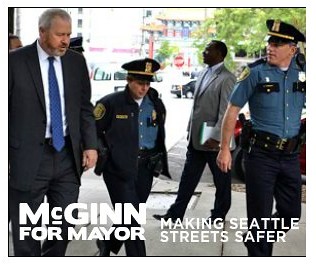
Mike McGinn for Seattle Mayor, reelection campaign digital ad, "Making Seattle Streets Safer"Digital ad for the McGinn campaign, Seattle.

2.  Seattle.  Seattle gives NYC a run for the money in terms of which city is more progressive, although Seattle has an advantage in being smaller with more likely conservative outer city or suburban voters ensconced in King County, while in NYC, instead such voters live in Staten Island and Queens.   Granted that San Francisco still is probably #1 overall...

There is a battle of progressive candidates for Mayor.  Incumbent Mike McGinn, considered by many to be too much of a brawler, is opposed by Sate Senator Ed Murray.  See "In last days of Seattle mayor’s race, a final push to get out the vote " from the Seattle Times.  The conservative Seattle Times doesn't favor the incumbent.

Also on the ballot, Socialist Alternative candidate Kshama Sawant against Richard Conlin ("Is Seattle Ready for Kshama Sawant?," Seattle Weekly).  She seems to be getting support from other councilmembers ("Mike O’Brien Expected to Make ‘Significant Statement’ In Support of Sawant," "Tonight It’s Licata and Sawant In The Spotlight," Seattle Weekly).

The Stranger alternative weekly endorses McGinn and Sawant ("The Stranger's Voters' Guide!").  From the article:
As for mayor, do you want Mike McGinn, who's backing a citywide light-rail network? Or do you want Ed Murray, who, we shit you not, recently held a fundraiser that used destroying bike lanes as its main tactic to raise money? We're sticking with pro-transit, pro-bike Mayor McGinn, thank you.

We're also telling you to vote against city council member Richard Conlin, whose biggest accomplishment is legalizing miniature goats (perhaps for gay-marrying purposes), and to instead vote for Kshama Sawant, a socialist economist who wants to increase the minimum wage to $15 an hour. And, even more important, we want more challengers like Sawant to run for office so we don't have the same washed-up, goat-loving, Metamucil-swilling incumbents dying at city hall after fruitless multi-decade careers.
Note that there is a referendum to move Seattle's elections to being district-based instead of at large, which could allow for "more progressive" candidates to be elected more generally.  A public funded campaign initiative is also on the ballot.  The Stranger supports both, arguing that running at large requires more financing and favors pro-business candidates, while smaller districts and public funding of campaigns would allow for a greater range of candidates.

Note also that Washington State has mail-in ballots and people don't have to go to a polling place to vote.

Plus also in King County, Washington on the ballot for the City of SeaTac, which includes the airport, is a referendum for a $15 minimum wage for jobs in the city.

3. The New York Times had a piece a couple weeks ago about reforming primary elections, California Sees Gridlock Ease in Governing," suggesting that moving to a format where in an open primary, the top two vote getters move to the general election, results in a broadening or moderating of the candidates, as opposed to how the system works in a closed primary, where the electorate tends to be more conservative.

Although the Washington Post has a piece "Reforming primary elections won't make government better" by GWU professor John Sides which cites various political science studies that conclude that reform won't make much difference.


It might be that this change works better at the scale of local elections, that national elections, especially if the gerrymandering of district boundaries continues, are more immune to these kinds of structural changes to the process.  Seattle shows that the effect from this kind of change at the local level can be significant.  How many cities--other than Minneapolis--have a declared Socialist running for a City Council seat that has made it past the primary?

In Seattle, having the top two vote getters in a primary moving on to the general election appears to provide the opportunity for a broadening of the candidates in terms of the political orientation they would bring to the job, rather than a narrowing which is more typical of the winner takes all method that is used most everywhere else across the US.

Such a change could make a difference in DC as well.  Because the city is almost exclusively Democratic, the top vote getter in the primary is virtually a lock for getting elected, having no real competition in the general election from alternative parties (Statehood-Green is a local party that hasn't had anyone on Council for more than 10 years; Republicans had one Councilmember, but in a Tea Party like move, deposed her in the primary and unrealized by them at the time, ended up consigning them to the sidelines.

I think a top two vote getters in the primary moving on to general election could make a difference in DC elections, adding a significant dose of competition to a system that works to eliminate it--DC's primary election is held 3-4 months earlier than is legally required, which I believe is designed to protect incumbents.

4.  Virginia and the Tea Party.  The federal government shutdown brought new attention to candidate for Governor Ken Cuccinnelli's links to the tea party and his conservative credentials.  While many voters have not unjustifiable reservations about the Democratic candidate Terry McAuliffe, they like Cuccinelli even less.  The polls show a likely win by McAulliffe.

Similarly, the Republican candidate for Lt. Governor is quite wacky as well, and is likely to lose.  It's closer for the candidates for Attorney General.  The Republican AG candidate is campaigning as less conservative than he is.  That election is maybe too close to call.

It's hard to say whether this is a bellweather nationally.  See "Dem favored in Va. gov race; voters seem wary of tea party" from the Seattle Times.  As much as 1/3 of Virginia's economy is dependent on the federal government, and in Northern Virginia in particular many people work for the federal government.

Traditionally the Virginia Senate and House are dominated by Republicans.  If some of these seats are picked up by Democrats it could herald a change in mood to which the National Party will have to pay attention.   See "In NoVa, veteran GOP delegate Rust fights for his seat" from the Washington Post, "Ken Cuccinelli Making Bad Candidate History in Virginia" from the Daily Beast, "Stark Choices: Much is at stake in Tuesday's Election" and "Headwinds may cost GOP seats in House" from the Richmond Times-Dispatch, and 

From the second RTD article:
It’s a pattern playing out across Northern Virginia; Hampton Roads, a defense-rich region also rattled when Washington went dark for 16 days; and, possibly, pockets of the western countryside. It’s energizing Democrats and alarming Republicans. It could augur what neither party had anticipated in early October: That badly outnumbered House Democrats could make significant gains, because of their party’s stronger-than-expected statewide ticket and backlash to the shutdown.
Recent internal polling by both parties suggests as much. Operatives in both parties disagree on how many House seats actually may be in play: Democrats believe there could be 10. Republicans put the number at six, maybe, eight, if conditions continue to erode.  ...
Gerrymandered House seats, coupled with the lower turnout of an off-year election, ensure that Republicans will retain control of the 100-member House of Delegates, where they now outnumber Democrats 2-to-1. But House pickups for Democrats — three to five seem realistic — would be a psychological boost, more so if they followed a sweep for governor, lieutenant governor and attorney general, which both parties agree is a distinct possibility.
Note that the Virginia House faces election every two years, while the Senate is up for election every four years.  See "Even if seats lost, GOP predicted to keep big majority" from the Norfolk Virginian-Pilot.
5.  Fallout on the Republicans from the federal government shutdown.  Because national elections are held in even years, there is little short term impact from the shutdown on candidates this year, although efforts to knock off tea party Congresspeople are underway in Michigan, Florida, and elsewhere.  There is a special election for a Congressional seat in Alabama ("In Alabama Race, a Test of Business Efforts to Derail Tea Party," New York Times), and big business including the US Chamber of Commerce has weighed in financially with support to a non-tea party type.

Over the next year, we'll see how the shutdown impacts the Republicans internally as well as in competition with the Democrats and whether or not the US House of Representatives could switch to a Democratic majority--still somewhat unlikely because of gerrymandering and a rural bias in how election districts are mapped.

6.  Takoma Park Maryland has extended the voting franchise in local elections to people as young as 16 years of age.  See "Some of Takoma Park's 16-, 17-year-olds excited to vote" from the Gazette.

People against the measure say other things need to be done to engage young people in community affairs.  Sure, that's true.  Do that stuff too.  It's not a zero sum game.  You can do both.

7.  Minneapolis also has a Socialist Alternative candidate on the ballot, Ty Moore in District 9.  See "Socialist Alternative: Minneapolis Ward 9 Council Candidate Revives City's Socialist Heritage " from the Uptake blog. Six candidates are vying for the seat but Moore is a front runner ("Minneapolis City Council could see up to 7 new faces," Minneapolis Star-Tribune).  Another leading candidate is Alondra Cano, a Mexican-American, who if elected, would be the first Hispanic on the City Council.  From the MST article:
“Ty Moore has the strong street organizing skills but risks being seen as a protester who won’t be effective in City Hall,” Schiff said. “Alondra’s challenge is convincing people that a DFL candidate can hold strong against corporate welfare.”

Moore is an activist who co-founded the local Occupy Homes movement, which stages sit-ins to prevent banks from seizing particular foreclosed houses. His campaign has focused heavily on stopping foreclosures and raising the city’s minimum wage to $15 an hour — the latter of which would require state action. He has been endorsed by the Service Employees International Union, and he accuses Cano of being too close to corporate interests and the mainstream DFL.  ...

Cano is a communications specialist for Minneapolis Public Schools who would be the first Mexican-American on the council. She is a former aide to Sixth Ward Council Member Robert Lilligren, worked as an activist on Latino issues, and has billed herself as the candidate with the most relationships at City Hall and elsewhere to help advocate on behalf of the ward. Mayor R.T. Rybak attended a fundraiser for her earlier this month.
 8.  There are a handful of transit related measures on ballots across the country as well, but the measures are mostly very local.

Labels: , , ,