Rebuilding Place in the Urban Space

"A community’s physical form, rather than its land uses, is its most intrinsic and enduring characteristic." [Katz, EPA] This blog focuses on place and placemaking and all that makes it work--historic preservation, urban design, transportation, asset-based community development, arts & cultural development, commercial district revitalization, tourism & destination development, and quality of life advocacy--along with doses of civic engagement and good governance watchdogging.

Monday, August 30, 2021

Democrats prefer cities says research | The politics of Sprawl

Definition of the word cosmpolitan, from the Merriam-Webster dictionary:

1 : having wide international sophistication : worldly Greater cultural diversity has led to a more cosmopolitan attitude among the town's younger generations. 2 : composed of persons, constituents, or elements from all or many parts of the world a city with a cosmopolitan population.

Will sends us a link to this Vice News article, "Walking Places Is Part of the Culture Wars Now."  From the article:

According to a recent Pew Research Center poll that studied the issue of whether people prefer to live in places where "schools, stores, and restaurants are within walking distance" versus where they are "several miles away," the biggest divide in opinion is not young versus old, urban versus rural, or education level. It is political preference. 

Just 22 percent of Conservatives want to live in walkable neighborhoods, while 77 percent prefer driving everywhere. A slightly higher percentage of Republicans or people who lean Republican as a whole, 26 percent, want walkable neighborhoods. Meanwhile, 44 percent of moderate Democrats and 57 percent of liberals want walkable neighborhoods, resulting in a 50/50 split among Democrats as a whole. 

Frazz comic strip, 11/15/2012

...But one of the most striking findings is that the gap in walkable neighborhood preference according to extreme political views is even wider than the gap between urban and rural respondents, where 50 percent of urban residents polled want walkable neighborhoods and 25 percent of rural ones do. In other words, whether or not you actually live in an urban or rural area is less of a predictor of whether you want walkable neighborhoods than the political beliefs one holds regardless of where they live.

I am not surprised, although seemingly "small town values" would include a recognition of the importance of access, proximity, and walkability.

I remember when I worked as a Main Street program manager in the Brookland neighborhood in DC, while the leader of the program promoted the tagline "Brookland, small town, in town" making the point that the community was village-like, but still in the city, another member made the point that to her, "small town" meant parochial.


Labels: , , ,

Monday, January 04, 2021

Quality of messaging: fact-based versus post-truth Republicans

-- "Post-truth politics and why the antidote isn’t simply ‘fact-checking’ and truth," The Conversation
-- "Defining Post-truth: Structures, Agents, and Styles,"  Ari-Elmeri Hyvönen
-- "Truth vs. Lies," October 2020 special issue, Scientific American


Yesterday, the Washington Post released a blockbuster, "I just want to find 11,780 votes’: In extraordinary hour-long call, Trump pressures Georgia secretary of state to recalculate the vote in his favor," a story with the audiotape of a call made on Saturday by President Trump to Georgia's Secretary of State, asking him to come up with 11,780 votes in Trump's favor, so the previous decision awarding the state's electoral votes to Biden could be challenged.

-- "Here’s the full transcript and audio of the call between Trump and Raffensperger"

(I listened to most of it, and while Trump was repetitive and evasive and a wack job, I wouldn't say he sounded "mentally ill," as many others have said.)

Today, a different Georgian election official had a press conference ("Trump made false claims in call pressuring Georgia secretary of state to undo Biden win, official says," NBC News) where he refuted each of Trump's fallacious claims.

What struck me was the "presentation board" he used to support his presentation.  It's matter of fact.

NBC News photo.

I thought back to the Republican campaign by members in the House of Representatives to impugn witness Michael Cohen testifying about his experiences working for and with Donald Trump ("'Liar, Liar, Pants on Fire,’ and Other Contentious Exchanges From Cohen’s Congressional Hearing," New York Times). Here's the quality of their presentation boards.

Reuters photo.

Labels: , , , , ,

Tuesday, November 19, 2013

The trope about the benefit of "Telling truth to power is mostly" is mostly B.S.: DC edition

The West Wing TV show had an episode I saw about the importance of staffers "telling truth to power."  I've never found it pays off work-wise.

Former DC Insurance Commissioner William P. White would probably say the same thing.  He was fired one day after ("DC insurance commissioner fired a day after questioning Obamacare fix," Post) stating publicly that a work-around on one element of the Affordable Care Act announced by President Obama wouldn't work well for DC, which has a successful state-level health care exchange.

The Washington Post editorializes today, "Mayor Gray delivers a chilling message to D.C. officials," that this isn't a good way to manage your employees.

2.  Last year, Mayor Gray fired the director of the Department of Environment for discussing with the EPA his disagreement with the Executive Branch's change in approach to dealing with EPA regulatory requirements over separating sewerage infrastructure from stormwater run off infrastructure ("Christophe Tulou fired as D.C. environment director," Washington Business Journal).

3.  And there has been a lot of discussion lately in the press (e.g., "On the path to a failed presidency?," Post) about how the Obama Administration isn't very good at listening to underlings who are trying to communicate "bad news." 

4.  I will say that the biggest lesson I got from my brief sojourn working for the executive branch in the Office of Planning for Baltimore County, Maryland is a substantive, real, and deep understanding of how the shots are called within the executive branch. 
The chief executive and there, really, the long time chief budget officer was more powerful than the County Executive, who is limited to two terms, and his office call the shots on policy.  They hire agency directors who understand this, and are willing to work within the parameters and constraints that are handed down to them.

Lowly staffers like me really didn't make policy.  (In fact, I worry a bit that my getting the agency director so worked up about transportation planning responsibilities coming back to the OP that he broached this with the Executive ended up getting him canned when a new administration took office.  Although I am sure that because of his progressive talk--not walk--he wasn't gonna be retained in any case.)

I had a couple of instances of citizens lecturing me about the value of sustainable transportation, and I would stop them, stating that their message would have a lot more impact and carry more weight when presented to their elected officials--I wasn't the person in the way of better sustainable transportation best practice, it was the DPW...

Were I able to have worked there long term (I don't know if it was possible, even if the County budget hadn't gone in the tank, despite what I was told), it would have been difficult to deal with this reality. 

5.  What happens is that people who won't tell bad news, or hide it, knowing the reaction it will evince end up getting fired anyway, when s**t hits the fan, e.g., failures in administrators in not being able to carry out the promises made by the Mayor in the face of inadequate systems e.g., "District officials criticize Fenty's management of summer jobs program." 

Mayor Fenty made unfulfillable promises, his staff likely didn't tell me to cool down the statements, and when they couldn't fulfill the expectations, they lost their jobs.

Also see the book Exit, Voice and Loyalty by Albert O. Hirschman.  The end of this essay by Malcolm Gladwell, "The Gift of Doubt," discusses that book. 

I look at the argument a bit differently. Loyalty is for the people who stay but don't say anything.  That's never worked well for me either.

Labels: , , , ,

Tuesday, November 05, 2013

More election stuff I neglected to mention

1. R.T. Rybak is not running for re-election of Mayor in Minneapolis and 35 people are running to replace him (AP story, "35 Candidates Vie to Be Next Minneapolis Mayor").  How is that possible?

The city has instituted ranked choice voting, and instead of having a primary, they have one election with all the candidates up.  They also have a low filing fee--$20--and presumably relatively low signature-petition requirements.   From the article:
Under ranked choice, if no candidate exceeds 50 percent of first-choice votes, that triggers a series of automatic runoffs in which lower-ranked candidates are eliminated and second and third choices are redistributed to remaining candidates' totals.
2.  A white guy, Mike Duggan, is the leading candidate to win election as the next Mayor of Detroit.  See "The race to become Detroit's next mayor" from the Washington Post and "Mike Duggan leads Benny Napoleon in Detroit race for mayor, poll" from the Detroit Free Press.

3.  On the New York State ballot is a constitutional amendment recommending casino expansion.  The NYT columnist Ross Douthat, a conservative, thinks that casino expansion is a race to the bottom.  From "Pot and Jackpots":
“In the Northeast and mid-Atlantic states,” a report from the Institute for American Values noted this year, “nearly every adult now lives within a short drive of a casino.” And after this Tuesday, that drive may get considerably shorter, because New York voters are expected to ratify a constitutional amendment allowing up to seven more casinos in the state.

... in the case of casinos, whose consequences for the common good are straightforwardly disastrous. As the Institute for American Values report points out, the alliance of state governments and gambling interests is essentially exploitative, and the tax revenue casinos supply comes at the expense of long-term social welfare. Casinos tend to lower property values and weaken social capital in the places where they’re planted, they’re more likely to extract dollars from distressed communities than to spur economic development, and their presence is a disaster for the reckless and the addiction-prone. 
While reading, I was struck by the work of University of Michigan political scientist Ronald Inglehart, on "post-industrial" political behavior and attitudes and their relevance, these days, to the US.  It's too bad I never took his class.  He focused on studying Europe at the time, although a cross-national study carries on the work.  

4.  In my discussion of "the tea party" and Republicans, I should have mentioned New Jersey.  The Tea Party movement hasn't been strong in that state, although Pennsylvania, which adjoins New Jersey, has a strong conservative bent and is the home of former Republican presidential candidate Rick Santorum, Christie, a Republican maintains strong support from Democrats and Independents for his "fix government" pragmatic approach.

5.  The National Journal has a good article, "A How-To Guide to Blowing Up the Constitution," about why the US Constitution no longer works all that well for operating government.  The people quoted tend to favor a more parliamentary type system, which one house is stronger than the other in the legislative branch, room for more than two parties and coalition government, and how the winner of the House gets the presidency/prime ministership.

6.  Depending on the nature of the conservative aims toward government--either support of less government vs. support of no government--maybe the "Republican" party will have to break up, and the possibility of coalition government in the House would have to be considered.

7.  Apparently in Montreal, election day was this past Sunday.  Municipal government there has been roiled over pay-to-play elections and the most recently elected mayor resigned.  His appointed replacement resigned too, over similar problems.  The Liberal Party-affiliated candidate, Denis Corderre, won ("Coderre wins Montreal mayoral election," Toronto Globe and Mail), turnout was low ("Low voter turnout in Montreal election," Global TV News), and Projet Montreal, the more left party controls three boroughs and 22 seats on the 65-seat City Council ("Projet Montréal poised to form opposition, sweep three boroughs," Montreal Gazette).

Labels: , , ,

Monday, November 04, 2013

2013 Election Roundup

Tuesday November 5th is election day in many places, as many cities and a handful of states have their elections in so-called "off years," to ensure that local and state races are not overshadowed by the races for the US House and Senate and every four years, for President.

1.  New York City.  Many call the likely election of Bill de Blasio as a rise of the progressives, in large part as a reaction to the hyper development focused agenda of Mayor Bloomberg ("Contesting the Bloomberg Legacy," Architect's Newspaper).

Although sustainable transportation advocates got a scare when in a radio interview, De Blasio seemed to equivocate on supporting various pro-transportation measures ("De Blasio: “Transportation Determines Opportunity, Livability, Biz Climate”," Streetsblog) initiated by Mayor Bloomberg and Transportation Commissioner Janette Sadik-Khan ("Bloomberg bigs head for the exits," Crain's New York Business).

There is no question that of all US mayors, no one has been better than Michael Bloomberg in terms of support of sustainable transportation over his term of office, which was all the more difficult because the Mayor of New York City has limited input into the running of the Metropolitan Transit Authority, which is run by New York State.
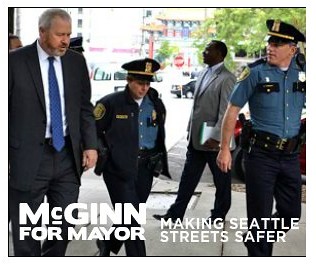
Mike McGinn for Seattle Mayor, reelection campaign digital ad, "Making Seattle Streets Safer"Digital ad for the McGinn campaign, Seattle.

2.  Seattle.  Seattle gives NYC a run for the money in terms of which city is more progressive, although Seattle has an advantage in being smaller with more likely conservative outer city or suburban voters ensconced in King County, while in NYC, instead such voters live in Staten Island and Queens.   Granted that San Francisco still is probably #1 overall...

There is a battle of progressive candidates for Mayor.  Incumbent Mike McGinn, considered by many to be too much of a brawler, is opposed by Sate Senator Ed Murray.  See "In last days of Seattle mayor’s race, a final push to get out the vote " from the Seattle Times.  The conservative Seattle Times doesn't favor the incumbent.

Also on the ballot, Socialist Alternative candidate Kshama Sawant against Richard Conlin ("Is Seattle Ready for Kshama Sawant?," Seattle Weekly).  She seems to be getting support from other councilmembers ("Mike O’Brien Expected to Make ‘Significant Statement’ In Support of Sawant," "Tonight It’s Licata and Sawant In The Spotlight," Seattle Weekly).

The Stranger alternative weekly endorses McGinn and Sawant ("The Stranger's Voters' Guide!").  From the article:
As for mayor, do you want Mike McGinn, who's backing a citywide light-rail network? Or do you want Ed Murray, who, we shit you not, recently held a fundraiser that used destroying bike lanes as its main tactic to raise money? We're sticking with pro-transit, pro-bike Mayor McGinn, thank you.

We're also telling you to vote against city council member Richard Conlin, whose biggest accomplishment is legalizing miniature goats (perhaps for gay-marrying purposes), and to instead vote for Kshama Sawant, a socialist economist who wants to increase the minimum wage to $15 an hour. And, even more important, we want more challengers like Sawant to run for office so we don't have the same washed-up, goat-loving, Metamucil-swilling incumbents dying at city hall after fruitless multi-decade careers.
Note that there is a referendum to move Seattle's elections to being district-based instead of at large, which could allow for "more progressive" candidates to be elected more generally.  A public funded campaign initiative is also on the ballot.  The Stranger supports both, arguing that running at large requires more financing and favors pro-business candidates, while smaller districts and public funding of campaigns would allow for a greater range of candidates.

Note also that Washington State has mail-in ballots and people don't have to go to a polling place to vote.

Plus also in King County, Washington on the ballot for the City of SeaTac, which includes the airport, is a referendum for a $15 minimum wage for jobs in the city.

3. The New York Times had a piece a couple weeks ago about reforming primary elections, California Sees Gridlock Ease in Governing," suggesting that moving to a format where in an open primary, the top two vote getters move to the general election, results in a broadening or moderating of the candidates, as opposed to how the system works in a closed primary, where the electorate tends to be more conservative.

Although the Washington Post has a piece "Reforming primary elections won't make government better" by GWU professor John Sides which cites various political science studies that conclude that reform won't make much difference.


It might be that this change works better at the scale of local elections, that national elections, especially if the gerrymandering of district boundaries continues, are more immune to these kinds of structural changes to the process.  Seattle shows that the effect from this kind of change at the local level can be significant.  How many cities--other than Minneapolis--have a declared Socialist running for a City Council seat that has made it past the primary?

In Seattle, having the top two vote getters in a primary moving on to the general election appears to provide the opportunity for a broadening of the candidates in terms of the political orientation they would bring to the job, rather than a narrowing which is more typical of the winner takes all method that is used most everywhere else across the US.

Such a change could make a difference in DC as well.  Because the city is almost exclusively Democratic, the top vote getter in the primary is virtually a lock for getting elected, having no real competition in the general election from alternative parties (Statehood-Green is a local party that hasn't had anyone on Council for more than 10 years; Republicans had one Councilmember, but in a Tea Party like move, deposed her in the primary and unrealized by them at the time, ended up consigning them to the sidelines.

I think a top two vote getters in the primary moving on to general election could make a difference in DC elections, adding a significant dose of competition to a system that works to eliminate it--DC's primary election is held 3-4 months earlier than is legally required, which I believe is designed to protect incumbents.

4.  Virginia and the Tea Party.  The federal government shutdown brought new attention to candidate for Governor Ken Cuccinnelli's links to the tea party and his conservative credentials.  While many voters have not unjustifiable reservations about the Democratic candidate Terry McAuliffe, they like Cuccinelli even less.  The polls show a likely win by McAulliffe.

Similarly, the Republican candidate for Lt. Governor is quite wacky as well, and is likely to lose.  It's closer for the candidates for Attorney General.  The Republican AG candidate is campaigning as less conservative than he is.  That election is maybe too close to call.

It's hard to say whether this is a bellweather nationally.  See "Dem favored in Va. gov race; voters seem wary of tea party" from the Seattle Times.  As much as 1/3 of Virginia's economy is dependent on the federal government, and in Northern Virginia in particular many people work for the federal government.

Traditionally the Virginia Senate and House are dominated by Republicans.  If some of these seats are picked up by Democrats it could herald a change in mood to which the National Party will have to pay attention.   See "In NoVa, veteran GOP delegate Rust fights for his seat" from the Washington Post, "Ken Cuccinelli Making Bad Candidate History in Virginia" from the Daily Beast, "Stark Choices: Much is at stake in Tuesday's Election" and "Headwinds may cost GOP seats in House" from the Richmond Times-Dispatch, and 

From the second RTD article:
It’s a pattern playing out across Northern Virginia; Hampton Roads, a defense-rich region also rattled when Washington went dark for 16 days; and, possibly, pockets of the western countryside. It’s energizing Democrats and alarming Republicans. It could augur what neither party had anticipated in early October: That badly outnumbered House Democrats could make significant gains, because of their party’s stronger-than-expected statewide ticket and backlash to the shutdown.
Recent internal polling by both parties suggests as much. Operatives in both parties disagree on how many House seats actually may be in play: Democrats believe there could be 10. Republicans put the number at six, maybe, eight, if conditions continue to erode.  ...
Gerrymandered House seats, coupled with the lower turnout of an off-year election, ensure that Republicans will retain control of the 100-member House of Delegates, where they now outnumber Democrats 2-to-1. But House pickups for Democrats — three to five seem realistic — would be a psychological boost, more so if they followed a sweep for governor, lieutenant governor and attorney general, which both parties agree is a distinct possibility.
Note that the Virginia House faces election every two years, while the Senate is up for election every four years.  See "Even if seats lost, GOP predicted to keep big majority" from the Norfolk Virginian-Pilot.
5.  Fallout on the Republicans from the federal government shutdown.  Because national elections are held in even years, there is little short term impact from the shutdown on candidates this year, although efforts to knock off tea party Congresspeople are underway in Michigan, Florida, and elsewhere.  There is a special election for a Congressional seat in Alabama ("In Alabama Race, a Test of Business Efforts to Derail Tea Party," New York Times), and big business including the US Chamber of Commerce has weighed in financially with support to a non-tea party type.

Over the next year, we'll see how the shutdown impacts the Republicans internally as well as in competition with the Democrats and whether or not the US House of Representatives could switch to a Democratic majority--still somewhat unlikely because of gerrymandering and a rural bias in how election districts are mapped.

6.  Takoma Park Maryland has extended the voting franchise in local elections to people as young as 16 years of age.  See "Some of Takoma Park's 16-, 17-year-olds excited to vote" from the Gazette.

People against the measure say other things need to be done to engage young people in community affairs.  Sure, that's true.  Do that stuff too.  It's not a zero sum game.  You can do both.

7.  Minneapolis also has a Socialist Alternative candidate on the ballot, Ty Moore in District 9.  See "Socialist Alternative: Minneapolis Ward 9 Council Candidate Revives City's Socialist Heritage " from the Uptake blog. Six candidates are vying for the seat but Moore is a front runner ("Minneapolis City Council could see up to 7 new faces," Minneapolis Star-Tribune).  Another leading candidate is Alondra Cano, a Mexican-American, who if elected, would be the first Hispanic on the City Council.  From the MST article:
“Ty Moore has the strong street organizing skills but risks being seen as a protester who won’t be effective in City Hall,” Schiff said. “Alondra’s challenge is convincing people that a DFL candidate can hold strong against corporate welfare.”

Moore is an activist who co-founded the local Occupy Homes movement, which stages sit-ins to prevent banks from seizing particular foreclosed houses. His campaign has focused heavily on stopping foreclosures and raising the city’s minimum wage to $15 an hour — the latter of which would require state action. He has been endorsed by the Service Employees International Union, and he accuses Cano of being too close to corporate interests and the mainstream DFL.  ...

Cano is a communications specialist for Minneapolis Public Schools who would be the first Mexican-American on the council. She is a former aide to Sixth Ward Council Member Robert Lilligren, worked as an activist on Latino issues, and has billed herself as the candidate with the most relationships at City Hall and elsewhere to help advocate on behalf of the ward. Mayor R.T. Rybak attended a fundraiser for her earlier this month.
 8.  There are a handful of transit related measures on ballots across the country as well, but the measures are mostly very local.

Labels: , , ,

Friday, November 09, 2012

Missing the point: cities, cosmopolitanism, and progressivism as a multicentury trend

People have been writing about the link between "sidewalks" and votes for Democratic candidates, or the support for "liberalism" in cities and towns versus the support for conservatism is less developed areas.  See "Why Do Sidewalks Predict Whom We’ll Vote For?" from Streetsblog.

Um, this has been the case for thousands of years, although back in the day, urban middle classes (bourgeoisie) in countries like France weren't looking to vote for President Obama.  (And of course, I wrote about this as a more recent phenomenon as it related to the 2004 article from the Stranger.)

The history of democracy is in part a history of urbanism.

-- "Rise of Towns," International History Project
-- "History of World Civilization - Greek Civilization: Polis; Athens" from the Historian and his facts blog

The rise of democratic government grew out of the creation of towns as semi-independent self-governing communities not directly managed by the monarchy.

Back in college, I remember coming across the work of Prof. Ronald Inglehart at the U of Michigan and his study of post-industrial social and political attitudes in Europe (although I never took a course from him).  Now this work has been repositioned and expanded into a international political attitudes survey project called the World Values Survey.

-- Chapter on "Culture and Democracy" by Ronald Inglehart
-- "Modernization, Cultural Change, and the Persistence of Traditional Values," Inglehart and Baker, American Sociological Review, 2000

The real issue isn't why urban-metropolitan area residents are progressive--and it's all relative.  In the DC metropolitan area, places like Prince William and Loudoun Counties in Virginia are considered quite conservative relative to Arlington or Montgomery Counties, DC or incorporated cities like Takoma Park, Maryland.  But compared to rural Montana, they are decidedly liberal, and voted for Obama.

The real issue is why exurban residents are neither "progressive" nor "post-industrial" although this is by no means a strictly urban-suburban-rural continuum.

And this is discussed in thousands and thousands and thousands of histories on the development of cities, modernization, and political theory.

Labels: , , , ,

Sunday, September 09, 2012

One nation, divisible

I try to keep the blog focused on community revitalization, which granted is a pretty broad topic and therefore allows me to write about many different issues, and you can argue that institutionalized racism is very much relevant to urban revitalization, since center cities tend to be the places where minorities, especially African-Americans, live, and the willingness to live in and financially assist center cities when necessary often references race and racism.

Ta-Nehisi Coates of The Atlantic Monthly has a great article in the September issue, "Fear of a Black President," about the election of President Obama, the post-election response, and the current campaign.

He cites the work of a graduate economics student which found the vote for Obama depressed somewhat because of people unwilling to vote for an African-American candidate.  That doesn't surprise me.  In fact, I have thought for a long time that if John McCain wasn't so out there, and if he hadn't picked such a scary candidate for vice president, that he would have been elected.  But it turns out that people will vote African-American if the alternative is scary-crazy.

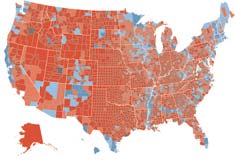
Also see "The Urban Archipelago: It's the Cities, Stupid," the post-2004 election screed by the editors of The Stranger, Seattle's alternative newsweekly.

It basically made the point that it is the cities and the East and West Coasts that are primarily democratic/progressive and that the interior of the country is conservative/Republican.

When you weight the map of "red-blue" by population, the country isn't as conservative dominated as it appears.
map2
2004 election results. Blue = Democrat; Red = Republican. Image from The Stranger.

---
Note: it happens that I was traveling last week, and one place I stayed had the book by Janny Scott about (Stanley) Ann Dunham, Pres. Obama's mother, A Singular Woman: The Untold Story of Barack Obama's Mother. It's an interesting book, and given my interest in public and entrepreneurial markets and cultural-indigeneous industries, it made me want to read her dissertation, as well as another book mentioned, Peasant Marketing in Java.

Labels: , , , ,

Monday, August 08, 2011

A concern about city-county consolidation

Mostly the writing about this, in Orfield's Metropolitics and Rusk's Cities without Suburbs and Inside Game, Outside Game, has been around cost savings through service consolidation and getting city access to greater property tax revenue streams that are typically generated by suburban areas compared to the generally declining property values that had typified the urban experience over the past 30-40 years.

Christopher Hume of the Toronto Star makes the point (" Toronto embarked on a civic, if not a civil, war") that Toronto's footprint, containing both the city and the suburbs, allowed conservative Rob Ford to win the mayoral election, because the suburban voters, more conservative than those in the city, tipped his way. From the article:

City versus suburb: Like it or not, that has become the story of Toronto politics in the 21st century. And if the Rob Ford phenomenon is any indication, the suburbs are winning.

The great urban/suburban divide has been the topic of conjecture going back decades, but in the past 30 years, the gap between the two has widened into a chasm. They are Canada’s new solitudes.

Though reasons are hard to pin down, the fact is that while suburbanites move further to the right, their urban counterparts remain firmly on the left.

Since 1997, writes the University of Toronto’s Alan Walks, “the inner cities are about three times more likely to vote NDP than are the suburbs, while the suburbs are twice as likely to vote for the Reform party as the inner city.”


Interestingly, the Post's article yesterday, "Minority growth may reshape Md. congressional map," about Congressional redistricting in Maryland discussed the same issue, but in reverse, about how creating districts with large numbers of more liberal voters--usually from Montgomery and Prince George's Counties, yields more Democratic congresspeople for the state.

Labels: , , , ,