Rebuilding Place in the Urban Space

"A community’s physical form, rather than its land uses, is its most intrinsic and enduring characteristic." [Katz, EPA] This blog focuses on place and placemaking and all that makes it work--historic preservation, urban design, transportation, asset-based community development, arts & cultural development, commercial district revitalization, tourism & destination development, and quality of life advocacy--along with doses of civic engagement and good governance watchdogging.

Thursday, May 01, 2014

Multinational corporate tax management and "localness"

Recently there were Congressional hearings about how Caterpillar Corporation negotiated a special tax relationship with Switzerland, and created a paper company domiciled there for the purpose of managing transactions for the sale of replacement parts ("Caterpillar Escaped $2.4 Billion Tax With Swiss Maneuver ," Bloomberg).  While the transactions were mostly conducted in the US, for the purpose of taxes, they ran through Switzerland, at a tax rate less than one-fifth of the rate that would be in the US.

And a few weeks ago, it was suggested that Walgreen's, the nation's largest pharmacy chain, which a couple years ago merged with a British company, Boots, should relocate its corporate headquarters to Europe, to reduce its taxes.  See "Should Walgreen Move to Europe for Leaner  Taxes?" from Businessweek Magazine and "If  Walgreen Co. moves its HQ to Europe, blame Washington's tax failure" from the Chicago Tribune (Walgreen's is based in Greater Chicago). From the Tribune article:
A group of shareholders reportedly is pressuring the giant retail chain for a move to the land of cuckoo clocks. The reason: lower taxes. Much lower taxes:
If Walgreen changes its legal domicile to Switzerland, where it recently acquired a stake in European drugstore chain Alliance Boots, the company could save big bucks on its corporate income-tax bill. The effective U.S. income-tax rate for Walgreen, according to analysts at Swiss Bank UBS: 37 percent. For Alliance Boots: about 20 percent.

We hope Walgreen doesn't relocate. Would company executives be smart to do so in order to best serve their shareholders? Hmm. We'd rather not say. So we'll respond to that question with another, broader but similarly urgent question:

How many companies have to turn refugee before Congress and the White House stop their bipartisan talking — but only talking — about the need to reform the federal tax code in general, and the corporate income tax in particular?
This week, Pfizer, a pharmaceutical firm based in New Jersey, announced that it will merge with a British corporation and will move its domicile to the UK, to reduce its corporate taxes ("Pfizer's Move Poses Challenge. Here's a Solution," New York Times) while last week Starbucks announced it will move its European headquarters to the UK, because of new lower corporate tax rates ("Starbucks moves Europe HQ to London," Financial Times).

Apparently the effective US corporate tax rate is about 27% while in Europe it is 21% and the UK has just announced a tax cut so that the UK corporate tax rate will be about 20%.

The NYT article suggests shifting taxes from corporations to shareholders.  From the article:
It’s counterintuitive, but Congress could avoid this problem by abolishing the tax on corporations’ profits and much more aggressively taxing their American shareholders — who are unlikely to flee to London along with Pfizer’s incorporation documents.
I don't know what is a "fair" corporate tax rate, but as long as corporations can play one nation against another, the likely scenario is a race to the bottom.

It's a long way from the "good corporate citizen" discussed in the recent Urbanophile post ("Portrait of a Change Agent") about J. Irwin Miller, a banker and leader of Cummins Engine, which is still based in the comparatively small town of Columbus, Indiana and the various "corporate citizenship" initiatives he undertook which have made the city a great success or how SC Johnson in Racine, Wisconsin is restoring its old research center, designed by Frank Lloyd Wright, and how it has exhibit facilities and gives tours of its campus ("A Corporate Paean to Frank Lloyd Wright," New York Times).

Labels: , , ,

Monday, May 20, 2013

Corporations as persons and as taxpayers (not)

The primary reason that I think the legal decision to treat corporations as the equivalent of persons was wrong has to do with the reality that corporations can be immortal (or virtually immortal) can people die, science fiction notwithstanding.

There is interesting discussion in the US (e.g., "Report: Apple used subsidiaries to avoid $44 billion in U.S. taxes" from the Los Angeles Times, general discussion that the US corporate tax rate is "too high") and Europe (various studies of how corporations like Starbucks use financial engineering to shift revenues from countries like the UK, e.g., "Fresh questions for Amazon over pittance it pays in tax" and "Corporate taxation: Wake up and smell the coffee" from The Economist) that if only corporate tax rates were lower, corporations wouldn't try to game the system.

Image: UK Uncut protesters draw attention to tax avoidance by Starbucks and the impact of Government cuts on women in front of the branch of Starbucks in Vigo Street, Central London. From Demotix.

In the UK, not the US, there has been massive public outrage over the fact that many corporations are not paying taxes.  See "Poll suggests growing 'public outrage' over multinationals tax bills" from Tax Journal.

A letter writer to the Financial Times ("Attitudes to free riding, and not tax rates, must change") makes the best point, that UK corporate tax rates are 12 points lower than US taxes and corporations still game their taxes.  From the letter:

... makes a sensible argument for changing the US tax code. If it is overly complicated, reform may be justified. However, his argument that the solution is lower rates does not follow.

The UK corporate tax rate is around 12 percentage points lower than that in the US, but still companies in areas as diverse as internet retailing, web search and coffee shops put considerable effort into avoiding it. The corporate tax rate in Ireland is roughly 10 percentage points lower still, but again companies do their best to avoid paying even that.

Though companies benefit from state expenditure, there is a rational temptation to free-ride. This is the case irrespective of the rate. The problem is not tax rates but tax attitude. It is Mr Damodaran’s other statement, that paying tax “is in conflict with a company’s fiduciary duty to its shareholders”, that defines the problem. However, it is not clear that a company has such a fiduciary duty. ...

For what it's worth, US retailers have been doing similar kinds of financial engineering for years, in terms of how they structure leases, intellectual property like logos, etc., to reduce stated profits at the local store level.

And of course, corporations manage their tax obligations similarly, with two sets of books (which is legal) for general reporting and for tax reporting.

You can't argue that corporations are necessarily amoral, but there is no question that the motivations for corporations can be significantly different than from real people, which is another reason why corporations shouldn't be treated legally as people and able to use this fiction as a way to avoid disclosing a wide variety of their activities.


Labels: , , , ,

Saturday, November 12, 2011

Institutional failures

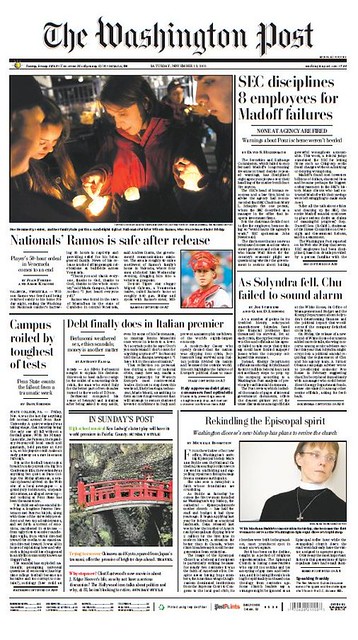
Interesting that four of the six articles on the front page of today's Post are about institutional failure:

-- the Securities and Exchange Commission and Bernie Madoff's Ponzi scheme--the agency reprimanded 8 but didn't fire anyone

-- Penn State University over the sex abuse scandal involving football coach Jerry Sandusky--in all likelihood, the campus police department's investigation of Sandusky in the late 1990s, and their failure to report the results to the local police department puts the university at risk for tens of millions of dollars of civil damages

-- the US Dept. of Energy's failure to keep other agencies and stakeholders in the loop about Solyndra and its failure

-- Italy's premier, Silvio Berlusconi, is finally leaving office as a result of the present debt crisis.
Washington Post front page, 11/12/2011

Labels: , , , , , ,

Saturday, January 29, 2011

"Learning" the wrong lesson is always dangerous and contributes to failure

20+ years ago I worked for the Center for Science for the Public Interest on publishing and communications. One of the first projects I worked on was the compilation and publication of a short booklet on the presence of a potential carcinogen in alcoholic beverages, and promoted it through a press release and subsequent press mentions. We sold a few thousand copies, which was pretty good.

While I thought of the publication as a policy document, about what FDA and BATF weren't doing, comparing them to the actions of the Canadian health authorities, etc., the report also had a list of various alcoholic beverages and the test results, for maybe 1,000+ items (I don't remember the number).

The reality is that the booklet sold as a kind of "self-help" report. People didn't care about the policy. They wanted to know if alcoholic beverages that they bought contained the potential carcinogen.

I had to learn the real reason why people bought the publication, in order to better understand the market for health information, and from that experience (the point about what the report really was about in the eyes of the purchaser was made by the then newsletter editor, we were talking over the lunchroom table), I began to build a framework for understanding CSPI's position in niche publishing.

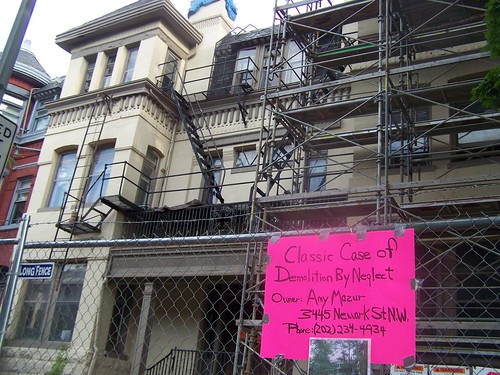
2. Similarly, a little more than one year ago, I ran into a fairly well known older politico type (an unsuccessful Council candidate who now has a well paying job for DC Government) and he commented about an entry I had written about a Dupont Circle historic preservation battle about a property and its "demolition by neglect."
1841 16th Street NW, Demolition by Neglect

He says, "you know why they won, don't you? I said, "you tell me." "Because they protested." (There was a protest. I don't have photos. It was covered in GGW I think.)

"No," I said. "They won because it's a designated neighborhood, so they have legal protections in place, so that when they protested, there were remedies and actions that could be taken to get them the result that they want." I then countered with an example in the Eckington neighborhood, where an 1880s (?) farmhouse had been demolished, when it too could have been rehabilitated, had the legal requirements been in place.

People don't seem to understand that when the law backs you, you can win. When it doesn't, it's very difficult to succeed, especially when your opponents are well financed.

3. This is relevant because of the Walmart issue. A lot of people think they can protest and through the "will of the people" (e.g., "we shall overcome") that Walmart can be vanquished, especially because this week, Walmart backed down on their plans to build a store on a Civil War battlefield (see "Wal-Mart drops Orange County battlefield store plans" and "Battlefield Walmart issue heads to court" from the Richmond Times-Dispatch).

I patiently tried to explain that this was a zoning issue. That people with standing (residents within a certain distance, with the support of the National Trust for Historic Preservation) sued the County to overturn the decision, based on the argument that the decisionmaking process was faulty. Note that the group didn't oppose Walmart generally, just their plans for that particular site.

As the case went to trial, Walmart backed down, and withdrew their plans for the site. From the first article:

"We just felt it was the right thing to do," said William C. Wertz, a spokesman for the Arkansas retailer. He said the company would seek another location in Orange County and compensate the county for its expenses in defending its decision to approve the store.

An industry analyst said Wal-Mart's decision was based on "practical business reasons" and harks back to founder Sam Walton's credo that Wal-Mart should never build a store where it isn't wanted.

Burt P. Flickinger III of Strategic Resource Group said it is rare for Wal-Mart to back away from a store once it has researched a location and settled on a site. But they may have wanted to avoid a continuing public relations hit at a time of disappointing sales and increased competition. "To the company's credit they decided to do something different," said Flickinger, who said he is a Wal-Mart shareholder.


Some people say again, it's because of the will of the people.

I think instead that the opponents had a good case, and rather than lose in court, especially because people weren't opposing Walmart's presence in the county, just on that particular site, they withdrew, because Walmart doesn't want to lose public and prominent battles, because that further arms opponents elsewhere.

Again, know what is going on, and understand it, before immediately deciding that something that happened somewhere, without really understanding what happened, bolsters your position.

4. Again, another Walmart example is the recent announcement by Walmart that they will be improving the healthful aspects of their foods ("Wal-Mart Plans to Make Its House Brand Healthier" from the New York Times).

I saw some article somewhere that asked why would Walmart actually follow through and implement what they said on this issue, because Walmart is known to be under ethical on labor issues, such as the case about systematic discrimination against women ("Lawyers Warned Wal-Mart of Risks Years Before Bias Suit" from the New York Times).

I responded that the writer missed the point. Walmart doesn't make "ethical" decisions. They make "business" decisions. Walmart made a business decision to improve the nutritional quality of their foods for business reasons -- to improve their competitive position, for public relations value, to build relationships with the First Lady, to increase sales. They will follow through.

Similarly, it was a "business" decision to reduce labor costs, hence allegedly discriminatory treatment of women.

The decisions were consistent, both are decisions about how to conduct their business, nothing more, nothing less.

Labels: , , , ,

Friday, November 26, 2010

"Random Analysis Recommendations" for restructuring the WMATA board of directors

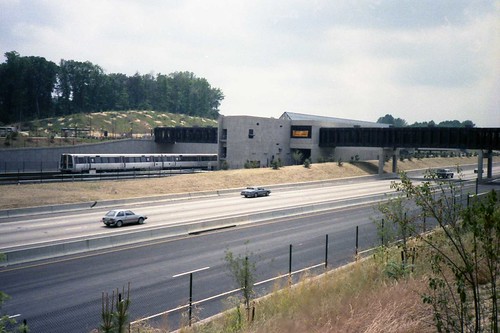
Vienna Metro
Flickr photo by Andy961 of the Vienna Metro. This end point subway station in the middle of I-66 illustrates the dilemma of transportation and land use policy in terms of compact development and a focus on core of a metropolitan region, transit versus automobility, and suburban sprawl and exurban development.

I have to admit I haven't had a chance to read the reports issued by a Council of Governments-Greater Washington Board of Trade task force ("Moving Metro Forward") or the WMATA Riders Advisory Council ("Report on Governance of WMATA") about how to restructure governance of the Washington Metropolitan Area Transit Authority (WMATA). All I know about these reports so far is what I read in the newspapers or blogs, and a comment by Jasper in the GGW blog entry "Govs, Gray hastily jump on BOT's WMATA bandwagon sums up my lack of being impressed by the proposals. Jasper said:

David, you tend to have good ideas, but these RARs (Random Acronym Recommendations) are useless because they do not address the real problem of the WMATA leadership: Lack of competence. As long as you can't demand competence from the leadership, WMATA will reflect that.

I'm taking a little liberty with Jasper's quote, changing the word acronym to analysis, because from what I read, I found the analyses wanting, even if they make some good points (but yes I will try to get to the reports).

Background

This cross-jurisdictional board is comprised of representatives from Maryland, Virginia, and DC, and now the Federal Government as well although this is a new development. In DC the board members are appointed by the Mayor and the DC City Council. In Maryland and Virginia they are appointed in various ways, but typically the representatives come from Fairfax County, the City of Alexandria, Arlington County, Montgomery County, and Prince George's County.

There are two representatives for each seat, one is the designated voting representative and the other is an alternate. Typically, the voting representative is very active, and it can be hit or miss for the alternate. Some of the representatives are particularly good. Some suck.

All of the representatives serve on the Board of Directors in addition to whatever other career and civic responsibilities they have.

Why do the powers-that-be care?

Because of the complaints that the WMATA board tends to be very micro-managerial and because of the massive risk management oversight failures that resulted in the horrific accident that killed 9 people in June 2009, the quality and focus of the board of directors has become a significant issue. The National Transportation Safety Board report on the accident had a lot to say about the quality of board leadership.

Plus, the legislative branch appointees tend to be the dominant members of the WMATA board, and that doesn't always sit well with business interests and the executive branches of the respective governments, especially these days, Governor McDonnell of Virginia. Many stakeholders see the Task Force initiative as a way to diminish the role of elected local representatives, who theoretically are more responsive to the concerns of actual users of the system.

Board of directors issues generally

I am no expert in the organization of boards of directors (although I sit on a couple boards currently, and have in the past as well), but this has been a big issue with regard to for profit corporations for more than one decade, and there has been a great deal of federal legislation (e.g. Sarbanes-Oxley Act of 2002) enacted, to bring about a more engaged board for public corporations, in response to massive corporate failures and financial fraud.

There are similar issues with nonprofit boards (do a google search on David Wilmot for example, or DC's United Planning Organization), although typically nonprofit board members are not compensated, and for profit board members are compensated.

Some people argue wrt the WMATA board that most boards aren't all that engaged anyway, especially nonprofit boards, and why should they be any different.

Given that WMATA has an annual budget close to $2 billion and serves hundreds of thousands of people every day and has thousands of employees, this is a pretty ridiculous statement.

Major recommendations of the COG-GWBOT Task Force

1. Create an over board over the WMATA board currently comprised of locally appointed officials, with appointments made by the Governor of Virginia, the Governor of Maryland, and the Mayor of Washington, DC, the chief elected executive officials of each of these respective governments.

2. Have the Chair of the WMATA board be more knowledgeable and not a somewhat honorific position that turns over every year.

I don't care one way or the other about the second recommendation and the first avoids acknowledging the fact that the Governors of Maryland and Virginia and the Mayor of DC can (and often) make bad appointments too, not to mention how the quality and outlook of these positions can vary considerably depending on which party is in office, and their perspective on transit vs. automobility.

An alternative set of recommendations, hopefully not too random

Background

Metropolitan areas typically conduct transportation policy and/or operations at five or so levels:

- Metropolitan planning organization designated by the Federal government to coordinate regional transportation planning (in the DC region this is the Transportation Policy Board of the Metropolitan Washington Council of Governments)

- this organization works with the state department of transportation (and thereby the U.S. Department of Transportation and other relevant federal agencies such as the Environmental Protection Agency), and in cases where the MPO crosses state lines, with multiple states (the DC region is not atypical in having the MPO operate across state lines) and other designated transportation districts (such as the Northern Virginia Transportation Commission)

- the metropolitan transit authority or authorities -- in the Washington Metropolitan Area, it's not just WMATA, but also the Virginia Railway Express and Maryland Commuter Railroad which function on this level

- jurisdiction based transportation and land use planning agencies

- jurisdiction based transit operations

My presentation Metropolitan Transit Planning: Towards a Hierarchical and Conceptual Framework doesn't discuss all this, merely the need to differentiate between transportation planning and transit planning and operations, but at the same time integrate transportation and transit planning in ways better than we do now.

Ideal recommendation

That the Transportation Policy Board become the overarching transportation policy and operations entity for the region, incorporating the WMATA Board.

This isn't that crazy. In some jurisdictions, such as Minneapolis, the transit authority is operated by the MPO, although this is typically the case for smaller regions, not those with large center cities.

But the problem with this recommendation is that these boards are still made up of elected officials and some volunteers, leading to all the same problems we have now with intermittent oversight and more parochial and less regionally oriented perspectives.

"Practical" recommendations

Hopefully, these aren't any more "random" than the recommendations of the other groups.

1. Don't create the over-board.

2. Create the position of "lead directors" to professionalize the board, similar to how corporate boards have created similar positions.


3. Make these positions full-time and paid.

4. Further expand the board with a voting representative and an alternate representative appointed by the Governor of Maryland, the Governor of Virginia. And designate the voting representative as the lead director for these respective jurisdictions.

5. Have the Mayor of DC and the Federal Government convert their voting representative appointment to that of the lead director.

This will create four "lead directors" (maybe that's too many but each jurisdiction needs this level of professional leadership given the importance of transit to the region's economic health and quality of life).

6. Each jurisdiction should provide additional financial and technical support (from planning and transportation departments), as should WMATA and the MPO to the WMATA board generally and to the lead directors specifically.

7. Consider adding three additional board members, who are elected by the public, one director each for Maryland, DC, and Virginia. These positions could be full time paid positions too, functioning in part as ombudspeople for riders and stakeholders, but also as transportation planning and transit advocates.

By making these directly elected positions also full time positions, they become a form of lead directors as well, giving the riders a more direct representation than exists currently. These positions too should be provided technical and support infrastructure as well.

Labels: , , , , ,