Rebuilding Place in the Urban Space

"A community’s physical form, rather than its land uses, is its most intrinsic and enduring characteristic." [Katz, EPA] This blog focuses on place and placemaking and all that makes it work--historic preservation, urban design, transportation, asset-based community development, arts & cultural development, commercial district revitalization, tourism & destination development, and quality of life advocacy--along with doses of civic engagement and good governance watchdogging.

Wednesday, February 26, 2025

A sad day for the Washington Post and Washington DC

As Jeff Bezos, owner of Amazon and of the Washington Post, announces the op-ed pages will shift to coverage on "freedom of markets" and "personal liberties"   ("Post owner Bezos announces shift in opinions section," Post, "Washington Post opinion editor departs as Bezos pushes to promote ‘personal liberties and free markets’," Guardian).

While I think it'll likely be "Wall Street Journal-lite"), it is a sad diminishment of the range of opinions offered by the paper.  It's not like I can read George Will or his politically leaning colleagues because of their arguments, but I never minded that they took up space on the pages.

With all the talk about disinformation and misinformation and the need for reliable sources of information, it's sad that the Post is throwing in with this dis- and mis-informatives, as an under-information or incomplete-information provider.  

It's not that you can't write about personal liberties and freedom of markets.  But you're telling an incomplete story if you avoid discussion of real discrimination, minoritarian rule, etc., as well as the need for regulation of markets to reduce the chance for overreach and economic collapse.

It's a long way from what the Graham Family thought were the strengths of Bezos digital knowledge in a future that was and is very uncertain for newspapers ("A Newspaper, and a Legacy, Reordered," New York Times).

From the Washington Post article, "The sale of The Washington Post: How the unthinkable choice became the clear path:"

Washington Post publisher Katharine Weymouth presented her uncle, company chief executive Donald E. Graham, with a once-unthinkable choice at a lunch meeting at downtown Washington's Bombay Club late last year. The paper was facing the like­lihood of a seventh straight year of declines in revenue, with one preliminary budget estimate showing the possibility of $40 million in losses for 2013. And despite years of heavy investment in new digital offerings, there was little sign that robust profits were about to return, she reported.

That left three choices, Weymouth told Graham. The family could continue presiding over the gradual decline of the newspaper they loved. They could move more aggressively to cut the paper’s staff more deeply than ever, hoping that they could return The Post to sustained profitability by sacrificing its longtime excellence.

Or they could sell, cutting ties to one of America’s iconic news organizations after four generations of family control in the hopes that The Post could thrive again under a new, deep-pocketed, civic-minded owner.

... Several factors allowed the deal to come together with relative speed. They included a long-standing friendship between Bezos and Graham, 68, an executive steeped in traditional newspaper publishing who had become a respected elder for a newer generation of tech magnates. Bezos was among the most successful of those, and the two men had on several occasions traded insights on their businesses.

“The Post is his baby,” Weymouth said of Graham. “He was not going to give his baby to anybody who he thought would not care for it properly.”

Looks like the baby got sold to a serial killer ("Post endorsement controversy sparks staff resignations, protests ," The Hill).

Then again, significant change was predicted, it just took 11 years to see how bad it could be ("No Change? Jeff Bezos Will Turn the Washington Post Upside Down," MediaShift).  First on the list, although actually much later:

So what can we expect to change within the next five years and why? Here are some reasonable assumptions:

The editorial policies, the coverage and the content will reflect the interests and ideologies of the owner. For the U.S. government’s hometown newspaper, that’s something to really be aware of.

Labels: , , , , ,

Thursday, January 11, 2024

Bad mapping: WMATA Metrorail weekend closures

 Via a Reddit post.


The legend doesn't explain the ongoing closure between Clarendon and Farragut West, or the temporary closure between Forest Glen, Silver Spring, and Takoma and on the Red Line.

It explains it in text on the webpage, but not the map.

Blue, Orange, and Silver Line Construction Friday, Jan. 12 - Monday, Jan. 15 *MDOT MTA Purple Line construction to impact Red Line service Saturday and Sunday only, Jan. 13-14, with no service between Forest Glen and Takoma. Silver Spring Station will be closed with free shuttle buses provided.

This stuff is on my mind because I've been working ongoing in part (not as a designer) on a map signage project for Sugar House Park, and clear, explanatory language and legend on the map (sign) has been a big issue.  

More difficult and a much longer process since we are all volunteers, although we started with a basic sign template based on the Salt Lake City Parks, Open Space, and Trail Signage Guidelines, which are quite good (not perfect, but quite good). 

It also shows the value of digital signage, which can be updated with messages and map changes in real time.  

Like what the NYC Subway is doing. with digital signs both on platforms and outside of the stations.

Labels: , , , , ,

Tuesday, March 20, 2018

Union Station master planning public meeting this Thursday (and an example of digital information kiosks delivering public meeting notices and related information)

I've seen ads in the Express for this upcoming meeting, Thursday 3/22 at 4pm.

-- Union Station Expansion Planning Project, Federal Railroad Administration

I did submit comments in the last go around. This piece referenced best practice station planning resources ("DC Union Station EIS FRA -- Comments due November 9th") and suggested leveraging  the federal ownership of Union Station and making it a North American flagship in terms of integrating sustainable modes into the station, and "undergrounding" off from the plaza in front of the station the various car pick up and drop off services, and some surface transit.

It will be interesting to see whether or not these ideas made it into the next stage of the planning process.

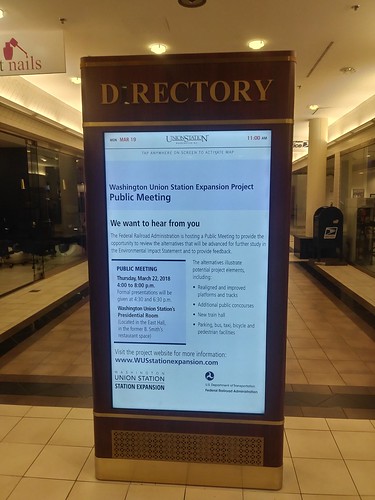
Public notice of Union Station Master Planning meeting, on ad kiosk at Union Station
I was surprised yesterday to see a public notice for the meeting displayed on the advertising-directory kiosks in Union Station.

It's a perfect example of what I argue for in the creation of a "public events and programs" advertising stream to be embedded within public kiosk systems. 

Below is a reprint of the section from the Silver Spring pieces ("PL #5: Creating a Silver Spring "Sustainable Mobility District" | Part 3: Program items 10-18," where I outline how such a system could work.

Create a digital community and transit information network [for Silver Spring,] employing kiosks and mobile applications.  For at least 15 years, I've been thinking about how to create and deliver a city- (county-) wide digital nonprofit and cultural communications feed, with sub-feeds for neighborhoods/districts.

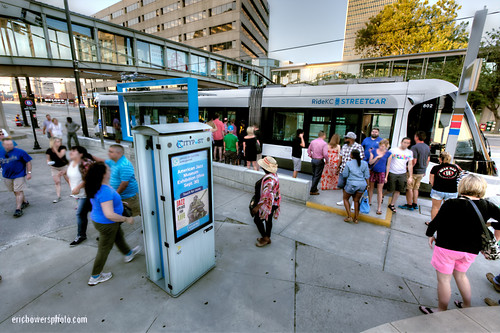
Now, with real-time transit information feeds like TransitScreen, you can use them as the engine but add other feeds to the engine.  That's how the digital information kiosks work (called CityPost, produced by Smart City Media) alongside the Kansas City Streetcar.

From the Digital Signage Today article "Meridian deploys outdoor interactive kiosks in Kansas City" :
The interactive kiosks, located at Kansas City Streetcar platforms and throughout downtown, enable travelers to check the arrival time of the next streetcar, offer Kansas City locals and tourists access to city services, and display information about local restaurants, activities and events...

Kiosk users can sync their smartphones to the kiosk with a mobile app to save and share information. For example, Kansas City Streetcar travelers might see an ad for dinner at a local restaurant. They are then able to pull that information onto their mobile device to access again at their convenience.
There is also the LinkNYC program, delivered by Civiq Smartscapes, but these systems tend to be more focused on delivering advertising rather than useful community-specific information.  I have similar concerns about a program done separately by the New York MTA transit agencies, with placement of kiosks on station platforms.

The feed would be multi-stream instead of a single advertising feed or a single transit information feed. 

Take (1) the digital ad feed presented in bus shelters and transit stations; (2) add transit and mobility information like the TransitScreen application; and (3) create and deliver a separate "community information feed" promoting  nonprofit and public sector organization, events, public meeting notices, etc.  (Note that Outfront Media is doing (1) and (2) on screens in Metrorail stations.)

There is great need for systematically delivering community information in public and visible ways in many places, because community media outlets are going out of business because of how the Internet has changed the business of media and advertising.

In fact, Montgomery County does a form of delivering community information digitally at the Silver Spring Civic Center, where they have two digital screens side-by-side behind the information desk.  One presents the TransitScreen info, and the other cycles through "ads" for Montgomery County Government agencies and services, and community events.   

The idea is to create content in a way that works at two scales: (1) a city or county; and (2) at the sub-city/county scale, by neighborhood/ transit district.

The stream would be device independent, so that it could be displayed on screens and kiosks as well as received on a digital feed.  Besides delivering this digital network in kiosks at transit stations and key "crossroads," in bus shelters, and civic buildings and sites, ideally, places like coffee shops, office and apartment buildings, etc., would put up screens and "subscribe" to the feed as a service to their customers/tenants--many do this with transit information already.

As another example, recently I came across the Pitt Smart Living Project, but it seems to focus only on delivering area-specific transit information.

-- Pitt Smart Living Project TransitScreen for Sennott Square

To create and deliver the community ads and event content, I'd set up an "advertising and design curriculum" as part of the School of Art and Design at Montgomery College, perhaps with the involvement of the journalism program of Montgomery-Blair High School, which very actively markets its Silver Chips student newspaper to the community beyond the school. 

A way to extend the community and educational value of the program would be to create an equivalent of the teen graphic design program of Boston's Artists for HumanityArts on the Block, based in Kensington, could participate too.    The firm handling advertising in Montgomery County's bus shelters would be another partner.

Currently the MC Media Arts & Technology program is located at the Rockville campus, but in keeping with the presence of Discovery Channel in Silver Spring, perhaps this academic program could shift to the Silver Spring campus.

-- Smart City Media video showing the program in Kansas City

An issue is whether or not to include "for profit" ads.  I would in part to defray costs, but outside of bus shelters, perhaps ads should be limited to businesses based in Silver Spring, potentially the Silver Spring retail trade area (which includes parts of DC and arguably, part of Prince George's County), and Montgomery County outside of Silver Spring.

Labels: , , , , , , ,

Monday, July 10, 2017

Bicycling information systems for bikeways

I've written about ideas to create community information networks--digital (see item #10, here, "PL #5: Creating a Silver Spring "Sustainable Mobility District" | Part 3: Program items 10-18 ) and analog--at the city and sub-city scale.

And I've suggested that bicycle route signage use branding and identity systems (see also the Better Bikeways signage project by Joseph Prichard and "Greater Knoxville Greenway signage project"), including map signage and signs with URLs/contact information for bikeway planning.

Dealing currently with the creation of cycletrack infrastructure in the Greater Takoma area because I sit on the neighborhood "Public Works and Infrastructure" Committee, I have been thinking about incorporating (1) community information boards; (2) murals; and (3) underpass lighting as part of the planning and construction process. 

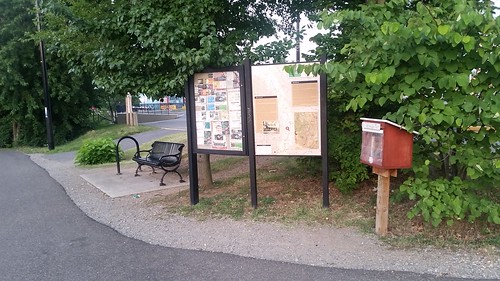
There is a community information board (and a Little Free Library) at the Rhode Island Metrorail Station "trailhead" on the Metropolitan Branch Trail, and a neighborhood association occasionally posts yard sign meeting notices at the R Street "trailhead," but these are exceptions.
Map sign, bulletin board and Little Free Library at the Rhode Island Avenue pedestrian bridge trailhead, Metropolitan Branch Trail
I think this is the only bulletin board placed on a DC bike trail.

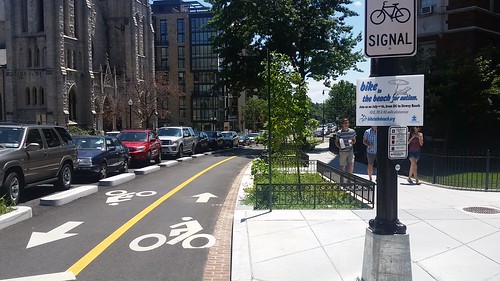
This weekend I noticed that the "Bike to the Beach" fundraising event posted signs promoting the event on various trails and cycletracks throughout the city.  I thought that was pretty smart, a well-targeted way to reach potential participants.

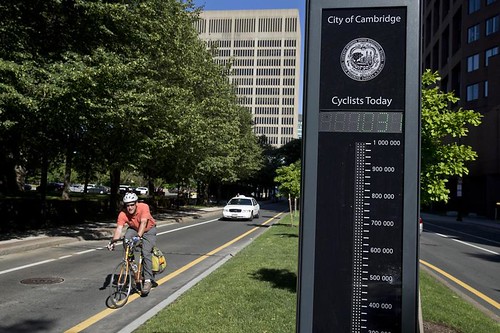
It reinforced the idea of the need for more systematic delivery of cycling-related information along bikeways, besides counters, and maybe digital information systems can be integrated into bike counter kiosks as one method.

A feed could be created as part of local and metropolitan bicycle planning, besides government agencies, it could include info from bicycle organizations and publications like the regional Spokes Magazine for the bicycling community, even ads (to help fund it).

15th Street Cycletrack between V and W Streets
15th Street Cycletrack between V and W Streets NW

Kansas City Streetcar Stop with Smart City Post Kiosks
Kansas City Streetcar Stop with Smart City Post Kiosks.  Flickr photo by Eric Bowers.

Bicycle counter, Cambridge, Massachusetts
Bicycle counter, Broadway Street, Cambridge, Massachusetts.  Photo by Michael Lee, Boston Globe.  Why not make this a kiosk incorporating biking related notices and information?

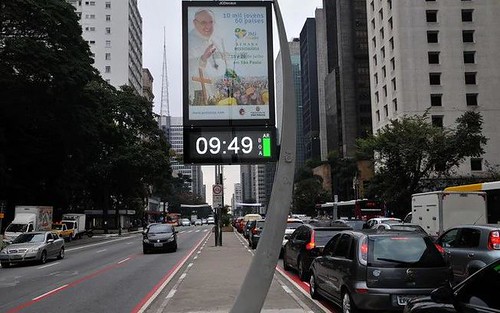
I noticed from images that on a cycletrack in Sao Paulo they have digital advertising kiosks.
Digital ad signage on Avenida Paulist ciclovia/cycletrack, Sao Paulo
Digital ad signage on Avenida Paulist ciclovia/cycletrack, Sao Paulo.

Labels: , , , ,