Rebuilding Place in the Urban Space

"A community’s physical form, rather than its land uses, is its most intrinsic and enduring characteristic." [Katz, EPA] This blog focuses on place and placemaking and all that makes it work--historic preservation, urban design, transportation, asset-based community development, arts & cultural development, commercial district revitalization, tourism & destination development, and quality of life advocacy--along with doses of civic engagement and good governance watchdogging.

Tuesday, August 12, 2025

Urban unrest (riots versus uprising), Watts anniversary

A couple weeks ago, PBS World Channel repeated an episode, "The Riot Report," from the PBS American Experience documentary series, about the Watts riots in 1965 (I learned about them when I was 12ish, reading the fiction book, The New Centurions), urban unrest in other cities, how it led to the creation of the National Advisory Commission on Civil Disorders––informally known as the Kerner Commission, after the chair Otto Kerner, Governor of Illinois, but that politicians, including President Johnson, weren't prepared to act on the recommendations, which were published in book form (I think I have a copy somewhere).

In this Aug. 12, 1965 file photo, demonstrators push against a police car after rioting erupted in the Watts district of Los Angeles. It began with a routine traffic stop 50 years ago this month, blossomed into a protest with the help of a rumor and escalated into the deadliest and most destructive riot Los Angeles had seen. The Watts riot broke out Aug. 11, 1965 and raged for most of a week. When the smoke cleared, 34 people were dead, more than a 1,000 were injured and some 600 buildings were damaged.(AP Photo)

I hadn't realized that their rebroadcast inadvertently presaged the 60th anniversary of the Watts riots, the first major urban riot after WW2 (if you don't count other civil rights battles as riots, which were often started by those opposed to civil rights).  Riots in Newark and Detroit followed, and many many more in 1968.

A number of buildings are left gutted and smoldering after being set afire during Los Angeles' six day riot in August 1965. Damages from looting and fires were estimated at $100 million, with hardly a store in the Watts area left untouched and whole blocks of buildings gutted to their foundations.

Ironically, the report was issued in late 1967, about five months before the assassination of Martin Luther King, Jr., which sparked rioting all over the country.  It's also ironic that Trump federalized the DC police department this week.

-- pdf version of the Kerner Commission Report

Late last year a book was published, positioned as an update of the Kerner Report, Creating Justice in a Multiracial Democracy New Will for Evidence-Based Policies That Work.  

It's all the more relevant given how the Christian/White National policy of the Trump Administration ("White Christian nationalists are poised to remake America in their image during Trump’s second term, author says," CNN) sweeps aside policies and funding for programs to alleviate poverty and to address the inequity that derives from racism ("With anti-DEI and ESG battles, Trump is waging war against freedom," The Hill).

There's been press coverage of the anniversary (""Watts Rebellion" 60th anniversary renews call for Kerner Report plan to fight poverty," Axios, "Watts riots, 60 years later: See National Guard’s response to LA chaos," USA Today, "Watts: 60 years after riots, challenges persist, but this South LA community marches on," Los Angeles Daily News).

Note that in talking about this issue, with people who participated in the 1968 riots, which destroyed thriving retail corridors like H Street NE, where I ended up living when I first moved to Washington in 1987, they didn't see them so much as what are referred to criminally as "riots," but as an "uprising" or "rebellion," still attacking and challenging the state, but with legitimate grievances.  From the LA Times:

For a moment there was even the temptation to make my own dash into one of the burning stores. But that quickly passed. One of my friends kept repeating with his face contorted with anger: “Maybe now they’ll see how rotten they treat us.” In that bitter moment, he said what countless other Black people felt as the flames and the smoke swirled.

The Watts article in the LADN is a retrospective, and identifies needs today that have existed for a long time.

800 block of H Street NE burning during the 1968 riots'. Joe Silberman, Washington Star.

Note that in talking about this issue, with people who participated in the 1968 riots, which destroyed thriving retail corridors like H Street NE, where I ended up living when I first moved to Washington in 1987, they didn't see them so much as what are referred to criminally as "riots," but as an "uprising," still attacking the state, but with legitimate grievances.

The Watts article in the LADN is a retrospective, and identifies needs today that have existed for a long time.

My lesson is that few places have the financial capital to be able to recover from a riot, it's like a natural disaster.  That was based on the forlorn nature of H Street, in 1987, roughly 20 years after, and in 2001, more than 30 years after it was still grim--despite being in the National Capital. 

In Watts too redevelopment languishes, " L.A. bought land in Watts and promised jobs. Now, it’s weeds and shanties' here,"  "Six decades after the Watts riots, too little has changed," LA Times, "Researchers, nonprofits working in Watts, South Central reflect on the region 60 years after riots," LADN).  From the second LA Times article:

... [the burning streets are] impossible to forget for another reason. Exactly six decades later, some of those streets look as if time has stood still. They are dotted with the same fast-food restaurants, beauty shops, liquor stores and mom-and-pop grocery stores. The main street near the block I lived on then is just as unkempt, pothole-ridden and trash littered now as it ever was. All the homes and stores in the area are hermetically sealed with iron bars, security gates and burglar alarms.

A special officer looks over the damage to a surplus store in the Watts area on Aug. 13, 1965, following the second night of rioting in the Watts district of Los Angeles. At dawn 900 officers armed with automatic weapons scattered the crowds. Bettmann Archive Via Getty Images 

In taking a hard look at what has changed in Watts — and all of America’s neighborhoods like Watts — since the riots, the picture is not flattering. According to Data USA, Watts still has the runaway highest poverty rate in L.A. County. Nearly one-third of the households are far below the official poverty level. It has the highest jobless rate. It is still plagued by the same paucity of retail stores, healthcare services, chronically low educational test scores and high dropout rates.

The only reason H Street NE finally did is the post-2000 recovery of interest in urban living, and its proximity to Downtown, Capitol Hill, and transportation assets.  We capitalized on that, when a group of us--good timing--organized a commercial district revitalization initiative.  

There have been ups and downs, and I'd say it's down somewhat now ("Progress, remembrance in Washington’s H Street Corridor," Washington Post), because of competition from other commercial districts elsewhere in the city, covid, and not as great subway access--which was addressed through venture capital subsidized trips on ride hailing vehicles--Uber and Lyft ("H Street NE nightlife district, failing?," "A follow up on the H Street article: Learning from Philadelphia | More sophisticated daypart, retail, cultural, and experience planning"), which has since dried up.

OTOH, since the 2000s, Greater H Street has experienced more than $1 billion in new development, which I see as an overall win ("DC makes yet another bad decision about streetcars: will replace the one line with a so called "fancy" bus | The Vision Thing" [2025]).

Brenda Hackett-Hall, 75, has lived in Watts since about age 2. She recalls the store her mother worked at got looted during the 1965 Watts Riots. Although she trusts the police, many in her community still do not, she says. (Photo by Linh Tat/Southern California Newspapers Group)

WRT crime, a somewhat different issue, in Uneasy Peace, Patrick Sharkey attributes a good deal of the 2000s era crime drop to community organizing and the creation of community organizations.  I think that's a part of it.  But it's not enough to have community organizations to turn around a riot corridor ("Watts after 50 years: ‘Still here. Not done’," LADN, from 2015).

You need capital + people's willingness to live there.

A Minneapolis liquor store going up in flames on May 28, three days after George Floyd’s death in police custody. Kerem Yucel/AFP.  The lot, at a major intersection, is still vacant 5 years later.

I think the destruction of Lake Street in Minneapolis after the George Floyd unrest, will be hard to recover from ("Red tape, rising costs slow efforts to rebuild businesses burned after Floyd’s murder," Minnesota Public Radio).

I think H Street and 14th Street NW in DC are rare examples of substantive post-riot revitalization.

Labels: , , ,

Saturday, August 02, 2025

Despite what Trump and Fox News says, cities are pretty good places to live

 About Seattle, "A Seattle visitor’s guide:  Riots, bad drivers, the big dark and overrated Dick’s burgers. Locals and experts tell the truth,." Seattle Times.

Josh Cruz, 38, head of marketing for a small software company, moved here from St. Petersburg, Fla., with his partner. Cruz belonged to a group of fans of the Tampa Bay Lightning hockey team. “One of the first literal responses I got from a conservative colleague was, ‘What are you gonna do there? Join antifa?’

“I took it to mean he watched too much Fox News,” Cruz says about his fellow hockey fan. He says his mom also asked about the protests that were portrayed as riots. “I told her the news focuses on one group of three people as the night ended, (who) did one stupid thing,” he says.

... Jeff Asher, co-founder of the firm, says, “From a crime perspective, Seattle is just like any major city. If crime is your main concern, then you shouldn’t be visiting any major American city.”

Friends and neighbors were in Portland recently it's fine, which is probably why housing prices are high ("Buying a Home in Portland Is More Expensive Than You Think") Wall Street Journal).

High demand for housing in Forest Hill Queens ("Home Buyers Are Paying Millions to Experience the ‘Fairy Tale’ of Forest Hills," Wall Street Journal).

SF isn't a cesspool.

Trump and his LA military incursions were a way to satisfy his base ("Newsom Slams Trump For ‘Brazen Abuse of Power’ as L.A. Mayor Imposes Curfew," New York Times), not based on reality ("Trump wants to 'liberate' Los Angeles, residents say 'no thanks'," Reuters), and the National Guard and Marine troops he sent there have left ("More than 1,000 National Guard troops leaving L.A. Newsom says Trump’s ‘political theater backfired’," Los Angeles Times), "Marines Will Begin Withdrawing From Los Angeles," New York Times).  

The "rioting" was limited to a couple blocks of demonstrations, with riot police and Trump's federal police and troops escalating the situation.

Although yes, Seattle, SF and Portland reached progressive overreach in the early 2020s, and the electorate dialed back, voting a bit more to the center than to the left.  This is particularly evident in Seattle.

In SF, a Levi Strauss heir connected to the business community won the mayoralty.  And the super progressive prosecutor was recalled out as crime climbed.

OTOH, also in Boston, the Downtown housing market is stagnant ("As housing prices in Mass. soar, they’ve remained stagnant in downtown Boston. Here’s what that means for the city").

It's so obvious on article comments that are negative on particular cities that the writer has no real experience with cities.  The same with Fox News and of course Trump ("‘Cesspools,’ ‘Hellholes’ and ‘Beautiful Places’: How Trump Describes the U.S.," New York Times, "Trump keeps brutalizing immigrants because he's failing at everything else," USA Today), "The politics of fear," New Yorker).

Fox trumps up crime in cities before elections especially and it probably had an effect in increasing the number of Republican House members from New York State ("Crime coverage on Fox News halved once US midterms were over," Guardian).


=====

In Boston's election for mayor, Josh Kraft, of the New England Patriots and a conservative, is running, figuring he had a chance like Daniel Lurie in SF.  His polling is terrible ("Can the Josh Kraft campaign be saved?," Boston Globe).

Labels: , , , , , , ,

Sunday, May 31, 2020

Fire I'll take you to burn (from the lyric to the song "Fire" by The Crazy World of Arthur Brown, 1968)

It's ironic that the demonstrations following the death of George Floyd at the hands of police misconduct is not quite one month after the 50th anniversary of the killings of student demonstrators at the hands of National Guardsmen and/or police at Kent State and Jackson State.

-- "50th anniversary of Kent State University shootings: May 4th"


While there have been plenty of demonstrations that haven't ended in mayhem, with the rioting across the country as a part of demonstrations against the killing of George Floyd ending up in looting and myriads of property destruction in cities like Chicago, Los Angeles, Oakland, Portland, Salt Lake City, etc., it's hard to know what to think.

I understand the rage, especially the symbolism of the burning down of the Third Precinct police station in Minneapolis.

But destroying stores like Target, I don't understand. Or destroying police cars in a place like Salt Lake.  Well, I do think I understand.

From the standpoint of revolutionary practice, taking advantage of events like demonstrations to foment violence in the name of revolution is the name of the game ("An Inside Look at the Antifa Movement," NBC Bay Area).

Oakland California, May 30, 2020

Protest in Salt Lake City Over the death of George Floyd
The New Radical Chic?  Protesters climb on a flipped over police vehicle Saturday, May 30, 2020, in Salt Lake City. Thousands of people converged on downtown Salt Lake City on Saturday to protest the death of George Floyd in Minneapolis, and some demonstrators set fire to a police car and threw eggs and wrote graffiti on a police station. (AP Photo/Rick Bowmer)

Then again, there is the general rage, which builds up over time, over how policing preferences the wealthy, whites, property, capital, and rioting is at the very least, understandable ("Did The 1965 Watts Riots Change Anything?," JSTOR). From the article:
... when researchers went out and actually talked with people in the neighborhood, they found a very different story. Looking at interviews with 586 black adults who lived within the curfew zone that marked the area of the riots, Sears and Tomlinson found that 22 percent said they’d been at least somewhat involved in the unrest. Fifty-six percent said the unrest had a purpose or goal, and 58 percent expected it to have favorable effects. And, while 50 percent said their overall feeling about the riots was unfavorable, more than a quarter reported feeling favorably about them. Even among those who were unhappy that the riots happened, 75 percent described it in terms like “a shame” or “a sad thing,” while only a quarter used words suggesting blame, like “disgrace,” “unnecessary,” or “senseless.”
In Planning in the Public Domain, John Friedmann distinguishes between (1) rote work based on the maintenance of the state; (2) radical practice, which challenges convention but still respects the boundaries of government and the social contract; and (3) revolutionary practice, which challenges the boundaries of government and is willing to go beyond.
Basic Concepts, Planning in the Public Domain

There is a great essay in the Guardian, "The answer to police violence is not 'reform'. It's defunding. Here's why," by Alex Vitale, Brooklyn College professor and author of the book The End of Policing (review).

He argues that the problems with policing are systemic and structural, regardless of throwing money at change and training.  That we have criminalized many social problems and de-emphasized non-police responses, while simultaneously militarizing the police.  The book goes through ten areas of policing and he recommends that police no longer be the first responders when it comes to these matters.  From the review:
Vitale argues that policing is ‘a tool for managing deeply entrenched inequalities’ that are organised along the intersecting terrains of race, class, gender and sexuality. This convincing critique of law enforcement underpins Vitale’s view that ‘any real agenda for police reform must look to replace police with empowered communities working to solve their own problems’.The book is organised into ten chapters that look at the criminalisation of different communities, including school children, sex workers and homeless people.

In the opening chapter, ‘The Limits of Police Reform’, Vitale examines how reforming police training concerning the use of physical force ignores a deeper, ‘casual disregard’ for black lives. Police training is part of the problem, since it is highly militarised and provided by private companies that serve police and military clients. The chapter discredits the liberal assumption that a more diverse police force equals a less racist one – diversity training is pointless since racism shapes official police procedure.
The Silent Majority/White fear of unrest as a political force that favors conservative responses.  Although, like how charlie made the point that it is likely that #BlackLivesMatter and the negative response by many helped to elect Donald Trump, I fear that the current demonstrations and rioting will help to peel off white support for Joseph Biden ("Echoes of the ‘silent majority,’ 50 years after Richard Nixon’s speech," Boston Globe; "This rage isn’t just for George Floyd. It’s for every victim of the police like him.," Washington Post) and could contribute to Trump's re-election ("This is the presidency George Wallace never had," Washington Post, albeit possibly without winning the popular vote, just like last time.

This song, from 1968, keeps popping into my mind.

Labels: , , ,

Tuesday, April 28, 2015

Baltimore: riots, the coercive power of the state, and public reaction

Washington Post graphic showing locations of rioting in Baltimore yesterday and last night.

In 2008, on the occasion of the MLK Holiday, I wrote this:
I have been meaning to write about the Barack Obama-Hillary Clinton debacle over "it takes a president, not a village, to get things done."

The reality is that change is a process.
As I have written before in terms of the writing by John Friedmann in terms of creating radical planning discourse, government is oriented to system maintenance and a wee bit of change and innovation.
Transformation efforts, and the Civil Rights Movement was the biggest social and political transformation effort/movement in U.S. society in the past 60+ years, start from outside government, with the people. (Revolutionary movements challenge governments and the entire political system.) 
Sure, laws are only changed by elected officials, but it takes thousands, millions of individual efforts before the point of legislative and/or executive branch change within government is reached, and eventually (if ever) realized.
Riots are expressions of anger and feelings of abandonment and hopelessness.

And expressions of anger are typical when citizens are increasingly disconnected from those institutions that are supposed to be representing and hearing from them.
Riots in Baltimore
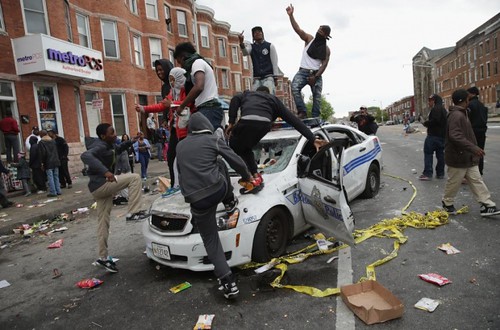
Demonstrators took over the streets. Photograph: Chip Somodevilla/Getty Images.

But while riots can push change forward--for example the Department of Justice review of the system of criminal justice and policing in response to the public outcry over the death of Michael Brown in Ferguson, Missouri led to a number of top level resignations of key officials including the police chief and city manager--in terms of "place effects," riots are hyper destructive and make urban improvement that much harder, if not impossible.

For example, on H Street NE in Washington, DC, it has taken between 40 and 45 years for the commercial district to show serious signs of recovery since the 1968 riots, which on H Street and elsewhere destroyed most of the city's independent retail businesses--which is why the state of independent retail in the city is still comparatively underdeveloped.
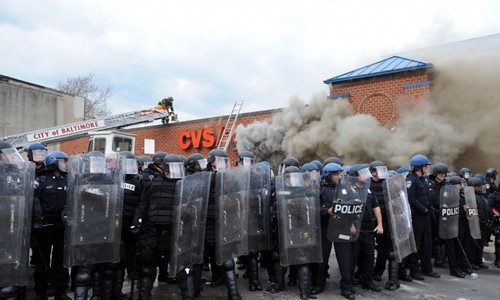
CVS burning at North and Pennsylvania Avenues, Baltimore
Looting and rioting broke out at North and Pennsylvania Avenues where a CVS was set on fire. Photograph: TNS/Landov / Barcroft Media.

But H Street NE in Washington DC is now part of a one of the strongest real estate markets in the US, while Baltimore and comparable cities still lag.  Most areas in Detroit affected by the 1967 riots have never recovered.  In fact, Pennsylvania Avenue in Baltimore has never recovered from the twin blows of the 1968 riots there, and the post-riot urban renewal process.

And often, groups can be incited to riot by people who for whatever reason, want violence to occur.

Once the spark is lit, the track of the outburst is unpredictable and unmanageable.

On the other hand, the power to use coercion and force on the behalf of the state comes with great responsibility.  Clearly, the Baltimore City police officers whose actions led to the death of Freddie Gray failed to acknowledge their responsibilities to citizens.
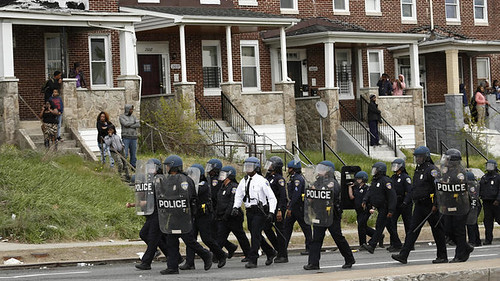
Police line marching toward protestors on Reisterstown Road, Baltimore
Drew Angerer, Getty Images.  Baltimore police officers walk in formation on Reisterstown Road near Mowdamin Mall as they advance toward protesters on April 27, 2015.

Baltimore's situation also gives me some perspective on one of the reasons that DC has more local police officers per capita than any other US city.  This doesn't even take into account the federal and other police departments that operate within DC.

DC has twice the number of local police officers than Baltimore.  But Baltimore has more poverty and is somewhat larger.

Labels: , , , , ,

Wednesday, August 17, 2011

More important pieces on the London riots

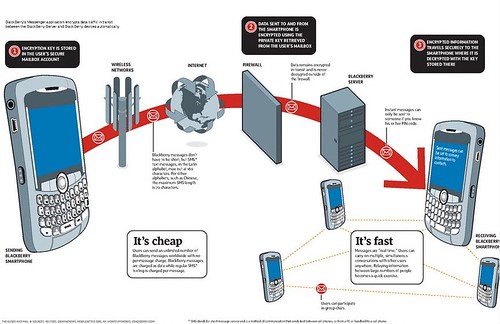
Why London rioters like to use BlackBerry smartphones
Graphic on why the Blackberry is the preferred device for sending riot organizing messages from the Toronto Globe & Mail. The messages are encrypted, and Blackberry doesn't charge a per message fee. Maybe there's still life for the Blackberry, which has been otherwise supplanted by Apple and Android smartphones. See "With BlackBerry in Decline, RIM will shed 2,000 jobs" from the New York Times.

This piece, "The moral decay of our society is as bad at the top as the bottom," is by the chief political correspondent of the conservative Daily Telegraph and it is biting about how the wealthy and corporate leaders are disconnecting themselves from Britain and from civic identity and responsibility.

"The UK riots: the psychology of looting: The shocking acts of looting may not be political, but they nevertheless say something about the beaten-down lives of the rioters" and "UK riots: This vigilantism is the very embodiment of 'big society': Folk taking to the streets with doner knives is what happens if communities are encouraged to fill in the gaps left by the state" by Zoe Williams in the Guardian.

(While I wrote about the "Tesco riot" a few months back, I missed this piece, "The Tesco riot is no surprise given people's powerlessness: Planning law is so loaded against local communities fighting supermarkets, it's amazing Bristol-style disturbances are so rare" also by Zoe Williams. It makes me think of the story in yesterday's Examiner about the Georgia Avenue Walmart.)

This article on UK riots by Dutch architectural critic Wouter VanStiphout in the UK architecture publication Building Design, "Back to normal?." From the article:

"Right now it has become very difficult to think of an urban politics, let alone an urban planning or design approach that would be able to take on the underlying problems of riots like the ones in the UK in a serious way.

"I do not think that the reason is that politics and planning have realised their limitations to shape society. I think that the reason is that urban politics and hence planning and urban design are too often treating the city with ulterior motives, instead of actually working for the city itself. The city has become a tool to achieve goals, political, cultural, economic or even environmental.

"Treating the city in this way means that we are constantly passing judgment on what the city should be, and who should be there, and what they should be doing, instead of trying to understand what the city actually is, who really lives there and what they are doing. This produces a dangerous process of idealisation, denying whole areas, whole groups their place in the urban community, because they do not fit the picture."


Other articles from Building Design on the topic are:


1. Brits like smashing stuff
2. We're too bloody soft on 'em
3. Bad parenting
4. Bad schools
5. Cuts
6. The class system, innit
7. Gang culture
8. Consumer culture
9. They have nothing to lose

-----
Note that with regard to revitalization (what in the UK they call "regeneration") I have always paid attention to the work being done in the UK because economic decay set there earlier than it has in the U.S.

With the U.S. set to take the same path as the UK on deficit reduction and the reduction of federal programs made available to the economically impoverished--and despite the whining by the conservatives, it's not like the programs available in the U.S. are that great--are the UK riots a marker, a bellweather, for the US?

Labels: , , , ,

Tuesday, August 09, 2011

What does the rioting in London (and other UK cities) mean?

(Image: Rioting in Toxteth, Liverpool, from the Guardian.)

It's too early to say. Maybe.

The conclusion from this Guardian editorial, "Urban riots: Thirty years after Brixton: Conspiracy and deprivation are just part of the story behind today's rioting, which must be understood so it can be overcome," offers food for thought:

The riots are a product of the lives which the rioters choose or feel constrained to live. Blaming the riots on individual wickedness, conspiracies or on government spending cuts is too glib for such complex issues, though they cannot be dismissed altogether even so. Both conspiracy and deprivation are part of the complex and grim story, as is the cult of violence, especially guns, and a rage against exclusion from consumerist fulfilment. A new Scarman would no longer be able to explain these riots as an outburst of resentment against the police. But they are an outburst of resentment and a mark of manifold failure all the same.

I had been mulling over writing a speculative piece about whether or not the worldwide financial crisis (see this Ezra Klein column "Double dip, or just one big economic dive?" from the Post), which is deeper than a recession (think the long period of financial decline and revival required after the Savings and Loan Debacle of the late 1980s--this period, for DC proper, lasted more than 10 years), and the possibility of a progressive response to the Tea Party in the U.S. will lead to a rise of civic activism and populism (not riots I hope).

After all, there has been organizing and demonstrating in Wisconsin and Ohio during the process of Governor-imposed restrictions on collective bargaining, and in Berkeley and other university campuses with regard to tuition increases, not to mention demonstrations in Israel ("Israeli protesters seek radical change" from AFP and "Israel protests show nation's beating heart: Protests led by the young have rekindled the spirit that built the nation," an op-ed from the LA Times), and Spain ("Spain Protest Movement Targets New Rallying Point" from Dow Jones Newswire)about the high cost of living and austerity programs, and in Germany against nuclear power ("Demonstrators in Germany Demand End of Nuclear Power" from the New York Times). Also see "May Day protests take place globally: Demonstrators in France, Greece, Turkey, Egypt, Germany and Iraq were among those protesting on a range of issues" from the Guardian.

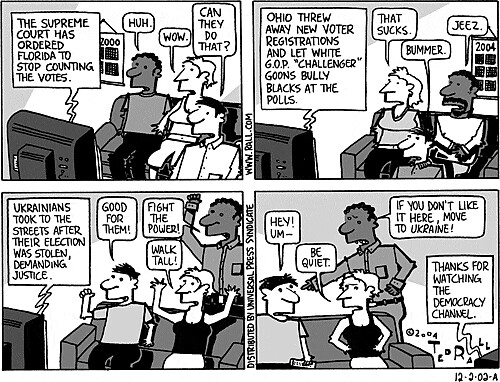
Although, as always, I am reminded of this 2004 Ted Rall editorial cartoon, and the point made by Neal Postman (Amusing Ourselves to Death: Public Discourse in the Age of Show Business) and others about media, entertainment, and an anaesthetizing effect as it relates to civic involvement.
Ted Rall editorial cartoon, 12/2/2004

Labels: , , , , , , ,