Rebuilding Place in the Urban Space

"A community’s physical form, rather than its land uses, is its most intrinsic and enduring characteristic." [Katz, EPA] This blog focuses on place and placemaking and all that makes it work--historic preservation, urban design, transportation, asset-based community development, arts & cultural development, commercial district revitalization, tourism & destination development, and quality of life advocacy--along with doses of civic engagement and good governance watchdogging.

Monday, June 03, 2013

A way for DC to begin adding yard waste collection as a separate element of waste collection and reduction programming
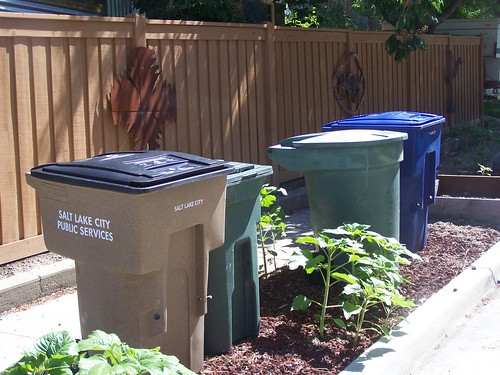
Salt Lake City's different types of trash (green), recycling (blue), and yard waste (brown) trash cans
Salt Lake City has four types of collection media for solid waste.  They collect paper, plastic, and metal in blue cans, have separate rectangular bins for glass (which only recently they started to collect), while trash is collected from green cans, and yard waste is put into the largest can size, which is colored brown.

For years, I have written that DC should separately collect yard waste, as is done in some of the neighboring jurisdictions, but we don't.

The State of Maryland sets (imposes) high waste diversion requirements on the counties, which is why they have active solid waste diversion programs.  For example, the Leafgro compost available in the region is made from leaves from Montgomery County.

Our household composts so we generate very little yard waste, but it's true that our "secondary" compost pile (certain kinds of weeds, branches) maintains its height despite the break down of the materials over time, because we constantly add to it each season, after rain storms, etc.

(In fact, since we lost one of our big trees, now I "steal" some of my neighbors collected leaves, so I have enough for the compost pile for the next year.)

In April I wrote an entry, "Waste in not using products for the normal 'useful' life: sidewalks and trash cans," where I complained that city plans to replace all of the city's trash cans don't make a lot of sense because my sense is that 90% of DC's trash cans have many years of useful life ahead of them.

But seeing the yard waste cans in Salt Lake City yesterday made me realize that a way forward on this issue in DC would be to recognize that DC is not "One City" (the tagline used by the Mayor and Executive Branch agencies), but two cities, and we could have differentiated waste collection programs (we already do in one sense) for yard waste, where we have only one program now.

Rowhouse neighborhoods at the core have different waste collection needs from the detached-housing dominated neighborhoods comprising the outer city

The "problem" with trash collection is that DC is two different cities--the rowhouse city mostly in the core and the outer city where single family detached housing predominates.  In the core of the city, households have small yards and don't have alley access.  They don't generate a lot of yard waste.
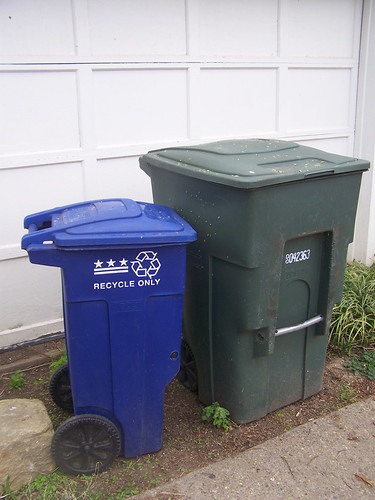
Garbage and recycling cans, DCIn the outer city (where we live), where much of the housing stock is detached with lots large enough to store bigger trash cans and most households generate lots of yard waste, which unless they compost, is put out for trash collection.

Right: trash and recycling cans in the outer city.  Note that in the core of the city, the trash cans they use are the same size as the blue recycling cans.

The city does recognize the "two cities" in trash collection policies

The city does treat the core differently from the outer city as it relates to trash collection. 

While the city's recycling cans are all the same size, the trash cans in the core are smaller than the cans in the outer city.  And in the core, they get trash collection twice each week and recycling service once/week.

This is because of the idea that there are more rodents in the core, plus the smell of trash can build up in small places, etc.

In the outer city, we have larger trash cans and once per week trash pick up.  For most of the blocks with alleys, the trash cans are "out of mind" stored on the alley side of the property.

Let's add yard waste diversion and collection programs to the outer city

Households in the outer city generate a lot of yard waste.  The city does do leaf pickup in the fall, and those leaves are composted.  But many leaves and thousands of tons of yard waste go into the regular "trash" stream, to be burned in Fairfax County for energy and DC pays for the privilege (around $30/ton of trash), because we don't have a yard waste diversion program.

In the core of the city most households don't generate a lot of yard waste, because they have minimal yards--although they still do generate some of this kind of "trash" (as well as compostable material). 

In the outer city at the very least, there should be an additional pick up strictly for yard waste, just as is done in places like Montgomery County, many communities in Prince George's County, and Salt Lake City (there the cans are bigger than our largest, and the color of the can is brown).

If we were big on innovation as a city--which for the most part we are not--it could be tested in some pilot neighborhoods rather than rolled out to the entire city in one fell swoop.

It would require a lot of "training" to get people to do it--MoCo has been doing it for years and still has an extensive outreach program as part of their division of solid waste--but it fits in with DC's new sustainability goals, would add some local jobs (more trash collection personnel, and probably some more trucks would be required, plus outreach personnel), on the other hand we would cut "landfill" costs.  Fairfax County would make less money and need to find more trash to burn but that's not our problem.

Basically, what I am saying that is instead of buying new cans when 90% of the cans are functional, let's buy some new recycling cans that are bigger and offer those to the households that need them (like my household), and let's buy a bunch of yard waste cans for a few pilot neighborhoods, and begin the process of DC shifting how it collects "trash," by instead diverting what isn't trash, in this case, "yard trim" or "yard waste" to better uses.

-- Montgomery County Yard Trim webpage
-- Montgomery County Composting program
-- Montgomery County instructions on how to compost
-- Montgomery County neighborhood mulch distribution program

Labels: , , , , ,

Friday, September 10, 2010

Book talk: The Polluters

Ben Ross is the president of Action Committee for Transit, a Montgomery County advocacy group that I give a lot of credit to for getting the Purple Line light rail program back on track--this program had basically died under the Ehrlich Administration. For the 2006 election campaign, ACT made the Purple Line a prominent issue both at the local level--offices in Montgomery County--and to some extent at the state level. With the election of Martin O'Malley as Governor (yes, there are differences between political parties), a renewed emphasis on transit occurred, promoting both the Purple Line in the DC region, and the Red Line project in the Baltimore region.

Ben's "day job" is an environmental science consultant and he has just had a book published on the topic. The book's discussion of how proponents for the status quo work their magic is applicable to other settings and issues, such as local government, transit, etc.

BOOK SIGNING & INFORMAL DISCUSSION


BOOK SIGNING & INFORMAL DISCUSSION


Thursday September 16, from 5 to 7 p.m.


CORK and FORK
1522 14th Street NW, Washington DC
(between Church and Q Streets, near Logan Circle)


THE POLLUTERS:
The Making of Our Chemically Altered Environment

By Benjamin Ross and Steven Amter


The Polluters brings to light a previously untold story of personal struggle, scientific conflict, and political intrigue over the environment. Research was slanted, unwelcome discoveries were suppressed, and political strings were pulled as the expanding chemical industry set loose a flood of environmental damage that still engulfs us.

Benjamin Ross is both environmental scientist and commentator on current affairs. He has served on committees of the National Academy of Sciences and the USEPA Science Advisory Board and writes frequently for Dissent magazine. He is also known in the Washington area as a leading transit activist.

Steven Amter is an environmental scientist at the Washington consulting firm of Disposal Safety Inc. He specializes in the history of pollution.

Labels: ,

Tuesday, August 24, 2010

2010 DC Historic Preservation Conference

Friday Sept. 24th and Saturday Sept. 25th.

More information here.

Labels: , , ,

Sunday, August 22, 2010

Primary election special: Reusable bags vs. plastic bags @ 5 cents each as both a nonissue and a whitey plot

https://blogger.googleusercontent.com/img/b/R29vZ2xl/AVvXsEgfy-WniiDC8ypyHghqsITnrGmafMFlDM0dMUqHGA_0TVRunJ0xTpHUkETKi8PsrCWudghk4Hj7nXSvUTMy9Wwv0YqulcliTSfJ1dZp3OKIAivs1u0F-80bxbIjJytPWqODup2o1A/s640/recycling-plastic-bags-plastic-waste-photo.jpg
Plastic bags at a recycling plant. Photo source unknown.

Judging by the number of people in the city I see carrying reusable bags, and using them at the drug store, carry out restaurants, supermarkets, 7-11 and other convenience stores, and other places, I tend to think that after a few months of the plastic bag 5 cent tax being in effect, that it has become a nonissue... despite Kelvin Robinson making it an issue in his campaign against Councilmember Tommy Wells in the Ward 6 Council election, according to the Washington Post's Mike DeBonis, in "n D.C.'s Ward 6, Wells's progressive agenda assailed as out of touch." I would also say that I seem to see a little bit less litter, although not supra-significantly.

(For background see "D.C. bags wasteful shopping habit with tax on paper and plastic" and "D.C. bag tax collects $150,000 in January for river cleanup" from the Post.)

Now if we could only get a bottle deposit law into effect. Talk about a race-baited campaign on environmental, evil whitey vs. poor black folk, grounds. The campaign against the bottle bill in 1988 was ugly, and the black churches and ministers mostly came on board of the anti-group, funding profusely by the beverage industry... (See the 1987 Post article, " Bottle Feud Taps Churches; Bill Opponents Said to Buy Off Congregations.")

A visionary political opponent ought to be focused on improving the environment and setting an ambitious "black" environmental agenda while doing it. Without doing that, Kelvin Robinson is stooping low rather than setting a high bar.

Also see:

- African American Environmentalist Association
- Principles of Environmental Justice

Note principle 7:

7) Environmental Justice should expand the definition of ‘environment’ and seek to redress unique inner city environmental problems.

I think that dealing with litter and a trashed river that flows through predominately African-American neighborhoods would be an issue of concern to politicians of all races...

Labels: , , ,

Tuesday, February 02, 2010

The "last word" on bag taxes...

1. The 5 cent tax on shopping bags "for food purchases" is confusing to some, see "D.C. bags wasteful shopping habit with tax on paper and plastic" from the Washington Post (also "D.C. shoppers opt for roughing it over paying 5-cent tax," as well as "Washington D.C.'s Bag Tax Frustrates Many Store Owners" from the Wall Street Journal.

But it didn't have to be confusing. It should be charged for all bags, not just for food purchases.

The point is to get us to be more environmentally conscious, because...

2. Yesterday's Baltimore Sun, in an article on recycling ("Balto. County hopes 'single-stream' will mean more recycling," reports that the Elkridge recycling processing center amalgamates 20 tons of plastic shopping bags per week.

From the article:

Waste Management Recycle America, which runs the Elkridge facility, estimates that collections jump about 30 percent in each municipality that launches single-stream recycling. Increasing the frequency of pickup, handing out recycling bins and adding new items to the list of acceptable materials also increase participation. ...

Maryland began requiring municipalities to recycle in 1988. Residents were throwing away almost 7 pounds of trash a day, enough to build a wall 3 feet wide and 6 feet tall for 4,387 miles, according to the Maryland Department of the Environment. It costs the city $67, for example, to dispose of each ton of waste. In the past four years, the state has met its waste diversion goals, reaching about 44 percent in 2008, the last year data is available, the department said. ...

And the city pays nothing, or even makes money, when it drops off material in Elkridge, depending on what Waste Management can sell it for. Prices, however, are inconsistent. They hit lows in the fall of 2008 and only began recovering in the summer, leaving little for the municipalities until this fall, said David E. Taylor, a district manager for the company. ...

And the city pays nothing, or even makes money, when it drops off material in Elkridge, depending on what Waste Management can sell it for. Prices, however, are inconsistent. They hit lows in the fall of 2008 and only began recovering in the summer, leaving little for the municipalities until this fall, said David E. Taylor, a district manager for the company.

For example, prices for aluminum, which goes to Anheuser-Busch to become new beer cans, dropped to $1,400 a ton before recovering to $2,400. Plastic bottles that go to Coca-Cola to become new bottles dropped to $100 a ton and later rose to about $900. And newspaper, which comprises 70 percent of the recycled material and becomes new newsprint, was bringing in nothing and is now commanding closer to $95 a ton.

The facility also sells 20 tons of plastic bags a week, though officials would rather residents not package material in them.

That's a lot of bags...

Labels:

Saturday, January 16, 2010

Coastal cities at risk from global warming

While I know that this issue is seemingly obvious, most people don't think about it much. Around the world, many major cities, especially the oldest cities, were built adjacent to water, because boats and ships were the primary means of transportation across long distances. Imagine the impact on cities like New York, Chicago, Detroit, Boston, New Orleans, Miami, Los Angeles, Seattle, etc., from rises in the sea level as the polar ice caps melt.

The Guardian reports, "British coastal cities threatened by rising sea 'must transform themselves': Hull and Portsmouth could be dramatically remodelled, suggests report" on one such study, Facing up to Rising Sea Levels. Retreat? Defence? Attack?, looking at the potential impact on cities in the UK. From the article:

The report, Facing up to Rising Sea Levels. Retreat? Defence? Attack?, suggests swaths of Hull and Portsmouth's city centres could be allowed to flood over the next 100 years and large parts of the populations moved out.

In a model that explores managed retreat from the coast in some areas, Hull's historic city centre would be limited to an island reached by bridges and Venetian-style water taxis, while in Portsmouth large parts of Portsea island would be given back to the sea while new "hillside living" developments would be built on densely packed hillside terraces, akin to the towns of Italy's Amalfi coast. "The scenarios we have created are extreme, but it is an extreme threat we are facing," said Ruth Reed, Riba president. "Approximately 10 million people live in flood-risk areas in England and Wales, with 2.6m properties directly at risk of flooding."

Other options include building out into rising waters using piers and platforms to create new habitable space – a strategy known as "attack". In Hull this could involve floating disused oil rigs up the Humber and reusing them for offices, homes and university buildings, while in Portsmouth two-storey piers could be built with the lower tier used for traffic and the top tier used for pedestrian space.

The DC-Maryland-Virginia region would be greatly impacted by rise in sea levels, as would all the cities and counties along the seaboard -- the Atlantic Ocean, Gulf of Mexico, Pacific Ocean, and the area around the Great Lakes in the Midwest could possibly be impacted as well.

"Climate politics" are truly local if you live close to the ocean.

Labels: ,

Sunday, January 10, 2010

Municipal taxes and fees #1

Bag Logo
From the DC Department of Environment website. DDOE press release: District’s 5-Cent Bag Fee Takes Effect January 1.

On January 1st. a shopping bag tax of 5 cents/bag went into effect in DC. Being a person big on efficiency, I have no problem with this assessment, even though sometimes I forget to bring bags with me, and of course, since so many purchases are spur of the moment, if you don't make a habit of carrying bags, you can be out 5 cents... even if I don't think necessarily that the stated purpose of the fee--to provide money to clean up the Anacostia River--has much to do with bags as plenty of discarded bags end up all over the city, and plenty of trash that isn't bags ends up in the Anacostia River.

But like with the idea of the gasoline excise tax, in how so many people believe that gasoline excise taxes cover the cost of building and maintaining the road network, while the reality is that at best 50% of the cost of roads are paid by taxes and fees (tolls, registration fees), some people believe that this unholy fee of 5 cents per bag makes it smarter to shop outside the city.

Today's Post has a letter to the editor ("All Opinions Are Local : Congrats! The bag tax has changed my behavior.") from one such deluded person, who writes:

My family and I will change our behavior by voting with our feet. We’ll go to Virginia to get our bags — and our groceries. I went tonight and was given 55 cents worth of grocery bags free of charge, and they even double-bagged my gallon of milk. I also paid $2.36 in sales tax revenue. I’m not sure that shifting sales tax revenue from the District to Virginia is what the law’s proponents had in mind, but that will be the effect in our household. Unfortunately, it will also affect D.C. businesses.

But the writer fails to take into account:

1. The opportunity cost in time to travel outside of the city to shop;
2. The variable (gasoline) and fixed (depreciation etc.) costs of using a vehicle to travel outside of the city to shop;
3. The fact that DC doesn't charge sales taxes on groceries, while Virginia charges 2.5% sales tax on groceries means that the reality is that Mr. Dierlam paid $1.81 in sales taxes to Virginia to "save" 55 cents.

Mr. Dierlam, by looking so narrowly at the bag issue, cost himself money "on principle."

I guess it's true when critics say that people too often aren't "rational actors" when it comes to economics.

For some time (I have a big efficiency kick) I have tried to bring a bag while shopping (a little tricky since a lot of my movement is done on bicycle), so while the bag tax is a bit of an imposition, it's nothing that will make me significantly change my behavior, other than to remember more often to bring a bag.

Labels: ,

Wednesday, December 30, 2009

A green paradigm shift

While he sees these changes coming to the fore next year, and I think that it is more a matter of a serious paradigm shift that will take decades to play out, with possible acceleration due to increases in the price of gasoline as well as more restricted supplies, the entry "the Green Top 10 for 2010" list, by Steve Mouzon in his Original Green blog, is provocative:

(Note that I don't see HGTV switching to being green, sustainable, and focused on historic preservation any time soon.)

1. The New City
How things will have to change in how we locate and build places in order to have sustainable communities and a sustainable society
2. The Big Convergence
How the convergence of three trends, the Economic Meltdown, Peak Oil, and Climate Change, will bring about big changes (potentially).
3. The emergence of Live-Work
4. The Return of Durability
5. The Re-coding of the city
Tthis is about making urban zoning focused on achieving an urban place where the city supports and is based upon walking, transit, and bicycling. Most zoning codes, even for cities, are focused upon the automobile and automobile-accommodating and automobile-centric development practices. I think it's definitely a long process for reshaping this. It's not just the code and zoning that has to change. It's elected officials and the real estate development industry that have to change simultaneously. They are resistant.
6. The Return of the Garden
7. The Meltdown Vacuum
The "green lining" in the economic turndown, as unsustainable practices have a better chance at being righted given new economic circumstances.
8. Gizmo Green Gets Exposed
The belief that new technologies are the solution to any and all problems.
9. The Sustainability of Preservation
10. Offshoring Reversal

Labels: , , , ,