Rebuilding Place in the Urban Space

"A community’s physical form, rather than its land uses, is its most intrinsic and enduring characteristic." [Katz, EPA] This blog focuses on place and placemaking and all that makes it work--historic preservation, urban design, transportation, asset-based community development, arts & cultural development, commercial district revitalization, tourism & destination development, and quality of life advocacy--along with doses of civic engagement and good governance watchdogging.

Thursday, June 02, 2022

Waste diversion, food waste versus yard waste composting and DC

For almost 10 years I've been writing about how DC could do a better job with waste diversion, especially yard waste--unlike all area jurisdictions, where state requirements force them to do it, DC doesn't do yard waste diversion.  Why I don't know.

According to the EPA, food waste is about 14.6% of the waste stream, and yard waste about 13.5% of the waste stream.


I've suggested that the city needs to have two different programs based on geographic, one for the outer city, where houses tend to have larger yards and generate large amounts of yard waste, and one for the core of the city, in particular the rowhouse neighborhoods, where houses with small yards tend to (but not uniformly) generate less yard waste.

-- "A way for DC to begin adding yard waste collection as a separate element of waste collection and reduction programming," 2013

In fact, as far as the core is concerned, a program could vary by block, depending on micro-local conditions, as there are plenty of blocks in rowhouse neighborhoods, especially in Capitol Hill and Columbia Heights, that generate fair amounts of yard waste. (Note that DC does some diversion of trees and branches, especially in conjunction with post-storm clean up.)

And I suggested the city could develop the program slowly, ward by ward, as it develops the capacity and expertise to do yard waste diversion.

I bring this up because WUSA-TV reports ("Public curbside composting? It could soon be a reality in DC") that the city is close to piloting to 10,000 households a program for picking up "organic" waste.  I am motivated to write this entry because according to the story:

“Making composting accessible to residents across the District is the single most meaningful step the District can take toward meeting its Zero Waste goals,” the committee report reads. “Organic waste, which includes food and yard waste, makes up roughly a third of the District’s waste stream.”

It's true, but judging on the proposed costs of the program, they aren't focusing on yard waste at all, just food waste.  From the report:

  • Opt-in mailers for all DPW-serviced households ($36,750)
  • Compost caddies for 10,000 households ($200,000)
  • Compostable bags (50 per household) ($24,000)
  • Curbside containers (5-gallon buckets) ($360,000)
  • Disposal costs ($93,600)
  • Collection costs ($3,640,000
  • Hauling costs ($37,440)
  • Ongoing education and outreach for opt-in households ($40,000)

First, more impact would be realized by yard waste diversion more generally, and rather than opening it up to the entire city as intimated by the report, pilot the program on a geographic-specific basis.

In my opinion, the most important steps the city could take wrt waste reduction ("More on zero waste practice (and DC)," 2015) would be to:

(1) institute yard waste diversion; 

(2) develop more focused waste diversion programs for other types of waste; 

(3) working with the private sector, develop recycling and waste diversion programs for multiunit housing; 

(4) expand food waste diversion programs from the current drop off program, working with community gardens, multiunit buildings, etc.; and 

(5) incorporate food waste diversion within regular yard waste programs, which is how it's done in Salt Lake City, San Francisco and other places.  But also encourage residents who are able to do on-site composting themselves.  Montgomery County, Maryland is a national leader on this, even though they have a formal yard waste collection program anyway.

This does remind me of the point I made in response to the development of a City Sustainability Plan during the Gray Administration (2011-2014).  I said the city has no chance in becoming the most sustainable city in the US by 2032 if even now, the practices that it adopts are nowhere near the best in class practices already adopted by the nation's most sustainably focused cities.

-- "Realizing all aspects of Sustainable DC," 2013

Conclusion.  In short, it seems like this pilot program won't accomplish all that much, compared to focusing on yard waste reduction first, developing geographically specific foci, targeting the outer wards initially, creating a pilot for rowhouse neighborhoods specific to their needs, and developing the yard waste diversion program in a manner where it can also handle food waste.

While simultaneously developing special waste diversion programs for multiunit housing and the encouragement of on-site composting for those households with the yard space to accommodate it, using Montgomery County's best practice as an example ("Urban/Community composting," 2014).

Labels: , , , ,

Thursday, June 28, 2018

As a bicyclist, this is why I stop to pick up glass bottle litter in the roadway

As a bicyclist, this is why I stop to pick up glass bottle litter in the roadway
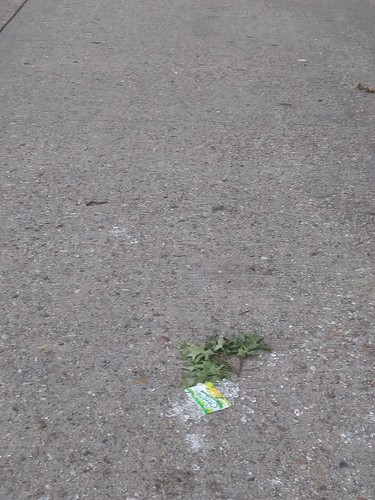
Broken glass bottle on 3rd Street NW on the interim route of the Metropolitan Branch Trail, adjacent to Fort Slocum Park.

There has been a fair amount of press coverage about the "new" phenomenon of "plogging," where runners pick up litter while they run.

-- "Plogging' Swedish fitness craze is coming to the US," Washington Post; "It's like jogging, but better for the environment. 'Plogging' has come to Miami," Miami Herald).

Mayor of DC Muriel Bowser even did a plogging event as part of Earth Day ("DPR Celebrates Earth Day with Citywide Plogging and More," DC DPR press release).

As a former runner, I can't see doing that because the frequent starts and stops would be hard on the body, and hard to recover from in terms of maintaining a decent pace and form while you run.

But I do pick up litter, recyclable bottles and cans mostly, while I bike.  Maybe there is a preponderance of litter and it looks terrible.  Or there are cans or bottles in the gutter while I am stopped at an intersection waiting for the traffic signal to change.

I tend to deposit such in residential waste recycling cans, although here and there in commercial districts there are also separate waste cans for recycling, usually painted blue, although there is a variant type in the NoMA district.

For the most part, given the number of flat tires I have experienced over the 28 years I have bicycled in DC, I almost always stop, "maintaining my pace or not," to pick up glass bottles discarded in the roadway because they will end up broken and that increases the likelihood of a flat tire for a cyclist.

… sadly, I rarely ever see other cyclists pick up litter.

Labels: , , ,

Tuesday, April 03, 2018

Creating local markets for recycled waste using the market for road paving

In the spirit of April being Earth Month
============

Been thinking about the problems that are being posed by China's stopping of buying recycled materials from other countries.  This had been the primary market for a goodly part of the recyclable waste stream in many communities, especially on the West Coast.

Also a major manufacturer of bottles using recycled glass is closing a plant in Massachusetts ("Milford glass bottle factory to close in spring," Milford Daily News) because of declining sales to "industrial" brewers of mass market beer, in the face of the rise of the craft beer sector. This is creating problems for the sales of recycled glass in New England.

Glass is used in asphalt paving in Baltimore, or at least it was at one time, based on the pavement of streets near to Penn Station, which glisten and sparkle from the use of glass.  "Glasphalt" enhanced asphalt can use up to 25% glass, depending on its size and whether it is used in the base or top coat ("Glass in asphalt gets another look," AsphaltPro).

Roof shingles too can be used in asphalt production ("Using recycled asphalt shingles in asphalt pavements" Asphalt Magazine). Shingles make up about 8% of construction waste. They would require extra processing to remove nails and other detritus, but that creates jobs.

The asphalt plant in DC is on industrial zoned land along the Metropolitan Branch railroad and subway tracks.

In cities with frequent repaving and with asphalt plants located within the community (e.g., in DC the asphalt plant along the Metropolitan Branch Trail is always busy), why not boost solid waste reduction and markets for recyclables by using glass and/or shingles as part of the feedstock for asphalt paving?

It would also be a way for the local transportation research program between Howard University and the DC Department of Transportation to do a wider range of projects.

For example, I learned about shingles as a potential pavement material from the publications I get from the transportation research center at the University of Minnesota, which also runs the Local Transportation Technical Assistance Program for the state and the various county, city, and town transportation agencies.

-- "Innovative asphalt mixture leads to new patent," Catalyst Newsletter, University of Minnesota CTS

Labels: , ,

Saturday, February 28, 2015

Haste makes waste: commingling trash and recycling vs. sustainability and core values

Core values are an organization's guiding principles, defining and shaping culture, how people make decisions, and act.

Many DC residents have been complaining about delays in the pick up of trash and recycling, as DPW crews have found it hard to collect in areas where snow and ice conditions make maneuvering large and heavy garbage trucks difficult and dangerous.

Someone on the ANC6A neighborhood e-list made a good suggestion, that when it is difficult to maneuver in alleys, collection should shift to the street.

In response to what mostly is whining (it's not like the problems with snow and ice aren't evident), Mayor Bowser announced a "All Hands on Deck" initiative, where DPW personnel will be out collecting trash all weekend in those areas where collections were missed.

It's to show "resolve" and action, but has a downside as according to the city's press release:
Due to public health concerns, crews will co-mingle trash and recycling to ensure that all cans are emptied as quickly as possible.
In order to pick up trash expeditiously, DPW will treat recyclables as trash.

The cans are reasonably well secured, so public health concerns are minimal.

Trashing recyclables is a  negative way to demonstrate the city's commitment to "sustainability," another example of the city setting practices at levels far below the state of best practice exhibited by other major cities ("Realizing all aspects of Sustainable DC"), and is an example of the lack of the existence of a strong set of values about how to perform governmental duties.

Trashed waste collection cans at the Fort Totten Transfer Station.  Photo by Theresa Ahmann.

Sadly this decision demonstrates consistency for good or bad in decision making between the Gray and Bowser Administrations.

Criticized for delays in picking up the old solid waste collection bins that the city made obsolete by providing new ones, the containers--made of plastic and eminently recyclable albeit with some difficulties--were also tossed in the trash ("D.C. said it was recycling — it wasn’t. Nearly 53 tons of plastic trash cans sent to landfill," Post).

At least they ended up being converted into electricity for Fairfax County ("D.C.'s trash is now Fairfax facility's treasured commodity," Post).

From the past blog entry:

When you aim to change, being behind can be an opportunity


DC, having a lot of park land (most of it under federal control), a decent transit system, being urban so it uses less energy per capita than suburban jurisdictions, and with a high rate of trips by sustainable means, does rank highly, number eight, on the list of North American's Greenest Cities, according to the Green City Index compiled by the Economic Intelligence Unit for the German systems corporation Siemens.

But I would argue that much of this, other than the green building effort, is the result of legacy decisions made as long ago as 1790, starting with the walkable and transit-centric urban design of the core of the city by Pierre L'Enfant.

And the Green Building effort is mostly the function of current construction and development marketing practices, and the fact that DC experienced a great deal of new construction over the past 15 years.

But what about practices that the city needs to engage in now?

If DC truly wants to be "the healthiest, greenest, and most livable city" in the US, North America, or the world, it has to set high standards and expectations for a wide range of decisions on matters big (cleaning up the Anacostia River) and small (dealing with solid waste collection and management), etc.

-------
But for being behind to be an opportunity, going forward policies and practices have to achieve at a much higher bar.

The current state of the city's "public health" is not so dire that treating recyclables as trash is an acceptable decision.

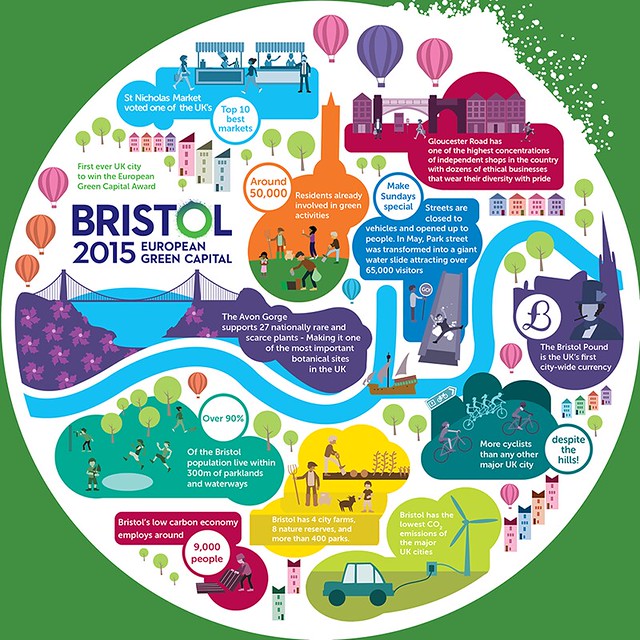
I can't imagine one of the European Union's Green Capitals--this year it's Bristol--making the same decision.
Bristol-2015-Infographic

Labels: , , , , , ,

Monday, June 03, 2013

A way for DC to begin adding yard waste collection as a separate element of waste collection and reduction programming

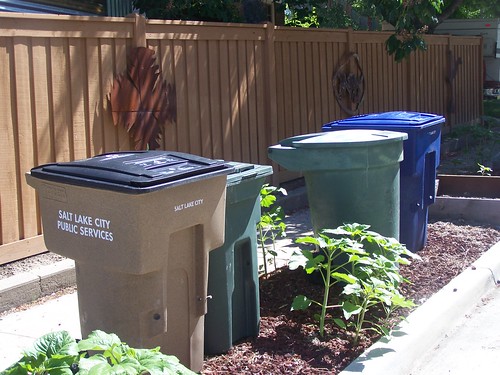
Salt Lake City's different types of trash (green), recycling (blue), and yard waste (brown) trash cans
Salt Lake City has four types of collection media for solid waste.  They collect paper, plastic, and metal in blue cans, have separate rectangular bins for glass (which only recently they started to collect), while trash is collected from green cans, and yard waste is put into the largest can size, which is colored brown.

For years, I have written that DC should separately collect yard waste, as is done in some of the neighboring jurisdictions, but we don't.

The State of Maryland sets (imposes) high waste diversion requirements on the counties, which is why they have active solid waste diversion programs.  For example, the Leafgro compost available in the region is made from leaves from Montgomery County.

Our household composts so we generate very little yard waste, but it's true that our "secondary" compost pile (certain kinds of weeds, branches) maintains its height despite the break down of the materials over time, because we constantly add to it each season, after rain storms, etc.

(In fact, since we lost one of our big trees, now I "steal" some of my neighbors collected leaves, so I have enough for the compost pile for the next year.)

In April I wrote an entry, "Waste in not using products for the normal 'useful' life: sidewalks and trash cans," where I complained that city plans to replace all of the city's trash cans don't make a lot of sense because my sense is that 90% of DC's trash cans have many years of useful life ahead of them.

But seeing the yard waste cans in Salt Lake City yesterday made me realize that a way forward on this issue in DC would be to recognize that DC is not "One City" (the tagline used by the Mayor and Executive Branch agencies), but two cities, and we could have differentiated waste collection programs (we already do in one sense) for yard waste, where we have only one program now.

Rowhouse neighborhoods at the core have different waste collection needs from the detached-housing dominated neighborhoods comprising the outer city

The "problem" with trash collection is that DC is two different cities--the rowhouse city mostly in the core and the outer city where single family detached housing predominates.  In the core of the city, households have small yards and don't have alley access.  They don't generate a lot of yard waste.

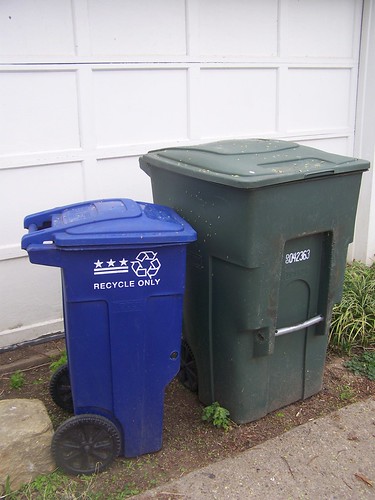
Garbage and recycling cans, DCIn the outer city (where we live), where much of the housing stock is detached with lots large enough to store bigger trash cans and most households generate lots of yard waste, which unless they compost, is put out for trash collection.

Right: trash and recycling cans in the outer city.  Note that in the core of the city, the trash cans they use are the same size as the blue recycling cans.

The city does recognize the "two cities" in trash collection policies

The city does treat the core differently from the outer city as it relates to trash collection. 

While the city's recycling cans are all the same size, the trash cans in the core are smaller than the cans in the outer city.  And in the core, they get trash collection twice each week and recycling service once/week.

This is because of the idea that there are more rodents in the core, plus the smell of trash can build up in small places, etc.

In the outer city, we have larger trash cans and once per week trash pick up.  For most of the blocks with alleys, the trash cans are "out of mind" stored on the alley side of the property.

Let's add yard waste diversion and collection programs to the outer city

Households in the outer city generate a lot of yard waste.  The city does do leaf pickup in the fall, and those leaves are composted.  But many leaves and thousands of tons of yard waste go into the regular "trash" stream, to be burned in Fairfax County for energy and DC pays for the privilege (around $30/ton of trash), because we don't have a yard waste diversion program.

In the core of the city most households don't generate a lot of yard waste, because they have minimal yards--although they still do generate some of this kind of "trash" (as well as compostable material). 

In the outer city at the very least, there should be an additional pick up strictly for yard waste, just as is done in places like Montgomery County, many communities in Prince George's County, and Salt Lake City (there the cans are bigger than our largest, and the color of the can is brown).

If we were big on innovation as a city--which for the most part we are not--it could be tested in some pilot neighborhoods rather than rolled out to the entire city in one fell swoop.

It would require a lot of "training" to get people to do it--MoCo has been doing it for years and still has an extensive outreach program as part of their division of solid waste--but it fits in with DC's new sustainability goals, would add some local jobs (more trash collection personnel, and probably some more trucks would be required, plus outreach personnel), on the other hand we would cut "landfill" costs.  Fairfax County would make less money and need to find more trash to burn but that's not our problem.

Basically, what I am saying that is instead of buying new cans when 90% of the cans are functional, let's buy some new recycling cans that are bigger and offer those to the households that need them (like my household), and let's buy a bunch of yard waste cans for a few pilot neighborhoods, and begin the process of DC shifting how it collects "trash," by instead diverting what isn't trash, in this case, "yard trim" or "yard waste" to better uses.

-- Montgomery County Yard Trim webpage
-- Montgomery County Composting program
-- Montgomery County instructions on how to compost
-- Montgomery County neighborhood mulch distribution program

Labels: , , , , ,

Tuesday, March 31, 2009

Fundamental changes in behavior vs. "recycling"

The issue of bags at stores is more about waste and how we use resources than it is about recycling. Sure we can recycle bags, but better to not use either a paper (which is worse for the environment than plastic, see the third page of this article "The Green Issue - Climate Change - Environment - Energy Efficiency" from the New York Times Sunday Magazine) or a plastic (which uses up that limited natural resource, oil) bag at all.

Better to use a bag or backpack that you already have, one that will last for many years. Of course, you have to remember to carry such bags. (There are small rollup bags you can carry that when you open them up they can be quite big.) And this can be a problem if you are on foot or bicycle and don't have bags "in your car" and for whatever reason you don't have a bag.

But in the end, it's no big deal, and it's probably not even worth writing a letter to the editor of the Washington Post about. Now, Corinne Smeriglio of DC did write a letter (as did Andy Shallal of Busboys and Poets, in favor), see "Paper, Plastic -- and a Price" and in it she betrayed that she doesn't understand that this isn't about "recycling" bags but about how we use resources more generally. From the letter:

Sure, politicians like to posture as friends of the environment. But wouldn't more be accomplished by expanding existing recycling programs? The D.C. government should work to raise awareness of these programs and to partner with local businesses. Regular community cleanups are another opportunity to boost recycling.

The fact is, people need bags when they shop. And considering that the recession is causing hardships for so many people, now is not the time to increase consumers' costs. The District should find a better way to ensure a clean environment.

As the U.S. moves from an economy built on using more (what I call an extensive use of resources) and on waste to a more parsimonious and efficient economy (what I call an intensive use of resources), not using bags when you don't have to is one of the many small changes in every day behavior that people will have to make.

Note to Ken, no I still don't have panniers on my bicycle. So when I buy groceries and carry them home, eventually the bag straps tear and break (I often use those bags you pick up at festivals, they're pretty cheap).

In Baltimore at this cool store called Red Tree in Hampden, Suzanne found an amazing bag made out of recycled tire tubes. Sure it was $52, but it will likely never break. Unlike those bags from Trader Joes...
-----------------------------
David writes:

I suspect that Corinne Smeriglio is not writing as a concerned citizen but as an industry rep with an interest to protect. I've been googling and haven't found the connection. She seems to work at Venturehouse.

I don't see
a young white zeta tau alpha sister being particularly concerned about the poor having to pay a nickel for a bag.

The Washington Post consciously posts letters to the editor by industry insiders without noting their financial interest in the matter.

Labels: , , ,

Friday, April 18, 2008

Start education young...

Building better habits is easy when you start young, and very very difficult when you wait til adulthood.

1. From "Bag a bargain with German recycling," in the Daily Telegraph (UK):

The recycling ethic is inculcated from an early age in Germany. At kindergarten toddlers learn to sort waste into four categories. Later on it becomes a cross-curricular topic, particularly in English lessons. I've loss count of the number of classes I've given on global warming, the dangers of deforestation and energy-saving tips.

2. From "Making Cycling Irresistable":

Training and Education. Dutch, Danish, and German children receive extensive training in safe and effective cycling techniques as part of their regular school curriculum. Most children complete such a course by the fourth grade. It includes both classroom instruction and “on the road” lessons, first on a cycling training track just for children, and then on regular cycling facilities throughout the city. Real police officers test the children, who receive official certificates, pennants, and stickers for their bikes if they pass the test. Since many children get to school by bike, training in safe cycling is considered essential to ensure their safety (German Federal Ministry of Transport, 2002). But it also gets kids off to a lifetime of safe cycling skills. And since all schoolchildren are included, it means that girls as well as boys start cycling at an early age.

3. More than 10 years ago, I read something about how in Japan, children are responsible for cleaning their schools, they don't have a separate custodian. This teaches very early responsibility and what litter means to you and others.

This was the source of this idea, which I have written about for awhile, where students should be responsible for school cleanup, but to also have a fall and spring outside cleanup of the area within a one block radius of the school, in association with the neighborhood outside of the school.

For example, this weekend is the Shaw Neighborhood Cleanup. From the Post:

Residents and friends of the Shaw neighborhood will come together Saturday to help make the community cleaner and greener. Shaw Main Streets will sponsor its fourth annual neighborhood wide cleanup and Greenup starting at 9 a.m. at Shaw Middle School, 925 Rhode Island Ave. NW.

Residents are invited to help plant cherry trees and flowers, pick up trash, and remove and paint over graffiti. Neighborhood civic associations will focus on their blocks, with supplies provided by event sponsors. Neighborhood restaurants will provide lunch at 1 p.m. at the school.


For more information, go to http://www.shawmainstreets.com or call 202-265-7429.

Labels: , , , ,

Wednesday, April 25, 2007

Do you think DC could do more with recycling?

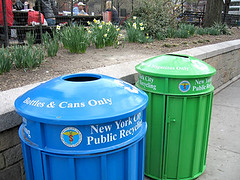
Recycling receptacles in NYC
Photo: Gotham Gazette. See "Catching Up on Recycling."

And in an e-discussion about the failed bottle deposit law of almost 20 years ago (the beverage industry fought it off with an ugly race-based campaign), Jim made a very good point:

3. Because people now think twice before throwing out bottles from their cars, etc., there is considerable generalizing to other forms of trash, and people (some) start to think twice before throwing ANYthing from their cars, etc. So DC's stream banks, sidewalks, etc., will show a marked improvement, not just re bottles.

Labels: , , , ,