Rebuilding Place in the Urban Space

"A community’s physical form, rather than its land uses, is its most intrinsic and enduring characteristic." [Katz, EPA] This blog focuses on place and placemaking and all that makes it work--historic preservation, urban design, transportation, asset-based community development, arts & cultural development, commercial district revitalization, tourism & destination development, and quality of life advocacy--along with doses of civic engagement and good governance watchdogging.

Tuesday, May 25, 2021

Security and the New York City Subway: the system is adding guards

Apparently there has been a rise in crime on the NYC Subway, and it's believed that this reduces the confidence and willingness to use transit there, so MTA is adding to the number of police, but in this period of complaints about "overpolicing," this is controversial.  From the Wall Street Journal article "New York City Subway Hires Security to Improve Safety":

The operator of New York City’s subway says it plans to spend $2.2 million a month on private security guards to address crime and quality-of-life issues in the sprawling system. 

Officials at the state-run Metropolitan Transportation Authority, which oversees the subway, have been increasing the number of guards while calling on the city to provide additional police officers following assaults on staff, instances of riders being shoved from station platforms, the killing of two homeless people and a customer survey indicating rising concern about safety...

Ms. Feinberg said the guards provide a sense of security for riders and transit workers at the agency’s 472 stations, where weekday ridership remains more than 60% below normal. Safety is essential to retain riders returning to the subway for the first time in a year, she and other MTA officials say...

Ms. Feinberg said the guards have been most needed at stations with persistent drug, vandalism and burglary issues, or where workers have been harassed or debris has been thrown onto tracks. The stations include Harlem–125th Street station, West Fourth Street–Washington Square and 181st Street on the Eighth Avenue Line, all in Manhattan.

Image from the Merseyrail twitter feed.

One thing I will say is that I was really struck by the number of highly visible on site personnel on transit systems in Liverpool and London.  

I mean a dozen staff and officers or more in stations in the core, major transfer stations, etc.  Most outfitted in bright yellow vests.

It turns out that some of these efforts involve the British Transport Police, they aren't strictly local initiatives.  For example, Project Servator is a BTP initiative.

I've never really seen anything like that in the US, except at a major transfer station on the LA Metro, the 7th Street/Metro Center station.

But order maintenance is a tough issue, and part of the response to BLM has been a kind of nullification of the recognition that public safety is not merely a matter of overpolicing and police officer excess.

Labels: , , , ,

Sunday, November 11, 2018

Train station platform "safety"

A Newsday article, "Crowded Penn Station platforms have LIRR riders on edge - literally," discusses problems at Penn Station on Long Island Railroad platforms, because the platforms are too narrow for the number of passengers.

The article references Katherine Hunter-Zaworski, a professor at Oregon State University and a co-author of a forthcoming TCRP report on the subject, TCRP A-40 Manual to Improve Safety at the Platform-Train Interface (PTI). (Presentation by Professor Hunter-Zaworski on the outline for the report.)

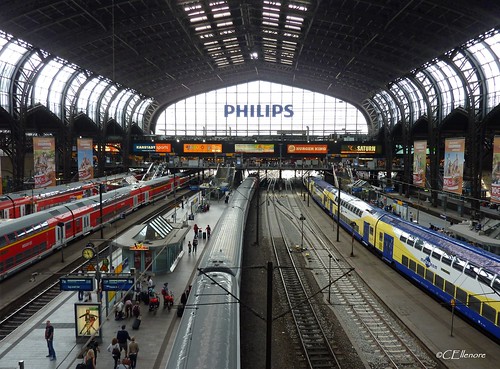
I am not well traveled, but I have been in train stations in Germany and the UK. The main station in Hamburg is as busy or busier than the busiest train stations in the US.

The big difference is that the platforms are much wider. Hamburg train station.
Hamburg Hauptbahnhof

Liverpool Lime Street Station
Liverpool Lime Street's magnificent roof

Penn Station
Untitled

Granted LIRR/MTA/Amtrak/USDOT don't want to reconfigure the trackage system under Penn Station because it would be an engineering and cost nightmare, but width of the platforms is the biggest issue. Without changing platform width, everything else is just dealing with the constraints.

It occurs to me in passenger train service there should be a manual like the Shared-Use Path Level of Service Calculator, to determine ideal widths of multi-use trails, based on regular usage numbers.

Labels: , , , , ,

Saturday, October 10, 2015

Federal Transit Administration's stepping in to regulate the safety elements of WMATA mark of a failure in regulatory oversight by DC, Maryland, and Virginia

WMATA, the Washington Metropolitan Area Transit Authority, operator of Metrorail heavy rail transit service service DC and its suburbs in Virginia and Maryland, has fallen through the cracks in terms of regulatory oversight.

The Metrorail crash in 2009 demonstrated that the somewhat voluntary "Tri-State Oversight Committee," didn't have enough authority given to it by the respective states to be able to command WMATA to act on its recommendations (see ""Subway Safety Panel Foiled by Constraints: 12-Year-Old Oversight Committee Has Little Influence.," Washington Post, 2009).

NTSB recommends FRA be given oversight authority over WMATA.  In the face of multiple safety failures in the system over the past 18 months, the National Transportation Safety Board recommended that the Federal Railroad Administration be given the authority to regulate WMATA ("NTSB wants feds to take of D.C. Metro system," USA Today), even though it isn't a traditional railroad, because the Federal Transit Administration isn't set up to provide day-in, day-out regulatory oversight of individual transit systems.

USDOT steps in because DC-Maryland-Virginia failed to provide adequate oversight.  The USDOT rejected that recommendation, and instead announced on Friday that the USDOT/FTA would provide regulatory oversight ("Federal agency to supervise Metro safety," Washington Post).

In the old days, state regulatory authorities oversaw transit systems.  In the days when transit systems were privately owned, state-based regulatory authorities regulated these firms.  These agencies, usually called "Public Service Commissions," regulated all "utilities," not just electricity, telephone, and natural gas, but transit as well (not railroads, which were regulated by the Interstate Commerce Commission).

This authority wasn't limited to regulating pricing of service, but included safety matters also.

Today, most of these agencies no longer regulate transit systems in a substantive way, because transit agencies are public agencies for the most part, and are regulated in part by the Federal Transit Administration and the Federal Railroad Administration.


Damage from the arcing incident in the tunnel near L'Enfant Plaza Station. NTSB photo.

But that was a fault of the states failing to put forward the right regulations, authority, and oversight structures.

California Public Utilities Commission never gave up responsibility for regulating local transit systems.  California's Public Utilities Commission never gave up its authority to regulate transit systems, and while the operation of transit systems in California hasn't been problem free, it happens that some of the problems resulting in death on the WMATA system have been avoided by the Bay Area Rapid Transit system (BART), because of the level of oversight provided by CPUC.

I wrote about the regulatory system in CPUC vs. the DC-Maryland-Virginia area nine times in 2009, after the Fort Totten crash, which resulted in 899 fatalities, and turned out to have been the result of inter-mixing signaling equipment from different firms, a problem that WMATA was warned about by the firm that provided the system's initial set of signaling equipment.

-- Another example that something "unique" isn't necessarily "exceptional"
-- Missing the real issue about WMATA
-- Will nine deaths lead to a better governance, oversight, and management system for WMATA? Or not?
-- The webpage of the California Public Utilities Commission oversight of rail transit systems
-- Oversight is necessary for business and government
-- Federal safety regulation of local transit systems

Passengers react on Monday, Jan. 12, 2015 afternoon as smoke filled a Metro train in a tunnel outside the L’Enfant Plaza Metro station. One person died from smoke inhalation and the failure to quickly evacuate the passengers. (Photo by Saleh Damiger)

WMATA had experienced multiple failures with this equipment before the fatal crash, although in each previous situation, train operators avoided catastrophe by stopping the train short of a crash.

Because no fatalities resulted from those incidents, the problem was discounted, treated as an anomaly, rather than inherent within the system.

DC-Maryland-Virginia failed to address their regulatory responsibilities for WMATA.  Using the California Public Utilities Commission as an example of national best practice, in the various posts from 2009, I wrote something like this:
In our region, I would recommend that DC, Maryland and Virginia set up a supra-regulatory committee as a joint venture, one that operates within the utilities oversight body of each jurisdiction, tasked with the regulation of rail transit systems. That would mean subway and light rail in Baltimore, passenger railroad services in Maryland and Virginia, heavy, light rail, and streetcar service in Metropolitan Washington, and light rail in Hampton Roads in Virginia.
DC, Maryland, and Virginia had 6 years to act on this. They didn't.

Given the continued failures, the USDOT/FTA was forced to step in.

Labels: , , , , , , ,

Friday, March 07, 2014

An example of differentiating policy in practical ways: crude oil by railroad

In terms of the reality that "one size doesn't fit all" in planning, here is an example of how to plan and apply policy differentially, depending on particular sets of needs.

Cities and residents in cities are very concerned about transportation of chemicals on railroad systems that travel through cities or to urban ports, because spills and accidents can be incredibly dangerous ("Seattle joins debate about limiting oil-by-rail," Seattle Times), as was proven in Lac-Mégantic, Quebec, where 47 people died when a train carrying crude oil derailed and touched off an inferno that incinerated portions of the town ("The deadly secret behind the Lac-Mégantic inferno," special report, Toronto Globe and Mail).

While there has been resistance in some sectors of the industry to safety changes to railcars transporting chemicals ("A lot at stake in tank-car design discussions," Progressive Railroading) such as crude oil because of the cost, it turns out that it would be "relatively easy" to create a differentiated policy for the specific requirements of railcars for crude oil and chemical transportation, by focusing higher requirements on more risky items, as measured by the  volatility of the chemicals being shipped.

It turns out that Bakken crude oil is significantly more volatile than other types of crude oil.  See "Bakken Shale Oil Carries High Combustion Risk" from the Wall Street Journal.  From the article:
The Journal analyzed data that had been collected by the Capline Pipeline in Louisiana, which tested crude from 86 locations world-wide for what is known as vapor pressure. Light, sweet oil from the Bakken Shale had a far higher vapor pressure—making it much more likely to throw off combustible gases—than crude from dozens of other locations.

Neither federal law nor industry guidelines require that crude be tested for vapor pressure. ... According to the data, oil from North Dakota and the Eagle Ford Shale in Texas had vapor-pressure readings of over 8 pounds per square inch, although Bakken readings reached as high as 9.7 PSI. U.S. refiner Tesoro Corp., a major transporter of Bakken crude to the West Coast, said it regularly has received oil from North Dakota with even more volatile pressure readings—up to 12 PSI.

By comparison, Louisiana Light Sweet from the Gulf of Mexico, had vapor pressure of 3.33 PSI, according to the Capline data.

Note that Canadian regulators have made a similar determination with regard to the tragic incident in Quebec ("Canadian Regulators Say Oil in Train Accident Was as Volatile as Gasoline," WSJ).

The solution is to require higher transport safety requirements according to the volatility of the product as determined by the vapor pressure content.

Labels: , , , , , ,

Sunday, June 13, 2010

Two good articles in Mass Transit Magazine

1. Reducing Risk By Michael Conlon and Brenda Himrich of the Minneapolis Metro Transit system, is about a safety campaign designed to reduce distracted driving on the part of bus drivers in their bus service.

When the system discovered that a bus driver was using a cell phone when getting into an accident with a bicyclist, they decided to develop an integrated campaign using internal media, training, and evaluation systems to reduce distracted driving--and accidents--by drivers. The media also ended up being repurposed as part of external communications programs.

The reason I find this article important is all the myriad of problems with safety that have been experienced over the past year with the WMATA system, and the need to develop an integrated and thorough response.

The Minneapolis transit system also quantified the financial benefits from accident reduction (as much as $30,000 for each accident eliminated). In the DC region it would be more, because so many of the accidents end up generating large settlements or legal awards.

2. Routing Culture By Tim Newcomb, is about transit system maps, objectives, communicating information, and schematic vs. geographic maps. From reading the comments, most of the map designers seem to be less focused on communicating broader information to occasional users.

Labels: , ,

Sunday, November 15, 2009

Federal safety regulation of local transit systems

In response to the massive failures of WMATA to provide a safe transit system--which resulted in the catastrophic accident in June which killed 9 people and injured many others--the federal government is about to put forward legislation to take responsibility for the specific regulation of local fixed rail transit operations. See "Fed safety oversight of transit systems proposed" from the Post.

I do think that there need to be national standards and systems promulgated for how transit systems are regulated. Clearly there are big gaps across the country. California's Public Utilities Commission demonstrates it is possible to provide excellent regulation of local rail transit. From their website:

The PUC's Rail Transit Safety Section is responsible for overseeing the safety of public transit guideways. The Commission's program ensures that transit agencies have and follow system safety programs that integrate safety in all facets of transit system operations. Every three years staff audits the transit agencies on the agencies' adherence to the system safety programs. Commission staff also review the design of new systems and system extensions, work with transit agencies to mitigate safety hazards, inspect construction to ensure conformance with applicable standards, and audit the safety certification practices of transit systems. Commission staff oversee the safety of operations, including accident investigations and resolution of safety related complaints.)

I agree that local systems need to be regulated. I'm just not sure that I think having the federal government do it is the best way. I wonder how much attention they'd pay to each system, and if the regulatory regime would be more political, or subject to other machinations when an anti-transit Administration is in power.

In our region, I would recommend that DC, Maryland and Virginia set up a supra-regulatory committee as a joint venture, one that operates within the utilities oversight body of each jurisdiction, tasked with the regulation of rail transit systems. That would mean subway and light rail in Baltimore, passenger railroad services in Maryland and Virginia, heavy, light rail, and streetcar service in Metropolitan Washington, and light rail in Hampton Roads in Virginia.

Labels: , ,