Rebuilding Place in the Urban Space

"A community’s physical form, rather than its land uses, is its most intrinsic and enduring characteristic." [Katz, EPA] This blog focuses on place and placemaking and all that makes it work--historic preservation, urban design, transportation, asset-based community development, arts & cultural development, commercial district revitalization, tourism & destination development, and quality of life advocacy--along with doses of civic engagement and good governance watchdogging.

Wednesday, July 22, 2015

Structuring community benefits agreements

(I have been really busy with a possible project and creating a detailed proposal for it.  We'll see where it goes.  But it definitely kept me from blogging.)

I have written a bunch in the past about community benefits agreements and how in DC, a relatively undefined framework for types of benefits, with the exception of added affordable housing in return for a density benefit, allows developers to not provide very much.

-- Community benefits agreements revised (again)
-- What community benefits are supposed to be versus what people think they are about
-- Community benefits agreements and energy considerations


And lack of good process allows many different actors to take part in negotiations in ways that diffuses impact.

Not to mention a lack of a good framework means that there is too little focus on realizing extranormal long term (structural) benefits.

I was reading a Montgomery County plan and it referenced that jurisdiction's public benefits process associated with special development considerations.  It's outlined in Division 4.7, Optional Method Public Benefits, in the new (2014) Montgomery County Zoning Code, on page 4-96.

All jurisdictions should create a comparable process.  And include in district, sector and neighborhood plans a section on community consensus priorities in order to help shape and accelerate the process.

A.  Major Public Facility

B. Transit Proximity

C. Connectivity and Mobility
1. Advance Dedication
2. Minimum Parking
3. Neighborhood Services
4. Public Parking
5. Through-Block Connection
6. Transit Access Improvement
7. Streetscape Improvement
8. Trip Mitigation
9. Way Finding

D. Diversity of Uses and Activities
1. Adaptive Buildings
2. Care Centers
3. Dwelling Unit Mix
4. Enhanced Accessibility for the Disabled
5. Live/Work
6. Moderately Priced Dwelling Units
7. Small Business Opportunity

E. Quality Building and Site Design
1. Architectural Elevations
2. Exceptional Design
3. Historic Resource Protection
4. Public Art
5. Public Open Space
6. Structured Parking
7. Tower Step-Back

F. Protection and Enhancement of the Natural Environment
1. Building Lot Terminations
2. Cool Roof
3. Energy Conservation and Generation
4. Habitat Preservation and Restoration
5. Recycling Facility Plan
6. Transferable Development Rights
7. Tree Canopy
8. Vegetated Area
9. Vegetated Roof
10. Vegetated Wall

G. Building Reuse

Labels: , , , , , , , , ,

Wednesday, May 27, 2015

Public access to building tops in the vertical city: cinemas, parks, and plazas

House & Garden UK has a feature on "LONDON'S MUST-SEE LATE NIGHT EVENTS," and one of the items listed is the Rooftop Film Club, which screens films in four different places across London (they are planning a NYC operation as well).

Many of the office buildings in DC's core do provide rooftop access to tenants as an amenity.

Some of the buildings provide access on 4th of July, to see the fireworks, which is pretty cool.

While I've written about how neat it is that the Salt Lake City Central Library's green roof and patio is open to the public and offers majestic views (Image at right from Utelitesoil).

The San Diego Central Library roof is open to the public and isn't so majestic as SLC but it is set up better for film presentation.

Showing movies on a library's downtown roof top would be an interesting extension of public access and use, given that most such access is otherwise privatized.

Image of the patio at the San Diego Central Library by Natalia Robert for Connect San Diego.

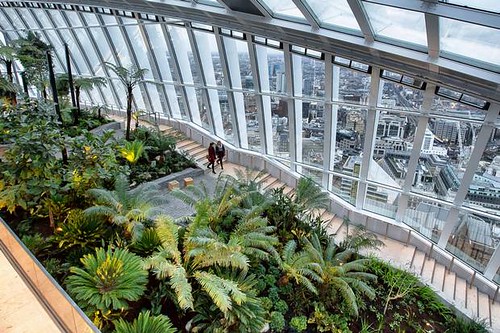
2.  As part of receiving approvals to build a skyscraper at 20 Fenchurch, in London, the developer offered to construct and operate an indoor park on the top three stories of the building.  See "Walkie Talkie park opens to public amid row over public access" from the London Evening Standard.

The space includes restaurants--one decidedly upscale offers a caviar plate for £325--but visitors are limited to 90-minute visits by timed appointment and must bring photo identification in order to get in the building.

The building, designed by starchitecct Rafael Viñoly, is 34 stories tall, and the fifth tallest in the city.
Sky Garden at the top of the "Walkie Talkie" building, London
Sky Garden at the top of the "Walkie Talkie" building, London.  Photo by Alex Lentati, for the London Evening Standard.

The building is notorious not just for its shape, which led to its nickname, but because concentrated light beams emanating from the glass curtain wall "melted" parts on a Jaguar parked on the street, so the building has been fitted with an awning to diffuse light bouncing from the building.

3.  Separate is the issue of access to "privately owned public spaces" which have been created as part of planning approvals, usually in return for variances, density bonuses, etc.

There is a book about such spaces in New York City (Privately Owned Public Space: The New York City Experience), and awareness of the issue came to the fore during the Occupy Wall Street movement, because Zuccotti Park, home to the protests, is such a space.

In San Francisco, the San Francisco Planning and Urban Research Association has published a public access guide to such spaces there, Streets of San Francisco.

4. SF' privately owned public spaces include rooftop plazas on a privately owned building, at One Kearny, pictured at right (Photo by Liz Hafalia, SF Chronicle), and the San Francisco Federal Building.

See "Privately owned public spaces: Guidance needed" from the San Francisco Chronicle.

SF's spaces came about as a result of the 1985 Downtown Plan, which called for 1 s.f. of public space for 50 s.f. of private space.

John King argues that it is time for the regulations to be updated, in part to deal with access issues, as many of the spaces, as pointed out by SPUR, are not promoted as being open to the public, as well as design issues, since many of the spaces aren't outfitted in ways that promote use, activation, and lingering.

Photo: Liz Hafalia, The Chronicle. The 11th floor Skygarden in the Federal Building has a remarkable view of South of Market, but there's no sign announcing it on 7th Street and there's a security checkpoint at the building's entrance.

I don't think that the SF Federal Building will start screening movies in its Skygarden, but it would be cool.

At least one of the House Office Buildings in DC has a nice terrace space overlooking Pennsylvania Avenue SE.

Labels: , , , , , ,

Saturday, July 18, 2009

The way development works

The Examiner reports, in "Link probed between D.C. councilman's support, developer dollars," that Ward 5 Councilmember Harry Thomas Jr. is being investigated because of his support of a local development project and a subsequent donation to the Ward 5 Business Council by the developer.

Now this is a complicated thing.

First, for the most part Councilmembers ALWAYS support reasonably decent (and plenty of INDECENT) development proposals in their wards. ALWAYS.

There is no way that Councilmember Thomas wouldn't have supported this project, whether or not community benefits monies went to organizations and projects supported by the Councilmember.

And this is a pretty good project, that I would support. It's to put quality rowhouses on a piece of underused land, and it extends the street grid to do so. It's a bit crippled by not extending the street grid to 4th Street NE, but all in all, it's an excellent development. See this DC MUD blog entry from a couple years ago, "Brookland Eyes 10 Acres of Development at St. Paul's," for more detail.

Second, it does shed light on the reality that the community benefits process is under-structured, which is something I have been concerned about for many years. It's a system that is designed to be messy and unstructured and fraught with peril.

See "Community Benefits Agreements," an updated blog entry from last April, for an outline of how to improve the structure and process of negotiating and awarding community benefits in zoning issues.

By setting priorities for neighborhood and area improvements beforehand, and then by directing community benefits monies towards consensus priorities, the kind of seeming graft that is discussed in the Examiner article will be much less of an issue.

Third, I will admit that the Ward 5 Business Council won't accomplish very much. It has a diffuse agenda and the people involved don't know very much, therefore they will yield very little in real accomplishment, regardless of how much and who gives money to the organization.

So the fact that Councilmember Cheh is setting up a Ward 3 Business Council seems troubling.

DISCLOSURE: The Padous filed a complaint against me when I worked for the Brookland CDC, claiming that deliberately falsified reports were filed. I wrote and signed the reports, so the complaint was against me. (Each month, individual DC Main Streets programs have to file a voluminous report with the RestoreDC program in the Dept. of Small and Local Business Development.) So the Inspector General's office investigated. They never really tell you when they close the investigation, but I don't consider this to be hanging over me. But it sure does make me question Abigail Padou's motives.

DISCLOSURE 2: I have been involved in "seeking" community benefits in various matters in the past. My strategy for what became H Street Main Street meant that community benefits related to the first phase of the Dreyfus Station Place project near Union Station got those benefits awarded to facade improvement on H Street, rather than to the H Street Community Development Corporation for non-H Street related programs. This was about $200,000.

And Abdo Development provided $10,000 (I know, not very much) to historic preservation survey activities in the H Street neighborhood, in association with their redevelopment of the Children's Museum into the Landmark Lofts project on H Street. I was involved in securing that donation as well.

DISCLOSURE 3: When I was the program manager for Brookland Main Street, EYA did donate to the Brookland Festival in 2007, and had a booth at the festival. I don't remember the amount, it was maybe $2,500.

Labels: , , , , , , , ,

Wednesday, April 08, 2009

Community benefits agreements and energy considerations

This memo has gone through a number of iterations over the past few years. This version was written in February 2008 and updated in June 2008. Below is the complete version, updated to last June, with edits and expansions as of today.

One of the reasons I'm reprinting it is to have one master version with the June 2008 revision. But the other is that I just read something, "Building Green," from the April issue of Chain Store Age magazine (a trade magazine for the chain retail industry) that reiterates a point that was made below. "Green building practices" are merely good business, they are profitable for developers and store owners, and therefore when considering proffers or community benefits in the context of zoning decision-making, green building characteristics should not receive any special consideration.

From the article:

The survey, called "Green Building Market Barometer," is from Turner Construction ... Survey respondents said that green buildings enjoy lower costs than non-green buildings in three important areas:

- energy;
- overall operating expenses; and
- total life cyle over a 10-year span.

The executives also reported that green buildings have better financial performance than non-green ones in terms of:

- higher building values;
- higher asking rents; and
- greater return on investment and higher occupancy rates.

Those perceptions are confirmed by other studies...

Although 87% of the surveyed executives believed that green buildings cost more to construct, some 73% said that higher costs would be paid back through lower operating costs, with a median estimated payback period of seven years. The results indicate that many executives still believe that green construction is significantly more expensive than traditional building methods, when in fact, according to Turner, it can often be achieved with little or not premium.

For example, a review by Davis Langdon, of a wide range of studies, found that hte average construction cost premium required to achieve a moderate level of green features (equivalent to LEED SIlver certification) was only 1% to 2%.

-----------------------------

The current community benefits system is ad-hoc and the lack of transparency and structure disproportionately benefits developers at the expense of communities

Through my involvement in community land use matters since 2000, including participation on the ANC6C Planning and Zoning Committee from 2003 to 2005, I have become increasingly concerned about the lack of structure and inadequate levels of citizen participation in the negotiation of community benefits agreements generally, the lack of transparency of agreements negotiated between developers and local nonprofits deemed "community organizations" to determine how monetary benefits are spent, as well as the relatively paltry amount of benefits provided by most projects, and the failure to garner amenities in ways that could significantly contribute to substantive structural improvements in the neighborhood and at the city at large.

Doesn't anybody remember the great reporting in The Common Denominator about the community amenities agreements associated with development at Fort Lincoln, agreements that have never been effectuated, and the fact that the DC Government isn't too worked up about this? (See May 6, 2002 - News - Residents cry foul: Ft. Lincoln developer reneges on city deal that delivered land rights; June 3, 2002 - News - Fort Lincoln residents seek Norton's help; August 12, 2002 - News - Residents sue, charge Ft. Lincoln New Town developer with fraud; and May 6, 2002 - News - LBJ's 'Great Society' spawned Fort Lincoln development plan all from The Common Denominator.)

Furthermore, communities that are better organized and have resources end up getting more (or some) benefits, while under-organized communities get little to nothing in terms of benefits from new development occuring within the neighborhood. (This should be considered a violation of the 14th Amendment to the U.S. Constitution, and the provision of "equal protection under the law." But this line of inquiry has been inadequately tested through the Courts.)

Justification for community benefits/proffers

The economic justification for developer-paid community benefits/proffers is two-fold. First, adding developable square footage to the project through zoning use changes (including planned unit developments), variances, and special exceptions make a property significantly more valuable. It is reasonable to ask that a developer pay back to the community some of this increase in value.

Second, development projects too often have a "trickle down" effect. Developments are frequently touted for their revitalization benefits, but in my experience without specifically linking the project to other improvements simultaneously, it is difficult to achieve the kinds of benefits touted by the project in short to intermediate periods of time.

For example, the "overnight" success of H Street NE actually represents more than 30 years and hundreds of millions of dollars of already expended federal and city development funds. People still complain about the failure of revitalization -- "when is it going to come? -- not realizing that so much time and money has already been invested.

But part of the "failure" is the failure to coordinate investment and improvements, and to ensure that a project fully connects to the neighborhood and/or commercial district beyond the confines of the lot lines of the development.

My joke about the two office buildings on the 600 block of H Street NE is that in 20 years, the only economic development spawned by the project was one hot dog cart Monday through Friday. (They started with two but there was only enough business for one.)

This "failure to thrive" comes from the failure to link big new projects to necessary and complementary neighborhood improvements simultaneously.

At the same time, coordinating private investment with investments in public space and community capacity will make new projects more valuable more quickly, so one could argue that for certain kinds of developments, especially commercial and probably condominium development, that the money comes right back in terms of increased value. E.g., if H Street were currently a thriving commercial district, it is likely that the Akridge "Burnham Place" development would already be underway, and that the Senate Square development would have sold out, despite the housing downturn, etc.

How much are zoning changes worth?

The Zoning Commission and Office of Planning do not provide a metric for calculating how much density bonuses are worth. Some projects receive density bonuses worth tens of millions of dollars, and frequently the community benefits offered are worth significantly less than $200,000.

For the sake of argument, I suggest that the economic value of density bonuses be paid into a proffer fund at the rate of at least 10%. So added density worth $10 million would generate a minimum of $1 million in funds for proffers.

Communities must first set priorities for neighborhood improvements

Having a structured conversation about community benefits is a necessary first step in the consideration of a wider-range of public-private partnerships organized around land use and development that is designed to yield neighborhood and/or city-wide stabilization and improvement benefits.

Without such a conversation, communities give up a lot with little in the way of calculable return, judging by my experiences thus far. Most benefits agreements are paltry, and too often are little more than graft projects designed to fund an ANC Commissioner's pet projects or organizations. In the past, while rare, individual residents have received personal benefits (such as health club access to a hotel) or air conditioners.

In order to craft agreements, first neighborhoods/Wards/ANCs must work together to develop a set of neighborhood priorities, and ensure that proffers are directed only to those items which the community agrees are important.

-------
There was a letter to the editor of the Post on 4/5/2009 about the need for a canopy over the Foggy Bottom Metro Station, "Foggy Bottom Metro Needs a Canopy." It seems painfully obvious that this would be a public space improvement that should logically be funded through proffers related to the various development projects in that community, projects that are still going forward despite the recession.
------

Priority areas for funding include civic institutions (public schools, libraries, parks), transportation-mobility improvements, streetscape improvements, community history and interpretation, public art, and commercial district revitalization programs, and historic preservation-based building rehabilitation.

Contributions must be substantive, yielding long-term benefits and consequences, rather than "flash in the pan" benefits with little in the way of structural impact. For example, a project at Fort Totten in Ward 5 provided funds for improvements to a local school and library, and an offer was made to the National Park Service to fund improvements to an adjacent park.

Probably improvements to public charter schools should not be considered an acceptable proffer, because the buildings and facilities are not owned by the DC Government (and thereby held in trust for the Citizens of the District of Columbia).

Is design improvement a community benefit but not a proffer?

Another consideration is project-specific design and urban design considerations more generally. "Design" is currently considered a community benefit under the Planned Unit Development system, but almost every instance where I have been involved the benefit to the community is nonexistent and changes to the project come only after an inordinate amount of work on the part of particularly engaged residents.

This is especially important with housing developments. In the current system of development, a commercial building may have a useful life as short as 20 years. In any case, it can be "freshened up" with a new facade at some point to extend its useful life. Owner-occupied housing is likely to never change its design. The hip modern designs of today are likely to become quite dated in as soon as 10 years.

We must remember with housing developments that "what you see is what you get," forever. Fostering design improvements to projects should be an important part of the development process, although I believe personally that this type of benefit should be built into the project as a direct cost independent of the proffer system.

Participation of community development corporations in the proffer process

In the past local CDCs have received ownership positions in development projects by private developers as a community benefit. In part this was done to assure that a particular developer would win development rights from the government entity that controlled the property, such as the Redevelopment Land Agency. But the contracts for these benefits are not open to the public (for the most part) and no accountability and oversight mechanism has been built into these agreements to ensure that "community benefits" truly result from the economic interest awarded to seemingly local organizations.

This must change. No development participation should be awarded to community organizations without the provision of transparency, the provision of direct benefits to the community, and a process of oversight and accountability over such agreements.

How should a community structure its thinking about community benefits?

Proffers can be categorized as one of five types:

1. National benefits;
2. City-wide benefits;
3. Neighborhood benefits within a geographically defined area such as an ANC;
4. Building-specific design improvements; and
5. Site/area physical improvements located within a few block radius of the project, the area most impacted by the project during and after construction.

National benefits. This category covers green/environmental/LEED type requirements. Generally, these kinds of investments pay back to the developer, and for the most part are "merely" good business practices that deserve little in the way of special consideration when valuing community benefits agreements.

It is important that these types of project improvements be considered in an absolute rather than a relative manner. E.g., who cares if a gas station has a couple solar panels? And losing the embodied energy of a building through demolition can likely not be recovered through green construction practices on new construction.

However, building materials recycling could be considered a national benefit deserving of special consideration as a proffer, because the cost of deconstruction is higher than standard demolition. Construction materials make up 50% of the waste stream and much could be recovered through building deconstruction. Therefore, it could be categorized as a city-wide benefit as well.

City-wide benefits. This category relates to city-wide policy, and would cover affordable housing, DC-based employment agreements, minority contracting requirements, and transportation infrastructure investments, among others. These are public policies that serve the city more broadly, rather than the specific neighborhood in which a project is located.

Employment and contracting requirements should be considered standard business practices not deserving of special consideration. Affordable housing requirements do cost money and should be awarded consideration.

Transportation demand management practices (spaces for car sharing, secured bicycle facilities, showers [for office developments]) should have been required as part of the recent Comprehensive Plan revision but were not. ANCs could step and demand that TDM planning and facilities be required for new housing and commercial developments.

Certain of these investments could be considered community amenities to the extent that they provide neighborhood benefits beyond benefits strictly for users of the site, such as car sharing spaces where the car can be used by members not living on the property and shared parking facilities.

Funding improvements of important projects with both neighborhood and city-wide benefits could also be included within the proffer system, e.g., the rehabilitation of a cultural resource asset such as a neighborhood movie theater, deaccessioned school building, etc.

Neighborhood benefits. This category would encompass proffers that are directed to facilities, organizations, services, and residents located within the defined geographical area where the project is located. For example, affordable housing, hiring policies, and business source agreements that target neighborhood/Ward residents and businesses specifically would be considered community benefits deserving of special consideration.

So would improvements made to local public schools, parks, and libraries. Or assistance made to important neighborhood projects. (For example, in the H Street neighborhood, proffers could have been used to help fund the cost of rehabilitating the Atlas Theater.)

Other examples of neighborhood benefits would be the provision of shared parking facilities, i.e., a parking garage supporting residents but also providing access to consumers visiting an adjacent commercial district, funding of historic preservation/cultural resource surveys, paying into community development education programs at the neighborhood level, funding of commercial and neighborhood improvement projects such as:

• community heritage/history interpretation and signage programs;
• public art projects;
• business directories/maps for installation in neighborhood-commercial bus shelters;
• bus stop, treebox, street furniture, sidewalk lighting, and other streetscape/infrastructure improvements deemed important by a neighborhood;
• neighborhood marketing programs including the development of brochures, booklets, and banner programs;
• traffic calming projects including bulb outs;
• funds paid into business development programs to support the development and improvement of local retail and home-based businesses; etc.

For example, in Brookland, the east side of the station does not have a canopy over the escalator/stairs. The cost to install a canopy is $900,000, and installation of this desired facility for the east exit at the Brookland station is not currently scheduled. Proffers could fund the installation of a canopy there independent of WMATA funding streams.

Similarly, a development project on the 600 block of H Street NE has agreed to pay for the creation of a mid-block crosswalk and the cost of the installation of a traffic signal. The signal alone costs $150,000.

Building-specific design improvements. A possible improvement would be urban design additions to the project that the developer does not want to make because of value engineering desires. This is a tougher nut to crack, and could be considered a neighborhood improvement as well.

For example, I was not able to convince the developer of the 600 H project to develop the south side of the project, rear buildings which will border houses and a historic alley, to comparable to traditional rowhouses--think crappy south Fairfax new townhouses around Fort Belvoir vs. the 1890s brick rowhouses that typify Greater Capitol Hill.

Partly this was a failure due to their suburban design sensibilities, but part was over cost, as the labor cost for traditional masonry is $15/s.f., much higher than the cost of slapping up a pane of glass for a commercial building or some hideous siding.

Site/area physical improvements. This category covers activities benefiting the area immediately around the specific development activity, the area that is most impacted physically, and on a day-to-day basis, by the project both during construction, and after it is finished. This includes streetscape improvements and other enhancements.

Conclusion

Equity. Somehow, the value of proffers needs to be shared more equally between city-wide, neighborhood, and micro project improvements.

Neighborhoods with many development opportunities will benefit disproportionately from the proffer system that does not "tax" the overall revenue stream generated by proffers. Improvements in other parts of the city can be funded in part by directing a percentage of all proffers to a fund for city-wide funded projects.

Another resource. Community Benefits Agreements: Making Development Projects Accountable,

Monitoring and Enforcement. This article from the New York Times, SQUARE FEET; The Trade-Offs in Zoning Trade-Offs," discusses how important monitoring is to the maintenance of public benefits. From the article:

Since 1961, when the first density bonus was codified into city zoning law, public amenity trade-offs have proliferated. The Hearst Tower, under construction at Eighth Avenue and 57th Street, was granted a density bonus in exchange for making improvements to the Columbus Circle subway station. The Biltmore Theater on 47th Street was fully restored by the developer of a residential tower on that street.

More common, however, are spaces that have been taken over for private purposes. For example, many spaces that were created for the public have been appropriated for cafe seating, a common violation of the density bonus that was publicized by Jerold Kayden, a professor of urban planning and design at the Harvard University Graduate School of Design, in his extensive study of public spaces created in New York City since 1961.

After the study was published, the city started enforcement procedures against a number of building owners, and Professor Kayden established a small nonprofit monitoring group called Advocates for Privately Owned Public Spaces, which is financed by the Municipal Art Society. The group keeps an updated database of more than 500 public spaces, but has neither the staff nor the resources to track public amenities built by private developers that are not regulated by city zoning laws.

It is important that the proffer system be open, transparent, and trackable.

Arlington County has a capital improvements database, which is now publicly accessible. (See the past blog entry "A laudable example of municipal transparency: Arlington opens municipal construction project tracking database to the public.")

A similar kind of database needs to be created in DC that would list all properties owned by the DC Government and its instrumentalities, including publicly chartered Community Development Corporations, and any and all such proffers and community benefits agreements associated with properties/developments.

And a system needs to be set up for monitoring and tracking compliance, with reports provided annually to ANCs for all projects within their borders, as well as a master report including all projects across the city.

Labels: , , , , , , , , ,

Saturday, June 21, 2008

Community benefits agreements: revised (again)

In February, I came out with a revised discussion and structure for thinking about community benefits agreements associated with development projects, in "Community benefits agreements (revised)."

That piece said that proffers can be categorized as one of four types:

1. National benefits;
2. City-wide benefits;
3. Neighborhood benefits within a geographically defined area such as an ANC; and
4. Micro-benefits within a couple block radius of the project.

I think this needs a slight refinement, because building-specific design improvements are so significant and needed that they should to be separated out into a separate category thusly:

1. National benefits;
2. City-wide benefits;
3. Building-specific design improvements;
4. Neighborhood benefits within a geographically defined area such as an ANC; and
5. Micro-benefits within a couple block radius of the project.

Building-specific design improvements would be things like masonry instead of siding, having design gee-gaws like a building clock viewable by all.

In the previous typology, I included these types of benefits within the micro-benefits category, writing this:

A possible improvement would be urban design additions to the project that the developer does not want to make because of value engineering desires. This is a tougher nut to crack, and could be considered a neighborhood improvement as well.

For example, I was not able to convince the developer of the 600 H project to develop the south side of the project, rear buildings which will border houses and a historic alley, to comparable to traditional rowhouses--think crappy south Fairfax new townhouses around Fort Belvoir vs. the 1890s brick rowhouses that typify Greater Capitol Hill.

Partly this was a failure due to their suburban design sensibilities, but part was over cost, as the labor cost for traditional masonry is $15/s.f., much higher than the cost of slapping up a commercial window or some hideous siding.
-------------------
So here is the rewrite of that section:

How should a community structure its thinking about community benefits?

Proffers can be categorized as one of five types:

1. National benefits;
2. City-wide benefits;
3. Neighborhood benefits within a geographically defined area such as an ANC;
4. Building-specific design improvements; and
5. Site/area physical improvements located within a couple block radius of the project, the area most impacted by the project during and after construction.

National benefits. This category covers green/environmental/LEED type requirements. Generally, these kinds of investments pay back to the developer, and for the most part are "merely" good business practices that deserve little in the way of special consideration when valuing community benefits agreements.

It is important that these types of project improvements be considered in an absolute rather than a relative manner. E.g., who cares if a gas station has a couple solar panels? And losing the embodied energy of a building through demolition can likely not be recovered through green construction practices on new construction.

However, building materials recycling should be considered a national benefit deserving of special consideration as a proffer, because the cost of deconstruction is higher than standard demolition. Construction materials make up 50% of the waste stream and much could be recovered through building deconstruction.

City-wide benefits. This category relates to city-wide policy, and would cover affordable housing, DC-based employment agreements, minority contracting requirements, and transportation demand management requirements, etc. These are public policies that serve the city more broadly, rather than the specific neighborhood in which a project is located.

Employment and contracting requirements should be considered standard business practices not deserving of special consideration. Affordable housing requirements do cost money and should be awarded consideration.

Transportation demand management practices (spaces for car sharing, secured bicycle facilities, showers [for office developments]) should have been required as part of the recent Comprehensive Plan revision but were not. ANCs could step and demand that TDM planning and facilities be required for new housing and commercial developments.

Certain of these investments could be considered community amenities to the extent that they provide neighborhood benefits beyond benefits strictly for users of the site, such as car sharing spaces where the car can be used by members not living on the property and shared parking facilities.

Funding improvements of important city-wide projects could also be included within the proffer system, e.g., the rehabilitation of a cultural resource asset such as a neighborhood movie theater, deaccessioned school building, etc.

Neighborhood benefits. This category would encompass proffers that are directed to facilities, organizations, services, and residents located within the defined geographical area where the project is located. For example, affordable housing, hiring policies, and business source agreements that target neighborhood/Ward residents and businesses specifically would be considered community benefits deserving of special consideration.

So would improvements made to local public schools, parks, and libraries. Or assistance made to important neighborhood projects. (For example, in the H Street neighborhood, proffers could have been used to help fund the cost of rehabilitating the Atlas Theater.)

Other examples of neighborhood benefits would be the provision of shared parking facilities, i.e., a parking garage supporting residents but also providing access to consumers visiting an adjacent commercial district, funding of historic preservation/cultural resource surveys, paying into community development education programs at the neighborhood level, funding of commercial and neighborhood improvement projects such as:

• community heritage/history interpretation and signage programs;
• public art projects;
• business directories/maps for installation in neighborhood-commercial bus shelters;
• bus stop, treebox, street furniture, sidewalk lighting, and other streetscape/infrastructure improvements deemed important by a neighborhood;
• neighborhood marketing programs including the development of brochures, booklets, and banner programs;
• traffic calming projects including bulb outs;
• funds paid into business development programs to support the development and improvement of local retail and home-based businesses; etc.

For example, in Brookland, the east side of the station does not have a canopy over the escalator/stairs. The cost to install a canopy is $900,000, and installation of such at the Brookland station is not currently scheduled. Proffers could fund the installation of a canopy there independent of WMATA funding streams.

Similarly, the 600 H Street NE development has agreed to pay for the creation of a mid-block crosswalk and the cost of the installation of a traffic signal. The signal alone costs $150,000.

Building-specific design improvements. A possible improvement would be urban design additions to the project that the developer does not want to make because of value engineering desires. This is a tougher nut to crack, and could be considered a neighborhood improvement as well.

For example, I was not able to convince the developer of the 600 H project to develop the south side of the project, rear buildings which will border houses and a historic alley, to comparable to traditional rowhouses--think crappy south Fairfax new townhouses around Fort Belvoir vs. the 1890s brick rowhouses that typify Greater Capitol Hill.

Partly this was a failure due to their suburban design sensibilities, but part was over cost, as the labor cost for traditional masonry is $15/s.f., much higher than the cost of slapping up a commercial window or some hideous siding.

Site/area physical improvements. This category covers activities benefiting the area immediately around the specific development activity, the area that is most impacted physically, and on a day-to-day basis, by the project both during construction, and after it is finished. This includes streetscape improvements and other enhancements.

Labels: , , , , , , ,

Friday, April 11, 2008

Development at the Armed Forces Retirement Home

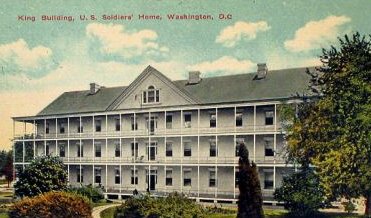
King Building, U.S. Soldiers Home, DC (Armed Forces Retirement Home0
From Reyn Anderson, Washington Central Parks:

Have you wanted to get involved in Washington Central Parks quest to get parts of the Armed Forces Retirement Home (AFRH) re-opened as public park and wondered how? Now’s your chance! Please come out THIS MONDAY, April 14, 6:30 -8 to a public meeting sponsored by the National Capital Planning Commission (at Bruce-Monroe Elementary School , 3102 Georgia Avenue ). You can download the AFRH’s development plans or view a hardcopy at the Petworth Library.

The AFRH’s plans still include:

- over 6 million square feet of development – that’s the size of the Pentagon, or ten times the DC USA development in Columbia Heights

- almost 9,000 parking spaces – that’s almost double the number of cars going out to a Nationals’ game at the new stadium, coming to our neighborhoods EVERY DAY

Come support the alternative: development along the public transportation corridors of North Capitol and Irving Streets, supported by Emancipation Park at the Old Soldiers’ Home! Emancipation Park will:

- preserve the setting of Lincoln ’s Cottage, where he worked on the Emancipation Proclamation, for generations to come

- provide a green backbone to support the neighborhoods East of Georgia Avenue, which currently have access to five times less parks and open space than neighborhoods West of Rock Creek Park!
-------------------
Note that I have suggested throughout the Small Area Planning process for Brookland, that transportation linkage be required between developments along the North Capitol Street Corridor, in particular the future development of the McMillan Reservoir, the Washington Hospital Center--the number one destination in the city without rail-based transit access, and the development on the AFRH property.

While Michael S. suggested a Brown Line heavy rail line to serve this area, streetcar service makes a lot of sense, as a form of "development oriented transit" (rather than "transit oriented development") as was pioneered with the Portland Streetcar's service of the newly created Pearl District, and Paul development of the South Lake Union district in Seattle, which also introduced streetcar service, to speed along "progress."
Conceptual map for transit expansion in the DC region
Conceptual map for transit expansion in the DC region, produced for Rebuilding Place in the Urban Space by the good graces of David Alpert and Greater Greater Washington. This includes the conceptual design of a brown line, as well as the revival of the old separated blue line proposal, which in this map, is colored silver, and includes the routing of the proposed Dulles Line.

BeyondDC's Transit vision suggests that this area could be serviced by streetcar as well.
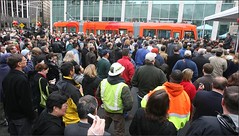
Crowds at the Seattle Streetcar launch
Crowds at the Seattle Streetcar Launch. Seattle Post-Intelligencer photo.

Labels: , , ,

Tuesday, March 25, 2008

Social infrastructure (community benefits)

Not too long ago, I wrote a revision of my thinking on community benefits issues, in the blog entry Community Benefits Agreements (revised).

According to the interview with Peter Newman, Vancouver, BC has taken this one step further. All development projects are required to devote 5% of the budget for a project to the enhancement of "social infrastructure." In most cities, such benefits usually kick in only when there are very specific zoning changes. From the interview:

Q: Done well: The spaces in between the buildings are important?

A. Very, very important. And this is what they do brilliantly in Vancouver. They do that with the community. This is the interesting dynamic.

Five percent of the cost of any new development goes into what they call social infrastructure - the space in between buildings. What you can do in landscaping, the cycle paths, the community centers...they've even built schools with it. But the local community decides what to do with it.
So if the local community has stake in density, there's no NIMBY there anymore: You want to go 40 stories? Well, maybe you could go to 50 stories, so we can have more money for our purposes.


It's a very different dynamic, which is why they've achieved high densities and very brilliant on the ground walkable neighborhoods.

Labels: , , , , , ,

Thursday, February 21, 2008

Community benefits agreements (revised)

--------------------
Note: on June 21st, 2008 I revised the typology below into five proffers/benefits categories. See "Community benefits agreements: revised (again)."
--------------------

The Ward 5 Economic Summit has a session on Community Benefits, although I have to say I wonder how hard hitting it will be. I'll miss it anyway (probably a good thing since it would likely bug me), because of the Florida Market tour this Saturday.

Talking with an ANC Commissioner last night after the presentation on traffic calming (more about that later, it was very good) about the community benefits process, I decided to update, revise, and expand some of my thinking on the subject.
----------------------------------

The current community benefits system is ad-hoc and the lack of transparency and structure disproportionately benefits developers at the expense of communities

Through my involvement in community land use matters since 2000, including participation on the ANC6C Planning and Zoning Committee from 2003 to 2005, I have become increasingly concerned about the lack of structure and inadequate levels of citizen participation in the negotiation of community benefits agreements generally, the lack of transparency of agreements negotiated between developers and local nonprofits deemed "community organizations" to determine how monetary benefits are spent, as well as the relatively paltry amount of benefits provided by most projects, and the failure to garner amenities in ways that could significantly contribute to substantive structural improvements in the neighborhood and at the city at large.

Doesn't anybody remember the great reporting in The Common Denominator about the community amenities agreements associated with development at Fort Lincoln, agreements that have never been effectuated, and the fact that the DC Government isn't too worked up about this? (See May 6, 2002 - News - Residents cry foul: Ft. Lincoln developer reneges on city deal that delivered land rights; June 3, 2002 - News - Fort Lincoln residents seek Norton's help; August 12, 2002 - News - Residents sue, charge Ft. Lincoln New Town developer with fraud; and May 6, 2002 - News - LBJ's 'Great Society' spawned Fort Lincoln development plan all from The Common Denominator.)

Furthermore, communities that are better organized and have resources end up getting more (or some) benefits, while under-organized communities get little to nothing in terms of benefits from new development occuring within the neighborhood.

Justification for community benefits/proffers

The economic justification for developer-paid community benefits/proffers is two-fold. First, adding developable square footage through zoning use changes (including planned unit developments), variances, and special exceptions make a property significantly more valuable. It is reasonable for a developer to pay back to the community some of this increase in value.

Second, development projects too often have a "trickle down" effect. Developments are frequently touted for their revitalization benefits, but in my experience without specifically linking the project to other improvements simultaneously, it is difficult to achieve the kinds of benefits touted by the project in short periods of time.

For example, the "overnight" success of H Street NE actually represents more than 30 years and hundreds of millions of dollars of already spent federal and city development funds. People still complain about the failure of revitalization -- "when is it going to come? -- not realizing that so much has been spent already.

But part of the "failure" is the failure to coordinate investment and improvements. My joke about the two office buildings on the 600 block of H Street NE is that in 20 years, the only economic development spawned by the project was one hot dog cart Monday through Friday. (They started with two but there was only enough business for one.)

The "failure to thrive" comes from the failure to link big new projects to necessary and complementary neighborhood improvements simultaneously.

At the same time, this kind of coordinated investment will make new projects more valuable more quickly, so one could argue that for certain kinds of developments, especially commercial and probably condominium development, that the money comes right back in terms of increased value. E.g., if H Street were currently a thriving commercial district, it is likely that the Akridge "Burnham Place" development would already be underway, and that the Senate Square development would have sold out, despite the housing downturn, etc.

How much are zoning changes worth?

The Zoning Commission and Office of Planning do not provide a metric for calculating how much density bonuses are worth. Some projects receive density bonuses worth tens of millions of dollars, and frequently the community benefits offered are worth significantly less than $200,000.

For the sake of argument, I suggest that the economic value of density bonuses be paid into a proffer fund at the rate of at least 10%. So added density worth $10 million would generate a minimum of $1 million in funds for proffers.

Communities must first set priorities for neighborhood improvements

Having a structured conversation about community benefits is a necessary first step in the consideration of a wider-range of public-private partnerships organized around land use and development that is designed to yield neighborhood and/or city-wide stabilization and improvement benefits.

Without such a conversation, communities give up a lot with little in the way of calculable return, judging by my experiences thus far. Most benefits agreements are paltry, and too often are little graft projects designed to fund an ANC Commissioner's pet projects or organizations. In the past, while rare, individual residents have received personal benefits (such as health club access to a hotel) or air conditioners.

In order to craft agreements, first neighborhoods/Wards/ANCs must work together to develop a set of neighborhood priorities, and ensure that proffers are directed only to those items which the community agrees are important.

Priority areas for funding include civic institutions (public schools, libraries, parks), transportation-mobility improvements, streetscape improvements, community history and interpretation, public art, and commercial district revitalization programs, and historic preservation-based building rehabilitation.

Contributions must be substantive, yielding long-term benefits and consequences, rather than "flash in the pan" benefits with little in the way of structural impact. For example, a project at Fort Totten in Ward 5 provided funds for improvements to a local school and library, and an offer was made to the National Park Service to fund improvements to an adjacent park.

Probably improvements to public charter schools should not be considered an acceptable proffer, because the buildings and facilities are not owned by the DC Government (and held in trust for the Citizens of the District of Columbia).

Is design improvement a community benefit but not a proffer?

Another consideration is project-specific design and urban design considerations more generally. "Design" is currently considered a community benefit under the Planned Unit Development system, but almost every instance where I have been involved the benefit to the community is nonexistent and changes to the project come only after an inordinate amount of work on the part of particularly engaged residents.

This is especially important with housing developments. In the current system of development, a commercial building may have a useful life as short as 20 years. In any case, it can be "freshened up" with a new facade at some point to extend its useful life. Owner-occupied housing is likely to never change its design. The hip modern designs of today are likely to become quite dated in as soon as 10 years.

We must remember with housing developments that "what you see is what you get," forever. Fostering design improvements to projects should be an important part of the development process, although this type of benefit should be built into the project as a direct cost independent of the proffer system.

Participation of community development corporations in the proffer process

In the past local CDCs have received ownership positions in development projects by private developers as a community benefit. In part this was done to assure that a particular developer would win development rights from the government entity that controlled the property, such as the Redevelopment Land Agency. But the contracts for these benefits are not open to the public (for the most part) and no accountability and oversight mechanism has been built into these agreements to ensure that "community benefits" truly result from the economic interest awarded to seemingly local organizations.

This must change. No development participation should be awarded to community organizations without the provision of transparency, the provision of direct benefits to the community, and a process of oversight and accountability over such agreements.

How should a community structure its thinking about community benefits?

Proffers can be categorized as one of four types:

1. National benefits;
2. City-wide benefits;
3. Neighborhood benefits within a geographically defined area such as an ANC;
4. Micro-benefits within a couple block radius of the project.

National benefits. This category covers green/environmental/LEED type requirements. Generally, these kinds of investments pay back to the developer, and for the most part are "merely" good business practices that deserve little in the way of special consideration when valuing community benefits agreements.

It is important that these types of project improvements be considered in an absolute rather than a relative manner. E.g., who cares if a gas station has a couple solar panels? And losing the embodied energy of a building through demolition can likely not be recovered through green construction practices on new construction.

However, building materials recycling should be considered a national benefit deserving of special consideration as a proffer, because the cost of deconstruction is higher than standard demolition. Construction materials make up 50% of the waste stream and much could be recovered through building deconstruction.

City-wide benefits. This category relates to city-wide policy, and would cover affordable housing, DC-based employment agreements, minority contracting requirements, and transportation demand management requirements, etc. These are public policies that serve the city more broadly, rather than the specific neighborhood in which a project is located.

Employment and contracting requirements should be considered standard business practices not deserving of special consideration. Affordable housing requirements do cost money and should be awarded consideration.

Transportation demand management practices (spaces for car sharing, secured bicycle facilities, showers [for office developments]) should have been required as part of the recent Comprehensive Plan revision but were not. ANCs could step and demand that TDM planning and facilities be required for new housing and commercial developments.

Certain of these investments could be considered community amenities to the extent that they provide neighborhood benefits beyond benefits strictly for users of the site, such as car sharing spaces where the car can be used by members not living on the property and shared parking facilities.

Funding improvements of important city-wide projects could also be included within the proffer system, e.g., the rehabilitation of a cultural resource asset such as a neighborhood movie theater, deaccessioned school building, etc.

Neighborhood benefits. This category would encompass proffers that are directed to facilities, organizations, services, and residents located within the defined geographical area where the project is located. For example, affordable housing, hiring policies, and business source agreements that target neighborhood/Ward residents and businesses specifically would be considered community benefits deserving of special consideration.

So would improvements made to local public schools, parks, and libraries. Or assistance made to important neighborhood projects. (For example, in the H Street neighborhood, proffers could have been used to help fund the cost of rehabilitating the Atlas Theater.)

Other examples of neighborhood benefits would be the provision of shared parking facilities, i.e., a parking garage supporting residents but also providing access to consumers visiting an adjacent commercial district, funding of historic preservation/cultural resource surveys, paying into community development education programs at the neighborhood level, funding of commercial and neighborhood improvement projects such as:

• community heritage/history interpretation and signage programs;
• public art projects;
• business directories/maps for installation in neighborhood-commercial bus shelters;
• bus stop, treebox, street furniture, sidewalk lighting, and other streetscape/infrastructure improvements deemed important by a neighborhood;
• neighborhood marketing programs including the development of brochures, booklets, and banner programs;
• traffic calming projects including bulb outs;
• funds paid into business development programs to support the development and improvement of local retail and home-based businesses; etc.

For example, in Brookland, the east side of the station does not have a canopy over the escalator/stairs. The cost to install a canopy is $900,000, and installation of such at the Brookland station is not currently scheduled. Proffers could fund the installation of a canopy there independent of WMATA funding streams.

Similarly, the 600 H Street NE development has agreed to pay for the creation of a mid-block crosswalk and the cost of the installation of a traffic signal. The signal alone costs $150,000.

Micro-benefits. This category covers projects benefiting the area immediately around the specific development activity, the area that is most impacted physically, and on a day-to-day basis, by the project both during construction, and after it is finished. This includes streetscape improvements and other enhancements.

A possible improvement would be urban design additions to the project that the developer does not want to make because of value engineering desires. This is a tougher nut to crack, and could be considered a neighborhood improvement as well.

For example, I was not able to convince the developer of the 600 H project to develop the south side of the project, rear buildings which will border houses and a historic alley, to comparable to traditional rowhouses--think crappy south Fairfax new townhouses around Fort Belvoir vs. the 1890s brick rowhouses that typify Greater Capitol Hill.

Partly this was a failure due to their suburban design sensibilities, but part was over cost, as the labor cost for traditional masonry is $15/s.f., much higher than the cost of slapping up a commercial window or some hideous siding.

Conclusion

Equity. Somehow, the value of proffers needs to be shared between city-wide, neighborhood, and micro project improvements.

Neighborhoods with many development opportunities will benefit disproportionately from the proffer system. Improvements in other parts of the city can be funded in part by directing a percentage of all proffers to a fund for city-wide funded projects.

Another resource. Community Benefits Agreements: Making Development Projects Accountable,

Monitoring and Enforcement. This article from the New York Times, SQUARE FEET; The Trade-Offs in Zoning Trade-Offs," discusses how important monitoring is to the maintenance of public benefits. From the article:

Since 1961, when the first density bonus was codified into city zoning law, public amenity trade-offs have proliferated. The Hearst Tower, under construction at Eighth Avenue and 57th Street, was granted a density bonus in exchange for making improvements to the Columbus Circle subway station. The Biltmore Theater on 47th Street was fully restored by the developer of a residential tower on that street.

More common, however, are spaces that have been taken over for private purposes. For example, many spaces that were created for the public have been appropriated for cafe seating, a common violation of the density bonus that was publicized by Jerold Kayden, a professor of urban planning and design at the Harvard University Graduate School of Design, in his extensive study of public spaces created in New York City since 1961.

After the study was published, the city started enforcement procedures against a number of building owners, and Professor Kayden established a small nonprofit monitoring group called Advocates for Privately Owned Public Spaces, which is financed by the Municipal Art Society. The group keeps an updated database of more than 500 public spaces, but has neither the staff nor the resources to track public amenities built by private developers that are not regulated by city zoning laws.

It is important that the proffer system be open, transparent, and trackable.

Arlington County has a capital improvements database, which is now publicly accessible. (See "A laudable example of municipal transparency: Arlington opens municipal construction project tracking database to the public.")

A similar kind of database needs to be created in DC that would list all properties owned by the DC Government and its instrumentalities, including publicly charterd Community Development Corporations, and any and all such proffers and community benefits agreements associated with properties/developments.

And a system needs to be set up for monitoring and tracking compliance, with reports provided annually to ANCs for all projects within their borders, as well as a master report including all projects across the city.

Labels: , , , , , , ,

Saturday, May 05, 2007

A substantive proffer

According to the Washington Business Journal story "JBG to donate $4 million toward developing D.C. parks," this is a required proffer--not a donation--as part of a Planned Unit Development zoning matter in SE DC.

PUDs are the only zoning matter that tend to require "community amenities," based on the value of additional square footage received by the developer over "matter of right" square footage that could have been built through the normal process.

We need to find out what the value calculation was. Not that anyone keeps track, but this appears to be one of the highest community amenity awards I've run across over the past few years. Most are so paltry as to be laughable.

Labels: , , , ,

Tuesday, March 20, 2007

Speaking of "wealth grants" and proffers

The reason that community benefits are provided is that variances, exceptions, density bonuses, and other changes to zoning and building regulations that benefit developers have significant economic value.

The idea is that the community-polity receive something in return.

To demonstrate how out of whack this is in DC, the Dreyfus Corporation seeks zoning variances for a project on 200 H Street NE that have a likely economic return of as much as $50 million. In return, Dreyfus offers about $500,000 of "community" benefits.

I have argued that the reason the negotiating process is unstructured, and that the reason that the Zoning Commission, the Board of Zoning Adjustment, and the Office of Planning don't provide training to community organizations and Advisory Neighborhood Commissions on how to negotiate with developers is because the Growth Machine wants their minions to limit the cost of this process for developers.

As long as a developer can get away with donating $50 to a block party, and calling that a community benefit, they don't have to pay very much.

ANC6A is asking for party status in the 200 H Street NE matter, to focus on this issue. See the document: Request for Party Status, ZC #05-37, 200 H St. NE from the ANC6A website.

This project is actually located within ANC6C, but since it is on H Street, it is a matter important to the entire community. And, frankly, to the residents of the entire city.

Go ANC6A!

Labels: , , ,