Rebuilding Place in the Urban Space

"A community’s physical form, rather than its land uses, is its most intrinsic and enduring characteristic." [Katz, EPA] This blog focuses on place and placemaking and all that makes it work--historic preservation, urban design, transportation, asset-based community development, arts & cultural development, commercial district revitalization, tourism & destination development, and quality of life advocacy--along with doses of civic engagement and good governance watchdogging.

Wednesday, July 26, 2017

Revisiting impact fees (versus "community benefits") for cultural uses

There is a big debate amongst residents about real estate development, and the idea that any new development should provide "community benefits." Sadly, I never took any anthropology courses, but I think this concept is related to the idea of paying your way in to be part of a new community and has some basis in anthropological theory.

In "In lower income neighborhoods, are businesses supposed to be "community organizations" first?," (2012), I wrote:
Years ago, I had a conversation with Mari of In Shaw, where we discussed ANC and community involvement with regard to new businesses opening up in the community, and how the community groups were much more focused on what they could get from the businesses. Mari made a comment to the effect that they are businesses not social welfare organizations (I can't remember the specifics, we're talking about a 7 year old or older conversation).

This comes up all the time when you read in the local media about business presentations at various community meetings.

Note that this isn't a phenomenon exclusive to "poor" neighborhoods. Years ago I was at a meeting of CulturalTourismDC and at the meeting, a representative from a theater that had recently opened in Penn Quarter, announced how they were looking for donations from local businesses, inducements for patrons, etc. I countered, why not think about how this can be "mutually beneficial" instead of all one way?

The reality is that in lower income communities, community ties, social networks, and other relationships are much more important and vital to every day living, and so when you look at businesses entering the community from the standpoint, you can understand why people would look at businesses not so much as entities trying to survive and make a profit, but instead as merely another actor-participant, different sure, within the web of existing community ties, and their expectations that all members of the community contribute within the web of social networks. Contributions to the community are the price that a business entrant has to pay in order to be allowed to participate and be considered a co-equal actor within the community network.
Are impact fees-community benefits more akin to "entry fees"?  But now I think this kind of thinking and expectation isn't limited to lower income communities.

That's the basis for thinking about impact fees in more rigorous ways, which I've been meaning to write about in the context of a different piece about "community benefits," which are handed out to facilitate development, but often not in a structured and transparent fashion, but in a more semi-corrupt way ("D.C.'s Insidious Culture of Developer Influence Won't End With Campaign Finance Reform," Washington City Paper).

Community benefits versus impact fees: Community benefits come in return for benefits.  In most places a requirement for the provision of "community benefits" is only triggered when the property owner seeks extranormal benefits such as waiver of fees and taxes, free land, tax incentives, etc., or zoning relief such as more density, a change in zoning, waiver of requirements, etc. 

So community benefits are conditional payments, awarded in return for specific, monetizable benefits.

Impact fees are the price to pay to join an existing community.  On the other hand, in communities that charge impact fees, such fees are mandatory for every property whether or not the developer seeks extranormal benefits or zoning relief.

Impact fees on new development pay towards infrastructure investments, usually for schools and transportation, and sometimes for other civic facilities and functions.

I think we could think of them as comparable to "membership fees" to join a food co-operative (e.g., the Takoma Park Co-op) or a golf club.

But instead of going towards private benefits -- discounts on food purchases, access to an otherwise private facility -- development impact fees pay towards the provision of public goods.

In the DC metropolitan area, DC doesn't charge impact fees, while counties like Montgomery and Prince George's do. DC elected officials argue that by not charging impact fees, we encourage and incentivize development in the city.

-- "Development impact fees," 2014
-- "Times have changed with regard to funding infrastructure improvements that make land more valuable," 2011

Montgomery County charges a fee for schools and a fee for transportation, while in addition to those, Prince George's charges impact fees for public utilities and public safety.

It does add a lot to the cost of a dwelling unit, but it's reasonable to ask for new developments to pay towards the sunk costs of creating and maintaining existing infrastructure and required expansions to meet the needs of the new residents being added to the community by new development because it uses and/or adds to the "load" on the infrastructure.

In DC, because of base of developable land is so small, as properties are developed in certain ways other uses are crowded out.  That's where planning is required, to provide for such uses, to step in where "the market doesn't work," and to ensure that the range of amenities and facilities in a community has both breadth and depth.

How about impact fees for cultural uses?  Cultural uses and space is an area not typically addressed through impact fees. But why not?

Last week's Washington City Paper has an article, "Artists' Collective," about the development of some temporary cultural space on a fallow lot which is slated for further development. It discusses the lack of cultural spaces in the city and Martin Ditto, principal of the company that owns the lot featured in the story, suggests that all new developments be required to provide cultural space. From the article:
There are potential remedies to the disappearing of cultural spaces. The website for the yet-to-be-released D.C. Cultural Plan lists “addressing rising real estate costs that affect artists’ abilities to find affordable space in the District” and “better leveraging of public land and infrastructure,” as key areas of focus. Ditto suggests a rule that anywhere from one to ten percent of new development space be earmarked for arts space.
How to use a cultural facilities impact fee.
While Martin Ditto's idea is interesting, I don't think that is the best way to go about "getting what we want."

1.  I do think we need more cultural space, but we shouldn't leave it up to the vagaries of property development to create the space.  This would likely result in lots of little underpowered spaces like at the Atlantic Plumbing multiunit apartments there is a 1,500 s.f. space for Washington Project for the Arts ("WPA Signs Lease on a New Home in U Street Corridor Cultural District," press release), and a surfeit of space in the districts experiencing the most development and no facilities in the districts with little development.

2.  Instead, it's better to have fewer, powered, well-located spaces. 

3.  And rather than expect developers to provide such spaces "on their own," and focused more on meeting their particular needs, let's plan and provide these spaces through the city, community development corporations, and other means.

4.  To fund it, how about impact fees to support cultural and civic infrastructure?

5.  Backed up by good cultural/neighborhood master plans.


Their use should be directed by various master plans covering needs at the city-wide, district/sector, and neighborhood scales ("Whose space...," 2012;  "Arts, culture districts, and revitalization," 2009; and "Ground up (guerrilla) art #2: community halls and music (among other things," 2011).

6.  With a high-powered implementing organization functioning at the city-wide scale, with sub-organizations focused on individual neighborhoods. 

To make this work and to build capacity, having a city-wide cultural nonprofit backing up neighborhood efforts would be best, functioning not like Cultural Development Corporation DC ("When BTMFBA isn't enough: keeping civic assets public through cy pres review," 2016), but more comparable to:
Examples of fundable projects in DC neighborhoods Examples of projects that either happened or didn't, I can see such impact fees on H Street going towards the Atlas Performing Arts Center, a new community library, the Fringe Theater Group, and new uses.

In Takoma, it could have paid towards acquiring the Takoma Theater (which was instead purchased by a for profits developer who ripped out the cinema/theater function) and towards the Electric Maid community arts space.

In Dupont Circle, it could help pay for redevelopment of the Dupont Underground space ("Dupont Underground looking for donors to build on initial success, Washington Post).

In Southwest DC, it could help pay towards the creation of new combined library-cultural center and the development of an organization like Brooklyn's BRIC, which recently opened the multifaceted BRIC House  ("BRIC Arts | Media House opens in Brooklyn," Theatre Projects) and a television studio in the Coney Island branch of the Brooklyn Public Library.

In Downtown/Penn Quarter it could have funded keeping the Goethe Institut there, when it faced a rent increase.

Etc.

Labels: , , , , , , , ,

Wednesday, July 22, 2015

Structuring community benefits agreements

(I have been really busy with a possible project and creating a detailed proposal for it.  We'll see where it goes.  But it definitely kept me from blogging.)

I have written a bunch in the past about community benefits agreements and how in DC, a relatively undefined framework for types of benefits, with the exception of added affordable housing in return for a density benefit, allows developers to not provide very much.

-- Community benefits agreements revised (again)
-- What community benefits are supposed to be versus what people think they are about
-- Community benefits agreements and energy considerations


And lack of good process allows many different actors to take part in negotiations in ways that diffuses impact.

Not to mention a lack of a good framework means that there is too little focus on realizing extranormal long term (structural) benefits.

I was reading a Montgomery County plan and it referenced that jurisdiction's public benefits process associated with special development considerations.  It's outlined in Division 4.7, Optional Method Public Benefits, in the new (2014) Montgomery County Zoning Code, on page 4-96.

All jurisdictions should create a comparable process.  And include in district, sector and neighborhood plans a section on community consensus priorities in order to help shape and accelerate the process.

A.  Major Public Facility

B. Transit Proximity

C. Connectivity and Mobility
1. Advance Dedication
2. Minimum Parking
3. Neighborhood Services
4. Public Parking
5. Through-Block Connection
6. Transit Access Improvement
7. Streetscape Improvement
8. Trip Mitigation
9. Way Finding

D. Diversity of Uses and Activities
1. Adaptive Buildings
2. Care Centers
3. Dwelling Unit Mix
4. Enhanced Accessibility for the Disabled
5. Live/Work
6. Moderately Priced Dwelling Units
7. Small Business Opportunity

E. Quality Building and Site Design
1. Architectural Elevations
2. Exceptional Design
3. Historic Resource Protection
4. Public Art
5. Public Open Space
6. Structured Parking
7. Tower Step-Back

F. Protection and Enhancement of the Natural Environment
1. Building Lot Terminations
2. Cool Roof
3. Energy Conservation and Generation
4. Habitat Preservation and Restoration
5. Recycling Facility Plan
6. Transferable Development Rights
7. Tree Canopy
8. Vegetated Area
9. Vegetated Roof
10. Vegetated Wall

G. Building Reuse

Labels: , , , , , , , , ,

Monday, December 09, 2013

More Walmart in DC

The Post had an article in yesterday's paper, "How Wal-Mart brings took Chicago -- and DC," about this week's opening of the two stores and how "Walmart is learning from its urban forays," especially Chicago.

This kind of article is a bit frustrating for me because the Post seems to have a history of running such articles after something opens, and not acknowledging such concerns during the development process, when activists are raising questions.  I remember being struck by this when the Convention Center opened in 2003 I think, and only afterwards was criticism really included in the newspaper's coverage.

Such after the fact reporting doesn't help us ensure that new projects yield the greatest possible benefit or that problems are adequately mitigated, etc.

That's the case with Walmart.

One of the things that the article mentions, is that the entry of big box stores like Walmart brings other chain stores as followers. 

But what is missed in this article and in some of the research on the subject is how changes in the store composition of commercial districts from a mix of locally owned stores and national chains to being more dominated by national chains also changes the district and has other economic effects.

Money spent in nationally-owned chains has less of a multiplier effect or the amount of money that recirculates within a community from subsequent transactions than money spent in locally owned stores, because national chains typically do not purchase goods and services locally, except maybe for some advertising.

Also, because chain stores typically don't get involved in local commercial district promotion and community participation, at least not to the extent that "may be warranted based on sales," this has the effect of diminishing local economic activity and community capital.  From the article:
said Maureen Martino, executive director of the Lakeview East Chamber of Commerce ... Once the stores opened, she was disappointed not to see the retailer play a more active role in sponsoring public schools or charities: 'I don't see them giving back without asking for anything back.'
That type of business calculus shouldn't be surprising to anyone the least bit familiar with how retailers operate.  And it's something that elected officials need to be concerned about when they recruit chain businesses to their communities.

And as pointed out in the article, in Chicago research hasn't demonstrated that the stores necessarily increase overall sales and tax revenue or employment, just change how it is organized and generated.

And I continue to argue that people are learning the wrong lesson about Walmart choosing to have stores in some horizontal mixed use projects in DC and Los Angeles as representing some change in how Walmart develops stores.  From the article:
But it also learned from Chicago and other urban markets like Los Angeles, said Virginia Parks, associate professor at the University of Chicago School of Social Services Administration.  Wal-Mart enhanced its store design further, agreeing to build two stores on the ground floor of apartment complexes.
Where Walmart is more of a tenant, they seem to be willing to take space in some mixed use projects, if the projects are in desirable locations. 

By comparison, where the Walmart real estate team is more involved in driving the project, they seem to be doing suburban-oriented single use buildings, even if the store may have structured parking or other more urban-appropriate design elements.

Cities need to have the right planning processes in place before Walmart comes calling, because after the process starts, it's too late to do anything--unless the elected officials are truly motivated to protect the interests of their community completely and delay the process while putting into place better and more complete planning controls.

In Hercules, California, the city used eminent domain power not to give land to Walmart, but to prevent them from entering the city ("Vote goes against Wal-Mart/ Council OKs using eminent domain to block retailer," San Francisco Chronicle).  Few cities have such fortitude.

It's another example of what I call "chance favoring the prepared city."  Without a plan, it's tough to ensure the best possible results.

Past blog entries

-- Lessons from Walmart's foray into DC
-- Wal-mart plays hardball with DC 
-- What community benefits are supposed to be versus what people think they are about

Labels: , , , ,

Wednesday, May 22, 2013

That damn Growth Machine: developers, incentives, givebacks, accountability

Construction site, Wisconsin Avenue NW, Cathedral CommonsWAMU-radio, the NPR affiliate of American University, has a series now on real estate development in DC, and how developers get incentives, promise "community benefits" as part of various deals, and often don't follow through.  See "Empty Promises: Developers Often Don't Deliver," which includes links to other segments of the series.

I haven't listened to all of it, and there are programs to come but I expect that the series doesn't provide any way forward, or a deeper analysis on why this occurs.

First, the issue is that this is way local political and economic elites are set up to work together on local economic development.  It's explained in political science as "Urban Regime" theory and in urban sociology it's called "the Growth Machine."  I've discussed it ad infinitum, but this entry is as good as any, "A superb lesson in DC 'Growth Machine' politics."

Ecco Park Condo promotion sign, Takoma DCThe basic point is that political and economic elites, despite seeming intra-elite competition, have the same agenda, focused on real estate development and land use intensification. It's why when different people get elected, things don't change very much as they are part of the same system (see "The 'system' vs. 'Anybody but Fenty'," Umm, it's the system," and "DC At large City Council Election: one insider picking off another insider is not a 'game changer').

Second, so this means that processes where the developers have to "give back," are under-defined to reduce out of pocket costs.

Third, it's complicated further by the fact that many people believe that in order to develop "your property" you ought to pay into the community.

That's not how capitalism and property rights work, but is a common belief.

I discuss this in terms of networks and community ties in the blog entry, "In lower income neighborhoods, are businesses supposed to be "community organizations" first?."  (This belief has also come up in discussions of the WAMU series on community e-lists in Petworth and Columbia Heights.)

Highland Park Apartments ad, Columbia Heights, DC, Express NewspaperAnd I explain the process by which "community benefits" are triggered here, "What community benefits are supposed to be versus what people think they are about" and "Not understanding what triggers a community benefits process."

And I offer a method for defining, monetizing, and structuring "community benefits" processes much better than how it is done currently, in these posts, "Community benefits agreements (revised)" and "Community benefits agreements: revised (again)."  The latter is merely a tweak of one element of the earlier entry.

These pieces are based on my various experiences working on or observing various development projects in DC mostly, but also to some extent with processes in some of the other jurisdictions in the area.

I don't expect that the WAMU series will get into much depth on why the processes work or don't work the way that they do, and a better way forward.

(Note that the images are illustrative only and do not necessarily reflect projects discussed in the WAMU series or in past blog entries.)

Labels: , , , , , ,

Tuesday, May 07, 2013

I hope for Aspen Hills' sake that Montgomery County is smart enough to learn from DC's planning errors with regard to Walmart's entry

Image of the Vitro Building in Aspen Hill from the Gazette.

The Examiner ("Opponents call Montgomery County vote 'fast-tracking Walmart'" and "Montgomery's dilemma: Walmart or empty hulk?") and Gazette ("Proposed Wal-mart site designed for unique tenant: Proposed Aspen Hill Wal-mart site was designed for specific tenant" and "Aspen Hill residents take sides on planned Walmart: Civic Association will discuss issue next month") have stories on how the Montgomery County Planning Board got approval from the Montgomery County Council to proceed with consideration for a zoning change for a parcel of land in Aspen Hill without having to go through a full master planning review and update process.

1.  This is somewhat controversial because the property is a vacant office building (see the 2010 Gazette story, "BAE Systems to leave Aspen Hill property by late June"), empty for almost three years, and concerned residents would prefer that the site be redeveloped instead of just sitting there.

The developer argues that there isn't demand for office, which is the zoning for the property.  (And note that in Silver Spring, more properties are being redeveloped as residential, because of a drop in demand for office space.  See "Silver Spring commercial plans shifting to residential" from the Gazette.)

2.  It's also controversial because the developer proposes a Walmart, and Walmart for reasons that have been covered here in great detail, is controversial (they just launched a new image campaign, see "Will Consumers, Hourly Associates Buy 'The Real Walmart'?" from RetailWire), especially in communities with strong unions (typically grocery store employees are represented by unions, and Walmart workers are not), because it can lead to store closings by unionized firms.

3.  Resident desperation is something that developers like, because it allows them to build something, not necessarily something good, because people's concerns for quality get beat down over time in the face of nothing happening (counter that to the piece the other day about the saga of the BP gas station vs. the 215 unit apartment building + a Giant Supermarket on H Street NE, which was ultimately a 13-year process).

4.  But because the use change for the site requires a change to zoning, this does give the county some leverage to push the developer to do something "better" rather than merely the minimum that's allowed.

My understanding is that the preference is for a mixed use project, even though the site is more than 2 miles from the Glenmont Metro Station.  Then again, high capacity transit station access is not an absolute requirement for mixed use--it comes down to market demand and opportunity.

5.  What are the lessons from DC? ("Lessons from Walmart's foray into Washington, DC")

- how to develop a property is a different decision from what type of use goes there
- the animus with regard to Walmart gets people all worked up and rash and therefore they deal with neither issue--how to develop versus the use--very well and Walmart and developers know this and use it to their advantage
- Walmart is now willing to consider mixed use properties, but ultimately they don't care how a site is developed so long as the location meets their preferences (so don't go to Walmart expecting them to advocate for your desires for mixed use)
- so ultimately whether or not a site with a Walmart is developed as a vertical mixed use project or a single site project is up to the developer
- with the suasion power of the local government planning and zoning process

Unlike many jurisdictions, DC doesn't have a "Big Box Review Ordinance."  Fortunately, Montgomery County does have such an ordinance, which gives them more capacity for review.

However, it does not address what people call "community benefits" issues, wage and other elements, which some activists and unionists think that such stores should have to provide.  (I don't necessarily, see "What community benefits are supposed to be versus what people think they are about.")

In both Montgomery County and DC there have been initiatives to create such requirements for big box stores, because of Walmart, although sadly there has been no initiative to create a "big box ordinance" or related planning and building regulations in DC.

6.  In short, the focus needs to be on Lee Development Company, the owner of the Aspen Hill site, and no one else (definitely not Walmart) in order to get the best possible mixed use result.

7.  In DC, sadly, reporting on a couple of the "good" Walmart store proposals within vertical mixed use projects has overshadowed the fact that half to two-thirds of the sites in DC will either be single site stores or horizontal mixed use.  2 out of 6 isn't very good.  It's terrible (except in baseball).

The development of the 1st and New Jersey Avenue NW site that will have a Walmart demonstrates that high quality mixed use urbanism with a big box--even a Walmart--is possible.  And it also shows that settling for sub-par urbanism at most of the sites will disserve DC for many decades.

Hopefully Montgomery County won't make the same mistake.

Proposed rendering for the Fort Totten Store (the company got their financing to go forward a couple weeks ago, see "Financing secured for Wal-Mart-anchored Fort Totten Square" from the Washington Business Journal)
Mixed use Walmart, rendering, Fort Totten Square, DC

Single use Walmart on a 4 acre site on Georgia Avenue NW
Walmart rendering, Georgia Avenue store, DC

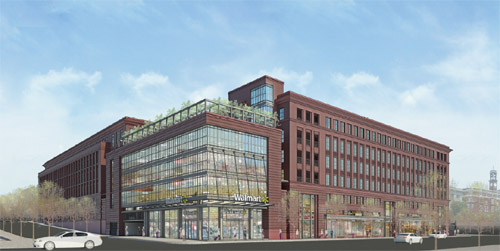
The 1st and New Jersey Avenue NW site under construction
the new mixed use building, including a Walmart, at 1st and New Jersey Avenue NW
Building under construction

Rendering
Walmart rendering, 1st and New Jersey Avenue NW

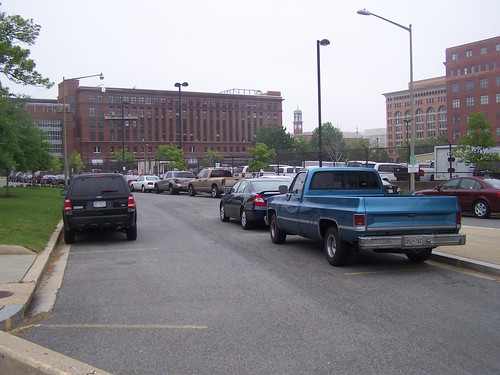
the new mixed use building, including a Walmart, at 1st and New Jersey Avenue NW, overall setting
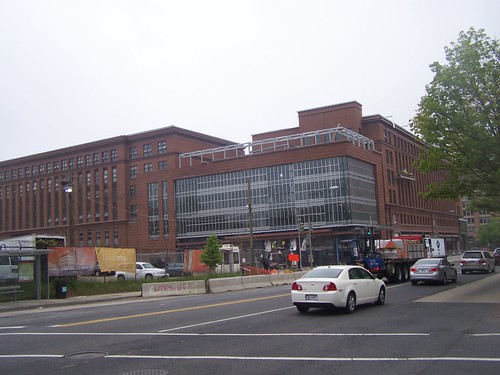
More than most, JBG, the developer of this site, respects context and developed a project that took its design and architectural cues from the buildings around the site, which include the Government Printing Office--the first building was constructed in the 1860s--which is shown in the far right of this photo.  The building to the immediate left of the GPO was constructed in the late 1980s, and also took its design cues from the GPO building.

Labels: , , , , , ,

Thursday, March 21, 2013

DC's proposed legislation on large retailers is misguided

Left: sign up sheet at the Walmart booth at the H Street Festival in September 2012.

See "DC Council panel hears testimony on 'living wage'" from the Post and "D.C. could force huge wage increase on city's big retailers" from the Examiner.

Obviously, opposition to this bill is why Walmart has been in full-time organizing mode since last summer, which I wrote about a couple times.  See "Wal-Mart is among 'Don't block D.C. Progress' backers" from the Post.

The legislation misguided because it focuses mostly on how the business treats its workers, and ignores the urban design and business district impact of large scale retailers on streetscape, urban design, commercial district revitalization, and small retailers.

That's because the legislation is being driven by labor interests--and I can't fault them for it--since typically large grocery chains like Safeway and Giant in the Washington region are unionized and chains like Walmart and Target (but not Costco) are not and this impacts prevailing wage rates and leads (generally) to the failure/consolidation of weaker supermarket companies when Walmart in particular enters a market.

Big box retail zoning ordinances, to my way of thinking, should be focused on the business and urban design impacts primarily, and less so the labor impact, although that does matter.

In the approval process for the coming Walmart store on Georgia Avenue, the DC Office of Planning declined to consider "economic impact" as a "neighborhood impact" within the context of the Large Tract Review regulation.

From "ANC4B Large Tract Review Report on Walmart, 5/2011":

The large tract review process is designed to ensure that extra-normal demands are not made of DC Government resources, including infrastructure, through the process of inter-agency review and
coordination. Specifically the process is designed:

• To minimize adverse environmental, traffic and neighborhood impacts;

• To avoid unnecessary public costs in terms of new services or facilities required of city agencies; and

• To carry out the policies of the District Elements of the Comprehensive Plan for the National Capital. (Section 2300.2 of 10DCMR23)


Without considering the potential for negative economic impact (what in the California Environmental Quality Assessment process they call "urban decay") it becomes impossible to mitigate in advance potential negative effects.

Then what is the point of the Large Tract Review regulation anyway?

I wrote about this here: "Lessons from Walmart's foray into Washington, DC" and "Walmart: in the city vs. of the city."  From the foray piece:

What interests me most is what are the lessons, for planners, elected officials, and citizens?

1. Walmart isn't driven by ethics, the decisions they make are business-based. 

2. Walmart wants to be in the city, in "urban" markets, but they are agnostic about building and project form. If the site they want is what they want, they just want to be there, they won't push the developer to do an urban-appropriate or better project.

3. Communities are in position to get their clocks cleaned, unless they have the right ordinances in place before Walmart comes knocking, and has already lined up support behind closed doors long before it's reported in the media.

4. The Respect DC Coalition acts as if they lost, but they really won, sort of..., as Walmart negotiated a community benefits agreement in DC, just that Respect DC wasn't part of the negotiation.  

5.  A big lesson is that advocates should focus. If you don't, your opponents set the agenda. 

6.  Setting the agenda for negotiation is key and it should be focused on the long term best interest of the city and impacted neighborhoods, not anything else.  

a. What matters to me is the research that says for every job that Walmart creates, 1.5 jobs is lost.

Instead of monies paid out to charities, mitigation of the potential negative impact of Walmart on independent businesses and commercial districts should have been the foremost priority of any financial "contributions" by Walmart.

b. The other thing that matters to me is whether or not the stores will support urbanism and appropriate urban design.

But by focusing on jobs issues, and money for charities, substantive urban-related issues end up getting completely ignored.
   
I wrote about similarly misguided regulatory efforts on "big box" regulation in Montgomery County Maryland here: "What community benefits are supposed to be versus what people think they are about."

The proposed DC legislation has all of the same defects as the Montgomery County proposal.

This might also be useful, "If you don't know urban political theory, it's likely that you don't understand local land use: St. Louis: DC; etc."

Labels: , , , , , , ,

Thursday, June 28, 2012

1% for arts: what about 1% for community?: An idea

I am not sure how I feel about commercial property developers getting "shaken down" for "community" benefits as part of development projects.  I am engaged in for profit business activities myself, and I know that the margins on projects are very narrow, and at some level, the point of business is business.

What people don't seem to understand, often, is that "community benefits" derived from land use development projects aren't awarded just because the business wants to build, they are "charged" in return for benefits received by the developer from changes in zoning, density, variances, or exceptions from zoning and building regulations compared to the planning and zoning controls in place that the property would otherwise be developed under.  The zoning changes result in increased revenue from the project and in turn, community benefits are a kind of economic return.

In short, community benefits aren't awarded "just because".  See "What community benefits are supposed to be versus what people think they are about."


But after reading this piece by Deborah Simmons, "Exacting cost for Costco's arrival in D.C." in one of last week's issues of the Washington Times, about the various "demands" made on Costco by a neighborhood association located adjacent to the forthcoming location of the Costco store on South Dakota Avenue NE, I got to thinking about formalizing the social and community cost of business of locating in a community in terms of a kind of 1% of the project for the community.

From the article:

Will Costco change its corporate community-benefits model to appease its new neighbors in Northeast Washington?  Senior citizens sure hope so as they gear up for a meeting with Costco representatives, city officials and other D.C. stakeholders scheduled for Saturday morning.

ANC Commissioner Bob King and an estimated 1,000 senior citizens who live in the Fort Lincoln neighborhood — an enclave of apartments and single-family homes, and the soon-to-be neighbors of Costco — already have their wish list together.

Their list is not extravagant — exercise equipment, buying-club power, Senior Olympics sponsorship, computers, a few free memberships here and there. Things to benefit seniors and other residents who live in the city as well as those who live in Fort Lincoln, which is bounded by South Dakota Avenue, Bladensburg Road and Eastern Avenue in Northeast.

Much on their wish list doesn’t exactly fit inside Costco’s generous donation box.

To wit, Costco’s website says its donations do not directly fund government entities, individuals or political organizations, and that it doesn’t give money directly to athletic teams, events or sponsorships, or to individual primary or secondary schools.  ... 


But none of these parameters is deterring Mr. King and his voter-rich and very active band of constituents. They want Costco to set up shop in their neck of the Northeast woods, but with certain community benefits “so that these big-box retailers don’t waltz through the community like Grant ran through Richmond,” as Mr. King put it.


Communities need strong frameworks for community benefits agreements -- I've written about this in the past, "Community benefits agreements (revised)" from 2008, although in a conversation I had with Robin Diener of the DC Library Renaissance Project, she makes an argument that I need to write about, that community benefits processes are typically very localized, focused on the neighborhoods where the projects are being constructed, and instead should be focused on providing benefits captured by the city as a whole--and relatedly, about big box ordinances, as I wrote in "Lessons from Walmart's foray into Washington, DC," which also discusses general demands for "community benefits" not triggered by zoning changes.

The 1% idea, which I don't know if I agree with or not, comes from public programs called something like "1% for the arts," where municipal capital improvement projects allocate 1% of the expenditures on the project towards public art, which is then incorporated into the project.

Seattle's webpage on the topic explains how the program of 1% for the arts works there:

The program specifies that 1% of eligible city capital improvement project funds be set aside for the commission, purchase and installation of artworks in a variety of settings. By providing opportunities for individuals to encounter art in parks, libraries, community centers, on roadways, bridges and other public venues, we simultaneously enrich citizens' daily lives and give voice to artists.

Basically, the 1% for the community idea is that for projects of a certain size, they could allocate some percentage between 0% and 1% to community benefits that aren't otherwise triggered by zoning bonuses and changes.

I think it's fraught with peril, has a lot of opportunity for corruption, would need a strict process for deciding on benefits--the participatory budgeting model is an example of how a process could be set up in a manner that is reasonably fair.

But at least it would formalize a process that is happening anyway and is pretty screwed up.

Labels: , , , , , ,

Saturday, April 21, 2012

Today is Earth Day

1. Earth Day 2012 website.

2. According to David Smith of the Affordable Housing Institute, authors of the paper,"The Economics of Green Building," ran the statistics on commercial buildings across the country and found:

• Green buildings commanded rents roughly 3% higher than non-green buildings of similar age, location, and type.

• This premium was larger in 2007 than in 2009, but is still persistent despite the downturn.

• Green properties sell at a 13% premium to conventional, all other things being equal – meaning after controlling for location, Net Operating Income, and other rentability factors

So green building projects shouldn't get special zoning and financial incentives (other than investment funding for retrofitting, which is a different issue), as I mentioned in this blog entry, "Community benefits agreements and energy considerations," back in 2009.

3. On Thursday, I mentioned the environmental initiatives of Walmart, in association with the Environmental Defense Fund, and some of the problems this poses to local activists and the development and maintenance of local commercial district microeconomies.

4. In Washington, DC on the National Mall, the National Sustainable Design Expo is running through Monday, April 23rd. 300 college students are showcasing the solutions they proffered in response to the EPA Contest, "People, Prosperity and the Planet."

5. This article in the Toronto Globe & Mail, "These employers back Green Team initiatives," lists the various initiatives by companies and agencies recognized as Canadian leaders on environmental issues. There are a bunch of good ideas including how the YMCA of Greater Toronto has a funding program to invest in environmental initiatives, including generating electricity from exercise bikes.


This is another example of how sustainability as an issue seems to be a good way to re/engage citizens in "planning" when our traditional methods of doing so don't seem to be working out all that well in terms of civic engagement and empowered participation.

6. Next week, Mayor Vincent Gray of DC will be issuing DC's sustainability plan.

Labels: ,

Tuesday, November 29, 2011

What community benefits are supposed to be versus what people think they are about

The Post editorialized against the proposed "Walmart" ordinance in Montgomery County last week, "Montgomery’s big-box bill sends the wrong signal to retailers," and today has another article about it, "Montgomery big-box bill is unconstitutional, county attorney says," where the County Counsel argues the bill is unconstitutional.

I started a blog entry about this last week, but didn't finish it. Here goes.

The proposed law in MoCo isn't unconstitutional, it's just flawed in concept and proposed execution.

I wouldn't even call it a big box bill, because it doesn't systematically focus on mitigating systematic negative economic impacts of such stores on independent retailers and commercial districts.

1. The point of community benefits agreements generally is that a developer/tenant receives monetizable benefits from density increases, zoning changes, and exceptions and variances from zoning regulations, and that the community should receive something in return for the positive changes to the economic value of the property received by the developer.

2. The point of big box review ordinances is to weigh the potential negative impact against positive impact, and ensure that the projected costs of the entry of the business are appropriately weighed in the review process, and plans and programs for mitigation provided.


-- In California, as part of environmental reviews, new developments are supposed to address issues of "urban decay" that they might cause.

From the Urban Decay Study, City of Sacramento Railyards Development Plan:

For the purpose of the assessment and consistent with the intent of the court decisions, “urban decay” is defined as the closure of retail and other stores in the surrounding area as a result of market competition and disinvestment - leaving decaying building shells in a state of sustained vacancy, long-term abandonment, repeated property damage, and/or deteriorated conditions that significantly impair the proper and safe use of the real estate. Properties in areas with higher than normal market vacancies and which have been empty and/or unused for at least three years or more are assumed to be in prolonged or sustained vacancies. An example in Sacramento would be the K-Street Mall, which has suffered urban decay – and is only now being transformed by coordinated public/private investment back to a state of economic vitality.

The point of big box ordinances is to address the potential for urban decay and mitigate it as part of the approval/disapproval process.

3. On the other hand, businesses aren't "eelemosynary" organizations--they aren't charitable.

Although there is this new kind of for profit organization called a "social benefit corporation." One is open in Takoma Park, Maryland ("Blessed Coffee in Takoma Park offers perks to community" from the Gazette). To me, there is too much effort and risk involved in creating, managing, growing, and maintaining a business to be able to sustain the effort while giving away all the profit. (It's also why member cooperatives have a difficult time staying in operation also.)

That doesn't mean you can't have a social orientation in doing your business. In fact, the underlying business/marking approach I am using for BicyclePASS is based on social change theory along with social marketing and collaborative consumption and product models. (See
"Professor Sarah Soule Explains Effective Social Movements" and "How Markets Are Made and Broken by Social Activists" from Stanford Business School Magazine.)

But, typically, wage rates and many aspects of how a business operates wouldn't be covered by the review process deriving from either one of these building regulation process.

I know that as I participate in the development of a business focused on "bicycle facilities systems integration" I don't want "the government" legislating various aspects of how we are to run our business either, as it can hamstring us.

Just as Eastern Market in DC isn't run very well based on the law that governs it, nor is the Post Office well served by being micromanaged by the U.S. Congress...

4. The proposed MoCo ordinance is flawed because it isn't construed as a law based on planning and zoning regulations based on government's "police powers" focused on maintaining the health and well being of individuals and communities so much as it is based on a belief that "businesses need to give back to the community."

Planning and zoning regulations shouldn't be about buying off community groups--giving some dribs and drabs to selected organizations (which is why various groups in DC have been bought off in favor of Walmart, because they've received charitable contributions and other benefits), it's to mitigate in a substantive manner the potential negatives generated by the entry of the business, and to monetize the value of the zoning "relief" received by the developer/tenant.

5. Communities need strong frameworks for community benefits agreements -- I've written about this in the past, "Community benefits agreements (revised)" from 2008, although in a recent conversation I had with Robin Diener of the DC Library Renaissance Project, she makes an argument that I need to write about, that community benefits processes are typically very localized, focused on the neighborhoods where the projects are being constructed, and instead should be focused on providing benefits captured by the city as a whole--and big box ordinances, as I wrote last week ("Lessons from Walmart's foray into Washington, DC").

6. The intent of the MoCo legislation is admirable, but lacks a strong basis in planning "theory" and therefore distracts from what really matters--mitigating negative impacts and ensuring a level playing field for businesses.

The process in DC is a perfect example of the failure to have strong zoning regulations, because the community "partnership" agreement negotiated with Walmart fails to provide any substantive mitigation programs and monies, even while it buys off various community groups through charitable contributions.

Labels: , , , , ,

Wednesday, November 23, 2011

Lessons from Walmart's foray into Washington, DC

signs in a store window against Walmart's entry into Washington, DC, Brookland neighborhood
Store window display in the Brookland neighborhood, 12th Street NE, Washington, DC.

I wish I had more time to write my definitive take on the Walmart issue in DC.

As part of the ANC4B review of the application to build a Walmart on Georgia Avenue, at the intersection with Missouri Avenue, on a block that used to be the home of Curtis Chevrolet, and is ringed on the perimeter by small apartment buildings, co-ops, and duplexes, I was the lead author of a review document (ANC4B Large Tract Review Report on Walmart, 5/2011; ANC4B Large Tract Review Report on Walmart, Summary Recommendations), which made a variety of points about the review process, the need to do economic impact analysis, and to provide for mitigation.

A big point I made in the document is that the animus about Walmart makes it very easy for Walmart and developers to use that anguish about Walmart, ranging from their anti-union stance to wage discrimination complaints and how execution of their business model tends to come at the expense of locally owned businesses and traditional shopping districts, to create noise that ends up constraining "the discourse" on issues that people can address, such as whether or not the building is designed right, if it's part of a mixed use project (this matters in cities), and the creation of a mitigation program to deal with the negative impact of Walmart store entry on independent businesses and business districts.

This point undergirds my take on events from the past week.

So yesterday's announcement, "Wal-Mart, D.C. strike community benefits deal" in the Washington Business Journal, and today's article, "Wal-Mart package for DC includes job-training program, $21 million in donations" in the Post, that Walmart is signing a community benefits agreement that was negotiated not with the Respect DC coalition, but with the Mayor's office, is interesting, and follows last week's announcement ("Wal-Mart plans to open six stores in the District" from the Post) that Walmart will now build 6 stores, not 4, in the city.

The new locations are at Fort Totten Square--this location is only 1.7 miles from the proposed Georgia Avenue Walmart location, so I wonder if it will actually be a grocery only operation, a Walmart Neighborhood Market--and at the Skyland Center, a polyglot collection of stores in Ward 7 that DC had marked for urban renewal type operations years ago, but still hasn't pulled the plan significantly forward.
Mixed use Walmart, rendering, Fort Totten Square, DC
Top photo: rendering, Fort Totten Square. Middle photo: Rendering, Proposed Walmart, Georgia Avenue Northwest, Washington, DC. Bottom photo: Walmart Neighborhood Market in Downtown Chicago.

Walmart rendering, Georgia Avenue store, DC

Walmart Neighborhood Market, 555 W. Monroe Street, Chicago
In the summer when Mayor Gray "threatened" Walmart, stating he wouldn't approve their entry into the DC market if they didn't open a store in Skyland, I wrote ("Misplaced priorities: threatening Walmart if they don't open another store") that this was likely a kind of con job, that probably Walmart had already agreed to open a store at Skyland, either internally within the company or with the DC Government, but held back a public announcement as a bargaining chip, so that the Mayor would be in a position of being able to announce a victory later, like they did last week.

The location of a store at Fort Totten isn't surprising, since JBG bought into that center earlier in the year, and JBG already has agreements with Walmart for urban style stores in the NoMA District in DC and in Tysons Corner at the old Moore Cadillac dealership site, and for a store in an urbanizing area, Rockville Pike in Montgomery County, although it's not clear if the development is intended to be mixed use ("Wal-Mart plans to open store on Rockville Pike" from the Washington Post).

What interests me most is what are the lessons, for planners, elected officials, and citizens?

1. Walmart isn't driven by ethics, the decisions they make are business-based.

When people criticized Walmart's involvement in a healthy foods initiative involving First Lady Michelle Obama ("With praise from Michelle Obama, Wal-Mart announces healthy food campaign" from the Post), saying why would Walmart keep to the agreement, since they seem to pay women less than men and they are anti-union, etc.

I replied that people were missing the point, that the same decision making calculus that led Walmart to discriminate against women, unions, etc.--so that they could make more money and reduced costs--was in play with the healthy food initiative--they could make more money.

2. Walmart wants to be in the city, in "urban" markets, but they are agnostic about building and project form. If the site they want is what they want, they just want to be there, they won't push the developer to do an urban-appropriate or better project.

In DC, 2 of the 6 proposed Walmart projects are being done by JBG, a real estate developer known for its comfort and success with mixed use projects; 2 of the projects are being done by traditional shopping center developers having limited experience with mixed use projects; one is being done by a developer with mixed use experience, but limited exposure and concern about operating in DC (the Georgia Avenue store); and the other is being done by a nonprofit developer with a limited portfolio of experience.

So only 2 of the 6 stores will be truly "urban." The other four will be "suburban" for all intents, oriented to automobile-based consumers, but in the city.

3. Communities are in position to get their clocks cleaned, unless they have the right ordinances in place before Walmart comes knocking, and has already lined up support behind closed doors long before it's reported in the media.

This was definitely the case in DC, which doesn't have a "big box review ordinance" for large site retail. Such ordinances assess economic impact and provide procedures for mitigating negative effect or disapproval. DC's "Large Tract Review" procedure is pretty limited, and focused on coordination, not mitigation.

Walmart's real estate department learns from every engagement and they apply the total array of knowledge-learning from previous stores to each new store proposal.

Don't you think Walmart was very strategic, and chose locations where the zoning already allowed them to open a store, with very limited provisions, if any, for public review?

A typical community is like a deer in headlights by comparison, as the Walmart team brings the experience of 3000+ store openings and thousands of contentious interactions to the table, and by comparison, community representatives--be they elected officials, government employees in planning and transportation departments, or citizens--don't have near the knowledge base. It's a classic case of imperfect information.

The lesson for other communities is to get your ordinances in order, and have them in place before Walmart comes knocking...

-- Big-Box Ordinance and Conditional Use Permit (CUP) Tool-Kit, Midwest Environmental Advocates

4. The Respect DC Coalition acts as if they lost, but they really won, sort of..., as Walmart negotiated a community benefits agreement in DC, just that Respect DC wasn't part of the negotiation.

-- Walmart DC Community Partnership Agreement

Respect DC can and should be disappointed, but they also deserve credit because Walmart did do a kind of community benefits agreement, even though only 2 of the 6 locations may have triggered extranormal requirements for negotiation.

Little in the law forced Walmart to come to the table and they already had the support of key elected officials, even though they already locked up key lobbyists like David Wilmot, and in a town where trades unions representing semi-skilled workers are pretty weak (see "Selling of Walmart" from the Washington City Paper).

I have to believe that the Respect DC effort was essential to the creation of the agreement and they should take some credit for it.

From the Mike DeBonis District of DeBonis Washington Post blog:

Here are some of the big “gets” for the city:

— An effort to work with local small and minority-owned businesses to do construction work;

— a citywide workforce development program aimed at “low-income families, minorities, veterans, at-risk youth and formerly incarcerated residents”

— the “expectation of filling a majority of available positions” with city residents;

— $21 million worth of “charitable partnerships”over the next seven years;

— a commitment not to sell guns or ammunition in its D.C. stores and to attempt to provide space for locally sourced products;

— and an embrace of “transportation demand management measures,” including Capital Bikeshare stations, bus shelters, and electric car charging stations.

And here is what’s not in the agreement:

— Specific wage commitments;

— any wage or benefit concession that goes beyond what Wal-Mart would otherwise provide or what District law already requires;

— enforceable goals for the hiring of District residents.

Moreover, the agreement, signed by a Wal-Mart senior vice president, is “subject and contingent upon business conditions.”

And this was in DC, after Walmart played total hardball and beat the crap out of the City of San Diego City Council, so that after the Council passed a really great big box review ordinance, and maintained it after a Mayoral veto, Walmart organized a referendum campaign (it can't be proven that Walmart organized it but they likely did) to overturn the ordinance, and rather than go through with it, the Council backed down and voted to rescind the ordinance. See "Wal-mart buys San Diego" from Huffington Post. From the article:

Wal-Mart needed only 8 weeks and maybe thirty thousand dollars to scare the daylights out of the City Council in San Diego. One local official in San Diego, California called it a "dark day for democracy."

In December of 2010, the City Council voted to override a veto by the Mayor of a zoning ordinance that requires certain big box stores over 90,000 square feet to study their impact on the local economy, on wages, and on traffic. It was a watered down ordinance at best -- but there was one "citizen" who didn't appreciate the City Council vote. Wal-Mart began portraying the ordinance as an outright ban on superstores, and the corporation hired professional signature collectors to put the issue on the San Diego ballot. Wal-Mart knew that San Diego could not financially afford to hold a referendum, so all the folks in Bentonville had to do was throw a head fake. It worked.

Cash-strapped San Diego would have to swallow hard to come up with the $3.4 million cost of a referendum. Wal-Mart put the City Council neatly in a box. The City Council voted 7-1 to rescind the ordinance -- not because they had a change of heart -- but because fighting Wal-Mart was not worth millions of dollars to the Council.

5. A big lesson is that advocates should focus. If you don't, your opponents set the agenda.

When your demands include everything (also known as "all kinds of s***"), all kinds of stuff, and a lot of it not business related, and a bunch of stuff that they have to do anyway (under DC law new construction has to be environmentally sustainable), it makes it impossible to focus, and to get action on the most important concerns. You'll get some of what you want, but mostly not what you want, but Walmart (or other company's) can say they responded to the community.

From today's Post article:

The announcement did little, however, to temper the concerns of grass-roots organizations and unions that opposed Wal-Mart’s entry into the District without an enforceable set of requirements, as the document is not legally binding and does not contain any penalties if Wal-Mart fails to fulfill its promises. ...

But Respect D.C., a coalition of activists that collected 3,000 signatures requesting that the store sign a binding agreement, called the Wal-Mart deal a “sham benefits agreement” and a “backroom deal.”

Mackenzie Baris, lead organizer for the not-for-profit DC Jobs With Justice, which has coordinated protests of Wal-Mart’s plans, said the coalition considered the document more of “a statement from Wal-Mart about their intentions.”

“It is in writing and it is signed, but it is not a binding document of any kind,” Baris said.

Victor L. Hoskins, deputy mayor for planning and economic development, said that Wal-Mart had already begun to meet its commitments and that he believed the city could hold the company to its promises without a legal document.


Hoskins is right, there is no reason to believe that Walmart won't follow the agreement. Respect DC is missing the point. Walmart made a business decision to make this agreement.

6. Setting the agenda for negotiation is key and it should be focused on the long term best interest of the city and impacted neighborhoods, not anything else.

I don't give a damn that Walmart is going to pay out $21 million to charities.

a. What matters to me is the research that says for every job that Walmart creates, 1.5 jobs is lost.

So is it the case that Walmart will create 1,800 jobs at the cost of 2,400 jobs, for a net loss of 600 retail sector jobs?

Is it the case that businesses will close?

-- note that there is some disagreement about this, at least in an urban market in Chicago, Wal-mart funded research claims that more businesses opened than were closed. I think this might be true, but the research did not address fundamental changes in the mix of businesses between locally owned and chain establishments. Chains spend less money in a community and therefore the economic impact of new business can be muted. In any case, sales tax receipts did not increase in the Austin neighborhood, despite the opening of the new Walmart store.

Is it the case that vacancies in our traditional commercial districts will increase?

-- note that with the exception of store proposed for Georgia Avenue, most of the Walmart stores will be located in areas in the city where local retail options are quite limited, and so it is possible that there won't be significant negative impact, except in Wards 1 and 4, proximate to the Georgia Avenue and Fort Totten locations.

Plus, while not relevant to DC, the shopping center at Eastern Avenue and Riggs Road, just across the border in Prince George's County is probably gonna get its clocked cleaned and eventually close, although it then becomes a good candidate for redevelopment and transit proximate redevelopment.

Instead of monies paid out to charities, mitigation of the potential negative impact of Walmart on independent businesses and commercial districts should have been the foremost priority of any financial "contributions" by Walmart.

The charitable contributions allow Walmart to buy support, but it doesn't mitigate the potential negative impact of their entry, and is therefore a misuse of funds and a derailing of the community benefits process, which is supposed to be focused on mitigating negative impacts, not enriching some groups and stakeholders.

b. The other thing that matters to me is whether or not the stores will support urbanism and appropriate urban design.

The Georgia Avenue store could have been a mixed use project, like the JBG projects at New Jersey Avenue NW and in Fort Totten.

But JBG isn't doing the Georgia Avenue site, Foulger-Pratt is, and Foulger-Pratt doesn't care about urbanism in DC (in fact the better they do development in DC comes at the expense of the success of their considerable investment in Silver Spring, Maryland, just across the DC-Maryland border), just maximizing the present value of the property while minimizing costs.

If the elected officials had pushed Walmart on this, Walmart could have pushed the developer, and a better project could have resulted

But by focusing on jobs issues, and money for charities, substantive urban-related issues end up getting completely ignored.

Since the impact of these projects will last for generations, getting it right from the outset is essential. Getting it wrong dooms communities to 20-40 years of lost opportunity. So Fort Totten benefits, because the Walmart project there is being done by an enlightened developer, while the Georgia Avenue community will languish, because of an unenlightened developer.

AND THAT'S MY LAMENT ABOUT THE PROCESS.
-------

I am agnostic about Wal-mart. I don't have to shop there. People who want to can. And plenty of DC residents go out to the suburbs to shop at Walmart.

Walmart's entry will likely lead to a competitive response by other retailers like Safeway and Giant to lower their prices and that can be advantageous to consumers whether or not they shop at Walmart. Plus, people want lower prices. (Although note Walmart tends to rank lower on customer service based on national surveys.)

And Walmart's entry into certain submarkets in the city will help catalyze and drive forward new projects and improvements in those areas, and in most of those areas (New York Avenue, Skyland, East Capitol, Georgia Avenue, Fort Totten) the communities have languished for years, even while the core of the city is improving.

But the negative impacts should be mitigated, and for all intents and purposes, mitigation of Walmart's negative impact on Washington's urbanism, independent businesses, and traditional commercial districts has been completely ignored by DC's elected officials.

That's a failure that should not be covered up, in the hype and hysteria over a community benefits agreement and $21 million of loot for charities.

Labels: , , , , ,

Tuesday, November 01, 2011

NYC Discretionary Economic Deals

NYC's Independent Budget Office has released a study, Who, What, Where, When?: Tracking the City’s Discretionary Economic Development Deals, which looks at

the distribution of subsidy deals involving bond financing and other discretionary benefits across industries, boroughs, and Mayoral administrations. Among the findings in the report requested by Public Advocate Bill de Blasio: More than half of the 1,098 projects included in our review are in Brooklyn and Queens, and more than a quarter of the total are manufacturing-related projects. But the projects benefitting business primarily located in Manhattan—finance, information, professional services, and consulting—account for more than half the value of all projects throughout the city. Our analysis is based on the annual reports that the Economic Development Corporation has been required to issue under Local Laws 69 and 48 since fiscal year 1994.

Labels: , , , , ,

Wednesday, October 19, 2011

DC increases the submission requirements for tax abatement requests

The "wild wild west" nature of land development and tax abatements gets a little less wild as the City Office of Tax and Revenue implements new information requirements on tax abatement requests. Before people could just get a Councilmember to submit legislation, which would trigger the process.

It might still be a very murky process, but this makes it easier to judge and prioritize requests.
From the second article:

With the start of fiscal 2012 on Oct. 1, applications for abatements and tax exemptions must be accompanied by their terms, value, a financial analysis and a summary of the proposed community benefits. That includes the number of affordable housing units to be developed, number of jobs that will be created.

In addition, the D.C. chief financial officer must offer an advisory opinion on whether or not a development project likely could be financed without the District’s financial aid. And the developer must document its efforts.

Labels: , , ,

Friday, September 16, 2011

Be Prepared: the real point on big box retail and urban locations

I got somewhat vexed by the American Society of Landscape Architects DIRT blog entry, "Walmart is coming to DC: is this good or bad?," on how great Walmart is for coming into DC because for the most part, it misrepresented issues around urban retail generally, design review specifically, and the integration of large scale retail appropriately into cities.


1. Increased interest in urban locations by big box retailers formerly focused on suburban locations is a good thing generally.

But we have to remember and recognize that businesses don't enter communities because they care about communities, but because they believe it is a sound economic decision to do so.

Rather than focus on "sentiment" ("our community is so great, Walmart wants to be here"), it's better to focus on fact and move forward accordingly.

Businesses like Walmart and Target and supermarkets are seeking urban locations because they have exhausted most of their opportunities in suburban markets, and see the opportunity for new revenues in urban locations. Walmart has suffered sales declines every quarter for the last two years, in large part because they focus on low income consumers, and they have been particularly hard hit by the recession. Therefore by repositioning towards urban markets, they can work to attract higher income consumers and continue to grow their firms.

Relatedly, in some communities, not all communities, the food desert issue may be relevant in terms of chain store entry, but not in many instances. Again, rather than focus on sentiment and/or cheerleading, focus on fact. In DC, most of the proposed Walmart locations do not serve the limited number of Census tracts in DC that are defined as food deserts.


2. Entry of chains often comes at the expense of independent and local retail, which could in fact reduce the quality of the local economy.

That is the primary criticism of Walmart generally, and has been for many years. Walmart proponents argue about the data, but even if you dispute the data, there is no question that the nature of local economies changes in many ways, most negatively, as a result of the conversion of "local retail ecosystems" into ones dominated by national retail chains which purchase few goods and services within the local economy, thereby reducing the total amount of money circulating within the economy, and increasing financial outflows from the community to corporate headquarters (Bentonville, AR for Walmart, Minneapolis for Target).
abandoned stores in downtown Clarendon, AR

3. Chain stores and urban design. Walmart and Target are willing to be urban as they they have changed their philosophy and now evince (1) a desire to be in center city locations; (2) a willingness to be in mixed use centers; and (3) a willingness to consider multi-floor store formats.

But they are agnostic about it. They only respond to the developer’s proposal. If the developer proposes something more traditionally suburban, it meets zoning requirements thereby limiting the ability of a community to oppose a project, and it’s in a location they want, they’ll take it, and put no pressure on the developer to create a truly urban project.

In DC, three of the four "Walmart" projects are basically suburban style projects, in "urban" clothing. Only the store proposed for New Jersey Avenue will be in a mixed use building. The other stores will be single use, either alone on their site, or as part of traditional shopping center developments.

DC like many communities, the zoning requirements define acceptable uses very generally, and provide little opportunity for community input.

In DC, the Large Tract Review process is triggered for large scale projects, but the process is more about review coordination than it is about substantively improving projects in the design phase. It offers few legal requirements or remedies and it is more of a back and forth consultative process.

4. The Lesson.

Center cities facing increased interest by big box retailers need to be prepared to deal with the entry of these firms, and ensure that they have robust design and business review ordinances in place to provide their communities with the tools they need to ensure more appropriate integration of these businesses into local economies.

The experience in DC is that many communities don't have the right ordinances in place.

By the time a company comes to your town, it's too late.

5. By having additional zoning and building regulation review procedures in place that are triggered for large scale uses, communities give themselves additional design and business model review capabilities.

-- Retail Initiative, New Rules project of the Institute for Local Self Reliance

6. Economic impact analysis and mitigation requirements (the above document calls them "Community impact analyses") should not be forgotten when creating these ordinances.

Given that there is evidence of significant changes to local economies, most negative, as a result of the entry of large scale chain retail, it is important that economic impact study provisions be required, and that a process for "mitigation" be required as part of the entry of the store into the community.

This provides a legal basis for what are called "community benefits agreements." Given point (1) above, that businesses enter communities for economic not sentimental reasons, having a strong legal basis for community impact determinations and mitigation requirements is the only way to systematically ensure that community benefit type agreements can be negotiated, if appropriate.

Note that I do believe that businesses are businesses and can't be expected, even if a community asks them, to improve any and every social ill. Only issues relevant to the community in terms of the impact of the entry of the business should be subject to such agreements.

Labels: , , , , ,

Sunday, September 11, 2011

Whole Foods and community change: Prince George's County vs. Boston

Image: Closed Hi-Lo Foods Supermarket, Jamaica Plain neighborhood, Boston. Wikimedia photo.
I've written about the issue in the Route 1 corridor in Riverdale Park, Prince George's County, where a proposal to create a mixed use development that would include a Whole Foods Supermarket is looked askance in some quarters because of the impact on traffic on the relatively constrained Route 1, and because the development would be in an area where there is absolutely no retail--it's mostly residential with some large commercial office sites. The Post has a piece about it today, "A Whole Foods in Prince George's?," and has editorialized against "nimbyism" over the plans for the site. See the blog entry, ""Nimbyism" on commercial corridors in DC and Prince George's County (+ Fort Meade)." Retail sprawl
I do agree with concerns that what we might call retail sprawl, of adding more greenfield retail development, when there are plenty of other existing retail sites not doing so well, is a bad thing. Somehow we need to get retailers to be willing to locate in existing centers so they can be improved, rather than create more new centers at the expense of the quality and viability of existing shopping districts. But there is no question that in Prince George's County there isn't opposition to Whole Foods per se. Whether or not people are happy about the proposed site, they want the company to locate in their county as an indicator that it is affluent and "deserving" of upscale retail.
Upscale chains, retail turnover, and gentrification-displacement In the Jamaica Plain section of Boston, plans to bring a Whole Foods Supermarket to a site, replacing a relatively low brow Hi-Lo Supermarket (which closed independently of decision making or actions on the part of Whole Foods) have been opposed in some quarters because they see the replacement of a relatively low cost supermarket provider with a high cost supermarket as an indicator of gentrification and neighborhood change and deleterious to lower income residents and small and local businesses, especially Hispanic food retailers. See "JP group drafting deal to negotiate with Whole Foods" from the Boston Globe Your Town blog.
This is exactly opposite of the sentiment in Prince George's County.
Community benefits agreement initiatives
Interestingly, not unlike what has happened in DC over Walmart, there is an initiative to try to create a "community benefits" agreement with Whole Foods, although it is contentious, as WF has vociferous supporters and opponents ("Police arrest 3, abruptly end Whole Foods first meeting with Jamaica Plain residents" from the Boston Globe), and the neighborhood association board voted 8-7 to oppose the store. But for the most part Whole Foods as a use is "matter of right" (replacement of a grocery store by another grocery store), providing little leverage to the community for bringing Whole Foods to the table to make a deal, because nothing prevents WF from opening a store. Like the proposed community benefits agreement for Walmart in DC put to Walmart in DC by the RespectDC Coalition, one could argue that there is a lot in the proposed benefits document that isn't relevant to the mission of Whole Foods (e.g., providing funds for low income residents to buy food at farmers markets), but the document produced, Ad-hoc Whole Foods Committee Report to full JPNC, June 28, 2011, by the Jamaica Plain Neighborhood Council on the issue is impressive--with more footnotes than the document I helped produced on the Walmart issue for ANC4B (the 4B document didn't discuss community benefits agreements but did discuss negative economic impacts and how to mitigate them). Part of the reason that sectors of the Jamaica Plain community believe they should be able to get community benefits is because in a different situation in the early 1990s, the redevelopment of a neighborhood brownfield site including a Stop & Shop Supermarket, did include a $500,000 "trust" fund to support community activities, including mitigation of negative impacts on small businesses (although no money ended up being paid out for that purpose). See "JP’s last supermarket war" from the Jamaica Plain Gazette, which discusses the previous project, how the developer brought in as partners two local nonprofits and provided the trust fund.
(The article from the JP Gazette is a good explanation of how inner city redevelopment projects tend to come together, especially in weak real estate markets.) But the situations are different (cf. the blog entry, "Not understanding what triggers a community benefits process").
While I am a strong supporter of community benefits agreements in situations where the developer/tenant seeks "relief" (zoning changes such as exceptions, variances, upzonings, including PUDs, and even for plans that differ significantly from what is recommended in community and comprehensive land use plans), I am torn about imposing community benefits plans on businesses generally. After all, they are businesses, and their purpose isn't one of social welfare.
In any case, if a community has a special zoning review process for "big box retail," regardless of whether or not the project is matter of right, then a community can have more input into projects along "community benefits" lines.
Without such provisions, communities have little leverage.
The need for Big Box Retail Review ordinances
This was definitely the case in DC, where not only do we not have a big box retail review ordinance, because elected officials jumped on the Walmart bandwagon fast and furious (see "The Selling of Walmart: How the world's biggest retailer won over D.C. without a fight" from the Washington City Paper) it became almost impossible to develop any forward momentum to deal with Walmart from a position of oppositional strength, in the situations where the developers needed that kind of push in order to do better projects.
No ability to push means the projects for the most part won't improve (a/k/a "suck").
And I would argue it's a dereliction of the responsibilities of elected officials to act solely as cheerleaders and not as "organizers" focused on achieving the best possible outcome to the city and its constituent neighborhoods.
San Diego passed a very strong big box review ordinance. But massive organized opposition by Walmart led to the City Council caving, and repealing the ordinance. See "City Council Votes To Repeal Big-Box Ordinance" from San Diego Channel 10 News.
I haven't been able to find the exact legislation ("Ordinance to Protect Small and Neighborhood Businesses"), but this report on the bill by the San Diego Office of Planning has a good overview of the provisions.
Plus a State Senator, Juan Vargas (D-40), introduced a similar bill at the state level, and the text of that bill (SB 469, "Small and Neighborhood Business Protection Act") can be reviewed here.
That's the kind of retail review ordinance that cities like DC or Boston need to have in place in order to deal with these kinds of projects, if you want to be able to have leverage for negotiation.
Better definitions for what community benefits agreements cover and what counts
Still, it is important that the parameters of what Community Benefits Agreements can do be well-defined.
From the standpoint of development projects I have been involved with in DC, I have written a number of blog entries over the years, including "Community benefits agreements (revised)" and "Community benefits agreements revised (again)" providing suggested direction and a typology that outlines definitions of the types of benefits that projects can provide: 1. National benefits; 2. City-wide benefits; 3. Building-specific design improvements; 4. Neighborhood benefits within a geographically defined area such as an ANC; and 5. Micro-benefits within a couple block radius of the project and a method for monetizing the "relief" granted to the property owner.
Note that this entry, "Community Benefits Agreements and Energy Consideration" discusses why, because for the most part "green improvements" to a building project are fully monetized in increased rental income and reduced operating costs, "green/sustainable" characteristics of building projects shouldn't be considered "community benefits" as part of negotiated packages.
Green benefits in the context of development projects are often a form of "greenwashing," a form of deceptive marketing-promotion, because the additional costs come back in additional revenues. Also see "Property Funds See the Value in Being Green from the New York Times. From the article: Constructing or renovating a building to make it environmentally sustainable can be a daunting task for any owner, but Jamestown Properties, a German commercial real estate investment company, has decided it will go “green” in nearly its entire $4 billion portfolio of buildings, all located in the United States. The overhaul involves fixes as simple as installing low-flow water fixtures and as complex as revamping heating, ventilation and air-conditioning systems. Jamestown expects to recoup costs through energy savings, the ability to charge higher rents and higher resale values.

Labels: , , , , ,