Rebuilding Place in the Urban Space

"A community’s physical form, rather than its land uses, is its most intrinsic and enduring characteristic." [Katz, EPA] This blog focuses on place and placemaking and all that makes it work--historic preservation, urban design, transportation, asset-based community development, arts & cultural development, commercial district revitalization, tourism & destination development, and quality of life advocacy--along with doses of civic engagement and good governance watchdogging.

Thursday, September 25, 2025

National Public Lands Day: Saturday September 27th, 2025

One of the downsides of all the drugs I take is I have to pee frequently (to reduce fluid on the lungs). So while traveling recently, we stopped at the Bonneville Dam in Oregon. What a site. (I'm glad we stopped there instead of a travel plaza!)

charlie recommended I read Cadillac Desert, a book on Western water issues, it's a great book.  

One of the many points is that the creation of dams in the 1930s in the Pacific Northwest, part for flooding, part of rural electrification, part a New Deal jobs program, ended up being an essential part of the WWII manufacturing effort, by producing gobs of cheap electricity, which helped to cheapen the cost of aluminum, among others.

Bonneville Dam is one of the federal installations considered public lands--National Park Service, US Forest Service (Department of Agriculture, US Fish and Wildlife Service (Department of the Interior), Bureau of Reclamation dam and recreation sites (Interior), and Army Corps of Engineers--navigable rivers, locks, dams, and related recreation areas, that will be honoring National Public Lands Day, held the fourth Saturday in September, with a volunteer activity.

Looking at the sluiceways, I was struck by how the FDR Administration and others built great things ("Let’s make every day National Public Lands Day," Environment America), while the Trump Administration is more focused on the destruction of government ("White House begins plan for mass firings if there’s a government shutdown," Washington Post).

Last year, volunteers on NPLD at NPS installations provided more than 41,000 hours of service, and they got a free entry pass to use later, for visiting an NPS site.  

Some states and local governments also hold events celebrating public lands ("EP Public Lands Day event is part of Minnesota Master Naturalist program," Eden Prairie Local News, "Fall River State Park celebrates National Public Lands Day with 23rd annual Rendezvous," Butler County [KS] Times-Gazette, "Celebrate Wyoming Public Lands Day by committing to protect them," Wyoming News-Tribune, "Chattanooga Parks And Outdoors Celebrates National Public Lands Day," Chattanooga Pulse).

Usually Public Lands Day is a free visitation day ("National Parks That Usually Charge Fees Are Free This Weekend," Outside Magazine).

This Daily Telegraph article is about lessons for British National Parks from other countries. But it's a really great scintillation of issues more generally. Good advice for all types of parks.
  1. Reduce farmland and ban grouse shooting
  2. Create leisure-friendly infrastructure 
  3. Devise and enforce strict rules for all.
  4. Invest in public transport 
  5. Control the flow of visitors
  6. Ban dogs 
  7. Ditch the “National Landscapes” moniker
  8. Think beyond the hills
  9. Build in winter resilience 
  10. Aim High
1.  Wildfires aren't limited to public lands, but are a big issue while the Trump Administration refuses to acknowledge climate change ("Next Thanksgiving, Smokey Bear should talk about climate change," Los Angeles Times, "Trump’s Attack on Government Capacity Will Fan the Flames of the Home Insurance Crisis," American Prospect).

Photo: Hank Van Denberg, Colorado Public Radio.


Although parks seemed to have weathered the cutbacks this past summer ("National parks appear to have weathered summer tourism storm despite cuts," USA Today).  From the article:
While there have been isolated reports of problems, visitors saw few systemic issues. Instead, they marveled at redwoods and giant sequoias, hiked through slot canyons and up Yosemite's Half Dome, snapped photos of elk and moose in Rocky Mountain National Park, and watched the stars swirl overhead at Agate Fossil Beds National Monument in Nebraska.

And there's also no evidence that routine maintenance has ground to a halt. Among other items, federal purchasing records show projects underway to buy 40 new picnic tables in Great Smoky Mountains National Park, paint a cedar shingle roof at James A. Garfield National Historic Site, and buy two new snowblowers for Crater Lake National Park.
A billboard in downtown Duluth criticizes cuts to national parks, including Voyageurs, paid for by new pro-labor news outlet More Perfect Union. Now, historians worry about the signs you won't see in national parks as the Trump administration urges visitors to report signs that cast American history in an unflattering light. (Jana Hollingsworth/The Minnesota Star Tribune)

However, as the value of previous investments in parks are consumed, this is not likely to continue ("More than 425 popular campsites across Pa. are closed indefinitely due to DOGE cuts," Philadelphia Inquirer, "Trump Is Setting the National Parks Up to Fail," Atlantic).  From the Atlantic:
But rangers say the real crisis is happening beyond the trails and campgrounds, where visitors can’t see it. Park employees’ experiences, which several people described to me and dozens more have shared publicly, suggest that the Department of the Interior sacrificed long-term stewardship of American lands to maintain a veneer of normalcy for this summer’s crowds. “We are really pulling out all the stops to make sure that the impacts are being hidden,” an emergency-services ranger in the western United States told me. (She and other park employees I spoke with for this story requested anonymity, out of fear of losing their job.)

The National Park Service lost about a quarter of its permanent staff to mass firings, buyouts, early retirements, and resignations this winter and spring. In April, Secretary of the Interior Doug Burgum made the department’s priorities for the remaining staff clear: In an order, he declared that parks had to stay “open and accessible” and “provide the best customer service experience for all visitors.” Any facility closures or reduced hours would need to be approved by NPS and Department of Interior leadership in Washington. The order alluded to the general importance of conservation but showed little interest in research, monitoring, or maintenance.

... All of that research required an army of employees, many of whom are now out of a job. Ryan Valdez, the senior director of conservation science at the nonprofit National Parks Conservation Association (NPCA), told me that the Park Service’s science arm, which once employed hundreds of people in land, water, air, wildlife, and climate-change programs, is “pretty much dismantled.”

Through a public billboard campaign,, the progressive news outlet More Perfect Union called on citizens to contact Congress about these transgressions ("Duluth billboards blast DOGE cuts to Voyageurs National Park," MST, "These billboards celebrate America’s national parks to call out DOGE cuts," Yello).

Shot in 1863, "Scourged Back" was a key image in abolitionists' anti-slavery campaigns during the American Civil War. McPherson & Oliver/National Gallery of Art. From the CNN story, "‘Scourged Back’ exposed the horror of slavery. Now it’s embroiled in America’s censorship debate."

The right calls the left 'woke,' crybabies about policies and practices.  The right is the woke side, afraid of the reality of history ("A walk through a Smithsonian museum reveals American genius and cruelty as Trump presses for change," AP, How park visitors responded when asked to report anti-American signs," Washington Post).

People walk past an informational panel at President's House Site Tuesday, Aug. 19, 2025, in Philadelphia.  (AP Photo/Matt Rourke)

Garbage spilling out of an outhouse near Beehive Reservoir in Okanogan-Wenatchee National Forest. Photo: U.S. Forest Service.

4.  Various anti-public land measures by the Trump Administration aim to extract resources, not promote conservation ("After national parks hearing, MAGA forces continue public land assault, greens say," WyoFile).

As Congress conducted a high-profile hearing in Grand Teton National Park 10 days ago to support parks funding, President Donald Trump’s administration and supporters were busy elsewhere eliminating public land protections across the West.

Those attacks include Agriculture Secretary Brooke Rollins’ move to rescind the Forest Service roadless rule that protects 59 million roadless acres considered vital to wildlife. Also, Interior Secretary Doug Burgum issued an order restricting use of the Land and Water Conservation Fund, which was created in 1964 to buy and preserve recreation lands. ("Interior Department changing conservation funding rules, what it can go toward and who can participate," Colorado Public Radio)

Meantime, the U.S. House on Sept. 3 put on the chopping block a Bureau of Land Management plan in Montana that restricted coal leasing. If agreed to by the Senate, the bill would open the door to “legal and regulatory chaos” across the West, the Center for Western Priorities warned.

And on Thursday, the BLM opened comment on the plan to roll back its Public Lands Rule that gave conservation an equal footing with industrial uses of property owned by all Americans. ("Trump administration moves to kill Biden-era Public Lands Rule for Bureau of Land Management," Summit Daily, "Trump administration wants to cancel Biden-era rule that made conservation a 'use' of public land," AP).

The administration and its supporters characterized the changes as necessary to help reduce the federal deficit, rectify allegedly unlawful policies and increase energy production, among other things.

In 1982, conceptual artist Agnes Denes planted and harvested a two-acre field of wheat on a rubble-strewn landfill in Lower Manhattan, located just a few blocks from Wall Street and the World Trade Center, for her incredible project Wheatfield – A Confrontation. 

The work was commissioned by the Public Art Fund and took four months to complete. Denes and her team meticulously prepared the infertile landfill, bringing in soil, digging 285 furrows by hand, and planting the seeds. For months, they tended to the field, maintaining an irrigation system, weeding, and fertilizing. The effort culminated in a successful harvest, yielding over 1,000 pounds of golden wheat. 


5.  Some states aim to monetize public lands too ("Michigan plans to clear 400+ acres of state forest near Gaylord for solar farm ," MLive).  From the article:
This comes as the DNR faces dwindling revenues from hunting and fishing licenses, and Michigan falls behind building enough renewable energy fast enough to risk not meeting a key state climate goal – 100% clean energy by 2040. Leasing 4,000 acres of public land statewide is part of the DNR’s plan to help remedy both problems in coming years. Officials said that state solar initiative may begin just west of Gaylord.

6.  Republican efforts to sell off public lands continue | Now the justification is for building housing ("Mike Lee says selling public lands will solve the West’s housing crisis. Past sales show otherwise," Utah News Dispatch, "Utah’s High-Stakes PR Campaign to Wrest Control of Public Lands," Mother Jones, "Utah is funding a media campaign to support its public lands lawsuit," Salt Lake Tribune, "Battles over public lands loom even after sell-off proposal fails," Stateline, "Across the West, a pitch to lower housing costs: Sell federal land," Washington Post, "How Seriously Should We Take the Sale of Federal Lands? Very Seriously, Experts Say," Outdoor Life).

In an essay for Bloomberg ("The US Government Is Sitting on a Possible Solution to the Housing Crisis") the author of Land Power ("Land, The First Frontier: An Interview with Michael Albertus about “Land Power”," Chicago Review of Books) makes the point that most public lands don't lend themselves to housing, despite the claims by people like Senator Mike Lee.  But he suggests some land does meet the criterion.

The trouble is that many federal lands are not attractive for development or have other important uses, including outdoor recreation, wilderness habitat preservation and forestry, as well as livestock grazing and mineral and energy extraction. Much of the terrain is too rugged for building or too far from the places where people want to live. That’s especially true of the vast expanses of arid land in the West, where most federal land is located. Many developers have made a similar point: The chief housing problem is that affordable homes are not available in the most attractive places to live, which are typically dynamic cities.

The idea of building whole cities from scratch in the middle of nowhere is unattractive to most homebuyers, who want to live where there are ample economic opportunities, services and cultural activities. Instead, the Trump administration should focus on identifying federal parcels of land within or adjacent to metropolitan areas that could be transformed into housing.

A considerable amount of property meets this criterion. One study found that in Utah alone, the US Forest Service and the Bureau of Land Management (BLM) own 217,000 acres within the boundaries of cities. Another 650,000 acres of federal land—excluding national parks, military bases and areas with other congressional protections—are located within a mile of Utah city boundaries. In a state where new homebuilding permits have hovered at 30,000 a year, that’s sufficient acreage to keep developers busy for decades.

7.  States with a true environmental ethic do not support rolling back public lands ("These Oregon natural areas could be logged, developed if Trump rescinds roadless rule," Portland Oregonian, "Why public lands should stay public and protected," Los Angeles Times, "WA forests are too complex for ‘cut or don’t cut’ thinking," Seattle Times) ("This Land Is My Land: Inside the Growing Movement to Fight Conservation," Mother Jones) while conservative states do.

From the LAT:

The federal government manages natural resources on the “public lands” across the nation as a kind of “commons” on behalf of all Americans. So regardless of where you live, you are part-owner of 640 million acres — roughly 28% of the country — protected as public lands. The vast majority of these holdings (about 95%) are managed by the “Big Four” agencies: the Bureau of Land Management (245 million acres), the U.S. Forest Service (193 million acres), the U.S. Fish and Wildlife Service (95 million acres), and the National Park Service (85 million acres).

The evolution of this vast, shared domain commenced in the wake of the American Revolution, when the new nation’s territorial appetite proved insatiable. After just 70 years, the continental outline of the United States looked as it does today. For this ever-ambitious republic, the key to extending American sovereignty from sea to shining sea was control over the land itself.

To transfer public lands into private hands efficiently, Congress passed a series of laws: the Homestead Act, the General Mining Act, the Desert Land Act and the Timber and Stone Act, for example. While these efforts unleashed a white tide of settlement on federal and unprotected Native lands, privatization also wreaked ecological havoc.

Photo: Spencer Heaps, Utah News Dispatch.

Historian Vernon Parrington called this giveaway “the Great Barbecue.” “Congress had rich gifts to bestow,” he argued, “in lands, tariffs, subsidies, favors of all sorts; and when influential citizens made their wishes known to the reigning statesmen, the sympathetic politicians were quick to turn the government into the fairy godmother the voters wanted it to be.”

After the Civil War, the federal government continued to promote Western settlement and resource extraction with little oversight or regulation. But the commodification of the nation’s beavers, bison, whales, old-growth forests, salmon, elk, grizzlies, wolves and agricultural lands to supply an insatiable global market finally prompted a former Interior Department secretary to lament that Americans were “a spendthrift people recklessly wasting [their] heritage” and saddled with “a government careless of the future.”

 8.  Park transportation and access.  In many places, parks and public lands aren't necessarily accessible to people who don't have a car.  

I've written a proposal for a 'recreation transportation district' for Salt Lake County to provide access to public lands.  

With a couple exceptions, like a winter ski bus, public transit to public lands--mostly the Uinta-Wasatch- Cache National Forest--isn't available.  (USFS keeps merging forests because of lack of funds.)  

There are federal transportation programs for parks, but they could be adopted on a more widespread basis ("Ditch the car: how to visit America's national parks without the congestion," Guardian).

I've got a mostly written blog entry on this, from a long time ago, that I'll try to finish for publication tomorrow.


Western railroad passenger tourism was built on visitation to the national parks, before there was even a national park system.

While suggestions for Britain, these recommendations are worthy of all ("Tourism transport in the UK is a mess – here's how to fix it," Daily Telegraph).

  1. Frequent hybrid and electric minibuses
  2. Regular electric trains from rural areas
  3. A national tram network
  4. E-bike roads
  5. One-way rural roads and coastal access lanes
  6. Expand slow ways (support walking)
  7. Canal services
  8. River and bay crossings [I'd add bridge crossings too]
  9. All-user access.  Cities, national parks, lakesides, canal paths, museums and high streets need to be fully accessible to all, whatever their mobility needs and abilities. We’re all getting older, and there will be many more older than younger people in years to come. Any path or porch or doorway that can’t be entered on wheels or with a stick should be yellow-taped and closed until it is.
  10. Short-haul ships to the EU

Labels: , , , ,

Friday, September 22, 2023

National Public Lands Day, Saturday September 23rd

 Always the fourth Saturday of September.

-- Last year's blog entry

Entrance to national parks is free.  Many parks, at all levels: national; state; and local, have events.  More should.

Federal shutdown.  Interesting that the federal government is on the verge of shutting down ("US government shutdown: What is it and who would be affected?," Reuters), which means that parks and open lands close too.  Although states and localities can step in with interim funding to keep them open.  From the article:

NATIONAL PARKS AND NATURAL RESOURCES It's not clear how the United States' 63 national parks would be affected. They remained open during the 2018-2019 shutdown, through restrooms and information desks were closed and waste disposal was halted. They were closed during a 2013 shutdown. 

 Wildfire fighting efforts would continue, though timber sales on national forest lands would be curtailed and fewer recreation permits would be issued.

Congress has tried to keep parks open, to ward off animus by the public.

Austerity impact on parks and open space.  This paper is about the UK, and how communities have given up on public spaces through privatization, because of a lack of money to maintain them.

-- "Austerity urbanism in England: The ‘regressive redistribution’ of local government services and the impact on the poor and marginalised," Environment and Planning A (2017)

Conservation as a legitimate use for public lands.  Republicans are up in arms that the Biden Administration wants to make "conservation" a legitimate land use for the leasing of public lands controlled by the Bureau of Land Management ("House Republicans aim to block a BLM land management proposal," Roll Call).

Trails access, mountain and electric bikes.  Is a big issue on Forest Service lands especially but parks and open spaces more generally ("New Mexico trail clash echoes culture war across US West," Reuters, "Major Proposed Oregon Mountain Bike Network Withdrawn from Consideration," Singletrack, "An electric bike rode into the backcountry. Now there's a nationwide turf war," USA Today, "On Orange County beaches, proliferation of e-bikes brings battle to the boardwalk," Los Angeles Times, "E-bikes are an environmental dream — except out in nature," San Jose Mercury News, "On beautiful country trails, fights over e-bikes can get ugly," Washington Post).

Wilderness.  There is tension in the federal laws on parks and public lands, between access and protection, including keeping some lands natural, or wilderness.  I'm not saying this is a scintillating article, but I read it at the doctor's office, "What does it mean to be ‘wild’? Inside the Gila Wilderness area," National Geographic.

Building bridges instead of barriers.  Really great article about the group "Mountain Bikers of Santa Cruz" and how they've developed into a major force, with a real focus on partnership and volunteerism, in expanding the trails network, using trails as a way to "add eyes on the street," their success in advocacy etc. ("How Mountain Bikers Beat Heroin Hill," Good Times).

Security planning for trails.  Using new cameras and license plate readers to crack down on thefts. ("New security measures in place after thieves target hiking trails along Chattahoochee River," WSB-TV). 

At the trailhead for the Decalibron Loop, hikers hoping to reach four of Colorado's 14,000-foot mountains are instead told to stay away. Photo: Rachel Woolf for The Washington Post.  

Sometimes you just have to buy the land.  In the vein of BTMFBA, sometimes to get access to open space, you have to buy it ("14,000 feet up, liability fears block access to iconic Colorado peaks," , "The Conservation Fund Solves Colorado “Fourteener” Closure by Securing Land and Permanent Public Access for Mount Democrat," Morning AgClips).

Some landowners provided access to open space, but changes in interpretation of legal liability in Colorado led some to dial back.  In this case, the Conservation Fund bought the property.

Labels: , , , ,

Friday, September 23, 2022

National Public Lands Day, Saturday September 24th

National Public Lands Day is always the fourth Saturday in September.  It's not just in support of "national" public lands managed by various federal agencies (National Park Service, Bureau of Land Management, USDA Forest Service, US Fish and Wildlife Service, Bureau of Reclamation), but is supposed to encourage recognition of public lands of all types.

I finally finished reading The Power of Scenery: Frederick Law Olmsted and the Origin of National Parks ("How did our national parks come to be? A new book explores their rocky start," Washington Post) which is an interesting discussion of parks issues, starting with how Frederick Law Olmsted, the primary designer of Central Park in New York City, set the stage for the creation of national parks in the US.

Olmsted was commissioned to run a mine and estate in California, and he was brought into the process that led to the creation of Yosemite National Park (although technically, Yellowstone is the first land actually designated as a national park).  He wrote an analysis calling for the park to be kept as natural as possible, although his recommendations were rejected, and the paper never really saw the light of day until more than 100 years after it was written.

I got some ideas, and there are some great references deserving of further reading.  It's a breezy read.

Free entry to federal lands.  One of the ways that the federal government celebrates NPLD is by making entry to federal lands free on that day.  Although availing yourself of that opportunity can be problematic as parks and other facilities may be overrun.

Videos/Television.  There is a documentary, part of a series by PBS affiliated WTTW of Chicago, "Ten Parks that Changed America." Plus there is the Ken Burns PBS documentary series on the National Parks.

There are some PBS programs like "This American Land" and "America Outdoors."

many of the various state public television groups run localized programs like "Maryland Outdoors," "Outdoor Idaho," and "All Across Oregon."

NBC Bay Area (San Francisco) runs a program about area parks and open spaces called "Open Road with Doug McConnell."

Leveraging the day for marketing/promotion and volunteerism.  Too many parks agencies fail to put NPLD on their calendar as a day to celebrate and leverage to promote parks issues.  

For example, Salt Lake City approved their ReImagine Nature master parks plan earlier this year, and has a parks bond issue on the ballot for November.  But no promotions of either tomorrow...

-- NPS Public Lands Day webpage

IssuesLast year's entry lists these issues.

1.  Scenario planning and planning for the possibility that federal and/or state parks can close, either for federal politically-produced shutdowns or budget cutbacks and that localities should plan for this possibility, so they can react quickly when circumstances change ("Federal shutdown as another example of why local jurisdictions should have more robust contingency and master planning processes," 2013).

2.  Facilitating access to parks for pedestrians and bicyclists, and adding transit services as appropriate ("A gap in planning across agencies: Prioritizing park access for pedestrians, bicyclists and transit users compared to motor vehicle access," 2015).

3.  Treating the urban forest in cities as a single entity, an urban arboretum ("Arbor Day").

4.  The tension in the National Park Service between big nature parks, mostly out west, and parks and sites serving urban areas ("Defining National Park Service installations in DC as locally or nationally serving") including National Heritage Areas, National Recreation Areas, Scenic Roads and Byways, and National Scenic Rivers.  

Blog commenter Edward Drozd made a great point about adding to the parks and open space portfolio to better serve the more populated areas of the East and Midwest.

5.  Federal parks agencies for the most part won't distribute non-federal locally produced brochures and other visitor materials.  This is a problem for cities especially, and DC.  The federal sites do not provide local information, and often don't even provide information on nearby sites run by different agencies.

6.  In the DC area, the National Park Service should have an overarching visitor center, the Greater Washington NPS Visitor Center, providing information on all the parks and sites, rather than rely on all the individual sites and more parochially-focused visitor centers

7.  Overuse ("Post-pandemic overcrowding of national parks causing bigger problems than just long lines," LiveScience, "How Crowded Are America’s National Parks? See for Yourself," New York Times, "Tourists Heeding Utah's 'Mighty 5' Campaign Overpower Moab," Wall Street Journal, "Utah Wanted All the Tourists. Then It Got Them," Outside Magazine).

8.  The tension between more passive and active access.  Senator Mike Lee aims to make all federal parks provide access to off road vehicles ("Mike Lee’s bill to allow off-highway vehicles in national parks is a bad idea," Salt Lake Tribune).

9.  Underfunding of maintenance.

10.  Greater diversity in access (Barriers and Strategies to Connecting Urban Audiences to Wildlife and Nature: Results from a Multi-Method Research Project, NC State Extension).

11.  Sound management and politics.  There is always oppositional tension between Republican and Democratic control of these agencies.  The Trump Administration looked at some privatization, reduced the size of certain sites ("Biden expected to reverse Trump’s order to shrink Utah national monuments," National Geographic), and moved the Bureau of Land Management HQ to Grand Junction, Colorado from DC--the Biden Administration is moving it back ("Trump Packed a Federal Land Agency Off to Colorado. Biden Is Bringing It Home," Mother Jones).

12.  Climate change (Adaptation to Climate Change in Public Lands Management, Resources for the Future, "Why we need a climate plan for our public lands," Wilderness Society). But also in how public lands are used for resource extraction, especially fossil fuels.

13.  Grazing etc.  As always, cattle users believe their interests are inadequately represented ("Mitigating Malheur’s Misfortunes: The Public Interest in the Public’s Public Lands," Georgetown Environmental Law Review).

Urban federal parks to complement the big Western parks.  I mentioned above that Blog commenter Edward Drozd made a great point about adding to the national parks and open space portfolio to better serve the more populated areas of the East and Midwest ("Defining National Park Service installations in DC as locally or nationally serving," 2019).

The Power of Scenery mentions that in the 1970s, the National Park Service studied this issue, not so much focused on East and Midwest but a set of urban parks, like the National Recreation Areas around Boston, New York City, and San Francisco. 

-- Recreation of the Nation's Cities: Problems and Approaches, US Department of Interior, 1968

-- A Preliminary Urban Parks Study, US Department of Interior, 1977

-- National Urban Recreation Study, US Department of Interior, 1977 (Technical Reports appendix, contains or lists quality resources)

Our Common Ground bookOur Common Ground: A History of America's Public Lands, by lawyer John Leshy, was published this year.  I haven't tracked it down yet.  

Leahy served as solicitor for the US Department of Interior and is the author of a definitive casebook on federal public lands law.

Labels: , , , ,

Monday, June 20, 2022

Utah Film Society Summer Film series a deep dive of documentaries on public lands issues

Salt Lake City is fortunate in having at least two film organizations:

  •  the Salt Lake Film Society, which owns and operates two cinemas, a modern one Downtown, and the art deco? style Tower Theatre in the 9th and 9th neighborhood, alongside a wide variety of public programs around town.  The Tower is also noteworthy for having a video rental operation in the foyer.  Although both theaters were impacted by covid.  For a time SLFS shifted to online viewing.  The modern Broadway Centre Cinema is open, but the Tower remains closed.
  • the Utah Film Center, which focuses more on film programming at a wide variety of venues with a great number of partners.

UFC is known for its Summer Film Series, which moves around town to a different venue each summer.  

This summer it's at Liberty Park, one of the city's premier large regional parks.  I missed the first film, last Friday. 

And this year, the series isn't solely focused on "fun" featuring films like "Casablanca" or "Cars" but includes a number of documentaries on public lands issues, which is particularly important and controversial in Utah because many interests across the state believe that the Federal Government, which owns not quite 67% of the state's lands, is over-involved, over-controlling, and stunts the development of the state.

-- Friday June 24th's film is on land art, including Robert Smithson's Spiral Jetty in the Great Salt Lake

-- Friday July 1st is on the public lands debate

-- Friday July 15th on roller rinks as public recreational spaces

-- Friday August 24th on reviving a declined and barren farm 

Along with some family films and "Summer of Soul."

It's a great example of how public spaces can promote civic engagement and knowledge building.


Labels: , , , , , , ,

Friday, January 21, 2022

Waterfronts/rivers/canals as districts needing special and ongoing "zoning" and environmental review

When I was briefly involved in the now scuttled Anacostia River Trust, I suggested that the group should advocate for a "Rivers and Waterfronts" element in the update to DC's Comprehensive Plan.  The Office of Planning wasn't favorable.  

Although a year later, they proposed a Waterfront Commission ("DC puts forward legislation to create Waterways Commission and Authority," ), something I'd been suggesting since 2006.  

I also suggested the organization should encourage Advisory Neighborhood Commissions in the communities abutting the Anacostia River to create a "River and Watershed Committee" to better address neighborhood environment issues arising from that proximity.

There are other efforts, like the Anacostia River and Potomac River Riverkeepers, the Alice Ferguson Foundation and its cleanup efforts, the Anacostia Watershed Society etc.  

And before that I advocated for more comprehensive planning initiatives along the river:

- "Wanted: A comprehensive plan for the "Anacostia River corridor"," 2012
-- "DC has a big "Garden Festival" opportunity in the Anacostia River," 2014
-- "A world class water/environmental education center at Poplar Point as another opportunity for Anacostia River programming (+ move the Anacostia Community Museum next door)," 2014
-- "The Anacostia River and considering the bridges as a unit and as a premier element of public art and civic architecture," 2014

Basically, cities see waterfronts as revitalization opportunities, as once industrial and constrained places in cities were abandoned, providing new opportunities for residential, retail, entertainment, etc.   Baltimore's Inner Harbor revitalization -- "Harborplace" -- became an example relevant to efforts world wide ("On the Revitalized Waterfront: Creative Milieu for Creative Tourism," Sustainability Journal, 2013, "Baltimore's Harborplace in bankruptcy and what that says about certain development trends in urban revitalization," 2019).

Some waterfront revitalization efforts I've come across over the years include:

Providence.  Reading a blog entry, "Save a Providence water view," in Architecture Here and Now, the writer, retired now from the Providence Journal, comments that planners and advocates could have done a better job in advocating for better projects along the waterfront.  From the article:

I feel sorry for people who have recently moved into the Benefit Street neighborhood. Perhaps they thought that this city, whose past is so clearly a model upon which to build its future, might adopt development policies that would protect and extend its built heritage. Not to mention residents with even longer tenure in the neighborhood. How could they imagine, after the excellent River Relocation Project of 1990-1996 that created a new, beautiful, traditional downtown waterfront, that the city would instead imitate most American cities, knuckling under to the profane demand, among “professionals,” for architecture that rejects the past and condemns us all to a purposely ugly future.

As the only architecture critic in Providence, and one of the few (if any) around the nation, who tries to follow and review vital projects through their stages of development from a classical design viewpoint, I share blame – for not nagging and blasting the city’s various design commissions (the so-called “experts”) with sufficiently harrowing curses.

I commented that cities like Baltimore and Cleveland (and in DC the federal interest is quality design is represented by the Committee of Fine Arts) have special urban design review processes for areas of special interest, usually downtown areas, and of course, historic preservation districts.

I guess it's in response to a competition to build a development on the waterfront ("'Massive and intrusive': Providence locals double down on waterfront apartment criticism," Providence Journal).  Oddly, the article is readable in my phone newsfeed but not on the computer.  Reading the article and others linked within demonstrate the importance of a waterfront "preservation and development" district calling for extranormal design review.  

Interestingly, because the parcel is part of the I-195 Redevelopment District Commission's purview, it's exempt from review by the city.  They say they will provide opportunity for review, but it isn't mandated.

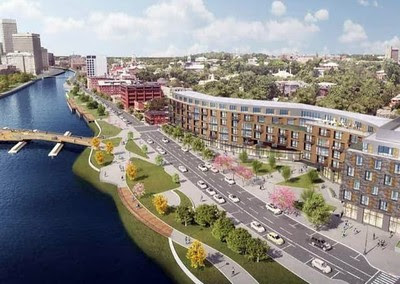
Development proposal for the Providence, Rhode Island waterfront

As I say about this more generally, without remedies -- provisions within law calling for review processes -- you can't do s*** ("Without remedies there's nothing you can do: historic preservation in Chicago and DC," 2014, "To be successful, local neighborhood stabilization programs need a packaged set of robust remedies: Part 2," 2020).

River corridors and waterfronts need to be special planning review districts too.

Philadelphia.  There are a couple of recent articles relevant to this.  This one on Fishtown makes the point that developments are being approved that are in areas that will be affected by rising water levels resulting from climate change ("Climate change should be a consideration in planning massive Fishtown housing developments," Philadelphia Inquirer).  From the article:

But along Philadelphia’s riverfronts, buildings are going up in areas that we know are going to flood. More than 600 new apartments are coming to the Navy Yard. New buildings will be constructed on the former PES refinery site in South Philly. And on the Delaware River in Fishtown, development is also being pushed through. I’m not a NIMBY, but a NIMBIIR: Not In My Backyard If It’s Riverfront.

Last summer, Philadelphia’s director of the Office of Sustainability, Christine Knapp, acknowledged the problem with unregulated, “piecemeal” development along our riverfronts in a Philadelphia Neighborhood Networks Zoom: “We need to have standards across the board that any new developments, that any new investments are made with the right science in mind,” Knapp said.

She continued: “When we let people build on the riverfront, it makes it worse for everyone else. But the city is also taking on the problem of what happens when that property floods and the city has to rescue folks, or the city has to be responsible for the response to that storm or that flood. It’s like a triple-edged problem. We absolutely need to get ahead of it.”

Also see "Blighted luxury houses facing Fishtown’s Penn Treaty Park will be demolished. Now what?," "Philadelphia officials stopped Rivers Casino from closing off its Delaware River trail, but that’s not enough," and "Lower Merion suddenly has a walkable riverfront, thanks to Pencoyd Landing development," by the Inquirer's fabulous urban design writer, Inga Saffron.

An interesting and relevant program is being developed in Philadelphia ("William Penn Foundation is giving $1.65 million to create a new Delaware River Climate Corps," Philadelphia Inquirer).  Training programs for watershed stewards, like by the Anacostia Watershed Society, and Riverkeeper advocacy programs have similar elements.

Further, a number of the city's rivers are deemed "impaired."

Pennsylvania.  Another Inquirer article, "Nearly 2,400 more miles of Pennsylvania’s streams are impaired now compared to just two years ago; Philly has the highest percentage," makes me think that as part of a 21st Century New Deal, dealing with rivers and water quality should be a priority and could be a way to better connect Democrats to rural-relevant issues and voters.  Of 85,000 miles of rivers, 28,000 miles are impaired.

Especially because rivers are the primary water source for most communities, the impact of climate change especially drought, etc.

DC.  There's a Post op-ed, "Everyone should be able to swim in the Potomac."  And DCist reports that five spots on the Potomac and Anacostia Rivers and the Washington Channel are already clean enough to swim in ("Water Quality Data Show Where Swimming Beaches Could Be On D.C. Rivers").

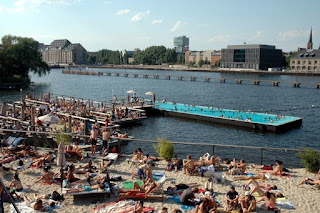
Badeschiff Pool with beach, Berlin. 

Again, when I did the ART stuff, I wrote a memo about how even though most of the Anacostia Riverfront in DC north of the 11th Street Bridge is controlled by the federal government, DC has the lease of the RFK Stadium and "campus" and there is a stretch of waterfront there that could be "converted to a beach" as a way to give people an opportunity to "touch" the river.  

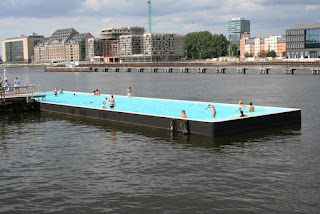
This would increase interest and the ability to mobilize citizens to change the dynamic within federal control ("Engaging citizens in DC's rivers and waterfronts as a way to drive improvements in water quality").  One of my ideas was to have a freshwater pool in the river.

Badeschiff, River Spree, Berlin.  Photos: Amusing Planet.

It's obvious that should have happened with the Potomac River a long time ago ("Pools in rivers to promote access and awareness," 2016).  

The funny thing is that outside of Georgetown, the east side of the river is pretty much all under the control of NPS.  And NPS rules make it very difficult to have local involvement and activation.

Worse, the Georgetown Waterfront Park, another NPS park, was created in part with land given to NPS by DC, because DC didn't want to take on the responsibility of having a park there.  What a lost opportunity.

Separately, wrt federal control, I argue that Anacostia Park should revert to DC because it is locally serving ("Defining National Park Service installations in DC as locally or nationally serving") and that maybe golf course isn't the best use for the Langston Golf Course ("DC, parks planning, and golf," "Golf, parks planning, and too many courses"). 

Maybe as part of improving access to Roosevelt Island ("Revisiting: Access to Theodore Roosevelt Island, a national park in Washington, DC") a pool could be created in the Potomac too.

Music barge/Cinema.  Another activation device is concerts on the river ("Music barge designed by Louis Kahn could anchor in Philadelphia as a concert stage," Philadelphia Inquirer).  We once took in the BargeMusic program in Brooklyn, although it's enclosed.

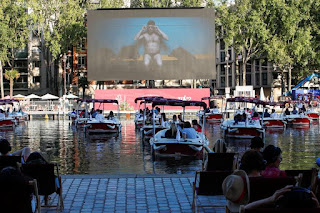
Reuters photo.

Paris screened movies to people on paddleboats ("Movie magic as Paris turns the Seine into open-air cinema," Reuters).  Chicago too.

Daylighting rivers and creeks.  Such review districts could include rivers and creeks that have been undergrounded ("Set the underground rivers free," Boston Globe).  From the article:

Exhuming waterways that run beneath developed areas and restoring their natural flow and width is known as “daylighting.” And in the Northeast, you don’t have to look far to find formerly lost rivers that have been brought back into the light. From Providence to New York to Boston’s Emerald Necklace, these forgotten waters are being surfaced to rejuvenate parks, revive local economies, and create bigger reservoirs that can prevent flooding during increasingly dangerous storms. ...

But for more than a century, putting streams in pipes or covering them with roads was a standard thing for cities to do. To create more paved ground for their expanding urban infrastructure, cities routed inconvenient waterways into culverts and conduits, overlaying the pipes with concrete. ...

It’s not just flora and fauna that can thrive when waterways are uncovered. During the 1990s, Providence daylit the Moshassuck and Woonasquatucket Rivers by removing highway and railroad infrastructure that had covered them for decades. This sparked the construction of Waterplace Park, a lagoon and a cobblestone riverwalk that became the hosting ground for the WaterFire festival led by the artist Barnaby Evans. Since its first river lighting in 1994, WaterFire has brought millions of visitors — and their wallets — to the city’s formerly depressed downtown. In 1997, the architect Friedrich St. Florian, who designed the Providence Place mall, called WaterFire “the crown jewel of the Providence renaissance.”

Daylighting success stories like Providence’s demonstrate why cities such as Detroit, Berkeley, Calif., and Yonkers, N.Y., have daylit lost rivers of their own. In the next few years, New York City will spend more than $130 million to excavate Tibbetts Brook, long buried beneath the Bronx.

Conclusion.  Definitely cities should create special interest design and environmental review districts for rivers, waterfronts, and canals.

Labels: , , , , , , , ,

Saturday, September 25, 2021

National Public Lands Day

The fourth Saturday of September is celebrated as National Public Lands Day.  For many people, its primary attraction is that National Park Service and other federal "parks" including National Forests (USDA), the Fish and Wildlife Service, and the Bureau of Reclamation are free that day ("A Proclamation on National Public Lands Day, 2021," White House).  

Of course, public lands aren't only federal, and many local, county, state and other related government agencies call attention to the day, hold events, waive fees for access, etc. as well.   

While many sites have volunteer activities, many don't.  I have always been surprised that few cities aim to leverage this day (or National Trails Day in June) as volunteer and publicity opportunities, even though NPLD is considered the largest single day public lands volunteer event across the US.

As usual there are many issues.

In this blog, we frequently raise three issues.

1.  Scenario planning and planning for the possibility that federal and/or state parks can close, either for federal politically-produced shutdowns or budget cutbacks and that localities should plan for this possibility, so they can react quickly when circumstances change ("Federal shutdown as another example of why local jurisdictions should have more robust contingency and master planning processes," 2013).

2.  Facilitating access to parks for pedestrians and bicyclists, and adding transit services as appropriate ("A gap in planning across agencies: Prioritizing park access for pedestrians, bicyclists and transit users compared to motor vehicle access," 2015).

3.  Treating the urban forest in cities as a single entity, an urban arboretum ("Arbor Day").

"The Forgotten History of Those Iconic National Parks Posters," Popular Mechanics.

4.  The tension in the National Park Service between big nature parks, mostly out west, and parks and sites serving urban areas ("Defining National Park Service installations in DC as locally or nationally serving") including National Heritage Areas, National Recreation Areas, Scenic Roads and Byways, and National Scenic Rivers.  

Blog commenter Edward Drozd made a great point about adding to the parks and open space portfolio to better serve the more populated areas of the East and Midwest.

5.  Federal parks agencies for the most part won't distribute non-federal locally produced brochures and other visitor materials.  This is a problem for cities especially, and DC.  The federal sites do not provide local information, and often don't even provide information on nearby sites run by different agencies.

6.  In the DC area, the National Park Service should have an overarching visitor center, the Greater Washington NPS Visitor Center, providing information on all the parks and sites, rather than rely on all the individual sites and more parochially-focused visitor centers.

-- Mission 66 Visitor Centers: HIstory of a Building Type (book), NPS
-- "Rustic to Utilitarian: The Modernization of Park Architecture," National Park Foundation
-- Visitor Center Policy, Directive and Standard, and Guidelines, US Bureau of Reclamation
-- "Iconic Visitor Center Architecture"
-- Australia's Accredited Visitor Information Centers: A Strategic Directions Paper, Queensland State, Australia

Other issues include:

7.  Overuse ("Post-pandemic overcrowding of national parks causing bigger problems than just long lines," LiveScience, "How Crowded Are America’s National Parks? See for Yourself," New York Times).  

Dissatisfied with the limited amount of parks marketing by NPS, Utah Tourism created its own promotion program for the national parks in the state, calling them "The Mighty 5."  Now the parks are "too successful" ("Tourists Heeding Utah's 'Mighty 5' Campaign Overpower Moab," Wall Street Journal, "Utah Wanted All the Tourists. Then It Got Them," Outside Magazine).

8.  The tension between more passive and active access.  Senator Mike Lee aims to make all federal parks provide access to off road vehicles ("Mike Lee’s bill to allow off-highway vehicles in national parks is a bad idea," Salt Lake Tribune).

9.  Underfunding of maintenance.

10.  Greater diversity in access (Barriers and Strategies to Connecting Urban Audiences to Wildlife and Nature: Results from a Multi-Method Research Project, NC State Extension).

11.  Sound management and politics.  There is always oppositional tension between Republican and Democratic control of these agencies.  The Trump Administration looked at some privatization, reduced the size of certain sites ("Biden expected to reverse Trump’s order to shrink Utah national monuments," National Geographic), and moved the Bureau of Land Management HQ to Grand Junction, Colorado from DC--the Biden Administration is moving it back ("Trump Packed a Federal Land Agency Off to Colorado. Biden Is Bringing It Home," Mother Jones).

12.  Climate change (Adaptation to Climate Change in Public Lands Management, Resources for the Future, "Why we need a climate plan for our public lands," Wilderness Society). We see this in terms of water and drought, sea level rise, and wildfires.  This year, hydroelectric power generation is being threatened by drought.  Canyons are resurfacing as water recedes ("Scientists Are Studying The Changes Occurring In Glen Canyon As Lake Powell Recedes," KUER/NPR).   But also in how public lands are used for resource extraction, especially fossil fuels.

13.  Grazing etc.  As always, cattle users believe their interests are inadequately represented ("Mitigating Malheur’s Misfortunes: The Public Interest in the Public’s Public Lands," Georgetown Environmental Law Review).

14.  Public media.  It is rare that for profit television covers public lands issues.  One exception is the NBC Bay Area (SF) show "Open Roads."  

Many state PBS groups produce and televise programs on public lands including "Outdoor Idaho" and "Outdoors Maryland."  Programs from all around the country can be viewed via PBS's Passport television access platform available to donors.

=========

A book to be published next year, Our Common Ground: A History of America's Public Lands, by lawyer John Leshy, who served as solicitor for the US Department of Interior, is the author of a definitive casebook on federal public lands law and is an emeritus professor of law.   

Labels: , , , ,

Friday, September 03, 2021

Golf, parks planning, and too many courses

As part of general parks and open space planning, I am critical about communities with "too many" golf courses.  

Participation in the sport, measured by the number of rounds and participants, is down significantly.  (Golf courses can still be an attraction for resorts, and residential development, although sometimes, the residents have to pitch in and buy the course.  See "Golf-Home Owners Find Themselves in a Hole," Wall Street Journal.)

The land could be used for other purposes, but of course, nearby residents would prefer conversion to a park rather than development, such as in Seminole County (Orlando) Florida ("Seminole County moves forward with buying 2 golf course properties," Orlando Sentinel), "Dead Courses are the new NIMBY battlefield," Bloomberg, "When suburban golf courses close, residents and cities often clash over what to do with the land. Some manage to avoid the drama," Chicago Tribune).

In DC, the Growth Machine affiliate of the Federal City Council got the lease for the three National Park Service courses in the city.  But there was never a master planning process where maybe closing down one of the courses was considered--better to have two strong courses than three weak ones ("DC, parks planning and golf").

Salt Lake City has six public courses for a city of 200,000 people, plus at least one private course.  While I am impressed that the concurrent parks planning processes mentions alternative parks uses for golf courses, it does not make the obvious point that usage is down and six courses is far too many for a city this size.

Golf course industry stoked by the New Deal.  One of the things I've learned while reading books about the New Deal is that its public works construction program included the creation of hundreds of public golf courses, which helped to stoke the interest in the sport, and was focused, like a lot of ND programming, on the middle class. According to an article, "The Bizarre History of American Sport," from Sports Illustrated (1962), there were thousands of athletics-related Works Progress Administration public works projects.

The Depression and the New Deal turned the trend toward participant sport. Although in the Depression millions were out of work, the average employed worker gained added leisure time because of increased industrial efficiency, legislation and union agitation. By the end of 1939 he had one day more of leisure than he had had in 1929 and two days more than his counterpart had had in 1890. In its public works programs, the Federal Government put heavy stress on recreation facilities, spending almost $1.5 billion by 1938. State, county and local governments added another $500 million. The WPA built 10,000 tennis courts, 3,026 athletic fields, 2,261 horseshoe courts, 1,817 handball courts, 805 swimming pools, 318 ski trails and 254 golf courses. Federal purchase of forest lands rose from half a million acres annually to two million, and in 1934 Congress authorized the establishment of fish and game sanctuaries in the national forests for the first time. In 1934 visitors to national parks totaled six million; in 1940 the total was 20 million.

Graphic in the Guardian showing the distribution of golf courses across London.  Few community parks master plans are this direct about golf courses.

Opportunity costs: open space versus housing.  An article in the Guardian states that London's golf courses could accommodate 300,000 people if converted to housing.  

Seattle has been studying golf courses as a specific element of parks planning--the city has four public courses ("Seattle considering what to do with 4 public golf courses and 528 acres of green space they cover," Seattle Times, "Unlike Seattle, Golf is Really Dying," Urbanist, Golf Master Planning, City of Seattle).  

Seattle's Golf Plan was direct about the drop in participation, rather than ignoring it or glossing it over.

I read somewhere that Seattle is now looking to shut down a public course, and while the prime use will still be parkland, they are proposing the construction of social housing on the perimeter, which is a step ahead of most other places.

An analysis of the Jefferson Park golf course found that 35,000 people could be accommodated if multiunit housing were to be built on the fairways, while still preserving 100 acres of forest ("Let's tee off for housing," Urbanist).

But this change is stymied by a different Seattle law, passed by referendum, that says there should be no net loss of parkland from various government actions--not taking into account of underutilization and/or use type of existing land.

Improvements in operation are possible.  But, in fairness, Golfweek Magazine has an article ("An Ohio golf course went from red to black in four years by cutting an $80K pro, adding sponsors and more") about the usage improvements at Brookside Golf Course, a public course in Ashland, Ohio.  So it's not just an issue of participation being down, but also a matter of management and marketing.  From the article:

The course is up $100,000 over expenses so far this season, a stark contrast to its deficit just four years ago. The city had to subsidize Brookside a total of $232,362 in 2017 to help offset annual operations. In 2019, the city contributed $65,000 to the golf course, Mayor Matt Miller said. 

By the following year, the course officially climbed into the black. How? By cutting costs, realigning staff and improving fundraising and community support. And more people are playing these days, which helps maintain a higher revenue stream.

Photo by Tom Puskar, Ashland Times-Gazette.

Although like with transit and other areas of customer focused services, public agencies tend to be not at the forefront of "user experience" planning and marketing, and it shouldn't surprise me this is an issue for golf.  So Ashland, Ohio deserves commendation ("Friends of Brookside group raises $35,000 for golf course," Ashland Times-Gazette).

But while the course is no longer losing money requiring subsidy and it is making money, it's not like it's wildly profitable.  Certainly, it wouldn't be if the city had 2-5 other courses, all competing for golfers.

For more about running municipal golf courses and the difficulty to be responsive, see "What about up there?," Golf Course Industry Magazine. and "City considers beer, wine sales for golf course," Everett Herald. (Food and drink should be a basic offering.)

Rightsizing the number of golf courses in a community makes sense, but like everything, it's hard, especially because of the nimby issue.  

Ashland is in a better place than DC or Salt Lake City or Seattle, because it doesn't need to close courses, and their steps of getting sponsorship, donations, adding new facilities, cutting costs and increasing greens and cart fees all contributed to the positive results.


But Seattle's provision of data on course revenue shows that one course generates the bulk of revenue (although it's not stellar), making the point that rightsizing the offering makes sense.

Labels: , , ,