Rebuilding Place in the Urban Space

"A community’s physical form, rather than its land uses, is its most intrinsic and enduring characteristic." [Katz, EPA] This blog focuses on place and placemaking and all that makes it work--historic preservation, urban design, transportation, asset-based community development, arts & cultural development, commercial district revitalization, tourism & destination development, and quality of life advocacy--along with doses of civic engagement and good governance watchdogging.

Thursday, March 05, 2026

I know that I sound like a broken record: The importance of planning in government | property development in Portland, Bilbao, Liverpool, Salt Lake, Washington, DC

Some cities plan.  Some cities release RFPs.  Others do "stuff."

When Obama got elected, and seemingly was interested in focusing on urban issues, I thought about the Pasteur quote: Chance Favors the Prepared Mind.

What I took it to mean was that if you are prepared (with plans) you can pounce on opportunity.  

The difference with a plan is you come up with a vision, ideally with creativity and positive public input.  An RFP asks others to come up with a vision, which may or not be a good fit.  

A good example is with Kennedy School in Portland.  The community came up with a some ideas for what they'd accept.  What they got was a great bed and breakfast, music venue and brew pub, by the McMenamin Group ("Fall Asleep in Class at Portland, Oregon’s Kennedy School," NTHP).  

Not an terrible outcome, but a similar Catholic facility deaccessioned in the Brookland neighborhood became a charter school.  When being located one block from the district's Main Street, 12th Street, it could have become a broader destination.

Later I codified this point as a part of best practice revitalization planning and in my concept of Transformational Projects Action Planning.  

-- "Updating the best practice elements of revitalization to include elements 7 and 8 | Transformational Projects Action Planning at a large scale"  (2022)  [this entry has other related links to other examples and iterations of the development of the TPAS concept]
-- "Why can't the "Bilbao Effect" be reproduced? | Bilbao as an example of Transformational Projects Action Planning" (2017)

Not only was Bilbao quick to act to land the Guggenheim Museum, they realized after it opened, that despite being close to the city's subway, they needed better surface transit to link various attractions, and added a tram within 4 years of the museum's opening.  The system continues to be expanded.  

It took DC 13 years to open its streetcar, and because the system never expanded (and because DC's elected officials were indifferent) the service will close this year, after a ten year run.

A couple examples are how, having a city revitalization plan in place, with an implementation organization and financing, Bilbao jumped on the decision of Graz, Austria to not host a Guggenheim Museum, and ended up with the Gehry designed international attraction instead, thereby rebranding and positioning the city as an international destination.

Liverpool's 2001 plan called for the city to be designated an EU Capital of Culture, when at the time in the current cycle, the UK wasn't even on the list as a participating country ("Liverpool regeneration as a process for regaining relevance at the regional, national, and global scales").  

A statue of the Beatles.

By the time UK was selected, Liverpool had at least four years of planning when other cities had none, so Liverpool was best positioned to be picked, and it was ("Almost two decades on, this vibrant UK city is still a ‘Capital of Culture’," Metro, "Liverpool event strategies," Spirit of 2012). 

Although there are differing viewpoints ("Liverpool’s European Capital of Culture legacy narrative: a selective heritage?," European Planning Studies, "The 'Liverpool model(s)': cultural planning, Liverpool and Capital of Culture 2008," International Journal of Cultural Policy, "‘Capital of Culture—you must be having a laugh!’ Challenging the official rhetoric of Liverpool as the 2008 European cultural capital," Social & Cultural Geography) which is true for Bilbao too.

Or, sometimes it's scenario planning wrt to potential for austerity and acts by other governments impacting local governments.  

-- "Contingency planning in parks planning: Montgomery County Maryland edition," 2013
-- "Federal shutdown as another example of why local jurisdictions should have more robust contingency and master planning processes," 2013

Sugar House Park, Salt Lake City.  I mention I'm on the board of a park.  While it's jointly owned by the city and county for reasons of history, it's underresourced.  We don't have the money to do a full blown plan.  We do have a planning framework from 2008, but there are many gaps.

As I outlined in 2024 in a series on gaps in park master planning  I try to use objective frameworks for decision making in that context.

This is the last month of my first term--4 years.  And we were talking about it in a meeting.  I mentioned my biggest learning is that so much of our agenda is externally driven.  Anyway, we have lots of projects to pursue, some quite major, and we need to have formal plans to move forward.  

A rendering of a proposed 89-foot, seven-story hotel on the corner of 2100 South and 1300 East next to Sugar House Park. A plan to rezone the lot received support from the Salt Lake City Planning Commission.

On a really big issue ("Plan to build a 7-story hotel next to Sugar House Park gets key endorsement,"  "New Utah law could address remaining issue in proposed hotel next to Sugar House Park,"KSL ) where the board is split, me and another person have created a great vision plan for an alternative to the site--hopefully the lessee will entertain it, especially if the hotel project isn't approved.  

(The final decision will be made by the City Council over the next couple months.  I'm in the "no" camp as it punctures forever the perimeter of the park, and no major urban public park in the US has a similar commercial puncture within the park.)

But that's just a vision, it would need detailed planning and design to move forward.   

And we have up to three other projects requiring a similar process of vision plan + detailed plan.  Not to mention a bunch of other projects.  I liken us to beggars, doing a form of barter to get what we want when working with other entities.  And the amount of time I spent on the vision is considerable, and came out as fast as it did only because of prior knowledge.  The other plans will require more research.

Photo: Joanne Lawton, WBJ.

Washington DC.  The Washington Business Journal reports that Ward 3 Council Representative Matt Frumin wants the city to buy a building in foreclosure, 4000 Connecticut Avenue NW.  It's huge. ("Frumin rallies District to snag former Whittle School building as foreclosure auction looms").  From the article:

A D.C. councilmember is renewing his push for the District to acquire the leasehold interest in a high-profile Northwest D.C. mixed-use building that’s scheduled to be sold at a foreclosure auction next month.

In an interview Tuesday, Councilmember Matt Frumin, D-Ward 3, described the 666,202-square-foot 4000 Connecticut Ave. NW — formerly home to Intelsat’s headquarters, then the Whittle School & Studios — as an “amazing location” that he expects will be sold for “far lower” than it would have a few years back when he unsuccessfully rallied the District to acquire the property for use as a vast civic center.

“How could we leverage this building at a key site to the benefit of the city?” Frumin said. “There's lots of possibilities, and if it could be gotten for a very attractive price, I hope the city will think about it.”

The leasehold interest in 4000 Connecticut — the State Department owns the land under the building — is scheduled to be sold at an April 8 foreclosure auction at Alex Cooper Auctioneers D.C. office. Affiliates of New York-based investment firm 601W Cos. and commercial real estate developer Berkley Properties co-own the leasehold interest and owe $132.2 million on the note held by an affiliate of Jericho, New York-based Winthrop Capital Partners, according to a foreclosure notice filed Monday with D.C.'s Recorder of Deeds.

It's an interesting idea.  BUT 

Plus, usually with white elephant projects like this (and note the property is proximate to the University of the District of Columbia), the cost of the building is minimal, and an arts use gets developed like Cabelfactory in a former Nokia manufacturing plant in Helsinki, La Friche in Marseille (Design Handbook for Cultural Centres, Trans-Europe Halles), or smaller projects in the US, like GoggleWorks in Reading, Pennsylvania ("GoggleWorks finances go back to black," Reading Eagle, "Next phases of GoggleWorks development include apartments, educational space," WFMZ-TV).

Since "the arts and culture don't make a profit" it's best to start with low cost buildings ("Arlington's Artisphere, cultural planning and Arlington's identity").  And Artisphere was 1/10th the size of the former Intelsat building.

It's unfair to suggest that Frumin should do this but.... In my entry, "Outline for a proposed Ward-focused (DC) Councilmember campaign platform and agenda," one of the points was that a Councilmember should have a thumbnail plan (basically a vision plan) for commercial districts.  

I should have also included "and for big buildings that might become vacant."

Councilmembers don't do planning independent of the Executive Branch.  This is an example where it could and should be done.

But basically, while CM Frumin has ideas, he hasn't further developed them over the two years the building has been vacant ("First Intelsat HQ. Then failed Whittle School. What’s next for D.C.'s 4000 Connecticut Ave. NW?," WBJ), which is opposite of "Chance Favor[ing[ the Prepared Mind." So opportunity doesn't favor this project.  Especially when the city budget is being compromised by the Republican Congress in multiple ways.  And the need to get a majority of Councilmembers to agree.

Former Imperial Sugar Plant, Fort Bend, Texas.

BTMFBA.  I myself am a proponent of arts organizations owning their own buildings.  And recommend that the locality set up a CDC to buy, hold, develop, and rehabilitate properties to preserve their use outside of the normal market forces of real estate.  While I often tout SEMAEST, the Paris CDC that does this with retail properties, Helsinki as a city does this with an agency called Kaapelli.  I've written about this in Philadelphia ("BTMFBA + programs to lease the properties to local businesses | Philadelphia").  And there are other examples.  

SEMAEST also has a retail incubator program allowing short term leasing in order to develop and test proof of concept ("Testing your business with Semaest: the example of Alma Grown in Town dedicated to urban agriculture" City of Paris).

-- "From BTMFBA to "community right to buy"," 2024
-- "BTMFBA: maintaining arts spaces in the face of rising real estate values | Seattle, New York City," 2024
-- "New form of BTMFBA in San Francisco," 2023
-- "A wrinkle on BTMFBA: let the city/county own the cultural facility, while you operate it (San Francisco and the Fillmore Heritage Center)," 2021
-- "BTMFBA: Baltimore and the Area 405 Studio," 2021
-- "Revisiting stories: cultural planning and the need for arts-based community development corporations as real estate operators," 2018
-- "BMFBTA revisited: nonprofits and facilities planning and acquisition," 2016
-- "BTMFBA: artists and Los Angeles," 2017
-- "BTMFBA Chronicles: Seattle coffee shop raises money to buy its building," 2018
-- "Dateline Los Angeles: BTMFBA & Transformational Projects Action Planning & arts-related community development corporation as an implementation mechanism to own property," 2018


But in the DC case, taking on a 660,000 s.f. building is pretty daunting.  Especially in that location.

Conclusion.  Without a good business plan, what Frumin proposes is a folly.  

Labels: , , , , ,

Tuesday, March 03, 2026

School closures and neighborhood effects

Given the decline in the number of school aged children, and outmigration from cities, school districts such as in Washington, DC, Chicago, and Philadelphia have been closing schools for decades.

The rational planning part of me is in favor because of the need to spend money efficiently, have enough students to be able to offer a wider range of programs, etc.

But the other side of my rational planning part also acknowledges that school closures have negative impact on neighborhoods, that elementary schools in particular are building blocks for neighborhoods (along with libraries).  

And that sports programs at the high school level can engender community pride, etc.

I pointed out this contradiction starting in 2011:

-- "One way in which community planning is completely backwards," 2011
-- "Missing the most important point about Clifton School closure in Fairfax County," 2011
-- "Rethinking community planning around maintaining neighborhood civic assets and anchors," 2011
-- "The bilingual Key Elementary School in Arlington County as another example of the "upsidedownness" of community planning," 2019
-- "National Community Planning Month: Schools as neighborhood anchors," 2022
-- "School closure and consolidation planning needs to focus on integration planning at the outset as a separate process," 2023

I suggested that cities ought to consider subsidizing continued school operation in some communities as a stabilization and revitalization measure.

Philadelphia is going through another round of school closure ("City Council members grill school district officials on plan to close 20 schools — and superintendent says he could have closed 40." Philadelphia Inquirer) and an op-ed about this "It’s not just about schools. It’s about neighborhoods," makes the same point as I did, but she describes better the effects of a school within a neighborhood beyond the curriculum.  From the article:

The conflict playing out in Philadelphia isn’t only about schools. It’s about the fact that the school district and City Council have different responsibilities for the same places, and the new facilities plan brings that conflict into sharp focus./p>

The facilities plan is doing exactly what it was designed to do. The trouble is that everything it was not designed to do.

A Philadelphia neighborhood school isn’t just one institution. It’s four, sharing an address. There’s the instructional platform: courses, teachers, schedules, the district’s domain. There’s the civic anchor: the building that signals to a neighborhood that its children count, and they belong. There’s the distribution node: where meals are served, where social workers operate, and where there is, most days, someone watching. And there’s the pathway to the future: where a counselor knows a family by name, where a student learns there’s a college or a trade or a life beyond the block.

... When that school building closes, all of those other things close with it. Some of those functions were formal educational programs. Others accumulated because families had nowhere else to go for them. The school became the place where paperwork was explained, problems were addressed and solved, and someone always knew which door to knock on next.

City Council doesn’t get to vote on the facilities plan, but it funds roughly 40% of the district’s $2 billion budget.

... What closes with a school building is not limited to instruction. Council’s budget is the instrument for the functions the facilities plan does not govern: housing investment, community infrastructure, colocated services, and neighborhood anchors that exist independent of school enrollment.

The conclusion to the article is succinct.

The district’s plan answers an educational question. What replaces the neighborhood functions housed in those buildings is a civic one.

That answer does not sit with the school district.

Recommendation.  School systems need to work more closely with city planning departments, to ensure decisions are made in a manner that promotes neighborhood stabilization and improvement.  If necessary, could funds be identified that could be provided to keep certain schools open, and to improve enrollments to make it more financially efficacious for doing so.

Labels: , , , , , ,

Tuesday, January 07, 2025

Toronto the Better series: Toronto Star

 (It will take a few months, but I am working on a piece about social infrastructure and community cohesion that goes beyond the library as a hub.)

The Toronto Star has introduced the Toronto the Better initiative ("It’s time to make Toronto better. For the sake of the city — and for all of us").  Under Mayor John Tory, his approach was one of austerity, not taxing enough to keep up with inflation, let alone new needs, or investment in declining public assets.

Laughingly, last election he said he was the solution to people's complaints about a declining city ("Brutal performance art criticism of Toronto's Mayor, John Tory, and his "austerity" agenda").  He did get reelected, but stepped down soon after when it was disclosed he had an affair.  

Mayor-elect Olivia Chow cycles with a peloton of supporters down Bay Street to Nathan Phillips Square ahead of her swearing in. Steve Russell / Toronto Star 

Olivia Chow won the special election ("Most Torontonians say life in the city is getting worse. Here’s how Olivia Chow can help change that," Star). She's a transportational cyclist ("Olivia Chow rides her bike to her first day as Toronto's mayor").

According to the article launching the Better initiative:

That’s why I’m excited to announce the Star’s major initiative for 2025: Toronto the Better — an ambitious, optimistic and constructive series exploring how we can improve the quality of life in this city, both collectively and individually. Our problems are well known; it’s time we start talking about solutions.

... Many readers have told me they want more uplifting, solutions-focused journalism. That’s exactly what Toronto the Better will deliver. Over the next year, we’ll draw from psychology and sociology research, best practices in urban planning and the lived experiences of Torontonians to find ways to make our city — and our lives — better. I’m hopeful we’ll not only inform, but also inspire. 

We’re kicking off the series today by focusing on purpose and meaning, starting with the benefits of giving back. As you make your New Year’s resolutions, I urge you to consider adding volunteering to your list. It’s not just an opportunity to help the community — it’s also one of the most impactful ways to improve your own well-being. Throughout the year, we’ll highlight the people and organizations making a difference in Toronto and share volunteering opportunities that can inspire real change. Even if just a handful of readers take up this challenge, it will be worth it — but imagine the impact if thousands did.
Interestingly, this series seems to be the flip side of an earlier campaign, "Can't We Do Better," spearheaded by City Hall columnist Edward Keenan ("Trashy litter bins, decrepit transit, cancelled swimming lessons: Toronto, can’t we do better? The stories in the Star series").

The new campaign takes on a more positive spin.

Labels: , ,

Wednesday, October 18, 2023

Equity/"Equity" versus efficiency and the school closure debate

I've mentioned that Salt Lake City is in the process of closing schools ("School closure and consolidation planning needs to focus on integration planning at the outset as a separate process").  

Enrollment of elementary school aged kids has dropped by 6,000 over the past 10 years, and the State Legislature has ordered the district to right size the number of elementary schools in response.

The way the city grew pre-1960s, there are a lot of schools concentrated in what is termed central city.  Even though the area is dense, and the city is growing in population, the number of households with children is declining, decreasing demand for classrooms.  Whereas when schools were built, they ended up being concentrated, because at the time there were lots of families with children.

On the other hand, on the east side of the city, schools are less concentrated so if a school is closed the distance a student will have to travel to another school is significantly increased or otherwise difficult.  

There is an op-ed in the Salt Lake Tribune, "Salt Lake school closures feels reminiscent of ‘The Hunger Games’," making the argument that equity demands that schools on the east side should be closed too, not just schools in the core.

I have made an equity argument before, although I didn't use that word, in arguing that strong neighborhoods are built around quality neighborhood schools ("National Community Planning Month: Schools as neighborhood anchors") and sometimes, when enrollment drops, it might be worth keeping a school open regardless because of its community impact.

But in the Salt Lake Schools case, the issue is efficiency--closing schools in an area where there is a preponderance of them, where there are other schools nearby that the students can attend--versus equity--closing schools across the city even if it isn't efficient and more costly, because it's unfair to make one particular area suffer most of the change.

I am on the efficiency side.

But it's interesting that equity is used as an argument generally, without acknowledging that sometimes it's just about cost, not unfairness.  

Note too in this case, it is about geographical and income equity, and much less about racial and demographic equity--although schools on Salt Lake's west side will also be "disproportionately" closed too, again because of demographics, not out of targeting.

The author uses low income students (Title I) as a proxy.  From the article:

The 25% schools with the lowest percent of low-income students are: Ensign (1.28%), Bonneville (8.24%), Uintah (9.18%), Indian Hills (13.25%), Highland Park (17.04%), Beacon Heights (18.21%) and Dilworth (20.22%). Combined, these schools served 376 Free Lunch students, which is 7.5% of the total Free Lunch students served in the SLCSD in 2022. 

Instead, the short-listed schools were selected west from the great divide in the central east and central west areas of SLCSD. Our tributes — Emerson, Hawthorne, Bennion, Riley, Jackson, Newman and Wasatch Elementaries — were reportedly identified through evaluation of all 27 SLCSD elementary schools, yet they are remarkably all geographically located west of the 25% most affluent neighborhoods and in two distinct lines that transect SLCSD, almost stacked like dominos, disproportionately impacting central east and central west neighborhoods.

It's an interesting argument, pitting middle class income whites against higher income whites (the area to the east is the highest income zip code in Salt Lake City).

Is it inequitable that a white household making $160,000 or more per year faces school closure and that a white household making $200,000 or more per year does not?

Labels: , , , , , ,

Monday, June 12, 2023

I discovered a massive omission in local parks master planning: it fails to discuss architecture and design in an overt way

I am on the board of a park in Salt Lake City.  It's an odd governmental construction in that it's owned by both the city and county, but run (theoretically) by an independent board.  The city and county jointly fund the park.  The county parks department is contracted to maintain it.  So city elected officials seem to think it is the responsibility of the county while the county officials, because the park is in the City, see it more as a city facility.

This has led to a severe underfunding of capital improvements--the two governments run on different processes and cycles for capital improvement funding, and I have been addressing this since I joined the board last year.

Generally, the park grounds are decently maintained, but the structures have been neglected for awhile.  

We are aiming to start replacing the pavilions--there are seven.  And the proposed new structure is stark, severe and pretty modern.  It doesn't fit.  But we need a narrative to explain why.

What it made me realize is that at the local and state level, there isn't a good understanding,  codification, and application of park architectural planning history to parks master planning.  

It never occurred to me, when reading park master plans, that architecture is never mentioned as an element, although of course it makes up the bulk of discussion in specific plans for buildings.

NPS rustic.  Park architectural design across the United States was initiated by the National Park Service through their development of a building construction program in the big Western national parks, starting in 1916, when NPS was created.

The style, called NPS rustic, features natural materials primarily stone and wood, with a focus on the use of regionally significant materials like flagstone or river rocks, cedar wood, red rock, etc.

The basic thrust of the style is to snugly fit buildings into nature and the landscape, rather than for the buildings to stick out. (Separately, the Forest Service has a great Built Environment Image Guide, organized by region.)

The approach prioritizes “architecture that is of and respectful of the natural landscape.” The first statement of policy for NPS called for “harmonizing improvements such as roads, trails, and buildings with nature."

This approach influenced other federal agencies dealing with public lands, especially the Forest Service, which like NPS, developed and published a wide variety of design guidance.

Railroad park tourism.  Park rustic has antecedents in railroad tourism endeavors.  

To promote tourism-based ridership, railroads focused a lot of attention on developing national parks as destinations, and even before the Park Service existed, constructed lodges, hotels and other buildings using the rustic style. (Note that the railroads were a driving force in the creation of the National Park Service, because of how important parks-related tourism was to their business.)

As visitorship increased, the park rustic architectural style influenced people's perceptions of how a park was “supposed to be” presented.  

Furthermore, it is likely that park officials and stakeholders from around the country visited these national parks, experienced the structures and the way they were integrated into the landscape, took these lessons and ideas back home, and aimed to implement a form of park rustic style appropriate in their local situation and context.

The New Deal as a transmission mechanism of park architectural style.  But this was accelerated in the 1930s.  New Deal works efforts, especially by the Civilian Conservation Corps, constructed many parks projects, not just on federal lands, but in state and local park systems too.

This not only resulted in more buildings and exemplary projects, but in the dissemination and adoption of the rustic approach to park architecture, its use of natural materials and its embrace of the landscape at the state and local level. 

CCC did not develop its own design guidance, it used technical assistance manuals developed by NPS and the Forest Service.

Rustic peaked before WWII and the new postwar style of "rustic modern."  The rustic style's application peaked during the New Deal.  Construction of parks projects ended with the onset of World War II and didn't pick up again until the mid 1950s.

The postwar design approach we could call "rustic modern" in that new construction techniques, materials like metal, concrete and expansive use of glass, prefabricated building components, and the modern approach to architecture were joined to the rustic style.

The aim is still to use natural materials and design and site buildings harmoniously within the landscape.  

Red Rock Canyon Visitor Center, Nevada.

Further modernizing park building style through the use of manufactured structures.  Whether they overtly discuss this or not, the rustic and rustic-modern style is the dominant architectural approach to creating park structures at all levels--federal, state, and local.

At the same time, for a variety of reasons local park systems are wont to speed up design and construction by using prefabricated structures.  Such structures have the advantage of lower cost compared to one off construction and are easier to maintain.  Firms producing these structures market heavily to park systems, exhibit at national conferences, etc.

The problem with this approach is that as building design has become more the "architecture of nowhere," with few design cues drawn from the immediate built environment and land use context, the nowhere style is creeping into the design of structures manufactured for parks.

But parks are still very much defined by their landscape, they have distinctive landscapes and land use contexts.  As a result the design of nowhere is inappropriate.  Plenty of parks still incorporate new or replacement buildings that are more rustic than they are modern.

The land use and viewshed context for Sugar House Park in Salt Lake City.

Sugar House Park landscape design and architecture.  Sugar House Park's landscape is decidedly manmade.  The "pond" is a flood control device.  The site, which had been a prison, and I presume pretty flat, was sculpted with hills--it's the only park in the center city that has hills as a unique feature.

WRT Sugar House Park's architecture, I'd call it park rustic pastiche.  

The pavilions are a mix of rustic and modern with wood, stone, and metal roofs.  We have an outdoor education building that is cinder block outside, but incorporates some elements of park rustic inside including a charming stone fireplace, and other brick and wood elements.  

And even though the park was constructed after 1955, it has patios on either side of the creek that look like they could have been constructed by a CCC work crew.

The viewshed is iconic, looking towards the Wasatch Front Mountain Range.  The landscape design deserves to be treated with respect when new buildings are considered.

Conclusion.  Without a clear understanding and codification of a park's landscape design, land use context, stylistic approach to the built environment, and viewshed (if applicable), it's easy to default to "modern" buildings.  

Not having these elements defined in parks master plans makes it hard to maintain a consistent approach to architecture that is in keeping with the architectural and landscape history of parks.  

What I am calling inconsistent = pastiche.

Going forward, definition of design values need to be added to parks master planning processes across the United States.

Labels: , , , , ,

Monday, May 22, 2023

Park Advisory Boards in Los Angeles

I am on the board of an independent park in Salt Lake City, well not that independent, as it is jointly owned by the city and county, but the land trust format means that the park has an opportunity for citizen oversight and input that is greater than the typical park.

It's comparable to parks conservancies which usually are independent organizations that have a contract with a city or county to run a park, comparable to a business improvement district.  The Central Park Conservancy and the Bryant Park Conservancy are premier examples of this form of park management.

The next level is a "Friends of the Park" organization.  Salt Lake has a few, but not one for every park, and the parks that have them, this provides an opportunity for residents to have more input and two-way communications about parks matters.  I participate in one such group because I want the various facilities in the nearby parks to mine to be coordinated, to reduce duplication, etc.

Note that rather than requiring separately incorporated friends groups for each park (or library), I suggest that an overarching group be created for a community, for all the parks (or libraries), with affinity groups for each park, but with overall administration and funds management rested in the master group.  Salt Lake doesn't do this for parks, but it does for libraries.  Park Pride in Atlanta is an overarching group, but there still might be separately incorporated friends groups for large parks.

I was thinking about this and the fact that most parks do not have this kind of opportunity for citizen input and oversight.  Who do you call when there is a problem, how do you create a program for your local park?

In Baltimore County, in the 1970s, as a budget move, they fired all the parks and recreation personnel responsible for programming.  They created a system of parks and/or recreation councils for specific or groups of parks and recreation facilities.  These councils are staffed by citizens who raise the funds for programming.

I think that's interesting, but I do think it's unfair that wealthy areas can raise lots of funds, while low income areas cannot   The County should have a system to step in and provide additional funding for communities unable to raise much in the way of funding.

And the County should have developed a system for technical training and capacity building for the people involved in parks and recreation councils, because we can be assured that most people involved aren't planners, and are unfamiliar with best practices in parks and recreation.

Plus, while anyone can organize anything, most people's interests are centered around team sports, so other forms of outdoor activities, such as biking or walking, tend to be ignored.  (For example, separately, I argue that bike cooperatives should be offered space in recreation centers.)


It happens that while I've been thinking about this, I was in Los Angeles, and while at the Highland Park Recreation Center, looking at their information board, I noticed a flyer seeking members for park advisory boards.

I doubt the City Recreation and Parks department does an annual conference, comparable to Atlanta's Park Pride organization, but they do publish a handbook for members.

I'm hoping to get an annual parks and recreation capacity building conference off the ground here in Salt Lake, within a couple years, hopefully.

Labels: , , , , ,

Wednesday, November 02, 2022

National Community Planning Month: Schools as neighborhood anchors

This post is a little late, National Community Planning Month ended yesterday, the end of October.

I had a bunch of ideas to write a bunch of pieces over the course of the month, like on citizen participation and civic engagement through participation in planning engagements, and on best practice engagement programs involving community groups and planning agencies ("Framingham Massachusetts creates Citizen Participation Officer position," 2018).

Next year...

Students, parents, and teachers participating in a clean up of the school grounds, Wasatch Elementary School, Salt Lake.

Schools as fundamental neighborhood anchors.  One of the ideas for a piece was built on my pieces around the idea that the way we do "neighborhood planning" and schools planning is upside down in that elementary schools are key community-civic assets embedded in neighborhoods, and the neighborhoods with successful elementary schools usually function better than neighborhoods with less successful schools--for a variety of reasons.

So we should re-prioritize planning around this point, making neighborhoods better by making schools better and vice versa.  

-- "One way in which community planning is completely backwards," 2011
-- "Missing the most important point about Clifton School closure in Fairfax County," 2011
-- "Rethinking community planning around maintaining neighborhood civic assets and anchors," 2011
-- "The bilingual Key Elementary School in Arlington County as another example of the "upsidedownness" of community planning," 2019

Yes, I know some of this is about demographics.  Schools with high income demographics tend to do much better than those with low income demographics.

But Dallas and their Transformation Schools initiative has proven that with the addition of focused resources and initiatives, that doesn't have to be the case.  

-- "Dallas parents flocking to schools that pull students from both rich and poor parts of town," Hechinger Report

Well not exactly, what they do is in a very purposeful way, they bring high and low income demographics together, in ways where both groups are well served. 

2.  Special Funding.  What this should mean is that schools should get additional funding, from the local government separate from the school system, or the school system's budget should include support, for these functions.  

Another element could be treating schools as "neighborhood cultural centers" too, the way I describe how neighborhood libraries should be positioned ("Neighborhood libraries as nodes in a neighborhood and city-wide network of cultural assets," 2019).

An activist arrives at the entrance of Parker Elementary School in Oakland, where parents and community organizers occupied the building after it was closed by the school district. (Melina Mara/The Washington Post)

3.  Recognition of the need for school support = neighborhood support.  There are stories about school closure planning in Oakland, California ("In Oakland, closing schools opens questions about a city’s soul," Washington Post).  

What amazed me about the situation is that the city has lots of charter schools ("How Charter Schools Became Such a Big Player in California's Education System," KQED/NPR), and they drew off enrollment from the traditional schools, so those schools started failing, in turn having negative impact on the neighborhood.  

One way to think of this is as mitigation.  If new schools are allowed to draw off students, and schools in neighborhoods are key neighborhood assets, this policy needs to be further considered.

Open enrollment is a problem in a way.  While it expands choice, opportunity, and equity, at the same time it disconnects students from neighborhood schools.  It's also complicated because some people in low income neighborhoods believe that local schools are always inferior to schools in high income areas ("DCPS middle schools in black wards, "positive deviance" and the pull of the attractiveness of schools in the upper income wards west," 2022).

4.  Individual schools need a program to systematically build relationships with their neighborhood.  (Note that sometime in the next few months, I plan to write a dedicated blog entry on this topic.)

A big problem, at least in cities, is that households have a lot fewer children.  In the average city, fewer than 25% of households have children, so that means 75% of the households in the average neighborhood have limited interest or connection to the local schools.

That means that schools need to invest resources in engaging with the neighborhood beyond the school grounds.  But school districts don't invest in this, don't create assistance programs for schools.  Most figure that PTAs suffice, but again, PTAs are mostly comprised of parents of schoolchildren, not interested parties without children.

I found this bookmark, promoting volunteering in the schools, in a book at a Library book sale.  It dates to the 1980s.

Arts Festival and fundraiser, Uintah Elementary School, Salt Lake City.

In Salt Lake, many of the city's schools, even in the West Side low income area, are threatened with closure as long term demographics expect the city's population of school aged children will decline, even as the city's population rises, because most of the new residents will have no children or fewer children, and family sizes are declining (even though Utah, because of the Mormon Church, tends to have way more children per household on average compared to other states).

But in the higher income east side of the city, only one school, just one, out of more than a dozen, is threatened with closure.  That's because that school, on the edge of an exclusive neighborhood, is in an area where the demographics don't favor households with children.

The school district doesn't understand at all the link between neighborhoods and school success, school success and neighborhoods, and the need to invest in outreach and building relationships beyond the school grounds.

Although many of the schools do art festivals in the Spring, doing great projects as fundraisers.  I don't know if that happens at the poorer schools too.

My neighborhood school, Bonneville Elementary, has introduced its first fall festival.

But assistance to schools for marketing, for creating successful differentiated programs, is wanting.  

There is a big arts initiative, and some STEM efforts, but language programs and other innovative programs like Montessori, present elsewhere, aren't part of the discussion here.

Turn a place around workshop, Project for Public Spaces.  Ironically, when I first got involved in urban revitalization in my Northeast DC neighborhood 20+ years ago, because of the disconnection from the neighborhood problem, I suggested that the local school do a form of the PPS "How to Turn A Place Around" workshop, focused on building connections between the neighborhood and the school, if only to reduce vandalism.

The school had a special program in French, and for a long time had higher enrollments, because resident grandparents were illegally enrolling their suburban resident grandchildren in the local school.  This was a childcare measure among others.  

Capital City Public Charter School, DC.  This school is located a couple blocks from our DC house, and for the first few years after it opened, they made a big effort to do outreach to the neighborhood, to invite residents to school events, etc., but it fell off.   I think this is an element of their "expeditionary learning" approach.

But they did place the school playground in the front yard of the school so it could also serve the neighborhood.  And they've created a food forest on their grounds too ("For D.C. students, lessons in growth, of the garden variety," Washington Post).

5.  Community schools.  One type of program, although more focused on schools in low income neighborhoods, is called "community schools" ("Schools #2: Successful school programs in low income communities and the failure of DC to respond similarly," 2019). 

There are a number of great examples ("Community Schools Offer More Than Just Teaching," New York Times).  From the article:

Community schools, which, among other things, integrate nonprofits, businesses and colleges on the school site to offer services to students and their families, have existed for more than a century. There are now an estimated 5,000 such schools nationwide, according to the national Coalition for Community Schools. ...

The trend is bolstered by research demonstrating that community schools help increase students’ attendance and graduation rates. By addressing an array of student and family issues — from hunger and homelessness to health care — schools are lifting barriers that prevent students from fully participating in and benefiting from their education. The approach also helps to build trust that allows families to embrace the schools and their child’s learning. ...

A full-service community school includes four elements: various integrated support services through nonprofits, businesses and higher-education institutions; active family and community engagement; expanded and enriched learning, which can include after-school, weekends and summers; and collaborative partnerships among parents, students, school administrators and community leaders.

And not mentioned in the NYT article is the "Family Learning Center" model being expanded in Vancouver, Washington ("As need soars, schools rally behind families in Vancouver, Wash. — and other cities take notice," Seattle Times).

6.  Related is the concept of co-location, "joint use" and "shared services" between agencies to further support schools.  For example, why couldn't the local library system be involved in running school media centers?  I read somewhere that Helsinki does this.

In Baltimore County, the Department of Recreation and Parks invests in recreation and community serving facilities in schools, so that these facilities can serve the community beyond the school day, and at the level required, which might be more than what the school would normally provide to serve only its school population.  They've done this for 70+ years.  It's sad that it's so atypical.

An obvious example are playgrounds.

-- "Joint Use Agreements," Planning for Whole Communities Toolkit, Puget Sound Regional Council
-- Shared Use webpage, Change Lab Solutions

7.  Walk and Bike to School initiatives as a way to do urban design improvements in a neighborhood.  While I argue that transportation agencies should be planning for "walkable communities" not pedestrians ("Planning for place/urban design/neighborhoods versus planning for transportation modes: new 17th Street NW bike lanes | Walkable community planning versus "pedestrian" planning," ), the improvements that come from developing safe routes to schools also serve neighborhoods.

-- "Wednesday is National Walk and Roll to School Day," 2022 
-- "Why isn't walking/biking to school programming an option in Suburban Omaha? | Inadequacies in school transportation planning," 2022

Note that such programs should also address night time activities ("Night-time safety: rethinking lighting in the context of a walking community," 2014).

School Walk and Bike Routes: A Guide for Planning and Improving Walk and Bike to School Options for Students, Washington State Department of Transportation
-- Safe Routes to School program, Washington State Department of Transportation
-- City of Tacoma SRTS program, including SRTS Action Plan.  

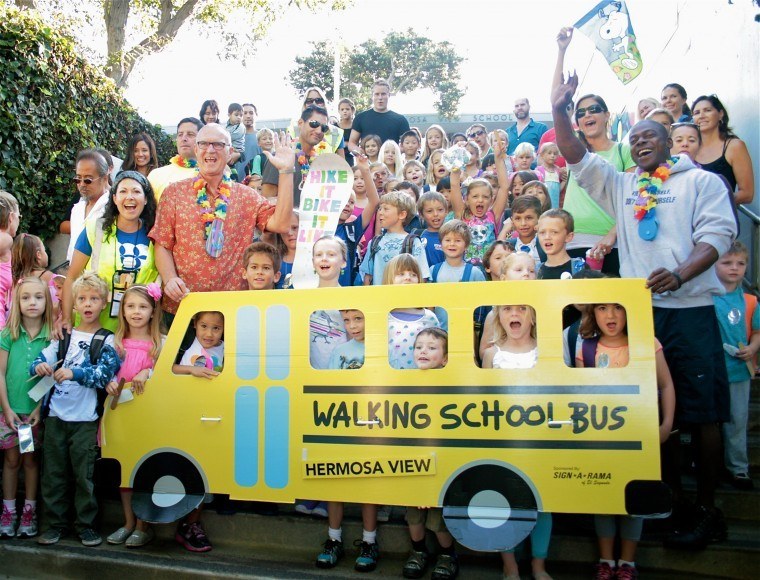
Walk and bike to school activities can also be a way to engage residents who don't have children, in supporting "bike buses" and "walking school buses."

But if kids aren't neighborhood residents, they aren't going to be walking or biking.

Labels: , , , , , ,