Women's History Month and urban planning
==========
This is a reprint from 2020. For the most part, links have not been checked.
==========
March is Women's History Month and Sunday March 8th is International Women's Day 2020.
Women as planners and architects. From the standpoint of labor within the urban planning profession, on the land use planning side women make up a larger and larger proportion of the planning workforce, although directorships of government planning agencies tend to be dominated by men.
-- "Jane Jacobs and the Power of Women Planners," CityLab
Although maybe the DC area is an exception given that plenty of articles opine about the need for more women in the profession ("Urban Planning Needs More Women," Rooflines).
There are major exceptions, for example Jennifer Keesmaat was the planning director for the City of Toronto, Ellen McCarthy and Harriet Tregoning were directors of planning in DC, and Amanda Burden was the Planning Commissioner for the City of New York ("Social Planner," New York Magazine) while Janette Sadik-Khan was the Transportation Commissioner. Sadik-Khan was succeeded by Polly Trachtenberg.

Increasingly, women are being chosen as transportation directors leading city agencies, for example in Pittsburgh, DC's former associate director of transportation planning, Karina Ricks, leads that agency. Philadelphia, Portland, and New York City among others.
There aren't too many women running the largest transit agencies, although plenty of women are in high positions in those agencies, and hold positions across the profession.
Southern California's Metrolink has appointed a woman as CEO ("Metrolink Board Names Stephanie Wiggins as Chief Executive Officer"). The interim director of NYC Subways is Sarah Feinberg. A woman briefly headed up Sound Transit in Seattle.
In the face of many prominent women, the architecture profession remains dominated by men ("Challenged to change their industries' faces," Daily Journal of Commerce; "Where are the women in architecture?," Austin American-Statesman). The landscape architecture field has plenty of women practitioners.
However, according to the AIA, now 50% of students in architecture programs are women, and the organization is now sponsoring an annual Women's Leadership Summit, which this year is in June in Miami.
One of the special interest sections of the American Planning Association is Planning and Women and the Women's Transportation Seminar is a professional development organization for women working in the transportation field.
Women and the history of the planning profession. One of the strands from which the planning profession in the US was birthed was out of women-initiated "good government" and "good places" initiatives in a time when women still didn't have the right to vote.
(2020 is the 100th anniversary of Women's Suffrage winning the right to vote in the US, which was realized through the passage of the 19th Amendment to the US Constitution.)
In the face of many prominent women, the architecture profession remains dominated by men ("Challenged to change their industries' faces," Daily Journal of Commerce; "Where are the women in architecture?," Austin American-Statesman). The landscape architecture field has plenty of women practitioners.
However, according to the AIA, now 50% of students in architecture programs are women, and the organization is now sponsoring an annual Women's Leadership Summit, which this year is in June in Miami.
One of the special interest sections of the American Planning Association is Planning and Women and the Women's Transportation Seminar is a professional development organization for women working in the transportation field.
Women and the history of the planning profession. One of the strands from which the planning profession in the US was birthed was out of women-initiated "good government" and "good places" initiatives in a time when women still didn't have the right to vote.
(2020 is the 100th anniversary of Women's Suffrage winning the right to vote in the US, which was realized through the passage of the 19th Amendment to the US Constitution.)
Women's civic and garden clubs were major actors in local civic affairs, including urban design (as beautification sometimes) until the 1960s at least.
Land use planning and architecture. Some argue that the principles of land use planning are designed to favor men ("If women built cities, what would our urban landscape look like," Guardian). From the article:
-- "Women's Place: Urban Planning, Housing Design, and WorkFamily Balance," Fordham Law Review
-- "Women in the Urban Environment," Signs Vol. 5, No. 3, Supplement. Women and the American City (Spring, 1980), pp. S188-S214
The presence of women as an indicator of safety in the public space. For years I have been strongly influenced by points made in writings about safety in public spaces and how the number of women out and about can be seen as an indicator of success or failure. John King, urban design writer for the San Francisco Chronicle wrote about this ("Great architecture, clean streets, culture -- it must be Minneapolis") in discussing Minneapolis as an example of his ten principles about how to make cities great:
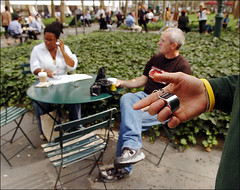 Keith Bedford for The New York Times. A man and a woman: Minding the gender gap in Bryant Park.
From the 2005 New York Times article "Splendor in the Grass":
 For example, SheTaxis, a women-focused taxi service in Greater New York City, modeled after the service in Mexico City ("Mexico launches fleet of pink cabs - driven by women, for women," New York Daily News) which was launched in 2009, launched in 2014 ("New Service Offers Taxis Exclusively for Women," New York Times).
But overall in the US, such services haven't fared too well.
SeeJaneGo, a ride hailing service catering to women, operating in Orange County, California, shuttered in 2018 ("See Jane Go, a ride-hailing service for women, by women, says farewell," Orange County Register).
In response to public safety issues, Mexico City has dedicated cars on its subway system for women although similar cars in Beijing don't seem to be working too well ("China's Women-Only Subway Cars, Where Men Rush In," New York Times), although such cars have existed in Tokyo since 1912 ("I used the women-only train carriages in Tokyo, for good reason – and I'd welcome them in the UK too," Independent).
Professor Anastasia Loukaitou-Sideris of UCLA has authored a number of papers on bus stop safety. Many transit agencies have introduced anti-harassment programs.
-- Hollaback! is an organization that addresses street harassment issues
-- Hot Spots of Bus Stop Crime, Prof. Anastasia Loukaitou-Sideris, UCLA
-- Geography of Transit Crime, Loukaitou-Sideris et al., UCLA
-- Transit Security: A Description of Problems and Countermeasures, FTA
Restroom equity. One long standing issue is restroom access. Women tend to take longer to use restroom facilities (men can stand for some of their needs, taking less space, while women need stalls), but in public buildings like sports facilities, train stations, airports, and convention centers, more restroom facilities for women tend to not be provided. Some cities and states have been changing laws to address this ("'Potty Parity': Equal Wait Time for Men's and Women's Restrooms," Time Magazine).
 Cover image: Wheels of Change: How Women Rode the Bicycle to Freedom (With a Few Flat Tires Along the Way), by Sue Macy.
Women and bicycling. There are many initiatives around promoting bicycle use by women. One of the earliest was by the Association of Pedestrian and Bicycle Professionals (Women Cycling Project). Now many local and state bicycle and alternative transportation organizations have women access initiatives.
The Race Pace chain of bicycle shops in Greater Baltimore has had for many years a sub-store called Bella Bikes dedicated to women's cycling, within their Ellicott City location. More bike shops are adding this kind of offering.
Women and political power. While there is no doubt that men are a majority of the holders of elected office at all levels across the United States ("Why Does the US Still Have So Few Women in Office?," The Nation), increasingly, women are winning elections for mayor in cities around the country. DC's Muriel Bowser is one such example, but there are many others, including Houston, Salt Lake City, and in 2017, Seattle and Montreal. More and more women are being elected to City Councils, etc.
Post the Trump victory, many more women are running for political office at all levels ("A year after the Women's March, a record number of women are running for office, will they win?," Washington Post; "More Than Twice As Many Women Are Running For Congress In 2018 Compared With 2016," NPR).
And a signpost of this movement was the midterm national election, where a great number of women of a diversity of race and politics were elected to the U.S. House of Representatives, although generally this was more a case of Democratic Party members over Republicans ("Banner Year for Female Candidates Doesn't Extend to Republican Party," New York Times).
Gender budgeting. In 2017, the Economist ran a provocative editorial, "Why governments should introduce gender budgeting," building on an earlier article, "Why national budgets need to take gender into account."
From the editorial:
-- "This Is What a Feminist Country Looks Like," New York Times
-- A Feminist Government, Government of Sweden
Land use planning and architecture. Some argue that the principles of land use planning are designed to favor men ("If women built cities, what would our urban landscape look like," Guardian). From the article:
In a classic 1980 essay called What Would a Non-sexist City Be Like?, the American urbanist Dolores Hayden called for centres that would “transcend traditional definitions of home, neighbourhood, city and workplace”. Since then, others have taken up the argument that a woman-friendly city would be more porous, the divisions between home and work less rigid, so that domestic work is acknowledged as a productive activity, and carers (of children, disabled relatives and older people) are less excluded from economic life. In any case, such divisions are often artificial, with women in developing-world cities undertaking economic activity that has too often been ignored.-- "Female-Friendly Cities: Rethinking the Patriarchy of Urban Planning," Ms. Magazine
-- "Women's Place: Urban Planning, Housing Design, and WorkFamily Balance," Fordham Law Review
-- "Women in the Urban Environment," Signs Vol. 5, No. 3, Supplement. Women and the American City (Spring, 1980), pp. S188-S214
The presence of women as an indicator of safety in the public space. For years I have been strongly influenced by points made in writings about safety in public spaces and how the number of women out and about can be seen as an indicator of success or failure. John King, urban design writer for the San Francisco Chronicle wrote about this ("Great architecture, clean streets, culture -- it must be Minneapolis") in discussing Minneapolis as an example of his ten principles about how to make cities great:
Women know best. The first night in Minneapolis, I dined at Cafe Brenda on walleye and wild rice, which, with blueberry muffins, constitute the trifecta of local cuisine. A stroll past sleepy blocks of warehouses evolving from red-light district to residential neighborhood led me to the banks of the Mississippi. Walking along grassy parkland toward the Falls of St. Anthony, I had the place to myself -- except for one woman jogging casually past me toward the horizon.The presence of women as an indicator of what works and what doesn't in managing public spaces ha been discussed over the years in various writings on New York City's Bryant Park.
When a city feels safe enough that a woman jogs along, alone, at dusk ... somebody is doing something right."
Keith Bedford for The New York Times. A man and a woman: Minding the gender gap in Bryant Park.From the 2005 New York Times article "Splendor in the Grass":
It was lunchtime at Bryant Park, and thousands of office workers were gathered beneath the emerald veil of trees. Ever since the park was renovated 13 years ago, it has been a remarkable space, and one of its most remarkable aspects is that the number of men and women is about equal, a balance that is carefully monitored as a barometer of the park's health. In 1980, when the space was rife with drug dealers and other scurrilous sorts, the ratio of men to women was about 9 to 1, said Dan Biederman, president of the Bryant Park Restoration Corporation.Transit, women and safety. Around the world women are harassed, even killed, in transit, India being particularly notorious. In a number of places, women-only taxi services have been created to provide safe transit.
But when the park reopened in 1992, the comfort level of women was seen as key to its resurgence, which is why the park's designers paid special attention to accouterments that appeal to women, like bathrooms with full-length mirrors, kiosk food and flowerbeds.
These days, the male-to-female ratio is just about even. And with this balance comes the possibility of triangulation, which Mr. Biederman defines with scientific precision as the tendency of an external stimulus to prompt strangers to interact. "If there's enough triangulation from things in the park," he said, "then people who don't know each other will break down and talk to each other."

But overall in the US, such services haven't fared too well.
SeeJaneGo, a ride hailing service catering to women, operating in Orange County, California, shuttered in 2018 ("See Jane Go, a ride-hailing service for women, by women, says farewell," Orange County Register).
In response to public safety issues, Mexico City has dedicated cars on its subway system for women although similar cars in Beijing don't seem to be working too well ("China's Women-Only Subway Cars, Where Men Rush In," New York Times), although such cars have existed in Tokyo since 1912 ("I used the women-only train carriages in Tokyo, for good reason – and I'd welcome them in the UK too," Independent).
Professor Anastasia Loukaitou-Sideris of UCLA has authored a number of papers on bus stop safety. Many transit agencies have introduced anti-harassment programs.
-- Hollaback! is an organization that addresses street harassment issues
-- Hot Spots of Bus Stop Crime, Prof. Anastasia Loukaitou-Sideris, UCLA
-- Geography of Transit Crime, Loukaitou-Sideris et al., UCLA
-- Transit Security: A Description of Problems and Countermeasures, FTA
Restroom equity. One long standing issue is restroom access. Women tend to take longer to use restroom facilities (men can stand for some of their needs, taking less space, while women need stalls), but in public buildings like sports facilities, train stations, airports, and convention centers, more restroom facilities for women tend to not be provided. Some cities and states have been changing laws to address this ("'Potty Parity': Equal Wait Time for Men's and Women's Restrooms," Time Magazine).
Women and bicycling. There are many initiatives around promoting bicycle use by women. One of the earliest was by the Association of Pedestrian and Bicycle Professionals (Women Cycling Project). Now many local and state bicycle and alternative transportation organizations have women access initiatives.
The Race Pace chain of bicycle shops in Greater Baltimore has had for many years a sub-store called Bella Bikes dedicated to women's cycling, within their Ellicott City location. More bike shops are adding this kind of offering.
Women and political power. While there is no doubt that men are a majority of the holders of elected office at all levels across the United States ("Why Does the US Still Have So Few Women in Office?," The Nation), increasingly, women are winning elections for mayor in cities around the country. DC's Muriel Bowser is one such example, but there are many others, including Houston, Salt Lake City, and in 2017, Seattle and Montreal. More and more women are being elected to City Councils, etc.
Post the Trump victory, many more women are running for political office at all levels ("A year after the Women's March, a record number of women are running for office, will they win?," Washington Post; "More Than Twice As Many Women Are Running For Congress In 2018 Compared With 2016," NPR).
And a signpost of this movement was the midterm national election, where a great number of women of a diversity of race and politics were elected to the U.S. House of Representatives, although generally this was more a case of Democratic Party members over Republicans ("Banner Year for Female Candidates Doesn't Extend to Republican Party," New York Times).
Gender budgeting. In 2017, the Economist ran a provocative editorial, "Why governments should introduce gender budgeting," building on an earlier article, "Why national budgets need to take gender into account."
From the editorial:
At its simplest, gender budgeting sets out to quantify how policies affect women and men differently (see article). That seemingly trivial step converts exhortation about treating women fairly into the coin of government: costs and benefits, and investments and returns. You don’t have to be a feminist to recognise, as Austria did, that the numbers show how lowering income tax on second earners will encourage women to join the labour force, boosting growth and tax revenues. Or that cuts to programmes designed to reduce domestic violence would be a false economy, because they would cost so much in medical treatment and lost workdays.By not looking at the differential impacts of policy in terms of gender, bias is structured into outcomes.
As well as identifying opportunities and errors, gender budgeting brings women’s issues right to the heart of government, the ministry of finance. Governments routinely bat away sensible policies that lack a champion when the money is handed out. But if judgments about what makes sense for women (and the general good) are being formed within the finance ministry itself, then the battle is half-won.
-- "This Is What a Feminist Country Looks Like," New York Times
-- A Feminist Government, Government of Sweden
Labels: architecture, transportation planning, urban design/placemaking, urban history, urban planning, women/gender issues
posted by Richard Layman @ 3:00 AM&Permanent Link
Follow this blog
2 comments







