Rebuilding Place in the Urban Space

"A community’s physical form, rather than its land uses, is its most intrinsic and enduring characteristic." [Katz, EPA] This blog focuses on place and placemaking and all that makes it work--historic preservation, urban design, transportation, asset-based community development, arts & cultural development, commercial district revitalization, tourism & destination development, and quality of life advocacy--along with doses of civic engagement and good governance watchdogging.

Monday, March 22, 2021

Active initiative in Edina, Minnesota to preserve affordable single family houses | But why not build triple deckers?


KARE-TV reports ("Edina launches pilot program to save affordable homes from teardown") that Edina, a high demand suburb of Minneapolis, has instituted a program aimed at reducing teardowns, which replace smaller, older, more affordable houses, with what some call "McMansions," which are much larger, more expensive houses, often ersatz when compared to the size and architectural style of houses when the neighborhood was first built.

According to this article, Edina and a neighborhood in Minneapolis are the two hottest markets for teardowns in Greater Minneapolis (in the past in the DC area, Arlington and Chevy Chase in Montgomery County have been particularly hot markets for teardowns).

From the KARE-TV article:

Citywide since 2008, nearly 1,000 Edina homes have been demolished – roughly eight percent of the city’s single-family homes. The average value of Edina's teardowns: $421,420 The average value of the homes built in their place: $1,165,786. That’s an increase of increase of 177%. “It's something just so out of whack,” Ruth says.

There is an opportunity cost involved in two ways, either positive or negative, depending on your perspective.  First, teardowns up-price the housing in a community, reducing affordability.  On the other hand, when a local government is reliant on property tax for the bulk of its operating revenue, this process increases the property tax revenue stream.

In either case, teardowns are a form of "reproduction of space" that leads to significant community changes.

-- Edina Neighbors for Affordable Housing

Edina launched as a pilot a "Housing Preservation Program" focused not on historic preservation per se, but on the preservation of housing affordability (that's what "housing preservation" means in the public and social housing field too, not historic preservation).

Working with the West Hennepin Affordable Housing Land Trust, Edina will use funds generated from developer proffers and community development block grants to buy the houses.

From the article:

The city mailed more than 1,000 post cards asking the question, “Do you want to sell your home but not for a teardown?” The city ... make[s] funds available to buy a limited number of houses for their appraised values to assure those homes remain intact and with families needing more affordable options. “This is not a moratorium at all on teardowns,” Stephanie Hawkinson, Edina’s affordable housing development manager, says. “We are not mandating that anyone sells their home to us. We're just providing them with a choice.”

It will be interesting to see how this works, how much funding they have, and whether or not sellers are willing to sell to the city initiative, instead of extracting a somewhat higher price from the for profit real estate development market. 

Multiple units as an another alternative?  One of the forces "generating" teardowns is large lot size.  The lots appear to be large and can accommodate multiple families just as easily as a large house. Another way to increase housing access would be to allow "multiple unit" housing types on these lots.

I would say duplexes are "too small" given the rise in demand for housing given the constant increase in population.  So build triplexes and larger units ("Massachusetts Triple Deckers as "Missing Middle Housing" -- triplexes").

Minneapolis has changed its "single family zoning" so that duplexes and triplexes are "matter of right" as well ("How Minneapolis Freed Itself From the Stranglehold of Single-Family Homes," POLITICO).  

My criticism is that relying on individual property owners to take the initiative means that it will take decades to see much effect ("A short point about why eliminating single family zoning won't result in a rise in "affordable housing" (any time soon)").

This Boston double triple decker, now four separate units, rather than six, is for sale for $1.4 million.

By contrast, creating an active housing conversion/building program comparable to the Edina program would be a way to generate a greater number of units more quickly.

Although in the short run, it won't yield housing that is newly affordable without subsidy, because it is built at current costs for land, labor, and materials. 

Labels: , , , , , , , , ,

Tuesday, September 03, 2013

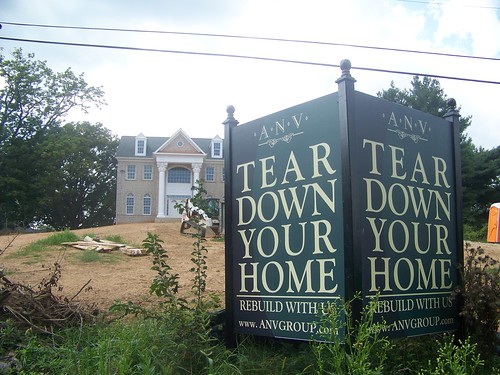
A sign promoting tear downs and McMansions in Great Falls, Virginia

A sign promoting tear downs and McMansions in Great Falls, Virginia

Labels: , ,

Thursday, November 13, 2008

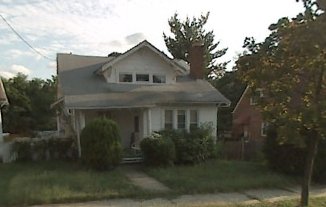
The house two doors down

Used to look like this. (This is how it looked when we made an offer on our house.)
House down the street
(Google Maps photo.)

Yes, I know it's homely. But the issue was lack of investment (a/k/a disinvestment) and lack of maintenance.

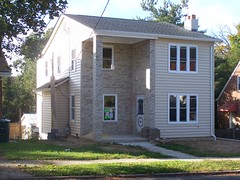
The owners (the daughter of the owner inheirited the house when he died) are supersizing it in order to maximize the value. They have distinctly suburban sensibilities, using materials and architectural styling that is not original to the neighborhood.
Nasty house being reconstructed two doors down
They likely will get their money out of it, because they didn't have to pay market price for the house. But I wish they would have just made it into a four square, which is a similar type of house in the arts & crafts-craftsman-bungalow typology. In Seattle, many new houses are constructed in this style.

You can see why I favor design review, whether or not a neighborhood is designated historic. When I first started getting involved heavily in civic affairs, about 8-9 years ago, I would be excited when I saw new foundations or other building activity on empty lots or nuisance properties in the city. Now, I expect the worst...

Labels: , , ,

Tuesday, August 14, 2007

Mansionization in Prince George's County

From email:

From Samuel J. Parker, Jr.,Chairman, Prince George 's County Planning Board

Are you familiar with the terms "McMansion" or "Mansionization"? What about infill development? Do you have any concerns related to infill development in your community/jurisdiction?

This issue, which has received a great deal of public attention across the nation, is one that the Prince George 's County Planning Board is also concerned about. Here at the Planning Board we have begun looking, more in-depth, at how Mansionization, (the phenomenon characterized by the construction of unusually large homes replacing smaller homes in an existing neighborhood or homes that are incompatible with the character of an existing neighborhood), is impacting our community locally.


Therefore, the Prince George's County Planning Board invites you to participate in a public forum to discuss Mansionization issues in Prince George's County, scheduled Wednesday, August 22, 2007 at 7:00 p.m. in the Prince George's County Parks and Recreation Administration Building, located at 6600 Kenilworth Avenue in Riverdale.

This meeting is part of a larger Study that has been launched by the Planning Board to address many of the concerns surrounding this issue. Community concerns surrounding Mansionization include perceptions of negative impacts on a neighborhood's character, negative economic impacts (i.e. higher taxes, forcing out older residents), and concerns surrounding the achievement of a proper balance between protecting property rights verses conserving the character of established neighborhoods and the community as a whole. Through this Study, the Planning Board hopes to examine the impacts of this issue on our local communities and work with you, as one of our community stakeholders, to identify the major concerns and solutions for resolving them.


Attached to this letter is a formal flyer announcing this public meeting, which is the first in a series of public forums planned to address the issue of Mansionization in Prince George 's County. We hope this will be a learning experience for everyone concerned and affected by this issue, and believe that the information we obtain through these meetings will be vital to future decision-making around this issue.

We look forward to hearing your concerns and suggestions at the upcoming meeting but ask that you do not wait to attend the meeting to offer your feedback. You can begin to contribute immediately by completing the attached four-question survey and either mailing it to us, or logging onto our website to complete and submit electronically. You can also bring the survey with you to the meeting on August 22.

We hope to see you on August 22 as we begin discussions with interested parties throughout the region on "Mansionization in Prince George 's County." To RSVP or get more information, contact the Prince George 's County Planning Board Office at 301- 952-3560, or e-mail, PublicAffairs@ppd.mncppc.org.

Labels: , , ,