Rebuilding Place in the Urban Space

"A community’s physical form, rather than its land uses, is its most intrinsic and enduring characteristic." [Katz, EPA] This blog focuses on place and placemaking and all that makes it work--historic preservation, urban design, transportation, asset-based community development, arts & cultural development, commercial district revitalization, tourism & destination development, and quality of life advocacy--along with doses of civic engagement and good governance watchdogging.

Wednesday, December 25, 2019

Happy Holidays! (and street lighting)

In the 1990s, residents in the Yalecrest neighborhood of Salt Lake City petitioned for the right to install decorative streetlights to provide better lighting at the pedestrian scale, complementing the more traditional streetlight program with taller poles focused on providing light to streets for motor vehicles.


Called the Privately Owned Street Lighting Program, the city often provides grant support, but the residents remained responsible for organizing and paying for the construction, as well as covering the ongoing costs of the electricity--billed to specific lots where the poles were erected--and changing burned out bulbs.


Separately, Salt Lake has a different program allowing for "enhanced service" comparable to the private lighting program, but had been organized as special service districts.  That changed recently, and the many smaller SSDs were rolled up into two consolidated "public lighting districts" to pay for, manage, and upgrade lighting systems to LED lights, etc.  Residents in those districts pay an additional monthly fee, tacked on to the city utility bills, which cover water and waste collection.

And the neighboring City of South Salt Lake has a Street Lighting Master Plan that covers night time lighting on multiple dimensions, in the manner of the most forward-thinking cities.
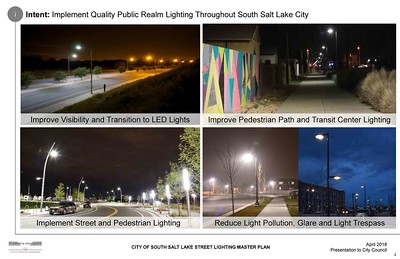
Goals of the City of South Salt Lake Street Lighting Master Plan

These past blog entries discuss best practice planning for lighting in multiple dimensions, not just for safety, but for activation, branding, etc.

-- "Night-time safety: rethinking lighting in the context of a walking community," 2014
-- "Lighting as an element of urban design and community identity," 2014
-- ""Night time as a daypart and a design product," 2017
-- "Revisiting stories: Night-time safety: rethinking lighting in the context of a walking community and Detroit's reduction in pedestrian deaths from lighting upgrades," 2018
-- "Philips Lighting changes name to Signify," 2018


In Washington, DC this kind of neighborhood lighting is installed in historic districts and is called Washington Globe lighting, although you can find this kind of lighting--which I think of as pedestrian and sidewalk oriented as opposed to the tall streetlights which focus on lighting streets for cars--in other neighborhoods.  The program is initiated, managed, funded and operated by the city, under the public space maintenance responsibilities of the DC Department of Transportation (DDOT).

-- "WASHINGTON’S STREETLIGHTS: ILLUMINATING THE CAPITAL CITY ONE ROAD AT A TIME," National Capital Planning Commission

It's very difficult to get the city to install this kind of lighting in places where it isn't already installed, and it is expensive to do so because the way it is installed is by integrating the lights into the separate street light electricity network installed within the public space.  That means digging up the street and planting strips, creating a trench, installing electrical lines, etc.

Separately, DC aims to do a master upgrade of all the city's streetlights, for energy and cost savings, although this has been controversial in many neighborhoods, concerning whether or not LED lights pumping out too much Kelvin can damage your health ("The Changing Glow Of D.C. As Streetlights Make The Switch To LEDs," WAMU/NPR), so the program has stalled.

The brilliance of the Salt Lake Privately Owned Street Lighting Program is that it is so much cheaper, maybe 10% of the cost of the normal way, because rather than a massive digging up of the public space to connect the lights to the public streetlight network, only a bit of the public space has to be disturbed, because each light is instead connected to the electricity system of individual houses--the lot on which the lightpole is installed takes on the responsibility.

While residents have to spend the time to make this happen, it doesn't require the lengthy approval and budgeting processes required when adding the lights to the publicly owned and managed streetlight network.

The Salt Lake program is interesting because it's an example of civic engagement, "self help," community and neighborhood organization, and civic pride.

This is demonstrated by how many property owners and adjacent residents "take ownership" and express civic pride in these lights, by decorating them for holidays--not just Christmas but Halloween--or just because.

They can do this, because unlike traditional streetlights, typical these streetlights are installed with plugs (electric outlets).  "Normal" streetlights are rarely installed with plugs because a city doesn't want to pay for extra, unauthorized electricity use.

Festively lit street lights in Salt Lake City

This streetlight has a lighted wreath and green lighted bulbs on the globe.


You can't really tell from the photos, but on this block, houses on one side have changed the light bulb to red and on the other side of the street, green.  So the globes glow very strongly either red or green.


This street has a coordinated treatment also.


Similarly, many residents go all out for holiday decorations, for Halloween, Christmas, even Thanksgiving.

On one nearby street, many of the residents coordinate Christmas decorating, calling their street, "Christmas Street"  Images from "Christmas Street in Sugarhouse," Utah's Adventure Family.  (My camera isn't good for night pictures.)


Labels: , , , , ,

Saturday, May 10, 2014

Historic preservation month post: building the capacity for self-help and "Rehab Addict" as an example of how more could be done

The first section of this post is an extract from a March entry. It comes up again because Suzanne and I just "argued" about this issue, and how Nicole Curtis (see below) keeps writing on her facebook page that she can't be the savior in response to all the plaintive queries she gets about helping people save historic houses in their various neighborhoods across the country. (S is a fervent believer in tough love...)

I keep saying that Nicole Curtis, and especially DIY Network and the HGTV Network, should step up and provide more information and resources so that people can better help themselves and build their own capacity to do what historic preservation minded house rehabbers do....

-----------------Reprint with augmentation --------------------

It's worth watching the DIY Network/HGTV show "Rehab Addict," featuring Nicole Curtis, who grew up in Metropolitan Detroit and now does architecturally-sensitive rehabs of problem properties in the Minneapolis and Detroit areas, which are featured on her show  ("Nicole Curtis of 'Rehab Addict' no ordinary house flipper," LaCrosse Tribune; "DIY Network's new 'Rehab Addict' tackles burned-out Detroit home," Detroit Free Press).

I like the show because most of the others on those networks are all about new construction and ripping the guts out of houses (even though I am generally appreciative of the quality of work done on the "Property Brothers" and "Income Property" shows, and the hosts of "Flip or Flop" are reasonably respectful of historic qualities in certain of the houses that come into their possession).

.. yes, I know that there is the "This Old House" program on PBS and the companion magazine (which is great), but that show is a lot more hoity-toity in that they do projects that cost many hundreds of thousands of dollars, while the projects that Nicole Curtis does are much more typical of a normal person's budget and capability.

It amazes me to no end that the National Trust for Historic Preservation isn't a program sponsor and doesn't work to "utilize" Nicole Curtis and the Rehab Addict show as a way to increase the awareness of the value of historic preservation-based approaches to housing improvement and community revitalization. 

This comes up because Nicole has a Facebook page, which sometimes unfortunately for her, isn't run by a publicist--she writes it herself.

And as a person in business, but with a tv show, she gets lots of plaintive contacts from people asking her to fix up problem properties in their communities.  Her response is "You've got to do it yourselves."

Of course she is right but at the same time I would argue that this is an opportunity to step in and step up and provide more in the way of guidance and resources... explain the process, the back story, of how things work, so people can begin to figure things out for themselves without having to start absolutely at square one.

First, while it's not her responsibility to lay out the process or information sources people need, DIY Network could do a better job providing support material on its website--for the most part it doesn't--for this show (and others) giving people more in depth information or at the very least a link list of resources.

E.g., a search on the term "National Trust for Historic Preservation" yields one hit on the DIY Network website and seven hits on the HGTV website.  The hits have no real actionable information.

Second, the National Trust for Historic Preservation should step up and offer to work with DIY Network/HGTV to provide this information.  For example, on this blog in the right sidebar I have a few hundred historic preservation links, although none specifically lay out the process on how to fix and old building, create a historic district, etc.

HGTV and NTHP used to work together a few years back before I started watching the channel, but it appears that this relationship has run its course. 

Third, DIY Network/HGTV Network could work out a couple of special episodes for "Rehab Addict,"about how preservation works in terms of taking a project on and rehabilitating the house (e.g., with manuals like the now out-of-print "Rehab Rochester" and similar publications as good resources), how the historic designation process works at the state, local, and national levels, how to create a historic district and what it means, short features on different historic preservation organizations, projects, and resources, etc.

This should be done in association with preservation organizations and building materials salvage groups, that aren't the normal "how to" shows that she does for each episode on a specific part of the house, but are more about the "back story" and process.

Right:  25 West Strawberry Street before it was renovated in Lancaster, PA.  Lancaster Newspapers photo.

For example, in Lancaster, PA, the Lancaster Housing Opportunities Partnership does the same kind of work that Nicole does.  See "Nonprofits work to rejuvenate a Lancaster city neighborhood one home at a time." 

In Cleveland, both the Cleveland Restoration Society and the Famicos Foundation--a Catholic charity--do amazing work.  In Pittsburgh, the Pittsburgh History and Landmarks Foundation is amazing as is Design Center Pittsburgh, which provides assistance to homeowners seeking to do quality renovations, etc.

But there are many great preservation groups across the country and hundreds of positive examples that can be used.

Fourth, DIY Network/HGTV ought to create a form of "public service commercials", switching out an occasional network promotion spot (called a "bumper") in favor of spots that promote historic preservation organizations, projects, resources, etc.

Resources for historic preservation (new)

There are many resources. Sadly, the National Trust for Historic Preservation is seriously dialing back on their publication programs. They have published hundreds of manuals and materials (including the Main Street commercial district revitalization program) over the years which are incredibly helpful. Now these items are very hard to find and I regret tossing old copies of their annual bookstore catalog to use as a reference for finding materials.

Here are three examples of the kinds of resources that the NTHP used to make readily available (from 2006):

-- "How to Preserve a Historic Home," National Trust Resource Center, Information Sheet #1
-- "How to Preserve a Historic Building," National Trust Resource Center, Information Sheet #2
-- "Working with Contractors and Architects; Finding Supplies and Furnishings;. Interior Design and Decorating, National Trust Resource Center, Information Sheet #32

2. The National Register for Historic Places, the unit of the National Park Service tasked with managing the federal historic preservation program, publishes many useful materials about the process of creating historic districts and different types of cultural resources and themes, as well as on the technical process of historic preservation.

3. Many great resources are produced by local and statewide historic preservation organizations. Although one of my favorites, the Rehab Rochester manual, published by the Landmark Society of Western New York, is out of print (but still available via the miracle of archive.org).

DC's own Capitol Hill Restoration Society has produced many bulletins over the years about various elements of historic houses, architectural styles, etc.

The guide on creating a historic district published by the Historic Districts Council of New York City is specific to NYC but I think very helpful for understanding the overall process.
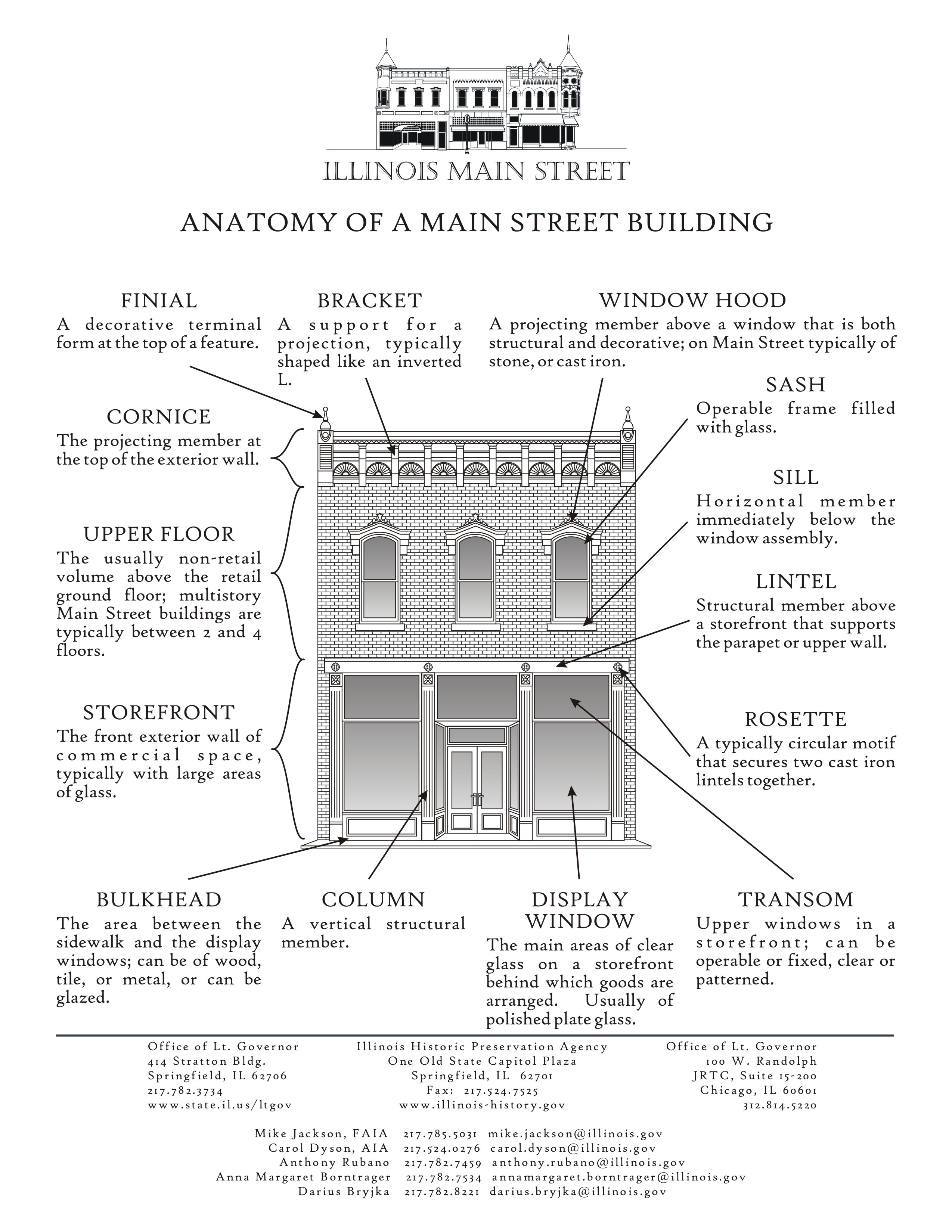
Anatomy of a Main Street building
4. Local and state historic preservation agencies publish important resources. For example, I mention from time to time particularly great examples of local historic preservation manuals, such as from Montgomery County Maryland, the Richmond, Virginia, and Roanoke, Virginia, along with the Philadelphia Rowhouse Manual.

I have always found useful materials published by the Illinois Historic Preservation Agency on "Main Street Design" and the Illinois Main Street program, but there are many such resources available to us.

5.  Including international resources published by programs in other countries, especially the UK, as well as by UNESCO and other organizations.

Labels: , , , , ,

Tuesday, April 15, 2014

San Antonio university architecture school neighborhood improvement program initiative

Right:  City of San Antonio photo.  

In the vein of Sunday's post about self-help efforts, Stuart calls our attention to a program run by the University of Texas at San Antonio's architecture school, where Professor Sue Ann Pemberton has developed a program called "Students Together Achieving Revitalization," where students come together to repair "derelict residences," working with the city's Office of Historic Preservation and local contractors.

From the San Antonio Express-News article "UTSA students go beyond the surface to repair East Side homes":
Over the last five years, the program's more than 700 participants have helped restore about 77 houses in East Side historic districts such as Knob Hill, Tobin Hill, Government Hill and Dignowity Hill. Property owners, who have to apply through the city's Office of Historic preservation, don't just get a paint job, but valuable repairs to porches, windows and roofing...
Note that programs like these are good ways to ameliorate the higher costs that be involved in maintaining historic properties, costs that are harder to bear for low income households.

Labels: , , ,

Sunday, April 13, 2014

Self-help civic initiatives in DC, Mount Rainier, MD, Ysilanti, MI, and Brookings, SD

One of the points within Tocqueville's Democracy in America that is very important is the self-help-community impulse that was expressed by word and action by so many. 

People from other countries frequently comment about how the civil society in the US is so much more vibrant than in their own countries--even as we are experiencing a serious decline in civic participation--voting, reading newspapers, participating in local organizations, etc.

On the other hand, opposition to the growth of "big government" comes in part out of the recognition that it reduces civic impulses.

You see this in DC especially.  My joke is that "big government--the federal government--trickles down and shapes little--local--government in its image."  Advisory Neighborhood Commissions are both a benefit and a bane to local participation.  It's great that neighborhoods have a right to weigh in on matters before DC government through ANCs.  On the other hand, people end up believing that even the minutest matters have to be taken care of by government rather than ourselves.

But DC has a couple of interesting civic initiatives underweigh that are a kind of government-civic partnership.

1.  Love Your Block DC, a program by the Serve DC volunteer unit of the Executive Branch, offers grants of up to $1,000 to support independent civic initiatives focused on micro-neighborhood improvements.

Unfortunately, they don't make a downloadable application fully available--it's set up to be read and filled out page-by-page online and you can't read the whole thing first.  So I can't tell you the application due date.

(P.S. one of my examples about re-figuring how city offices ostensibly focused on engaging with the public is the Serve DC program.  I think offices like this should be based in the Main Branch of the Central Library, and open on those hours, rather than more traditional "business" hours, and located in less accessible government buildings.)

2.  I have been remiss in not writing about the Age-Friendly DC Block by Block Walk initiative.   Trainings preceded the March 20th launch of the program, which lasts til the end of the month.  The intent is to walk every block in the city " to help identify neighborhood assets and issues needing attention, particularly through the lens of residents, workers, and visitors 60 and older."

I think the main effort is a walkability audit, which frankly, ought to be done throughout the city, as part of sustainable mobility and community development planning anyway.  The kinds of things they are looking to record (see graphic) are the kinds of things that ought to be recorded anyway, such as in a neighborhood audit (cf. the 2007 entry "Systematic neighborhood engagement").

And it's the flip side of a point made in Safe Routes to Schools programs (and in my entry "Night-time safety: rethinking lighting in the context of a walking community") that these programs of developing and promoting safe walking routes benefit all residents, not just schoolchildren.

I think about these issues more and more as I age, don't see as well, don't hear as well (yes, young'uns, it will happen to you too, soon enough you realize that you are not perpetually 18 years of age).  I think about it a lot vis-a-vis Suzanne's parents, when we take them on transit or watch them drive in areas they are unfamiliar with.  So this is an important initiative too.

... but I doubt this initiative will do separate day time and night time walks.

3. And then there are some interesting projects locally and elsewhere, which also exemplify civic initiative, some involving local government and some not.

Before and after of a 2013 Paint Ypsilanti project.

In Ypsilanti, Michigan (it's next to Ann Arbor), the "Paint Ypsilanti" project ("Paint Ypsilanti project looking to expand after successful launch," Ypsilanti Courier) is not unlike Rebuilding Together's focus on housing improvement and repair for low income households or the HGTV show "Curb Appeal: The Block," where they fix up a house on a block but then also do some other smaller for other houses on the same block, to maximize the impact.

From the website:
 "Paint Ypsilanti is founded on the simple premise that we want to increase the vibrancy of our neighborhoods by providing assistance to residents unable to keep up financially and/or physically with the maintenance for their homes.  After completing a successful pilot project in 2013, the program has plans to expand and hopes to provide paint, landscaping materials and labor for 20 project recipients in 2014."
In Brookings, South Dakota, presentation consultant Robert Yapp is leading three different workshops (painting historic houses, exterior wood repair, window repair and weatherization) that involve fixing up particular houses as a form of training--I expect that the buildings getting the extra attention are owned by people of limited means. 

See the press release, "BOB YAPP HISTORIC PRESERVATION WORKSHOPS - May 1-3, 2014," from the city website.  Brookings has a strong historic preservation and Main Street commercial district revitalization programs, which are about promoting civic health as well as economic development.

Note that these kinds of programs exemplify the point made by Rolf Goetze in Building Neighborhood Confidence that the point of government assistance for community development and revitalization isn't to make the residents dependent on the municipality, it's to provide a push and confirm to people that the community is worth staying in and investing in.

4.  Locally, Mount Rainer, Maryland is sponsoring their annual "Better Block" initiative, on Friday April 25th. From the press release:
April 25th from 6 – 10 pm, the Mount Rainier Circle and intersecting streets of Rhode Island Avenue and 34th street will come alive for one evening of music, workshops, parade, performances, open studios, arts activities, and more. This year, creative placemaking activities will feature Lesole’s Dance Project, Urban Eats Arts and Music Café, Adinkra Cultural Arts Studio, Beloved Community Mosaics, artist Kenny George and Patrick McDonough’s Chard/Hops spot, a Hoop Jam by Noelle Powers to the body rollin’ tunes of BOOMscat, an open studio at Ani Kasten Ceramics, a pop-up exhibition by Krista Schlyer and family crafts with Community Forklift.
For more information:

-- Art Lives Here placemaking initiative
-- Gateway Arts District, in Mount Rainier, Brentwood, North Brentwood, Hyattsville, Maryland

Labels: , , , , , ,

Friday, January 10, 2014

Community Owned Radio and Takoma (DC/MD) Radio?

Community media is another issue (see the extensive writings by Robert McChesney) that is very important to civic well being and participation.

The chaining up of radio and television and newspapers, not to mention the decline of metropolitan newspapers, and the decline of locally-relevant news content within such media helps to dumb down a community and reduce its ability to self-organize.

Community websites, blogs, and social media have stepped up a bit to fill the gap, but the reality is that such sites are for the most part micro-media, and require users to actively seek out and/or produce the content.

And there are various initiatives to support community broadband and community radio as the provision of the infrastructure necessary to support community media.

Even though "mainstream media" is declining, the reality is that most mainstream media outlets get much larger readership, viewership, or listenership than social media.  So vehicles with broader reach are necessary too.

More attention is being given to low power community radio.  Low power radio has a couple mile radius.  For the longest time, it hasn't been legal--and in DC, one such guerrilla effort is Radio CPR in the Mount Pleasant neighborhood, a neighborhood which over the years has supported a variety of community-grassroots initiatives.

But times are changing and the Federal Communications Commission allowed a round of applications for licenses, which were due by November 15th, 2013.

-- Low Power Radio webpage, FCC
-- Prometheus Radio Project

Historic Takoma, the historic preservation and community organization in Takoma Park Maryland and the Takoma neighborhood in DC is looking to apply for one of the licenses.   (I suspect that Radio CPR applied for a license but I don't know.)

See their webpage at Takoma Radio.  Also see "Takoma Park resident tries to bring community low-power FM radio to her area" from the University of Maryland Diamondback.

From the webpage:
LPFM does not require special receiving equipment. It’s regular FM radio with a less powerful signal. Our station will operate at 100 watts and reach two to five miles from downtown Takoma Park. Nationally,there are over 800 community-based, non-profit LPFM stations on the dial already. This is the first “give-away” in urban areas, frequencies are scarce, additional rules apply, and Takoma Radio is highly prepared.
They have a fundraiser concert tonight at the Seekers Church Space in Takoma DC.

Although I don't know much about the bands.


. 

Labels: , , ,

Friday, December 14, 2012

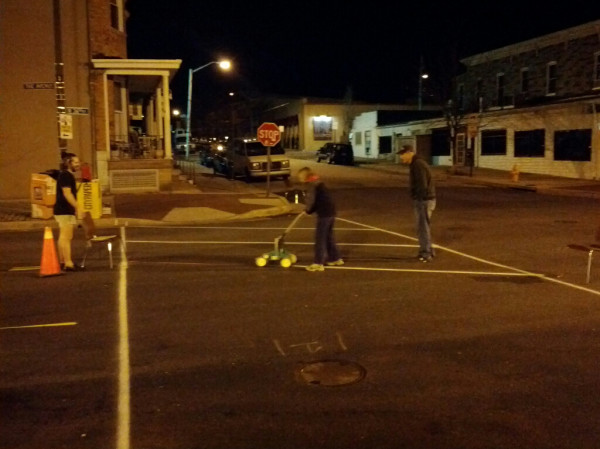
Sometimes you just have to go guerrilla: creating needed crosswalks

Left: guerrilla crosswalk in New Haven, Connecticut.  Photo by Thomas MacMillan.

So apparently the Montgomery County Department of Transportation doesn't want to put a crosswalk desired by residents in Clarksburg, until they get around to a scheduled road improvement project. See "Montgomery County denies request from Clarksburg parents to mark crosswalk: Clarksburg Elementary School parents say there have been close calls" from the Gazette.

In other communities, including New Haven and Baltimore, fed up residents tired of waiting for a crosswalk painted their own.  Also see "Urbanist Manifesto: Grab Your Spray Paint, 'Cause City Planning's Going DIY" from Building Green.

From "Caution: Guerrilla Crosswalk Ahead" in the New Haven Independent:

Frustrated by the lack of a crosswalk on a busy Whitney Avenue stretch, street-painters took matters into their own hands—and, in the view of a lawmaker down the block, inadvertently made the street more dangerous for pedestrians.

The new DIY crosswalk appeared early Sunday morning at the corner of Audubon Street and Whitney Avenue. It’s a homespun affair, comprising a column of spray-painted rectangles connecting the north corner of Audubon with the sidewalk in front of Gourmet Heaven and Moe’s Southwest Grill, on the west side of Whitney.

Below is the crosswalk that people are concerned about.


Brian Lewis/The Gazette Several families of elementary school-age children cross Stringtown Road to their Observation Drive neighborhood and wait in the median for traffic to clear. Families would like a marked crosswalk installed instead of busing students to Clarksburg Elementary School.

Labels: , , , , , ,

Friday, May 04, 2012

Jane's Walks this weekend (+ Go Richmond)

-------
I didn't get it together to try to organize a set of walks in DC.  My thought is to have walks in places where people have suggested placemaking improving changes, such as bringing back the sidewalk in the Cleveland Park commercial district, restoring Truxton Circle, and improving Dupont Circle's sense of place.  Next year...
-------
Jane's Walk, 2009
Flickr photo by Natalie Maynor.  Jackson Mississippi's 2009 Jane's Walk was a one-hour walking tour in Fondren, led by Jennifer Baughn of the Mississippi Department of Archives and History and Charlie Brenner of the Jackson-Hinds Library System.

This weekend, people affiliated with the Jane's Walk organization (named for Jane Jacobs) offer walking tours in the US and Canada, as well as in countries in Europe, Asia, South America, and Australia.  From the website:

Jane’s Walk is a series of free neighbourhood walking tours that helps put people in touch with their environment and with each other, by bridging social and geographic gaps and creating a space for cities to discover themselves. Since its inception in 2007, Jane’s Walk has happened in cities across North America, and is growing internationally.

In the US, Jane's Walk tours are coordinated by Jane Jacobs Walk, under the support and sponsorship of the Center for the Living City and the Department of City and Metropolitan Planning at the University of Utah College of Architecture & Planning.

-- Five primers on the work of Jane Jacobs
-- "Touring the City With Fresh Eyes," New York Times
-- "Tour Sacramento's neighborhoods during Jane's Walk" from the Sacramento Bee
-- "Walk for urban planning" City Messenger, Australia
-- "A walk on Toronto’s northwest fringe, with a side of curry" from the Toronto Globe & Mail


I forgot to mention that separately, the Richmond (VA) Times-Dispatch is sponsoring Go! Discover Richmond, a 10km walk through various city neighborhoods on Saturday.    From "GO! the extra mile: The best way to see the best Richmond has to offer is on a 10K walk Saturday":

The event replaces the Anthem Stride Through Time, a similar event that focused primarily on historical landmarks and was sponsored by Anthem Blue Cross Blue Shield. About 2,200 people participated last year, Keogh said. Anthem was recently announced as title sponsor of Sports Backers' annual fall Richmond Marathon, a 26.2-mile race that draws about 17,000 runners and walkers.

Labels: , , , , , ,

Thursday, April 12, 2012

DC Repurposing Space Showcase, Sunday April 15th


(There are other similar kinds of initiatives coming up, in Upper NW DC and Mount Rainier, Maryland, which I will be writing about next week.)

From Repurposing Space:

The DC Box Collective, Wangari Gardens and Tumbleweed Tiny Houses, bring you ‘Repurposing Space’, a showcase of three ways local organizations are working to reuse vacant or underutilized land in the District. See detailed schedule of events at Repurposing Space.

Wangari Gardens is a newly planned community garden space, orchard, rain garden, and community space located on 2.7 acres. The DC Box Collective is working on adapting used shipping containers to fit the needs of under-resourced District neighborhoods.

Tumbleweed Tiny Houses have been one of the earliest promoters of tiny home living, and have inspired a few DC residents to build tiny houses on wheels this summer. On site will be a model of the Tumbleweed Fencl, a 130 square foot tiny home on wheels perfectly suited for infilling urban backyard or alley spaces. Visitors are encouraged to come learn firsthand about all three exciting initiatives.

The event will take place on Sunday, April 15th - Noon-5pm @ Wangari Gardens. The gardens are located west of the Washington Hospital Center/Children’s Medical Center, bordered by Irving St. NW, Kenyon St. NW, and Park Pl. NW. A minimum $5 contribution is requested for a tour of the Fencl. All proceeds to benefit the sponsoring organizations.

Labels: , , ,

Sunday, February 05, 2012

Civil society, civic engagement, and public life (a continuing discussion)

Dan Reed has a piece in Greater Greater Washington, "Do-it-yourself culture makes our community stronger," about what young people like him call "DIY Culture" but I refer to as "self-help," which is a frequent theme in the blog, about community organizing, neighborhood action, capacity building institutions to strengthen civil society, etc.

So the previous entry on the Super Bowl and the Baltimore Grand Prix quotes from a Baltimore Sun op-ed about how secrecy and an unwillingness to be public may well have doomed the Grand Prix and certainly contributed to the $12 million of losses on the event last fall.

Speaking of "self-help" culture in Baltimore, a group created some guerrilla crosswalks in Hampden, out of the belief that finally, they had waited too long.
Guerrilla crosswalk installation, Hampden, Baltimore
Guerrilla crosswalk installation, Hampden, Baltimore. Photo: Jed Weeks.

Building civic capacity
Friday I met with DC City Council candidate and we were talking about how the city's political and governance culture needs a reboot and a fundamental commitment to small "d" democracy and civic participation, and the weak civic culture and lack of vision generally.

I talked with him about this, and the absolute necessity of capacity building institutions for community organizations, Advisory Neighborhood Commissions, I mentioned "participatory budgeting" while he mentioned the equivalent of "donor advised funds" and the community foundation model as a way to provide grants to nonprofit organizations instead of the somewhat corrupt way that DC does it now, etc.

But I said, what if we did create those kinds of supporting organizations and civic infrastructure and what if the way things happen now continue to happen and he replied that it wouldn't happen, when you build people's capacity and control over their lives, over their participation in local civic affairs, in how civic affairs are conducted and how civil society works, it will function better.

Baltimore City Trails Summit
And that reminded me that last weekend I went to the Baltimore City Trails Summit and there were probably about 80 people there ("Baltimore City bikers look for more recreation, commuting options" from the Baltimore Sun). It was heartening to hear the commitment from the City Parks Commissioner and other city officials, but it was also extremely exciting to learn about the various citizen-initiated projects to bring trails to various places around the city.

Compared to going to meetings about such topics in the DC area, it was "mind-shattering" to see "old people" (people in the 60s and 70s) as key advocates for bringing trails to their neighborhoods, because they see the value in having places to walk and bike (and skateboard and walk your dog and push the baby carriage and rollerblade) that are free of cars.

And how the city and nonprofits use National Trails Day, June 2nd, as a way to organize local events across the city to promote parks and trails in Baltimore.
National Trails Day in Baltimore volunteer form
It's a completely different attitude compared to DC proper, about how to organize, how to leverage resources, how to engage citizens and produce change. "The DC Way" (as opposed to "The Arlington Way") is very much a top-down driven process.

Metropolitan Branch Trail
Speaking of which in terms of local trails and bikeways in the DC region, Montgomery County has decided to delay by 6 years their investments in making key connections for the Metropolitan Branch Trail in the Silver Spring area--the trail when complete and with a connection to the Capital Crescent Trail in Silver Spring makes a kind of horseshoe trail network serving east and west Washington DC from Bethesda and Silver Spring and points in between.

From the Washington Area Bicycle Association:

As our members and supporters know, WABA has worked for decades to help bring about a high-quality trail connection between Silver Spring and downtown DC. The Metropolitan Branch Trail (MBT) can provide this connection, but its progress is threatened.

This year, the budget proposed by the Montgomery County Executive cuts design and construction funding for the county’s portion of the MBT for the next six years. We need the County Council to ensure that these years of effort are not wasted and that the County’s commitments to prioritize the completion of the trail are kept.

Priorities are determined not in empty words, but in budgetary commitments. In this budget the promises to build this trail are broken.

Your opportunity to tell the County Council to return the MBT to the county’s budget is this Tuesday, February 7th at 7pm. Please come and show your support for the trail.

If you are unable to attend in person, CLICK HERE to email the County Council to state your support for the trail and to request that funding be restored.

I can't help but believe that if we had a more engaged citizenry, not unlike the people at the Baltimore City Trails Summit, that it wouldn't be taking more than 30 years--from concept in 1987 to finished trail in 2018--for the Metropolitan Branch Trail to become reality.

CicLAvia logo
CicLAvia/Feet in the Streets (Greater Los Angeles)

Speaking of the need for civic engagement driven strategies to drive Ciclovia/Sunday Streets type programs, where streets are closed as special events for placemaking, biking, walking, and other activities, the City of Pomona seems to have had almost as many people coming to an organizing meeting for creating a Ciclavia program there!, as DC gets to come out to the equivalent event at Fort Dupont in Southeast DC, far away from the city's centers. See "Pomona Hosts a Great CicLAvia Stakeholder Meeting" from the CicLAvia blog.

It's all about the process and commitment to civic engagement.
Pomona_Meeting, Ciclavia
Pomona meeting, CicLAvia.

People Power...

Labels: , , , , , , ,

Wednesday, October 12, 2011

Citizen self-help (continued)

Governing Magazine has an interesting story, "Student Solutions to Environmental Problems Save Governments Money," about a school-based initiative in Alaska, where for more than 10 years, there has been a project planning process focused on environmental issues. From the article:

Last year, Alaska Gov. Sean Parnell signed a bill allowing municipalities to offer tax exemptions on residential renewable energy upgrades. The new law wasn’t a legislator’s idea, though. It came from a high school freshman. The legislation, an amendment that will make it more affordable for Alaskans to install solar panels or erect wind turbines, was crafted by a 15-year-old student named Freya Chay.

Chay’s idea was the result of a student competition called Caring for the Kenai (CFK), which encourages young people to come up with ways to improve their local environment and better prepare their community for a natural disaster. CFK is more than a contest. It’s a cooperative effort among schools, governments, businesses and environmental groups to use young minds to solve some of the region’s most pressing environmental problems. It’s also part of the high school curriculum, and meets state and national standards for science and language arts.


In college I used to marvel and how many thousands of student hours were spent writing papers, which nothing happened with. Same goes for all the student papers done at the local colleges and universities in the DC region--little of the work is harvested and retained. On the other hand, has an annual conference for the urban studies department, where student projects are presented to government officials and the public. See the past blog entry, "Idea: College student urban research conference."

But this is for junior high and high school students. Talk about making "community service" requirements actionable and substantive...

And the Los Angeles Times reports, in "Blighted by cutbacks, rose garden is reborn under volunteers' care," about how the San Jose Municipal Rose Garden, is a case study in citizen self-help when in response to budget cuts, thousands of people helped to restore the weed-choked park, and continue to maintain it today.
San Jose Municiplal Rose Garden on Mother's Day 2011
The San Jose Municiplal Rose Garden on Mother's Day 2011 at the height of the garden's first bloom. Six years ago, the garden which is the horticultural heart of the Silicon Valley, was on "rose probation." The weeds were higher than the flowers. Beds were dry and cracked. The herbicide the city was using to kill weeds was taking out prize blooms as collateral damage. By December, 2010, that very same rose garden was voted America's best and turned into a case study for how to keep municipal gardens alive when city budgets have been pruned to death. (Photo: Terry Reilly / Friends of the San Jose Rose Garden.)

Labels: , , , , ,

Thursday, February 24, 2011

Another self help example: Girl Scout to clean up run down walking tunnel in Pennsylvania

Former Liberty Bell Trolley Line underpass below Reading Railroad in Perkasie PA Pictures, Images and Photos
Former Liberty Bell Trolley Line underpass below Reading Railroad in Perkasie PA. Photobucket image by sneezehorse.

According to "Girl Scout plans project to beautify Perkasie trolley tunnel" from the Perkasie News Herald, Meghan Kennedy, an eighth-grader at Pennridge Middle School North, is going to clean up the graffiti and trash in an "abandoned" trolley tunnel, which is now used as a walking route.

From the article:

Kennedy has been a member of Girl Scout Troop 3768 for eight years and plans to complete the project to earn her Silver Award, which requires 50 hours of planning and work on a service project.

On walks home from Menlo Aquatic Center last summer, Kennedy noticed the graffiti and broken glass that littered the tunnel. She plans to paint the walls with graffiti-resistant paint, clear debris from the path through the tunnel, and plant flower-beds. As part of the Silver Award requirements, she researched the history of the trolley line and is working on gathering a team of 10 volunteers whom she will lead in the beautification effort.


DC has community service requirements for high school students, but I sure don't see much in the way of actionable projects and results.

-------
On New Year's Day, in "New Years post #3: How about more community self-help (Peter Riehle and Eastern Market Metro Plaza)" I mentioned Peter Riehle, now an Eagle Scout living in DC's Capitol Hill neighborhood, and his project to restore benches in one of the park spaces across the street from Eastern Market Metro Plaza.

Given the increasingly pressed budgets faced by local governments, we are going to need to step up and do more ourselves--not to mention behave better to begin with in terms of litter and graffiti--in order to maintain and improve our communities.

Labels: , , , ,