Rebuilding Place in the Urban Space

"A community’s physical form, rather than its land uses, is its most intrinsic and enduring characteristic." [Katz, EPA] This blog focuses on place and placemaking and all that makes it work--historic preservation, urban design, transportation, asset-based community development, arts & cultural development, commercial district revitalization, tourism & destination development, and quality of life advocacy--along with doses of civic engagement and good governance watchdogging.

Friday, October 28, 2022

City light shows: architectural lighting events

 I am a big fan of architectural lighting generally.  Few cities have lighting master plans and even fewer address lighting as an element of special events and programming ("Philips changes name to Signify").

I've written about events like Glow in Georgetown DC, Dlectricity in Detroit, and Chestnut Hill's "Light of Night" in Philadelphia.

I didn't know that Pittsburgh has had an architectural lighting event for 60 years, now going into the 61st ("Downtown will sparkle for Highmark Light Up Night on Nov. 19," Pittsburgh Post-Gazette).  From the article:

According to The Pittsburgh Downtown Partnership, which announced the event on Thursday, a Saturday Light Up Night not only eliminates rush-hour traffic concerns, but attracts more people to the event.

Walkway under the David L. Lawrence Convention Center. Flickr image by Jocelyn Coblin. 

Light Up Night will feature free musical performances, fireworks, tree lightings and more. Full details on the festivities will be announced in a press conference on Wednesday morning.

 All big cities should consider doing this kind of event ("Planning programming by daypart, month, season," "Night time as a daypart and a design product").

And it should be organized as part of a multifaceted set of activities.  If anything, I think Pittsburgh, doing it for one night only, might be a bit too conservative.

Public art projections, public history projections, architectural lighting of buildings, church steeples (Cleveland has a program that assists churches in the cost of implementing and operating the ongoing lighting of steeples), etc., should be considered as part of neighborhood cultural history planning, public art planning, and community and commercial district activation planning.

-- "Planning programming by daypart, month, season: and Boston Winter Garden, DC's Holiday Market, etc.," 2019

Of course, adherents to Dark Sky considerations would disagree.

Labels: , , , , , ,

Monday, January 24, 2022

The building blocks of neighborhood revitalization (reprint from 2005)

For the past few years, I've tried to append in the comments threads on entries of relevant articles, resources, etc., that I've come across since (so long as I remember the article).  While searching for an article to append I comment, I came across this one, from March 2005.  

I didn't blog in earnest til February 2005, so it's one of my earliest entries.  Meaning I've been blogging for almost 17 years.

The book House by House, Block by Block: Rebuilding America's Urban Neighborhoods, by Alexander von Hoffman, details success stories in urban revitalization. According to the book, there are five common threads to stitching a challenged community back together: 

  • A sense of place. A community has to see itself as worth saving. It needs a central idea around which people can coalesce - whether it's a history visible in cobbled streets and gaslights, a central church or school about which people who've stayed in the neighborhood have fond memories, or something as simple as a name. 
  • A group of tenacious leaders, reflective of the whole community. Reviving neighborhoods need "people with a certain kind of courage - maybe even foolish courage - in the face of devastation," says von Hoffman. That doesn't mean one charismatic leader. It means a broad coalition, including the "usual voices" - activists, religious and political leaders, philanthropists, developers - and voices less commonly heard: members of all the area's major ethnic groups, ordinary citizens who've never been politically active in their lives. 
  • A problem, and good conversation about it. Groups start with a shared sense that their community has a problem. They probably don't agree on what that problem is, and they certainly don't agree on what to do about it. So the first step is to facilitate an exchange in which every voice gets heard, every grievance aired. This is a slow process, as everyone who's taken part in such a conversation acknowledges, because fundamentally it's about trust, and trust doesn't happen on a deadline. If participants have the patience to see the process through, however, they almost invariably arrive at a common sense of the problem they're facing - and a common vision of how to tackle it. 
  • A sustainable plan, and the people who can implement it. At some point, though, it's time to stop talking and get practical. Community groups that aim for less - rehabbing a single building, constructing a swimming pool, repaving a street - often stop there, having failed to look systemically at what their area needs and what steps might really get them there. 
  • Political support. The strongest coalition with the best plan is worthless without political leaders who take it seriously. Realistically, Chrislip says, you can't expect politicians to be behind every new neighborhood initiative that starts up. But the sooner they start coming to meetings, seeing a group's seriousness about change, and being engaged in the process, the better for that neighborhood's future.
Coyotl-Coyote, a 14-foot sculpture done by artist Larry Gonzalez Rivas, is unveiled during the Willits & Sullivan Beautification Project celebration at the intersection of Willits and Sullivan Streets in Santa Ana on Saturday, January 22, 2022. The sculpture is the first to be commissioned by the city’s Arts & Culture Office. (Photo by Mark Rightmire, Orange County Register/SCNG).

The article I wanted to append is from the Orange County Register, "Santa Ana unveils new sculpture, part of a neighborhood beautification effort," because it's relevant to this series:


White Tower, Thessaloniki.  Photo: Herbert Frank, Wikipedia.

Another very interesting article in my email feed yesterday is "Conceiving monument networks through lighting design" (Academic Letters, 2021).  It's relevant to various past entries on lighting as an element of activation and master planning:

Labels: , , , , ,

Friday, September 24, 2021

Dlectricity event in Midtown Detroit this weekend

Jake Fried's Brain Wave, Mind Frame and Night Vision, three video projections of mesmerizing hand-drawn stop-motion animations during Dlectricity preview outside of the Michigan Science Center in Detroit on Sept. 23, 2021. Photo: Junfu Han, Detroit Free Press

I am a big fan of night time lighting initiatives.  Dlectricity is one in Detroit, although it's been on hiatus for four years ("After 4-year-absence, Dlectricity will light up Midtown Detroit this weekend," Detroit Free Press).  It's being relaunched this weekend.

The most comprehensive city street lighting master plans include elements on public art and events and festivals ("Philips changes name to Signify").

And in commercial district revitalization planning ("Planning programming by daypart, month, season," 2016, "From more space to socially distance to a systematic program for pedestrian districts (Park City (Utah) Main Street Car Free on Sundays)," 2020), lighting is one of the elements that needs to be addressed more systematically ("Night time as a daypart and a design product," 2017).

Labels: , , , , , ,

Wednesday, December 25, 2019

Happy Holidays! (and street lighting)

In the 1990s, residents in the Yalecrest neighborhood of Salt Lake City petitioned for the right to install decorative streetlights to provide better lighting at the pedestrian scale, complementing the more traditional streetlight program with taller poles focused on providing light to streets for motor vehicles.


Called the Privately Owned Street Lighting Program, the city often provides grant support, but the residents remained responsible for organizing and paying for the construction, as well as covering the ongoing costs of the electricity--billed to specific lots where the poles were erected--and changing burned out bulbs.


Separately, Salt Lake has a different program allowing for "enhanced service" comparable to the private lighting program, but had been organized as special service districts.  That changed recently, and the many smaller SSDs were rolled up into two consolidated "public lighting districts" to pay for, manage, and upgrade lighting systems to LED lights, etc.  Residents in those districts pay an additional monthly fee, tacked on to the city utility bills, which cover water and waste collection.

And the neighboring City of South Salt Lake has a Street Lighting Master Plan that covers night time lighting on multiple dimensions, in the manner of the most forward-thinking cities.
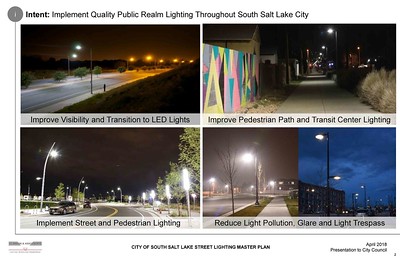
Goals of the City of South Salt Lake Street Lighting Master Plan

These past blog entries discuss best practice planning for lighting in multiple dimensions, not just for safety, but for activation, branding, etc.

-- "Night-time safety: rethinking lighting in the context of a walking community," 2014
-- "Lighting as an element of urban design and community identity," 2014
-- ""Night time as a daypart and a design product," 2017
-- "Revisiting stories: Night-time safety: rethinking lighting in the context of a walking community and Detroit's reduction in pedestrian deaths from lighting upgrades," 2018
-- "Philips Lighting changes name to Signify," 2018


In Washington, DC this kind of neighborhood lighting is installed in historic districts and is called Washington Globe lighting, although you can find this kind of lighting--which I think of as pedestrian and sidewalk oriented as opposed to the tall streetlights which focus on lighting streets for cars--in other neighborhoods.  The program is initiated, managed, funded and operated by the city, under the public space maintenance responsibilities of the DC Department of Transportation (DDOT).

-- "WASHINGTON’S STREETLIGHTS: ILLUMINATING THE CAPITAL CITY ONE ROAD AT A TIME," National Capital Planning Commission

It's very difficult to get the city to install this kind of lighting in places where it isn't already installed, and it is expensive to do so because the way it is installed is by integrating the lights into the separate street light electricity network installed within the public space.  That means digging up the street and planting strips, creating a trench, installing electrical lines, etc.

Separately, DC aims to do a master upgrade of all the city's streetlights, for energy and cost savings, although this has been controversial in many neighborhoods, concerning whether or not LED lights pumping out too much Kelvin can damage your health ("The Changing Glow Of D.C. As Streetlights Make The Switch To LEDs," WAMU/NPR), so the program has stalled.

The brilliance of the Salt Lake Privately Owned Street Lighting Program is that it is so much cheaper, maybe 10% of the cost of the normal way, because rather than a massive digging up of the public space to connect the lights to the public streetlight network, only a bit of the public space has to be disturbed, because each light is instead connected to the electricity system of individual houses--the lot on which the lightpole is installed takes on the responsibility.

While residents have to spend the time to make this happen, it doesn't require the lengthy approval and budgeting processes required when adding the lights to the publicly owned and managed streetlight network.

The Salt Lake program is interesting because it's an example of civic engagement, "self help," community and neighborhood organization, and civic pride.

This is demonstrated by how many property owners and adjacent residents "take ownership" and express civic pride in these lights, by decorating them for holidays--not just Christmas but Halloween--or just because.

They can do this, because unlike traditional streetlights, typical these streetlights are installed with plugs (electric outlets).  "Normal" streetlights are rarely installed with plugs because a city doesn't want to pay for extra, unauthorized electricity use.

Festively lit street lights in Salt Lake City

This streetlight has a lighted wreath and green lighted bulbs on the globe.


You can't really tell from the photos, but on this block, houses on one side have changed the light bulb to red and on the other side of the street, green.  So the globes glow very strongly either red or green.


This street has a coordinated treatment also.


Similarly, many residents go all out for holiday decorations, for Halloween, Christmas, even Thanksgiving.

On one nearby street, many of the residents coordinate Christmas decorating, calling their street, "Christmas Street"  Images from "Christmas Street in Sugarhouse," Utah's Adventure Family.  (My camera isn't good for night pictures.)


Labels: , , , , ,

Thursday, June 28, 2018

Philips Lighting changes name to Signify

As a leading firm manufacturing lights and lighting systems, Philips has encouraged cities to develop lighting master plans and has a variety of initiatives supporting architectural lighting programs and public art-related lighting projects. The company was spun off from the main firm in 2016 and has changed its name to Signify, although it will still use the Philips brand (press release).

One of the firm's recent projects involved an LED lighting scheme implemented across 24 buildings alongside the Pearl River in Guangzhou, China.

From the press release:
Signify (Euronext: LIGHT), the world’s leader in lighting, announced today that it completed the illumination of 24 buildings in Guangzhou’s central business district along the Pearl River area in China. The large-scale connected LED lighting project, which includes façade lighting and animations projected onto buildings, further underlines the company’s leadership as the lighting company for the Internet of Things.

Sightseeing in technicolor: Home to a population of over 14 million, Guangzhou is one of the most populated and fastest growing cities in the world. The 2,000 km Pearl River runs through the city and is known for its vibrant waterfront and high-rise buildings.

During the night the lights from the buildings are reflected in the river, creating spectacular watercolors to enchant citizens and tourists. As well as highlighting architectural features, the connected LED lighting is used to create dynamic light effects and images to be projected on the buildings such as blossoming flowers.

“Connected architectural lighting unifies technology and art, unlocking new possibilities for urban lighting projects and designers. By lluminating the city’s riverside buildings, a dazzling urban artform has risen to enthrall citizens and visitors alike. The beautiful lighting is also highly energy efficient and illustrates our leadership in connected lighting and lighting for the Internet of Things.“ said Jacques Letzelter, Global Business Leader Public Segment at Signify.
Eindhoven, Netherlands, where the firm is based, was one of the first cities to create a comprehensive master plan, although the document no longer is accessible online. The plan identified six categories of light:
  • urban lighting (streets, public areas)
  • buildings and objects
  • art (indoor and outdoor)
  • events and festivals
  • information
  • advertising.
More recently I came across another exemplary example of a lighting master plan, for Bath, England:

-- CREATING THE CANVAS FOR PUBLIC LIFE IN BATH: Pattern Book | Lighting Strategy

and I discussed it in the context of planning for "Night time as a daypart and a design product" (December 2017).

Chicago announced an initiative to create a Citywide Lighting Framework Planning Process, with elements comparable to those in Eindhoven's plan, with an emphasis on artistic lighting, but it isn't clear if a formal plan document has been made public.

-- A Search for the Design Team for the Lighting Framework Plan for Chicago, presentation, City of Chicago
-- "The Chicago SkyLine and the Citywide Lighting Framework Plan: Unveiling of Two Visionary Urban Projects for the City of Chicago," Davis Brody Bond
-- images

Interestingly, Chicago first developed a lighting master plan in the late 1990s ("Daley's Light Plan Hopes To Bring Bit Of Paris To Loop," Chicago Tribune)

Cities replacing traditional streetlight networks with LEDs are motivated more in terms of saving money ("Several Cities Convert To LED Streetlights In Conservation Efforts ," NPR).

Cities should also be thinking about upping their approach to lighting in a more comprehensive manner and take the opportunity to do so in the context of streetlight conversion planning.

Lighting Urban Community International (LUCI) is an international association for cities addressing lighting matters.

Labels: , , , , ,




