Rebuilding Place in the Urban Space

"A community’s physical form, rather than its land uses, is its most intrinsic and enduring characteristic." [Katz, EPA] This blog focuses on place and placemaking and all that makes it work--historic preservation, urban design, transportation, asset-based community development, arts & cultural development, commercial district revitalization, tourism & destination development, and quality of life advocacy--along with doses of civic engagement and good governance watchdogging.

Tuesday, February 25, 2025

WTF? Detroit News op-ed: Ease building secondary dwellings in Detroit | Is no solution to lack of housing demand

Before my life disintegrated with the death of my father, the middle house is where we lived in Detroit.  Our Congresswoman lived down the street.  The Zillow estimate is $242,000.

The op-ed ("Ease building secondary dwellings in Detroit," Detroit News) argues that the solution to Detroit's broken micro-economy is making it easier to build accessory dwelling units.  He suggests lowering permit fees, among other steps.

ADUs can pull double duty for the city. They build generational wealth for Detroiters, while supporting housing affordability. It’s a simple amendment that does not upend the general plan of the city and frees citizens to utilize their properties how they please. It’s time to start building back a city meant for everyone, not just the few who can afford it.

This is misguided.  Detroit has tens of thousands of vacant properties and lots ("Detroit Shrinks Itself, Historic Homes and All," Wall Street Journal, 2010).  From the article:

Mayor Dave Bing has pledged to knock down 10,000 structures in his first term as part of a nascent plan to "right-size" Detroit, or reconfigure the city to reflect its shrinking population. When it's all over, said Karla Henderson, director of the Detroit Building Department, 

This house, in the upscale Palmer Woods neighborhood, was demolished but looks recoverable to me.

"There's going to be a lot of empty space." Mr. Bing hasn't yet fully articulated his ultimate vision for what comes after demolition, but he has said entire areas will have to be rebuilt from the ground up. For now, his plan calls for the tracts to be converted to other uses, such as parks or farms.

Even when the demolitions are complete, Detroit will still have a huge problem on its hands. The city has roughly 90,000 abandoned or vacant homes and residential lots, according to Data Driven Detroit, a nonprofit that tracks demographic data for the city.

... "Neighborhoods that are considered stable are now at 20% vacancy," said Deborah Younger, a development consultant involved in the demolition effort.

Making ADUs a little easier to build isn't the answer to an "over supply" of recovarable properties.

At a conference a number of years ago, Alan Mallach and I had a conversation where we expressed incredulity that advocates in Baltimore were advocating for inclusionary zoning, when the city has thousands of vacant properties.  The same goes with ADUs in Detroit.

This op-ed discusses "gentrification."  Yes, some neighborhoods will experience inward investment and this brings sometimes unwanted change.  But the solution to disinvestment is investment, and that's part of the equation of gentrification.

Detroit has tens of thousands of vacant properties and lots.  It is in desperate need of increased demand for housing.  

In the meantime the city demolishes hundreds of buildings each year because of lack of demand ("City of Detroit demolished 6000 homes since 2020," CBS, Detroit Demolition Program, "Detroiters spent $49M on demolition. Where did the money go?," BridgeDetroit).  

The City of Detroit has spent more than $10 million demolishing blighted homes in District 7 on the city’s west side. Some residents say they are glad to see vacant properties being torn down, while others wonder how the money is being spent. (BridgeDetroit photo by Bryce Huffman)

Looking at images of distressed homes in Detroit is particularly depressing.  From the article:

2023 was as a special year for Detroit. For the first time in decades the city gained 1,852 new residents, reflecting a city finally out of its rut and ready to prosper again. True to Detroit’s commitment, property values across the city increased.

On paper, this seems like nothing but fantastic news, but if you ask Detroiters, they tell a different story of gentrification. Gentrification is a process where less wealthy neighborhoods have money invested into them. This can be advantageous for only those who can afford it. With rising property values come higher property taxes. High taxes can be a factor that pushes original residents out of the area, and it’s no secret that many Detroit neighborhoods are ripe for gentrification. 


The article argues that zoning is used to maintain segregation, although rather than term it race based, it expands the definition economically, according to income and the cost of a property.

Detroit, for example, still supports civil-rights era zoning codes that actively enforce segregation based on income. This is slyly done under the guise of mandating setback lines and density maximums to force builders into only one type of development: single-family homes. 

The article suggests that ADUs can help bring about affordability.  Detroit has decades of affordability ahead because of lack of demand and a huge overage of potential housing supply.

A single-family home is not a vice within itself, it is the overabundance and lack of affordable units that artificially spikes housing prices, leaving those less fortunate in the dust. This is not what Detroit needs.

Besides Detroit having lots of small lots, making it a bit harder for ADUs to have space, the reality is that they aren't "that cheap" to build.  Yes, you don't have to pay for land, but you do have to pay for utility hookups including sewer, water, and electricity, and that can be expensive.  A $300,000 or more new to build ADU is a lot more expensive than it is to renovate a $25,000 house.

Plus, in a weak market like Detroit an ADU is harder to finance.  Since it's possible in Detroit to buy and renovate houses for much less than $300,000, an ADU isn't likely to appraise at the cost of construction for a mortgage loan, because it is higher priced than the market.  So ADU builders will have to self-finance.

=====

By contrast, in Pittsburgh, Robert Fragasso recommends another course ("What the city of Pittsburgh can do with abandoned houses," Pittsburgh Post-Gazette).  It's nothing new, been done by cities over the decades.  But renovation is better than demolition.

Pittsburgh has 10,000 abandoned houses and empty lots, of which 1300 have reported code violations, and restoring these properties to the tax rolls would go far in helping to balance the city and school district budgets. Using the average city property tax of $2500 on those 10,000 properties, adding $25 million in new revenues.

Our political leaders seek governmental solutions to this problem, solutions the city cannot afford, when the private sector offers a potential answer. Here’s my proposal: Instead of expending scarce public funds for demolition and leaving empty lots behind, allow individuals to buy properties for $1 in return for a signed contract to demolish or gut the structure within 60 days (unless it can be successfully rehabbed), build a new residence within 12 months and agree to owner-occupy.

... Once renovation begins in a neighborhood more follows. We have seen this in areas that have been restored.

There is a conundrum.  If you offer such properties to lower income households out of the goal of equity, they may lack the capital necessary to fix the house in 12 months.  OTOH, if you focus on developers, the houses end up being rentals, disallowing individual homeowners the opportunity to build equity.

Note the math compared to an ADU.

The math for the buyer is compelling. The cost of home construction in Pittsburgh begins at around $150 per square foot. Remember the land was obtained in the original $1 transaction. The median home size in Pittsburgh is 1500 square feet, which equates to a construction cost of $225,000. /p>

If the buyer can do some of the work, the resultant cost could be less. That total cost would be much less if the existing structure could remain, be gutted and rebuilt from the inside out. Add $10,000 for demolition or gutting of the structure and the upward estimate of total construction would be $235,000. That is about the average cost of an existing home in Pittsburgh, but this would be a new home.

In Detroit, the cost of demolition is about $20,000.

Labels: , , , ,

Friday, September 09, 2016

Baltimore's Port Covington TIF deal and concomitant community benefits package

Kevin Plank, founder of Under Armour separately owns a real estate development company, Sagamore Development, and his firm has been pursuing a big redevelopment project in a part of the city's formerly active industrial waterfront now called Port Covington, which is adjacent to I-95.

This project succeeds another project for the same area, then called Westport, that went for nought because of the recession ("As Plank announces Westport acquisition, city's hopes are high," Baltimore Sun).

The project will include a new headquarters for Under Armour, more than 14,000 units of new housing, other office and retail development, and public space and infrastructure improvements.

The total value is expected to be about $5.5 billion.

To fund the new infrastructure for the area, Sagamore is asking the city for $660 million in "tax increment financing," which is a huge amount for any city, let alone Baltimore, a city with declining revenues and multiple priorities.

In return, the firm has agreed to a reasonably large community benefits package ("Port Covington $135M deal with BUILD, city hailed as end to 'business as usual' in Baltimore," Baltimore Business Journal) but negotiating it was not without controversy, and pitted nonprofits against each other.

Interestingly, on Wednesday, Kevin Plank representing both Under Armour and Sagamore Development, published a full page ad in the Baltimore Sun to communicate their side of the story.

BE SURE TO CLICK THROUGH AND READ THE AD.

Community benefits packages.  See the past blog entry "Community benefits agreements: revised (again)" for more discussion on the general issue of proffers and getting a reasonable economic return.

In 2014, there was a very interesting article on the topic, with a concerted negotiating group and strategy for a project in Southeast DC ("Ward 8 group wants millions from Congress Heights developer") in the Washington Business Journal, but I could never get the firm City Partners, to talk with me about it. From the article:
A collection of Congress Heights-area community leaders is seeking millions of dollars from the development team planning a 446,000-square-foot mixed-use project atop the Congress Heights Metro station.

A draft community benefits agreement drawn up by "A Community Coalition for Responsible Development,"or ACCORD, includes demands for office space, financial assistance for local nonprofits, revolving working capital funds for subcontractors, attorney's fees, jobs and job training, and reduced rents for retailers. ...

ACCORD includes Advisory Neighborhood Commission 8E, the Congress Heights Community Association, Congress Heights Community Training & Development, Lead the Way Foundation and Ward 8 Council Against Domestic Violence.

Its requests are extensive. Square 5914 has not signed onto the agreement.

The provisions include:
  • A minimum $2 million financial support for ACCORD, paid out over 20 years, to support Ward 8 nonprofit organizations that provide recreational, social services, and educational programs.
  • A 1,000-square-foot office space for 10 years, with three 10 year extensions, for ANC 8E, at a cost of $1 per month.
  • Attorney fees up to $25,000 to pay for the negotiation of the community benefits agreement.
  • A $200,000 revolving working capital fund to ensure that small subcontractors can cover payroll and other costs on a weekly basis.
  • Guarantees that the general contractor will spend at least 40 percent of its project funding on certified business enterprises, 50 percent of which much be located within Ward 8.
  • Providing at least 30 percent of its construction jobs to Ward 8 residents.
  • Setting aside 8 percent of the total amount of residential square footage for households earning less than 80 percent of the area median income.
  • Employment training for graduates of occupational skills training programs, with the Far Southeast Collaborative and OIC getting first preference.
  • Two street level retail spaces for local businesses, at 75 percent of market lease value, plus assistance with initial tenant improvements.
FWIW, I don't imagine this proposal got very far.

There isn't all that much in the way of "big profits" on such properties in weak real estate submarkets.

To pay big community benefits you have to expect either that the property was government owned and was sold below cost or that there is great profit to made.  Instead people believe that "community benefits" are in order as a price to pay to be able to enter a community (see the past blog entries "In lower income neighborhoods, are businesses supposed to be "community organizations" first?" and "What community benefits are supposed to be versus what people think they are about" and "Jamaica Plain group drafting deal to negotiate with Whole Foods," Boston Globe).

But it is interesting that like in Baltimore, allied groups collaborated and negotiated jointly, and they are thinking big.

Weak markets and the tension between revitalization versus new construction.  The Port Covington project also sheds light on a big problem faced by weaker market cities, the tension between reinvestment in existing places versus investment in the production of brand new development on brownfield and "grayfield" sites, where industrial or other sites are converted to new uses, but while there are other buildings elsewhere in the city accommodating many of these uses already.

The site formerly known as Westport.  Baltimore Sun photo.

New construction vs. stoking demand for existing underutilized property.  Part of the problem is the issue of demand.  Baltimore's problem economically is weak demand for real estate/commercial activity, and building new may merely shift tenants around, rather than create (or attract) new economic activity.

In fact that was the root of the difficulty of launching the Westport project, because there was already so much vacant extant property elsewhere in Baltimore, financiers weren't interested in creating even more commercial space ("Westport Waterfront's woes loom particularly large for surroundings," BBJ).

Similarly, this has been an issue in Philadelphia, with the construction of the new Comcast headquarters, which comes at the loss of tenants for other properties ("Will new towers boost Philly rents, or cut them?," Philadelphia Inquirer, because demand for commercial space isn't increasingly substantively commensurate with the additional commercial space delivered through the project.

Tenants seeking special concessions or modern spaces move to the new space, leaving older spaces vacant..

An economically substantial anchor is key to big new projects.  Generally, these kinds of projects, especially at this scale, are fraught with risk, but having a large anchor tenant like Under Armour reduces the risk considerably.  Port Covington is less risky and much easier to finance compared to Westport, but it's still not a slam dunk.  Hence the request for TIF funding, which reduces how much traditional financing the project needs to move forward, especially at the earliest stages where costs mount and revenues are nonexistent.

Executive jobs vs. "back office" jobs and the return to the city movement by corporations. While there is the visibly evident trend of large corporations moving back to cities (past blog entries "Smart Growth America report on businesses moving back to center cities (and suburban core business districts)" and "A lesson that seeing is believing: Panasonic's new building in Newark, NJ as an example, positive and negative, in businesses coming back to the city center"), it is not lockstep.

Some cities, like Washington and Philadelphia, don't seem to be big beneficiaries of such movement ("Businesses moving back to the center: not a universal trend"), and in many places, other firms continue to move to the suburbs.

Furthermore, companies moving back aren't moving everyone back, but mostly "command, control, and coordination" positions ("Leaving for the city," Economist). continuing the multi-decade trend of separating lower value ("back office") positions and either outsourcing them or moving them to lower cost locations.

One Court Square Citibank complex in the Long Island City district of Queens.

For example, in the 1980s Citibank moved certain functions to Long Island City from Manhattan ("Citi-Owned LIC Site Could Give Rise to a 40-Story Building," Curbed NY), and other financial firms moved "back office" functions to Jersey City ("Lehman Bros. to Move 900 Back-Office Jobs to Jersey City," New York Times, 1993; "Jersey City remains attractive to corporations," Jersey Journal) and elsewhere.

This helped them cut costs.

In weak real estate markets, there isn't the same imperative to real estate costs.  What makes Under Armour unusual is that at this stage of the company's development, they haven't separated out "back office" jobs from their corporate campus, the way that companies have done so in higher value real estate markets.

Managing corporate real estate costs.  I haven't been keeping up with the Harvard Business Review now for the past couple years, which is unfortunate because it usually has some conceptually provocative writings.

But long before I was involved in urban revitalization, when I was doing business television production, I remember coming across the first article by "Sandy" Apgar of Baltimore in the mid-1990s, and finding it very interesting.

-- "Uncovering Your Hidden Occupancy Costs," Harvard Business Review, May-June 1993, which was followed by

-- "Managing Real Estate to Build Value," Harvard Business Review, November-December 1995,

Today this is nothing new ("Changing Office Trends Hold Major Implications for Future Office Demand," CoStar Group; "Law firms in D.C. are shrinking, leaving behind vacancies," Washington Post); National Strategy for Real Property, The White House/Office of the President) but 20 years ago it was a big deal.

Labels: , , , ,

Thursday, September 04, 2014

Urban farming vs. Urban residential infill

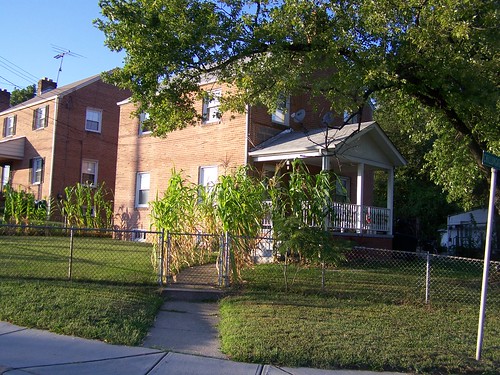
A corn-based entryway, Chillum Road, Prince George's County
A corn-based entryway at a house on Chillum Road in Prince George's County, Maryland.

The Atlantic Cities has a piece, "How Urban Farming Is Making San Francisco's Housing Crisis Worse," which makes the point that providing tax incentives in San Francisco for vacant lots to be urban farms/gardens, when San Francisco has a housing crisis is bad policy (a/k/a "insane").

Interestingly, I had the same kind of argument apparently 4 years ago ("Gardeners near Capitol Hill prepare to repel a Marine Corps invasion," Washington Post), with an ex-commenter, about this same issue in the context of Greater Capitol Hill and the expansion of the Marine Barracks.  Said expansion will end up taking out an urban garden.

I said that the choice was easy, build.

... making the point that urban gardens are a land utilization strategy for weak real estate submarkets when there are no or limited viable alternatives for absorbing/using the land.  Ironically, an Atlantic Magazine blog ("Community garden, or gardening community") argued in favor of not building on the garden, using it as a community building element.  (I see the point, but in the Capitol Hill neighborhood, most people have alternatives, they just can't garden on a large scale.)

A household on the 100 block of 4th Street SE plants basil and tomatoes in the treeboxes adjacent to their house.

Ideally, urban gardens aren't aren't an end game, but an interim strategy--just like the sad end when artists get displaced after improving the "quality" and perception of a neighborhood so that it is repriced and becomes "valorized".

He challenged me to come up with reasons.  I didn't get into it.  It's all about "highest and best use."

I wasn't that great at economics in college--graphic reason and math skills (not good at calculus) did me in.  But urban real estate issues make very clear how economics works.

The reason for DC's skyrocketing housing prices?   Greater demand and minimal supply.  So prices go up.

Limited supply of new affordable housing?  New construction costs more than previously built properties (most of the time).

Because of the height limit, land supply and build out capacity is limited.  This constrains the economic viability of constructing lower cost housing at a profit.  So people build to the most profitable, expensive segments.

When housing demand is high, residential lots should be used for housing.  If not, it's one more contributor to higher rents or property purchase prices.

Labels: , , , , ,

Friday, August 22, 2014

What can adjoining cities do when one city is doing well and the other poorly?

For much of my life, driving east on Jefferson Avenue in Detroit towards Macomb County there has been a very clear delineation of urban success and urban failure once you cross Alter Road and enter Grosse Pointe Park, Michigan, one of five "Grosse Pointes" (Grosse Pointe, +Farms, +Woods, +Shores), a higher income set of communities west of Detroit, in Wayne County, with a total population of about 46,000.

Grosse Pointe Park, Michigan has been in the news because of a couple "urban design interventions" they've done that sever through streets that would normally connect the city with Detroit ("Cross-border drive that symbolized city-suburb disparity blocked permanently for farmer's market," MLive).

They've installed sidewalks across through streets and a farmers market shed blocks another street, although they've just agreed to take it down and work with the City of Detroit on a mutually agreeable "gateway" ("Detroit and Grosse Pointe Park reach deal to create 'gateway' along the cities' controversial border," MLive).

The farmer sheds in Grosse Pointe Park, as seen from the Detroit side, form a barrier to blight. (David Coates / The Detroit News)

Detroit is a shell of its once great success, as more than 1.2 million residents have moved out of the city over the last 60 years.  The population of Wayne, Oakland, and Macomb Counties as of the 2010 Census is only about 100,000 more people than in 1960.

The difference is that it has been redistributed mostly out of Detroit and to some extent out of Wayne County.  (The metropolitan area has also grown in that time, accounting for greater growth than just within the three counties.)

That matters because ultimately, neighborhood revitalization is dependent on demand for residential building stock.

The Detroit News editorializes ("Grosse Pointe Park stands up to blight: Controversy over blocked road overshadows community's pro-active effort to keep its downtown healthy") in favor of Grosse Pointe Park's acts, justifying them as a form of community protection and maintenance of a successful commercial district.

Instead the newspaper ought to be positing ways that the communities might be able to better work together to spread success back into Detroit, rather than celebrating Grosse Pointe Park's hunkering down and building walls between the communities.

Revitalization is sparked most easily by building off current success.  So what I would recommend is the creation of a Jefferson Avenue-East Side Detroit Revitalization Plan focused on leveraging the success of the Grosse Pointes--the five cities have a very high per capita income--the Ford Family tends to live in this area, amongst others.

This Google Earth image shows the area west (the Detroit side, on the left) and east (in Grosse Pointe Park) of Alter Road.  The Detroit side on the left of the image shows a great loss of most of its residential building stock, to decay and demolition.  From the image, the Detroit side looks almost rural.
Detroit/Grosse Pointe Park

But the big problem is lack of substantial demand for housing in the Detroit metro area, let alone in a declining area of Detroit, and a willingness to pay the very high property taxes that Detroit charges--taxes are high to raise the funds needed to cover the infrastructure that remains for the whole city, even though much is now unpopulated.

(One solution is a long term abatement on property taxes on new housing.  Philadelphia and Baltimore have done this.  But such an abatement, in a city that is broke, could be problematic.)

Concentrated renewal is necessary.  The other problem is that outside of Detroit's Downtown, the areas of relative success are in the bordering communities on the east (Wayne County) and west (The Grosse Pointes), and theoretically in the north (Oakland County), not in Detroit.  Although judging by Google Earth, much of Detroit's west side seems intact, including neighborhoods where I used to live, even if housing prices are low.

To focus Detroit's redevelopment in the outskirts of the city militates against concentrated renewal. Since Downtown is successful as it becomes a mixed use district, the city needs to focus growth there and as demand increases, work to recover adjoining areas, expanding outward.

In as dire straits as Detroit is, very difficult choices have to be made on where to invest public resources in order to maximize the likelihood of success.

Perhaps some of Detroit's land needs to be able to be "deaccessioned" and revert to township status, and the opportunity for renewal in those areas could shift spatially from the core/Detroit, to the energies present on the outskirts, such as the Grosse Pointes on the east side.

Labels: , , , , , ,