Rebuilding Place in the Urban Space

"A community’s physical form, rather than its land uses, is its most intrinsic and enduring characteristic." [Katz, EPA] This blog focuses on place and placemaking and all that makes it work--historic preservation, urban design, transportation, asset-based community development, arts & cultural development, commercial district revitalization, tourism & destination development, and quality of life advocacy--along with doses of civic engagement and good governance watchdogging.

Tuesday, December 30, 2025

Local initiative in Huntsville, Alabama aims to improve security by banning problem customers across 18 bars

One of the first issues I got involved in in DC had to do with the overconcentration of liquor stores in my downtrodden neighborhood.  Such is linked to increased crime and community problems ("The Association between Density of Alcohol Establishments and Violent Crime within Urban Neighborhoods," Alcohol, Clinical and Experimental Research).  

I had learned about Seattle creating special zones to limit the sales of single bottles of beer, as an attempt to limit those problems ("Seattle may extend alcohol-sale limits to much larger area," "City tries to curb liquor sales," Seattle Times).  In 2003, the Washington Post published a story on those efforts ("Neighbors fight beer sales") and I got my picture in the paper (albeit on a slow news day)..

I wasn't against the sale of alcohol in managed situations (restaurants and taverns) unlike my neighbors, who couldn't see the difference in effect of on premise consumption of alcohol versus off premise consumption ("Restaurants and liquor licenses--How much is too much on H Street?," blog, 2005).

But the fact is, with establishments that are more alcohol-forward than food forward, with entertainment, music, dancing, etc., drinking can fuel violence.  I advocated for better security plans, and places did have them.

From "Bar Brawls," University of Toronto Magazine.

But one big problem is the focus not on sequestering and having the police deal with perpetrators, the plan is "to move them outside, off the premises, where it is no longer our problem."

All that does is displace the problem, it moves it from inside the club to outside, and the problem continues.  The media is full of articles about such problems all around the country, culminating in shootings and sometimes, deaths.

A consortium of clubs in Huntsville is dealing with this proactively, by maintaining a list of problem customers/people who have been banned, sharing the list across their 18-member group, and not permitting them to enter the premises to begin with ("North Huntsville bars band together to blacklist troublemakers across 18 venues," Fox 54/Rocket City News). 

The network allows participating venues to share information about patrons who have caused problems at any location within the group. When security staff scan a customer's identification at the entrance, the system immediately alerts them if that person has been banned from another business in the network, showing the duration of the ban, the reason for it, and which establishment issued it.

... Jabar Westbrook, owner of Goodtimez Billiards and other north Huntsville businesses, said the system addresses a common problem where troublemakers simply move from one venue to another after being ejected.

"Sometimes it's the same people going from place to place causing trouble, and so we're just trying to create consistency where no matter what, those people who are troublemakers can't just go somewhere else," Westbrook said.

This program makes a lot of sense, allowing bars to be proactive, instead of reactive.  It expands the range of options discussed in Assaults in and Around Bars, 2nd Edition (Center for Problem Oriented Policing, Arizona State University).

Labels: , , , ,

Thursday, May 07, 2020

Revisiting the language of revitalization/blaming the building: May is National Historic Preservation

A colleague was involved in a Reddit discussion about historic preservation in Baltimore.  Basically, the person with the counter-argument was arguing that the building configurations are out of sorts with what people want today, there are too many vacant buildings already, etc.

The real issue is disinvestment. What people call "blight" is a result of disinvestment. Rather than blame the place (I call this "blaming the building"), focus on disinvestment and explain the process.

Too often people are lulled into believing that demolition, especially of historic buildings, is a solution to "blight" when merely it creates a different form of blight, a vacant lot, and that's even  harder and more expensive to correct--building a new building--especially in weak real estate markets where obtaining financing is extremely difficult.

This is about what I call the language of revitalization, making the point that the opposite of or solution to disinvestment isn't demolition -- which just exchanges one problem -- a vacant house -- for another -- a vacant lot -- it is investment.

"Blight" is a symptom of "disinvestment" not the cause of it. Too often the word blight is used to justify demolition when really the issue is one of investment, maintenance, and opportunity.

Blaming the building is an easy trap to fall into.

Buildings or neighborhoods called dilapidated, run-down, blight, eyesores, nuisances, decrepit, (etc.) are victims (and survivors) of disinvestment.

The solution is not demolition, but investment instead of disinvestment.  Maintenance and/or rehabilitation is the proper response to neglect or demolition-by-neglect, not demolition.

A related argument is "the building is full of rats" as a justification for demolition.  Why not just get rid of the rats?

Photo by Aaron Leitz.

E.g., there is a building by the NoMA Metrorail station. It had been an arena, a church, then a trash transfer facility in the years of the city's decline.

I led a successful campaign to get it designated (industrial heritage) to prevent Waste Management from tearing it down because they figured that would make the site easier to sell.

But the same reason WM wanted to clear the lot -- now 1/2 block from an infill Metrorail station -- made the location potentially incredibly valuable.

Today it is a brewpub (in the old ice manufacturing part), an REI flagship store, and offices.

I'm not totally happy with the result as the IMP firm (they run Meriweather) wanted to run it as a concert hall but the property owner wouldn't give them the time of day.

But the building is alive and vibrant.

But I argued with a young guy once about it. He said it's full of rats; tear it down. Again, investment vs. disinvestment. And in this case, the solution to rats isn't demolition, it's eradicating the rats.

I guess this reiterates the value of "young preservationists initiatives" I just wrote about.  Such initiatives educate people about the value of historic preservation and brings them together to work on projects that save buildings and improve neighborhoods.

Labels: , , , ,

Tuesday, May 05, 2020

Young Urban Preservationist initiatives | May is National Historic Preservation Month

When I first started involvement in neighborhood improvement, historic preservation, and commercial district revitalization, my triggers (I had been interested in cities for decades, having lived off and on in Detroit when I was younger) were a report, Restore the Core, by the Sierra Club on DC area smart growth issues, a road trip from Miami to NJ with stops along the way in Savannah, Charleston, Beaufort, and Wilmington, and a phone call from a neighborhood preservationist looking for someone in the H Street NE neighborhood who might be interested.

From that call I acted on what I learned from that road trip, that my neighborhood was no less beautiful and historic than places we visit when we travel.  So I started reading up on preservation, went to conferences, etc.

Interestingly, when I got involved in the Main Street commercial district revitalization program, which grew out of the historic preservationist movement, I found that the people who were most involved tended to live within a block or two of the commercial district and were 10-15 years younger generally, compared to traditional preservation organizations.

Pittsburgh.  At one of the conferences, there was a presentation on the Young Preservationists Association of Pittsburgh. I thought that was a good idea, because historic preservation group demographics generally skew pretty old, and new and younger demographics "need a way in."

Their activities include a speaker program, working with youth (separately the Pittsburgh History and Landmarks Foundation has an extensive youth education program), spiffing up buildings ("Painting for Preservation"), happy hours, and the Top Ten program, which identifies preservation opportunities ("priorities") for the year, with the aim of improving properties, etc.

Rochester, New York.  It turns out that there is a similar organization in Rochester, New York, the Young Urban Preservationists, under the auspices of the Landmark Society of Western New York.  They lead tours, organize classes, have happy hours, etc.

Midwest.  And a cross-state coalition in the Midwest, the Rust Belt Coalition of Young Preservationists, which organizes conferences bringing together various groups, like the Buffalo Young Preservationists (New York), Young Ohio PreservationistsYoung Friends of the Preservation Alliance (of Greater Philadelphia), Great Lakes Bay Young Preservationists, the Skyline Council of Landmarks Illinois, Kansas City, Missouri, and Wheeling Young Preservationists (West Virginia).

And there is a group in Steubenville, Ohio too.  They started a fun run as a fundraiser (since taken over by another group), and a First Friday event for the commercial district.

Other areas.  There is the Pacific Northwest Young Preservationists, a group in Burlington Vermont,  I've probably missed others.

Charleston.   ... has the Young Preservationists of Charleston (YPC) Public Group.

Conclusion: More preservation groups need to create "young preservationists" affinity groups. Given that preservation (not unjustifiably) is frequently positioned as "against change/development" by younger "urban groups" typified by the recent dust up between preservationists and climate change/urbanists in DC over hideous solar panels affixed to the roof of a historic house in the Takoma neighborhood of Washington, DC ("When saving the planet spoils the charm of historic houses: climate change activists clash with historic preservationists," Washington Post), it behooves preservation groups to be more proactive and reach out to new and younger audiences as residents turn over and conditions change.

The Trust has a blog entry on the topic, "Building the Young Preservationist Movement," but again, I learned about this kind of effort c. 2002. The Trust also published Millennials and Historic Preservation: A Deep Dive Into Attitudes and Values, which should provide insights into the push button issues for younger audiences new to historic preservation as a movement and as a regulatory construct.

(I think this is South Scoville Avenue in Oak Park, Illinois.)

The preservation message needs to be constantly reinforced, because new entrants to historic neighborhoods typically are unfamiliar with the battles and efforts that likely were required to stabilize and improve the neighborhood that they now take for granted ("Owning in a Historic District," Time Tells).

A realization.  The reason I became a staunch preservationist is because I came to believe that historic preservation-based approaches were the most sustainable, with long term positive impacts, for urban revitalization.

Above I mentioned how Main Street groups, focused on commercial district revitalization, tend to have members significantly younger than those in traditional preservation groups.

Looking at the various websites of the aforementioned groups, the reality is that most seem to be in communities that have experienced significant disinvestment over the past few decades (e,g., "Young Preservationists cite places to save in Pittsburgh region," Pittsburgh Post-Gazette; ).

In communities like Indianapolis, Wheeling, Pittsburgh, and Philadelphia, the planning priorities are more about revitalization than the maintenance of thriving neighborhoods.

These "young preservation" groups are more like cross-city revitalization initiatives, rather than neighborhood specific.

BY contrast, DC (and Charleston) is in a different stage for the most part.  Not in 2000, when I started out.

But today, most of the core city neighborhoods have stabilized and improved and since the turn in revaluing living the city, have experienced significant price appreciation to the point where only the well off can afford to buy a house.

The concerns in reaching out to younger, "well off" demographics in a city like DC are about building the support for historic preservation in terms of maintaining architectural quality and regulation, no longer is it about stabilization in the face of what was then a shrinking city.

Labels: , , , , , ,

Tuesday, February 18, 2014

Maryland gubernatorial campaign transportation agenda

As I mentioned in the post last week, "Tolls, parking taxes, elections, oh my!," Purple Line Now! is sponsoring a candidates forum tonight and only one major gubernatorial candidate even mentions transportation in his platform.

I suggested that advocacy groups join together and produce a state and county-level campaign agenda for sustainable transportation to use during the election cycle.  No one has taken me up on the idea.

I wrote this in email as a start:

1.  With regard to Action Committee for Transit (Montgomery County's leading transit advocacy group, which is starting to stake more positions on other sustainable transportation issues), while they have a position on MARC two way service through MoCo, there isn't a MARC tab in the left sidebar of their website.

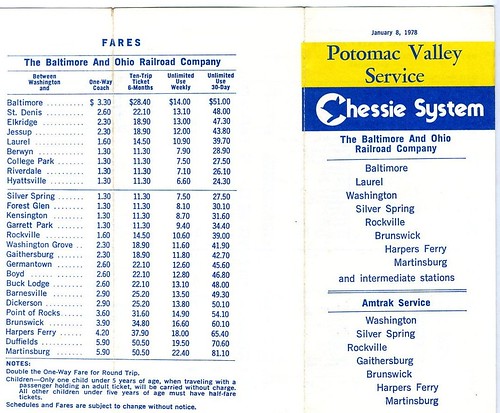
Historically, train service to Martinsburg WV wasn't two-way during the daytime, because back then few people from DC had any reason to "reverse commute" to Montgomery County.  With the development of office complexes in the Wisconsin Avenue and I-270 corridors, taking the train from DC or Silver Spring to White Flint, Rockville, Gaithersburg, or Frederick may make sense and would be a lot faster, albeit more expensive, than current public transit alternatives.
19780108 01 Potomac Valley Service timetable

Flickr image of the timetable by David Wilson.

2.  ACT is also in favor of an extension to the western leg of the red line (as am I and something I've been meaning to write about).

3.  Lately I have been mentioning a separate Metro line emanating from Fort Totten up New Hampshire Ave. to White Oak, although this is something Ben Ross and I talked about briefly once before.

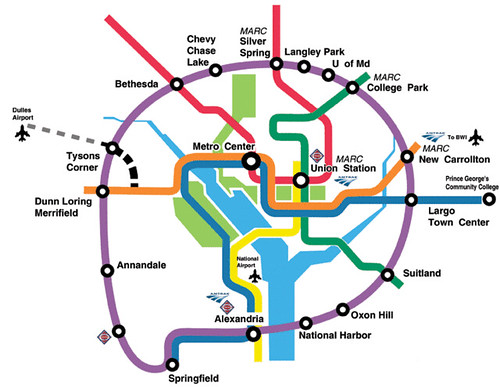
Andrew Bossi's conceptual map of metrorail expansion shows a separated yellow line, but with a routing different from what I am thinking about.  DC's objectives for a separated yellow line are different from Montgomery County's, so having two different extensions probably makes sense.


4.  Which would be different from a separated yellow line primarily serving DC up Georgia Ave. and going to Silver Spring, but beyond that would be up to MoCo

5.  I just don't know MD and MoCo issues well enough to say what a MoCo transportation agenda should be but here are some things:
  • Allowing a local add-on gasoline excise tax
  • extending complete streets requirements at the state level to local jurisdictions
  • Building the Purple Line obviously
  • Two way MARC service to/from Frederick, adding a third track to accommodate this
  • Extending the western leg of the Red Line
  • Making Wisconsin Ave.-Rockville Pike a "Signature Street" (see my writings about this concept--below) from the DC line to (and past) Rockville for Montgomery County and SHA/MDOT/State of Maryland as a pilot project + the White Flint MARC Station
  • Beginning planning for a New Hampshire Avenue Yellow Line Metrorail expansion to White Oak, emanating from Fort Totten Metrorail station
  • Montgomery County's BRT initiative
  • Planning with the State of Virginia to extend the Purple Line west to Tysons
Purple Line Map  DC Metro
6.  For Prince George's I don't have much other than:
  • Building the Purple Line obviously
  • But as importantly beginning the planning for the segment between New Carrollton and Alexandria Virginia, with priority emphasis from the Suitland station to Alexandria for service to National Harbor
  • Making University Boulevard a "Signature Street"
7.  For Greater Baltimore I would recommend:
8.  For the state I would have:
  • Allowing a local add-on gasoline excise tax
  • Approaching Virginia to begin the discussions about merging MARC and VRE and beginning to create one integrated passenger rail system for the region, ultimately serving DC, MD, VA, and parts of WV, PA, and DE ("Regional transportation planning and fixed rail service")
  • Expanding planning for Purple Line extensions to Virginia from Bethesda and from New Carrollton
-----Signature Streets------------------------

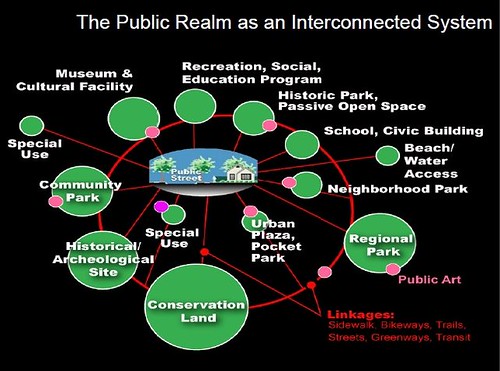
Public Realm as an Interconnected system, Slide from presentation, Leadership and the Role of Parks and Recreation in the New Economy, David Barth
Public Realm as an Interconnected system, Slide from presentation, "Leadership and the Role of Parks and Recreation in the New Economy," David Barth and Carlos Perez, AECOM.
* At the very end of the planning process for the Western County Pedestrian and Bicycle Access Plan, I came up with a concept that I called "Signature Streets" but I just didn't have the time to develop it more thoroughly or "sell" it adequately to the advisory committee.
The basic ideas were:
(1)  combine complete streets principles
(2)  with smart growth ideas (the County has a policy prioritizing investment in extant places)
(3)  along with the integrated public realm concepts of David Barth
(4)  by designating a subset of the county's road network as foundational or "signature"
(5)  and upgrading these streets with systematic special and complete treatment so that sustainable transportation modes (walking, biking, and transit) are integrated into the mobility system (also related is Barth's concept that streets should be treated as linear parks), along with streetscape improvements (the County already has an excellent streetscape improvement program, just not a focus on sustainable transportation) and placemaking elements
(6)  and justifying using bond funding to pay for the development of the upgraded mobility network and acquisition of the necessary right of way.
See, in counties, to expand the right of way, you have to buy the land.  That's expensive.  The government doesn't want to do it.  But by laying it out in terms of developing a road-based complete mobility network that extends quality of life and how the county "deserves" a road-mobility system that meets its needs in the 21st Century and as the third largest jurisdiction in the State of Maryland makes this kind of re-thinking achievable.
With regard to bond funding, even in bad times, parks-related bond initiatives pass overwhelming in Baltimore County.  And this idea is kind of an extension of parks.  The model that I suggested was Seattle's Bridging the Gap initiative.  [Add-on, at the time I didn't know about the MAPS3 program in Oklahoma City, which is another example, of course the sales tax funded light rail construction acceleration program in Greater Los Angeles is another example]
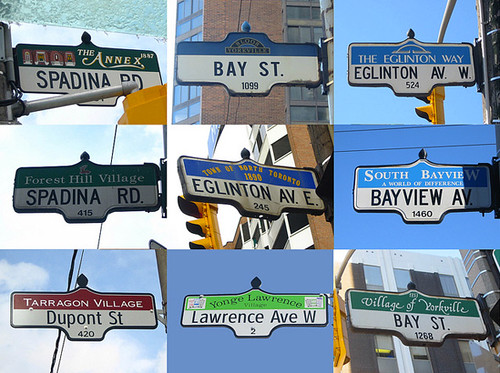
I suggested denoting signature streets with special street signs, not unlike how the City of Toronto has special "sign topper" designations for all sorts of areas in the city.
Toronto Street signs typology

Labels: , , , , ,

Tuesday, April 16, 2013

More 30 mph speed limits on neighborhood serving arterials in DC

Granted these roads are the classic definition of principal arterials as connecting activity centers and therefore carrying a lot of traffic.  But at the same time these are pedestrian-centric residential areas as well, although that's more true for Wisconsin Avenue than Nebraska Avenue.

I was traveling yesterday in this part of the city in a car and was watching for the signs.

3000 block of Wisconsin Avenue NW (the speed limit changes to 25 mph just south of Massachusetts Avenue, but it's 30 mph, I think to the DC-MD line)
30 mph speed limit sign, 3000 block of Wisconsin Avenue NW

Nebraska Avenue, approaching Connecticut Avenue from the northeast (I'm not sure how much of the street is 30 mph, I think it goes back and forth between 25 mph and 30 mph)
30 mph speed limit sign on Nebraska Avenue NW

... which makes the current version of the StreetSmart "pedestrian safety" advertising campaign all that more ironic.  (As with the last few campaigns from this program, I am unimpressed with this campaign too.  I may write about it...  See "Being Direct in Advertising: Pedestrian Safety.")
StreetSmart bus ad, pedestrian safety, 2013

Labels: , , , ,

Thursday, August 30, 2012

Hampton Roads-Virginia Beach Kings professional basketball team

So there are reports ("Va. Beach board has spent nearly $700,000 in effort to get arena" from the Norfolk Virginian-Pilot among others) that Virginia Beach, Virginia is looking to build an arena and land a professional basketball team, perhaps the Sacramento Kings.


Now, as discussed in yesterday's entry about the success of the Chicago Cubs vs. the Chicago White Sox, which I ascribed to the place values of their respective venues (but commenter Alex B. made the counter point that the Cubs also have a larger fan base and more engaged fans), I do admit that while  professional sports aren't particularly good for metropolitan economies generally--if you don't spend money on sports tickets you spend it on something else and vice versa--there is no question that some sports have more positive impact than others, and depending how the arena-stadium is sited and integrated into a community, a sports venue can contribute either positively or negatively to other urban revitalization and economic objectives.

We can argue about the nature of the Atlantic Yards project in Brooklyn more generally, but even so there is no question that a basketball arena there will have much more positive effect and will be incredibly well served by transit, compared to an outlying suburban location.

Same with the impact of the Washington Wizards and Capitals sports teams, playing in an arena in Downtown DC--also well served by transit--versus playing in their former suburban location unconnected to other commercial areas and mostly reached by automobile.

RFK Stadium in DC is a good example of how not to locate a sports stadium within a city, and there are other examples across the country, of how sports stadiums can be positive or negative, depending on the type of sport and how the stadium/arena connects to the city around it.  (Suburban locations pretty much fail generally, although the arena for the Anaheim Ducks hockey team anchors a small commercial area.)

I've written about the Sacramento Kings a bunch this year in terms of the quest by Sacramento Mayor Kevin Johnson (an ex-basketball player) to build a new arena for the team, and to get the team's commitment to paying towards the new arena ("Stadiums and arenas and funding: Sacramento and Seattle edition").  Part of the desire for the arena is to further spark downtown redevelopment.

But the scary thing is that even successful teams like the Phoenix Coyotes hockey team--they were Western Conference finalists this year -- may require municipal subsidy.  Right now, the city of Glendale, Arizona is paying $25 million per year to keep the team in their city.

But compared to other "major league communities," the Sacramento metropolitan area is comparatively small in terms of population, plus it's been devastated by the real estate crash, so housing values, property taxes, and other revenues have dropped precipitously.

Even so, the Sacramento Metropolitan Area is 60% bigger than the Hampton Roads Metropolitan Area and has a higher median household income, and while Hampton Roads is more economically viable compared to some of the smaller areas with teams such as Oklahoma City and Jacksonville ("A richer region means better odds for the NBA" from the Virginian-Pilot), the area has economic issues of its own, facing almost certain decline as military budgets shrink, as the regional economy is dependent on spending on military bases and ship construction, and sea levels rise with global warming.


Anyway, after all the scrambling by Mayor Johnson, the Sacramento Kings team pulled out of the deal.  See "Maloofs, city leaders lacking trust" from ESPN and "Maloofs doubted AEG revenue estimate in spurning Sacramento arena," from the Sacramento Bee.
ead more here: http://www.sacbee.com/search_results?q=maloofs+doubted+aeg&aff=1100#storylink=cpy"," from the Sacramento Bee.

That would make me extremely leery, were I a government official in another locale, in dealing with them (not to mention the one Maloof lady on "Real Housewives of Beverly Hills").  In addition to the general difficulties of pulling together a deal of course.  From "Va. Beach mayor: Arena could cost $275M to $400M" in the Norfolk Virginian-Pilot:

Sessoms said the city could not build it without financial help from the company, the state and the NBA.

"I would assume from out of those three, there's got to be some cash," he said, adding that he was told by Comcast-Spectacor representatives that revenue generated by the arena would pay debt service on any city funding for the project.

Several state programs could provide financial assistance.

Gov. Bob McDonnell recently offered a $4 million performance grant to the Washington Redskins as part of a $6.4 million public package to keep the NFL team's headquarters in Loudoun County and establish a summer training facility in Richmond.

If larger sums are needed for the proposed Virginia Beach project, industrial development authorities and the Virginia Public Building Authority are options. Both have the capacity to issue debt for substantial development projects.

In addition, Virginia law gives certain localities, including Virginia Beach, authority to retain some sales tax revenue collected at a facility that is a joint public-private venture - such as a sports stadium - to pay off construction debt.

Plus, the place where the Virginia Beach proposes to put the arena, next to the Convention Center, is in an outlying part of the city, where there are limited opportunities spillover benefits--e.g., the way that the Gallery Place area is filling out, with the Verizon Center being a key anchor, or how the Capitol Riverfront area is developing--although the plans predated the Washington Nationals stadium, there is no question that the ballpark is an anchor and a significant contributor to the neighborhood's branding as a place to live and visit.

.... although that location would likely be served by light rail, if the Tide light rail system is extended to Virginia Beach (past blog entry "Light rail in Norfolk, Virginia and suburban Washington, DC").

Then again, maybe the Sacramento Kings ownership group--the Maloofs--are bored with Sacramento and want to move, or figure they can sell out for a higher price to a more motivated group interested in moving the team.


Politics versus governance and handling sports teams and arena-stadium funding decisions

Okay, so my general position is that local and state governments shouldn't be funding sports teams and venues, because there is much greater economic return from spending on different kinds of programs and revitalization initiatives (especially transit).

But from an advocacy standpoint, do you just take the "no, no, no" position, when in the end the team will be landed and the venue will get public funding anyway?

Is it better from a "governance" perspective, to work on making the deal better or at least "less worse" from the public standpoint?

I think so.  Therefore I offer the following as a set of recommendations to start the development of a more general agenda/set of positions on such questions, with the aim of advocates and public officials using such a checklist as a way to shape their agenda and negotiations on such projects going forward.

Stadium/arena placement, design, and mitigation

1.  One of the most important decisions concerns placing the venue in the right location so that there will be additional positive economic and urban revitalization benefits, rather than expecting trickle down benefits to happen magically.

Urban revitalization and historic preservation consultant Don Rypkema argues that the economic benefits of stadiums/arenas typically peter out after 1.5 blocks.  If we are purposeful about linkage, leveraging, and investing in improvements before the facility opens, rather than a decade later (like around the DC Convention Center), I think the improvement zone impact from such venues can be significantly expanded and enhanced.

SBC Park, San Francisco
SBC Park opened in 2000 as Pacific Bell Park. By far the most breathtaking of the 18 major league ballparks that have opened since 1989, it glories in its tight perch between a big city and a wide-open bay. SF Chronicle photo by Michael Macor.
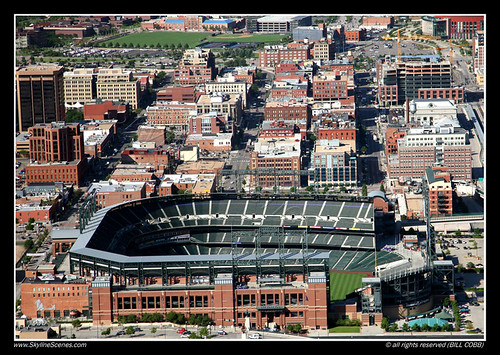
Coors Field in LoDo, Denver
Coors Field in LoDo, Denver by SkylineScenes, on Flickr.


2.  Achieving the "Camden Yards" effect (although I argue that Camden Yards doesn't do all that it could do, at least it is adjacent to Downtown Baltimore).  Building a facility with the right urban design qualities is essential (past blog entry, "Tale of Two (or more) Cities"--if you click through the images will come up--plus Alex B.'s comment in yesterday's blog entry about the Cubs/Sox and his point that the US Cellular Field could have been designed to capture the beauty of the Chicago Skyline as the defining architectural element of the in-stadium experience).

Note that over the life of the Verizon Center, most of the retail locations not on 7th St. (the best place to locate) have failed.

-  Philip Bess, City Baseball Magic--Plain Talk and Uncommon Sense about Cities and Baseball Parks
cm_giants_2
Photo by Mike Kepika of the San Francisco Chronicle.  People leaving the streetcars to see a Giants game at PacBell Park.

3.  That includes locating the facility so that transit accessibility is primary and convenient, to limit motor vehicle trips to the facility.

4.  Related, that includes putting an agreement in place with regard to funding transit service (if necessary), before the team starts playing ("Incentives vs. requirements: stadiums/arenas and transportation demand management"), but also to develop package deals and incentive programs to promote transit use.

5.  Mitigating the negative impacts for those businesses that are displaced in the construction of the new facility, and going the extra distance to retain them (e.g., the Nationals stadium caused the Washington Glass School art program to move to Maryland, because not enough effort was made to assist them in staying).

6.  Making agreements on when events are scheduled, because the team owners will try to schedule the events in a manner that makes it difficult for people to patronize non-arena establishments, especially before the game.  Instead, people go directly to the venue, and spend all their money inside, limiting spillover benefits.

7.  Having a ticket tax, such as that suggested by the Hill District Consensus Group in Pittsburgh (Hill District seeks more arena-area parking money for development" and "SEA urged to use a portion of parking revenue to support Hill" from the Pittsburgh Post-Gazette) to fund economic development in the area.  Other fees on the ticket can fund arena improvements sure, but there should be an ongoing funding stream to mitigate negative impacts on the neighborhood that result from events.

Economic issues

1.  Localities funding stadiums should have an ownership interest/financial interest in the revenue stream from the team and stadium.

While many agreements give the locality ownership of the facility around the time the facility is no longer worth anything, communities don't make much money on the facility during the successful period.

DC paid more the Nationals Stadium than the owners paid to Major League Baseball to acquire the team, but the city gets much less back economically than the owners.

Note that this is a nonstarter with the professional sports leagues.  And Congress will never step up and pass legislation that gives more power to localities vis-a-vis sports teams and the leagues.  For example, Major League Baseball is legally allowed to collude.

2. Leagues should not fight local taxation on player earnings.  DC is in a special place because it can't enact a "commuter" tax.  Many other states take the position that income is earned by game, where the game is played, and tax player salaries accordingly.  DC can't do that, and Major League Baseball lobbied to ensure that this wouldn't change.  Anyway, localities where stadiums-arenas are located need to be able to tax player salaries in part recompense for the expense of siting and maintaining these facilities.

3.  Metropolitan areas should create multi-jurisdictional financing authorities (Maryland does this at the state level) to fund such facilities, rather than putting all the burden on the center city, comparable to how the Allegheny County Regional Asset District  and other special funding districts work.

-- Maryland Stadium Authority

These agreements and systems need to be in place long before sports teams and leagues come calling.

The non-city jurisdictions won't like it, but the fact is that these facilities need to be located in central places, and the burden for funding them needs to be more fairly distributed than it tends to be right now.  Also see "Firm plan for new stadium still eludes Richmond area" from the Richmond Times-Dispatch.

-- Richmond Metropolitan Authority

-----------
I am sure there are more points to be added.  This is a start.

Labels: , , , ,

Thursday, May 31, 2012

The last day of National Historic Preservation Month...


Dick Wolf at a presentation.  Photo by Bruce Guthrie.

I had big visions for how I would blog about historic preservation issues including preservation policies and my take on the state of the field, throughout the month of May, which is preservation month.  I also intended to run some book reviews on important books in the field.  I didn't get to this, abetted in part by a massive failure within yahoomail--the access function to past emails is not working, so I couldn't access notes I'd written about what to cover.

But the past week gives us another cause for reflection, because of the death of two stalwarts in the local preservation movement, Everett Ortner in Brooklyn, and Richard (Dick) Wolf in DC.

Ortner was a co-founder with his wife, Evelyn, who predeceased him, of what became New York City's Brownstone Revival Coalition.  They helped spearhead a reconsideration of Manhattan and Brooklyn neighborhoods as places to live rather than as places to flee--what we would call "urban pioneering."  Basically they were at the start of the urban pioneering/living in the city movement, in the face of urban renewal and urban freeway movement, both of which were the kiss of death for many cities, even though such initiatives were thought to be the solution and augur for next generation growth.  See "Everett Ortner, Leader in Brooklyn Brownstones' Revival, Dies at 92" from the New York Times.

Yesterday, the Capitol Hill Restoration Society announced the death of Dick Wolf, who died on Wednesday from pancreatic cancer, and the City Paper has an article about him, "Capitol Hill Crusader Dick Wolf Passes Away."  A CHRS statement lists Dick's many involvements in key historic preservation and planning actions:


• establishing the DC Historic Preservation Act;
• establishing the DC Comprehensive Plan, the Ward 6 Plan, and zoning to carry out the intent of the Comprehensive Plan;
• including the importance of the residential neighborhood in the Architect of the Capitol’s Master Plan;
• establishing the Capitol Hill Historic District in 1976;
• re-developing Eastern Market, and the efforts to preserve and re-open the market after the disastrous fire;
• redeveloping the Ellen Wilson houses into the national award-winning Townhomes on Capitol Hill [a HOPEVI project];
• promoting the Main Street Project which transformed Barrack’s Row into a lively commercial district;
• supporting the rezoning of the MedLINK property [Capitol Hill Hospital, on Massachusetts Avenue] to retain a scale consistent with the surrounding neighborhood;
• successfully opposing a large glass curtain-wall office building at 14th and Pennsylvania (current site of Harris Teeter) and stopping a church at 6th and A Streets, NE from demolishing an entire block of historic homes to create a mega-headquarters;
• supporting the CHRS Beyond the Boundaries Project, to document the buildings, and record the history of Capitol Hill south of H Street, NE and east to 19th Street. 


Dick was a pain in the ass, irascible, and didn't listen to other people.  I don't know if that was because he was "old", because of his experience dealing with duplicity by developers and city officials for so many years, or just his personality.

As the epicenter for a lot of changes in the city--redevelopment of Union Station, office building construction, neighborhood revitalization, the Southeast-Southwest Freeway, the subway system--you couldn't help but realize that what happened in Capitol Hill was also happening elsewhere in the city.

Wolf shaped one very important aspect of the Capitol Hill Restoration Society that is relatively unique amongst "neighborhood" preservation groups--its more outward outlook and concern for what happens to the areas bordering Capitol Hill.  

As a result, CHRS ended up passing a resolution setting the boundaries of its interest area, which is far larger than the specific and legal boundaries of the Capitol Hill Historic District, and the organization has worked to assist people and organizations on preservation and development issues in those areas.

That was the case with historic preservation and H Street revitalization issues in my old H Street neighborhood in DC, which is located just outside of the boundary of the CHHD, which ends at F Street NE.

This helps groups today.

But he didn't just tell people what to do.  He was one of the volunteers a couple years ago when the annual CHRS House and Garden Tour focused on the area around H Street.

On the other hand, I'd say he was by no means perfect.  I won't list my disagreements, but one particular one is over streetcars.  He saw them as a scourge for the city, while I see streetcars as offering better and more comfortable ways to get around the city without having to drive a car.  Too many "neighborhood" "preservation" groups are focused on maintaining automobility and parking space inventory, and the CHRS and Dick have been guilty of this too.

He was from the generation where the car was seen as freeing and streetcars were "old technology" and I have to believe that this shaped his thinking about streetcars and the 21st century city.

But there is no question that I learned from my various interactions with him, even though I think that we differed in what we thought was possible because he came to the fore during the time when the city's primary neighborhood need was to stabilize an otherwise shrinking and declining city, while my involvements have peaked more towards the time when the city has an opportunity to grow, with the H Street NE commercial district being a prime example of this kind of opportunity.

I don't know how much of that was generational or just his irascible personality.  My joke with planning people is that I worry that I will end up like him--although in person I am generally not too confrontational unless the presenters are dropping 70% or more of b.s., and then I can't hold it in...

In both cases, Brooklyn/New York City and Capitol Hill/Washington, DC are a little worse off today, with the loss of these pro-city stalwarts.

I hope we have it within us to step up, follow, and continue to shape the future of the city and its neighborhoods in a positive, innovative, and forward thinking way.

Labels: , , , , , ,

Thursday, December 08, 2011

Newt's crazy but children should be responsible for cleaning schools

Image: Japanese schoolchildren engaged in cleaning their school. From the Journal of Educational Controversy blog.

While Newt Gingrich is close to being a lunatic, and disconnected in large part from the real world, the idea of children being the school custodians ("Child labor: Newt gets it right" from the Manchester Union-Leader) is not crazy.

It's what they do in Japan. In Japan, children being responsible for cleaning their schools engenders an understanding of picking up after yourself, personally and within your community.

Many years ago I read a story in the New York Times Magazine, "Where Children Rule" (1997), about how schooling is organized in Japan. The article convinced me that's how we should do things in the U.S. In the meantime, I continue to pick up litter from the streets and sidewalks of my community.

It's a shame that Newt raised the issue the way that he did, because now this kernel of a good idea, brought to us by Nicholas Kristof in the New York Times, will never get any traction in the U.S. because of its association with Gingrich.

From the article:

A bell rings, and the students at Takihara Elementary School gallop off the grass playing field from their lunch break and head for class -- armed with brooms and mops and rags. The hallways resound with squeals and shouts as the boys and girls empty the trash cans. In the bathrooms they scrub the white toilets and chase one another with wet rags and generally rearrange the dirt.

Since Japanese schools have no janitors, it is up to the students to wash the windows and scrub the floors themselves. So every day for 20 minutes, the kids get out the washrags. Even the first graders join in. ...

Elementary schools in Japan, Singapore and South Korea are renowned as the best in the world because of their brilliant academic performance. Yet, particularly in Japan, the important thing is not so much to produce smart children as to produce good children, responsible children, disciplined children. The entire program aims to teach children to work together and to cooperate in solving problems. And by and large it works. As a Tokyo resident for the last two and a half years, I don't always find it a very attractive or interesting place to live. It's too crowded and too boring. But I'm convinced that Japanese people today are, by and large, the nicest and most responsible people in the world. Not the friendliest, not the happiest, certainly not the funniest, but the nicest. And at least in part, that is because of the school system.


Kathleen Parker, the columnist syndicated by the Post, suggests that while Newt is crazy, the idea of children earning "incentives" for working at school be explored, and this be open to all children, not just lower income students. See "Let them clean toilets."

I think she misses the point. Children should be responsible for cleaning the school and around the school in order to learn how to work together, to learn that when somebody litters other people have to pick it up, and that if they act responsibly, others aren't forced to clean up after them.

They shouldn't be paid for it, and they shouldn't expect rewards for it, other than learning the value of work and doing a job properly.

Labels: , , , ,

Saturday, October 15, 2011

Do individual actions matter?

One of the discussions in community organization and participatory democracy is do individual actions matter?

E.g., does my recycling really make a difference? Or does bringing my own bag to the grocery store make a difference (in a place where there isn't a bag tax)? Or picking up litter, since more people just throw more stuff the next day ("One piece of trash theory;" Don't Mess With Texas Research Results).

Does using public transit make a difference (umm, yes)?

Or getting an electric car over an internal combustion engine (in early stage of the technology, probably not, between the extra energy expended to create the car + greenhouse gas effects, maybe it will be better in late stages, + the induced driving effect--people believe that their driving of an electric car is less harmful, so they drive more,). Etc.

I know that I notice programs like the Certified Wildlife Habitat from the National Wildlife Federation. Communities in Maryland use it to be certified at the community and individual household level. Certified households get a yard sign, which is how I learned about it in the first place.

There is a "River Star Homes" project in the Elizabeth River Watershed in Virginia. Certified households get a yard flag.
RiverStarsHomes_Flag, Elizabeth River Watershed, Virginia Beach, Virginia

I think these programs are important. Maybe feeling better about yourself because you buy an electric car isn't as good.

Although the overall impact is an issue. How much impact do you have? My street is cleaner because I pick up litter. But, seeing my examples, the households on the street that generate the most litter haven't changed their behavior. Or, Suzanne confronted someone who doesn't pick up after their dog. They just changed their route to avoid our block, and so now some other household gets to pick up after them, not just us...

Labels: , , , , , , , ,

Monday, October 03, 2011

Financial issues at the National Trust for Historic Preservation?

The National Trust for Historic Preservation is a nonprofit organization operating as a national organization focused on promoting and supporting historic preservation. Originally it was a federally chartered agency, and received allocations from the federal government to promote its work. The organization owns a number of historic properties across the country, and is now a membership organization. It publishes Preservation Magazine, has a number of regional and field offices around the country, has an annual conference, initiatives around commercial district revitalization (National Main Street Center), is involved in financing some projects, advocates on preservation issues, and works with state- and local-level counterpart organizations, and publishes an annual list of key historic properties that may be threatened by demolition or neglect.

Gannett Newspapers' Lower Hudson Valley website reports on budget cuts to an NTHP-owned property there, in "Cuts at Lyndhurst to slash public tours," and states that they are part of a broader budgetary cutback for the organization. With the recession, many nonprofits have faced financial difficulties. Apparently the NTHP hasn't been able to avoid similar problems.

From the article:

Funding problems at the National Trust for Historic Preservation has led to major staff layoffs at Tarrytown-based Lyndhurst that are expected to curtail daily tours. And, there are suggestions that some portions of the 67 acre-site might be sold off.

Earlier this month staff was told of the elimination of five positions beginning with the director held by John Braunlein. Others on the layoff list were Curator Educators Judy Beil and Ira Stein; Manager of Communication Stephanie Brown and Office Manager Virginia Cassell.

The move is part of major restructuring and "a decision to move from a regional to a field office model of operations,"David J. Brown, executive vice president and chief preservation officer wrote in a Sept. 21 memo to National Trust staff. He identified Lyndhurst as one of four "challenged" sites. [emphasis added]

At Lyndhurst "regular daily tours and some public programming will be suspended ot allow full attention to the re-visioning process. The work at these sites is expected to yield innovative approaches to historic site management, which will be applicable to other historic sites nationwide," he continued in his memo. ...

Lyndhurst is known as one of the best examples of Gothic Revival architecture offering sweeping views of the Hudson River. It draws thousands of visitors each year for house and garden tours, hosts school groups and community events, and is touted by many tourist sites as an important destination. The landscaped property, once the home of industrialist Jay Gould, also runs weddings and special events, which are expected to continue as planned.

Labels: , ,

Thursday, June 23, 2011

Defining deviance down vs. defining deviance up

Dog owning miscreants, photo by District Curmudgeon.

Daniel Patrick Moynihan wrote an essay, now very famous, called Defining Deviance Down, which made the point that as various types of deviance became more widespread, the definition of deviance in terms of various infractions becomes looser, because communities have limited resources in terms of its ability to "sanction" offenders, either through the maintenance of social codes of order through norms, socialization, and public opprobrium, or through what I call the exercise of the "coercive power" of the state.

In the UK, under the previous Labour Government, the state fought back against deviance through the "anti-social behavior orders" and various initiatives focused on ridding communities of people who were proven to be persistent, habitual nuisances and offenders, out of the recognition that negative behaviors of some people can lead to a significant reduction in the quality of life for other residents in a community. The current government is scrapping ASBOs for more traditional problem-oriented policing approaches. See "Asbos to be scrapped following review" from the Daily Telegraph.

In the U.S. we soldier on.

Somehow I missed the entry in District Curmudgeon about a couple who let their dog s*** in a treebox without cleaning it up.

Apparently I missed the thread about it in Greater Greater Washington, where someone was spiritedly defending the miscreants, and accusing the Curmudgeon of stalking.

Fred Siegel's The Future Once Happened Here is a book from the late 1990s about the decline of cities, and its major thrust is the point of how defining deviance down supported a significant decline in social order and the quality of life in cities, and that until certain mayors in certain cities took a stand against bad behavior in the public sphere, ranging from quality of life offenses like littering to transit turnstile jumping and crime, in an application of the "Fixing Broken Windows" ideas of Kelling and Wilson (1982 article from The Atlantic. (Also see the article "Making Neighborhoods Safe" from 1989.)

In 2005, I wrote about the cause celebre in Korea, when a woman let her dog s*** on the subway and didn't pick it up. People took photos and through the power of social media, social opprobrium was laid thick on the woman and she ended up quitting her job. See the 2005 Post column titled "Subway Fracas Escalates Into Test Of the Internet's Power to Shame."

AWESOME.

At the time, I speculated that in the U.S., something like this is unlikely, happen, because we don't have much of a culture of responsibility. Plus, the digital divide would make it hard to shame people who aren't online.

When people demand better won't we get it?

While about "art," I think today's Frazz comic strip is relevant to this discussion. It's really tomorrow's Frazz, because the paper doesn't always print them in order, so I can't insert the image here.

In the 3rd frame of the 4 panel strip, Frazz tells Coach Hacker that "you don't adjust art down to your expectations."

People who don't behave and act properly don't need other people to defend them, we as society need people to admonish them, so that they will do better the next time.

By demanding the best of ourselves and others, we can have a functioning society.

(Also see the "communitarian" ideas by Amitai Etzioni.)

Labels: , , , , , ,

Tuesday, March 15, 2011

Great advice on how to advocate

I was much impressed with the guidance on how to do advocacy properly, provided in the Bike Summit agenda document (pages 12-14)

STEP ONE: figuring out what you want

Prepare carefully and thoroughly for your meeting. Take the time before you arrive in Washington, D.C. to get to know your legislator(s) by reviewing their Web site to learn more about issues that may be of importance to them, as well as find out what committees they are on and/or leadership positions they may hold. Work with state contacts and other state delegates to develop a meeting agenda that participants can clearly understand.

STEP TWO: WHOM SHOULD YOU ASK?

Meetings have been set up for you with your respective members, so be sure to identify yourself as a constituent at the outset of the meeting. You should also be aware that many of the meetings will actually be with staff.

Many grassroots advocates underestimate the important role of legislative staff. A supportive staff person can often make the difference between success and failure. Staffers play an invaluable role in shaping a legislator’s agenda and position on issues. It is important that you make every effort to cultivate a positive working relationship with staff. Over time, staff may even come to regard you as a helpful resource for information on your issue.

If you do meet with a staffer, most likely it will be with the Legislative Assistant (LA) who handles transportation and/or natural resources and the environment. Remember that you are the expert and that most staff handle multiple policy issues and may not be familiar with all the details about our issues. Fortunately, you’re there to help them out on bicycling.

STEP THREE: DELIVERING YOUR MESSAGE

Stay on message, stick to the issue(s), state only a few key points in support of your position and make a definite request for action. Many meetings are ineffective because a participant brings up other issues or strays from the key arguments supporting your position. Have a message and stick to it. Your effectiveness is based on geography. Legislators want to hear your thoughts and opinions because you are a constituent. One of your most useful strategies is to relate the issue and your position to your community. Legislators have many other avenues to get national or state analysis, reports and statistics. Excellent local success stories and examples are critical in making the case for the National Bike Summit asks. If you participated in the pre-summit webinars, you will have done your homework ahead of time to see if there are any personal stories you can share that relate to the 2011 Legislative priorities.

We are aware that you may also have local issues you want to discuss with your senator or representative – we encourage you to ask for a meeting back in your home district to address these. There is considerable power in having a simple, unified and consistent voice when we are up on Capitol Hill representing the bicycle movement; covering the key national Summit ask is the priority for this one day.


Prior to the meeting, give some thought as to whom in the delegation might be best suited to make the request based upon what you know about the member or staffer. For instance, there may be someone in your group that has a good relationship with the member or staff you are meeting with.

Additionally, a business person may be better suited to speak to a more conservative member, while an activist might be better suited to lead if the meeting is with a more progressive member.

Do not forget why you are there. It is appropriate and expected that you will make a request at your meeting. The key is to make sure that your request is clearly articulated and actionable by the legislator.

It is always best to make a direct and specific request that is tied to pending legislative activity (if possible). For example when you ask that a legislator co-sponsor a bill, make reference to bill numbers and be knowledgeable about the status of the bill. Making a specific request gives you the opportunity to evaluate the legislator’s response.

Finally, thank the Member and/or staffer for taking the time to meet with you and your delegation to discuss our legislative priorities for the 2011 legislative session.

STEP FOUR: FOLLOWING UP

Following up after a meeting is almost as important as the meeting itself. Sending a thank you letter after the meeting that expresses appreciation and reinforces your message and any verbal commitment of support made by the legislator or staff is key. Not many people take this simple step – you’ll stand out positively if you do so!

If you promise during the meeting to get back in touch with additional information, be sure that you do so. Failure to follow up on your promise will call your credibility into question. Follow-up is important even if the legislator does not agree to support your request because you are building a long-term relationship.

-------
I was very much impressed with this advice. Very direct and to the point. It is Step 3 where many advocates screw up.

One of my biggest frustrations is a failure to be cogent and a failure to have a focused message.

It's also good to understand how power works and who makes decisions and who doesn't...

When I was a bike and pedestrian planner in Baltimore County last year, sometimes people would start lecturing me about why bicycling is sustainable. I would stop them--hopefully gently--and explain that they needed to talk to their legislators about this, not me, because I already know...

And I can't count how many times I've heard advocates not stay on point, or bring in amazingly irrelevant points. E.g., a "well-respected" Brookland architect, in discussing the 12th Street NE streetscape project, raised the point with DC DOT (!!!) in a strident voice about how US funds are wasted in Mideast Wars and went on and on. Last I checked, DDOT couldn't impact that...

Labels: , ,

Wednesday, February 23, 2011

Howard County Police Department Best Practice on Aggressive Driving


One of the presenters at the Bike Maryland Symposium yesterday as Howard County Chief of Police William McMahon.

He made the point that in Howard County, there are relatively few homicides, 4-6 each year, while each year there are 20-25 motor vehicle related deaths, and that nationally there are more deaths from motor vehicles than there are from homicides. (In Maryland, this is true for every jurisdiction except two, Baltimore City and Prince George's County.)

He made the point that a death is a death and that deaths from motor vehicle accidents should be treated as seriously as homicides.

One of the practices he mentioned that the department does is a practice that definitely needs to be taken up by other jurisdictions.

While there is a high standard of evidence required for the police to be able to write a ticket or charge someone with a crime if a police officer did not witness the incident, the Howard County Police Department encourages people to report acts of aggressive driving involving cars, pedestrians, or bicyclists.

They will send a letter to the owner of the vehicle stating that (1) a report was made; (2) concerning the vehicle and a particular illegal act; (3) the consequences from acting in this fashion; and (4) an "apology" if this report was made in error.

They send out over 300 letters each month.

I think it's an interesting program. Most of the time people don't get the cues they need to stop behaving badly, until it's too late. This kind of program ought to be in place in more jurisdictions across the county.

Of course, some departments might argue that it takes a lot of resources. But then, given that in most jurisdictions, more people die or are injured in motor vehicle accidents, maybe the way that resources are allocated need to be changed somewhat to accommodate this fact.

(Images from the Columbia Patch and the Savage-Guilford Patch.)

Labels: , , ,

Wednesday, December 29, 2010

The Seattle Nightlife Initiative is not what typical residents would expect

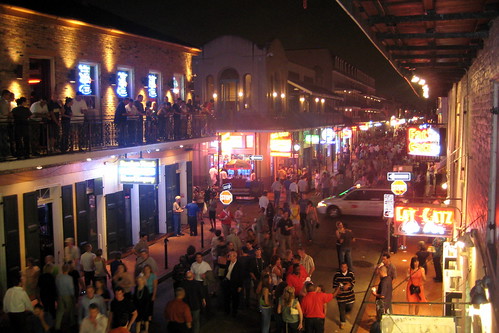
New Orleans - French Quarter - Bourbon Street at Night
Bourbon Street photo on Flickr by wallyg. My experience with how people perceive night life issues is that they think even one place is the equivalent of Bourbon Street in New Orleans. But there is only one Bourbon Street (+ Times Square in NYC at New Years and other special events). No other city comes close. Still, residential and patron/merchants concerns need to be balanced, and strong management and operations systems need to be in place in order to maintain order.

It calls for extending the hours that bars are open, beyond 2 am. From "McGinn: Seattleites want later bar hours" in the Seattle Post-Intelligencer:

In issuing a report about the status of his Nightlife Initiative, the mayor said of the more than 2,200 people who took part in an online survey:

31.9 percent said they wanted a more active and vibrant nightlife scene in Seattle - the highest priority.
28.4 percent said they wanted later liquor service hours.
21.4 percent said public safety during nighttime should be improved.
It's the later drinking hours that get the most attention, and at a news conference at historic Washington Hall in the Central District McGinn said he would work with state officials in what could be a "years-long" process to try to extend the hours that people could get a shot and a beer at local watering holes. ...

McGinn said there was no concrete proposal to present to the state Liquor Control Board yet, but he envisioned a pilot program where certain businesses would be given a conditional license allowing them to serve alcohol past 2 a.m. Neighbors, business owners and regulators would then need to review how things were going.

Addressing the concerns of neighbors and bar owners has been a priority for McGinn and the City Council. In July, the mayor unveiled his 8-point plan for improving the safety of Seattle's night-life scene and reducing conflicts between drinking establishments and residents in more urban neighborhoods like Belltown. The plan called for allowing bars to serve alcohol after 2 a.m. But that would require the state Liquor Control Board's blessing. ...

McGinn said Seattle's push to encourage safe and active nightlife is about "public safety, there's economic reasons for doing this...it's quality of life (active nightlife) is why people want to be here."

--------
One of my earliest blog entries was about nightlife planning in Adams-Morgan in the context of the Adams-Morgan Transportation Study, comparing it to efforts in the United Kingdom, and my amazement that a Parliamentary Committee actually did a night time walkthrough in a nightlife district in London, as part of a report and response to government proposals to change nightlife regulations. Also of interest is the government report, Good Practice in Managing the Evening and Late Night Economy: A Literature Review from an Environmental Perspective.

Also the Greater London Assembly and the Borough of Camden did a study of Camden Town, which is also useful, as mentioned in the blog entry "Report on London's night time economy". From the summary of the report on Camden Town:

From the summary of Camden Town night time economy research study:

The Economic Development, Culture, Sport and Tourism Committee has carried out a scrutiny investigation into London's night time economy to find out what ideas and good practice exist to support the night-time economy and improve things for people who live side-by-side with London’s night life. Among the ideas that we found were:

-- The planning system makes it difficult for councils to have enough control over what goes on in London’s night-time areas, and there are fears that the new licensing laws will make this more difficult.
-- Londoners and business want the tube to run later, especially at weekends.
-- More needs to be done to attract a wider range of people into London’s town centres at night – this should include ideas such as later opening of museums and galleries and more non-alcohol related activities.
--There are good examples of how town-centre managers can help co-ordinate services and work with residents and businesses in London’s night-time areas.
--Good design is needed to make sure that new developments and refurbished properties in these areas include effective sound insulation.
--Design can also help by ‘designing-out’ crime through improving lighting and creating open spaces where people feel safe.
--Londoners and London’s businesses want the media to paint a more accurate picture of night-time London by not always concentrating on the problems.


Also see the article, "Governing Nightlife: Profit, Fun and (Dis)Order in the Contemporary City" from the journal Entertainment Law. The article focuses on how economic development concerns have trumped residential concerns and at the same time have standardized "acceptable" forms of entertainment at the expense of alternative forms.

On my list to read, but I haven't got around to it, is the edited volume The City as an Entertainment Machine.

Labels: , , , , ,

Thursday, November 25, 2010

7-11, Zoning, and you can't take the hood out of the hood

(Image from nVerse.)

There is a fascinating comment thread in the Frozen Tropics entry "TBD: ANC/7-11 Negotiations Break Down" about the 7-11 store there, and how ANC6A has challenged the granting of a certificate of occupancy there, because they aver that the store should be classified as a fast food restaurant because of the nature of what they sell, and the impact on the community of the greater amount of litter (although people seem to be focused on chicken bones) that is generated as a result.

My friend-colleague ANC Commissioner Drew Ronneberg is getting excoriated (for the most part) in the thread by people who say you can't do much about the litter and why should the store be held responsible, and what could be done anyway.

Other people think that something should be done, but they aren't the majority of the commenters.

Drew is one of the stalwarts helping to make improvement of H Street NE a reality, by doing the hard "block by block" kind of work on the planning and zoning side that is necessary because typical property owners don't care much about H Street beyond the lot lines of their particular property. (This by the way is true of most commercial property owners, not just those on H Street.)

In the thread, when challenged about what to do, Drew wrote:

If 7-Eleven applies for zoning relief as a fast food establishment, they need to go through a public process. As part of this process, the community can propose conditions for incorporating into the BZA order to reduce the amount of trash on the surrounding neighborhood.

To quote from the Zoning Commission:

“In an attempt to strike a balance between the differing interests, the Commission believes that the BZA process would permit fast food restaurants but would offer the opportunity to consider, on a case-by-case basis, any adverse affects that may be caused by a fast-food restaurant.”

Ideas include

1) requiring 7-Eleven to install trash receptacles in their store
2) requiring 7-Eleven to supplement the funding of the H Street Connection's porter service to clean up trash on surrounding streets. The management of the Shopping Center already spends $200/month to help clean up trash on the 700 block of 10th St, but as the residents of that block can tell you, more frequent service is necessary.

I'm sure other ideas would come up in the public process. ...


An entry in The Hill is Home from the summer, "7-Eleven: Good Neighbor for H Street or Not?," describes the issues pretty well, that the 7-11 the writer is familiar with at 8th and Maryland Avenue NE has problems with loitering and panhandling, and 7-11 branded trash is visible for blocks around the store. Note however that many people in the FT comment thread make the point that the 7-11 store on H Street is particularly well run, although still subject to clientele-related problems.

I live about 3 blocks from a 7-11 myself, although the particular store is a more typical for 7-11 suburban type of location, at the junction of two major roads, and fronted by a parking lot. I do somewhat systematically pick up litter in my neighborhood when I walk from the Metro, and in the vicinity of Blair Road and Kansas Avenue when I bike through there.

Image from Slashfood of 7-11 display of hot fast food items.

There is no question that fast food restaurant-based litter makes up a preponderance of the litter tossed on the streets generally, and within a couple block radius of the 7-11 specifically and especially, 7-11 branded pizza and hot dog carriers and now the 7-11 branded beverage containers (which are a relatively new product) proliferate.

Part of the problem with some litter and litter generators (the stores that sell products that tend to be consumed in the public space more, and the materials are then disposed of in improper ways) is that as people see litter around, they feel "authorized" to litter themselves. (See the blog entry "Every Litter Bit Hurts" from 2005, which summarizes my litter learnings from being involved in H Street Main Street from 2002-2004.) It's a very basic illustration of the "broken windows" theory of order and disorder.

As far as a remedy for this goes, I'd be happy if every two days, people from the 7-11 store walked at least a one block radius of the store and picked up litter.

This way, they'd be "paying" for the consequences of their sales, which instead, like the chicken bones on H Street, or the soiled pizza and hot dog containers on the streets, yards, and sidewalks, are typically borne by others, if not financially, at least with some significant social costs.

It is interesting that the thread comments don't get very focused on practical action.

This is something that I find quite frustrating with regard to community action and involvement.

I don't understand why it's so hard to be good at it, and very easy to be bad at it.

But improving our neighborhoods and the city requires us to be able to work together effectively and efficiently, even if we don't always agree, or disagree quite violently (e.g., "The Plan").

Labels: , , , ,