Rebuilding Place in the Urban Space

"A community’s physical form, rather than its land uses, is its most intrinsic and enduring characteristic." [Katz, EPA] This blog focuses on place and placemaking and all that makes it work--historic preservation, urban design, transportation, asset-based community development, arts & cultural development, commercial district revitalization, tourism & destination development, and quality of life advocacy--along with doses of civic engagement and good governance watchdogging.

Friday, June 26, 2026

Boston wonders if they can re-support nightlife based on the results so far from the World Cup

People waited to be seated outside The Union Bar. Photo: Christian Kantosky, Boston Globe.

The Boston Globe has been writing about the impact of the World Cup on the city's nightlife.

Where the Scots cleaned out alcohol supplies ("‘We’ve never seen anything like it’: Patrons emptied bars and liquor stores in Boston this weekend"), the city extended open hours till 3 am ("Governor Healey signs bill allowing 3 a.m. last call for the World Cup, expanding public drinking through July"), outdoor public drinking zones, like Bourbon Street in New Orleans, etc.  

So the Boston Globe wonders if "Boston nightlife is in the midst of a grand social experiment. Can the good vibes last?."

As someone who worked on commercial district revitalization for 20 years in DC and wrote a lot about this issue, they missed the biggest possible point and difference, the addition of many tens of thousands of people from out of the area who were there for nightlife.

-- "Richard's Rules for Restaurant-Based Revitalization: New business models are needed for 2025" (especially the comments where I quote from relevant articles I come across)

Bourbon Street.

Temporarily, World Cup cities are functioning more like 24/7 nightlife districts in Las Vegas, Miami, and not quite NYC, plus Bourbon Street in New Orleans, Beale Street in Memphis?.  People go to those cities to party.  

I follow Reddit Las Vegas and people write about going there and being drunk and/or high for most of their stay.  Maybe the Scots were like that.  Not Bostonians.

Plus the super posh clubs with bottle service and all night dancing, massive pool parties in Vegas, etc.

Beale Street.

A traditional city, at least in the US, just doesn't have that kind of latent populations always going out, and willing to be shitfaced and then go to work.  Concerns like:
  • Having to work two jobs
  • mobility when drunk
  • the impact of smartphones on entertainment choices, less ability to socialize
  • the cost of going out
  • consumption of experiences
  • labor for the establishments and the the rise of the cost of goods sold, 
  • rents and changing business models due to work from home reducing office visits
  • people drinking less
  • People consuming edibles instead of drinking, 
  • mocktails (just as expensive to produce, lower margins, 
  • etc.
Make it a lot harder to go out.

Labels: , , , , , , ,

Tuesday, December 30, 2025

Local initiative in Huntsville, Alabama aims to improve security by banning problem customers across 18 bars

One of the first issues I got involved in in DC had to do with the overconcentration of liquor stores in my downtrodden neighborhood.  Such is linked to increased crime and community problems ("The Association between Density of Alcohol Establishments and Violent Crime within Urban Neighborhoods," Alcohol, Clinical and Experimental Research).  

I had learned about Seattle creating special zones to limit the sales of single bottles of beer, as an attempt to limit those problems ("Seattle may extend alcohol-sale limits to much larger area," "City tries to curb liquor sales," Seattle Times).  In 2003, the Washington Post published a story on those efforts ("Neighbors fight beer sales") and I got my picture in the paper (albeit on a slow news day)..

I wasn't against the sale of alcohol in managed situations (restaurants and taverns) unlike my neighbors, who couldn't see the difference in effect of on premise consumption of alcohol versus off premise consumption ("Restaurants and liquor licenses--How much is too much on H Street?," blog, 2005).

But the fact is, with establishments that are more alcohol-forward than food forward, with entertainment, music, dancing, etc., drinking can fuel violence.  I advocated for better security plans, and places did have them.

From "Bar Brawls," University of Toronto Magazine.

But one big problem is the focus not on sequestering and having the police deal with perpetrators, the plan is "to move them outside, off the premises, where it is no longer our problem."

All that does is displace the problem, it moves it from inside the club to outside, and the problem continues.  The media is full of articles about such problems all around the country, culminating in shootings and sometimes, deaths.

A consortium of clubs in Huntsville is dealing with this proactively, by maintaining a list of problem customers/people who have been banned, sharing the list across their 18-member group, and not permitting them to enter the premises to begin with ("North Huntsville bars band together to blacklist troublemakers across 18 venues," Fox 54/Rocket City News). 

The network allows participating venues to share information about patrons who have caused problems at any location within the group. When security staff scan a customer's identification at the entrance, the system immediately alerts them if that person has been banned from another business in the network, showing the duration of the ban, the reason for it, and which establishment issued it.

... Jabar Westbrook, owner of Goodtimez Billiards and other north Huntsville businesses, said the system addresses a common problem where troublemakers simply move from one venue to another after being ejected.

"Sometimes it's the same people going from place to place causing trouble, and so we're just trying to create consistency where no matter what, those people who are troublemakers can't just go somewhere else," Westbrook said.

This program makes a lot of sense, allowing bars to be proactive, instead of reactive.  It expands the range of options discussed in Assaults in and Around Bars, 2nd Edition (Center for Problem Oriented Policing, Arizona State University).

Labels: , , , ,

Monday, February 06, 2023

Change takes forever: plastic bag bans, liquor stores and crime

I noticed an article that Baltimore County, Maryland is on the verge of passing a plastic bag ban.  DC did that in 2009.

There is an article from Fox45 in Baltimore that states: "Law enforcement expert says liquor stores are hotspots for crime in Baltimore City."  From the article:

According to a 2018 Johns Hopkins University study, every 10% increase where alcohol outlets were located, there was also a 4.2% increase in violent crimes.

A FOX45 investigation determined three deadly shootings in the first month of the year, were just a few hundred feet from a liquor store. ...

Retired FBI Agent Tyrone Powers says liquor stores lead many of the things city leaders have been sounding the alarm about.

“We don’t talk about those open-air liquor stores which attract drug dealing, which attracts the violence that we’re talking about," said Powers.

The cited paper:

-- "Outlet Type, Access to Alcohol, and Violent Crime," Alcoholism: Clinical Experimentation and Research (2018)

Overconcentration of liquor stores and the connection to crime was one of the first issues I worked on once I got involved in revitalization efforts, then centered on the H Street NE neighborhood and commercial district in Washington, DC.

In the early 2000s!  In fact I was featured on the front page of the Metro section, albeit below the fold, in the Washington Post on Labor Day 2003, on the issue, in an article written by Craig Timberg. That article is almost 20 years old.

-- "Neighbors Fight Single-Beer Sales; H Street Merchants Decry Effort as an Attack on Northeast Businesses, Poor" (accessible using Proquest Newsstand, available at many public libraries)

We certainly haven't made much progress in many communities, have we?

One of the justifications to restrict sales in places like Seattle was the high cost of providing emergency services to regular users, and their service calls were usually associated with alcohol use.

Some blog entries

-- "Alcoholic beverage sales restrictions moving forward in Seattle," 2006
-- "Disproportionate link between Circle K convenience stores and crime in Phoenix suburbs," 2011
-- "The sales of alcoholic beverages in cities (DC vs. Chicago)," 2012

Journal article

-- "Regulating Availability: How Access to Alcohol Affects Drinking and Problems in Youth and Adults," Alcohol Research and Health (2011).  "This article briefly outlines the history of this work over four areas, focusing on the minimum legal drinking age, the privatization of alcohol control systems, outlet densities, and hours and days of sale."

Labels: , , , , , ,

Wednesday, July 15, 2020

Alcohol in parks?

Toronto Star contributing columnist Matt Elliott suggests that restrictions on alcohol consumption in parks be lifted, as one response to the coronavirus ("Condos are shrinking and COVID-19 is less likely to spread outside. So why does Toronto still ban booze in parks?").

Like antiquated restrictions on alcohol sales within a certain distance from schools and churches (schools and churches generally are open at times when alcohol is not consumed, so why the restrictions?), it may be time to reconsider alcohol consumption limitations in parks. 

Elliott points out that when marijuana was legalized in Toronto, the parks department changed the rules to allow it.

I'd argue against it, not on the grounds of legality, but because of the smell and second hand smoke, in keeping with initiatives to restrict cigarette smoking in parks and on trails (Smoke-Free Tobacco-Free Places Outdoors, Public Health Law Center).

Years ago, seeing a concert at Parc La Fontaine in Montreal, I seem to recall that we brought wine to drink with our dinner.  Apparently, as long as you're consuming alcohol with food, it's legal ("Drinking in Public Montreal Style," TripSavvy).

The biggest problem with alcohol isn't consumption as much as it is the potential for overconsumption, big parties generally and out of control parties specifically.

In 2014, the Wall Street Journal ran an article, "Cities Want Young Families to Play and Stay: New Features Include Parks, Playgrounds and Beer Gardens," about the addition of more adult friendly amenities in parks as a way to better retain younger demographics. From the article:
Doug and Maureen Towne, who live in Phoenix with their children Autumn, 10, and Ben, 2, have long toyed with the idea of moving to the suburbs. Doug works in nearby Scottsdale. Maureen drives back and forth from the Scottsdale school where Autumn will be entering fifth grade. A move, says Ms. Towne, is "definitely tempting."

But for now they are staying put. One factor: plans for a $118 million redesign of the Margaret T. Hance Park, which is near their home. There will be a beer garden and restaurant; an 800-foot zip line for adults and children; splash parks with fountains for kids to cool off; and "playscapes" such as climbing walls with rocks and boulders. "If we stay, I know it's going to be great," Ms. Towne says. ...

HR&A consults with dozens of cities a year, and Ms. [Candace] Damon has noticed one element increasingly featuring in park design: German-style outdoor beer gardens. In the past year, a half-dozen parks she has consulted on have placed beer gardens at or near the top of the list of things the community wants, she says.

Ms. Damon says a beer garden is a playful element that isn't focused on children—but doesn't shun them either. Designs have included nearby play equipment, enough open spaces for running around, and low-key snacks and finger foods. "It's about creating a space where adults can gather with children, without having to be solely focused on taking care of the kids," she says.
The Philadelphia Horticulture Society has an extensive pop up "beer garden" program.  Most of the spaces are on private property, but one is in Franklin Park near the Philadelphia Museum of Art. 

The PHS program has multiple gardens, but mostly in the Center City. 

The PHS program has sparked friendly competition.  The Philadelphia Parks and Recreation Department/Fairmount Conservancy now offer a pop up program of their own, rotating through almost two dozen parks in a season. 

The separately managed Spruce Harbor Park also has a summer beer garden, as do other neighborhood locations.

Beer garden in the East Falls neighborhood.

Conclusion.  The issue is whether or not alcohol is legal if you bring it yourself versus having to buy it to consume it, in more controlled settings, like a cordoned off beer garden.

How to do it management and regulatory-wise.  I think the Montreal rule is reasonable, although probably difficult to enforce: (1) it's legal if you're eating and (2) I would add a limit on how many drinks can be consumed; and probably (3) restrictions on large groups and alcohol consumption; (4) unless specifically permitted.  (5) Creating controlled beer gardens as an activation initiative is a separate issue.

Labels: , ,

Tuesday, April 24, 2012

The sales of alcoholic beverages in cities (DC vs. Chicago)

When I was an involved neighborhood activist, one of the H Street issues I got dragged into was the sales of packaged alcoholic beverages  (package sales, Class A and B licenses), in particular the negative behaviors associated with the consumption of these products in the public space, and the overconcentration of stores selling such items in distressed neighborhoods, like how H Street was at that time.  E.g., there were more Class A and B licenses selling alcohol in the H Street neighborhood than there were in Georgetown.

See in the 1980s, as an "economic development" strategy, under one of the Barry Administrations, the ability to sell alcoholic beverage was significantly expanded.  And as this decision coincided with continued population outmigration and the development, distribution, and sales of crack, it was one of the contributors to problems in neighborhoods and commercial districts across the city, as more liquor stores became sites for loitering and other problems.

The problem is that alcohol consumption can be problematic and contributes to a number of social problems.  My basic thing is that I don't care if people drink, I just don't want to have to deal with people drinking and carrying on in the public space.

In 2001, then Councilman Adrian Fenty first came to fame because he proposed a ban on the sales of "singles" in Ward 4.  Eventually, the law was passed and it led to similar efforts in other neighborhoods.

I testified on that and other legislative initiatives back in the day (as a "prop" for one of my testimonies, I wanted to bring in a box of empties that I had picked up within one block of my house, over 100 bottles and cans, but they wouldn't let me bring the box into City Hall out of fear that the bottles could be used as projectiles).

And it made it into the Washington Post in 2003 on this topic, in "Neighbors Fight Single-Beer Sales; H Street Merchants Decry Effort as an Attack on Northeast Businesses, Poor."  (The photo I use in the right sidebar is from the story.)

I introduced the writer (Craig Timberg) to some research showing the connection between sales and problems, and he trumped me by finding (and introducing me to) better research on the topic, which is how I came to be aware of the work by Professor Dennis Gorman and others on the links between store locations, sales, and problems in particular neighborhoods over the sales of alcoholic beverages.

So it's interesting that for "revenue purposes," DC's Mayor Gray has proposed extending the sales of by the drink alcoholic beverages in restaurants, bars, and taverns by an hour or two each night, and allowing the package sales of beer, wine, and alcohol on Sundays.  See "DC bar and nightclub owners back Gray plan to extend hours for alcohol sales" and "Sunday liquor sales in DC at last" from the Washington Post.

Interestingly, almost simultaneously, in Chicago, Mayor Emanuel is calling for the restriction of alcoholic beverage sales by "problem stores."  See "Mayor says problem liquor stores a ‘cancer,’ proposes crackdown" from the Chicago Sun-Times.

From the CST article:


With Chicago’s murder rate up 60 percent over last year, Mayor Rahm Emanuel on Wednesday launched a coordinated crackdown aimed at shutting down liquor and convenience stores that serve as magnets for crime.

“These locations often harbor drug dealers and street gang members and become a cancer on the community,” the mayor told the first graduating class of police recruits since he took office.

“By taking aggressive enforcement action, we can send a clear message that the streets of Chicago belong to the children and the law-abiding residents of Chicago — not drug dealers and gang bangers.”

So I guess DC and Chicago are at different places revitalization-wise these days.

Selling alcoholic beverages on Sundays isn't necessarily a bad thing, especially as the closure of stores on Sunday is a vestige of religious practices shaping government regulation, which technically is a violation of the First Amendment.  

The problem with alcoholic beverage regulation in cities is that it isn't fine tuned enough.  And the revenue benefit from the cost of the licenses and a goodly amount of the tax revenue isn't high enough to cover the social costs of dealing with the problems that result from negative consumption behaviors in the public space.  

Unlike in Chicago, in this latest go-around, there's been in DC almost no discussion by public officials about the negatives, which as you know were a particularly big issue in the early part of last decade (and one of the issues that brought Adrian Fenty to citywide prominence).

In short, in stable neighborhoods liquor sales aren't a problem, but they are a problem in distressed neighborhoods.  So that liquor store across from Safeway in Chevy Chase or Magruders, etc., isn't likely to generate problems because of a Sunday opening, but stores in other places, say the 700 block of H Street NE, are more likely to generate problems.

There's a quote by me in the 2003 article about how Sundays, when alcohol sales are forbidden, were truly a "day of rest" on H Street in terms of loitering and other problems.

It would be reasonable to set up a scoring system for all the class A and B licenses in terms of complaints, loitering, etc., and the places that have problems should have to provide security and management mitigation plans so that the negatives are reduced.  

I don't have a good diagram of my own, but the one below, from a Seattle Times article from 2004, "Seattle may extend alcohol-sale limits to much larger area" illustrates how incidents can be mapped and scored, and this information can be used to make decisions about where hours and sales days can be reasonably extended without special precautions, and where sales extension should be restricted.
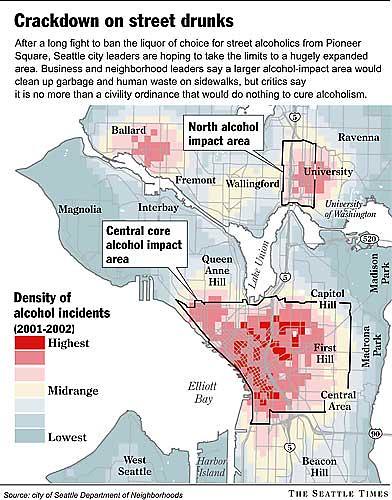
Alcohol impact areas, Seattle

Places with "high negatives scores" shouldn't be allowed to sell on Sundays.  E.g., it should be incentivized rather than just seen as a revenue generator.  As the situation improves because problems are mitigated for particular places denied the _privilege_ to sell on Sunday, decision could be revisited.

Relatedly, with hours extensions for selling of alcoholic beverages in restaurants, bars, and taverns, a similar kind of mapping of the city's establishments should occur so that locations that are truly neighborhood serving (say like Takoma Park) would have to go through an additional "special exception" type approval process (combined with regular reviews) before being allowed to extend their sales hours.

Some neighborhoods aren't able to handle the additional business and negative externalities that can come from such sales.  (Also see "Riots claimed 200 liquor stores, but South L.A. still suffers" from the Los Angeles Times.)

Labels: , , , , ,




